|
시장보고서
상품코드
2125389
축류 및 사류 펌프 : 시장 점유율 분석, 업계 동향 및 통계, 성장 예측(2026-2031년)Axial And Mixed Flow Pumps - Market Share Analysis, Industry Trends & Statistics, Growth Forecasts (2026 - 2031) |
||||||
 Mordor Intelligence
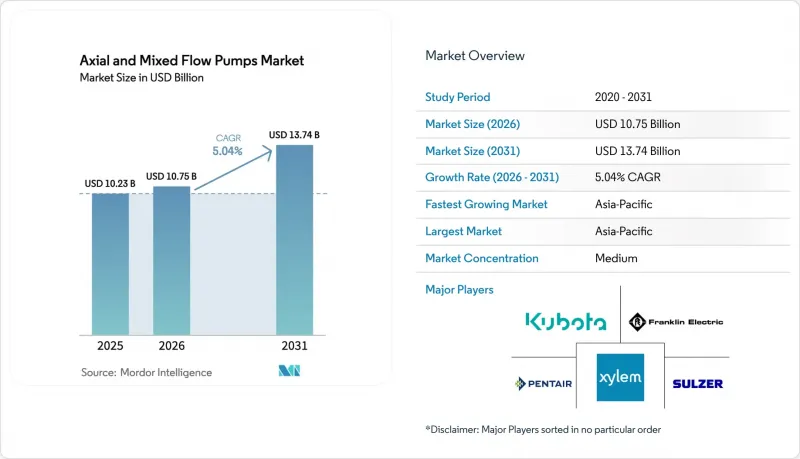
Mordor Intelligence에 의하면, 2026년 축류 및 사류 펌프 시장 규모는 107억 5,000만 달러로 추정되고 2025년 102억 3,000만 달러에서 확대해, 2031년에는 137억 4,000만 달러에 이를 것으로 예측됩니다.
2026년부터 2031년까지의 연평균 성장률(CAGR)은 5.04%가 될 것으로 전망됩니다.
본 보고서는 유체 유형(축류, 방사류, 사류), 단수(단단, 다단), 설치 방향(수직, 수평), 건축자재(주철, 스테인리스 스틸 등), 최종 사용자 산업(석유 및 가스, 상하수도, 발전, 화학 등) 및 지역별로 분류되어 있습니다. 시장 전망은 금액(달러) 기준으로 제시되어 있습니다.
세계의 축류 및 사류 펌프 시장 동향 및 인사이트
도시 상하수도 인프라 확충
노후된 배관 및 처리 시설이 수명을 다해가는 한편, 신흥국에서는 증가하는 도시 인구에 대응하기 위해 처리 능력 확대가 진행되고 있어, 급수 및 수처리 개보수를 위한 지출이 증가하고 있습니다. 싱가포르의 ‘NEWater’ 확장 프로젝트와 같은 사업에서는 대량의 해수 취수를 효율적으로 관리하기 위해 대구경 축류 펌프가 채택되고 있습니다. 가변 속도 구동 장치는 에너지 소비를 15-25% 절감하여, 탄소 배출 감축 의무를 안고 있는 유틸리티체에게 결정적인 이점이 됩니다. 2024년에 아시아태평양에서 2,000억 달러를 초과하는 정부 경기 부양책이 시행됨에 따라, 대용량 유닛 입찰 프로젝트가 직접적으로 증가하고 있습니다. 유틸리티체가 라이프사이클 서비스 계약을 채택함에 따라, 펌프, 모터, 디지털 모니터링 플랫폼을 세트로 제공할 수 있는 제조업체는 재주문을 확보하는 데 가장 유리한 입장에 있습니다.
석유 및 가스 중류 프로젝트에 대한 투자 확대
북미 사업자들은 2024년에 파이프라인 개보수에 150억 달러를 투자했으며, 그 결실로 340억 달러 규모의 트랜스 마운틴 확장 프로젝트가 실현되었습니다. 이 프로젝트에서는 산악 지대 사용에 견딜 수 있는 정격의 축류 펌프 스테이션이 지정되었습니다. API 610 규정을 준수함으로써 구매자는 평균 고장 간격(MTBF)을 6만시간 이상으로 유지하는 견고한 설계를 선택하도록 권장받고 있습니다. 아르헨티나의 바카 무에르타를 비롯한 라틴아메리카의 셰일 개발 프로젝트에서는 하루 50만 배럴을 수송하기 위해 유사한 펌프 시스템이 필요합니다. 높은 처리 능력과 엄격한 가동률 목표에 따라, 이러한 중류 구간에서는 원심 펌프보다 축류 펌프가 계속해서 선호되고 있습니다.
고점도 유체에서의 성능 제한
점도가 100 cP를 초과하면 축류 및 사류 펌프의 효율이 최대 30%까지 저하되므로, 화학 제조업체들은 더 광범위한 유체 특성 범위에서 출력을 유지할 수 있는 자기 구동식 원심 펌프 모델을 선택하고 있습니다. FDA 파트 11 세척 기준을 준수하는 제약 공장에서는 위생 관리의 복잡성으로 인해 축류식 설계를 채택하는 것을 더욱 자제하는 경향이 있습니다. 새로운 임펠러 형상이나 구동 기술로 효율 저하 문제가 해결되기 전까지는 고점도 유체 분야에서의 보급률은 주요 물·에너지 시장에 비해 뒤처질 것으로 보입니다.
부문별 분석
축류 및 사류 펌프 시장에서 혼합류 구성 시장 규모는 사용자가 광범위한 양정 범위에서 효율을 추구함에 따라 급속히 확대되고 있습니다. 혼합류 제품은 2031년까지 연평균 성장률(CAGR) 6.78%를 기록했으나, 2025년 매출의 44.55%는 여전히 축류식 설계가 차지했습니다. 가스 발전소나 원자력 발전소의 냉각수 회로에서는 5m에서 15m의 양정 범위에서 유체역학적 안정성을 유지할 수 있는 사류 펌프의 채택이 점점 늘어나고 있습니다. 사업자들로부터는 부하 변동이 빈번하게 발생하는 경우, 순수한 축류식 펌프에 비해 최대 8%의 에너지 절감 효과가 보고되고 있습니다. 가변 피치 임펠러 및 복합재 케이싱에 대한 연구 개발이 지속되고 있으며, 이를 통해 비용 격차를 더욱 좁히고 횡류 펌프의 성장 궤도를 강화하는 것을 목표로 하고 있습니다.
도시 지역의 홍수 대책에 대한 꾸준한 도입도 이 기술의 확산을 여실히 보여주고 있습니다. 도쿄의 새로운 지하 저수지에서는 변동하는 빗물 수위에 대응하기 위해 사류 펌프가 채택되어, 흡입 양정이 급격히 변화하더라도 안정적인 토출량을 발휘했습니다. ISO 9906 시험 절차에 따른 표준화를 통해 보다 광범위한 운전 조건에서의 성능이 검증되어 구매자의 신뢰도가 높아지고 있습니다. 이에 따라 신규 건설 및 개보수 프로젝트 모두에서 사류 펌프의 채택이 가속화되고 있습니다.
단단식 어셈블리는 축류 및 사류 펌프 시장 점유율을 주도하고 있으며, 2025년에는 60.74%를 차지했습니다. 이는 저양정의 수처리 및 관개 용도에서 그 단순성이 높이 평가받고 있기 때문입니다. 그러나 다단식 제품 라인은 현재 50-100m의 토출 압력을 목표로 하는 원자력 발전소의 양정 요건 증가에 힘입어 연평균 성장률(CAGR) 6.9%로 성장할 전망입니다. 다단식 설계는 고도 차이로 인해 단단식 설계의 한계가 시험받는 파이프라인 부스터 스테이션에서도 핵심을 이루고 있습니다. 각 제조업체는 케이싱의 모듈화를 통해 높은 초기 투자 비용을 줄이고 있으며, 이를 통해 사업자는 전체 유닛을 재설치하지 않고도 수요 증가에 따라 단수를 추가할 수 있게 되었습니다.
트랜스 마운틴 프로젝트에서는 산악 지대의 고도차를 보완하기 위해 중류부 스테이션에 다단 축류 펌프를 도입하여, 중유의 가혹한 가동 사이클 하에서도 수명 주기 비용 측면에서 유리함을 입증했습니다. 예측 분석과 압력 센서를 결합함으로써, 진동이 심해지기 전에 기술자에게 단계 간 불균형 편차를 경고하여, 중요한 에너지 회랑에서 높은 가동률 목표 달성을 지원하고 있습니다.
지역별 분석
아시아태평양은 2025년 지출의 43.52%를 차지하며, 연평균 성장률(CAGR) 5.78%로 계속 확대되고 있습니다. 이는 대도시권이 홍수 대책을 강화하고, 농촌 지역이 식수 네트워크를 확충하며, 산업 회랑이 에너지 관련 메가 프로젝트에 설비를 정비하고 있기 때문입니다. 중국은 대용량 축류 펌프 세트를 통합한 배수 터널에 500억 달러를 배정하고 있는 반면, 인도의 ‘Jal Jeevan Mission’은 2,000개 이상의 지역 계약업체에 펌프 수주 기회를 제공합니다. 베트남과 필리핀을 필두로 한 동남아시아 국가들은 효율 목표를 달성하기 위해 가변 속도 드라이브와 스마트 원격 측정 기술을 결합한 다자간 자금 조달을 확보했습니다.
북미에서는 노후화된 인프라를 해결하기 위한 송유관 개보수 및 지방 자치 단체의 인프라 재생 사업을 통해 확고한 시장 점유율을 유지하고 있습니다. 이 지역의 축류 및 사류 펌프 시장 점유율은 환경 관련 벌금 위험을 감수할 수 없는 상장 파이프라인 사업자들이 요구하는 API 준수 구조의 혜택을 받고 있습니다. 미국의 상수도 유틸리티자들은 향후 20년 동안 6,250억 달러 규모의 설비 갱신을 앞두고 있어, 연방 정부의 자금 조달 주기가 변동하더라도 지속적인 수주 전망이 확보되어 있습니다. 유럽에서는 에너지 효율과 탄소 예산이 우선시되고 있습니다. 유틸리티자들은 IE5 모터를 채택하는 한편, 하드웨어 설치 전에 침수 시나리오를 시뮬레이션하는 디지털 트윈을 도입하고 있으며, 이러한 노력은 EU의 택소노미 규정에 의해 뒷받침되고 있습니다. 스페인에서 덴마크에 이르는 연안 도시에서는 해수 열원 히트펌프의 시범 도입이 진행 중이며, 각 도시마다 내식성이 뛰어난 축류 펌프 유닛이 필요합니다. 한편, 중동 및 아프리카에서는 해수 담수화 및 석유화학 산업의 확장으로 수요가 급증하고 있으며, NEOM과 같은 메가 프로젝트에서 고품질 스테인리스 듀플렉스 재질의 채택이 입증되고 있습니다. 남미는 규모는 작지만, 광업 및 육상 LNG 개발을 통해 꾸준한 성장을 이루고 있으며, 이러한 프로젝트에서는 험준한 지형을 넘어 공정용수를 수송하기 위해 축류식 부스터 펌프가 활용되고 있습니다.
기타 혜택 :
- 엑셀 형식 시장 예측(ME) 시트
- 3개월간의 애널리스트 지원
자주 묻는 질문
목차
제1장 서론
제2장 조사 방법
제3장 주요 요약
제4장 시장 구도
제5장 시장 규모 및 성장 예측
제6장 경쟁 구도
제7장 시장 기회 및 향후 전망
KTH 26.09.14According to Mordor Intelligence, the axial and mixed flow pumps market size in 2026 is estimated at USD 10.75 billion, growing from 2025 value of USD 10.23 billion with 2031 projections showing USD 13.74 billion, growing at 5.04% CAGR over 2026-2031.
This report is Segmented by Flow Type (Axial, Radial, Mixed), Number of Stages (Single Stage, and Multi Stage), Installation Orientation (Vertical, and Horizontal), Material of Construction (Cast Iron, Stainless Steel, and More), End-User Industry (Oil and Gas, Water and Wastewater, Power Generation, Chemicals, and More), and Geography. The Market Forecasts are Provided in Terms of Value (USD).
Global Axial And Mixed Flow Pumps Market Trends and Insights
Expansion of Municipal Water and Wastewater Infrastructure
Spending on water supply and treatment upgrades is increasing as aging pipes and treatment facilities reach the end of their lifespan, while emerging nations scale up their capacity to support growing urban populations. Projects such as Singapore's NEWater expansion rely on large-bore axial flow pumps to manage high-volume seawater intakes efficiently. Variable-speed drives trim energy consumption by 15-25%, a decisive benefit for utilities facing carbon-reduction mandates. The government stimulus exceeding USD 200 billion in the Asia-Pacific region during 2024 is translating directly into tender pipelines for high-capacity units. Manufacturers that can bundle pumps, motors, and digital monitoring platforms are best positioned to capture repeat orders as utilities adopt lifecycle-service contracts.
Increasing Investments in Oil and Gas Midstream Projects
North American operators invested USD 15 billion in 2024 pipeline upgrades, culminating in the USD 34 billion Trans Mountain expansion, which specified axial flow pump stations rated for use in mountainous terrain. Compliance with API 610 encourages buyers to opt for robust designs that maintain a mean-time-between-failure of over 60,000 hours. Latin American shale programs, typified by Argentina's Vaca Muerta, require similar pumping systems to move 500,000 barrels per day. High throughput and tight uptime targets continue to favor axial configurations over centrifugal alternatives in these midstream links.
Performance Limitations with High-Viscosity Fluids
When viscosity exceeds 100 cP, axial and mixed flow pumps lose up to 30% of their efficiency, prompting chemical producers to opt for magnetic-drive centrifugal models that maintain output across a broader range of fluid properties. Pharmaceutical plants tied to FDA Part 11 cleaning codes further retreat from axial designs due to sanitization complexities. Until new impeller geometries or drive technologies reverse efficiency penalties, penetration in viscous-fluid verticals will lag core water and energy markets.
Other drivers and restraints analyzed in the detailed report include:
- Accelerated Urban Flood Control and Irrigation Schemes in Asia-Pacific
- Adoption of Variable Speed Drive Axial Pumps for Wave Energy Converters
- Rising Prevalence of Alternative Inline Propeller Pump Designs
For complete list of drivers and restraints, kindly check the Table Of Contents.
Segment Analysis
The axial and mixed flow pumps market size for mixed flow configurations is growing rapidly as users seek efficiency across a range of heads. Mixed flow products recorded a 6.78% CAGR through 2031, although axial designs still controlled 44.55% of 2025 revenues. Cooling-water circuits in gas and nuclear plants are increasingly opting for mixed-flow units that maintain hydraulic stability over a range of 5 m to 15 m heads. Operators report energy savings of up to 8% against pure axial alternatives when load swings are frequent. Continued R&D into variable-pitch impellers and composite casings aims to further narrow cost gaps, reinforcing the mixed flow growth arc.
Robust municipal flood-control deployments also illustrate the migration of technology. Tokyo's new underground reservoirs utilized mixed-flow pumps to accommodate fluctuating stormwater levels, demonstrating steady throughput even as suction heads changed dramatically. Standardization under ISO 9906 test procedures builds buyer confidence by validating performance across broader duty points, thereby accelerating the adoption of mixed flow in both greenfield and retrofit packages.
Single-stage assemblies dominated the axial and mixed flow pumps market share, accounting for 60.74% in 2025, which is favored for simplicity in low-head water treatment and irrigation applications. Yet multi-stage lines expanded at a 6.9% CAGR, propelled by rising head requirements at nuclear stations that now target 50-100 m discharge pressures. Multi-stage designs also anchor pipeline booster stations, where elevation changes strain the limits of single-stage designs. Manufacturers mitigate higher capital costs by modularizing casings, allowing operators to add stages as demand grows without the need to reinstall entire units.
The Trans Mountain project integrated multi-stage axial pumps in its mid-line stations to offset mountain passes, demonstrating favorable lifecycle economics under heavy-oil duty cycles. Predictive analytics, combined with pressure sensors, alerts technicians to stage-imbalance drift before vibration escalates, supporting higher availability targets within critical energy corridors.
Complete Report Scope:
- By Flow Type
- Axial
- Radial
- Mixed
- By Number of Stages
- Single Stage
- Multi Stage
- By Installation Orientation
- Vertical
- Horizontal
- By Material of Construction
- Cast Iron
- Stainless Steel
- Duplex or Super Duplex
- Other Material of Construction
- By End-User Industry
- Oil and Gas
- Water and Wastewater
- Power Generation
- Chemicals
- Food and Beverage
- Pharmaceuticals
- Metals and Mining
- Construction
- Other End-User Industries
- By Geography
- North America
- United States
- Canada
- Mexico
- Europe
- Germany
- United Kingdom
- France
- Russia
- Rest of Europe
- Asia-Pacific
- China
- Japan
- India
- South Korea
- Australia
- Rest of Asia-Pacific
- Middle East and Africa
- Middle East
- Saudi Arabia
- United Arab Emirates
- Rest of Middle East
- Africa
- South Africa
- Egypt
- Rest of Africa
- Middle East
- South America
- Brazil
- Argentina
- Rest of South America
- North America
Geography Analysis
The Asia-Pacific region retained 43.52% of 2025 expenditures and is pacing forward at a 5.78% CAGR as megacities strengthen flood protection, rural districts expand potable water networks, and industrial corridors equip energy megaprojects. China has earmarked USD 50 billion for drainage tunnels that integrate high-capacity axial sets, while India's Jal Jeevan Mission channels pump orders to over 2,000 regional contractors. Southeast Asian nations, led by Vietnam and the Philippines, secured multilateral funding that bundles variable-speed drives with smart telemetry to meet efficiency targets.
North America holds an entrenched share through oil-pipeline refurbishments and municipal rehabilitations that address aging infrastructure. The axial and mixed flow pumps market share in this region benefits from API-compliant builds, which are demanded by publicly traded pipeline operators that cannot risk environmental penalties. U.S. water utilities face USD 625 billion of capital replacements over two decades, ensuring a recurring order funnel even as federal funding cycles fluctuate. Europe prioritizes energy efficiency and carbon budgets. Utilities are adopting IE5 motors, paired with digital twins that simulate flooding scenarios before hardware installation, a practice reinforced by EU taxonomy rules. Coastal cities from Spain to Denmark trial seawater-source heat pumps, each requiring corrosion-resistant axial units. Meanwhile, demand in the Middle East and Africa escalates through desalination and petrochemical expansions, with megaprojects such as NEOM validating premium stainless duplex materials. South America, although smaller, is experiencing steady growth from mining and onshore LNG developments that rely on axial booster pumps to transport process water over challenging terrain.
- Xylem Inc.
- Franklin Electric Co., Inc.
- Sulzer Ltd
- Kubota Corporation
- Pentair plc
- Torishima Pump Manufacturing Co., Ltd.
- Ebara Corporation
- The Weir Group PLC
- Hayward Tyler Limited
- Peerless Pump Company
- Grundfos Holding A/S
- Flowserve Corporation
- KSB SE and Co. KGaA
- ITT Inc.
- SPX FLOW, Inc.
- Tsurumi Manufacturing Co., Ltd.
- Ruhrpumpen, S.A. de C.V.
- Kirloskar Brothers Limited
- WILO SE
- Patterson Pump Company
- Zhejiang Dayuan Pumps Industrial Co., Ltd.
- Shanghai Kaiquan Pump (Group) Co., Ltd.
Additional Benefits:
- The market estimate (ME) sheet in Excel format
- 3 months of analyst support
TABLE OF CONTENTS
1 INTRODUCTION
- 1.1 Study Assumptions and Market Definition
- 1.2 Scope of the Study
2 RESEARCH METHODOLOGY
3 EXECUTIVE SUMMARY
4 MARKET LANDSCAPE
- 4.1 Market Overview
- 4.2 Market Drivers
- 4.2.1 Expansion of Municipal Water and Wastewater Infrastructure
- 4.2.2 Increasing Investments in Oil and Gas Midstream Projects
- 4.2.3 Accelerated Urban Flood Control and Irrigation Schemes in Asia Pacific
- 4.2.4 Adoption of Variable Speed Drive Axial Pumps for Wave Energy Converters
- 4.2.5 Surging Demand for Seawater Source Heat Pump Systems in Coastal Cities
- 4.2.6 Rise of Modular Pump Stations for Data Center Liquid Cooling Loops
- 4.3 Market Restraints
- 4.3.1 Performance Limitations with High-Viscosity Fluids
- 4.3.2 Rising Prevalence of Alternative Inline Propeller Pump Designs
- 4.3.3 Supply Chain Disruptions for High-Alloy Stainless Steel Components
- 4.3.4 Escalating Energy Efficiency Regulations Increasing Compliance Costs
- 4.4 Industry Value Chain Analysis
- 4.5 Regulatory Landscape
- 4.6 Technological Outlook
- 4.7 Porter's Five Forces Analysis
- 4.7.1 Bargaining Power of Suppliers
- 4.7.2 Bargaining Power of Buyers
- 4.7.3 Threat of New Entrants
- 4.7.4 Threat of Substitutes
- 4.7.5 Intensity of Competitive Rivalry
- 4.8 Impact of Macroeconomic Factors
5 MARKET SIZE AND GROWTH FORECASTS (VALUE)
- 5.1 By Flow Type
- 5.1.1 Axial
- 5.1.2 Radial
- 5.1.3 Mixed
- 5.2 By Number of Stages
- 5.2.1 Single Stage
- 5.2.2 Multi Stage
- 5.3 By Installation Orientation
- 5.3.1 Vertical
- 5.3.2 Horizontal
- 5.4 By Material of Construction
- 5.4.1 Cast Iron
- 5.4.2 Stainless Steel
- 5.4.3 Duplex or Super Duplex
- 5.4.4 Other Material of Construction
- 5.5 By End-User Industry
- 5.5.1 Oil and Gas
- 5.5.2 Water and Wastewater
- 5.5.3 Power Generation
- 5.5.4 Chemicals
- 5.5.5 Food and Beverage
- 5.5.6 Pharmaceuticals
- 5.5.7 Metals and Mining
- 5.5.8 Construction
- 5.5.9 Other End-User Industries
- 5.6 By Geography
- 5.6.1 North America
- 5.6.1.1 United States
- 5.6.1.2 Canada
- 5.6.1.3 Mexico
- 5.6.2 Europe
- 5.6.2.1 Germany
- 5.6.2.2 United Kingdom
- 5.6.2.3 France
- 5.6.2.4 Russia
- 5.6.2.5 Rest of Europe
- 5.6.3 Asia-Pacific
- 5.6.3.1 China
- 5.6.3.2 Japan
- 5.6.3.3 India
- 5.6.3.4 South Korea
- 5.6.3.5 Australia
- 5.6.3.6 Rest of Asia-Pacific
- 5.6.4 Middle East and Africa
- 5.6.4.1 Middle East
- 5.6.4.1.1 Saudi Arabia
- 5.6.4.1.2 United Arab Emirates
- 5.6.4.1.3 Rest of Middle East
- 5.6.4.2 Africa
- 5.6.4.2.1 South Africa
- 5.6.4.2.2 Egypt
- 5.6.4.2.3 Rest of Africa
- 5.6.4.1 Middle East
- 5.6.5 South America
- 5.6.5.1 Brazil
- 5.6.5.2 Argentina
- 5.6.5.3 Rest of South America
- 5.6.1 North America
6 COMPETITIVE LANDSCAPE
- 6.1 Market Concentration
- 6.2 Strategic Moves
- 6.3 Market Share Analysis
- 6.4 Company Profiles (includes Global level Overview, Market level overview, Core Segments, Financials as available, Strategic Information, Market Rank or Share for key companies, Products and Services, and Recent Developments)
- 6.4.1 Xylem Inc.
- 6.4.2 Franklin Electric Co., Inc.
- 6.4.3 Sulzer Ltd
- 6.4.4 Kubota Corporation
- 6.4.5 Pentair plc
- 6.4.6 Torishima Pump Manufacturing Co., Ltd.
- 6.4.7 Ebara Corporation
- 6.4.8 The Weir Group PLC
- 6.4.9 Hayward Tyler Limited
- 6.4.10 Peerless Pump Company
- 6.4.11 Grundfos Holding A/S
- 6.4.12 Flowserve Corporation
- 6.4.13 KSB SE and Co. KGaA
- 6.4.14 ITT Inc.
- 6.4.15 SPX FLOW, Inc.
- 6.4.16 Tsurumi Manufacturing Co., Ltd.
- 6.4.17 Ruhrpumpen, S.A. de C.V.
- 6.4.18 Kirloskar Brothers Limited
- 6.4.19 WILO SE
- 6.4.20 Patterson Pump Company
- 6.4.21 Zhejiang Dayuan Pumps Industrial Co., Ltd.
- 6.4.22 Shanghai Kaiquan Pump (Group) Co., Ltd.
7 MARKET OPPORTUNITIES AND FUTURE OUTLOOK
- 7.1 White-space and Unmet-Need Assessment