|
시장보고서
상품코드
2125413
중국의 사이버 보안 : 시장 점유율 분석, 업계 동향과 통계, 성장 예측(2026-2031년)China Cybersecurity - Market Share Analysis, Industry Trends & Statistics, Growth Forecasts (2026 - 2031) |
||||||
 Mordor Intelligence
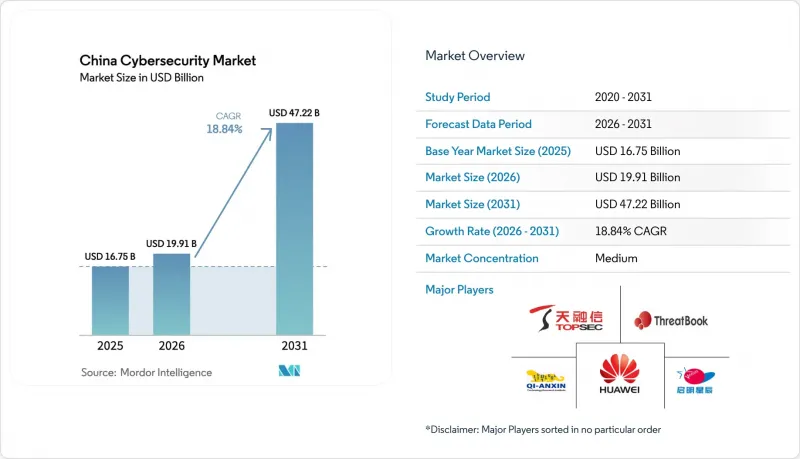
Mordor Intelligence에 따르면 중국의 사이버 보안 시장 규모는 2025년 167억 5,000만 달러에서 증가하며, 2026년에는 199억 1,000만 달러에 달할 것으로 추정되고 있습니다. 이 리포트는 제공 형태(솔루션 및 서비스), 도입 형태(온프레미스 및 클라우드), 조직 규모(중소기업(SME) 및 대기업) 및 최종사용자 업계(은행·금융 서비스·보험, 의료·생명과학, IT·통신, 정부·공공 행정, 기타)별로 분류되어 있습니다. 시장 예측은 금액(달러) 기반으로 제시되고 있습니다.
중국 사이버 보안 시장의 동향 및 인사이트
중국의 사이버 보안 및 데이터 보안 관련 법규 준수 의무
2024년, 중국의 ‘국가 데이터 보안 관리 규정(NDSMR)’에 따른 규제 집행이 강화되어, 당국은 데이터 보안상의 미비 사항에 대해 786건의 행정 처분을 내렸습니다. 이는 2023년 대비 32% 증가한 수치입니다. 이러한 증가는 데이터 보호에 대한 규제 당국의 관심이 높아지고 있음을 여실히 보여주며, 기업 이사회로 하여금 암호화, 로그 기록, 데이터 분류 툴을 선택적 기술 투자가 아닌 필수 예산 항목으로 우선시하도록 압박했습니다. 2025년까지 각 조직은 정기적인 규정 준수 검토 단계를 넘어, 많은 조직이 3년 주기의 감사 주기를 지속적인 규정 준수 대시보드로 대체하여 위험 및 규정 준수 현황을 실시간으로 모니터링하게 되었습니다. 이러한 변화로 인해 관리형 보안 서비스에 대한 수요가 증가했으며, 은행, 의료, 통신 등 주요 산업 분야에서 다년간의 MSSP 계약 도입이 가속화되었습니다.
국유 기업의 클라우드 네이티브 아키텍처로의 급속한 전환
국유자산감독관리위원회(SASAC)는 2024년 말까지 78개 중앙 국유 기업이 신규 워크로드의 최소 절반을 국내 클라우드 플랫폼으로 이전했음을 확인했습니다. 이에 따라 클라우드 네이티브 도입이 중국내 사이버 보안 수요의 주요 촉진요인이 되었습니다. 이러한 전환에 따라 컨테이너화된 환경을 보호하고, 쿠버네티스(Kubernetes) 설정을 강화하며, 통합된 프레임워크 내에서 API 관련 위험을 관리할 수 있는 통합 보안 포지션 관리 솔루션에 대한 수요가 증가했습니다. Kubernetes 강화와 API 게이트웨이 폐쇄를 결합한 보안 태세 툴은 여러 벤더의 조각난 솔루션에 비해 입찰 주기를 17% 단축시켰으며, 이는 국영 기업이 조달 결정시 신속한 도입, 통합 간소화 및 운영 효율성을 우선시했음을 보여줍니다.
분산된 벤더 생태계가 통합의 격차를 초래
중국 공업정보화부(MIIT)는 중국 내에서 라이선스를 취득한 사이버 보안 공급업체 827곳을 리스트화했으며, 이로 인해 벤더 생태계는 극도로 세분화되었습니다. 이러한 세분화로 인해 보안 운영에서 25개 이상의 포인트 제품을 관리하는 기업에서는 통합의 격차가 발생하고, 결과적으로 사고 대응 시간이 길어졌습니다. 조직은 상호 운용성 확보, 통합된 가시성 유지, 그리고 여러 툴에 걸친 위협 탐지 및 대응 조율에 있으며, 종종 어려움을 겪고 있습니다. 그 결과, 시장 통합의 필요성이 점점 더 커지면서, 통합 대시보드, 효율화된 보안 관리, 그리고 보다 효율적인 사고 대응 능력을 추구하는 최고정보보안책임자(CISO)들의 지지를 얻게 되었습니다.
부문 분석
2025년, 기업이 토큰화, 데이터 손실 방지, 행동 분석형 방화벽과 같은 규정 준수 기능을 핵심 네트워크에 통합하는 움직임이 가속화됨에 따라 해당 솔루션은 중국 사이버 보안 시장 점유율의 59.48%를 차지했습니다. 규정 준수 기한이 임박한 특성상 자금 사정이 어려운 수출 기업 사이에서도 라이선스 수입은 견고한 추세를 보였으며, 한편 하드웨어와 소프트웨어 번들 패키지는 대형 은행 및 병원의 감사 소요 시간을 단축시켰습니다. GB/T 35273 및 ‘네트워크 데이터 보안 관리 규정’ 모두에 따라 어플라이언스 인증을 획득할 수 있는 벤더들은 현재 프리미엄 가격을 책정하고 있으며, 이는 법규의 중복이 수요를 공고히 하고 있음을 여실히 보여줍니다. 이와 동시에, 이사회가 통합 대시보드와 유지보수 부담 경감을 약속하는 풀스택 플랫폼에 주목함에 따라 틈새 시장용 포인트 툴 공급업체들은 시장에서 점차 밀려나고 있습니다.
기업이 만성적인 분석 인력 부족에 직면한 가운데, 서비스 시장은 연평균 성장률(CAGR) 19.96%로 확대되어 중국 사이버 보안 시장 전체를 능가하는 속도로 성장할 전망입니다. 차이나 통신은 2024년에 124억 위안(17억 달러)의 보안 서비스 매출을 기록하며 31%의 증가율을 보였습니다. 이는 관리형 탐지 및 대응(MDR) 계약이 주류로 자리 잡았음을 보여줍니다. Tier 1 SOC 아웃소싱을 통해 사내 직원은 위협 탐지에 집중할 수 있게 되며, 사고 대응 정액제 계약은 규제 당국의 요건을 충족하는 ‘평균 격리 시간(MTOC)’을 보장합니다. 예측 기간 중 규정 준수 규칙이 하나 추가될 때마다 지속적인 서비스 지출 증가로 이어질 것으로 예상되며, 연중무휴 24시간 운영 센터를 보유한 플랫폼 사업자에게는 구조적인 성장 여지가 생길 것입니다.
중국의 사이버 보안 시장에서는 클라우드 기반 도입이 주류를 이루며, 2025년에는 시장의 69.72%를 차지했습니다. 이러한 선도적 지위는 사이버 보안법, 데이터 보안법(DSL), 개인정보 보호법(PIPL)에 대한 준수 요건에 힘입은 것으로, BFSI(은행·금융·보험),의료, 제조, 정부 등 각 부문에서 클라우드 컴퓨팅이 급속히 보급된 것을 반영합니다. 기업은 확장성 향상, 비용 효율성 개선, 운영 복원력 강화, 그리고 안전한 디지털 전환(DX) 구상을 지원하기 위해 계속해서 워크로드를 클라우드로 이전했습니다. 동시에, 하이퍼스케일러와 국내 클라우드 제공업체들은 인프라 서비스(IaaS)에 고급 보안 기능을 직접 통합함으로써, 조직이 진화하는 사이버 위험에 대처하는 동시에 독립형 보안 툴을 관리할 때의 복잡성을 줄일 수 있도록 했습니다.
클라우드 기반 보안은 2031년까지 연평균 성장률(CAGR) 19.12%로 확대될 것으로 예상되며, 중국 사이버 보안 시장에서 가장 빠르게 성장하는 도입 형태가 될 전망입니다. 중국이 계속해서 ‘주권 클라우드’ 도입에 주력하고 있는 점, 5G 사설 네트워크의 확대, 그리고 AI를 활용한 보안의 클라우드 플랫폼 통합이 이러한 성장을 지원할 것으로 예상됩니다. 조직의 하이브리드 및 멀티클라우드 전략 도입이 진행됨에 따라 클라우드 워크로드 보호, ID 거버넌스, 지속적인 모니터링,위협 탐지, 제로 트러스트 프레임워크와 같은 고급 솔루션에 대한 수요는 더욱 가속화될 것으로 예상됩니다. 이러한 동향에 따라 클라우드는 중국 사이버 보안 환경의 핵심 요소로서, 또한 안전한 기업 현대화를 실현하기 위한 중요한 추진력으로서의 입지를 더욱 공고히 할 것입니다.
기타 혜택:
- 엑셀 형식의 시장 예측(ME) 시트
- 3개월간의 애널리스트 지원
자주 묻는 질문
목차
제1장 서론
제2장 조사 방법
제3장 개요
제4장 시장 구도
제5장 시장 세분화
제6장 경쟁 구도
제7장 시장 기회와 향후 전망
KSAAccording to Mordor Intelligence, China's cybersecurity market size is estimated at USD 19.91 billion in 2026, up from USD 16.75 billion in 2025. This report is Segmented by Offerings (Solutions, and Services), Deployment (On-Premise, and Cloud), Organization Size (Small and Medium Enterprises (SMEs), and Large Enterprises), and End-User Industry (Banking, Financial Services, and Insurance, Healthcare and Life Sciences, IT and Telecommunication, Government and Public Administration, and More). The Market Forecasts are Provided in Terms of Value (USD).
China Cybersecurity Market Trends and Insights
Mandatory Compliance with China's Cybersecurity and Data-Security Laws
Regulatory enforcement under China's NDSMR intensified in 2024, with authorities issuing 786 administrative penalties for data security lapses, representing a 32% increase from 2023. This increase underscored the growing regulatory focus on data protection and compelled corporate boards to prioritize encryption, logging, and data classification tools as essential budget items rather than discretionary technology investments. By 2025, organizations had moved beyond periodic compliance reviews, with many replacing three-year audit cycles with continuous compliance dashboards to monitor risks and regulatory adherence in real time. This shift strengthened demand for managed security services and accelerated the adoption of multi-year MSSP contracts across key industries, including banking, healthcare, and telecom.
Rapid Shift of State-Owned Enterprises to Cloud-Native Architectures
The State-owned Assets Supervision and Administration Commission (SASAC) confirmed that, by the end of 2024, 78 central SOEs had migrated at least half of their new workloads to domestic cloud platforms, making cloud-native adoption a key driver of cybersecurity demand in China. This shift increased the need for integrated security-posture management solutions that can secure containerized environments, strengthen Kubernetes configurations, and manage API-related risks within a unified framework. Security posture tools that combine Kubernetes hardening with API gateway closures reduce tender cycles by 17% faster than multi-vendor patchwork, indicating that SOEs prioritized faster deployment, simplified integration, and operational efficiency in procurement decisions.
Fragmented Vendor Ecosystem Creating Integration Gaps
The Ministry of Industry and Information Technology (MIIT) listed 827 licensed cybersecurity suppliers in China, creating a highly fragmented vendor ecosystem. This fragmentation created integration gaps and extended incident response times for enterprises managing more than 25 point products across their security operations. Organizations often face challenges in achieving interoperability, maintaining centralized visibility, and coordinating threat detection and response across multiple tools. As a result, market consolidation became increasingly necessary and gained support from chief information security officers seeking unified dashboards, streamlined security management, and more efficient incident response capabilities.
Other drivers and restraints analyzed in the detailed report include:
- Proliferation of 5G Private Networks in Smart-Manufacturing Hubs
- Government "Eastern Data, Western Computing" Initiative Driving Regional SOC Build-outs
- Acute Shortage of Advanced Threat-Analytics Talent
For complete list of drivers and restraints, kindly check the Table Of Contents.
Segment Analysis
Solutions captured 59.48% of the China cybersecurity market share in 2025 as enterprises rushed to hardwire compliance features such as tokenization, data loss prevention, and behavioral analytics firewalls into core networks. The up-front nature of compliance deadlines kept license revenue buoyant even among cash-constrained exporters, while bundled hardware software packages shortened time-to-audit for large banks and hospitals. Vendors able to certify appliances under both GB/T 35273 and the Network Data Security Management Regulations now command premium pricing, underscoring how statutory overlap cements demand. In parallel, niche suppliers of point tools are being edged out as boards turn to full-stack platforms that promise unified dashboards and lower maintenance friction.
Services are set to expand at a 19.96% CAGR, outpacing the broader China cybersecurity market, as enterprises confront a chronic analytics talent shortfall. China Telecom recorded security-service revenue of CNY 12.4 billion (USD 1.7 billion) in 2024, a 31% lift that signals mainstream acceptance of managed detection and response contracts. Tier-one SOC outsourcing frees internal staff for threat hunting, while incident-response retainers guarantee regulator-friendly mean time to contain metrics. Over the forecast window, every incremental compliance rule is expected to translate into higher recurring services spend, giving platform players with 24/7 operations centres a structural growth runway.
In China's cybersecurity market, cloud-based deployments dominated, accounting for 69.72% of the market in 2025. This leadership reflected the country's rapid adoption of cloud computing across the BFSI, healthcare, manufacturing, and government sectors, supported by the need to comply with the Cybersecurity Law, Data Security Law (DSL), and Personal Information Protection Law (PIPL). Enterprises continued to migrate workloads to the cloud to enhance scalability, improve cost efficiency, strengthen operational resilience, and support secure digital transformation initiatives. At the same time, hyperscalers and domestic cloud providers embedded advanced security capabilities directly into infrastructure-as-a-service offerings, enabling organizations to address evolving cyber risks while reducing the complexity of managing standalone security tools.
Cloud-based security is projected to expand at a CAGR of 19.12% through 2031, making it the fastest-growing deployment mode in the China cybersecurity market. China's continued focus on sovereign cloud adoption, the expansion of 5G private networks, and the integration of AI-enabled security into cloud platforms are expected to support this growth. As organizations increasingly implement hybrid and multi-cloud strategies, demand for advanced solutions, such as cloud workload protection, identity governance, continuous monitoring, threat detection, and zero-trust frameworks, is expected to accelerate further. These trends are likely to strengthen cloud's position as a core component of China's cybersecurity landscape and a critical enabler of secure enterprise modernization.
Complete Report Scope:
- By Offering
- Solutions
- Application Security
- Cloud Security
- Data Security
- Identity and Access Management
- Infrastructure Protection
- Integrated Risk Management
- Network Security
- Endpoint Security
- Services
- Professional Services
- Managed Services
- Solutions
- By Deployment Mode
- On-Premise
- Cloud
- By End-User Industry
- Banking, Financial Services, and Insurance (BFSI)
- Healthcare and Life Sciences
- IT and Telecommunication
- Government and Public Administration
- Industrial Manufacturing
- Retail and E-Commerce
- Energy and Utilities
- Transportation and Logistics
- Other End-User Industries
- By Organization Size
- Small and Medium Enterprises (SMEs)
- Large Enterprises
List of Companies Covered in this Report:
- Qi-Anxin Technology Group Inc.
- Huawei Technologies Co., Ltd.
- Venustech Group Inc.
- ThreatBook
- Beijing TopSec Network Security Technology Co.
- 360 Enterprise Security Group
- NSFOCUS Technologies Group
- Tencent Cloud Security
- Beijing Chaitin Future Technology Co.
- Sangfor Technologies Inc.
- iJiami
- IDsManager
- CoreShield Times
- River Security
- Asiainfo Security
- TopHant Inc.
- Beijing Lingxin Technology (Legendsec)
- DBAPPSecurity
- Ant Group Zoloz Security
- Hillstone Networks
- Meiya Pico
- Palo Alto Networks
Additional Benefits:
- The market estimate (ME) sheet in Excel format
- 3 months of analyst support
TABLE OF CONTENTS
1 INTRODUCTION
- 1.1 Study Assumptions and Market Definition
- 1.2 Scope of the Study
2 RESEARCH METHODOLOGY
3 EXECUTIVE SUMMARY
4 MARKET LANDSCAPE
- 4.1 Market Overview
- 4.2 Market Drivers
- 4.2.1 Mandatory Compliance with China's Cybersecurity and Data-Security Laws
- 4.2.2 Proliferation of 5G Private Networks in Smart-Manufacturing Hubs
- 4.2.3 Rapid Shift of State-Owned Enterprises to Cloud-Native Architectures
- 4.2.4 Rise of AI-Powered Industrial Internet Threat Vectors
- 4.2.5 Explosive Growth in Cross-Border E-commerce Requiring Secure Payment Rails
- 4.2.6 Government "Eastern Data, Western Computing" Initiative Driving Regional SOC Build-outs
- 4.3 Market Restraints
- 4.3.1 Fragmented Vendor Ecosystem Creating Integration Gaps
- 4.3.2 Acute Shortage of Advanced Threat-Analytics Talent
- 4.3.3 Price-Sensitive SMB Segment Limiting Premium Security Spend
- 4.3.4 Geopolitical Tech-Export Restrictions Disrupting Supply Chains
- 4.4 Evaluation of Critical Regulatory Framework
- 4.5 Industry Value-Chain Analysis
- 4.6 Technological Outlook
- 4.7 Porter's Five Forces Analysis
- 4.7.1 Bargaining Power of Suppliers
- 4.7.2 Bargaining Power of Buyers
- 4.7.3 Threat of New Entrants
- 4.7.4 Threat of Substitutes
- 4.7.5 Intensity of Competitive Rivalry
- 4.8 Key Use Cases and Case Studies
- 4.9 Impact on Macroeconomic Factors of the Market
- 4.10 Investment Analysis
5 MARKET SEGMENTATION
- 5.1 By Offering
- 5.1.1 Solutions
- 5.1.1.1 Application Security
- 5.1.1.2 Cloud Security
- 5.1.1.3 Data Security
- 5.1.1.4 Identity and Access Management
- 5.1.1.5 Infrastructure Protection
- 5.1.1.6 Integrated Risk Management
- 5.1.1.7 Network Security
- 5.1.1.8 Endpoint Security
- 5.1.2 Services
- 5.1.2.1 Professional Services
- 5.1.2.2 Managed Services
- 5.1.1 Solutions
- 5.2 By Deployment Mode
- 5.2.1 On-Premise
- 5.2.2 Cloud
- 5.3 By End-User Industry
- 5.3.1 Banking, Financial Services, and Insurance (BFSI)
- 5.3.2 Healthcare and Life Sciences
- 5.3.3 IT and Telecommunication
- 5.3.4 Government and Public Administration
- 5.3.5 Industrial Manufacturing
- 5.3.6 Retail and E-Commerce
- 5.3.7 Energy and Utilities
- 5.3.8 Transportation and Logistics
- 5.3.9 Other End-User Industries
- 5.4 By Organization Size
- 5.4.1 Small and Medium Enterprises (SMEs)
- 5.4.2 Large Enterprises
6 COMPETITIVE LANDSCAPE
- 6.1 Market Concentration
- 6.2 Strategic Moves
- 6.3 Market Share Analysis
- 6.4 Company Profiles {(includes Global level Overview, Market level overview, Core Segments, Financials as available, Strategic Information, Market Rank/Share for key companies, Products and Services, and Recent Developments)}
- 6.4.1 Qi-Anxin Technology Group Inc.
- 6.4.2 Huawei Technologies Co., Ltd.
- 6.4.3 Venustech Group Inc.
- 6.4.4 ThreatBook
- 6.4.5 Beijing TopSec Network Security Technology Co.
- 6.4.6 360 Enterprise Security Group
- 6.4.7 NSFOCUS Technologies Group
- 6.4.8 Tencent Cloud Security
- 6.4.9 Beijing Chaitin Future Technology Co.
- 6.4.10 Sangfor Technologies Inc.
- 6.4.11 iJiami
- 6.4.12 IDsManager
- 6.4.13 CoreShield Times
- 6.4.14 River Security
- 6.4.15 Asiainfo Security
- 6.4.16 TopHant Inc.
- 6.4.17 Beijing Lingxin Technology (Legendsec)
- 6.4.18 DBAPPSecurity
- 6.4.19 Ant Group Zoloz Security
- 6.4.20 Hillstone Networks
- 6.4.21 Meiya Pico
- 6.4.22 Palo Alto Networks
7 MARKET OPPORTUNITIES AND FUTURE OUTLOOK
- 7.1 White-space and Unmet-Need Assessment