|
시장보고서
상품코드
2125460
난방 장비 시장 : 시장 점유율 분석, 업계 동향 및 통계, 성장 예측(2026-2031년)Heating Equipment - Market Share Analysis, Industry Trends & Statistics, Growth Forecasts (2026 - 2031) |
||||||
 Mordor Intelligence
Mordor Intelligence에 의하면, 난방 장비 시장 규모는 2025년 451억 4,000만 달러로 평가되었고, 2026년에는 472억 4,000만 달러로 추정되고, 2031년까지 612억 1,000만 달러에 이를 것으로 예상되며, 2026-2031년 CAGR 5.32%로 성장할 전망입니다.
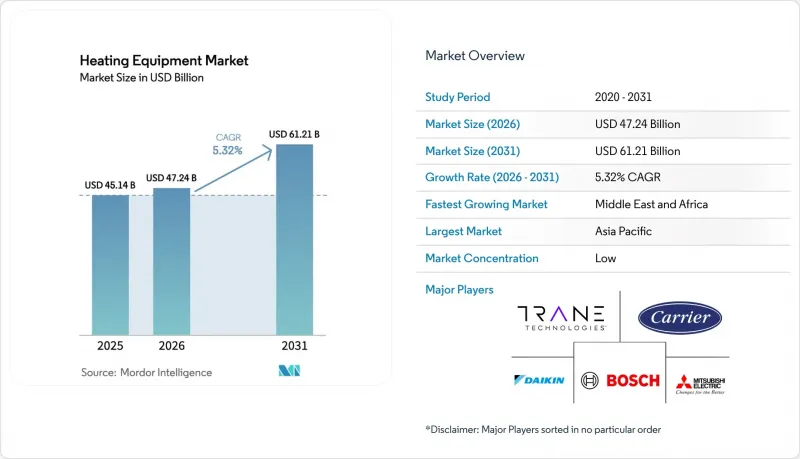
본 보고서는 기기 유형별(보일러, 화로, 히트 펌프 등), 최종 사용자 산업별(주거, 상업, 산업, 공공·기관), 연료 유형별(천연가스, 전력, 석유 등), 기술별(응축식, 비응축식 등), 설치 유형별(신규 설치, 교체·개보수), 지역별로 분류되어 있습니다. 시장 예측은 금액(달러)으로 제시되어 있습니다.
세계의 난방 장비 시장 동향 및 인사이트
한랭 지역에서의 개보수 프로그램을 통한 전기화 추진
영하의 지역에서는 현재, 연료유나 프로판 시스템을 대체하는 히트펌프로의 개보수에 공공 자금이 투입되고 있습니다. 뉴욕주의 ‘클린 히트(Clean Heat)’ 프로그램은 2025년에 2억 5,000만 달러를 배정하여 10만 가구의 주택 개조를 진행하는 한편, 퀘벡주는 잉여 수력발전을 활용하기 위해 3억 캐나다 달러(2억 2,200만 달러)를 편성했습니다. 하드웨어 준비는 완료되었습니다. 미쓰비시의 ‘Zuba-Central’ 덕트식 유닛은 영하 30°C에서도 최대 출력을 유지하며, 캐리어사는 결로를 방지하기 위해 수원 히트펌프와 글리콜 루프를 결합하고 있습니다. 기술의 성숙도 측면에서 볼 때, 병목 현상은 설치 업체의 대응 능력과 하드웨어 혁신에 비해 여전히 약 2년 정도 뒤처져 있는 전기 요금 체계로 옮겨가고 있습니다.
탄소 중립 기업 캠퍼스에는 부지 내에 설치된 히트펌프가 필수적입니다.
‘과학 기반 목표(SBT)’를 추구하는 기업들은 스코프 1 배출량을 제로로 만들기 위해 보일러를 대형 수열식 또는 지열식 시스템으로 교체하고 있습니다. 마이크로소프트는 12곳의 데이터센터 캠퍼스를 개조하여 천연가스 사용량을 85% 감축하는 동시에 탄소 상쇄 구매를 폐지했습니다. 아마존은 독일과 폴란드의 물류창고에 지열 이용형 장치를 도입했으며, 유니레버는 2030년까지 40개 공장에서 전기화를 추진하고 있습니다. 각 프로젝트의 규모는 500kW를 초과하는 경우가 많으며, 수년에 걸쳐 서비스 수익을 창출하기 때문에 OEM 기업들은 장비 판매가 아닌, 공급된 kW시 단위로 요금을 부과하는 ‘히트 펌프 애즈 어 서비스(Heat Pump as a Service)’ 계약을 선호하는 경향이 있습니다.
전기가화 진행 지역에서의 송전망 용량 병목 현상
급속한 전기화로 인해 겨울철 피크 수요가 2배로 증가하여, 가스 난방 주택을 위해 설계된 변압기나 배전선에 과부하가 걸릴 우려가 있습니다. 내셔널 그리드(National Grid)는 그레이터 런던 지역의 저전압 회로 중 22%에 대한 보강이 필요하다고 지적하고 있으며, 그 개보수 비용은 가구당 약 4,000파운드(5,200달러)에 달하고 공사 기간은 18개월에 이릅니다. 에버소스(EverSource)사는 변전소의 예비 용량이 부족하여 매사추세츠주에서 1,200건의 신청을 연기했습니다. 독일의 전력 회사는 2035년까지 500억 유로(540억 달러)의 송배전망 투자가 필요할 것으로 추산하고 있으며, 이 비용은 결국 전기 요금 인상으로 이어질 것입니다. 수요 반응(Demand Response)을 통한 수요 억제는 효과적이지만, 계약업체가 고객 등록 및 스마트 온도 조절기 설치·시운전을 수행해야 하기 때문에 도입 과정이 복잡해집니다.
부문 분석
2025년에도 보일러는 여전히 37.54%의 시장 점유율을 차지했으며, 이는 90°C 이상의 출력이 필요한 산업용 증기 및 지역 난방 수요에 힘입은 것입니다. 한편, 히트 펌프는 연평균 성장률(CAGR) 6.38%로 확대되고 있으며, 북미에서는 강제 송풍식 난방기의 대체, 유럽에서는 온수식 라디에이터 시장을 점점 더 잠식하고 있습니다. 미국에서는 덕트식 주택에 난방기가 여전히 남아 있지만, 현재는 덕트식 인버터 히트펌프로의 직접적인 대체가 진행되고 있습니다. 복사 패널과 같은 틈새 기기는 특수한 용도로 사용되고 있지만, 높은 이익률을 유지하고 있습니다. 경쟁상의 전환점으로, 주택 및 소규모 상업시설의 고객은 전기화로 빠르게 전환하고 있는 반면, 고온이 필요한 산업용 분야에서는 기상 기술이나 수소 혼합 기술이 보급될 때까지 보일러가 유지되고 있습니다. 열펌프와 보일러를 결합한 하이브리드 패키지는 연간 부하의 80%를 전기화하면서도 극심한 피크 시간대에는 화석 연료를 통한 백업이 가능하게 함으로써 도입을 용이하게 하고, 전력 계통에 미치는 영향과 주택 소유자의 비용을 평준화합니다.
전략적 차별화의 핵심은 소프트웨어에 있습니다. Trane사의 ‘Tracer’ 플랫폼은 재실 현황과 기상 상황을 예측하여 비피크 요금 시간대에 예열을 수행하고, 수요 감축에 대한 전력 회사의 인센티브를 활용합니다. 이러한 기능 덕분에 난방 장비 시장은 하드웨어의 이익률에서 수명 주기 서비스 가치로 전환되고 있으며, 가격만을 내세우는 신규 시장 진출기업의 진입 장벽을 높이는 동시에 기존 기업들이 분석 기능을 보증 및 유지보수와 함께 제공하도록 유도하고 있습니다.
2025년에는 주거용 구매자가 시장 점유율의 57.83%를 차지한 것으로 평가되었으며, 2031년까지 연평균 성장률(CAGR) 6.42%로 확대될 것으로 전망됩니다. 이러한 성장은 미국의 세액 공제, 유럽의 개보수 의무, 그리고 중국의 석탄에서 전력으로의 전환에 힘입고 있습니다. 한편, 총 소유 비용(TCO)을 중시하는 상업용 부동산 관리 회사는 약 25%의 점유율을 차지하고 있으며, 빌딩 자동화 시스템과의 통합이 용이한 장치를 선호하는 경향이 보입니다.
12%를 차지하는 산업용 고객은 120°C 이상의 내열성과 맞춤형 설계를 중시하며, 500kW 유닛 1대당 10만 달러 이상을 지불하는 경우도 드물지 않습니다. Thermax사는 이러한 전문성을 바탕으로 제약 업계 및 유제품 업계의 폐열 활용 프로젝트를 수주했습니다. 공공시설의 경우, 투자 회수 기간이 길어짐에도 불구하고 정책상의 의무로 인해 조기 도입이 진행되고 있습니다. 따라서 구매 행태는 다양하며, 주택용 판매는 리베이트 제도의 편의성과 자금 조달에, 상업용 거래는 수요 반응 및 보증에, 산업용 계약은 공정 통합의 깊이에 좌우됩니다.
지역별 분석
아시아태평양은 중국의 석탄 보일러 전환, 인도의 중산층을 통한 덕트식 히트펌프로의 교체, 그리고 일본의 인버터식 유닛에 대한 보조금 지급에 힘입어 2025년 매출의 40.19%를 차지했습니다. 유럽은 독일, 프랑스, 영국의 규제가 수렴됨에 따라 약 30%로 그 뒤를 이었으나, 송전망 제약과 노동력 부족이 성장을 저해하고 있습니다. 북미는 약 20%를 차지했습니다. ‘인플레이션 감축법’에 따른 가구당 최대 2,000달러의 세액 공제가 한랭 지역에서의 도입을 가속화한 반면, 캐나다 각 주에서는 수력 발전의 잉여 전력을 활용했습니다. 중동 및 아프리카은 태양열·열펌프 하이브리드 시스템을 규정하는 NEOM과 같은 기가 프로젝트를 배경으로 연평균 성장률(CAGR) 7.78%로 성장을 주도하고 있습니다. 남미 시장은 여전히 소규모이지만, 수력 발전 자원이 풍부한 브라질 남부 주에서는 사회주택에 스플릿형 히트펌프 시스템이 채택되면서 성장세가 가속화되고 있습니다.
중국 시장은 북부의 집중형 지역 난방과 남부의 개별 스플릿형 유닛으로 양분되어 있어, 각 OEM 업체들은 지역별로 제품 라인을 조정할 수밖에 없습니다. 인도에서는 아파트 건설이 급증함에 따라 2025년 다이킨의 매출이 18% 증가했습니다. 일본 경제산업성은 액화천연가스(LNG) 수입을 억제하기 위해 2030년까지 500만 가구를 대상으로 하는 목표를 세웠습니다. 중동에서는 두바이의 지역 냉방 네트워크가 호텔 온수 공급에 열회수식 칠러를 시범 도입하고 있어, 더운 기후의 지역에서도 난방 수요가 존재함을 여실히 보여주고 있습니다.
2025년, 유럽은 난방 장비 시장 점유율의 약 30%를 차지했습니다. 이는 개보수 보조금 도입과 탄소 가격 상승이 맞물려 보일러 교체가 가속화된 결과이지만, 지속적인 확장을 위해서는 특히 변압기 납기 기간이 18개월에 달하는 런던이나 뮌헨 등의 도시에서 설치 업체의 미처리 수주를 해소하고, 도시 지역의 배전망을 강화하는 것이 필수적입니다. 북미는 2025년 수요의 약 20%를 차지하고 있으며, 가구당 최대 2,000달러의 ‘인플레이션 감축법’에 따른 세액 공제와 캐나다 각 주에서 제공하는 한랭지 리베이트가 주택 분야의 도입을 뒷받침하고 있습니다. 데이터센터의 폐열 회수는 미국의 하이퍼스케일 코리도 전역에 새로운 성장 여지를 제공하고 있으며, 이 지역의 사업자들은 디젤 보일러 가동 시간을 줄이기 위해 흡수식 히트펌프와의 결합을 검토하고 있습니다. 라틴아메리카는 현재로서는 틈새 시장에 그치고 있지만, 수력 자원이 풍부한 브라질 남부 주들에서는 히트펌프를 통해 부하를 비피크 시간대로 전환하도록 장려하는 요금 체계의 시범 도입이 진행되고 있어, 향후 규모 확대를 위한 기반이 마련되고 있습니다.
기타 혜택 :
- 엑셀 형식 시장 예측(ME) 시트
- 3개월간의 애널리스트 지원
자주 묻는 질문
목차
제1장 서론
제2장 조사 방법
제3장 주요 요약
제4장 시장 구도
제5장 시장 규모 및 성장 예측
제6장 경쟁 구도
제7장 시장 기회 및 향후 전망
AJY 26.09.15According to Mordor Intelligence, the heating equipment market size is expected to increase from USD 45.14 billion in 2025 to USD 47.24 billion in 2026 and reach USD 61.21 billion by 2031, growing at a CAGR of 5.32% over 2026-2031.
This report is Segmented by Equipment Type (Boilers, Furnaces, Heat Pumps, and More), End-User Industry (Residential, Commercial, Industrial, and Public/Institutional), Fuel Type (Natural Gas, Electricity, Oil, and More), Technology (Condensing, Non-Condensing, and More), Installation Type (New Installation, and Replacement/Retrofit), and Geography. The Market Forecasts are Provided in Terms of Value (USD).
Global Heating Equipment Market Trends and Insights
Electrification Push in Cold-Climate Retrofit Programs
Sub-zero regions now direct public money toward heat-pump retrofits that displace fuel-oil and propane systems. New York's Clean Heat program allocated USD 250 million in 2025 for 100,000 residential conversions, while Quebec earmarked CAD 300 million (USD 222 million) to leverage surplus hydro power. Hardware is ready; Mitsubishi's Zuba-Central ducted unit maintains full output at minus-30 °C, and Carrier pairs water-source heat pumps with glycol loops to prevent frosting. The choke point has shifted from technology readiness to installer capacity and utility rate design that still lags hardware innovation by roughly two years.
Carbon-Neutral Corporate Campuses Demand On-Site Heat Pumps
Corporations pursuing Science Based Targets swap boilers for large water-source or ground-source systems to erase Scope 1 emissions. Microsoft retrofitted 12 data-center campuses, cutting natural-gas use 85% and retiring offset purchases. Amazon specified ground-source units for German and Polish warehouses, and Unilever is electrifying 40 factories by 2030. Each job often exceeds 500 kW, carries multi-year service revenue, and favors heat-pump-as-a-service contracts in which OEMs bill per delivered kilowatt-hour rather than equipment sales.
Grid-Capacity Bottlenecks in Electrified Neighborhoods
Rapid electrification can double winter peaks, overloading transformers and feeders sized for gas-heated homes. National Grid flagged 22% of low-voltage circuits in Greater London for reinforcement, with upgrade costs near GBP 4,000 (USD 5,200) per household and lead times stretching 18 months. Eversource delayed 1,200 applications in Massachusetts because substations lacked spare capacity. German utilities estimate EUR 50 billion (USD 54 billion) of network investment by 2035, expenses that ultimately raise delivered electricity prices. Demand-response curtailments help, but add installation complexity when contractors must enroll customers and commission smart thermostats.
Other drivers and restraints analyzed in the detailed report include:
- Gas-Phase Heat Pump Innovations for High-Temperature Industrial Drying
- Performance-Based Building Codes Accelerating Boiler Replacement
- Skilled-Labor Shortages for Multi-Technology Retrofits
For complete list of drivers and restraints, kindly check the Table Of Contents.
Segment Analysis
Boilers still hold 37.54% market share in 2025, anchored by industrial steam and district-energy loads requiring 90 °C-plus output. Heat pumps, however, are advancing at a 6.38% CAGR and increasingly cannibalize forced-air furnace replacements in North America and hydronic radiators in Europe. Furnaces linger in ducted U.S. housing but now face direct substitution via ducted inverter heat pumps. Niche devices such as radiant panels capture specialty applications yet carry premium margins. The competitive divide shows residential and light-commercial customers pivoting hard toward electrification, while high-temperature industrial lines retain boilers until gas-phase technology or hydrogen blending scales. Hybrid heat-pump-plus-boiler packages ease adoption by allowing 80% electrified annual load with fossil backup for extreme peaks, smoothing grid impact and homeowner cost.
Strategic differentiation revolves around software. Trane's Tracer platform forecasts occupancy and weather, pre-heats during off-peak tariffs, and unlocks utility incentives for demand shedding. These features move the heating equipment market from hardware margin to lifetime service value, raising barriers for price-only entrants and encouraging incumbents to bundle analytics with warranty and maintenance.
In 2025, residential buyers made up 57.83% of the market share and are projected to grow at a CAGR of 6.42% through 2031. This growth is bolstered by U.S. tax credits, European retrofit mandates, and China's transition from coal to electricity. Meanwhile, commercial property managers, focusing on total cost of ownership, command a share of about 25%, showing a preference for units primed for building-automation integration.
Industrial customers, at 12%, value 120 °C-plus capability and custom engineering, often paying more than USD 100,000 per 500-kW unit; Thermax leveraged this specialization to win pharmaceutical and dairy waste-heat projects. Public facilities adopt early due to policy mandates despite longer paybacks. Purchase behavior thus varies, residential sales hinge on rebate simplicity and financing, commercial deals on demand-response and warranty, and industrial contracts on process integration depth.
Complete Report Scope:
- By Equipment Type
- Boilers
- Furnaces
- Heat Pumps
- Radiators
- Other Heater Types
- By End-User Industry
- Residential
- Commercial
- Industrial
- Public/Institutiona
- By Fuel Type
- Natural Gas
- Electricity
- Oil
- Biomass
- Hydrogen-Ready
- By Technology
- Condensing
- Non-Condensing
- Air Source Heat Pumps
- Ground Source Heat Pumps
- Hybrid Systems
- Smart Connected Systems
- By Installation Type
- New Installation
- Replacement/Retrofit
- By Geography
- North America
- United States
- Canada
- Mexico
- South America
- Brazil
- Argentina
- Rest of South America
- Europe
- United Kingdom
- Germany
- France
- Spain
- Italy
- Rest of Europe
- Asia-Pacific
- China
- India
- Japan
- Australia
- South Korea
- Rest of Asia-Pacific
- Middle East and Africa
- Middle East
- Saudi Arabia
- United Arab Emirates
- Turkey
- Rest of Middle East
- Africa
- South Africa
- Kenya
- Rest of Africa
- Middle East
- North America
Geography Analysis
Asia-Pacific held 40.19% of 2025 revenue as China converted coal boilers, India's middle class upgraded to ducted heat pumps, and Japan subsidized inverter units. Europe followed at roughly 30% as German, French, and United Kingdom mandates converged, though grid limits and labor shortages temper growth. North America represented about 20%; Inflation Reduction Act credits up to USD 2,000 per home accelerated adoption in cold states, while Canadian provinces leaned on hydro surplus. The Middle East and Africa lead in growth at a 7.78% CAGR amid giga-projects like NEOM that specify solar-thermal-heat-pump hybrids. South America remains small but gains momentum in Brazil's hydro-rich southern states where social housing now opts for split heat-pump systems.
China's market splits between centralized district heating in the north and individual split units in the south, forcing OEMs to tailor product lines. India logged Daikin sales growth of 18% in 2025 as apartment construction boomed. Japan's trade ministry targets 5 million residential units by 2030 to curb liquefied natural-gas imports. In the Middle East, Dubai's district-cooling network pilots heat-recovery chillers to supply hotel hot water, underlining that heating demand exists even in hot climates.
Europe accounted for roughly 30% of the heating equipment market share in 2025 as retrofit grants and rising carbon prices converged to accelerate boiler replacement, yet sustained expansion hinges on clearing installer backlogs and reinforcing urban distribution grids, particularly in cities such as London and Munich that face 18-month transformer lead times. North America held about 20% of 2025 demand, with Inflation Reduction Act tax credits of up to USD 2,000 per household and provincial cold-climate rebates in Canada boosting residential uptake. Data-center waste-heat recovery offers fresh upside across the United States hyperscale corridor, where operators are evaluating absorption-heat-pump pairings to curb diesel-boiler runtime. Latin America remains a niche today, yet Brazil's hydro-rich southern states are piloting tariff structures that reward heat-pump load shifting to off-peak periods, laying groundwork for future scaling.
- Daikin Industries Ltd.
- Carrier Global Corporation
- Robert Bosch GmbH
- Trane Technologies plc
- Ariston Holding N.V.
- NIBE Industrier AB
- Danfoss A/S
- Panasonic Holdings Corporation
- Thermax Limited
- Mitsubishi Electric Corporation
- Lennox International Inc.
- Viessmann Climate Solutions SE
- Glen Dimplex Group
- Rheem Manufacturing Company
- BDR Thermea Group B.V.
- Bradford White Corporation
- A. O. Smith Corporation
Additional Benefits:
- The market estimate (ME) sheet in Excel format
- 3 months of analyst support
TABLE OF CONTENTS
1 INTRODUCTION
- 1.1 Study Assumptions and Market Definition
- 1.2 Scope of the Study
2 RESEARCH METHODOLOGY
3 EXECUTIVE SUMMARY
4 MARKET LANDSCAPE
- 4.1 Market Overview
- 4.2 Market Drivers
- 4.2.1 Electrification Push in Cold-Climate Retrofit Programs
- 4.2.2 Carbon-Neutral Corporate Campuses Demand On-Site Heat Pumps
- 4.2.3 Gas-Phase Heat Pump Innovations for High-Temperature Industrial Drying
- 4.2.4 Performance-Based Building Codes Accelerating Boiler Replacement
- 4.2.5 Waste-Heat-to-Heat-Pump Integration in District Energy
- 4.2.6 Green Hydrogen Blending Pilots in Commercial Boilers
- 4.3 Market Restraints
- 4.3.1 Grid-Capacity Bottlenecks in Electrified Neighborhoods
- 4.3.2 Skilled-Labor Shortages for Multi-Technology Retrofits
- 4.3.3 Volatile Nickel Prices Inflating Advanced Heat-Pump BOM
- 4.3.4 Fragmented Residential Rebate Administration
- 4.4 Industry Ecosystem Analysis
- 4.5 Regulatory Landscape
- 4.6 Technological Outlook
- 4.7 Impact of Macroeconomic Factors
- 4.8 Porter's Five Forces Analysis
- 4.8.1 Bargaining Power of Suppliers
- 4.8.2 Bargaining Power of Buyers
- 4.8.3 Threat of New Entrants
- 4.8.4 Threat of Substitute Products and Services
- 4.8.5 Intensity of Competitive Rivalry
5 MARKET SIZE AND GROWTH FORECASTS (VALUE)
- 5.1 By Equipment Type
- 5.1.1 Boilers
- 5.1.2 Furnaces
- 5.1.3 Heat Pumps
- 5.1.4 Radiators
- 5.1.5 Other Heater Types
- 5.2 By End-User Industry
- 5.2.1 Residential
- 5.2.2 Commercial
- 5.2.3 Industrial
- 5.2.4 Public/Institutiona
- 5.3 By Fuel Type
- 5.3.1 Natural Gas
- 5.3.2 Electricity
- 5.3.3 Oil
- 5.3.4 Biomass
- 5.3.5 Hydrogen-Ready
- 5.4 By Technology
- 5.4.1 Condensing
- 5.4.2 Non-Condensing
- 5.4.3 Air Source Heat Pumps
- 5.4.4 Ground Source Heat Pumps
- 5.4.5 Hybrid Systems
- 5.4.6 Smart Connected Systems
- 5.5 By Installation Type
- 5.5.1 New Installation
- 5.5.2 Replacement/Retrofit
- 5.6 By Geography
- 5.6.1 North America
- 5.6.1.1 United States
- 5.6.1.2 Canada
- 5.6.1.3 Mexico
- 5.6.2 South America
- 5.6.2.1 Brazil
- 5.6.2.2 Argentina
- 5.6.2.3 Rest of South America
- 5.6.3 Europe
- 5.6.3.1 United Kingdom
- 5.6.3.2 Germany
- 5.6.3.3 France
- 5.6.3.4 Spain
- 5.6.3.5 Italy
- 5.6.3.6 Rest of Europe
- 5.6.4 Asia-Pacific
- 5.6.4.1 China
- 5.6.4.2 India
- 5.6.4.3 Japan
- 5.6.4.4 Australia
- 5.6.4.5 South Korea
- 5.6.4.6 Rest of Asia-Pacific
- 5.6.5 Middle East and Africa
- 5.6.5.1 Middle East
- 5.6.5.1.1 Saudi Arabia
- 5.6.5.1.2 United Arab Emirates
- 5.6.5.1.3 Turkey
- 5.6.5.1.4 Rest of Middle East
- 5.6.5.2 Africa
- 5.6.5.2.1 South Africa
- 5.6.5.2.2 Kenya
- 5.6.5.2.3 Rest of Africa
- 5.6.5.1 Middle East
- 5.6.1 North America
6 COMPETITIVE LANDSCAPE
- 6.1 Market Concentration
- 6.2 Strategic Moves
- 6.3 Market Share Analysis
- 6.4 Company Profiles (Includes Global Level Overview, Market Level Overview, Core Segments, Financials as Available, Strategic Information, Market Rank/Share, Products and Services, and Recent Developments)
- 6.4.1 Daikin Industries Ltd.
- 6.4.2 Carrier Global Corporation
- 6.4.3 Robert Bosch GmbH
- 6.4.4 Trane Technologies plc
- 6.4.5 Ariston Holding N.V.
- 6.4.6 NIBE Industrier AB
- 6.4.7 Danfoss A/S
- 6.4.8 Panasonic Holdings Corporation
- 6.4.9 Thermax Limited
- 6.4.10 Mitsubishi Electric Corporation
- 6.4.11 Lennox International Inc.
- 6.4.12 Viessmann Climate Solutions SE
- 6.4.13 Glen Dimplex Group
- 6.4.14 Rheem Manufacturing Company
- 6.4.15 BDR Thermea Group B.V.
- 6.4.16 Bradford White Corporation
- 6.4.17 A. O. Smith Corporation
7 MARKET OPPORTUNITIES AND FUTURE OUTLOOK
- 7.1 White-Space and Unmet-Need Assessment