|
시장보고서
상품코드
2125490
충전기 시장 : 시장 점유율 분석, 업계 동향 및 통계, 성장 예측(2026-2031년)Filling Machines - Market Share Analysis, Industry Trends & Statistics, Growth Forecasts (2026 - 2031) |
||||||
 Mordor Intelligence
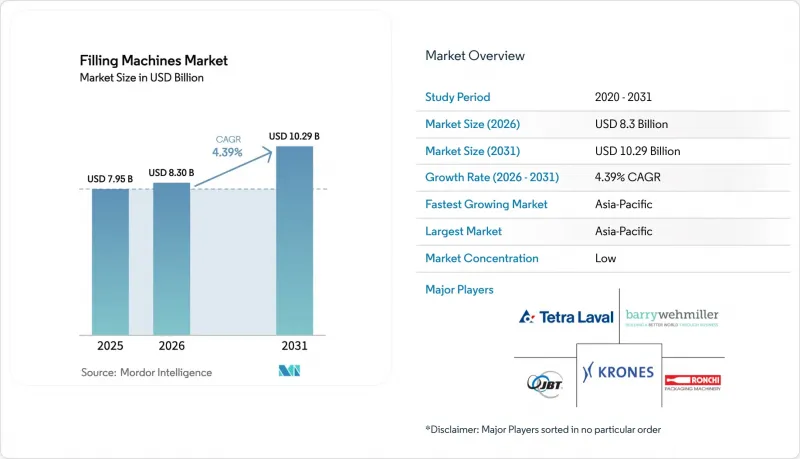
Mordor Intelligence에 의하면, 충전기 시장 규모는 2025년에 79억 5,000만 달러로 평가되었고, 2026년 83억 달러에서 2031년까지 102억 9,000만 달러에 이를 것으로 예측되며, 예측 기간(2026-2031년) CAGR은 4.39%를 나타낼 전망입니다.
본 보고서는 장비 유형별(무균식, 로터리식, 기타), 자동화 수준별(완전 자동, 반자동, 기타), 용기 유형별(병, 캔, 기타), 충전 기술별(중력, 피스톤, 기타), 최종 사용자 산업별(식음료, 의약품·생물제제, 기타), 지역별(북미, 유럽, 기타)로 분류되어 있습니다. 시장 전망은 금액(달러) 기준으로 제시되어 있습니다.
세계의 충전기 시장 동향 및 인사이트
고속·위생적인 생산 라인용 RTD 음료 수요 증가
RTD 음료 시장은 2032년까지 1조 달러에 달할 전망이며, 이에 따라 각 병입 업체들은 무균성을 해치지 않으면서 시간당 10만 병을 초과하는 생산 능력을 갖춘 라인을 도입할 수밖에 없는 상황입니다(『Dairy Foods』지). 유제품 베이스 RTD 제품에는 열에 민감한 단백질과 기능성 첨가물이 포함되어 있기 때문에 충전 라인에서는 층류 충전과 즉각적인 세척이 요구됩니다. 저당분 및 무유당 제품의 경우 점도와 관련된 문제가 발생하지만, 피스톤 펌프와 질량 유량계 시스템은 유량을 자동으로 조절하여 이 문제를 해결합니다. 크로네스(Krones)는 최근 Nu-Pure Beverages에 PET 라인을 납품했습니다. 이 라인은 충전, 캡핑, 검사를 하나의 프레임에 통합하여 설치 공간을 절약하고 있습니다. 소비자의 편의성에 대한 요구와 고품질 영양을 추구하는 추세가 맞물리면서, 미생물 수를 허용 한도 이하로 억제하면서도 여러 RTD 레시피를 신속하게 전환할 수 있는 모듈식 시스템에 대한 투자가 지속적으로 촉진되고 있습니다.
유통 기한 연장을 목적으로 한 무균 기술의 채택 확대
2024년, 제약 회사와 식품 기업들이 상온 보관 솔루션을 통해 콜드체인 비용을 최대 40%까지 절감하고자 모색함에 따라 무균 충진 도입이 가속화되었습니다(FDA). Emergent BioSolutions는 제품, 용기, 작업자를 격리하는 SA25 로봇 워크셀을 채택하여 바이알 크기에 대한 유연한 대응과 더 높은 무균성을 확보했습니다. 개정된 FDA 지침에서는 계량 펌프의 정확도와 멸균 검증의 중요성이 강조되었으며, 이에 따라 각 공급업체들은 개입 위험을 대폭 줄이면서 생물학적 제제의 처리 능력을 향상시키는 글러브리스 아이솔레이터의 도입을 추진하고 있습니다. 식품 브랜드 또한 유사한 무균 원리를 활용하여 방부제를 사용하지 않고도 12개월의 유통기한을 가진 주스를 제공하고 있으며, 이는 산업 전반에 걸쳐 설계의 수렴이 진행되고 있음을 보여줍니다.
첨단 충전 시스템에 필요한 막대한 초기 설비 투자
최첨단 무균 충전기의 가격은 500만 달러를 초과하는 경우도 있으며, 적합성 평가에 드는 비용이 프로젝트 예산의 25%를 추가로 차지하기 때문에 중소기업이나 신흥 시장의 가공업체에게는 큰 부담이 되고 있습니다. 일회용 백은 세척 비용을 절감해 주지만, 연간 6자리 수의 소모품 비용이 발생합니다. 수탁 제조업체가 이 설비 투자의 대부분을 부담하고 있지만, 생산 능력은 여전히 수요를 따라가지 못해 긴 리드타임이 지속되고 있습니다.
부문 분석
로터리식 플랫폼은 탄산 음료 및 비탄산 음료 생산 라인에서 입증된 높은 가동률 덕분에 2025년 충전기 시장 점유율의 23.10%를 차지했습니다. 다운스트림 공정에서는 바이오 의약품이나 방부제를 사용하지 않는 주스 등 기밀성이 높은 충전 셀이 요구되므로, 무균 충전 유닛은 2031년까지 7.12%라는 주목할 만한 연평균 성장률(CAGR)을 보일 것으로 전망됩니다. 무균 충전기 시장 규모는 확대될 것으로 예상되며, 공급업체들이 격리형 로봇 기술에 주력하고 있음을 알 수 있습니다. 공급업체들은 하나의 섀시 내에 피스톤식, 질량 유량식, 시간·압력 제어식 모듈을 조합하고 있으며, 이를 통해 공장에서는 아침에는 물과 같은 스포츠 음료를, 밤에는 고점도의 스무디를 처리하는 등의 유연성을 확보하고 있습니다.
소스나 크림의 충진에는 여전히 용적식 피스톤 충전기가 주류를 이루고 있지만, 의약품의 1% 단위 충진에서는 순중량 방식이 지지를 얻고 있습니다. 테트라팩의 ‘A1 1100’은 무균 배리어와 7열 구동 시스템을 융합하여 시간당 4만 팩의 생산을 실현하고 있습니다. 또한, 분말 충전기가 액체 라인에 통합됨에 따라 CDMO는 새로운 클린룸을 증설하지 않고도 수익 다각화를 도모할 수 있게 되었습니다.
2025년, 반자동 충전기는 설비 투자 제약과 사업자의 제어 사이의 균형을 맞추며 충전기 시장 점유율의 57.80%를 차지했습니다. 그러나 임금 상승과 밸리데이션 엔지니어 부족을 배경으로, 완전 자동화는 연평균 성장률(CAGR) 5.42%로 급속히 확대되고 있습니다. 가동 중지 시간을 대폭 줄여주는 AI 기반 자가 진단 기능의 도입으로, 완전 자동화 라인의 충전기 시장 규모는 더욱 확대될 것으로 예측됩니다. IoT에 연결된 HMI는 데이터를 기업의 품질 관리 시스템에 직접 전송하여 수작업으로 작성하는 서류 작업을 줄여줍니다. 섬세한 화장품이나 사람의 숙련된 손놀림이 필요한 파일럿 규모의 의약품 배치의 경우, 수동식 탁상형 유닛이 여전히 필수적입니다.
현재 하이브리드 시스템에는 트레이에 제품을 적재하거나 추적 가능한 라벨을 부착하는 코봇이 통합되어 있어, 인간의 손재주와 기계의 재현성을 융합하고 있습니다. 규제 감사가 온라인화됨에 따라 공장에서는 자동으로 생성되는 감사 추적이 요구되고 있으며, 소프트웨어 기능이 입찰의 주요 기준이 되고 있습니다.
지역별 분석
아시아태평양은 2025년 매출의 39.20%를 차지했으며, 연평균 성장률(CAGR) 8.42%로 성장하고 있습니다. 이는 중국과 인도가 상온 보관 가능한 유제품 및 백신 충전·마감 공장에 투자하고 있음을 반영합니다. 베트남과 인도네시아는 다국적 위탁 충전 업체를 유치하는 자유무역협정의 지원을 받아 음료 생산 능력을 확대되고 있습니다. 현지 OEM 업체들은 현재 유럽 파트너로부터 서보 드라이브 라이선스를 취득하여 엔트리 레벨 기계 비용을 절감하고, 지역 내 경쟁을 심화시키고 있습니다.
북미는 매출액 기준 2위를 차지하고 있으며, 높은 수익률을 보이는 바이오의약품, 수제 음료, 공급 리스크를 줄이기 위한 리쇼어링 노력에 힘입고 있습니다. 미국의 ‘인플레이션 억제법’에 따른 보조금은 무균 주사기 라인에 자금을 투입하고 있는 반면, 캐나다의 유제품 협동조합은 에너지 회수형 CIP 루프를 갖춘 파우치 충전기로의 교체를 추진하고 있습니다. 북미의 충전기 시장 규모는 하드웨어, 소프트웨어, 예비 부품을 구독 모델로 통합한 예측 유지보수 계약의 보급에 힘입어 꾸준히 확대될 것으로 전망됩니다.
유럽은 여전히 혁신의 중심지이며, 독일, 이탈리아, 스웨덴 공급업체들이 디지털 아이솔레이터 및 재활용 가능한 포장을 지원하는 캔 충전기를 수출하고 있습니다. EU의 그린 딜이 제시한 목표에 따라 저탄소 모터와 폐쇄형 물 시스템의 도입이 가속화되고 있습니다. 동유럽에서는 자체 브랜드 제품 수출업체에 대응하기 위해 구식 중력식 라인을 서보 구동 순중량 측정 플랫폼으로 전환하는 작업이 진행되고 있습니다. 중동 및 아프리카와 남미는 도입 대수 면에서는 뒤처져 있지만, 유제품, 주스, 의약품의 2차 포장 부문에서 엔트리 레벨 로터리 유닛에 대한 수요가 두 자릿수 성장세를 보이고 있습니다.
기타 혜택
- 엑셀 형식 시장 예측(ME) 시트
- 3개월간의 애널리스트 지원
목차
제1장 서론
제2장 조사 방법
제3장 주요 요약
제4장 시장 구도
제5장 시장 규모 및 성장 예측
제6장 경쟁 구도
제7장 시장 기회 및 향후 전망
AJYAccording to Mordor Intelligence, the filling machines market size was valued at USD 7.95 billion in 2025 and estimated to grow from USD 8.3 billion in 2026 to reach USD 10.29 billion by 2031, at a CAGR of 4.39% during the forecast period (2026-2031).
This report is Segmented by Equipment Type (Aseptic, Rotary, and More), Automation Level (Fully-Automatic, Semi-Automatic, and More), Container Type (Bottles, Cans, and More), Filling Technology (Gravity, Piston, and More), End-User Industry (Food and Beverage, Pharmaceutical and Biologics, and More), and Geography (North America, Europe, and More). The Market Forecasts are Provided in Terms of Value (USD).
Global Filling Machines Market Trends and Insights
Growth of RTD Beverage Demand for High-Speed Hygienic Lines
RTD beverages are on a clear path toward USD 1 trillion by 2032, forcing bottlers to install lines that exceed 100,000 bottles per hour without compromising sterility, Dairy Foods. Dairy-based RTD products contain proteins and functional additives that are heat-sensitive, so lines must deliver laminar filling and instantaneous cleanup. Sugar-reduced and lactose-free variants raise viscosity challenges that piston-pump or mass-flow-meter systems solve by self-adjusting flow rates. Krones recently delivered a PET line to Nu-Pure Beverages that marries filling, capping, and inspection in one frame to save floor space. Consumer cravings for convenience, combined with premium nutrition trends, keep fuelling investment in modular systems capable of flipping between multiple RTD recipes while holding microbial counts below accepted limits.
Rising Adoption of Aseptic Technology for Shelf-Life Extension
Aseptic filling accelerated in 2024 as pharmaceutical and food companies looked to cut cold-chain costs by as much as 40% through ambient-storage solutions, FDA. Emergent BioSolutions adopted SA25 robotic workcells that isolate product, container, and operator, achieving flexible vial sizing and higher sterility assurance. Updated FDA guidance highlights metering pump accuracy and sterilization validation, prompting vendors to install gloveless isolators that slash intervention risk while speeding biologic throughput. Food brands use the same aseptic principles to offer preservative-free juices with a 12-month shelf life, signaling cross-sector design convergence.
High Upfront CAPEX for Advanced Filling Systems
Cutting-edge aseptic fillers can top USD 5 million, with qualification adding 25% to project budgets, straining SMEs and emerging-market processors. Single-use bags lower cleanup costs but impose six-figure annual consumable bills. Contract manufacturers shoulder much of this capex, but capacity still lags demand, sustaining long lead times.
Other drivers and restraints analyzed in the detailed report include:
- Automation Uptake to Offset Skilled-Labor Shortages
- Stricter Food-Safety Regulations Mandating Equipment Upgrades
- Complex Region-Specific Validation and Compliance Burden
For complete list of drivers and restraints, kindly check the Table Of Contents.
Segment Analysis
Rotary platforms delivered 23.10% of the 2025 filling machines market share, owing to proven uptime in carbonated and still beverage lines. Downstream, aseptic units post the headline 7.12% CAGR to 2031 as biologics and preservative-free juices demand hermetically sealed dosing cells. The filling machines market size for aseptic units is expected to grow, underscoring supplier focus on isolated robotics. Suppliers blend piston, mass-flow, and time-pressure modules within one chassis, giving plants latitude to process water-like sports drinks in the morning and high-viscosity smoothies by night.
Volumetric piston fillers persist in sauces and creams, while net-weight systems gain favor for 1% pharma dosing. Tetra Pak's A1 1100 merges aseptic barriers with 7-row drives to deliver 40,000 packs per hour Tetra Pak. Powder fillers are now grafted onto liquid lines, letting CDMOs diversify revenue without adding new cleanrooms.
Semi-automatic machines held 57.80% of the filling machines market share in 2025 by balancing capital restraint with operator control. Yet full automation races at 5.42% CAGR, nudged by wage inflation and validation-engineer shortages. The filling machines market size for fully automatic lines is projected to widen, aided by AI self-diagnostics that slash downtime. IoT-linked HMIs feed data directly into enterprise quality systems, trimming human paperwork. Manual tabletop units remain indispensable for fragile cosmetics and pilot-scale pharma batches that need human finesse.
Hybrid systems now embed cobots that load trays or apply traceable labels, marrying manual dexterity with machine repeatability. As regulatory audits migrate online, factories push for auto-generated audit trails, turning software capability into a core tender criterion.
Complete Report Scope:
- By Equipment Type
- Aseptic
- Rotary
- Volumetric (Piston / Gravity)
- Net-Weight
- Other Equipment Types
- By Automation Level
- Fully-Automatic
- Semi-Automatic
- Manual / Hand-held
- By End-User Industry
- Food and Beverage
- Pharmaceutical and Biologics
- Cosmetics and Personal Care
- Chemicals and Industrial
- Others End-User Industries
- By Container Type
- Bottles
- Cans
- Pouches and Sachets
- Tubes and Cartridges
- Vials / Syringes
- Other Container Types
- By Filling Technology
- Gravity
- Piston
- Time-Pressure
- Mass / Flow-Meter
- Vacuum
- Auger (Powder)
- By Geography
- North America
- United States
- Canada
- Mexico
- Europe
- Germany
- United Kingdom
- France
- Italy
- Spain
- Russia
- Rest of Europe
- Asia-Pacific
- China
- India
- Japan
- South Korea
- Australia and New Zealand
- Rest of Asia-Pacific
- Middle East and Africa
- Middle East
- United Arab Emirates
- Saudi Arabia
- Turkey
- Rest of Middle East
- Africa
- South Africa
- Nigeria
- Egypt
- Rest of Africa
- Middle East
- South America
- Brazil
- Argentina
- Rest of South America
- North America
Geography Analysis
Asia-Pacific generated 39.20% of 2025 revenue and is growing at 8.42% CAGR, reflecting China and India's investments in shelf-stable dairy and vaccine fill-finish plants. Vietnam and Indonesia expand beverage capacity, aided by free-trade pacts that lure multinational co-packers. Local OEMs now license servo drives from European partners, trimming entry-level machine cost and boosting regional competitiveness.
North America sits second by value, supported by high-margin biologics, craft beverages, and reshoring commitments to cut supply risk. Grants under the US Inflation Reduction Act channel funds to aseptic syringe lines, while Canadian dairy co-ops renew pouch fillers with energy-recovery CIP loops. The filling machines market size for North America is forecast to climb steadily as predictive-maintenance contracts bundle hardware, software, and spares into subscription models.
Europe remains the innovation nucleus, with German, Italian, and Swedish vendors exporting digital isolators and recyclable-pack-ready can fillers. The EU Green Deal targets accelerate the deployment of low-carbon motors and closed-loop water systems. Eastern Europe is converting outdated gravity lines to servo-driven net-weight platforms to serve private-label exporters. Middle East & Africa and South America trail in installed base yet show double-digit demand for entry-level rotary units in dairy, juice, and pharma secondary packaging.
- Krones AG
- Tetra Laval Group
- Syntegon Technology GmbH
- KHS GmbH
- JBT Corporation
- Ronchi Mario S.p.A.
- Barry-Wehmiller Companies Inc.
- Coesia Group
- GEA Group AG
- Serac Group
- IMA Group
- Shibuya Corporation
- Pro Mach Inc.
- Accutek Packaging Equipment
- Shemesh Automation
- US Bottlers Machinery
- Fuji Machinery Co. Ltd.
- OPTIMA Packaging Group
- Adelphi Group
Additional Benefits:
- The market estimate (ME) sheet in Excel format
- 3 months of analyst support
TABLE OF CONTENTS
1 INTRODUCTION
- 1.1 Study Assumptions and Market Definition
- 1.2 Scope of the Study
2 RESEARCH METHODOLOGY
3 EXECUTIVE SUMMARY
4 MARKET LANDSCAPE
- 4.1 Market Overview
- 4.2 Market Drivers
- 4.2.1 Growth of RTD beverage demand for high-speed hygienic lines
- 4.2.2 Rising adoption of aseptic technology for shelf-life extension
- 4.2.3 Automation uptake to offset skilled-labor shortages
- 4.2.4 Stricter food-safety regulations mandating equipment upgrades
- 4.2.5 Quick-changeover agility for multi-SKU DTC brands
- 4.2.6 AI-enabled inline inspection driving predictive-maintenance ROI
- 4.3 Market Restraints
- 4.3.1 High upfront CAPEX for advanced filling systems
- 4.3.2 Complex region-specific validation and compliance burden
- 4.3.3 Supply volatility of pharma-grade single-use components
- 4.3.4 Shortage of validation engineers delaying line deployment
- 4.4 Supply-Chain Analysis
- 4.5 Regulatory Landscape
- 4.6 Technological Outlook
- 4.7 Porter's Five Forces Analysis
- 4.7.1 Bargaining Power of Suppliers
- 4.7.2 Bargaining Power of Buyers
- 4.7.3 Threat of New Entrants
- 4.7.4 Threat of Substitute Products
- 4.7.5 Intensity of Competitive Rivalry
- 4.8 Investment Analysis
5 MARKET SIZE AND GROWTH FORECASTS (VALUE)
- 5.1 By Equipment Type
- 5.1.1 Aseptic
- 5.1.2 Rotary
- 5.1.3 Volumetric (Piston / Gravity)
- 5.1.4 Net-Weight
- 5.1.5 Other Equipment Types
- 5.2 By Automation Level
- 5.2.1 Fully-Automatic
- 5.2.2 Semi-Automatic
- 5.2.3 Manual / Hand-held
- 5.3 By End-User Industry
- 5.3.1 Food and Beverage
- 5.3.2 Pharmaceutical and Biologics
- 5.3.3 Cosmetics and Personal Care
- 5.3.4 Chemicals and Industrial
- 5.3.5 Others End-User Industries
- 5.4 By Container Type
- 5.4.1 Bottles
- 5.4.2 Cans
- 5.4.3 Pouches and Sachets
- 5.4.4 Tubes and Cartridges
- 5.4.5 Vials / Syringes
- 5.4.6 Other Container Types
- 5.5 By Filling Technology
- 5.5.1 Gravity
- 5.5.2 Piston
- 5.5.3 Time-Pressure
- 5.5.4 Mass / Flow-Meter
- 5.5.5 Vacuum
- 5.5.6 Auger (Powder)
- 5.6 By Geography
- 5.6.1 North America
- 5.6.1.1 United States
- 5.6.1.2 Canada
- 5.6.1.3 Mexico
- 5.6.2 Europe
- 5.6.2.1 Germany
- 5.6.2.2 United Kingdom
- 5.6.2.3 France
- 5.6.2.4 Italy
- 5.6.2.5 Spain
- 5.6.2.6 Russia
- 5.6.2.7 Rest of Europe
- 5.6.3 Asia-Pacific
- 5.6.3.1 China
- 5.6.3.2 India
- 5.6.3.3 Japan
- 5.6.3.4 South Korea
- 5.6.3.5 Australia and New Zealand
- 5.6.3.6 Rest of Asia-Pacific
- 5.6.4 Middle East and Africa
- 5.6.4.1 Middle East
- 5.6.4.1.1 United Arab Emirates
- 5.6.4.1.2 Saudi Arabia
- 5.6.4.1.3 Turkey
- 5.6.4.1.4 Rest of Middle East
- 5.6.4.2 Africa
- 5.6.4.2.1 South Africa
- 5.6.4.2.2 Nigeria
- 5.6.4.2.3 Egypt
- 5.6.4.2.4 Rest of Africa
- 5.6.4.1 Middle East
- 5.6.5 South America
- 5.6.5.1 Brazil
- 5.6.5.2 Argentina
- 5.6.5.3 Rest of South America
- 5.6.1 North America
6 COMPETITIVE LANDSCAPE
- 6.1 Market Concentration
- 6.2 Strategic Moves and Developments
- 6.3 Market Share Analysis
- 6.4 Company Profiles (includes Global level Overview, Market level overview, Core Segments, Financials as available, Strategic Information, Market Rank/Share, Products and Services, Recent Developments)
- 6.4.1 Krones AG
- 6.4.2 Tetra Laval Group
- 6.4.3 Syntegon Technology GmbH
- 6.4.4 KHS GmbH
- 6.4.5 JBT Corporation
- 6.4.6 Ronchi Mario S.p.A.
- 6.4.7 Barry-Wehmiller Companies Inc.
- 6.4.8 Coesia Group
- 6.4.9 GEA Group AG
- 6.4.10 Serac Group
- 6.4.11 IMA Group
- 6.4.12 Shibuya Corporation
- 6.4.13 Pro Mach Inc.
- 6.4.14 Accutek Packaging Equipment
- 6.4.15 Shemesh Automation
- 6.4.16 US Bottlers Machinery
- 6.4.17 Fuji Machinery Co. Ltd.
- 6.4.18 OPTIMA Packaging Group
- 6.4.19 Adelphi Group
7 MARKET OPPORTUNITIES AND FUTURE OUTLOOK
- 7.1 White-space and Unmet-Need Assessment