|
시장보고서
상품코드
2125501
미국의 통신 타워 시장 : 시장 점유율 분석, 업계 동향 및 통계, 성장 예측(2026-2031년)United States Telecom Tower - Market Share Analysis, Industry Trends & Statistics, Growth Forecasts (2026 - 2031) |
||||||
 Mordor Intelligence
Mordor Intelligence에 의하면, 미국의 통신 타워 시장 규모는 2025년 73억 4,000만 달러로 평가되었고, 2026년에는 76억 3,000만 달러로 추정되고, 2031년까지 90억 1,000만 달러에 이를 것으로 예측되며, 2026-2031년 CAGR 3.38%로 성장할 전망입니다.

본 보고서는 연료 유형별(재생에너지 및 비재생에너지), 타워 유형별(라티스 타워, 가선식 타워, 모노폴 타워, 스텔스 타워), 설치 형태별(옥상 및 지상 설치형), 소유 형태별(사업자 소유, 합작 투자, 민간 소유, MNO 직영), 지역별로 분류되어 있습니다. 시장 전망은 금액(달러) 기준으로 제시되어 있습니다.
미국의 통신 타워 시장 동향 및 인사이트
5G 미드밴드 및 C-band 밀집화의 급격한 확대
Verizon이 2025년 말까지 C-밴드 커버리지 90%를 달성하더라도 여전히 국지적인 용량 부족이 남아 있기 때문에 이 회사는 수천 곳의 매크로 사이트에서 추가 공간을 임대하게 될 것입니다. T-Mobile은 2.5GHz 대역의 주파수 대역을 풍부하게 보유하고 있어 필요한 타워 수가 적고, 이로 인해 비대칭적인 경쟁 환경이 조성되어 AT&T와 Verizon은 신규 건설에 자금을 투자하기보다 기존 구조물에 테넌트를 추가해야 하는 압박을 받고 있습니다. 경매 110에서 3.45-3.55GHz 라이선스를 취득한 통신 사업자는 2027년까지 단계적인 구축 마일스톤을 달성해야 하며, 이로 인해 타워 기업의 수익 파이프라인에 두 번째 밀도 향상 붐이 포함되었습니다. 마스터 리스 계약의 수정 조항에는 라이선스 보유자가 추가 무선 장비를 가동할 때마다 임대료가 단계적으로 인상되는 에스컬레이터 조항이 포함되어 있어, 소유주는 수익을 앞당겨 확보할 수 있게 되었습니다. 이러한 고밀도화의 추진은 인구 밀도가 높아 기지국당 4번째 또는 5번째 임차인 유치의 경제적 근거가 되는 주요 도시 회랑에서 가장 활발하게 진행되고 있습니다.
고정 무선 접속 가입자 수의 급속한 증가
Verizon은 2025년 말 기준으로 570만 회선의 고정 무선 접속 회선을 보고했으며, 경영진은 2027년까지 900만 회선을 목표로 하고 있습니다. 이는 교외 카운티에서 수천 건의 옥상 및 모노폴 임대 계약이 증가함을 의미합니다. 2025년 6월, NTIA가 고정 무선 솔루션을 광섬유와 동등하게 취급하기로 결정함에 따라 424억 5,000만 달러 규모의 BEAD 보조금이 풀렸고, 비용이 많이 드는 농촌 지역에서 통신 사업자들의 입찰이 가속화되었습니다. 타워 기업들은 이에 대응하여, 주 광대역 담당 기관이 프로젝트 채택을 최종 결정하기 몇 달 전에 대상 구획의 토지를 옵션 계약으로 확보하고, 통신 사업자의 입주를 위해 자산을 사실상 사전 배치하고 있습니다. 몬태나주나 와이오밍주에서는 광섬유 설치 비용이 건당 5만 달러를 초과하는 경우도 있지만, 현재는 무선 제안이 주 평가 기준의 과반수를 차지하고 있으며, 보조금이 건설 착공으로 전환되면 중기적으로 임대 계약이 급증할 것으로 확실시되고 있습니다. 이러한 움직임에 따라 공공 자금과 민간 타워 부동산이 연계되면서, 농촌 지역의 디지털 격차 해소가 진전되고 있습니다.
150피트 미만의 지자체 높이 제한
샌프란시스코 등 일부 도시의 도시계획 조례에서는 신규 타워의 높이를 40-65피트로 제한하고 있는데, 이는 중파 대역 전파에 가장 적합한 120-180피트보다 훨씬 낮은 수준이므로, 통신 사업자들은 옥상 임대나 스몰 셀 노드에 의존할 수밖에 없는 실정입니다. 볼더시는 역사 지구에서 35피트의 제한을 적용하고 있으며, 이로 인해 눈에 띄지 않는 설치 방식이나 옥상 설치와 같은 대안 시설의 임대료는 표준 지상 설치 부지에 비해 최대 70% 더 비쌉니다. FCC의 2025년 명령에 따라 높이 및 후퇴 규정에 관한 지방 자치 단체의 권한이 유지되었으므로, 이러한 제약은 당분간 지속될 것입니다. 현재 타워 설치 업체들은 구역 지정 승인을 얻기 위해 깃대, 교회 첨탑, 인공 나무 등을 은폐 시설로 활용하고 있지만, 각각 설치 비용에 7만 5,000-15만 달러가 추가됩니다. 그 대가로 네트워크의 기하학적 조건이 악화됩니다. 40피트 높이의 스텔스 설치 지점에서는 반 마일 미만의 반경만 커버할 수 있기 때문에 단일 모노폴과 동일한 서비스 지역을 확보하려면 훨씬 더 많은 설치 장소가 필요하기 때문입니다.
부문 분석
재생에너지로 가동되는 기지국은 2025년에 미국 통신 타워 시장 규모의 약 37.44%를 차지했으며, 2031년까지 연평균 성장률(CAGR) 3.96%를 나타낼 것으로 예측됩니다. 아메리칸 타워(American Tower)는 국내 전체 설치 거점의 재생에너지 도입률을 2024년 22%에서 2030년까지 60%로 끌어올리겠다고 공약했으며, 이 계획은 수천 건에 달하는 태양광 발전과 축전지를 결합한 개보수에 의존하고 있습니다. 크라운 캐슬(Crown Castle)은 유사한 배출 감축 목표를 추구하고 있으며, 현재 1kW시당 150달러 미만으로 떨어진 리튬 이온 배터리 비용 하락을 활용하여 연간 500곳의 설치 거점을 전환하고 있습니다. 그러나 두 가지 장벽이 이러한 추진력을 약화시키고 있습니다. 첫째, 캘리포니아주와 텍사스주에서는 계통 연계 대기 기간이 최대 24개월에 달하여, 프로젝트의 수익성을 뒷받침하는 순계량제를 통한 계통 연계가 지연되고 있습니다. 둘째, 산불이 빈번하게 발생하는 지역에서는 배터리 설치에 추가 허가가 필요하여, 건설 일정에 3-6개월이 더 소요됩니다. 이러한 과제에도 불구하고, 통신 사업자들은 기업의 지속가능성 평가 기준을 충족하기 위해 저탄소 타워에 대해 10%-15%의 임대료 프리미엄을 지불할 의향이 있어, 이로 인해 포트폴리오 소유자의 수익성이 향상되고 있습니다. 만약 연방 의회가 태양광 발전에 대한 30%의 투자 세액 공제를 2032년 이후로도 연장한다면, 재생에너지의 점유율은 현재 예측 범위를 웃도는 속도로 확대될 것이며, 미국 통신 타워 시장 전체의 성장률은 기준선 예측을 상회할 가능성이 있습니다.
2025년 도입 건수의 62.56%를 차지하며 여전히 주류를 이루고 있는 비재생 에너지 시스템은 3.38%라는 완만한 속도로 확대될 전망입니다. 사이클론이 빈번히 발생하는 멕시코만 연안 시장에서는 디젤 발전에 의한 이중화가 여전히 필수적이며, 전기 요금이 저렴한 지역에서는 천연가스 마이크로터빈이 비용 면에서 우위를 발휘합니다. 그러나 미국 증권거래위원회(SEC)가 마련 중인 탄소 공시 규정에 따라 통신 사업자에 대한 친환경 에너지 원으로의 전환 압력은 더욱 강해지고 있습니다. 예측 기간 동안 연료 물류 비용을 고려할 때, 디젤 발전기와 태양광 배터리 하이브리드 시스템 간의 비용 평준화가 달성될 가능성이 높으며, 이를 통해 재생에너지 솔루션이 매년 시장 점유율을 확대할 수 있는 기반이 마련될 전망입니다. 따라서 지속가능성을 중시하는 임차인을 유치하려는 타워 소유주에게 에너지 전략은 경쟁상의 차별화 요소가 될 것입니다.
2025년, 미국 통신 타워 시장에서 모노폴 구조의 점유율은 59.62%를 차지했습니다. 이는 20-30피트의 설치 면적으로 인해 토지 확보가 용이하기 때문입니다. 라티스 타워는 풍하중이나 빙하중이 단일 기둥의 구조 강도에 문제를 야기하는 지방 지역에서는 여전히 주류를 이루고 있지만, 그 점유율은 25% 전후에 머물러 있으며 정체되거나 감소하는 추세에 있습니다. 건설 비용은 저렴하지만 많은 부지가 필요한 가선식 설계는 중서부 및 평원 지대의 주에 집중되어 있으며, 전체 설치 대수의 약 10%를 차지하고 있습니다. 성장세가 두드러지는 것은 스텔스형 카테고리로, 2031년의 연평균 성장률(CAGR)은 4.37%로 예측됩니다. 깃대형 은폐 구조물 1기당 비용은 20만-30만 달러로, 표준 모노폴 타워보다 약 60% 비싸지만, 지자체 승인 기간은 6-9개월로, 은폐되지 않은 대안의 최대 18개월에 비해 짧습니다.
Dish Wireless는 이러한 구조적 변화를 여실히 보여주고 있습니다. 2025년 말 기준 건설 중인 이 회사의 Open RAN 사이트 1만 8,000곳 중 60%가 더 가벼운 무선 장비와 가상화된 베이스밴드 유닛을 채택한 스텔스형 또는 옥상 설치형을 활용하고 있습니다. 캘리포니아주, 플로리다주, 뉴욕주의 지자체는 높이가 50피트를 초과하는 경우 은폐 솔루션을 사실상 의무화하는 경관 영향 평가를 법제화했으며, 이로 인해 인공 가지, 커버, 나무 껍질 패널이 포함된 모듈식 키트의 채택이 가속화되고 있습니다. 각 스텔스 사이트가 커버하는 반경이 축소됨에 따라 1제곱마일당 타워 수가 증가하여, 소유 사업자의 임대 계약 체결 속도가 빨라지고 있습니다. 부동산 가치가 높아 지역 주민들의 격렬한 반대가 발생하기 쉬운 부유층 교외 지역에서는 통신 사업자가 규제상의 확실성을 확보하기 위해 은폐 비용 증가분을 예산에 반영하는 사례가 늘어나고 있으며, 이로 인해 미국 통신 타워 시장 전체에서 이 부문은 평균을 상회하는 성장 추세를 확고히 하고 있습니다.
기타 혜택
- 엑셀 형식 시장 예측(ME) 시트
- 3개월간 애널리스트 지원
자주 묻는 질문
목차
제1장 서론
제2장 조사 방법
제3장 주요 요약
제4장 시장 구도
제5장 시장 규모 및 성장 예측
제6장 경쟁 구도
제7장 시장 기회 및 향후 전망
AJY 26.09.15According to Mordor Intelligence, the United States telecom tower market size is expected to increase from USD 7.34 billion in 2025 to USD 7.63 billion in 2026 and reach USD 9.01 billion by 2031, growing at a CAGR of 3.38% over 2026-2031.
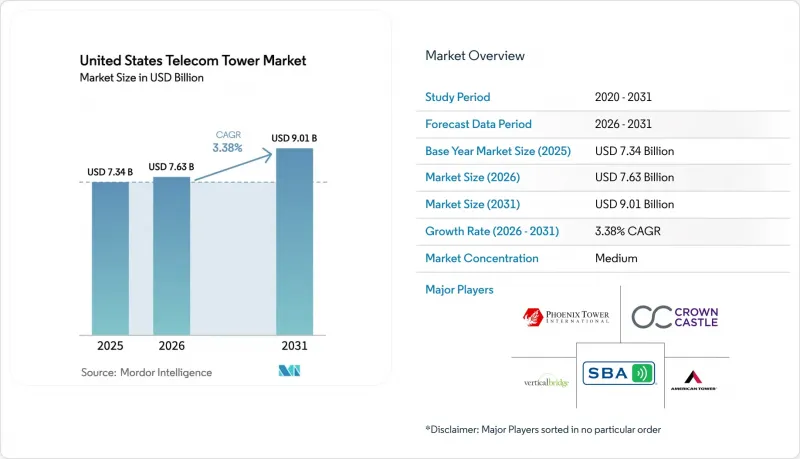
This report is Segmented by Fuel Type (Renewable, and Non-Renewable), Tower Type (Lattice Tower, Guyed Tower, Monopole Tower, and Stealth Tower), Installation (Rooftop, and Ground-Based), Ownership (Operator-Owned, Joint Venture, Private-Owned, and MNO Captive), and Geography. The Market Forecasts are Provided in Terms of Value (USD).
United States Telecom Tower Market Trends and Insights
Surging 5G Mid-Band and C-Band Densification Wave
Verizon's completion of 90% C-band coverage by late 2025 still leaves localized capacity gaps, leading the carrier to lease incremental space on thousands of macro sites. T-Mobile's deeper 2.5 GHz inventory requires fewer towers, creating an asymmetric competitive environment that is pressuring AT&T and Verizon to add tenants on existing structures rather than fund new builds. Carriers that secured 3.45-3.55 GHz licenses in Auction 110 must meet staged build-out milestones through 2027, embedding a second densification wave into tower-company revenue pipelines. Master lease amendments now include escalator clauses that step up rents as licensees light up additional radios, allowing owners to pull forward value. The densification push is most intense in the top urban corridors, where population density drives the economic case for a fourth or fifth tenant per structure.
Rapid Growth in Fixed-Wireless Access Subscriber Targets
Verizon reported 5.7 million fixed-wireless access lines at 2025 year-end, and management aims for 9 million by 2027, which implies thousands of incremental rooftop and monopole leases in exurban counties. NTIA's June 2025 decision to treat fixed-wireless solutions on par with fiber unlocked USD 42.45 billion in BEAD grants, accelerating carrier bids in high-cost rural territories. Tower companies have responded by optioning land parcels in eligible blocks months before state broadband offices finalize project awards, effectively pre-positioning assets for carrier tenancy. In Montana and Wyoming, where fiber passes can exceed USD 50,000 each, wireless proposals now win a majority of state scoring matrices, guaranteeing a medium-term leasing surge once grants convert to construction starts. The dynamic couples public capital with private tower real estate to close the rural digital divide.
Municipal Height Caps Below 150 Feet
Planning codes in cities such as San Francisco cap new towers at 40-65 feet, far below the 120-180 feet optimum for mid-band propagation, forcing carriers to rely on rooftop leases or small-cell nodes. Boulder enforces a 35-foot limit in historic districts, which raises rent premiums on stealth or rooftop alternatives by up to 70% compared with standard ground sites. Because the FCC's 2025 order preserved local authority on height and setback rules, this constraint persists indefinitely. Tower firms now deploy flagpole, church-steeple, and artificial-tree concealments, each adding USD 75,000-USD 150,000 to site costs, in exchange for zoning approval. The trade-off is unfavorable network geometry, since a 40-foot stealth site covers less than a half-mile radius, demanding many more locations to achieve the same footprint as a single monopole.
Other drivers and restraints analyzed in the detailed report include:
- Infrastructure Investment and Jobs Act Rural Broadband Grants
- Accelerated Tower Colocation to Offset Carrier Capex Constraints
- Elevated Cost of Capital with Fed Funds Greater Than 4.75 Percent
For complete list of drivers and restraints, kindly check the Table Of Contents.
Segment Analysis
Renewable-powered sites captured roughly 37.44% of the United States telecom tower market size in 2025 and are projected to grow at a 3.96% CAGR through 2031. American Tower has pledged to lift renewable penetration across its domestic footprint from 22% in 2024 to 60% by 2030, a plan that relies on thousands of solar-plus-battery retrofits. Crown Castle is converting 500 sites per year, chasing a similar emissions pathway and benefiting from falling lithium-ion battery costs, now under USD 150 per kilowatt-hour. Two barriers temper momentum. First, interconnection queues in California and Texas extend up to 24 months, delaying net-metered tie-ins that underpin project economics. Second, wildfire zones require additional permits for battery energy storage, adding another three to six months to build schedules. Despite these frictions, carriers are willing to pay 10%-15% rent premia on low-carbon towers to satisfy corporate sustainability scorecards, improving return profiles for portfolio owners. If Congress extends the 30% solar investment tax credit beyond 2032, the renewable share could accelerate past today's forecast band, lifting the overall United States telecom tower market growth above baseline projections.
Non-renewable systems, still dominant with 62.56% of 2025 deployments, will expand at a slower 3.38% rate. Diesel redundancy remains critical in cyclone-prone Gulf markets, and natural-gas micro-turbines offer cost advantages where utility power is cheap. Yet looming carbon disclosure rules issued by the Securities and Exchange Commission intensify pressure on carriers to migrate toward green energy sources. Over the forecast horizon, cost parity between diesel gensets and solar-battery hybrids is likely once fuel logistics premiums are considered, setting the stage for renewable solutions to gain incremental share each year. Thus, energy strategy stands as a competitive differentiator for tower owners courting sustainability-oriented tenants.
Monopole structures accounted for 59.62% of the United States telecom tower market share in 2025, thanks to 20-30 foot ground footprints that simplify land acquisition. Lattice towers remain the workhorse in rural areas where wind and ice loads challenge single-pole integrity, but their share sits near 25% and is flat to declining. Guyed designs, cheaper to erect yet land-intensive, concentrate in the Midwest and Plains states, representing roughly 10% of aggregate inventory. The growth standout is the stealth category, with a projected 4.37% CAGR to 2031. A single flagpole concealment costs USD 200,000-USD 300,000, roughly 60% above a standard monopole, yet municipalities approve these structures within six to nine months versus up to 18 months for non-concealed alternatives.
Dish Wireless illustrates the structural shift. Of its 18,000 Open RAN sites under construction as of late 2025, 60% leverage stealth or rooftop formats that rely on lighter radios and virtualized baseband units. Municipalities in California, Florida, and New York have codified aesthetic impact assessments that effectively mandate disguise solutions above 50 feet, accelerating take-up of modular kits featuring faux branches, shrouds, and bark panels. Because each stealth site covers a reduced radius, tower counts per square mile climb, inflating lease velocity for owner-operators. In affluent suburbs where property values drive fierce community opposition, carriers increasingly budget for higher concealment costs to secure regulatory certainty, cementing the segment's above-average growth pattern within the broader United States telecom tower market.
Complete Report Scope:
- By Fuel Type
- Renewable-powered
- Non-renewable-powered
- By Type of Tower
- Lattice Tower
- Guyed Tower
- Monopole Tower
- Stealth Tower
- By Installation
- Rooftop
- Ground-based
- By Ownership
- Operator-owned
- Joint Venture
- Private-owned
- MNO Captive
List of Companies Covered in this Report:
- TowerCos
- Mobile Network Operator
Additional Benefits:
- The market estimate (ME) sheet in Excel format
- 3 months of analyst support
TABLE OF CONTENTS
1 INTRODUCTION
- 1.1 Study Assumptions and Market Definition
- 1.2 Scope of the Study
2 RESEARCH METHODOLOGY
3 EXECUTIVE SUMMARY
4 MARKET LANDSCAPE
- 4.1 Market Overview
- 4.2 Market Drivers
- 4.2.1 Surging 5G Mid-Band and C-Band Densification Wave
- 4.2.2 Rapid Growth in Fixed-Wireless Access Subscriber Targets
- 4.2.3 Infrastructure Investment and Jobs Act Rural Broadband Grants
- 4.2.4 Accelerated Tower Colocation to Offset Carrier Capex Constraints
- 4.2.5 Extension of IRS Bonus Depreciation for Tower Upgrades (Section 168k)
- 4.2.6 FCC Pre-Emption of Excessive Local Siting Fees (NPRM WT-25-276)
- 4.3 Market Restraints
- 4.3.1 Municipal Height Caps Below 150 Feet
- 4.3.2 Elevated Cost of Capital with Fed Funds > 4.75 Percent
- 4.3.3 Section 232 Steel Tariffs Lifting Tower Fabrication Costs
- 4.3.4 Cable-MVNO CBRS Small-Cell Off-Load Reducing Macro Demand
- 4.4 Industry Value Chain Analysis
- 4.5 Regulatory Landscape Related to Telecom Infrastructure
- 4.6 Technological Outlook
- 4.7 Porter's Five Forces Analysis
- 4.7.1 Bargaining Power of Suppliers
- 4.7.2 Bargaining Power of Buyers
- 4.7.3 Threat of New Entrants
- 4.7.4 Threat of Substitutes
- 4.7.5 Intensity of Competitive Rivalry
5 MARKET SIZE AND GROWTH FORECASTS (VALUE)
- 5.1 By Fuel Type
- 5.1.1 Renewable-powered
- 5.1.2 Non-renewable-powered
- 5.2 By Type of Tower
- 5.2.1 Lattice Tower
- 5.2.2 Guyed Tower
- 5.2.3 Monopole Tower
- 5.2.4 Stealth Tower
- 5.3 By Installation
- 5.3.1 Rooftop
- 5.3.2 Ground-based
- 5.4 By Ownership
- 5.4.1 Operator-owned
- 5.4.2 Joint Venture
- 5.4.3 Private-owned
- 5.4.4 MNO Captive
6 COMPETITIVE LANDSCAPE
- 6.1 Market Concentration
- 6.2 Details of Major Mergers and Acquisitions
- 6.3 Market Share Analysis for Top Vendors
- 6.4 Company Profiles (includes Global Level Overview, Market Level Overview, Core Segments, Financials as available, Strategic Information, Market Rank/Share, Products and Services, Recent Developments)
- 6.4.1 TowerCos
- 6.4.1.1 American Tower Corporation
- 6.4.1.2 Crown Castle Inc.
- 6.4.1.3 SBA Communications Corporation
- 6.4.1.4 Vertical Bridge REIT LLC
- 6.4.1.5 Phoenix Tower International
- 6.4.2 Mobile Network Operator
- 6.4.2.1 Verizon Communications Inc.
- 6.4.2.2 AT&T Inc.
- 6.4.2.3 T-Mobile US Inc.
- 6.4.2.4 Dish Wireless LLC
- 6.4.1 TowerCos
7 MARKET OPPORTUNITIES AND FUTURE OUTLOOK
- 7.1 White-space and Unmet-need Assessment