|
시장보고서
상품코드
2125503
하드 디스크 드라이브(HDD) 시장 : 시장 점유율 분석, 업계 동향 및 통계, 성장 예측(2026-2031년)Hard Disk Drive (HDD) - Market Share Analysis, Industry Trends & Statistics, Growth Forecasts (2026 - 2031) |
||||||
 Mordor Intelligence
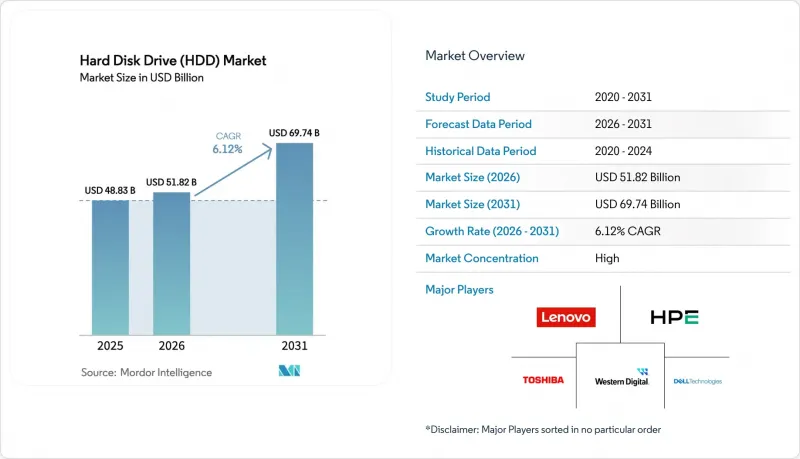
Mordor Intelligence에 의하면, 2026년 하드 디스크 드라이브(HDD) 시장 규모는 518억 2,000만 달러로 추정되고, 2025년 488억 3,000만 달러에서 확대해, 2031년에는 697억 4,000만 달러에 이를 것으로 예측됩니다.
2026-2031년 연평균 성장률(CAGR)은 6.12%를 나타낼 전망입니다.

본 보고서는 폼 팩터별(2.5인치, 3.5인치, 기타), 용도별(모바일·휴대용, 소비자용 데스크톱·게이밍, 기타), 저장 용량별(5TB), 인터페이스별(SATA, SAS, PCIe/NVMe), 최종 사용자 산업별(IT 및 통신, 기타), 기록 기술별(CMR/PMR, SMR, HAMR·에너지 어시스트 방식), 지역별로 분류되어 있습니다. 시장 예측은 금액(달러) 기준으로 제시되어 있습니다.
세계의 하드 디스크 드라이브(HDD) 시장 동향 및 인사이트
하이퍼스케일 및 클라우드 스토리지 용량에 대한 수요 증가
하이퍼스케일 데이터센터의 수는 2024년 말 기준 1,136개에 달하며, AI 가속기가 컴퓨팅 환경을 재구축함에 따라 2030년까지 3배로 증가할 것으로 예측됩니다. 스토리지 부문은 주요 클라우드 사업자의 2025년 설비 투자 계획의 약 5분의 1을 차지했으며, 콜드 티어 구축에서 하드 디스크 드라이브 시장의 우위를 점할 초대용량 랙에 수십억이 투입되고 있습니다. 웨스턴디지털(Western Digital)의 예측에 따르면, HDD 출하량(엑사바이트 기준)은 주로 HAMR에 의한 기록 밀도 향상에 힘입어 2024년부터 2028년까지 23% 성장할 것으로 전망됩니다. 미국은 하이퍼스케일 도입 용량의 54%를 차지하고 있지만, 현지 전력 제약으로 인해 테라바이트당 전력 소비 효율이 뛰어난 드라이브가 선호되고 있습니다. 현재 디스어그리게이트형 아키텍처를 통해 컴퓨팅과 스토리지가 분리되어 있으며, HDD가 방대한 콜드 데이터 풀을 처리하는 한편, SSD가 핫 데이터에 대한 액세스를 관리하고 있습니다.
니어라인 워크로드에서 SSD의 TB당 비용 우위
시게이트는 2024 회계연도에 출하한 398 엑사바이트의 드라이브에서 테라바이트당 15달러의 비용을 달성했다고 보고했으며, 엔터프라이즈용 SSD와의 비용 차이는 추정치로 2.5배를 유지하고 있습니다. 30테라바이트 용량대에서는 가격 차이가 약 3-4배로 확대되어, 비용 효율을 중시하는 콜드 데이터 계층에서 하드 디스크 드라이브 시장의 우위를 공고히 하고 있습니다. 각 플래시 메모리 제조업체들은 3D NAND의 미세화를 통해 1테라바이트당 비용을 지속적으로 낮추고 있지만, 수명 및 쓰기 비용의 제약으로 인해 순차 처리가 중심이 되는 워크로드에서는 드라이브가 총 소유 비용(TCO) 측면에서 여전히 유리합니다. 기업의 구매 담당자들은 지출과 서비스 수준 목표를 최적화하기 위해 고성능 SSD 계층과 대규모 HDD 용량 풀을 결합한 하이브리드 전략을 점점 더 명확하게 제시하고 있습니다.
SSD 1TB당 단가의 급격한 하락과 엔터프라이즈용 플래시의 TCO 우위
각 플래시 벤더들은 현재 232층 3D NAND를 생산하고 있으며, 분기마다 비트당 단가를 낮추고 있습니다. 퓨어 스토리지(Pure Storage)가 하이퍼스케일러 기업으로부터 수주한 사례는 에너지, 냉각, 설치 공간 절약을 종합적으로 고려했을 때, 플래시가 매력적인 총소유비용(TCO)을 실현하는 시나리오를 여실히 보여주고 있습니다. 61.44TB 엔터프라이즈용 SSD의 등장은 가격이 비싸긴 하지만, 용량 측면에서의 수렴을 시사하고 있습니다. QLC NAND는 비트당 단가를 더욱 낮출 것으로 기대되지만, 수명 제한으로 인해 이러한 제품은 읽기 중심 워크로드로만 제한됩니다. 기업 구매 담당자들이 종합적인 조달 관점을 채택하는 경향이 강해지는 가운데, HDD는 플래시가 비용 격차를 좁히는 속도를 능가하는 속도로 용량을 지속적으로 향상시켜야 합니다.
부문 분석
3.5인치 제품은 2025년에 매출의 65.62%를 차지했으며, 2031년까지 연평균 성장률(CAGR) 9.29%로 하드 디스크 드라이브 시장 전체를 상회하는 성장을 보일 것으로 전망됩니다. 대형 플랫터 덕분에 랙당 기가바이트 수라는 지표에서 뛰어난 성능을 발휘하며, 바닥 면적당 가격을 1제곱피트당 수천 달러로 추산하는 하이퍼스케일 사업자에게 매우 중요합니다. 3.5인치 제품의 하드 디스크 드라이브 시장 규모는 2031년까지 452억 달러를 넘어설 것으로 예측됩니다. HAMR 및 UltraSMR 기술의 발전으로 공급업체들은 동일한 섀시에서 40TB를 구현하는 로드맵을 수립할 수 있게 되어, 이 부문의 규모의 경제가 강화되고 있습니다.
더 작은 2.5인치 드라이브는 노트북이나 소형 서버용으로 제공되고 있지만, SSD로의 대체가 진행 중이어서 성장 전망은 제한적입니다. 1.8인치 미만의 폼 팩터는 틈새 시장인 가전제품이나 산업용 기기에 채택되고 있습니다. 3.5인치 플랫폼을 채택한 고밀도 JBOD 섀시는 더 적은 스핀들 수로 엑사바이트 규모의 목표를 달성할 수 있기 때문에 콜드 티어 아키텍처에서 비용 면에서의 우위를 유지하고 있습니다. 시게이트가 최근 일본 시장에서 20TB 및 24TB BarraCuda 제품을 소비자용 가격대로 출시한 것은 대용량 3.5인치 제품에 대한 지속적인 투자를 뒷받침하는 것입니다.
니어라인 엔터프라이즈 환경은 2025년 출하 대수의 44.10%를 차지했으며, 연평균 성장률(CAGR) 9.52%를 나타낼 것으로 예측되어, 주요 워크로드 중 가장 높은 성장률을 보이고 있습니다. 클라우드 아키텍트는 확대되는 AI 훈련 세트를 저비용 고밀도 계층으로 통합하고 있으며, 이로 인해 하드 디스크 드라이브(HDD) 시장은 페타바이트 규모의 클러스터에서 계속해서 중심적인 위치를 차지하고 있습니다. 니어라인 용도에서 HDD 시장 점유율은 맥킨지가 예측한 콜드 데이터의 급증에 힘입고 있으며, 이는 HDD의 순차 쓰기 및 경제적인 저장이라는 강점과 부합합니다.
소비자용 데스크톱 PC와 게이밍 PC는 꾸준히 SSD로 전환되고 있으며, 1TB 미만의 엔트리 모델에 대한 수요는 감소하고 있습니다. 한편, 모니터링용 어레이와 NAS 장치는 쓰기 패턴과 용량 요구 사항이 자기 매체에 적합하기 때문에 견조한 수요를 유지하고 있습니다. 엔터프라이즈 데이터센터 팀은 SSD와 HDD가 공존하는 디스어그리게이션 모델을 계속 도입하고 있으며, 향후 10년 동안 니어라인 계층이 엑사바이트 단위로 가장 큰 절대적 성장률을 보일 것으로 예측됩니다.
지역별 분석
아시아태평양은 2025년에 전 세계 매출의 36.10%를 차지했으며, 2031년까지 연평균 성장률(CAGR) 6.84%로 성장할 전망입니다. 중국과 일본은 하이퍼스케일 시설의 확대와 국내 OEM 출하를 통해 지역 수요를 뒷받침하고 있으며, 태국은 2024년 8월 웨스턴디지털의 6억 9,300만 달러 규모의 확장 계획이 승인됨에 따라 계속해서 제조 거점으로서의 위상을 유지하고 있습니다. 인도의 경우, 전자상거래 및 재택근무 추세가 지속됨에 따라 2024년 2분기 출하 대수는 전분기 대비 12% 증가했습니다. 말레이시아의 170억 달러 규모 데이터센터 및 모니터링 프로그램을 포함한 동남아시아 전역의 스마트 시티 예산으로 인해, 이 지역의 엑사바이트 규모 수요가 더욱 높아지고 있습니다.
북미는 두 번째로 큰 시장 규모를 자랑하며, 설치된 클라우드 용량의 54%를 차지하는 미국의 하이퍼스케일 사업자에 의해 주도되고 있습니다. 무역 정책으로 인한 역풍이 비용 불확실성을 초래하고 있지만, 제안된 우대 조치는 국내 조립을 촉진하고 공급망 단축으로 이어질 가능성이 있습니다. 버지니아주의 데이터센터 회랑 주변에서 전력망 제약이 심화됨에 따라, 설계자들은 테라바이트당 전력 소비 효율을 중시하게 되었으며, 이로 인해 올플래시 어레이보다 하드 디스크 드라이브(HDD) 시장이 유리한 상황을 맞이하고 있습니다. 캐나다와 멕시코는 부지, 재생 가능 전력, 국경 간 물류 측면에서 우위를 제공함으로써 지원적인 역할을 수행하고 있습니다.
유럽에서는 엄격한 데이터 주권 요건 속에서도 기업의 업데이트 주기가 일관되게 유지되고 있습니다. 독일과 영국에서는 규정 준수상의 보존 기간 요건을 충족하기 위해 콜드 티어 클러스터가 도입되고 있는 반면, 프랑스에서는 공공 부문의 클라우드 워크로드가 확대되고 있습니다. 이 지역의 순환 경제에 대한 집중은 벤더의 재활용 프로그램과 맞물려 있으며, 예를 들어 웨스턴디지털은 2024년에 5만 파운드의 폐드라이브에서 희토류 원소를 회수할 예정입니다. 장기적인 탄소세 논의가 기록 기술 선택에 영향을 미칠 가능성이 있습니다. HDD 제조업체들은 경쟁 스토리지 매체에 비해 전체 수명 주기 동안의 CO₂ 배출량이 적다는 점을 강조하고 있습니다.
기타 혜택
- 엑셀 형식 시장 예측(ME) 시트
- 3개월간의 애널리스트 지원
자주 묻는 질문
목차
제1장 서론
제2장 조사 방법
제3장 주요 요약
제4장 시장 구도
제5장 시장 규모 및 성장 예측
제6장 경쟁 구도
제7장 시장 기회 및 향후 전망
AJY 26.09.15According to Mordor Intelligence, hard disk drive market size in 2026 is estimated at USD 51.82 billion, growing from 2025 value of USD 48.83 billion with 2031 projections showing USD 69.74 billion, growing at 6.12% CAGR over 2026-2031.
This report is Segmented by Form Factor (2. 5-Inch, 3. 5-Inch, Others), Application (Mobile/Portable, Consumer Desktop and Gaming, and More), Storage Capacity (5TB), Interface (SATA, SAS, PCIe/NVMe), End-User Industry (IT and Telecommunications, and More), Recording Technology (CMR/PMR, SMR, HAMR and Energy-Assisted), and Geography. The Market Forecasts are Provided in Terms of Value (USD).
Global Hard Disk Drive (HDD) Market Trends and Insights
Rising Demand for Hyperscale and Cloud Storage Capacity
Hyperscale data-center count reached 1,136 at year-end 2024 and is projected to triple by 2030 as AI accelerators reshape computing footprints. Storage represents roughly one-fifth of the 2025 capex plans of major cloud operators, channeling billions into very-large-capacity racks that favor the Hard Disk Drive market for cold-tier deployments. Exabyte shipments of HDDs are forecast by Western Digital to grow at 23% between 2024 and 2028, driven primarily by HAMR-enabled density gains. The United States holds 54% of installed hyperscale capacity, yet local power constraints reward drives that deliver superior watts-per-terabyte performance. Disaggregated architectures now separate compute from storage, letting HDDs handle vast cold data pools while SSDs manage hot data access.
Cost/TB Advantage Over SSDs in Near-line Workloads
Seagate reported achieving USD 15 per terabyte across 398 exabytes shipped in fiscal 2024, preserving an estimated 2.5X cost gap against enterprise SSDs. At 30 TB capacity points, the price delta widens to roughly 3-4X, reinforcing the Hard Disk Drive market in cost-sensitive cold-data tiers. Flash manufacturers continue lowering dollars-per-terabyte through 3D NAND scaling, yet endurance and write-cost constraints keep total-cost-of-ownership favorable to drives for sequential-heavy workloads. Enterprise buyers increasingly articulate hybrid strategies that blend high-performance SSD tiers with large pools of HDD capacity to optimize spend and service-level objectives.
Rapid SSD $/TB Declines and Enterprise Flash TCO Gains
Flash vendors now produce 232-layer 3D NAND, pushing bit costs lower each quarter. Pure Storage's design wins at hyperscalers highlight scenarios where flash achieves compelling total cost when energy, cooling, and floor space savings are lumped into the equation. The arrival of 61.44 TB enterprise SSDs signals capacity convergence, albeit at a premium price. QLC NAND promises further dollar-per-bit gains, yet endurance constraints confine such products to read-heavy workloads. As corporate buyers increasingly adopt a holistic procurement lens, HDDs must continue to elevate capacity faster than flash narrows its cost gap.
Other drivers and restraints analyzed in the detailed report include:
- Growth of Video-Surveillance Data for Smart-City Roll-outs
- AI-Driven Cold-Data Tiering Adoption
- Extreme Supplier Concentration and Supply-Chain Shocks
For complete list of drivers and restraints, kindly check the Table Of Contents.
Segment Analysis
3.5-inch units delivered 65.62% revenue in 2025, outpacing the overall Hard Disk Drive market with a 9.29% CAGR to 2031. Their large platters enable superior gigabytes-per-rack metrics, critical for hyperscale operators that price floor space in thousands of dollars per square foot. The Hard Disk Drive market size for 3.5-inch products is projected to eclipse USD 45.2 billion by 2031. HAMR and UltraSMR advances let vendors roadmap 40 TB on the same envelope, reinforcing the segment's scale economics.
Smaller 2.5-inch drives cater to notebooks and compact servers but face SSD substitution, limiting growth prospects. Sub-1.8-inch form factors occupy niche consumer electronics and industrial gear. High-density JBOD chassis relying on 3.5-inch platforms retain cost leadership in cold-tier architectures because fewer spindles meet exabyte targets. Seagate's recent Japan launch of 20 TB and 24 TB BarraCuda SKUs at consumer-friendly pricing underscores continued investment in the high-capacity 3.5-inch roadmap.
Near-line enterprise environments garnered 44.10% of 2025 shipments and will grow at a 9.52% CAGR, the fastest among major workloads. Cloud architects funnel expanding AI training sets onto low-cost, high-density tiers, keeping the Hard Disk Drive market central to petabyte-scale clusters. The Hard Disk Drive market share for near-line roles benefits from the cold-data swell forecast by McKinsey, which aligns with drives' sequential write and economical retention strengths.
Consumer desktop and gaming PCs move steadily to SSD, trimming unit demand for entry drives below 1 TB. Surveillance arrays and NAS devices remain resilient because write patterns and capacity needs suit magnetic media. Enterprise data-center teams continue adopting disaggregated models where SSD and HDD coexist, but the near-line layer commands the highest absolute exabyte growth through the decade.
Complete Report Scope:
- By Form Factor
- 2.5-inch
- 3.5-inch
- Others (<1.8-inch, Enterprise JBOD)
- By Application
- Mobile/Portable
- Consumer Desktop and Gaming
- NAS and SOHO
- Enterprise and Data-Center
- Near-line / Cold-Data
- Surveillance and Smart-City
- By Storage Capacity
- <1 TB
- 1 - 3 TB
- 3 - 5 TB
- >5 TB
- By Interface
- SATA
- SAS
- PCIe / NVMe (U.2, U.3)
- By End-User Industry
- IT and Telecommunications
- Consumer Electronics OEMs
- Cloud and Hyperscale Providers
- Industrial and Video-Surveillance
- Government and Defence
- By Recording Technology
- CMR / PMR
- SMR
- HAMR and Energy-Assisted
- By Geography
- North America
- United States
- Canada
- Mexico
- Europe
- Germany
- United Kingdom
- France
- Russia
- Rest of Europe
- Asia-Pacific
- China
- Japan
- India
- South Korea
- Australia
- Rest of Asia-Pacific
- Middle East and Africa
- Middle East
- Saudi Arabia
- United Arab Emirates
- Rest of Middle East
- Africa
- South Africa
- Egypt
- Rest of Africa
- Middle East
- South America
- Brazil
- Argentina
- Rest of South America
- North America
Geography Analysis
Asia-Pacific commanded 36.10% of global revenue in 2025 and is growing at a 6.84% CAGR through 2031. China and Japan anchor regional demand through hyperscale build-outs and domestic OEM shipments, while Thailand continues as a manufacturing hub with Western Digital's USD 693 million expansion approved in August 2024. India's retail drive volumes expanded 12% quarter-over-quarter in Q2 2024 as e-commerce and home-office trends persisted. Smart-city budgets across Southeast Asia, including Malaysia's USD 17 billion data-center and surveillance programs, intensify regional exabyte uptake.
North America is the second-largest territory, propelled by U.S. hyperscale operators that hold 54% of installed cloud capacity. Trade-policy headwinds inject cost uncertainty, though proposed incentives encourage domestic assembly that could shorten supply chains. Growing power-grid constraints around Virginia's data-center corridor steer architects toward watts-per-terabyte efficiencies that favor the Hard Disk Drive market versus all-flash arrays. Canada and Mexico play supportive roles by providing land, renewable electricity, and cross-border logistics advantages.
Europe maintains consistent enterprise replacement cycles amid stringent data-sovereignty mandates. Germany and the United Kingdom deploy cold-tier clusters to meet compliance retention windows, while France expands public-sector cloud workloads. The region's circular-economy focus dovetails with vendor recycling programs, such as Western Digital's recovery of rare-earth elements from 50,000 pounds of retired drives in 2024. Long-term carbon tax discussions may influence recording-technology choices as HDD makers showcase lower lifecycle CO2 than competing storage media.
- Western Digital Corporation
- Toshiba Electronic Devices & Storage Corporation
- Hewlett Packard Enterprise Company
- Dell Technologies Inc.
- Lenovo Group Limited
- Huawei Technologies Co., Ltd.
- Transcend Information Inc.
- ADATA Technology Co., Ltd.
- Buffalo Inc.
- Nidec Corporation
- Showa Denko K.K.
- Hoya Corporation
- NetApp Inc.
- Pure Storage Inc.
- Samsung Electronics Co., Ltd. (external HDD brand)
- Micron Technology Inc. (external storage systems)
- Violin Systems LLC
- Synology Inc.
- QNAP Systems Inc.
- LaCie S.A.S. (Seagate brand)
Additional Benefits:
- The market estimate (ME) sheet in Excel format
- 3 months of analyst support
TABLE OF CONTENTS
1 INTRODUCTION
- 1.1 Study Assumptions and Market Definition
- 1.2 Scope of the Study
2 RESEARCH METHODOLOGY
3 EXECUTIVE SUMMARY
4 MARKET LANDSCAPE
- 4.1 Market Overview
- 4.2 Market Drivers
- 4.2.1 Rising demand for hyperscale and cloud storage capacity
- 4.2.2 Cost/TB advantage over SSDs in near-line workloads
- 4.2.3 Growth of video-surveillance data for smart-city roll-outs
- 4.2.4 AI-driven cold-data tiering adoption
- 4.2.5 Large-capacity HAMR roadmap up to 50 TB drives
- 4.2.6 Circular-economy recycling programs lowering BOM costs
- 4.3 Market Restraints
- 4.3.1 Rapid SSD $/TB declines and enterprise flash TCO gains
- 4.3.2 Extreme supplier concentration and supply-chain shocks
- 4.3.3 Prospective carbon taxes on energy-intensive HDD output
- 4.3.4 Rack-density limits favouring flash-based architectures
- 4.4 Value / Supply-Chain Analysis
- 4.5 Regulatory Landscape
- 4.6 Technological Outlook
- 4.7 Porter's Five Forces Analysis
- 4.7.1 Threat of New Entrants
- 4.7.2 Bargaining Power of Buyers
- 4.7.3 Bargaining Power of Suppliers
- 4.7.4 Threat of Substitutes
- 4.7.5 Intensity of Competitive Rivalry
- 4.8 Macroeconomic Impact Assessment
5 MARKET SIZE AND GROWTH FORECASTS (VALUE)
- 5.1 By Form Factor
- 5.1.1 2.5-inch
- 5.1.2 3.5-inch
- 5.1.3 Others (<1.8-inch, Enterprise JBOD)
- 5.2 By Application
- 5.2.1 Mobile/Portable
- 5.2.2 Consumer Desktop and Gaming
- 5.2.3 NAS and SOHO
- 5.2.4 Enterprise and Data-Center
- 5.2.5 Near-line / Cold-Data
- 5.2.6 Surveillance and Smart-City
- 5.3 By Storage Capacity
- 5.3.1 <1 TB
- 5.3.2 1 - 3 TB
- 5.3.3 3 - 5 TB
- 5.3.4 >5 TB
- 5.4 By Interface
- 5.4.1 SATA
- 5.4.2 SAS
- 5.4.3 PCIe / NVMe (U.2, U.3)
- 5.5 By End-User Industry
- 5.5.1 IT and Telecommunications
- 5.5.2 Consumer Electronics OEMs
- 5.5.3 Cloud and Hyperscale Providers
- 5.5.4 Industrial and Video-Surveillance
- 5.5.5 Government and Defence
- 5.6 By Recording Technology
- 5.6.1 CMR / PMR
- 5.6.2 SMR
- 5.6.3 HAMR and Energy-Assisted
- 5.7 By Geography
- 5.7.1 North America
- 5.7.1.1 United States
- 5.7.1.2 Canada
- 5.7.1.3 Mexico
- 5.7.2 Europe
- 5.7.2.1 Germany
- 5.7.2.2 United Kingdom
- 5.7.2.3 France
- 5.7.2.4 Russia
- 5.7.2.5 Rest of Europe
- 5.7.3 Asia-Pacific
- 5.7.3.1 China
- 5.7.3.2 Japan
- 5.7.3.3 India
- 5.7.3.4 South Korea
- 5.7.3.5 Australia
- 5.7.3.6 Rest of Asia-Pacific
- 5.7.4 Middle East and Africa
- 5.7.4.1 Middle East
- 5.7.4.1.1 Saudi Arabia
- 5.7.4.1.2 United Arab Emirates
- 5.7.4.1.3 Rest of Middle East
- 5.7.4.2 Africa
- 5.7.4.2.1 South Africa
- 5.7.4.2.2 Egypt
- 5.7.4.2.3 Rest of Africa
- 5.7.4.1 Middle East
- 5.7.5 South America
- 5.7.5.1 Brazil
- 5.7.5.2 Argentina
- 5.7.5.3 Rest of South America
- 5.7.1 North America
6 COMPETITIVE LANDSCAPE
- 6.1 Market Concentration
- 6.2 Strategic Moves
- 6.3 Market Share Analysis
- 6.4 Company Profiles (includes Global level Overview, Market level overview, Core Segments, Financials as available, Strategic Information, Market Rank/Share, Products and Services, Recent Developments)
- 6.4.1 Western Digital Corporation
- 6.4.2 Toshiba Electronic Devices & Storage Corporation
- 6.4.3 Hewlett Packard Enterprise Company
- 6.4.4 Dell Technologies Inc.
- 6.4.5 Lenovo Group Limited
- 6.4.6 Huawei Technologies Co., Ltd.
- 6.4.7 Transcend Information Inc.
- 6.4.8 ADATA Technology Co., Ltd.
- 6.4.9 Buffalo Inc.
- 6.4.10 Nidec Corporation
- 6.4.11 Showa Denko K.K.
- 6.4.12 Hoya Corporation
- 6.4.13 NetApp Inc.
- 6.4.14 Pure Storage Inc.
- 6.4.15 Samsung Electronics Co., Ltd. (external HDD brand)
- 6.4.16 Micron Technology Inc. (external storage systems)
- 6.4.17 Violin Systems LLC
- 6.4.18 Synology Inc.
- 6.4.19 QNAP Systems Inc.
- 6.4.20 LaCie S.A.S. (Seagate brand)
7 Market Opportunities & Future Outlook
- 7.1 White-space & Unmet-need Assessment