

|
시장보고서
상품코드
2125604
북미의 우편 서비스 시장 : 시장 점유율 분석, 산업 동향 및 통계 데이터, 성장 예측(2026-2031년)North America Postal Services - Market Share Analysis, Industry Trends & Statistics, Growth Forecasts (2026 - 2031) |
||||||
 Mordor Intelligence
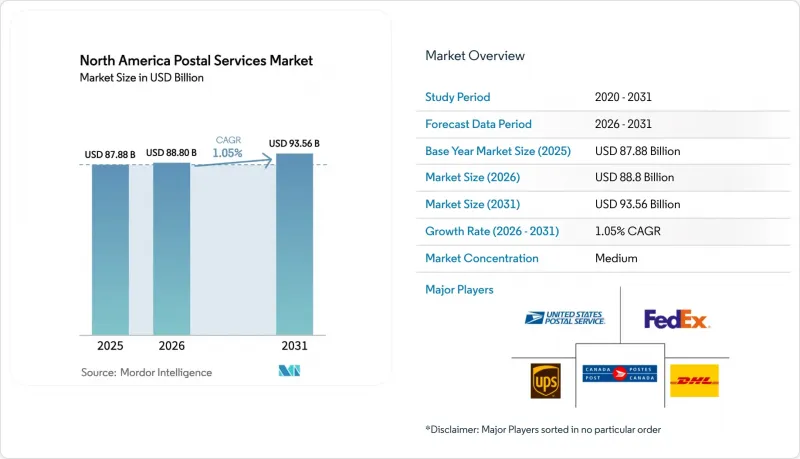
Mordor Intelligence에 의하면, 2026년 북미 우편 서비스 시장 규모는 888억 달러로 추정되고, 2025년 878억 8,000만 달러에서 확대해, 2031년에는 935억 6,000만 달러에 이를 것으로 예측됩니다.
2026-2031년 연평균 성장률(CAGR) 1.05%로 성장할 것으로 전망됩니다.
본 보고서에서는 업계를 유형별(일반 우편 서비스, 속달 우편 서비스), 품목별(서신, 소포), 배송지별(국내, 국제), 최종 사용자별(B2B, B2C 등), 배송 수단별(육상, 항공 등), 국가별(미국 등)로 분류하고 있습니다. 시장 전망은 금액(달러) 기준으로 제시되어 있습니다.
북미의 우편 서비스 시장 동향 및 인사이트
당일 배송 수요에 힘입은 전자상거래 소포 처리량의 급증
2023년, 미국의 소포 처리량은 217억 개에 달한 것으로 평가되었으며, 2029년까지 290억 개로 증가할 것으로 전망되어, 우편 사업자들은 우편 배달 노선보다 소포 처리 능력을 우선시할 수밖에 없는 상황에 몰리고 있습니다. 온라인 쇼핑을 이용하는 소비자에게 신뢰성이 구매의 중요한 판단 기준이 되고 있기 때문에 각 사업자는 현재 초고속 배송 약속보다 2-3일이라는 예측 가능한 배송 기간을 중시하는 추세입니다. USPS(미국 우정공사)는 2024년 연말 성수기를 대비해 일일 처리 능력을 약 6,000만 개로 늘렸습니다. 이는 소포 중심의 네트워크로의 영구적인 전환을 반영한 것입니다.
미국 내 중소기업의 하이브리드 우편 및 주문 처리 API 도입
USPS 및 민간 운송업체가 제공하는 통합이 용이한 배송 API에 힘입어, 현재 중소기업은 미국 전체 우편 처리량의 28.9%를 차지하고 있습니다. 2024년에 출시된 Web Tools 업데이트를 통해 종단 간 추적 기능과 통합된 통관 데이터가 추가되어, 소규모 사업자도 전자상거래 대시보드에서 직접 규정 준수 라벨을 인쇄할 수 있게 되었습니다. 이러한 디지털 브릿지를 통해 엔터프라이즈 수준의 물류 기능이 널리 이용 가능해졌으며, 네트워크 전반에 걸쳐 수익성이 높은 물동량이 유지되고 있습니다.
미국 정부 기관의 디지털 전환에 따른 퍼스트 클래스 우편 처리량 감소
퍼스트 클래스 우편 처리량은 2008 회계연도부터 2023 회계연도에 걸쳐 50% 감소하여, USPS에게 가장 수익성이 높은 수입원 중 하나가 침식되고 있습니다. 과거에 세금 고지서나 급여 명세서를 우편으로 발송하던 정부 기관들도 현재는 디지털 전달을 표준화하고 있어, 수익에 대한 압박이 더욱 심화되고 있습니다. 소포 수입이 증가했음에도 불구하고, USPS는 2023 회계연도에 65억 달러의 순손실을 기록했으며, 종이 매체 통신물의 추가적인 감소는 보편적 서비스 의무의 자금 조달을 위협하고 있습니다.
부문별 분석
특급 배송 서비스는 2026-2031년 연평균 성장률(CAGR) 3.55%를 기록하며 시장 전체 성장률을 상회할 전망입니다. 이는 기업들이 예측 가능한 배송 시간대에 대해 프리미엄 요금을 지불함으로써 얻는 이점 덕분입니다. 택배 업체의 생산자물가지수(PPI)가 지속적으로 상승하고 있는 것은 수요가 지속되고 있음을 뒷받침하며, 주요 사업자들은 수거 마감 시간 연장 및 배송 완료 시간 조기화를 통해 시간 지정 배송 경로를 강화하고 있습니다.
표준 서비스는 대상 고객 기반이 가장 넓은 서비스이지만, 장기적인 우편물 감소 추세에 직면해 있습니다. 그러나 전국적인 배송 네트워크를 확립해야 하는 보편적 서비스 의무 덕분에 2025년에도 북미 우편 서비스 시장 점유율의 62.85%를 차지했습니다. USPS는 기준을 재검토하여 퍼스트 클래스 우편물의 75%가 1-5일의 배송 기간을 유지하고, 14%가 더 신속한 서비스를 받을 수 있도록 함으로써 약속과 실제 운송 흐름을 일치시키고 있습니다.
2025년, 소포는 58.05%의 점유율을 차지하며 북미 우편 서비스 시장 수익의 대부분을 창출했습니다. 각 사업자는 기계화된 분류를 확대하고, 편지 처리 시설에서 소포 처리 라인으로 인력을 재배치함으로써 성수기에도 개당 처리 시간을 불과 20초까지 단축할 수 있게 되었습니다. 북미 우편 서비스 시장 중 소포 사업과 관련된 시장 규모는 초대형 가정용품이나 온도 관리가 필요한 식료품 등 확대되는 전자상거래 품목군을 배경으로 연평균 성장률(CAGR) 3.65%를 나타낼 것으로 예측됩니다.
대조적으로, 편지 처리량은 감소 추세를 이어가고 있습니다. 2008-2023년 퍼스트 클래스 우편 처리량은 절반으로 줄었고, 이에 따라 북미 우편 서비스 시장에서 편지의 점유율도 하락했습니다. 그럼에도 불구하고, 법률 문서, 선거 관련 자료, 직접 메일을 통한 마케팅 등은 여전히 수요를 유지하고 있어, 잔여 수익성을 확보하기 위한 고속 편지 분류 기술에 대한 선택적 투자를 뒷받침하고 있습니다.
기타 혜택 :
- Excel 형식 시장 예측(ME) 시트
- 3개월간의 애널리스트 지원
자주 묻는 질문
목차
제1장 서론
제2장 분석 방법
제3장 주요 요약
제4장 시장 구도
제5장 시장 규모 및 성장률 예측
제6장 경쟁 구도
제7장 시장 기회 및 향후 전망
AJY 26.09.15According to Mordor Intelligence, North America postal services market size market size in 2026 is estimated at USD 88.8 billion, growing from 2025 value of USD 87.88 billion with 2031 projections showing USD 93.56 billion, growing at 1.05% CAGR over 2026-2031.
This report Segments the Industry Into by Type (Standard Postal Services and Express Postal Services), by Items (Letters and Parcels), by Destination (Domestic and International), by End-User (Business-To-Business (B2B), Business-To-Consumer (B2C) and More), by Delivery Mode (Road, Air and More) and by Country (United States, and More). The Market Forecasts are Provided in Terms of Value (USD).
North America Postal Services Market Trends and Insights
E-commerce Parcel Volume Boom Driven by Same-Day Delivery Demands
Parcel traffic reached 21.7 billion pieces in the United States during 2023 and is projected to climb toward 29 billion by 2029, adding pressure on postal operators to prioritise parcel capacity over letter routes. Operators are now favouring predictable two-to-three-day windows over ultra-fast promises because reliability has become the key buying criterion for online shoppers. USPS upgraded seasonal processing to about 60 million parcels per day for the 2024 holiday peak, reflecting a permanent shift toward parcel-centric networks.
SMB Adoption of Hybrid Mail & Fulfilment APIs in the United States
Small and midsize businesses now contribute 28.9% of total U.S. postal volume, catalysed by easy-to-integrate shipping APIs offered by USPS and private carriers. Web Tools updates released during 2024 add end-to-end tracking and harmonised customs data, enabling even micro-merchants to print compliant labels directly from e-commerce dashboards. This digital bridge is democratising enterprise-grade logistics capabilities and sustaining higher-margin traffic across the network.
First-Class Mail Volume Decline from Digital Substitution in U.S. Government Agencies
First-Class Mail fell by 50% between FY 2008 and FY 2023, eroding one of USPS's most profitable revenue streams. Government bodies that once mailed tax notices and benefits statements are now defaulting to digital delivery, deepening revenue pressure. Even with higher parcel income, USPS posted a USD 6.5 billion net loss in FY 2023, and further declines in physical correspondence threaten funding for universal-service mandates.
Other drivers and restraints analyzed in the detailed report include:
- U.S. Postal Service's Network Modernization Increasing Processing Capacity
- Canada Post's Parcel Expansion Hubs Enhancing Cross-Border Reach
- Chronic Labor Shortages & Rising Union Wage Pressures at National Posts
For complete list of drivers and restraints, kindly check the Table Of Contents.
Segment Analysis
Express services recorded a 3.55% CAGR for 2026-2031, surpassing overall market momentum. The benefits from premium pricing as businesses pay for predictable arrival windows. Continuous Producer Price Index gains for couriers confirm sustained demand, and major operators bolster time-definite lanes with later cut-offs and earlier clearances.
Standard services, although covering the broadest addressable base, wrestle with secular mail decline. Yet they still commanded 62.85% of the North America postal services market share in 2025 due to universal-service obligations that entrench nationwide delivery networks. USPS is recalibrating standards so 75% of First-Class Mail maintains a 1-5-day window and 14% gains faster service, aligning commitments with real-world transport flows.
Parcels held 58.05% share in 2025, generating the lion's share of revenue for the North America postal services market. Operators expanded mechanised sortation and shifted labour from letter plants to parcel lanes, enabling single-piece handling rates as low as 20 seconds per unit during peak periods. The North America postal services market size tied to parcel business is forecast to grow at 3.65% CAGR on the back of expanding e-commerce categories such as oversized home goods and temperature-controlled groceries.
Letter volumes, in contrast, continue their downtrend. Between 2008 and 2023, First-Class Mail halved, and the North America postal services market share for letters slipped accordingly. Still, legal documents, voter materials, and direct-mail marketing keep a rump demand that supports selective investments in high-speed letter sorting technology meant to safeguard remaining profitability.
Complete Report Scope:
- By Type
- Standard Postal Services
- Express Postal Services
- By Item
- Letters
- Parcels
- By Destination
- Domestic
- International
- By End-User
- Business-to-Business (B2B)
- Business-to-Consumer (B2C)
- Consumer-to-Consumer (C2C)
- By Delivery Mode
- Road
- Air
- Sea
- Rail
- By Country
- United States
- Canada
- Mexico
List of Companies Covered in this Report:
- United States Postal Service (USPS)
- Canada Post Corporation
- FedEx Corporation
- United Parcel Service Inc. (UPS)
- Deutsche Post DHL Group (DHL Express)
- Purolator Inc.
- OnTrac Logistics
- LaserShip / OnTrac Group
- Pitney Bowes Inc.
- Stamps.com (Auctane)
- Correos de Mexico (SEPOMEX)
- SCI Group
- Spee-Dee Delivery Service
- GLS-US (formerly GSO)
- RR Donnelley Logistics
- Neopost (Quadient)
- Sendle USA
- ShipBob Inc.*
Additional Benefits:
- The market estimate (ME) sheet in Excel format
- 3 months of analyst support
TABLE OF CONTENTS
1 Introduction
- 1.1 Study Assumptions & Market Definition
- 1.2 Scope of the Study
2 Research Methodology
3 Executive Summary
4 Market Landscape
- 4.1 Market Overview
- 4.2 Market Drivers
- 4.2.1 E-commerce Parcel Volume Boom Driven by Same-Day Delivery Demands
- 4.2.2 SMB Adoption of Hybrid Mail & Fulfilment APIs in the United States
- 4.2.3 U.S. Postal Service's Network Modernization Increasing Processing Capacity
- 4.2.4 Canada Post's Parcel Expansion Hubs Enhancing Cross-Border Reach
- 4.2.5 Mexico's Logistics-Park Near-shoring Surge Raising Mailroom Outsourcing
- 4.2.6 State-Level Sustainability Mandates Accelerating Fleet Electrification
- 4.3 Market Restraints
- 4.3.1 First-Class Mail Volume Decline from Digital Substitution in U.S. Gov. Agencies
- 4.3.2 Chronic Labor Shortages & Rising Union Wage Pressures at National Posts
- 4.3.3 Airport & Border Capacity Bottlenecks Slowing Cross-Border Parcel Flows
- 4.3.4 Mexican Rural Addressing Gaps Increasing Last-Mile Delivery Costs
- 4.4 Value / Supply-Chain Analysis
- 4.5 Regulatory Outlook
- 4.6 Technological Outlook
- 4.7 Porter's Five Forces
- 4.7.1 Competitive Rivalry
- 4.7.2 Bargaining Power of Buyers
- 4.7.3 Bargaining Power of Suppliers
- 4.7.4 Threat of Substitutes
- 4.7.5 Threat of New Entrants
5 Market Size & Growth Forecasts (Value)
- 5.1 By Type
- 5.1.1 Standard Postal Services
- 5.1.2 Express Postal Services
- 5.2 By Item
- 5.2.1 Letters
- 5.2.2 Parcels
- 5.3 By Destination
- 5.3.1 Domestic
- 5.3.2 International
- 5.4 By End-User
- 5.4.1 Business-to-Business (B2B)
- 5.4.2 Business-to-Consumer (B2C)
- 5.4.3 Consumer-to-Consumer (C2C)
- 5.5 By Delivery Mode
- 5.5.1 Road
- 5.5.2 Air
- 5.5.3 Sea
- 5.5.4 Rail
- 5.6 By Country
- 5.6.1 United States
- 5.6.2 Canada
- 5.6.3 Mexico
6 Competitive Landscape
- 6.1 Market Concentration
- 6.2 Strategic Moves
- 6.3 Market Share Analysis
- 6.4 Company Profiles {(includes Global level Overview, Market level overview, Core Segments, Financials as available, Strategic Information, Market Rank/Share for key companies, Products & Services, and Recent Developments)}
- 6.4.1 United States Postal Service (USPS)
- 6.4.2 Canada Post Corporation
- 6.4.3 FedEx Corporation
- 6.4.4 United Parcel Service Inc. (UPS)
- 6.4.5 Deutsche Post DHL Group (DHL Express)
- 6.4.6 Purolator Inc.
- 6.4.7 OnTrac Logistics
- 6.4.8 LaserShip / OnTrac Group
- 6.4.9 Pitney Bowes Inc.
- 6.4.10 Stamps.com (Auctane)
- 6.4.11 Correos de Mexico (SEPOMEX)
- 6.4.12 SCI Group
- 6.4.13 Spee-Dee Delivery Service
- 6.4.14 GLS-US (formerly GSO)
- 6.4.15 RR Donnelley Logistics
- 6.4.16 Neopost (Quadient)
- 6.4.17 Sendle USA
- 6.4.18 ShipBob Inc.*


