

|
시장보고서
상품코드
2125612
유럽의 바이오차 시장 : 시장 점유율 분석, 산업 동향 및 통계 데이터, 성장 예측(2026-2031년)Europe Biochar - Market Share Analysis, Industry Trends & Statistics, Growth Forecasts (2026 - 2031) |
||||||
 Mordor Intelligence
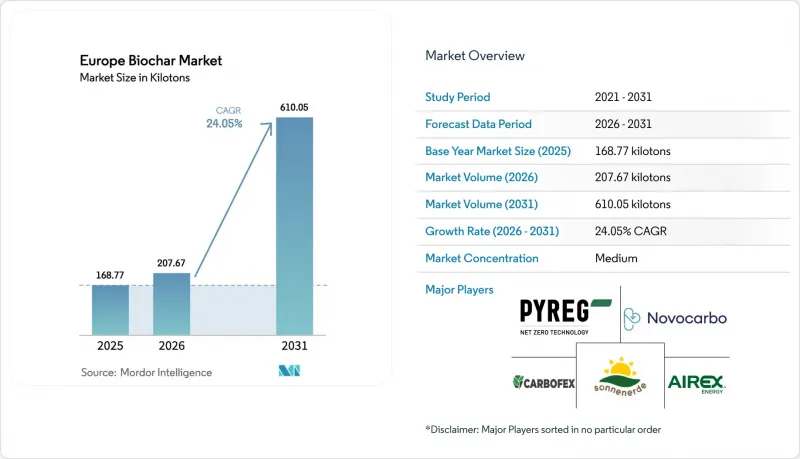
Mordor Intelligence에 의하면, 유럽의 바이오차 시장 규모는 2025년에 168.77 킬로톤이라고 평가되었고, 2026년 207.67 킬로톤으로부터 성장을 계속해 2031년까지 610.05 킬로톤에 이를 것으로 추정되고 있습니다.
예측 기간(2026-2031년) 연평균 성장률(CAGR)은 24.05%로 예측됩니다.
본 보고서는 기술별(열분해, 가스화 시스템, 기타 기술), 용도별(농업, 축산, 산업용, 기타 용도), 지역별(독일, 영국, 프랑스, 이탈리아, 스페인, 북유럽 국가, 튀르키예, 러시아, 기타 유럽)로 분류되어 있습니다. 시장 예측은 수량(톤) 단위로 표시됩니다.
유럽의 바이오차 시장 동향 및 인사이트
EU 내 재생형·유기 농업 수요 급증
EU의 공동농업정책(CAP) 하에서 자금을 지원받는 유기농업 및 재생형 농업 프로그램에는 2023-2027년 81억 유로가 배정되어 있으며, 바이오차은 에코 스킴(Eco-Schemes)에 기반한 보조금 대상 토양 개량재로 인정받고 있습니다. 프랑스에서는 2024년에 유기농지 면적이 11% 확대되었으며, 가뭄 스트레스 상황에서 바이오차를 시비한 결과 곡물 및 포도원의 수확량이 15%-22% 증가한 것으로 확인되었습니다. 이에 따라 프랑스 농림부는 국가 토양 건강 로드맵에 바이오차를 포함시키기로 결정했습니다. 독일은 2025년, 탄소 고정 효과를 검증하고 농지에서 시행 절차를 최적화하기 위해 500개 농장을 대상으로 5,000만 유로 규모의 실증 사업을 시작했습니다. 보조금 덕분에 수요가 앞당겨지고 있지만, 입자 크기, 원료의 출처, 작물별 시용량에 관한 농업 지침이 통일되지 않아 밭에서 나타나는 결과에 편차가 발생하고 있으며, 이는 보급을 저해하는 요인이 되고 있습니다. 이탈리아와 스페인에서는 국내법이 EU 규정 2019/2783을 완전히 반영할 때까지 바이오차이 여전히 ‘실험적’ 분류에 머물러 있어 보급이 지연되고 있습니다.
탄소 크레딧 구매 계약의 확대
2024년에는 마이크로소프트, Shopify, Stripe 등의 기업이 지속 가능한 탄소 제거를 우선시한 결과, 자발적인 구매자에 의한 바이오차 제거 인증서 조달량은 전년 대비 161% 증가한 4만 7,000장에 달했으며, CO2e 1톤당 150-200유로에 거래되었습니다. NOVOCARBO사는 2025년, 스위스의 재보험사와 10년간 10만 톤을 인수하는 계약을 체결하고 1,800만 유로의 선급 수익을 확보했습니다. 이 자금을 통해 브란덴부르크주에 12 kt 규모의 플랜트가 건설되었습니다. 현재 발행되는 계약의 89%에서 유럽 바이오차 인증(EBC) 감사가 실시되고 있으며, 품질 및 지속가능성 기준이 엄격해지고 있습니다. 가격 변동은 여전히 심하며, 2025년 말에는 지속가능성에 대한 주장을 면밀히 검토한 결과 현물 가격이 22% 하락함에 따라, 장기 계약을 체결하지 않은 생산자들은 이익률 압박에 직면해 있습니다. 2026년에 도입될 예정인 EU의 탄소 제거 인증에서는 모니터링 및 검증 기준이 강화될 전망이며, 사내에 분석 체계를 갖춘 통합형 사업자에게 유리하게 작용할 것으로 예측됩니다.
EU 내 바이오매스 및 폐기물 물류 체계의 파편화가 원료 비용을 상승시키고 있습니다.
수집 및 건조 인프라가 불충분하여 원료 비용은 북유럽의 임업 잔여물 35유로/톤에서 남유럽의 농업 폐기물 90유로/톤까지 폭이 넓습니다. 2024년에는 독일 농업 잔여물 중 산업용으로 활용된 비율은 고작 38%에 그쳤으며, 나머지는 소각되거나 밭에 방치되었습니다. 스페인이나 이탈리아의 올리브 가지치기 잔여물은 소규모 농가들에 흩어져 있어, 80km를 초과하는 운송이 필요해지면 바이오차 생산이 경제성을 잃는 경우가 많습니다. 2025년 프랑스 INRAE가 시범 운영한 이동식 열분해 장치는 원료 비용을 42% 절감했으나, 180만 유로의 설비 투자가 필요하여 자금력이 있는 협동조합에만 적합합니다. EU의 바이오매스 동원 전략에 따르면 2026년부터 집적 허브에 대한 공동 자금 지원이 이루어질 예정이지만, 실질적인 개선이 나타날 것은 2028년 이후가 될 가능성이 있습니다.
부문 분석
2025년 유럽 바이오차 시장에서 열분해법은 75.06%의 점유율을 차지했으며, 유럽 바이오차 시장 규모에서 차지하는 그 비율은 2031년까지 연평균 성장률(CAGR) 24.55%로 확대될 것으로 예측됩니다. PYREG사의 P500 및 P1500과 같은 연속 공급형 반응 장치는 가스화 장치보다 낮은 산소 농도 및 온도 제어 조건에서 내습성 혼합 잔여물을 처리할 수 있어,이를 통해 설치 기간을 9개월로 단축하고, 2022-2025년 톤당 설비 투자액을 28% 절감했습니다.
가스화 시스템은 여전히 틈새 시장이지만, 합성가스의 병산을 통해 높은 설비 투자 비용을 상쇄할 수 있어 펄프·제지·제재소가 통합된 시설에서 주목받고 있습니다. 스웨덴 Bussme Energy사의 다운드래프트식 장치는 85%의 열효율을 달성하여, 화석 연료 대체를 목표로 하는 공장들로부터 관심을 받고 있습니다. 수열 탄화 및 마이크로파 열분해는 에너지 수요가 높고 원료 적합성이 제한적이기 때문에 여전히 파일럿 규모에 머물러 있습니다. 규제 체계는 기술 중립적이지만, 열분해 플랜트는 뛰어난 원료 적응성과 일관된 탄소 안정성 덕분에 EBC 인증의 92%를 획득하고 있습니다.
기타 혜택 :
- Excel 형식 시장 예측(ME) 시트
- 3개월간의 애널리스트 지원
자주 묻는 질문
목차
제1장 서론
제2장 분석 방법
제3장 주요 요약
제4장 시장 구도
제5장 시장 규모 및 성장률 예측
제6장 경쟁 구도
제7장 시장 기회 및 향후 전망
AJY 26.09.15According to Mordor Intelligence, the Europe biochar market size was valued at 168.77 kilotons in 2025 and is estimated to grow from 207.67 kilotons in 2026 to reach 610.05 kilotons by 2031, at a CAGR of 24.05% during the forecast period (2026-2031).
This report is Segmented by Technology (Pyrolysis, Gasification Systems, and Other Technologies), Application (Agriculture, Animal Farming, Industrial Uses, and Other Applications), and Geography (Germany, United Kingdom, France, Italy, Spain, Nordic Countries, Turkey, Russia, and Rest of Europe). The Market Forecasts are Provided in Terms of Volume (Tons).
Europe Biochar Market Trends and Insights
EU Regenerative & Organic-Farming Demand Surge
Organic and regenerative agriculture programs funded under the EU Common Agricultural Policy allocate EUR 8.1 billion for 2023-2027, and biochar qualifies as a subsidized soil amendment under Eco-Schemes. France expanded organic acreage by 11% in 2024 and documented cereal and vineyard yield gains of 15%-22% when biochar was applied under drought stress, prompting its Ministry of Agriculture to embed biochar in the national soil-health roadmap. Germany launched a EUR 50 million demonstration covering 500 farms in 2025 to validate sequestration and fine-tune field protocols. While subsidies pull demand forward, inconsistent agronomic guidelines on particle size, feedstock origin, and crop-specific rates create variable field results that slow mainstream adoption. Italy and Spain lag because biochar still carries an experimental classification until domestic law fully transposes EU Regulation 2019/2783.
Scale-Up of Carbon-Credit Purchase Agreements
Voluntary buyers procured 47,000 biochar removal certificates in 2024, up 161% year over year, at EUR 150-200 per t of CO2e, as corporates such as Microsoft, Shopify, and Stripe prioritized durable removals. NOVOCARBO locked a 10-year, 100,000-ton offtake with a Swiss reinsurer in 2025, securing EUR 18 million in advance revenue that financed a 12 kt plant in Brandenburg. European Biochar Certificate (EBC) audits now accompany 89% of issuances, tightening quality and permanence standards. Pricing remains volatile; spot values fell 22% in late 2025 amid scrutiny of durability claims, so producers without long-term contracts face margin pressure. Forthcoming EU Carbon Removal Certification, slated for 2026, is expected to raise monitoring and verification thresholds, advantaging integrated players with in-house analytics.
Fragmented EU Biomass-Waste Logistics Inflate Feedstock Costs
Feedstock costs swing from EUR 35/t for Nordic forestry residues to EUR 90/t for Southern European agricultural waste because collection and drying infrastructure is patchy. Only 38% of German agricultural residues were utilized industrially in 2024, with the remainder burned or left in the field. Olive-pruning residues in Spain and Italy are scattered across smallholder farms, and transport beyond 80 km often renders biochar production uneconomic. Mobile pyrolysis units piloted by France's INRAE in 2025 cut feedstock expense 42% but carry a EUR 1.8 million capex that suits only well-capitalized cooperatives. The EU Biomass Mobilisation Strategy will co-fund aggregation hubs from 2026, yet meaningful relief may not arrive until 2028.
Other drivers and restraints analyzed in the detailed report include:
- Inclusion of CMC14 Biochar in EU Fertilising Products Regulation
- Industrial Heat-Recovery Economics from District-Heating Pyrolysis
- Absence of Pan-EU Agronomic Guidelines for Biochar Field-Rates
For complete list of drivers and restraints, kindly check the Table Of Contents.
Segment Analysis
Pyrolysis controlled 75.06% of the 2025 Europe biochar market share, and its portion of the Europe biochar market size is forecast to grow at a 24.55% CAGR through 2031. Continuous-feed reactors such as PYREG's P500 and P1500 process moisture-tolerant mixed residues at lower oxygen and temperature control requirements than gasifiers, slashing installation timelines to nine months and dropping per-ton capex by 28% between 2022 and 2025.
Gasification systems remain niche but appeal to integrated pulp, paper, and sawmill sites where syngas co-production offsets higher capex; Bussme Energy's downdraft units in Sweden attain 85% thermal efficiency and attract mills targeting fossil fuel substitution. Hydrothermal carbonization and microwave pyrolysis remain at pilot scale due to high energy demand and limited feedstock compatibility. Regulatory regimes are technology-neutral, but pyrolysis plants have captured 92% of EBC certifications because of superior feedstock tolerance and consistent carbon stability.
Complete Report Scope:
- Technology
- Pyrolysis
- Gasification Systems
- Other Technologies
- Application
- Agriculture
- Animal Farming
- Industrial Uses
- Other Applications
- Geography
- Germany
- United Kingdom
- France
- Italy
- Spain
- Nordic Countries
- Turkey
- Russia
- Rest of Europe
List of Companies Covered in this Report:
- Airex Energy
- Bussme Energy AB
- Carbofex Ltd
- Carbon Centric
- Carbon Finland Oy
- Carbon Gold Ltd
- CARBUNA
- CharLine GmbH
- Circular Carbon GmbH
- EGoS GmbH
- EOC Energy Ocean
- LUCRAT GmbH
- Nettenergy BV
- NOVOCARBO GMBH
- PYREG GmbH
- Sonnenerde GmbH
- Verora AG
Additional Benefits:
- The market estimate (ME) sheet in Excel format
- 3 months of analyst support
TABLE OF CONTENTS
1 Introduction
- 1.1 Study Assumptions & Market Definition
- 1.2 Scope of the Study
2 Research Methodology
3 Executive Summary
4 Market Landscape
- 4.1 Market Overview
- 4.2 Market Drivers
- 4.2.1 EU regenerative & organic-farming demand surge
- 4.2.2 Scale-up of carbon-credit purchase agreements
- 4.2.3 Inclusion of CMC14 biochar in EU Fertilising Products Regulation
- 4.2.4 Industrial heat-recovery economics from district-heating pyrolysis
- 4.2.5 Biochar-enabled phosphorus recycling from sewage-sludge streams
- 4.3 Market Restraints
- 4.3.1 Fragmented EU biomass-waste logistics inflate feedstock costs
- 4.3.2 Absence of pan-EU agronomic guidelines for biochar field-rates
- 4.3.3 Potential long-term PAH / heavy-metal liability for non-certified char
- 4.4 Value Chain Analysis
- 4.5 Porter's Five Forces
- 4.5.1 Bargaining Power of Suppliers
- 4.5.2 Bargaining Power of Buyers
- 4.5.3 Threat of New Entrants
- 4.5.4 Threat of Substitutes
- 4.5.5 Degree of Competition
5 Market Size & Growth Forecasts (Volume)
- 5.1 Technology
- 5.1.1 Pyrolysis
- 5.1.2 Gasification Systems
- 5.1.3 Other Technologies
- 5.2 Application
- 5.2.1 Agriculture
- 5.2.2 Animal Farming
- 5.2.3 Industrial Uses
- 5.2.4 Other Applications
- 5.3 Geography
- 5.3.1 Germany
- 5.3.2 United Kingdom
- 5.3.3 France
- 5.3.4 Italy
- 5.3.5 Spain
- 5.3.6 Nordic Countries
- 5.3.7 Turkey
- 5.3.8 Russia
- 5.3.9 Rest of Europe
6 Competitive Landscape
- 6.1 Market Concentration
- 6.2 Strategic Moves
- 6.3 Market Share (%)**/Ranking Analysis
- 6.4 Company Profiles (includes Global-Level Overview, Market-Level Overview, Core Segments, Financials as available, Strategic Information, Products & Services, Recent Developments)
- 6.4.1 Airex Energy
- 6.4.2 Bussme Energy AB
- 6.4.3 Carbofex Ltd
- 6.4.4 Carbon Centric
- 6.4.5 Carbon Finland Oy
- 6.4.6 Carbon Gold Ltd
- 6.4.7 CARBUNA
- 6.4.8 CharLine GmbH
- 6.4.9 Circular Carbon GmbH
- 6.4.10 EGoS GmbH
- 6.4.11 EOC Energy Ocean
- 6.4.12 LUCRAT GmbH
- 6.4.13 Nettenergy BV
- 6.4.14 NOVOCARBO GMBH
- 6.4.15 PYREG GmbH
- 6.4.16 Sonnenerde GmbH
- 6.4.17 Verora AG
7 Market Opportunities & Future Outlook
- 7.1 White-Space & Unmet-Need Assessment


