|
시장보고서
상품코드
2125630
아연 시장 : 시장 점유율 분석, 산업 동향 및 통계 데이터, 성장 예측(2026-2031년)Zinc - Market Share Analysis, Industry Trends & Statistics, Growth Forecasts (2026 - 2031) |
||||||
 Mordor Intelligence
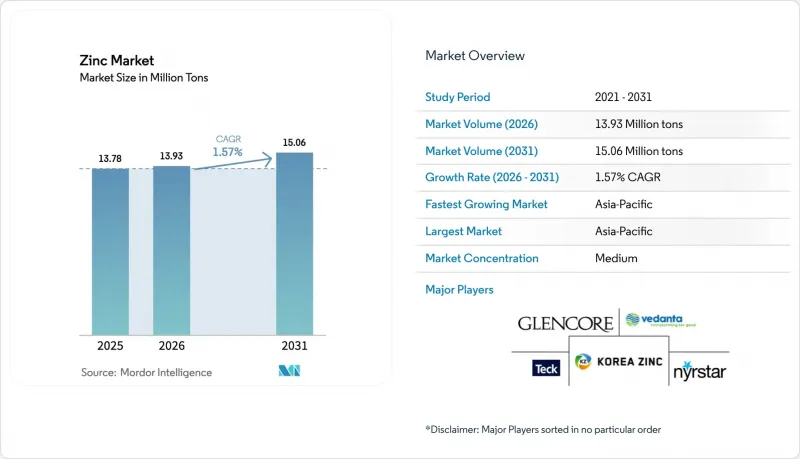
Mordor Intelligence에 의하면, 아연 시장 규모는 2025년에 1,378만 톤으로 평가되었고, 2026년 1,393만 톤에서 2031년까지 1,506만 톤에 이를 것으로 추정되며, 예측 기간(2026-2031년) CAGR은 1.57%를 나타낼 전망입니다.
본 보고서는 형태별(정제 아연(슬래브), 아연 합금 등), 제조 공정별(1차 생산, 2차 생산), 용도별(아연 도금, 다이캐스팅 등), 최종 사용자 산업별(건설, 운송, 생활용품 등), 지역별(아시아태평양, 북미, 유럽, 남미, 중동 및 아프리카)로 분류되어 있습니다. 시장 예측은 수량(톤) 기준으로 제시되어 있습니다.
세계의 아연 시장 동향 및 인사이트
인프라 주도형 아연 도금 수요의 급증
수년에 걸친 공공 자본 프로그램으로 인해 아시아 및 북미 전역의 아연 도금 업체들에게 수요 전망이 확고해졌습니다. 인도의 1조 4,000억 달러 규모의 국가 인프라 계획, 아세안(ASEAN)의 고속도로 회랑, 그리고 미국의 ‘인프라 투자 및 고용법’에서는 ISO 1461 및 ASTM A123 두께 기준을 준수하는 수십만 톤의 도금 강재가 필요합니다. 아연 도금 피막은 지방 지역에서 50-100년의 내구 수명을 실현하며, 수명 주기 경제성이 중시되는 상황에서 선호되는 부식 방지 소재로서의 입지를 확고히 하고 있습니다.
전기차(EV) 및 재생에너지 분야의 내식성 강재 성장
배터리식 전기차 플랫폼에서는 도로용 제설제나 열 사이클을 견디기 위해 Zn-Ni 및 Zn-Mg 합금 코팅이 지정되어 있습니다. 한편, 해상 풍력 발전용 모노파일에서는 염화물에 의한 부식을 방지하기 위해 용융 아연 도금에 더해 유기계 탑코트가 채택되고 있습니다. 얇은 두께의 고강도 강재로 인해 톤당 도금량은 감소하지만, 도금 강재의 총 톤수는 충분한 속도로 증가하고 있으며, 수요 증가세를 유지함으로써 아연 시장에 대한 장기적인 수요를 뒷받침하고 있습니다.
엄격한 환경 규제 및 ESG 규제
CBAM(탄소 국경 조정 메커니즘)의 인증서 가격이 1톤당 CO2 배출량 기준 약 85유로이기 때문에 EU 역외산 정제 아연의 입고 비용은 1톤당 130-240달러 상승했습니다. 중국의 ‘이산화탄소 배출 정점 달성 및 탄소 중립’ 로드맵에 따라 2024년에는 30개의 소규모 제련소가 폐쇄되어 20만 톤의 생산 능력이 상실되었습니다. 이는 이미 3-5%의 프리미엄으로 거래되고 있는 저배출 공급으로의 전환을 부각시키고 있습니다. EU의 ‘기업 지속가능성 보고 지침’에 따른 스코프 3 감사로 인해 인증을 받은 제련소가 유리한 입지를 차지하고, 탄소 배출량이 높은 경쟁사들은 불리한 입장에 놓이게 되었습니다.
부문 분석
정제 아연(슬래브)은 2025년 거래량의 72.21%를 차지했으며, 아연 도금, 다이캐스팅, 황동 가공 수요를 뒷받침하고 있습니다. 대조적으로, 아연 화합물은 타이어용 산화아연 활성제, 자외선 차단용 의약품 등급, 그리고 플렉서블 전자기기용 투명 전도성 필름에 힘입어 연평균 성장률(CAGR) 2.89%로 증가할 전망입니다. 유럽 및 인도에서 웰츠 키른(Weltz-Kiln) 설비가 확장됨에 따라, 전기 아크로(EAF)의 분진에서 산화아연을 회수하여 CO₂ 배출 강도를 75% 저감할 수 있게 됨에 따라, 재활용 원료와 연계된 아연 시장 규모는 확대되고 있습니다.
2차 아연은 CBAM 크레딧 및 기업의 스코프 3 목표와 같은 정책적 호재를 받고 있습니다. 이에 따라 종합 광산 기업들은 두 자릿수 프리미엄을 얻을 수 있는 화합물 및 합금 사업으로 전환하고 있으며, 중국공급 과잉이 지속되는 가운데 원자재인 슬래브로부터의 수익을 다각화하고 있습니다.
2025년에는 1차 생산이 생산량의 65.62%를 차지했으나, 1톤당 아연(tZn)에 대해 1.5-2.5톤의 CO2 배출량이라는 탄소 발자국은 치솟는 탄소 비용에 직면해 있습니다. 광산 가동 지연과 상위 10개 광산이 정광 공급량의 40%를 차지하고 있다는 사실도 추가적인 위험 요인으로 작용하고 있습니다. 한편, 2차 생산(재활용)은 연평균 성장률(CAGR) 2.71%로 확대되며 아연 시장 점유율을 확보해 가고 있습니다. 이는 습식 야금에 의한 침출 기술의 발전으로 전기 아크로(EAF)의 분진이나 황동 스키밍으로부터의 회수율이 향상되고 있기 때문입니다. 유럽의 웰츠(WELTZ) 제련소에서는 현재 연간 50만 톤의 폐기물을 처리하고 있으며, 인도에서는 철강 부문에서 발생하는 400만 톤의 분진을 처리하기 위한 생산 능력을 확충하고 있습니다.
지역별 분석
아시아태평양은 2025년에 전 세계 총 처리량의 62.86%를 차지한 것으로 평가되었으며, 중국의 송전망 현대화 및 인도의 1조 4,000억 달러 규모의 인프라 계획으로 인해 도금 강재 수요가 흡수됨에 따라 2.50%라는 가장 높은 연평균 성장률(CAGR)을 보일 것으로 전망됩니다. 인도네시아의 누산타라 신수도 건설 등 아세안(ASEAN)의 메가 프로젝트가 아연 도금 강재 수요를 두 배로 늘리는 한편, 일본과 한국은 아연·알루미늄·마그네슘(Zn-Al-Mg) 코팅 기술을 제공합니다. 규제적 지원, 중국의 ‘이산화탄소 배출 정점 달성 및 탄소 중립’ 정책에 따른 제련소 폐쇄, 그리고 인도의 토양 건전화를 목적으로 한 비료에 대한 우대 조치가 해당 지역의 소비를 뒷받침하고 있습니다.
북미는 미국 인프라 법안과 캐나다의 저탄소화를 위한 트레일 제련소 개보수의 혜택을 받고 있습니다. South32사의 엘모사 프로젝트를 통해 2027년에는 정련 생산량이 15만 톤 증가하여 수입 의존도가 낮아질 전망입니다. 멕시코의 수출 지향형 자동차 생산 라인 덕분에 아연 도금 공장은 거의 풀가동을 유지하고 있으며, 이것이 지역의 아연 수급을 뒷받침하고 있습니다.
2026년부터 시행되는 유럽의 CBAM(탄소 국경 조정 메커니즘)에 따라, Nyrstar, Boliden 및 기타 규제를 준수하는 제련소에서 생산된 인증된 저탄소 금속에 대한 수요가 증가하고 있습니다. 동시에, 시행 결정 2024/367-368에 따라 배관 제조업체는 개정된 음용수 지침에 근거하여 아연 용출량을 5 mg/L 미만으로 억제해야 할 의무가 있어, 합금의 재조성이 촉진되고 있습니다.
기타 혜택 :
- Excel 형식 시장 예측(ME) 시트
- 3개월간의 애널리스트 지원
자주 묻는 질문
목차
제1장 서론
제2장 분석 방법
제3장 주요 요약
제4장 시장 구도
제5장 시장 규모 및 성장률 예측
제6장 경쟁 구도
제7장 시장 기회 및 향후 전망
AJY 26.09.15According to Mordor Intelligence, the zinc market size was valued at 13.78 Million tons in 2025 and is estimated to grow from 13.93 Million tons in 2026 to reach 15.06 Million tons by 2031, at a CAGR of 1.57% during the forecast period (2026-2031).
This report is Segmented by Form (Refined Zinc (Slab), Zinc Alloys, and More), Production Process (Primary Production, Secondary Production), Application (Galvanizing, Die-Casting, and More), End-User Industry (Construction, Transportation, Consumer Goods, and More), and Geography (Asia-Pacific, North America, Europe, South America, and Middle-East and Africa). The Market Forecasts are Provided in Terms of Volume (Tons).
Global Zinc Market Trends and Insights
Infrastructure-Led Galvanizing Demand Surge
Multiyear public-capital programs are locking in visibility for galvanizers across Asia and North America. India's USD 1.4 trillion National Infrastructure Pipeline, ASEAN expressway corridors, and the U.S. Infrastructure Investment and Jobs Act require hundreds of thousands of tons of coated steel that must comply with ISO 1461 and ASTM A123 thickness norms. Galvanized coatings deliver service lives of 50-100 years in rural zones, cementing their status as the preferred corrosion barrier where lifecycle economics dominate.
Growth of Corrosion-Resistant Steel in EV and Renewables
Battery-electric platforms specify Zn-Ni and Zn-Mg alloy coatings to withstand road salt and thermal cycling, while offshore-wind monopiles rely on hot-dip galvanizing plus organic topcoats to fight chloride attack. Although thinner high-strength steels reduce coating per ton, total coated-steel tonnage rises fast enough to maintain volume growth, reinforcing long-run support for the zinc market.
Stringent Environmental and ESG Regulations
CBAM certificates priced near EUR 85 tCO2 raise landed costs for non-EU refined zinc by USD 130-240 t. China's dual-carbon roadmap shut 30 small smelters in 2024, erasing 200,000 t of capacity and underscoring a shift toward low-emission supply that already trades at 3-5% premiums. Scope 3 audits under the EU Corporate Sustainability Reporting Directive elevate certified smelters and disadvantage high-carbon peers.
Other drivers and restraints analyzed in the detailed report include:
- Expansion of Zinc-Based Fertilizers in Micronutrient-Deficient Soils
- Emergence of Zinc-Ion and Zinc-Air Batteries
- Fertilizer Heavy-Metal Limits Curbing Zinc Sulfate
For complete list of drivers and restraints, kindly check the Table Of Contents.
Segment Analysis
Refined zinc (slab) controlled 72.21% of 2025 volume, underpinning galvanizing, die-casting, and brass-mill demand. In contrast, zinc compounds will rise at 2.89% CAGR, buoyed by zinc-oxide activators in tires, UV-blocking pharmaceutical grades, and transparent-conductor films for flexible electronics. The zinc market size linked to recycled feed is widening as Waelz-kiln expansions in Europe and India reclaim oxide from electric-arc-furnace dust at 75% lower CO2 intensity.
Secondary zinc enjoys policy tailwinds from CBAM credits and corporate Scope 3 targets. Integrated miners are therefore pivoting toward compounds and alloys that earn double-digit premiums, diversifying revenue away from commodity slabs amid persistent Chinese oversupply.
Primary production held 65.62% of output in 2025, but its 1.5-2.5 t CO2 tZn footprint faces escalating carbon costs. Mine delays and the fact that the top ten sites supply 40% of concentrates add another layer of risk. Conversely, secondary production (recycling) is growing at 2.71% CAGR capture zinc market share as hydrometallurgical leaching upgrades recovery from EAF dust and brass skimmings. European Waelz kilns now process 500,000 t of waste annually, and India is adding capacity to process 4 million t of dust generated by its steel sector.
Complete Report Scope:
- By Form
- Refined Zinc (Slab)
- Zinc Alloys
- Zinc Compounds (Oxide, Sulfate, etc.)
- Secondary/Recycled Zinc
- By Production Process
- Primary Production (Mining and Smelting)
- Secondary Production (Recycling)
- By Application
- Galvanizing
- Die-Casting
- Brass
- Zinc Oxide and Chemicals
- Other Applications
- By End-user Industry
- Construction
- Transportation
- Electrical and Electronics
- Consumer Goods
- Other End-user Industries
- By Geography
- Asia-Pacific
- China
- India
- Japan
- South Korea
- Indonesia
- Malaysia
- Thailand
- Vietnam
- Rest of Asia-Pacific
- North America
- United States
- Canada
- Mexico
- Europe
- Germany
- United Kingdom
- Italy
- France
- Russia
- Spain
- Turkey
- NORDIC Countries
- Rest of Europe
- South America
- Brazil
- Argentina
- Colombia
- Rest of South America
- Middle-East and Africa
- Saudi Arabia
- United Arab Emirates
- Qatar
- South Africa
- Egypt
- Nigeria
- Rest of Middle-East and Africa
- Asia-Pacific
Geography Analysis
Asia-Pacific accounted for 62.86% of global tonnage in 2025 and is set for the highest 2.50% CAGR as China's grid-modernization and India's USD 1.4 trillion infrastructure pipeline absorb coated steel. ASEAN mega-projects such as Indonesia's Nusantara capital city multiply galvanized demand, while Japan and South Korea supply Zn-Al-Mg coating know-how. Regulatory pushes, China's dual-carbon smelter closures, and India's soil-health fertilizer incentives reinforce regional consumption.
North America benefits from the U.S. infrastructure law and Canada's low-carbon Trail smelter upgrade. South32's Hermosa project will add 150,000 t of refined output in 2027, reducing import reliance. Mexico's export-oriented auto lines keep galvanizers running near capacity, anchoring regional zinc flows.
Europe's CBAM, enforceable from 2026, lifts demand for certified low-carbon metal from Nyrstar, Boliden, and other compliant smelters. At the same time, Implementing Decisions 2024/367-368 compel plumbing manufacturers to validate zinc release below 5 mg L under the revised Drinking Water Directive, spurring alloy reformulations.
- Boliden Group
- Glencore
- Grupo Mexico
- Hudbay Minerals Inc.
- IVANHOE MINES
- KOREAZINC
- MMG Australia Limited
- Nexa
- Nyrstar
- South32
- Teck Resources Limited
- Vedanta Limited
- Volcan
Additional Benefits:
- The market estimate (ME) sheet in Excel format
- 3 months of analyst support
TABLE OF CONTENTS
1 Introduction
- 1.1 Study Assumptions and Market Definition
- 1.2 Scope of the Study
2 Research Methodology
3 Executive Summary
4 Market Landscape
- 4.1 Market Overview
- 4.2 Market Drivers
- 4.2.1 Infrastructure-led galvanizing demand surge
- 4.2.2 Growth of corrosion-resistant steel in EV and renewables
- 4.2.3 Expansion of zinc-based fertilisers in micronutrient-deficient soils
- 4.2.4 Emergence of zinc-ion and zinc-air batteries
- 4.2.5 EU drinking-water zinc-coated plumbing mandate
- 4.3 Market Restraints
- 4.3.1 Stringent environmental and ESG regulations
- 4.3.2 Price volatility from supply shocks and surpluses
- 4.3.3 Fertiliser heavy-metal limits curbing Zn sulphate
- 4.4 Value Chain Analysis
- 4.5 Porter's Five Forces
- 4.5.1 Bargaining Power of Suppliers
- 4.5.2 Bargaining Power of Buyers
- 4.5.3 Threat of New Entrants
- 4.5.4 Threat of Substitutes
- 4.5.5 Degree of Competition
5 Market Size and Growth Forecasts (Volume)
- 5.1 By Form
- 5.1.1 Refined Zinc (Slab)
- 5.1.2 Zinc Alloys
- 5.1.3 Zinc Compounds (Oxide, Sulfate, etc.)
- 5.1.4 Secondary/Recycled Zinc
- 5.2 By Production Process
- 5.2.1 Primary Production (Mining and Smelting)
- 5.2.2 Secondary Production (Recycling)
- 5.3 By Application
- 5.3.1 Galvanizing
- 5.3.2 Die-Casting
- 5.3.3 Brass
- 5.3.4 Zinc Oxide and Chemicals
- 5.3.5 Other Applications
- 5.4 By End-user Industry
- 5.4.1 Construction
- 5.4.2 Transportation
- 5.4.3 Electrical and Electronics
- 5.4.4 Consumer Goods
- 5.4.5 Other End-user Industries
- 5.5 By Geography
- 5.5.1 Asia-Pacific
- 5.5.1.1 China
- 5.5.1.2 India
- 5.5.1.3 Japan
- 5.5.1.4 South Korea
- 5.5.1.5 Indonesia
- 5.5.1.6 Malaysia
- 5.5.1.7 Thailand
- 5.5.1.8 Vietnam
- 5.5.1.9 Rest of Asia-Pacific
- 5.5.2 North America
- 5.5.2.1 United States
- 5.5.2.2 Canada
- 5.5.2.3 Mexico
- 5.5.3 Europe
- 5.5.3.1 Germany
- 5.5.3.2 United Kingdom
- 5.5.3.3 Italy
- 5.5.3.4 France
- 5.5.3.5 Russia
- 5.5.3.6 Spain
- 5.5.3.7 Turkey
- 5.5.3.8 NORDIC Countries
- 5.5.3.9 Rest of Europe
- 5.5.4 South America
- 5.5.4.1 Brazil
- 5.5.4.2 Argentina
- 5.5.4.3 Colombia
- 5.5.4.4 Rest of South America
- 5.5.5 Middle-East and Africa
- 5.5.5.1 Saudi Arabia
- 5.5.5.2 United Arab Emirates
- 5.5.5.3 Qatar
- 5.5.5.4 South Africa
- 5.5.5.5 Egypt
- 5.5.5.6 Nigeria
- 5.5.5.7 Rest of Middle-East and Africa
- 5.5.1 Asia-Pacific
6 Competitive Landscape
- 6.1 Market Concentration
- 6.2 Strategic Moves
- 6.3 Market Share(%)/Ranking Analysis
- 6.4 Company Profiles (includes Global level Overview, Market level overview, Core Segments, Financials as available, Strategic Information, Products and Services, Recent Developments)
- 6.4.1 Boliden Group
- 6.4.2 Glencore
- 6.4.3 Grupo Mexico
- 6.4.4 Hudbay Minerals Inc.
- 6.4.5 IVANHOE MINES
- 6.4.6 KOREAZINC
- 6.4.7 MMG Australia Limited
- 6.4.8 Nexa
- 6.4.9 Nyrstar
- 6.4.10 South32
- 6.4.11 Teck Resources Limited
- 6.4.12 Vedanta Limited
- 6.4.13 Volcan
7 Market Opportunities and Future Outlook
- 7.1 White-space and Unmet-Need Assessment