|
시장보고서
상품코드
2125651
아메리카의 센서 시장 : 시장 점유율 분석, 업계 동향 및 통계, 성장 예측(2026-2031년)Americas Sensor - Market Share Analysis, Industry Trends & Statistics, Growth Forecasts (2026 - 2031) |
||||||
 Mordor Intelligence
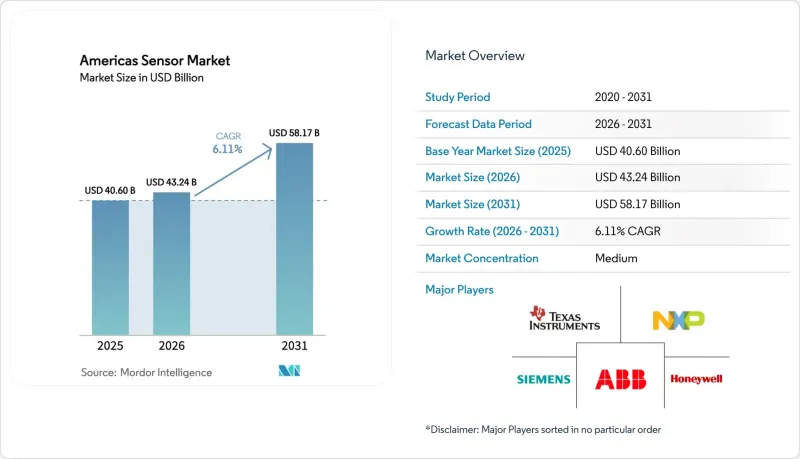
아메리카의 센서 시장 규모는 2025년 406억 달러로 평가되었고, 2026년에는 432억 4,000만 달러로 추정되고, 2026-2031년 CAGR 6.11%로 성장을 지속할 전망이며, 2031년까지 581억 7,000만 달러에 이를 것으로 예측됩니다.
본 보고서는 측정 매개변수별(온도, 압력 등), 작동 모드별(광학식, 전기저항식, 바이오센서 등), 센서 기술별(MEMS 및 비MEMS), 최종 사용자 산업별(자동차, 소비자 가전 등) 및 지역별로 분류되어 있습니다. 시장 예측은 금액(달러) 기준으로 제시되어 있습니다.
아메리카의 센서 시장 동향 및 인사이트
소비자용 IoT 기기의 급속한 보급
2025년, 북미의 출하 대수는 12억 대에 달한 것으로 평가되었으며, 웨어러블 기기 및 홈 오토메이션 시스템에 온도, 근접, 관성 센서가 탑재되고 있습니다. Matter 프로토콜에 대한 소매업체의 요구 사항에 따라, 공급업체들은 MEMS 패키지 내에 Bluetooth Low Energy 5.4 및 Thread 무선 기능을 사전 탑재해야 하며, 이로 인해 외부 부품 수가 40% 감소했습니다. 브라질의 ANATEL은 결의안 제715호에 따라 인증 절차를 간소화하여 현지 제품 출시 주기를 3개월로 단축했습니다. 이러한 규제 측면의 진전과 더불어 5년 이상의 배터리 수명에 대한 기대가 더해지면서, 초저전력 설계가 구매의 주요 기준으로 중요시되고 있습니다. Zigbee 트래픽을 Matter로 변환하는 개조용 게이트웨이는 2025년 매출에 3억 8,000만 달러를 추가할 것으로 예상되며, 이는 잠정적인 상호 운용성 기회를 반영한 것입니다.
제조업 분야의 자동화 투자 증가
2024년, 미국 내 산업용 로봇 도입 대수는 12% 증가한 4만 4,303대에 달했으며, 힘 및 토크 센서, 근접 센서, 비전 센서가 사람과 로봇의 안전한 협업을 가능하게 했습니다. 멕시코에서는 진동 모니터링 시스템 덕분에 예기치 않은 가동 중단 시간이 35% 감소한 결과, 로봇 1대당 센서 장착 수가 28% 증가했습니다. 조사 대상 제조업체의 80%가 현재 자본 예산의 최소 5분의 1을 스마트 팩토리 자산에 할당하고 있으며, 우선순위 목록에서는 센서 하드웨어가 소프트웨어를 앞지르고 있습니다. 브라질의 ‘Rota 2030’ 인센티브 제도에서는 센서가 탑재된 기계에 대해 가속 감가상각이 제공되어, 2015년 이전 생산 라인의 개조를 촉진하고 있습니다. 2024년에 24만 4,940개의 미국 일자리가 국내로 복귀한 것도 국내 센서 수요를 더욱 끌어올리고 있습니다.
안전에 중요한 센서에 대한 엄격한 규제 인증
2025년, 클래스 II 및 III 의료기기에 대한 FDA의 시판 전 승인 소요 기간은 평균 14개월이었습니다. 혈당 센서나 혈압 센서의 경우, 다양한 피험자 집단에서 ±10%의 정확도가 요구됩니다. NHTSA의 2025년 6월 명령에 따르면, 사고에 연루된 첨단 운전자 보조 시스템(ADAS)용 센서에 대해 실제 환경에서의 성능 데이터 제출이 의무화되어, 이로 인해 Tier 1 공급업체의 연간 규정 준수 비용은 200만-300만 달러 증가하게 됩니다. 브라질의 ANVISA 결의 제822호에 따라 FDA 승인을 받은 경우에도 현지 임상시험이 의무화됨에 따라, 시장 출시까지의 기간은 사실상 2배로 늘어났고, 국내 벤더가 소비자용 웰니스 웨어러블 시장에서 18%의 점유율을 확보하게 되었습니다. 남미와 북미 대륙 전체에 걸쳐 규정이 서로 다르기 때문에 공급업체는 여러 제품 변형과 문서 세트를 유지할 수밖에 없어 고정비가 증가하며, 소규모 기업 시장 진입을 가로막고 있습니다. 지역적 무역 협정이 있음에도 불구하고, 규제 조화는 더딘 상태입니다.
부문 분석
미국이 미세먼지 및 오존 기준을 강화하고 1,200곳의 연속 모니터링 거점을 추가함에 따라, 화학 센서는 2026-2031년 6.59%라는 가장 높은 연평균 성장률(CAGR)을 나타낼 전망입니다. 2025년 미주 센서 시장 점유율의 19.85%를 차지한 온도 측정 기기는 HVAC(냉난방·환기·공조) 및 콜드체인 물류 분야에서 여전히 매우 중요하지만, 가격 하락에 직면하여 성장이 둔화되고 있습니다. 압력 측정 제품은 셰일 가스 채굴을 뒷받침하고 있으며, 2025년에는 퍼미안 분지에 8,500개의 지하 게이지가 도입되었습니다. 액면 측정 기기는 하루 총 180억 갤런을 관리하는 지자체 정수장을 지원하고 있습니다.
일회용 바이오리액터의 유량 계측 기술은 일회용 열식 질량 유량 센서를 통해 검증 주기가 3일로 단축되면서 발전했습니다. 근접 센서는 아마존 시설에서 운영되는 75만 대의 모바일 로봇을 가능하게 하여 대규모 수요를 뒷받침하고 있습니다. 관성 모듈, 자기 센서, 진동 센서, 환경 감지기는 각각 스마트폰에서 예측 유지보수 솔루션에 이르기까지 틈새 시장이지만 확대되고 있는 이용 사례에 대응하고 있으며, 미주 센서 시장의 광범위한 영역을 부각시키고 있습니다.
2025년, 광학 센싱은 매출의 23.43%를 차지했으며, 스마트폰용 포토다이오드부터 교량에 설치되는 광섬유 변형 게이지까지 폭넓게 활용되었습니다. LiDAR와 관련된 미주 센서 시장 규모는 로보택시의 확대에 따라 연평균 성장률(CAGR) 6.96%로 증가할 것으로 예측되며, Waymo는 텍사스주에서 200대의 차량을 추가할 수 있는 허가를 받았습니다. 전기 저항 소자는 계속해서 산업용 온도 루프의 핵심을 담당하고 있으며, 2025년에는 1,200만 개가 출하될 전망입니다. 바이오센서 분야에서는 2025년 8월 애보트(Abbott)사의 연속 케톤 모니터가 FDA 승인을 획득함에 따라 그 적용 범위가 확대되었습니다.
압전 저항형 자동차 매니폴드 센서, 적층형 CMOS 이미지 센서, 정전용량식 터치 컨트롤러, 압전식 초음파 소자 및 레이더 IC는 인포테인먼트에서 어댑티브 크루즈 컨트롤에 이르기까지 폭넓은 용도를 지원하며, 미주 센서 시장에 깊이를 더하고 있습니다. 이러한 작동 모드가 하나로 어우러져, 소비자용, 산업용, 모빌리티 생태계에 도움이 되는 범용성이 높은 툴킷을 형성하고 있습니다.
기타 혜택 :
- 엑셀 형식 시장 예측(ME) 시트
- 3개월간의 애널리스트 지원
자주 묻는 질문
목차
제1장 서론
제2장 조사 방법
제3장 주요 요약
제4장 시장 구도
제5장 시장 규모 및 성장 예측
제6장 경쟁 구도
제7장 시장 기회 및 향후 전망
AJY 26.09.15According to Mordor Intelligence, the Americas sensor market size is expected to grow from USD 40.60 billion in 2025 to USD 43.24 billion in 2026 and is forecast to reach USD 58.17 billion by 2031 at 6.11% CAGR over 2026-2031.
This report is Segmented by Parameter Measured (Temperature, Pressure, and More), Mode of Operation (Optical, Electrical Resistance, Biosensor, and More), Sensor Technology (MEMS, and Non-MEMS), End-User Industry (Automotive, Consumer Electronics, and More), and Geography. The Market Forecasts are Provided in Terms of Value (USD).
Americas Sensor Market Trends and Insights
Rapid Proliferation of Consumer IoT Devices
North American shipments reached 1.2 billion units in 2025, embedding temperature, proximity, and inertial components in wearables and home-automation systems. Retailer mandates around the Matter protocol are pushing vendors to preload Bluetooth Low Energy 5.4 and Thread radios inside MEMS packages, trimming external component counts by 40%. Brazil's ANATEL streamlined certification under Resolution 715, cutting local launch cycles to three months. These regulatory wins, paired with battery-life expectations beyond five years, are elevating ultra-low-power design to a core purchasing criterion. Retrofit gateways translating Zigbee traffic into Matter added USD 380 million in 2025 revenue, reflecting an interim interoperability opportunity.
Rising Automation Investments in Manufacturing
Industrial robot installations in the United States climbed 12% to 44,303 units during 2024, with force-torque, proximity, and vision sensors enabling safe human-robot collaboration. Sensor content per robot rose 28% in Mexico as vibration-monitoring systems cut unplanned downtime by 35%. Eighty percent of surveyed manufacturers now channel at least one-fifth of capital budgets into smart-factory assets where sensing hardware eclipses software on the priority list. Brazil's Rota 2030 incentives, offering accelerated depreciation for sensor-equipped machinery, fuel retrofits of pre-2015 production lines. The reshoring of 244,940 U.S. jobs during 2024 further brightens domestic sensor demand.
Stringent Regulatory Certification for Safety-Critical Sensors
FDA premarket approvals for Class II and III devices averaged 14 months in 2025, with glucose and pressure sensors requiring +-10% accuracy across diverse cohorts. NHTSA's June 2025 order mandates real-world performance data for any Advanced Driver Assistance System sensor tied to a crash, adding USD 2-3 million in annual compliance for tier-1 suppliers. Brazil's ANVISA Resolution 822 now obliges local trials even when FDA clearance exists, effectively doubling time-to-market and giving domestic vendors an 18% share in consumer wellness wearables. Divergent rules across the Americas force vendors to maintain multiple product variants and documentation sets, inflating fixed costs and deterring small entrants. Harmonization lags despite regional trade pacts.
Other drivers and restraints analyzed in the detailed report include:
- Government Incentives for Smart-Infrastructure Retrofits
- Expansion Of Electric and Autonomous Vehicles
- High Capital Expenditure for MEMS Fabrication Lines
For complete list of drivers and restraints, kindly check the Table Of Contents.
Segment Analysis
Chemical devices are set for the fastest 6.59% CAGR during 2026-2031 as the United States enforces tighter particulate-matter and ozone standards, adding 1,200 continuous-monitoring sites. Temperature units, which held 19.85% of the Americas sensor market share in 2025, remain pivotal in HVAC and cold-chain logistics yet face price erosion that is moderating growth. Pressure products underpin shale extraction, with 8,500 downhole gauges deployed in the Permian Basin in 2025. Level instrumentation supports municipal water plants that collectively oversee 18 billion gallons daily.
Flow sensing in single-use bioreactors advanced when a disposable thermal mass-flow sensor cut validation cycles to three days. Proximity sensors enable 750,000 mobile robots in Amazon facilities, sustaining high-volume demand. Inertial modules, magnetics, vibration, and environmental detectors each address niche but expanding use cases from smartphones to predictive-maintenance suites, underscoring the broad terrain of the Americas sensor market.
Optical sensing kept a 23.43% revenue slice in 2025, spanning photodiodes for smartphones and fiber-optic strain gauges on bridges. The Americas sensor market size attached to LiDAR is projected to rise at 6.96% CAGR on the heels of robotaxi scaling, with Waymo cleared to add 200 vehicles in Texas. Electrical resistance elements continue to anchor industrial temperature loops, shipping 12 million units in 2025. Biosensors broadened horizons when Abbott's continuous ketone monitor secured FDA clearance in August 2025.
Piezoresistive automotive manifold sensors, stacked CMOS image sensors, capacitive touch controllers, piezoelectric ultrasound elements, and radar ICs together provide depth to the Americas sensor market, supporting applications from infotainment to adaptive cruise control. Collectively, these operational modes frame a versatile toolkit serving consumer, industrial, and mobility ecosystems.
Complete Report Scope:
- By Parameter Measured
- Temperature
- Pressure
- Level
- Flow
- Proximity
- Environmental
- Chemical
- Inertial
- Magnetic
- Vibration
- Other Parameter Measured
- By Mode of Operation
- Optical
- Electrical Resistance
- Biosensor
- Piezoresistive
- Image
- Capacitive
- Piezoelectric
- LiDAR
- Radar
- Other Mode of Operation
- By Sensor Technology
- MEMS Sensors
- Non-MEMS Sensors
- By End-User Industry
- Automotive
- Consumer Electronics
- Smartphones
- Tablets, Laptops and Computers
- Wearable Devices
- Smart Appliances
- Other Consumer Electronics
- Energy and Utilities
- Industrial Automation
- Medical and Wellness
- Construction, Agriculture and Mining
- Aerospace
- Defense and Security
- By Geography
- North America
- United States
- Canada
- South America
- Brazil
- Mexico
- Argentina
- Chile
- Rest of South America
- North America
List of Companies Covered in this Report:
- Texas Instruments Incorporated
- TE Connectivity Ltd.
- Omega Engineering Inc.
- Honeywell International Inc.
- Rockwell Automation Inc.
- Siemens AG
- ams-OSRAM AG
- NXP Semiconductors N.V.
- Infineon Technologies AG
- Bosch Sensortec GmbH
- SICK AG
- ABB Ltd.
- OMRON Corporation
- STMicroelectronics N.V.
- Analog Devices, Inc.
- Microchip Technology Inc.
- Sensata Technologies Holding plc
- Murata Manufacturing Co., Ltd.
- Panasonic Holdings Corporation
- Qualcomm Incorporated
Additional Benefits:
- The market estimate (ME) sheet in Excel format
- 3 months of analyst support
TABLE OF CONTENTS
1 INTRODUCTION
- 1.1 Study Assumptions and Market Definition
- 1.2 Scope of the Study
2 RESEARCH METHODOLOGY
3 EXECUTIVE SUMMARY
4 MARKET LANDSCAPE
- 4.1 Market Overview
- 4.2 Market Drivers
- 4.2.1 Rapid Proliferation of Consumer IoT Devices
- 4.2.2 Rising Automation Investments in North and South American Manufacturing
- 4.2.3 Government Incentives for Smart-Infrastructure Retrofits
- 4.2.4 Expansion of Electric and Autonomous Vehicles Requiring Multi-Sensor Suites
- 4.2.5 Emergence of Low-Power Edge AI Enabling On-Sensor Analytics
- 4.2.6 Growing Demand for Biodegradable Eco-Sensors to Meet ESG Targets
- 4.3 Market Restraints
- 4.3.1 Stringent Regulatory Certification for Safety-Critical Sensors
- 4.3.2 High Capital Expenditure for MEMS Fabrication Lines
- 4.3.3 Supply-Chain Concentration in Exotic Materials (GaN, SiC)
- 4.3.4 Cyber-Security Liabilities Tied to Sensor Data Integrity
- 4.4 Industry Value-Chain Analysis
- 4.5 Regulatory Landscape
- 4.6 Technological Outlook
- 4.7 Porter's Five Forces Analysis
- 4.7.1 Bargaining Power of Suppliers
- 4.7.2 Bargaining Power of Consumers
- 4.7.3 Threat of New Entrants
- 4.7.4 Threat of Substitute Products
- 4.7.5 Intensity of Competitive Rivalry
- 4.8 Impact of Macroeconomic Factors on the Market
5 MARKET SIZE AND GROWTH FORECASTS (VALUE)
- 5.1 By Parameter Measured
- 5.1.1 Temperature
- 5.1.2 Pressure
- 5.1.3 Level
- 5.1.4 Flow
- 5.1.5 Proximity
- 5.1.6 Environmental
- 5.1.7 Chemical
- 5.1.8 Inertial
- 5.1.9 Magnetic
- 5.1.10 Vibration
- 5.1.11 Other Parameter Measured
- 5.2 By Mode of Operation
- 5.2.1 Optical
- 5.2.2 Electrical Resistance
- 5.2.3 Biosensor
- 5.2.4 Piezoresistive
- 5.2.5 Image
- 5.2.6 Capacitive
- 5.2.7 Piezoelectric
- 5.2.8 LiDAR
- 5.2.9 Radar
- 5.2.10 Other Mode of Operation
- 5.3 By Sensor Technology
- 5.3.1 MEMS Sensors
- 5.3.2 Non-MEMS Sensors
- 5.4 By End-User Industry
- 5.4.1 Automotive
- 5.4.2 Consumer Electronics
- 5.4.2.1 Smartphones
- 5.4.2.2 Tablets, Laptops and Computers
- 5.4.2.3 Wearable Devices
- 5.4.2.4 Smart Appliances
- 5.4.2.5 Other Consumer Electronics
- 5.4.3 Energy and Utilities
- 5.4.4 Industrial Automation
- 5.4.5 Medical and Wellness
- 5.4.6 Construction, Agriculture and Mining
- 5.4.7 Aerospace
- 5.4.8 Defense and Security
- 5.5 By Geography
- 5.5.1 North America
- 5.5.1.1 United States
- 5.5.1.2 Canada
- 5.5.2 South America
- 5.5.2.1 Brazil
- 5.5.2.2 Mexico
- 5.5.2.3 Argentina
- 5.5.2.4 Chile
- 5.5.2.5 Rest of South America
- 5.5.1 North America
6 COMPETITIVE LANDSCAPE
- 6.1 Market Concentration
- 6.2 Strategic Moves
- 6.3 Market Share Analysis
- 6.4 Company Profiles (includes Global Level Overview, Market Level Overview, Core Segments, Financials as available, Strategic Information, Market Rank/Share, Products and Services, Recent Developments)
- 6.4.1 Texas Instruments Incorporated
- 6.4.2 TE Connectivity Ltd.
- 6.4.3 Omega Engineering Inc.
- 6.4.4 Honeywell International Inc.
- 6.4.5 Rockwell Automation Inc.
- 6.4.6 Siemens AG
- 6.4.7 ams-OSRAM AG
- 6.4.8 NXP Semiconductors N.V.
- 6.4.9 Infineon Technologies AG
- 6.4.10 Bosch Sensortec GmbH
- 6.4.11 SICK AG
- 6.4.12 ABB Ltd.
- 6.4.13 OMRON Corporation
- 6.4.14 STMicroelectronics N.V.
- 6.4.15 Analog Devices, Inc.
- 6.4.16 Microchip Technology Inc.
- 6.4.17 Sensata Technologies Holding plc
- 6.4.18 Murata Manufacturing Co., Ltd.
- 6.4.19 Panasonic Holdings Corporation
- 6.4.20 Qualcomm Incorporated
7 MARKET OPPORTUNITIES AND FUTURE OUTLOOK
- 7.1 White-Space and Unmet-Need Assessment