

|
시장보고서
상품코드
2125691
태국의 건설 장비 시장 : 시장 점유율 분석, 업계 동향 및 통계, 성장 예측(2026-2031년)Thailand Construction Equipment - Market Share Analysis, Industry Trends & Statistics, Growth Forecasts (2026 - 2031) |
||||||
 Mordor Intelligence
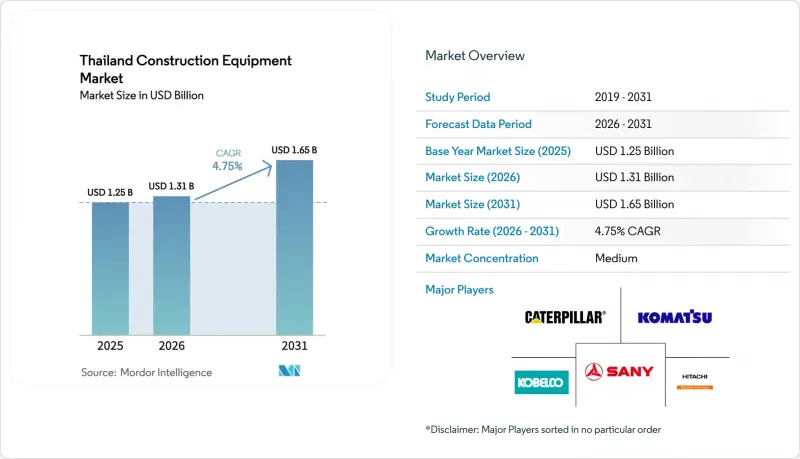
Mordor Intelligence에 의하면, 태국의 건설 장비 시장 규모는 2025년 12억 5,000만 달러로 평가되었고, 2026년 13억 1,000만 달러에서 2031년까지 16억 5,000만 달러로 확대될 것으로 예측되며, 2026-2031년 연평균 복합 성장률(CAGR)은 4.75%를 나타낼 전망입니다.
본 보고서는 기계 유형별(크레인, 기타), 추진력별(내연기관, 전기·하이브리드), 출력별(100HP 이하, 기타), 최종 사용자별(인프라, 기타), 용도별(토공, 기타), 지역별로 분류되어 있습니다. 시장 전망은 입수 가능한 데이터를 바탕으로 금액(달러)과 수량(대)으로 제시되어 있습니다.
태국의 건설 장비 시장 동향 및 인사이트
동부 경제 회랑(EEC) 내 메가 프로젝트의 급증
거대한 규모를 자랑하는 여러 EEC 2단계 프로젝트가 중대형 굴삭기, 격자 붐식 크롤러 크레인, 수륙 양용 말뚝 박기 기계 수요를 견인하고 있습니다. 항공 허브 확장, 항만 현대화, 여러 공항을 연결하는 고속철도 회랑 등 주요 인프라 개발 프로젝트에서 장비 가동률은 팬데믹 이전 수준을 크게 상회하고 있습니다. 건설업체들은 가동률 데이터를 금융기관 및 보험사에 전송하는 텔레매틱스 지원 장비를 점점 더 선호하고 있으며, 이를 통해 자금 조달 비용을 대폭 절감할 수 있게 되었습니다. 일부 지역에서는 2차 리스 시장이 등장하여, 중소규모 건설업체들이 유휴 장비를 서브리스함으로써 추가적인 프로젝트 기회를 활용할 수 있게 되었습니다. 일본의 각 OEM 기업들은 장기 서비스 계약에 예측 유지보수 구독 서비스를 포함시키고 있으며, 이를 통해 안정적인 애프터마켓 수익을 확보함과 동시에 장비의 가동 수명을 연장하고 있습니다.
민관 파트너십을 통한 인프라 구축 가속화
교통성은 수많은 프로젝트를 아우르는 대규모 민관 파트너십(PPP) 계획을 발표했습니다. 또한, 가까운 시일 내에 시작될 예정인 몇 가지 새로운 이니셔티브에 대해 추가 자금이 배정되었습니다. 건설·운영·양도(BOT) 모델로 운영되는 주요 고속도로에서는 배출량 상한선이 설정되어 있어, 연비가 높은 그레이더와 콤팩터의 사용이 장려되고 있습니다. 야심 찬 대규모 인프라 프로젝트인 ‘서던 랜드브리지’에는 다수의 중장비가 투입될 예정이며, 향후 10년 후반에 운영이 시작될 전망입니다. PPP 계약에는 공사 기간 지연 발생 시의 위약금에 관한 조항이 포함되어 있습니다. 이에 따라 실시간 규정 준수 추적이 가능한 BIM 통합형 기계의 도입이 촉진되고 있습니다. 주요 컨세션 입찰에 따른 자금 수요에 대응하기 위해 중소규모 기업들은 틈새 시장 역할을 하는 하도급으로의 전략적 전환이나 단기 임대 사업 전개를 추진하고 있습니다.
건축자재 가격 급등에 따른 도급업체의 설비 투자 압박
2024년, 태국의 건설 비용 지수는 철강, 시멘트, 디젤 연료에 대한 지속적인 인플레이션 압력에 힘입어 완만하게 상승했습니다. 인건비도 대폭 상승하여, 이미 핍박받고 있는 하도급 업체의 이익률을 더욱 압박하고 있습니다. 그 결과, 중소 건설업체들은 장비 교체를 미루고, 대신 EEC의 잉여 재고에서 중고 장비를 조달하고 있습니다. 정부의 가격 상한 규제가 시행되고 있지만 그 효과는 제한적이며, 프로젝트 예산은 세계 상품 가격 변동의 영향을 받기 쉬운 상황에 놓여 있습니다. 가격 안정화가 회복되지 않거나 에스컬레이터 조항에 따른 가격 조정이 이루어지지 않는 한, 소규모 하도급업체에 대한 신규 장비 판매는 부진한 상태를 유지할 것으로 예측됩니다.
부문별 분석
2025년, 태국 건설 장비 시장 점유율의 47.16%를 굴삭기가 차지했습니다. 이는 EEC의 메가 프로젝트군에서 말뚝 기초 공사나 도랑 파기 공사에서 굴삭기가 필수적인 역할을 하고 있음을 반영합니다. 3개 공항을 연결하는 고속철도 및 우타파오 항공 허브의 조달 수요 급증에 힘입어, 이 부문만으로도 태국 건설 장비 시장의 거의 절반을 차지했습니다. 중국 브랜드는 가격 할인을 최소화하면서 판매 대수를 늘렸으나, 일본의 기존 제조업체들은 첨단 텔레매틱스 기술과 5년 서비스 계약을 통해 이익률을 유지했습니다.
로더 및 백호는 지방 도로 공사, 관개 수로, 농업 가공 복합 시설에서 토공 작업과 자재관리을 전환할 수 있는 다기능 기계에 대한 수요가 증가하고 있어, 2031년까지 연평균 성장률(CAGR) 4.77%를 나타낼 것으로 예측됩니다. 렌탈 사업자들은 소규모 농업 종사자 협동조합에 서비스를 제공하기 위해 스키드 스티어 로더와 아티큘레이트 로더의 제품 라인업을 확대하며, 카사바 물류의 현대화를 추진하고 있습니다. 텔레스코픽 핸들러와 모터 그레이더는 판매 대수가 적음에도 불구하고, 횡단 경사도의 정밀도가 중요시되는 PPP 고속도로 건설 현장에서 도입이 점점 더 확대되고 있습니다.
2025년에는 디젤 연료를 전국적으로 구할 수 있고 충전 인프라가 아직 보급되지 않은 상황을 배경으로, 내연 기관이 매출의 88.71%를 계속 차지했습니다. 그럼에도 불구하고, 전기 및 하이브리드 기계는 이를 상회하는 성장이 예상되며, 2031년까지 연평균 성장률(CAGR) 4.88%로 확대되어 태국 건설 장비 시장의 저탄소 부문 규모를 끌어올릴 것으로 전망됩니다. 방콕의 고급 호텔 체인 및 기업 본사에서는 LEED 인증 취득 요건으로 배터리식 미니 굴삭기 사용이 계약상 의무화되어 있으며, 이를 통해 각 OEM 업체들은 고습도 환경에 대응하는 인산철 리튬 배터리 팩의 시범 도입이 가능해졌습니다.
크레인의 경우, 하이브리드 구동 시스템이 디젤 발전기와 배터리 버퍼를 결합함으로써 혼잡한 현장에서 공회전 시 배출량을 30% 가까이 줄이고 있습니다. 급속 교체 가능한 배터리 스키드의 용량이 300kWh에 도달할 때까지는 채석장이나 광산에서 내연기관(ICE)이 계속해서 주류를 이룰 것으로 보입니다. 제로 배출 기계에 대한 정부의 물품세 면제 조치로 인해 총 소유 비용은 낮아졌지만, 보급은 주행 거리 제약과 재판매 시 유동성에 대한 불확실성으로 인해 여전히 저해되고 있습니다.
기타 혜택
- 엑셀 형식 시장 예측(ME) 시트
- 3개월간의 애널리스트 지원
자주 묻는 질문
목차
제1장 서론
제2장 조사 방법
제3장 주요 요약
제4장 시장 구도
제5장 시장 규모 및 성장 예측
제6장 경쟁 구도
제7장 시장 기회 및 향후 전망
AJY 26.09.15According to Mordor Intelligence, the Thailand construction equipment market size is projected to expand from USD 1.25 billion in 2025 and USD 1.31 billion in 2026 to USD 1.65 billion by 2031, registering a CAGR of 4.75% between 2026 to 2031.
This report is Segmented by Machinery Type (Cranes and More), Propulsion (Internal Combustion Engine and Electric & Hybrid), Power Output (Below 100 HP and More), End-User (Infrastructure and More), Application (Earth-Moving and More), and Geography. The Market Forecasts are Provided in Terms of Value (USD) and Volume (Units), Based On Availability.
Thailand Construction Equipment Market Trends and Insights
Surge in Megaprojects Under Eastern Economic Corridor
Several EEC Phase 2 projects, valued at a significant amount, are driving demand for medium- to large-excavators, lattice-boom crawler cranes, and amphibious pile drivers. Important infrastructure developments, including an aviation hub expansion, a port upgrade, and a high-speed rail corridor connecting multiple airports, are operating at fleet capacities well above pre-pandemic levels. Contractors are increasingly favoring telematics-enabled machines that transmit utilization data to lenders and insurers, enabling notable reductions in financing costs. In certain regions, secondary leasing markets have emerged, allowing smaller contractors to sub-lease idle equipment and capitalize on additional project opportunities. Japanese OEMs are incorporating predictive-maintenance subscriptions into long-term service contracts, ensuring steady aftermarket revenue and extending equipment's operational lifespan.
Public-Private Partnerships Accelerating Infrastructure Roll-Outs
The Ministry of Transport has unveiled a significant public-private partnership (PPP) docket encompassing numerous projects. In addition, additional funding has been allocated for several new initiatives set to launch in the near future. Key motorways operating under a build-operate-transfer model impose emissions ceilings, promoting the use of fuel-efficient graders and compactors. The ambitious Southern Land Bridge, a significant infrastructure project, is set to deploy a substantial number of heavy machines, with operations expected to commence later in the decade. Embedded in PPP contracts are provisions for liquidated damages in the event of schedule delays. This has spurred the adoption of BIM-integrated machinery, which ensures real-time compliance tracking. In response to the capital demands of primary concession bids, smaller firms are strategically shifting towards subcontracting niche roles and pursuing short-term rentals.
Construction-Input Inflation Squeezing Contractor CAPEX
In 2024, Thailand's construction cost index rose moderately, driven by ongoing inflationary pressures on steel, cement, and diesel. Labor costs also rose significantly, further squeezing subcontractors' already tight margins. As a result, smaller builders are postponing fleet upgrades, turning instead to used equipment from EEC surplus inventories. While government price caps have been implemented, their impact is limited, leaving project budgets vulnerable to fluctuations in global commodity prices. Without a return to price stability or a rise in escalator clauses, sales of new equipment to micro-contractors are expected to remain subdued.
Other drivers and restraints analyzed in the detailed report include:
- Tourism-Led Rebound in Commercial and Hospitality Construction
- Renewable-Energy Build-Out Lifting Demand for Cranes and Earth-Moving Gear
- Skilled-Operator Shortages Pushing Renters Over Buyers
For complete list of drivers and restraints, kindly check the Table Of Contents.
Segment Analysis
Excavators accounted for 47.16% of the Thailand construction equipment market share in 2025, reflecting their indispensable role in pile foundations and trenching across the EEC megaproject lattice. This segment alone accounted for nearly half of Thailand's construction equipment market, driven by a procurement surge for the three-airport high-speed rail and the U-Tapao aviation hub. Chinese brands gained volume with minimal price discounts, but Japanese incumbents defended margins through advanced telematics and five-year service pacts.
Loaders and backhoes are forecast to register a 4.77% CAGR through 2031 as provincial roadworks, irrigation canals, and agriprocessing complexes demand multi-function machines that toggle between earth-moving and material-handling roles. Rental yards diversify into skid-steer and articulated loaders to serve smallholder cooperatives, modernizing cassava logistics. Telescopic handlers and motor graders, although smaller in volume, are increasingly deployed on PPP motorway sites where cross-slope precision is prioritized.
Internal combustion engines retained 88.71% of revenue in 2025, underpinned by diesel's national availability and the absence of universal charging. Nevertheless, electric and hybrid units are predicted to outpace, expanding at a 4.88% CAGR through 2031 and lifting the Thailand construction equipment market size in the low-carbon segment. Luxury hotel chains and corporate headquarters in Bangkok contractually require battery-electric mini-excavators for LEED credits, enabling OEMs to trial lithium-iron-phosphate packs rated for humid environments.
Hybrid drivetrains marry diesel generators to battery buffers on cranes, cutting idle emissions by nearly 30% on congested sites. ICE will stay entrenched in quarrying and mining until fast-swap battery skids reach 300 kWh capacities. Government waivers on excise for zero-emission machinery narrow the total cost of ownership, but uptake remains gated by range constraints and resale liquidity uncertainties.
Complete Report Scope:
- By Machinery Type
- Cranes
- Telescopic Handlers
- Excavators
- Loaders & Backhoe
- Motor Graders
- Other Machinery Types
- By Propulsion
- Internal Combustion Engine
- Electric & Hybrid
- By Power Output
- Below 100 HP
- 101 - 200 HP
- Above 200 HP
- By End-user
- Infrastructure
- Residential and Commercial Construction
- Mining and Industrial
- Agriculture
- Energy and Utilities
- By Application
- Earth-moving
- Material Handling
- Road Construction
- Lifting & Hoisting
- By Region
- Bangkok Metropolitan Area
- Central Thailand
- Northern Thailand
- Northeastern Thailand
- Southern Thailand
List of Companies Covered in this Report:
- Caterpillar Inc.
- Komatsu Ltd.
- Hitachi Construction Machinery Co. Ltd.
- Kobelco Construction Machinery Co. Ltd.
- SANY Group
- XCMG Group
- Zoomlion Heavy Industry Science & Technology Co. Ltd.
- Hyundai Construction Equipment Co. Ltd.
- Liebherr Group
- CNH Industrial N.V.
- JC Bamford Excavators Ltd (JCB)
- Volvo Construction Equipment
- Doosan Bobcat
- Wirtgen Group (John Deere)
- Yanmar Holdings Co. Ltd.
- Takeuchi Mfg. Co. Ltd.
- Kubota Corporation
- Sumitomo Construction Machinery Co. Ltd.
- Terex Corporation
- Manitowoc Company Inc.
Additional Benefits:
- The market estimate (ME) sheet in Excel format
- 3 months of analyst support
TABLE OF CONTENTS
1 Introduction
- 1.1 Study Assumptions & Market Definition
- 1.2 Scope of the Study
2 Research Methodology
3 Executive Summary
4 Market Landscape
- 4.1 Market Overview
- 4.2 Market Drivers
- 4.2.1 Surge In Megaprojects Under Eastern Economic Corridor (EEC)
- 4.2.2 Public-Private Partnerships Accelerating Infrastructure Roll-Outs
- 4.2.3 Tourism-Led Rebound in Commercial and Hospitality Construction
- 4.2.4 Renewable-Energy Build-Out (Solar Farms, BESS) Lifting Demand for Cranes and Earth-Moving Gear
- 4.2.5 Localization of EV Supply-Chain Plants Requiring Green-Field Factory Construction
- 4.2.6 Rapid Adoption of Machine-Control & BIM-Integrated Equipment to Cut Project Over-Runs
- 4.3 Market Restraints
- 4.3.1 Construction-Input Inflation Squeezing Contractor CAPEX
- 4.3.2 Skilled-Operator Shortages Pushing Renters Over Buyers
- 4.3.3 High Import Duties and Sparse Charging Infra Delaying Electric Heavy Machinery Uptake
- 4.3.4 Tight Credit Conditions for SMEs Slowing Fleet Renewal Cycles
- 4.4 Value / Supply-Chain Analysis
- 4.5 Regulatory Landscape
- 4.6 Technological Outlook
- 4.7 Porter's Five Forces
- 4.7.1 Threat of New Entrants
- 4.7.2 Bargaining Power of Suppliers
- 4.7.3 Bargaining Power of Buyers
- 4.7.4 Threat of Substitutes
- 4.7.5 Competitive Rivalry
5 Market Size & Growth Forecasts (Value (USD) and Volume (Units))
- 5.1 By Machinery Type
- 5.1.1 Cranes
- 5.1.2 Telescopic Handlers
- 5.1.3 Excavators
- 5.1.4 Loaders & Backhoe
- 5.1.5 Motor Graders
- 5.1.6 Other Machinery Types
- 5.2 By Propulsion
- 5.2.1 Internal Combustion Engine
- 5.2.2 Electric & Hybrid
- 5.3 By Power Output
- 5.3.1 Below 100 HP
- 5.3.2 101 - 200 HP
- 5.3.3 Above 200 HP
- 5.4 By End-user
- 5.4.1 Infrastructure
- 5.4.2 Residential and Commercial Construction
- 5.4.3 Mining and Industrial
- 5.4.4 Agriculture
- 5.4.5 Energy and Utilities
- 5.5 By Application
- 5.5.1 Earth-moving
- 5.5.2 Material Handling
- 5.5.3 Road Construction
- 5.5.4 Lifting & Hoisting
- 5.6 By Region
- 5.6.1 Bangkok Metropolitan Area
- 5.6.2 Central Thailand
- 5.6.3 Northern Thailand
- 5.6.4 Northeastern Thailand
- 5.6.5 Southern Thailand
6 Competitive Landscape
- 6.1 Market Concentration
- 6.2 Strategic Moves
- 6.3 Market Share Analysis
- 6.4 Company Profiles (Includes Global Level Overview, Market Level Overview, Core Segments, Financials as Available, Strategic Information, Market Rank/Share for Key Companies, Products and Services, SWOT Analysis, and Recent Developments)
- 6.4.1 Caterpillar Inc.
- 6.4.2 Komatsu Ltd.
- 6.4.3 Hitachi Construction Machinery Co. Ltd.
- 6.4.4 Kobelco Construction Machinery Co. Ltd.
- 6.4.5 SANY Group
- 6.4.6 XCMG Group
- 6.4.7 Zoomlion Heavy Industry Science & Technology Co. Ltd.
- 6.4.8 Hyundai Construction Equipment Co. Ltd.
- 6.4.9 Liebherr Group
- 6.4.10 CNH Industrial N.V.
- 6.4.11 JC Bamford Excavators Ltd (JCB)
- 6.4.12 Volvo Construction Equipment
- 6.4.13 Doosan Bobcat
- 6.4.14 Wirtgen Group (John Deere)
- 6.4.15 Yanmar Holdings Co. Ltd.
- 6.4.16 Takeuchi Mfg. Co. Ltd.
- 6.4.17 Kubota Corporation
- 6.4.18 Sumitomo Construction Machinery Co. Ltd.
- 6.4.19 Terex Corporation
- 6.4.20 Manitowoc Company Inc.
7 Market Opportunities & Future Outlook
- 7.1 White-space & unmet-need assessment


