|
시장보고서
상품코드
2125744
중국의 의약품 포장 시장 : 점유율 분석, 업계 동향과 통계, 성장 예측(2026-2031년)China Pharmaceutical Packaging - Market Share Analysis, Industry Trends & Statistics, Growth Forecasts (2026 - 2031) |
||||||
 Mordor Intelligence
Mordor Intelligence에 의하면, 중국 의약품 포장 시장 규모는 2025년 211억 3,000만 달러에서 2026년에는 224억 1,000만 달러로 확대되어 2026년부터 2031년까지 CAGR 6.05%로 성장을 지속하여, 2031년에는 300억 7,000만 달러에 이를 것으로 예측됩니다.
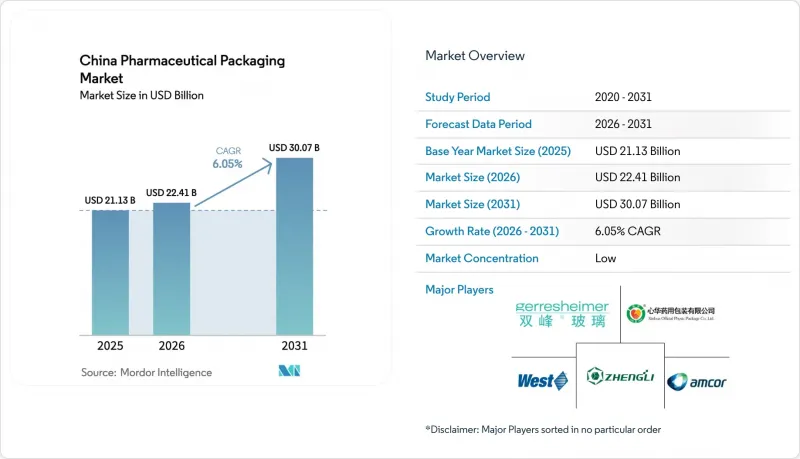
본 보고서는 포장 유형(1차 포장, 2차 포장, 3차 포장), 소재(플라스틱, 유리 등), 제형(고형 경구제, 주사제 등), 최종 사용자(제약 제조업체 등), 기술(기존, 무균·멸균 등) 및 지역별로 분류되어 있습니다. 시장 예측은 금액(달러) 기준으로 제시되어 있습니다.
중국 의약품 포장 시장 동향 및 인사이트
위조 의약품에 대한 엄격한 규제 강화
국가약품감독관리국(NMPA)이 제정한 전 유리제 주사기에 관한 YY 1001-2024 규격을 배경으로, 감독 관리의 범위는 유효 성분에서 포장의 각 층까지 확대되고 있습니다. 판매 단위별 일련번호 부여가 의무화됨에 따라 공급망의 불투명성이 해소되었으며, 주요 컨버터 기업들은 EU의 FMD(의약품 위조 방지 지침) 및 미국의 DSCSA(의약품 안전 추적법) 규정과 부합하는 상호 운용 가능한 추적·추적성 시스템 도입을 추진하고 있습니다. 상하이와 선전의 지방 당국은 블록체인을 활용한 통관 채널을 도입하여, 일련번호가 부여된 코드의 인증을 진행하면서 통관 시간을 단축하고 있습니다. 개방형 아키텍처 솔루션을 조기에 도입한 기업은 제품 리콜 발생 건수가 적어, 다국적 기업과 프리미엄 가격 협상이 가능해졌습니다. 반면, 중소기업은 초기 투자 및 유지비 부담으로 어려움을 겪고 있습니다. 기준을 충족하지 못하는 제품 라인 시장 퇴출로 인해 저가 공급 능력이 감소함에 따라, 중국 의약품 포장 시장에서 일련번호가 부여된 포장의 평균 판매 가격은 서서히 상승하고 있습니다.
국내 제네릭 의약품 및 바이오의약품 제조 거점 확대
중국 바이오의약품 시장 규모는 2024년에 6,506억 위안(915억 달러)을 넘어 2029년까지 2배로 성장할 것으로 예측되며, 이에 따라 범용 병에서 무균 배리어 시스템으로의 전환이 가속화되고 있습니다. 장쑤성, 산둥성, 광둥성 각 성에 형성된 클러스터는 벌크 수지 공급업체, 용기 가공업체, 충전·마감 공장이 동일한 거점에 집적되어 물류 비용을 절감하는 통합 공급망의 핵심을 담당하고 있습니다. Luye Pharma사의 지속형 주사제 ‘ERZOFRI(R)’가 미국 FDA의 승인을 획득한 것은 저온 보관을 견딜 수 있는 고리형 올레핀 폴리머 소재 주사기에 대한 국내 혁신 기업들 수요가 증가하고 있음을 뒷받침합니다. 다국적 기업들은 연구개발 인큐베이터 및 합작 투자를 통해 현지 사업 기반을 강화하고 있으며, 미국 및 EU 약전 기준 인증을 받은 포장 파트너를 둘러싼 경쟁이 치열해지고 있습니다. 그 결과 발생한 생산 능력 경쟁은 ISO 5 청정실 및 네스트형 바이알 트레이에 대한 설비 투자를 촉진하여, 중국 의약품 포장 시장의 성장 전망을 더욱 견고하게 하고 있습니다.
변동이 심한 석유계 원자재 가격이 플라스틱 포장 비용을 상승시키고 있다.
고밀도 폴리에틸렌(HDPE)의 2024년 평균 가격은 톤당 910달러였으나, 2025년에 500만 톤의 생산 능력이 새로 공급됨에 따라 가격 동향은 예측 불가능한 상황에 빠졌습니다. 동시에 PVC 수입 관세가 1%에서 5.5%로 인상되어 톤당 23달러의 비용 증가가 발생하며, 특수 필름 등급에 의존하는 가공업체들을 압박하고 있습니다. 환율 변동과 원유 가격의 급등락으로 인해 장기 수지 계약이 복잡해지고 있으며, 포장 제조업체들은 가능한 한 유리나 섬유 기판으로의 다각화를 강요받고 있습니다. 수지 가격 리스크를 헤지할 수 없는 제조업체들은 중국 의약품 포장 시장에서 이익률 하락에 직면하고 있습니다.
부문별 분석
1차 용기는 2025년에 61.88%의 점유율을 차지하며, 약물 전달 기능과 밀봉 기능이 융합됨에 따라 2031년까지 연평균 성장률(CAGR) 8.96%로 성장할 것으로 전망됩니다. SCHOTT Pharma의 TOPPAC 폴리머 주사기 시리즈는 2024년에 54%의 매출 성장을 기록하며, mRNA 백신에 적합한 고리형 올레핀 솔루션에 대한 수요가 증가하고 있음을 보여주고 있습니다. 중국 의약품 포장 시장에서 비경구 투여용 포장 분야에서는 중첩형 즉시 사용형 구성 덕분에 충전 및 마무리 공장에서의 무균 설정 시간이 단축되고 있습니다. 2차 및 3차 포장은 급성장하는 전자상거래(이커머스)에 발맞추어 진화하고 있습니다. 골판지 운송 상자에는 충격 센서가 내장되어 있어, 상하이 자유무역지대에 위치한 세계 수출 허브에서 소포 발송 기준을 준수할 수 있게 되었습니다.
2차 포장은 일련번호가 부여된 QR 코드 및 색상별로 구분된 물류 라벨에 따른 접이식 골판지 상자 수요에 힘입어 한 자릿수 중반의 성장률로 확대되고 있습니다. 3차 포장의 형태는 AI가 탑재된 스마트 세관 스캐너와 연동하여 팔레트의 통관을 신속하게 처리함으로써 보세 창고에서의 체류 수수료를 절감하고 있습니다. 이러한 변화들이 맞물리면서 1차 포장을 중심으로 한 혁신이 중국 의약품 포장 시장의 원동력으로 자리 잡고 있습니다.
2025년에는 비용 효율이 뛰어난 HDPE 병과 폴리프로필렌 블리스터에 힘입어 플라스틱이 50.05%의 점유율을 유지했습니다. 그러나 탄소 가격 제도와 병원의 친환경 조달 방침이 확산됨에 따라 섬유계 기판은 연평균 성장률(CAGR) 8.35%로 성장을 지속하고, 있습니다. DS Smith사의 ‘TailorTemp’ 쉬퍼는 성형 섬유가 열 성능을 저하시키지 않으면서도 CO₂ 배출량을 40% 절감할 수 있음을 입증하고 있습니다. 바이오의약품의 성장과 프리미엄 포지셔닝을 배경으로, 중국 의약품 포장 시장에서 유리 바이알 및 카트리지 시장 규모는 꾸준히 확대되고 있습니다.
차단 성능이 비용을 상회하는 경우, 알루미늄은 콜드 폼 블리스터에 여전히 필수적인 소재입니다. 중소기업들은 내습성을 저해하지 않으면서 다가오는 PFAS 금지 규제에 대응하기 위해 폴리(프로파일렌 카보네이트) 블렌드의 활용을 검토하고 있습니다. 따라서 중국의 전체 의약품 포장 시장에서는 소재 대체 결정에 있어 규제상의 역풍, 탄소 회계, 의약품 안정성 확보라는 요건 간의 균형이 이루어지고 있습니다.
기타 혜택:
- 엑셀 형식 시장 예측(ME) 시트
- 3개월간의 애널리스트 지원
자주 묻는 질문
목차
제1장 서론
제2장 조사 방법
제3장 주요 요약
제4장 시장 구도
제5장 시장 규모와 성장 예측
제6장 경쟁 구도
제7장 시장 기회와 향후 전망
JHS 26.09.11According to Mordor Intelligence, the China pharmaceutical packaging market size is expected to grow from USD 21.13 billion in 2025 to USD 22.41 billion in 2026 and is forecast to reach USD 30.07 billion by 2031 at 6.05% CAGR over 2026-2031.
This report is Segmented by Packaging Type (Primary Packaging, Secondary Packaging, Tertiary Packaging), Material (Plastics, Glass, and More), Drug Form (Solid Oral, Parenteral, and More), End-User (Pharma Manufacturers, and More), Technology (Conventional, Aseptic and Sterile, and More), and Geography. The Market Forecasts are Provided in Terms of Value (USD).
China Pharmaceutical Packaging Market Trends and Insights
Stringent Regulatory Clamp-Down on Counterfeit Medicines
Enhanced oversight now extends from active ingredients to every packaging layer, underpinned by the National Medical Products Administration's YY 1001-2024 standards for all-glass syringes. Mandatory serialization at each saleable unit has curtailed supply-chain opacity, prompting larger converters to install interoperable track-and-trace systems that harmonize with EU FMD and U.S. DSCSA rules. Provincial authorities in Shanghai and Shenzhen deploy blockchain-enabled customs channels that shorten clearance times while authenticating serialized codes. Early adopters of open architecture solutions record fewer product-recall incidents and negotiate premium pricing with multinational clients, whereas SMEs grapple with upfront investment and maintenance fees. Market exit of non-compliant lines removes low-price capacity, slowly lifting average selling prices for serialized packs in the China pharmaceutical packaging market.
Expansion of Domestic Generics and Biologics Manufacturing Base
China's biopharma value exceeded CNY 650.6 billion (USD 91.5 billion) in 2024 and is projected to double by 2029, fueling a pivot from commodity bottles toward sterile barrier systems. Provincial clusters in Jiangsu, Shandong, and Guangdong anchor integrated supply networks where bulk resin suppliers, container converters, and fill-finish plants co-locate to pare logistics cost. Luye Pharma's U.S. FDA clearance for ERZOFRI(R), a long-acting injectable, underscores domestic innovators' rising demand for cyclic olefin polymer syringes that resist low-temperature storage. Multinationals deepen local footprints through R&D incubators and joint ventures, intensifying competition for packaging partners certified to U.S. and EU pharmacopeia standards. The resulting capacity race spurs capex in ISO 5 cleanrooms and nested vial trays, fortifying growth prospects for the China pharmaceutical packaging market.
Volatile Petro-Feedstock Prices Inflating Plastic Pack Costs
High-density polyethylene averaged USD 910 per ton in 2024, but a 5 million-ton capacity influx in 2025 skews pricing unpredictably. Simultaneously, PVC import duties rose from 1% to 5.5%, adding USD 23 per ton and squeezing converters reliant on specialized film grades. Currency volatility and crude-oil price swings complicate long-term resin contracts, forcing packaging makers to diversify into glass or fiber substrates when feasible. Manufacturers unable to hedge resin exposure face shrinking margins within the China pharmaceutical packaging market.
Other drivers and restraints analyzed in the detailed report include:
- Ageing Population Driving Chronic-Care Drug Volumes
- Provincial Reimbursement Tilt Toward Patient-Friendly Formats
- Capex Burden of Serialisation/Anti-Counterfeit Lines for SMEs
For complete list of drivers and restraints, kindly check the Table Of Contents.
Segment Analysis
Primary containers captured 61.88% share in 2025 and are projected to grow at 8.96% CAGR through 2031 as drug-delivery functionality merges with containment. SCHOTT Pharma's TOPPAC polymer syringe range posted 54% sales growth in 2024, signaling appetite for cyclic olefin solutions suitable for mRNA vaccines.Within the China pharmaceutical packaging market size for parenteral packs, nested ready-to-use configurations lower aseptic setup time in fill-finish plants. Secondary and tertiary packs evolve alongside booming e-commerce; corrugated shippers integrate shock sensors, enabling parcel-ready compliance for global export hubs in Shanghai free-trade zones.
Secondary packs advance at mid-single-digit growth, propelled by folding-carton demand that accompanies serialized QR codes and color-coded logistics labels. Tertiary formats integrate with AI-enabled Smart Customs scanners that clear pallets faster, reducing in-bond detention fees. Collectively, these shifts entrench primary-pack-centric innovation as the engine of the China pharmaceutical packaging market.
Plastics retained 50.05% share in 2025, buttressed by cost-effective HDPE bottles and polypropylene blisters. Yet fiber substrates clock an 8.35% CAGR as carbon-pricing schemes and hospital green-procurement policies gain traction. DS Smith's TailorTemp shipper shows that molded-fiber can match thermal performance while trimming CO2 by 40%. The China pharmaceutical packaging market size for glass vials and cartridges expands steadily amid biologics growth and premium positioning.
Aluminum remains critical for cold-form blisters when barrier integrity outweighs cost. SMEs explore poly(propylene carbonate) blends to meet impending PFAS prohibitions without sacrificing moisture resistance. Material substitution decisions thus balance regulatory headwinds, carbon accounting, and drug-stability imperatives across the China pharmaceutical packaging market.
Complete Report Scope:
- By Packaging Type
- Primary Packaging
- Plastic Bottles (HDPE, PET)
- Blister Packs (PVC, Cold-form Alu)
- Pre-fillable Syringes
- Vials and Ampoules
- IV Containers
- Inhalers
- Others Primary Packaging
- Secondary Packaging
- Folding Cartons
- Corrugated Shippers
- Bags and Pouches
- Clamshells and Trays
- Tertiary Packaging
- Primary Packaging
- By Material
- Plastics
- Glass
- Aluminium Foil / Laminate
- Paper and Paperboard
- By Drug Form
- Solid Oral
- Parenteral
- Topical / Transdermal
- Inhalation
- Ophthalmic
- Other Drug Form
- By End-User
- Pharma Manufacturers
- Contract Manufacturing Organisations (CMOs)
- Hospitals and Clinics
- By Technology
- Conventional
- Aseptic and Sterile
- Smart and Connected (NFC/RFID)
- Anti-counterfeit / Serialisation
- Sustainable / Recyclable Solutions
List of Companies Covered in this Report:
- Amcor Plc
- Gerresheimer AG (Gerresheimer Shuangfeng)
- West Pharmaceutical Services Inc.
- Shandong Pharmaceutical Glass Co. Ltd
- Taishan Xinhua Pharmaceutical Packaging Co. Ltd
- SCHOTT AG
- Nipro PharmaPackaging
- AptarGroup Inc.
- Perlen Packaging (Suzhou) Co. Ltd
- Ningbo Zhengli Pharmaceutical Packaging
- Yuhuan Kang-jia Enterprise Co. Ltd
- Dongguan Fukang Plastic Products Co. Ltd
- Hangzhou Xunda Packaging Co. Ltd
- Jiangsu Hanlin Pharmaceutical Packaging
- Luoyang Dirante Pharmaceutical Packaging
- JOTOP Glass
- SGD Pharma
- Chongqing Zhengchuan Pharmaceutical Packaging
- Zhejiang B.I. Industrial Co. Ltd
- China National Pharmaceutical Packaging Corp.
Additional Benefits:
- The market estimate (ME) sheet in Excel format
- 3 months of analyst support
TABLE OF CONTENTS
1 INTRODUCTION
- 1.1 Study Assumptions and Market Definition
- 1.2 Scope of the Study
2 RESEARCH METHODOLOGY
3 EXECUTIVE SUMMARY
4 MARKET LANDSCAPE
- 4.1 Market Overview
- 4.2 Market Drivers
- 4.2.1 Stringent regulatory clamp-down on counterfeit medicines
- 4.2.2 Expansion of domestic generics and biologics manufacturing base
- 4.2.3 Ageing population driving chronic-care drug volumes
- 4.2.4 Provincial reimbursement tilt toward patient-friendly formats
- 4.2.5 Cross-border e-pharmacy boom needing parcel-ready packs
- 4.2.6 Carbon-neutrality targets boosting recyclable/biopolymer packs
- 4.3 Market Restraints
- 4.3.1 Volatile petro-feedstock prices inflating plastic pack costs
- 4.3.2 Capex burden of serialisation/anti-counterfeit lines for SMEs
- 4.3.3 Impending PFAS restrictions threatening blister film obsolescence
- 4.3.4 GMP packaging-design talent shortage slows innovation
- 4.4 Supply-Chain Analysis
- 4.5 Regulatory Landscape
- 4.6 Technological Outlook
- 4.7 Porter's Five Forces Analysis
- 4.7.1 Bargaining Power of Suppliers
- 4.7.2 Bargaining Power of Buyers
- 4.7.3 Threat of New Entrants
- 4.7.4 Threat of Substitutes
- 4.7.5 Intensity of Competitive Rivalry
- 4.8 Industry Ecosystem Analysis
- 4.9 Raw-Material Analysis
- 4.10 Recent Innovations and New Product Development
- 4.11 Emerging Trend Analysis and Key Success Factors
5 MARKET SIZE AND GROWTH FORECASTS (VALUE)
- 5.1 By Packaging Type
- 5.1.1 Primary Packaging
- 5.1.1.1 Plastic Bottles (HDPE, PET)
- 5.1.1.2 Blister Packs (PVC, Cold-form Alu)
- 5.1.1.3 Pre-fillable Syringes
- 5.1.1.4 Vials and Ampoules
- 5.1.1.5 IV Containers
- 5.1.1.6 Inhalers
- 5.1.1.7 Others Primary Packaging
- 5.1.2 Secondary Packaging
- 5.1.2.1 Folding Cartons
- 5.1.2.2 Corrugated Shippers
- 5.1.2.3 Bags and Pouches
- 5.1.2.4 Clamshells and Trays
- 5.1.3 Tertiary Packaging
- 5.1.1 Primary Packaging
- 5.2 By Material
- 5.2.1 Plastics
- 5.2.2 Glass
- 5.2.3 Aluminium Foil / Laminate
- 5.2.4 Paper and Paperboard
- 5.3 By Drug Form
- 5.3.1 Solid Oral
- 5.3.2 Parenteral
- 5.3.3 Topical / Transdermal
- 5.3.4 Inhalation
- 5.3.5 Ophthalmic
- 5.3.6 Other Drug Form
- 5.4 By End-User
- 5.4.1 Pharma Manufacturers
- 5.4.2 Contract Manufacturing Organisations (CMOs)
- 5.4.3 Hospitals and Clinics
- 5.5 By Technology
- 5.5.1 Conventional
- 5.5.2 Aseptic and Sterile
- 5.5.3 Smart and Connected (NFC/RFID)
- 5.5.4 Anti-counterfeit / Serialisation
- 5.5.5 Sustainable / Recyclable Solutions
6 COMPETITIVE LANDSCAPE
- 6.1 Market Concentration
- 6.2 Strategic Moves
- 6.3 Market Share Analysis
- 6.4 Company Profiles (includes Global-level Overview, Market-level Overview, Core Segments, Financials as available, Strategic Information, Market Rank/Share, Products and Services, Recent Developments)
- 6.4.1 Amcor Plc
- 6.4.2 Gerresheimer AG (Gerresheimer Shuangfeng)
- 6.4.3 West Pharmaceutical Services Inc.
- 6.4.4 Shandong Pharmaceutical Glass Co. Ltd
- 6.4.5 Taishan Xinhua Pharmaceutical Packaging Co. Ltd
- 6.4.6 SCHOTT AG
- 6.4.7 Nipro PharmaPackaging
- 6.4.8 AptarGroup Inc.
- 6.4.9 Perlen Packaging (Suzhou) Co. Ltd
- 6.4.10 Ningbo Zhengli Pharmaceutical Packaging
- 6.4.11 Yuhuan Kang-jia Enterprise Co. Ltd
- 6.4.12 Dongguan Fukang Plastic Products Co. Ltd
- 6.4.13 Hangzhou Xunda Packaging Co. Ltd
- 6.4.14 Jiangsu Hanlin Pharmaceutical Packaging
- 6.4.15 Luoyang Dirante Pharmaceutical Packaging
- 6.4.16 JOTOP Glass
- 6.4.17 SGD Pharma
- 6.4.18 Chongqing Zhengchuan Pharmaceutical Packaging
- 6.4.19 Zhejiang B.I. Industrial Co. Ltd
- 6.4.20 China National Pharmaceutical Packaging Corp.
7 MARKET OPPORTUNITIES AND FUTURE OUTLOOK
- 7.1 White-space and Unmet-need Assessment