

|
시장보고서
상품코드
2125751
ESG 소프트웨어 시장 : 시장 점유율 분석, 업계 동향 및 통계, 성장 예측(2026-2031년)ESG Software - Market Share Analysis, Industry Trends & Statistics, Growth Forecasts (2026 - 2031) |
||||||
 Mordor Intelligence
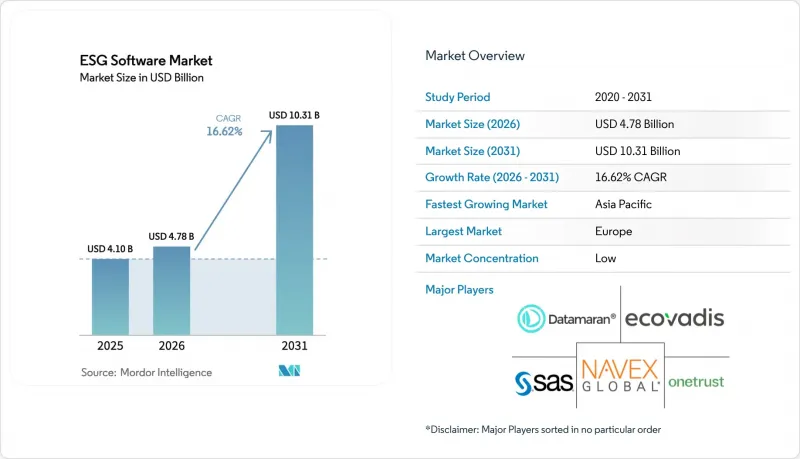
Mordor Intelligence에 의하면, 2026년 ESG 소프트웨어 시장 규모는 47억 8,000만 달러로 추정되고, 2025년 41억 달러에서 확대해, 2031년에는 103억 1,000만 달러에 이를 것으로 예측됩니다.
2026-2031년 연평균 성장률(CAGR) 16.62%를 기록하며 성장할 것으로 전망됩니다.
본 보고서에서는 산업을 제품 및 서비스별(솔루션, 서비스), 배포 방식별(클라우드, 온프레미스, 하이브리드), 조직 규모별(소규모 기업, 중견 기업, 대기업), 최종 사용자 산업별(은행, 금융서비스 및 보험(BFSI), IT 및 통신, 제조업, 소매 및 전자상거래, 헬스케어 및 생명과학, 정부·공공 부문, 기타), 지역별로 분류하고 있습니다. 시장 예측은 금액(달러)으로 표시되어 있습니다.
세계의 ESG 소프트웨어 시장 동향 및 인사이트
ESG 공시 표준화를 위한 규제 추진
세계 각국의 정책 입안자들은 지속가능성에 관한 규제를 조정하고 있으며, 기업들은 유럽의 CSRD, 미국의 SEC 기후변동 지침, 캘리포니아주 및 아시아태평양의 유사한 법규를 준수해야만 합니다. CSRD만 해도 보고 의무 대상이 5만 개사 이상으로 확대되었으며, 많은 레거시 시스템으로는 대응할 수 없는 이중 중요성 평가가 요구되고 있습니다. 이와 병행하여, SEC 규정에 따라 대규모 조기 제출 의무 기업은 2025 회계연도부터 스코프 1 및 스코프 2 배출량을 공개해야 하며, 여러 프레임워크를 지원하는 컴플라이언스 엔진에 대한 수요가 증가하고 있습니다(sec.gov). 미리 매핑된 공시 템플릿이나 감사 대응이 완료된 증거 저장소를 통합한 벤더는 특히 중복되는 프레임워크를 준수해야 하는 세계 다국적 기업들 사이에서 우선적인 파트너로 자리 잡고 있습니다.
투명성에 대한 투자자 및 이해관계자의 압력
기관 투자자들은 자본 접근을 상세한 ESG 성과 데이터와 연계하고 있습니다. 유럽 소매 은행업에 대한 조사에 따르면, 고객의 24%가 ESG 실적 미흡을 이유로 은행을 변경할 의사를 밝혔습니다. Digital Realty와 같은 기업은 이미 재생에너지 소비 비율 66%를 추적하고 있으며, 전용 소프트웨어를 사용하여 공급업체의 60%에 대해 ESG 위험 평가를 수행하고 있어, 실시간 대시보드가 이해관계자의 신뢰에 얼마나 큰 영향을 미치는지 보여주고 있습니다. 그린본드 발행액이 꾸준히 증가하고 있기 때문에 자동화된 투자자 보고 모듈과 재무 시스템과의 API 수준 연동은 CFO에게 필수적인 기능이 되었습니다.
레거시 시스템이 다수 존재하는 산업에서의 높은 도입 및 통합 비용
독자적인 제어 시스템을 채택하고 있는 제조업체의 경우, ESG 데이터 피드 도입에 따른 비용이 막대해집니다. 제조업체는 CSRD 및 SEC 요건을 충족하기 위해 인력을 확충하고 AI를 도입할 계획이지만, 초기 시범 프로젝트에서는 구식 데이터 아키텍처로 인한 예산 초과가 드러나고 있습니다. 병원은 EU 택소노미(EU Taxonomy)를 준수하기 위해 환자 관리 시스템과 배출량 계산 도구를 연동해야 하며, 이로 인해 IT 프로젝트의 범위가 더욱 확대되고 있습니다(envoria.com). 데이터센터를 업그레이드하는 유틸리티 회사들도 유사한 비용에 직면해 있습니다. 이는 현재 기술 리더의 89%가 조달 과정에서 지속가능성 지표를 우선시하고 있기 때문입니다. 통합에 시간이 오래 걸리고 맞춤형 커넥터 도입이 도입 지연을 초래하여 전반적인 연평균 성장률(CAGR)을 끌어내리고 있습니다.
부문 분석
2025년에는 솔루션이 매출의 대부분을 차지했으나, 통합, 자문, 관리형 보고 등의 서비스 계약은 2031년까지 연평균 성장률(CAGR) 18.06%로 확대될 전망입니다. 도입 프로젝트에서는 대부분의 경우 핵심 ESG 플랫폼에 탄소 회계, 제품 스튜어드십, 감사 모듈이 결합되어 있어, 이를 통해 수년에 걸친 컨설팅 계약에 대한 수요가 촉진되고 있습니다. 표준화된 제공 프레임워크를 갖춘 벤더는 도입 주기를 단축할 수 있으므로, ERP(전사적 자원 관리) 제품군을 개편하는 제조업체에게 매력적입니다. 한편, 기업들이 복잡한 공급업체 데이터 온보딩을 전문가에게 아웃소싱함에 따라 ESG 소프트웨어 시장의 통합 서비스 규모는 꾸준히 확대될 것으로 예측됩니다. 관리형 서비스는 여전히 신흥 틈새 시장이지만, 거버넌스 의무가 증가함에 따라 조직이 비용 절감을 위해 ‘서비스형 규정 준수(Compliance-as-a-Service)’로 전환함에 따라 수요가 증가할 것으로 예측됩니다.
부수적인 영향으로는 통합 활동의 활성화가 있습니다. 플랫폼 제공업체들은 소프트웨어 라이선스와 도입 역량을 세트로 제공하기 위해 전문성이 높은 컨설팅 회사를 점점 더 많이 인수하고 있습니다. 고객은 단일 공급자에 의한 책임의 명확성을 중시하고 있으며, 이로 인해 벤더는 규제, 산업 벤치마크, 보증 기준에 걸친 전문 지식의 폭을 넓혀야 하는 압박을 받고 있습니다. 예측 기간 동안 ESG 소프트웨어 시장에서는 종합적인 변혁 파트너십이 표준이 됨에 따라 제품과 전문 서비스의 경계가 모호해질 것으로 보입니다.
멀티테넌트형 클라우드가 여전히 주요 배포 모델인 반면, 정부의 조달 방침 및 데이터 상주 요건으로 인해 하이브리드 아키텍처에 대한 수요가 증가하고 있습니다. 하이브리드 배포에서 ESG 소프트웨어 시장 규모는 시나리오 계획을 위해 클라우드 분석을 활용하면서도 기밀 데이터를 온프레미스에 보관해야 하는 에너지 및 공공 서비스, 공공 기업에 의해 주도되어 가장 높은 CAGR을 나타낼 것으로 예측됩니다. 주권과 확장성의 균형을 맞추려는 조직들은 프라이빗 데이터센터나 주권형 클라우드 영역 전반에 걸쳐 워크로드를 오케스트레이션하는 컨테이너화된 마이크로서비스를 채택하고 있습니다. 이에 대응하여 소프트웨어 벤더들은 정책 기반 데이터 라우팅, 암호화, 제로 트러스트 프레임워크를 추가하고 있습니다.
구독 모델이 CSRD의 단계적 도입 일정과 부합하기 때문에 클라우드의 우위는 지속되고 있습니다. 소프트웨어 업그레이드를 통해 고객의 다운타임을 유발하지 않고 새로운 공시 템플릿이 통합됩니다. 이는 유럽이 유럽 지속가능성 보고 기준(ESRS)을 세분화하는 데 있어 매우 중요합니다. 스코프 1 배출량을 모니터링하는 IoT 센서 등 대량의 데이터를 수집하는 경우, 탄력적인 클라우드 스토리지를 활용함으로써 설비 투자를 피할 수 있습니다. ESG 소프트웨어 시장 점유율은 클라우드 선구 기업들에 계속 집중될 전망이지만, 다층적인 하이브리드 로드맵을 갖춘 기업들은 성장 속도가 빠르고 규제 영향을 쉽게 받는 업종에서 점유율을 확대되고 있습니다.
지역별 분석
유럽은 통일된 정책 프레임워크와 강력한 투자자들의 활동주의를 통해 리더십을 유지하고 있습니다. 2024년 1월부터 시행되는 CSRD는 플랫폼의 업데이트 및 확장 물결을 일으켰습니다. 프랑스, 독일, 북유럽 국가에 본사를 둔 다국적 기업들은 이중 중요성(double materiality) 결과를 매핑하는 통합형 제품군을 확대되고 있습니다. 따라서 유럽 관련 ESG 소프트웨어 시장 규모는 안정적이면서도 성숙한 성장세를 보이고 있습니다.
아시아태평양은 가장 급격한 성장 궤도를 보이고 있습니다. 중국은 2026년까지 300개 이상의 상장 기업에 지속가능성 보고서 제출을 의무화하고 있으며, 이에 따라 국내외 공급업체들이 표준화된 툴셋을 도입하고 있습니다. 싱가포르에서는 2025년에 모든 상장 기업에 대해 기후 변화 정보 공개가 의무화될 예정이며, 일본에서는 2025년에 HEROZ와 NZAM이 공동으로 출시한 사례가 보여주듯이, AI를 활용한 ESG 스코어링 도구가 추진되고 있습니다. 또한, 각국 정부가 그린 파이낸스 택소노미를 마련하고 있어, 국경을 넘는 투자자들은 공통된 데이터 정의를 강력히 요구하고 있으며, 이는 지역 간 수렴을 촉진하고 있습니다.
북미에서는 꾸준한 진전이 보이고 있습니다. SEC(미국 증권거래위원회)의 규정에 따라 상장기업은 스코프 1과 스코프 2의 추적을 자동화하도록 권장받고 있으며, 한편 캘리포니아주의 ‘기후 책임 포장’과 같은 주 차원의 노력으로 인해 공시 대상이 공급업체까지 확대되고 있습니다. 활기 넘치는 벤처 생태계가 AI를 중심으로 한 ESG 스타트업에 자금을 지원하고 있으며, Xcel Energy와 같은 전력 회사는 탄소 중립 공약을 달성하기 위해 탄소 모니터링 소프트웨어를 시험 운영 중입니다.
중동 및 아프리카는 여전히 발전 단계에 있지만, 특히 다각화 및 저탄소 전략을 추구하는 국부펀드와 국영 석유 회사들 사이에서 초기 단계의 관심이 나타나고 있습니다. 시범 프로젝트는 세계 자본 시장의 기대에 부응하는 것이 필수적인 걸프협력회의(GCC) 회원국에 집중되어 있습니다.
기타 혜택
- 엑셀 형식 시장 예측(ME) 시트
- 3개월간의 애널리스트 지원
자주 묻는 질문
목차
제1장 서론
제2장 조사 방법
제3장 주요 요약
제4장 시장 구도
제5장 시장 규모 및 성장 예측
제6장 경쟁 구도
제7장 시장 기회 및 향후 전망
AJY 26.09.15According to Mordor Intelligence, the ESG software market size in 2026 is estimated at USD 4.78 billion, growing from 2025 value of USD 4.1 billion with 2031 projections showing USD 10.31 billion, growing at 16.62% CAGR over 2026-2031.
This report Segments the Industry Into Offerings (Solution, Services), by Deployment (Cloud, On-Premise), by Enterprise (SMEs, Large Enterprises), by End-User Vertical (BFSI, IT and Telecom, Manufacturing, Retail and E-Commerce, Healthcare, Government, Other End-User Verticals), and by Geography. The Market Forecasts are Provided in Terms of Value (USD).
Global ESG Software Market Trends and Insights
Regulatory Push for Standardized ESG Disclosures
Global policymakers have synchronized sustainability rules, forcing firms to align with CSRD in Europe, SEC climate directives in the United States, and similar statutes in California and Asia-Pacific. The CSRD alone expands mandatory reporting to more than 50,000 companies, requiring double materiality assessments that many legacy systems cannot support. Parallel SEC rules oblige large accelerated filers to disclose Scope 1 and Scope 2 emissions starting with fiscal year 2025, intensifying demand for multi-framework compliance engines sec.gov. Vendors that embed pre-mapped disclosure templates and audit-ready evidence repositories have become preferred partners, especially among global multinationals navigating overlapping frameworks.
Investor & Stakeholder Pressure for Transparency
Institutional investors link access to capital with granular ESG performance data. European retail banking research indicates 24% of customers would switch banks over poor ESG credentials. Corporations such as Digital Realty already track 66% renewable energy consumption and evaluate 60% of their suppliers for ESG risks using dedicated software, signaling how real-time dashboards influence stakeholder confidence. Green bond volumes continue to climb, so automated investor reporting modules and API-level integrations with treasury systems have become must-have features for CFOs.
High Implementation & Integration Costs for Legacy-Heavy Industries
Industrial enterprises with proprietary control systems face steep expenses retrofitting ESG data feeds. Manufacturers expect to add staff and adopt AI to meet CSRD and SEC requirements, yet early pilots expose budget overruns tied to outdated data architectures. Hospitals must connect patient management systems with emissions calculators to comply with EU taxonomy, further inflating IT project scopes envoria.com. Utilities upgrading data centers confront similar costs because 89% of technology leaders now prioritize sustainability metrics in procurement. Long integration timelines and custom connectors slow adoption, dampening overall CAGR.
Other drivers and restraints analyzed in the detailed report include:
- Operational Efficiency Gains via Centralized ESG Data
- Rising Adoption of Cloud-Native ESG Platforms Among SMEs
- Data Quality & Fragmentation Across Global Supply Chains
For complete list of drivers and restraints, kindly check the Table Of Contents.
Segment Analysis
Solutions generated the majority of revenue in 2025, yet service engagements such as integration, advisory, and managed reporting are expanding at 18.06% CAGR through 2031. Implementation projects often pair core ESG platforms with carbon accounting, product stewardship, and audit modules, spurring demand for multi-year consulting contracts. Vendors with standardized delivery frameworks shorten deployment cycles, appealing to manufacturers retrofitting enterprise resource planning suites. Meanwhile, the ESG software market size for integration services is projected to climb steadily as firms outsource complex supplier data onboarding to domain specialists. Managed services remain an emerging niche, but rising governance obligations suggest an uptick as organizations pivot to "compliance-as-a-service" to control costs.
Second-order impacts include heightened consolidation activity: platform providers increasingly acquire boutique consultancies to bundle software licenses with delivery capacity. Clients value single-provider accountability, pushing vendors to broaden domain knowledge across regulations, industry benchmarks, and assurance standards. Over the forecast period, the ESG software market will likely blur the line between product and professional service as holistic transformation partnerships become standard.
Although multitenant cloud remains the primary deployment model, government procurement policies and data-residency requirements lift demand for hybrid architecture. The ESG software market size for hybrid deployments is set to record the fastest CAGR, driven by energy utilities and public firms that must retain sensitive data on-premise while leveraging cloud analytics for scenario planning. Organizations balancing sovereignty with scalability adopt containerized micro-services that orchestrate workloads across private data centers and sovereign cloud zones. Software vendors have responded by adding policy-based data routing, encryption, and zero-trust frameworks.
Cloud supremacy continues because subscription models align with CSRD phase-in schedules. Software upgrades integrate new disclosure templates without customer downtime, critical when Europe refines European Sustainability Reporting Standards. For high-volume data ingest-such as IoT sensors monitoring Scope 1 emissions-elastic cloud storage avoids capital outlay. ESG software market share will remain concentrated around cloud first movers; however, firms with multilayer hybrid roadmaps are capturing fast-growth, regulation-sensitive verticals.
Complete Report Scope:
- By Offering
- Solutions
- Sustainability Reporting and Disclosure Platforms
- Carbon Accounting Software
- Supply-Chain ESG Management
- Risk and Compliance Management
- Audit and Assurance Tools
- Services
- Implementation and Integration
- Consulting and Advisory
- Training and Support
- Managed Services
- Solutions
- By Deployment
- Cloud (SaaS)
- On-Premise
- Hybrid
- By Organization Size
- Large Enterprises (more than 1,000 employees)
- Mid-Sized Enterprises (250 to 999)
- Small Enterprises (less than 250)
- By Functionality
- Data Collection and Aggregation
- Materiality Assessment
- Analytics and Benchmarking
- Reporting and Disclosure Automation
- Scenario Analysis and Forecasting
- Stakeholder Engagement
- By End-User Industry
- BFSI
- IT and Telecom
- Manufacturing
- Automotive
- Chemicals and Materials
- Heavy Industry and Engineering
- Retail and E-commerce
- Healthcare and Life Sciences
- Energy and Utilities
- Government and Public Sector
- Others (Education, Hospitality, etc.)
- By Geography
- North America
- United States
- Canada
- Mexico
- South America
- Brazil
- Argentina
- Rest of South America
- Europe
- United Kingdom
- Germany
- France
- Italy
- Spain
- Netherlands
- Russia
- Rest of Europe
- Asia-Pacific
- China
- Japan
- India
- South Korea
- Australia and New Zealand
- ASEAN-5
- Rest of Asia-Pacific
- Middle East and Africa
- Israel
- Saudi Arabia
- United Arab Emirates
- Turkey
- Rest of Middle East
- Africa
- South Africa
- Nigeria
- Kenya
- Rest of Africa
- North America
Geography Analysis
Europe retains leadership owing to unified policy frameworks and strong investor activism. The CSRD, effective from January 2024, triggered a wave of platform renewals and expansions. Multinational corporations headquartered in France, Germany, and the Nordics scale up integrated suites that map double materiality outcomes. The ESG software market size attached to Europe thus shows stable yet mature expansion.
Asia-Pacific exhibits the steepest growth trajectory. China mandates sustainability reports for more than 300 listed entities by 2026, prompting local and foreign suppliers to adopt standardized toolsets. Singapore will require climate disclosures from all listed companies in 2025, and Japan promotes AI-driven ESG scoring agents, as demonstrated by HEROZ and NZAM's joint launch in 2025. Governments also establish green-finance taxonomies, so cross-border investors insist on common data definitions, driving regional convergence.
North America advances at a steady clip. SEC rules spur public companies to automate Scope 1 and Scope 2 tracking, while state-level initiatives-such as California's Climate Accountability Package-extend disclosure to suppliers. A thriving venture ecosystem funds AI-first ESG startups, and utilities like Xcel Energy pilot carbon-monitoring software to meet net-zero commitments.
The Middle East and Africa remain nascent but display early interest, especially among sovereign wealth funds and national oil companies pursuing diversification and low-carbon strategies. Pilot projects concentrate in Gulf Cooperation Council nations where compliance with global capital-market expectations becomes essential.
- Datamaran
- EcoVadis
- NAVEX
- SAS Institute
- OneTrust
- Coolset
- TruValue Labs (FactSet)
- Diligent
- Workiva
- Persefoni
- Sphera Solutions
- Enablon (Wolters Kluwer)
- Intelex
- Cority
- Plan A
- Greenstone
- IBM Envizi
- Salesforce (Net Zero Cloud)
- FigBytes
- ESG Book
- Novisto
- IsoMetrix
- Benchmark ESG (Gensuite)
Additional Benefits:
- The market estimate (ME) sheet in Excel format
- 3 months of analyst support
TABLE OF CONTENTS
1 INTRODUCTION
- 1.1 Study Assumptions and Market Definition
- 1.2 Scope of the Study
2 RESEARCH METHODOLOGY
3 EXECUTIVE SUMMARY
4 MARKET LANDSCAPE
- 4.1 Market Overview
- 4.2 Market Drivers
- 4.2.1 Regulatory push for standardized ESG disclosures
- 4.2.2 Investor and stakeholder pressure for transparency
- 4.2.3 Operational efficiency gains via centralized ESG data
- 4.2.4 Rising adoption of cloud-native ESG platforms among SMEs
- 4.2.5 AI-powered predictive analytics enabling proactive risk management
- 4.2.6 Tokenization and blockchain for immutable ESG data provenance
- 4.3 Market Restraints
- 4.3.1 High implementation and integration costs for legacy-heavy industries
- 4.3.2 Data quality and fragmentation across global supply chains
- 4.3.3 Shortage of in-house ESG expertise and change-management capability
- 4.3.4 Evolving standards causing solution re-architecture cycles
- 4.4 Regulatory Landscape
- 4.5 Technological Outlook
- 4.6 Porter's Five Forces
- 4.6.1 Bargaining Power of Suppliers
- 4.6.2 Bargaining Power of Buyers
- 4.6.3 Threat of New Entrants
- 4.6.4 Threat of Substitutes
- 4.6.5 Competitive Rivalry
- 4.7 Investment Analysis
- 4.8 Macroeconomic Impact Assessment
5 MARKET SIZE AND GROWTH FORECASTS (VALUE, USD)
- 5.1 By Offering
- 5.1.1 Solutions
- 5.1.1.1 Sustainability Reporting and Disclosure Platforms
- 5.1.1.2 Carbon Accounting Software
- 5.1.1.3 Supply-Chain ESG Management
- 5.1.1.4 Risk and Compliance Management
- 5.1.1.5 Audit and Assurance Tools
- 5.1.2 Services
- 5.1.2.1 Implementation and Integration
- 5.1.2.2 Consulting and Advisory
- 5.1.2.3 Training and Support
- 5.1.2.4 Managed Services
- 5.1.1 Solutions
- 5.2 By Deployment
- 5.2.1 Cloud (SaaS)
- 5.2.2 On-Premise
- 5.2.3 Hybrid
- 5.3 By Organization Size
- 5.3.1 Large Enterprises (more than 1,000 employees)
- 5.3.2 Mid-Sized Enterprises (250 to 999)
- 5.3.3 Small Enterprises (less than 250)
- 5.4 By Functionality
- 5.4.1 Data Collection and Aggregation
- 5.4.2 Materiality Assessment
- 5.4.3 Analytics and Benchmarking
- 5.4.4 Reporting and Disclosure Automation
- 5.4.5 Scenario Analysis and Forecasting
- 5.4.6 Stakeholder Engagement
- 5.5 By End-User Industry
- 5.5.1 BFSI
- 5.5.2 IT and Telecom
- 5.5.3 Manufacturing
- 5.5.3.1 Automotive
- 5.5.3.2 Chemicals and Materials
- 5.5.3.3 Heavy Industry and Engineering
- 5.5.4 Retail and E-commerce
- 5.5.5 Healthcare and Life Sciences
- 5.5.6 Energy and Utilities
- 5.5.7 Government and Public Sector
- 5.5.8 Others (Education, Hospitality, etc.)
- 5.6 By Geography
- 5.6.1 North America
- 5.6.1.1 United States
- 5.6.1.2 Canada
- 5.6.1.3 Mexico
- 5.6.2 South America
- 5.6.2.1 Brazil
- 5.6.2.2 Argentina
- 5.6.2.3 Rest of South America
- 5.6.3 Europe
- 5.6.3.1 United Kingdom
- 5.6.3.2 Germany
- 5.6.3.3 France
- 5.6.3.4 Italy
- 5.6.3.5 Spain
- 5.6.3.6 Netherlands
- 5.6.3.7 Russia
- 5.6.3.8 Rest of Europe
- 5.6.4 Asia-Pacific
- 5.6.4.1 China
- 5.6.4.2 Japan
- 5.6.4.3 India
- 5.6.4.4 South Korea
- 5.6.4.5 Australia and New Zealand
- 5.6.4.6 ASEAN-5
- 5.6.4.7 Rest of Asia-Pacific
- 5.6.5 Middle East and Africa
- 5.6.5.1 Israel
- 5.6.5.2 Saudi Arabia
- 5.6.5.3 United Arab Emirates
- 5.6.5.4 Turkey
- 5.6.5.5 Rest of Middle East
- 5.6.6 Africa
- 5.6.6.1 South Africa
- 5.6.6.2 Nigeria
- 5.6.6.3 Kenya
- 5.6.6.4 Rest of Africa
- 5.6.1 North America
6 COMPETITIVE LANDSCAPE
- 6.1 Market Concentration
- 6.2 Strategic Moves
- 6.3 Market Share Analysis
- 6.4 Company Profiles (includes Global level Overview, Market level overview, Core Segments, Financials as available, Strategic Information, Market Rank/Share for key companies, Products and Services, and Recent Developments)
- 6.4.1 Datamaran
- 6.4.2 EcoVadis
- 6.4.3 NAVEX
- 6.4.4 SAS Institute
- 6.4.5 OneTrust
- 6.4.6 Coolset
- 6.4.7 TruValue Labs (FactSet)
- 6.4.8 Diligent
- 6.4.9 Workiva
- 6.4.10 Persefoni
- 6.4.11 Sphera Solutions
- 6.4.12 Enablon (Wolters Kluwer)
- 6.4.13 Intelex
- 6.4.14 Cority
- 6.4.15 Plan A
- 6.4.16 Greenstone
- 6.4.17 IBM Envizi
- 6.4.18 Salesforce (Net Zero Cloud)
- 6.4.19 FigBytes
- 6.4.20 ESG Book
- 6.4.21 Novisto
- 6.4.22 IsoMetrix
- 6.4.23 Benchmark ESG (Gensuite)
7 MARKET OPPORTUNITIES AND FUTURE OUTLOOK
- 7.1 White-space and Unmet-Need Assessment


