

|
시장보고서
상품코드
2154241
북미의 폭동 진압 시스템 : 시장 점유율 분석, 업계 동향과 통계, 성장 예측(2026-2031년)North America Riot Control System - Market Share Analysis, Industry Trends & Statistics, Growth Forecasts (2026 - 2031) |
||||||
 Mordor Intelligence
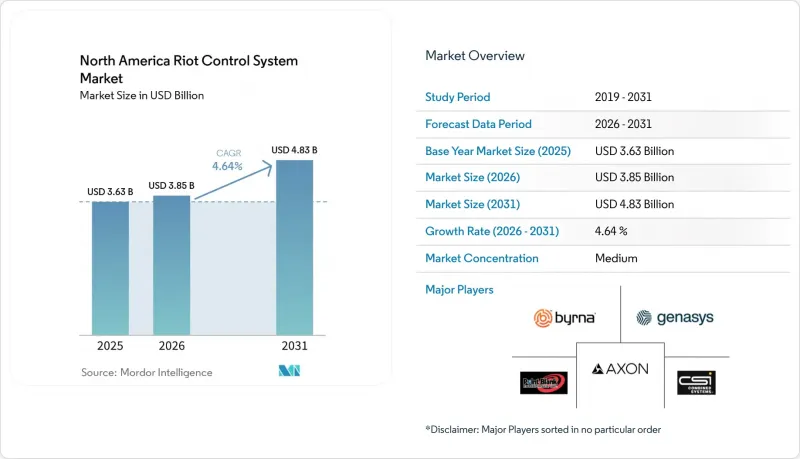
에 따르면 북미의 폭동 진압 시스템 시장 규모는 2026년에 38억 5,000만 달러로 평가되어 예측 기간(2026-2031년)에 CAGR 4.64%로 추이하며, 2031년까지 48억 3,000만 달러에 달할 것으로 추정되고 있습니다.
북미 폭동 진압 시스템 시장의 동향 및 인사이트
격화되는 시민의 소요 사태가 당국의 조달 일정을 재편하게 만들었습니다.
북미 폭동 진압 시스템 시장은 시위 건수 증가와 시위 활동의 지역적 확산에 힘입어 성장하고 있습니다. Crowd Counting Consortium의 기록에 따르면 2025년 미국의 시위 건수는 1만 700건 이상에 달해, 2017년의 4,588건에 비해 133% 증가했습니다. 이 컨소시엄은 또한 2025년 6월까지 미국 카운티의 60% 이상에서 시위가 확인되었다고 보고했습니다. ACLED의 기록에 따르면 2025년 8월에는 1,500건 이상의 시위 사건이 발생했으며, 이러한 활동은 로스앤젤레스, 시카고, 뉴어크에서 진행된 이민 단속 작전을 중심으로 집중되었습니다. 소모성 탄약의 대량 사용으로 인해 일반적인 연간 조달 주기가 끝나기 전에 재고가 고갈될 가능성이 있습니다. 따라서 시위가 기존 대도시권을 넘어 확대될 경우, 소규모 교외 및 지방 법 집행 기관은 처음으로 초급 수준의 방호 장비와 비살상 발사 장치의 필요성에 직면하게 될 것입니다.
연방 및 주 정부의 자금 지원으로 인해 향후 수년에 걸친 조달 여력이 생길 것입니다.
연방 및 주 정부의 자금 지원으로 인해 장비 교체 지연이 완화되면, 북미의 시위 진압 시스템 시장은 혜택을 볼 것입니다. 연방 의회는 2026 회계연도 법무부(DOJ) 보조금 삭감 폭을 1%로 제한하여, 당초 15% 삭감안에서 수정하고 형사 사법 보조금으로 48억 4,000만 달러를 유지했습니다. COPS(지역사회 경찰 서비스)의 2026 회계연도 기술 및 장비 프로그램에서는 미국 국립표준기술연구소(NIST)의 요건을 충족하는 법 집행 기관용 장비 및 기술에 대해 경쟁 없는 초청형 보조금으로 4억 141만 달러가 제공됩니다. 개별 보조금 규모는 최대 2,000만 달러에 달하며, 특정 제품의 단순한 교체가 아닌 통합적인 조달을 지원합니다. 캐나다에서는 2026년 4월, 전국경찰연맹이 RCMP(캐나다 왕립기마경찰)에 영향을 미치고 있는 노후화된 장비와 단편적인 조달로 인한 예산 초과 문제를 해결하기 위해 ‘공공안전 조달 전략’ 및 ‘사무국’의 설치를 요구했습니다. 개혁 과정을 통해 각 기관이 축적된 장비 수요에 대응함에 따라 집중적인 갱신 주기가 형성될 가능성이 있습니다.
인권 측면에서의 면밀한 검토가 특정 제품 범주를 제약
북미의 시위 진압 시스템 시장은 장비가 피할 수 있는 부상이나 관리가 미흡한 배치와 관련되어 있을 경우, 더욱 엄격한 감시를 받고 있습니다. '의사 인권 옹호 단체(Physicians for Human Rights)'와 캘리포니아 대학교 버클리 캠퍼스 인권 센터는 2025년 6월부터 2026년 5월까지 미국 16개 도시에서 발생한 군중 통제 무기 오용과 관련된 412건의 확인된 사례를 기록했습니다. 이 조사에서는 실명 및 외상성 뇌 손상을 포함한 203건의 부상이 기록되었으며, 그 중 64%가 국토안보부(DHS) 산하 기관에 의해 발생한 것으로 보고되었습니다. 산탄식 발사체나 집중형 화학 탄약은 전기 충격이나 음향 시스템에 비해 법적 규제 및 평판상의 위험이 높아지고 있습니다. 또한 PHR의 조사에 따르면 2025년 여름 로스앤젤레스에서 열린 ICE(이민·관세 집행국) 반대 시위에서 100명 가까운 언론인이 비살상 무기로 사격을 받은 것으로 밝혀졌습니다. 각 기관이 기존의 광범위 살포형 무기에서 전환해 나가는 가운데, 정밀도가 높고 규제를 준수하는 제품을 제조하는 제조사는 더 유리한 입지를 차지할 가능성이 있습니다.
부문 분석
2025년, 북미 폭동 진압 시스템 시장에서 공격용 장비가 59.63%의 점유율을 차지했습니다. 이는 동적 탄약, 지역 차단 시스템(Area Denial System), 전기 충격 장치의 보충에 힘입은 결과입니다. 연방 기관들은 이러한 제품을 높은 빈도로 사용하고 있으며, 소모품의 반복적인 구매가 발생하고 있습니다. 미국 세관·국경보호청(CBP)은 123가지 제품 유형에 걸쳐 비치명적 특수 탄약을 요구하고 있으며, 예상 조달량은 화약통 24만 2,000개 이상, 충격탄 10만개 이상입니다. 공격용 장비 중에서는 지향성 에너지 및 전기 충격 플랫폼이 가장 활발한 하위 범주로 자리 잡고 있습니다. ICE의 G.L.O.V.E. 구매나 해군의 비치명적 교란 수류탄 조달 등은 조직 차원에서 저치명성 툴에 대한 관심을 반영하고 있습니다. 가스 및 스프레이의 경우, 오용 사례가 보고됨에 따라 더욱 엄격한 감시 대상이 되고 있습니다. 이에 따라 제품 개발은 보다 정밀한 분사 방식과 더욱 명확한 안전 관리 방향으로 나아가고 있습니다.
개인용 보호 장비는 북미 폭동 진압 시스템 시장에서 가장 빠르게 성장하는 제품 카테고리이며, 2026-2031년까지 연평균 성장률(CAGR) 5.92%로 확대될 것으로 예측됩니다. 경찰관의 안전 확보에 관한 의무는 국경 경비 역할로도 확대되고 있는 반면, 인증 요건으로 인해 각 기관은 기준을 충족하지 않는 장비를 교체해야 합니다. 인증 절차에는 18-24개월이 소요될 수 있으며, 이는 Point Blank Enterprises, Blackhawk, United Tactical Supply와 같은 미국의 유서 깊은 공급업체들에게 유리하게 작용합니다. 아라미드 섬유의 납기 지연으로 인해 공급업체들은 장기적인 섬유 공급 계약을 확실히 체결한 기업과 주문 이동이 지연되고 있는 기업으로 양분되고 있습니다. 2026년 7월의 국방 공급망에 관한 대통령령은 주요 계약업체들에게 원자재부터 완제품에 이르는 핵심 공급망을 가시화하도록 지시하고 있습니다. 이에 따라 향후 3-5년 동안 방탄 복합재료의 국내 조달을 위한 노력이 강화될 가능성이 있습니다.
기타 혜택:
- 엑셀 형식의 시장 예측(ME) 시트
- 3개월간의 애널리스트 지원
자주 묻는 질문
목차
제1장 서론
- 조사 전제조건과 시장 정의
- 조사 방법
제2장 조사 방법
제3장 개요
제4장 시장 구도
- 시장 개요
- 시장 성장 촉진요인
- 시장 성장 억제요인
- 밸류체인 분석
- 규제 상황
- 기술 전망
- Porter's Five Forces 분석
제5장 시장 규모와 성장 예측
- 제품 유형별
- 최종사용자별
- 기술별
- 지역별
- 미국
- 캐나다
- 멕시코
제6장 경쟁 구도
- 시장 집중도
- 전략적 동향
- 시장 점유율 분석
- 기업 개요
- Axon Enterprise Inc.
- Safariland, LLC
- Combined Systems, Inc.
- EDGE Group PJSC
- Genasys, Inc.
- Pacem Solution International, LLC
- Rheinmetall AG
- Desert Wolf
- Etienne Lacroix Group
- Revelyst, Inc.
- NonLethal Technologies, Inc.
- FN HERSTAL(FN Browning Group)
- Katmerciler A.S.
- STREIT Group
- Byrna Technologies Inc.
- United Tactical Supply
- Point Blank Enterprises, Inc.
제7장 시장 기회와 향후 전망
KSAAccording to Mordor Intelligence, the North America riot control system market size was valued at USD 3.85 billion in 2026 and is estimated to reach USD 4.83 billion by 2031, at a 4.64% CAGR during the forecast period (2026-2031).
North America Riot Control System Market Trends and Insights
Escalating Civil Unrest Reshapes Agency Procurement Timelines
The North America riot control system market is supported by a higher volume of demonstrations and a broader geographic spread of protest activity. The Crowd Counting Consortium recorded more than 10,700 protests in the US during 2025, 133% higher than the 4,588 it recorded in 2017. The Consortium also reported activity in more than 60% of US counties by June 2025. ACLED recorded more than 1,500 demonstration events during August 2025, with activity concentrated around immigration-enforcement operations in Los Angeles, Chicago, and Newark. Heavy use of consumable munitions can exhaust inventories before a normal annual procurement cycle ends. Smaller suburban and rural agencies, therefore, face a need for entry-level protective equipment and less-lethal launchers for the first time when demonstrations expand beyond established metropolitan locations.
Federal and Provincial Funding Creates Multi-Year Procurement Runway
The North America riot control system market benefits when federal and provincial funding reduces delays in equipment renewal. Congress limited reductions in FY2026 DOJ grant funding to 1%, retaining USD 4.84 billion in criminal justice grants after an initial 15% reduction proposal. The COPS FY2026 Technology and Equipment Program provides USD 401.41 million in noncompetitive invitational grants for law-enforcement equipment and technology that meets National Institute of Standards and Technology requirements. Individual awards can reach USD 20 million, supporting integrated purchases rather than narrow product replacements. In Canada, the National Police Federation called in April 2026 for a Public Safety Procurement Strategy and Secretariat to address expired equipment and fragmented procurement overruns affecting the RCMP. A reform process could produce a concentrated replacement cycle as agencies address accumulated equipment needs.
Human-Rights Scrutiny Constrains Specific Product Categories
The North America riot control system market faces tighter scrutiny when equipment is associated with preventable injuries or poorly controlled deployments. Physicians for Human Rights and the UC Berkeley Human Rights Center documented 412 verified incidents of crowd-control weapon misuse across 16 US cities from June 2025 through May 2026. The review documented 203 injuries, including blindings and traumatic brain injuries, and reported that DHS agencies accounted for 64% of incidents. Scattershot projectiles and concentrated chemical munitions face greater legislative and reputational exposure than electroshock or acoustic systems. PHR also found that nearly 100 journalists were shot with less-lethal weapons during Los Angeles anti-ICE protests in the summer of 2025. Manufacturers of precise, compliant products may be better placed as agencies move away from legacy bulk-dispersal tools.
Other drivers and restraints analyzed in the detailed report include:
- Non-Lethal Preference Reshapes Procurement Doctrine
- Border-Security Spill-Over Expands the Addressable Market
- High Costs and Lifecycle Economics Exclude Smaller Agencies
For complete list of drivers and restraints, kindly check the Table Of Contents.
Segment Analysis
Offensive equipment held 59.63% of the North America riot control system market share in 2025, supported by replenishment of kinetic munitions, area-denial systems, and electroshock devices. Federal agencies use these products at a high operational tempo, which creates repeat purchases of consumable equipment. CBP sought less-lethal specialty munitions across 123 product types, with projected volumes above 242,000 pyrotechnic canisters and 100,000 impact munitions. Directed-energy and electroshock platforms are the most active subcategories within offensive equipment. ICE's G.L.O.V.E. purchase and the Navy's non-lethal diversionary grenade procurement reflect institutional interest in lower-lethality tools. Gases and sprays face greater scrutiny after documented misuse incidents. This is directing product development toward more precise dispersal methods and clearer safety controls.
Personal protective equipment is the fastest-growing product category in the North America riot control system market and is projected to expand at a 5.92% CAGR from 2026 to 2031. Officer-safety mandates are extending into border-enforcement roles, while certification requirements require agencies to replace noncompliant equipment. The qualification process can take 18-24 months, which favors established US suppliers such as Point Blank Enterprises, Blackhawk, and United Tactical Supply. Extended aramid-fiber lead times divide suppliers into those with secure long-term fiber agreements and those with delayed order fulfillment. The July 2026 executive order on defense supply chains directs prime contractors to map critical supply chains from raw materials to finished products. This can strengthen domestic sourcing efforts for ballistic composites over the next 3-5 years.
Complete Report Scope:
- By Product Type
- Personal Protective Equipment
- Vests
- Helmets
- Gas Masks
- Shields
- Offensive Equipment
- Area Denial
- Anti-vehicle
- Anti-personnel
- Ammunition
- Rubber Bullets
- Wax Bullets
- Plastic Bullets
- Bean Bag Rounds
- Sponge Grenades
- Explosives
- Flashbang Grenades
- Sting Grenades
- Gases and Sprays
- Water Cannons
- Scent-based Weapons
- Tear Gas
- Pepper Spray
- Directed Energy Weapons
- Electro-shock Weapons
- Other Offensive Equipment
- Area Denial
- Personal Protective Equipment
- By End-User
- Law Enforcement
- Special Forces
- By Technology
- Electronic and Sonic Weapons
- Kinetic Impact Weapons
- Chemical Agents
- Others
- By Geography
- United States
- Canada
- Mexico
List of Companies Covered in this Report:
- Axon Enterprise Inc.
- Safariland, LLC
- Combined Systems, Inc.
- EDGE Group PJSC
- Genasys, Inc.
- Pacem Solution International, LLC
- Rheinmetall AG
- Desert Wolf
- Etienne Lacroix Group
- Revelyst, Inc.
- NonLethal Technologies, Inc.
- FN HERSTAL (FN Browning Group)
- Katmerciler A.S.
- STREIT Group
- Byrna Technologies Inc.
- United Tactical Supply
- Point Blank Enterprises, Inc.
Additional Benefits:
- The market estimate (ME) sheet in Excel format
- 3 months of analyst support
TABLE OF CONTENTS
1 INTRODUCTION
- 1.1 Study Assumptions and Market Definition
- 1.2 Research Methodology
2 RESEARCH METHODOLOGY
3 EXECUTIVE SUMMARY
4 MARKET LANDSCAPE
- 4.1 Market Overview
- 4.2 Market Drivers
- 4.2.1 Escalating civil unrest and protest frequency
- 4.2.2 Federal and provincial funding boosts for law-enforcement modernization
- 4.2.3 Preference for non-lethal options to reduce liability and fatalities
- 4.2.4 Border-security spill-over procurement for crowd-control gear
- 4.2.5 AI-enabled situational-awareness platforms bundled with gear sales
- 4.2.6 Climate-protest surge creating demand spikes for mobile gear inventory
- 4.3 Market Restraints
- 4.3.1 Intensifying human-rights and legal scrutiny on use-of-force tools
- 4.3.2 High up-front and lifecycle costs of next-gen equipment
- 4.3.3 Section 889 import restrictions limiting electronics sourcing
- 4.3.4 Advanced-composite material supply bottlenecks extending lead-times
- 4.4 Value Chain Analysis
- 4.5 Regulatory Landscape
- 4.6 Technological Outlook
- 4.7 Porter's Five Forces Analysis
- 4.7.1 Threat of New Entrants
- 4.7.2 Bargaining Power of Suppliers
- 4.7.3 Bargaining Power of Buyers
- 4.7.4 Threat of Substitutes
- 4.7.5 Intensity of Competitive Rivalry
5 MARKET SIZE AND GROWTH FORECASTS (VALUE)
- 5.1 By Product Type
- 5.1.1 Personal Protective Equipment
- 5.1.1.1 Vests
- 5.1.1.2 Helmets
- 5.1.1.3 Gas Masks
- 5.1.1.4 Shields
- 5.1.2 Offensive Equipment
- 5.1.2.1 Area Denial
- 5.1.2.1.1 Anti-vehicle
- 5.1.2.1.2 Anti-personnel
- 5.1.2.2 Ammunition
- 5.1.2.2.1 Rubber Bullets
- 5.1.2.2.2 Wax Bullets
- 5.1.2.2.3 Plastic Bullets
- 5.1.2.2.4 Bean Bag Rounds
- 5.1.2.2.5 Sponge Grenades
- 5.1.2.3 Explosives
- 5.1.2.3.1 Flashbang Grenades
- 5.1.2.3.2 Sting Grenades
- 5.1.2.4 Gases and Sprays
- 5.1.2.4.1 Water Cannons
- 5.1.2.4.2 Scent-based Weapons
- 5.1.2.4.3 Tear Gas
- 5.1.2.4.4 Pepper Spray
- 5.1.2.5 Directed Energy Weapons
- 5.1.2.6 Electro-shock Weapons
- 5.1.2.7 Other Offensive Equipment
- 5.1.2.1 Area Denial
- 5.1.1 Personal Protective Equipment
- 5.2 By End-User
- 5.2.1 Law Enforcement
- 5.2.2 Special Forces
- 5.3 By Technology
- 5.3.1 Electronic and Sonic Weapons
- 5.3.2 Kinetic Impact Weapons
- 5.3.3 Chemical Agents
- 5.3.4 Others
- 5.4 By Geography
- 5.4.1 United States
- 5.4.2 Canada
- 5.4.3 Mexico
6 COMPETITIVE LANDSCAPE
- 6.1 Market Concentration
- 6.2 Strategic Moves
- 6.3 Market Share Analysis
- 6.4 Company Profiles (includes Global level Overview, Market level Overview, Core Segments, Financials as available, Strategic Information, Market Rank/Share for key companies, Products and Services, and Recent Developments)
- 6.4.1 Axon Enterprise Inc.
- 6.4.2 Safariland, LLC
- 6.4.3 Combined Systems, Inc.
- 6.4.4 EDGE Group PJSC
- 6.4.5 Genasys, Inc.
- 6.4.6 Pacem Solution International, LLC
- 6.4.7 Rheinmetall AG
- 6.4.8 Desert Wolf
- 6.4.9 Etienne Lacroix Group
- 6.4.10 Revelyst, Inc.
- 6.4.11 NonLethal Technologies, Inc.
- 6.4.12 FN HERSTAL (FN Browning Group)
- 6.4.13 Katmerciler A.S.
- 6.4.14 STREIT Group
- 6.4.15 Byrna Technologies Inc.
- 6.4.16 United Tactical Supply
- 6.4.17 Point Blank Enterprises, Inc.
7 MARKET OPPORTUNITIES AND FUTURE OUTLOOK
- 7.1 White-space and Unmet-Need Assessment


