

|
시장보고서
상품코드
2154313
기업 AI 지식 운영 : 시장 점유율 분석, 업계 동향과 통계, 성장 예측(2026-2031년)Enterprise AI Knowledge Operations - Market Share Analysis, Industry Trends & Statistics, Growth Forecasts (2026 - 2031) |
||||||
 Mordor Intelligence
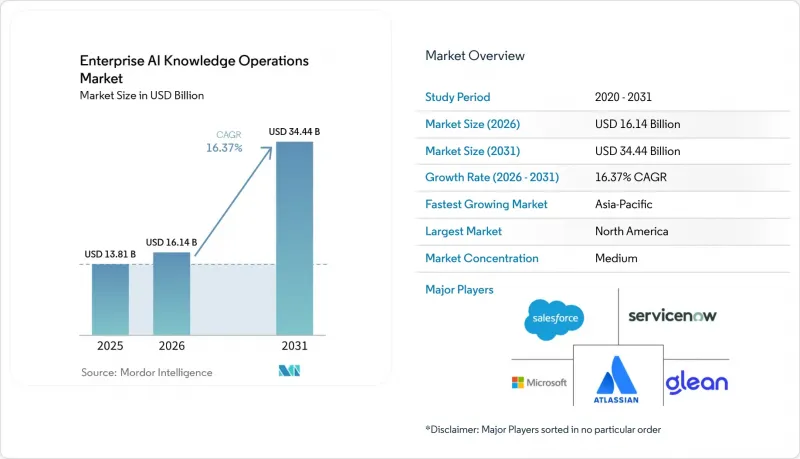
에 따르면 기업 AI 지식 오퍼레이션 시장 규모는 2025년 138억 1,000만 달러, 2026년 161억 4,000만 달러에서 2031년까지 344억 4,000만 달러로 확대할 것으로 예측되고 있으며, 2026-2031년까지 연평균 성장률(CAGR)은 16.37%에 달할 전망입니다.
글로벌 기업 AI 지식 운영 시장의 동향 및 인사이트
SaaS 스택 전반에 걸친 기업 지식의 파편화
SaaS 애플리케이션이 추가될 때마다 조직 내에 새로운 지식 사일로가 발생할 수 있습니다. 직원들은 하나의 업무를 수행하는 과정에서 프로젝트 트래커, 문서 저장소, 고객 시스템, 사내 메시징 툴, 공유 작업 공간 등에서 정보를 필요로 하는 경우가 많습니다. 이러한 시스템 간 정보 요청의 경우, 반복적으로 검색을 수행하거나 수동으로 비교하거나, 정보의 저장 위치를 알고 있는 동료의 도움을 받아야 합니다. 이러한 분산 현상은 개별 검색 툴이 아닌 공유된 검색 레이어를 필요로 하므로 기업 AI 지식 운영 시장의 가치를 높이고 있습니다. Glean사는 자사 플랫폼이 275개 이상의 앱 커넥터를 지원한다고 밝혔으며, 이는 벤더가 광범위한 기업 지원에 중점을 두고 있음을 반영합니다. 일원적으로 색인화된 시스템은 조직이 시간이 지남에 따라 툴, 사용자, 컨텐츠를 추가해 나가는 과정에서 정보 접근성을 개선할 수 있습니다. 애플리케이션마다 개별 에이전트를 사용하면, 본래 해결해야 했던 단편화가 다시 발생할 가능성이 있습니다.
권한을 고려한 시맨틱 검색과 근거에 기반한 답변
시맨틱 검색은 키워드 일치에만 의존하지 않고, 요청의 의미를 해석합니다. 또한 기업에서는 정보가 사용자나 에이전트에게 전달되기 전에 검색 과정에서 접근 권한을 적용해야 합니다. 이러한 요구 사항은 특히 정보 공개가 중대한 결과를 초래할 수 있는 규제 환경에서 기업 AI 지식 운영 시장의 기준을 높이고 있습니다. Amazon Bedrock Managed Knowledge Base는 문서 수준의 접근 제어와 실시간 접근 제어 리스트(ACL) 확인 기능을 갖추고 있으며, 2026년 6월에 일반 제공이 시작되었습니다. 승인되고 버전 관리가된 자료를 바탕으로 답변을 구성함으로써, 조직은 답변의 근거를 평가하고 그 출처를 파악하기가 더 쉬워집니다. 또한 이를 통해 접근 권한 적용이 검색 후에 별도로 적용되는 제어가 아니라, 플랫폼 설계의 핵심이 됩니다.
AI 생성 답변의 ‘환각’ 위험과 신뢰성의 한계
‘환각’ 현상으로 인해 최신 정보나 검증된 정보로 지원되지 않음에도 불구하고 그럴듯한 답변이 생성될 가능성이 있습니다. 이러한 위험 때문에 기반 없는 조언이 의사결정에 영향을 미칠 수 있는 금융, 법무, 임상 또는 업무 프로세스에서 지식 툴을 사용할 때 기업은 신중을 기하고 있습니다. 따라서 기업 AI 지식 운영 시장에서는 사용자가 각 답변을 검증하고, 그 출처를 파악하며, 불확실성을 인식할 수 있는지 여부에 대한 과제를 해결해야 합니다. 인용을 기반으로 한 검색이나 신뢰도 임계값을 설정함으로써, 시스템이 불확실한 컨텐츠를 확립된 사실로 제시하는 것을 방지할 수 있습니다. 지식 시스템은 반환되는 결과의 수나 응답의 유창성뿐만 아니라, 추적 가능성과 감사 가능성 측면에서도 평가받게 되었습니다. 플랫폼이 답변 생성 과정이나 사용자가 정보원에 대한 접근 권한을 가지고 있는지 여부를 보여줄 수 없는 경우, 이러한 요건들이 도입의 걸림돌이 될 수 있습니다.
부문 분석
2025년, 기업 AI 지식 운영 시장의 매출 중 소프트웨어 플랫폼이 72.83%를 차지했습니다. 기업은 애플리케이션별로 개별적인 관리가 필요한 것이 아니라, 단일 거버넌스 계층을 통해 여러 사용 사례를 처리할 수 있는 중앙 집중식 및 구성 가능한 검색 시스템을 선호합니다. 시스템이 관련 조직적 맥락을 통합할 수 있으므로 연결된 각 애플리케이션은 더 많은 사용자와 워크플로우에 대해 공유 인덱스의 유용성을 높일 수 있습니다. Atlassian의 보고서에 따르면 Rovo는 50개 이상의 연결된 SaaS 애플리케이션을 인덱싱했습니다. 개별 툴을 사용할 경우 관리 작업이 중복되거나, 결과의 일관성이 떨어지거나, 사용자가 어떤 시스템에 최신 정보가 포함되어 있는지 판단하기 어려워질 가능성이 있으므로 기업 AI 지식 운영 업계에서는 이 공유 인덱스 모델이 채택되고 있습니다.
기업 AI 지식 운영 시장에서 해당 서비스는 2031년까지 연평균 성장률(CAGR) 16.78%로 확대될 것으로 예측됩니다. 기업은 레거시 저장소를 연동하고, 시스템 간 권한을 동기화하며, 지속적인 컨텐츠 유지 관리를 위한 실효성 있는 책임 체계를 정의해야 하므로 도입 작업은 여전히 중요합니다. 매니지드 운영은 초기 도입 완료 후 컨텐츠 업데이트, 인덱스 관리, 거버넌스 검토 및 사용자 지원도 지원합니다. 이러한 요구로 인해 서비스는 일회성 기술적 설정이 아닌, 다수의 벤더와의 관계에서 지속적인 요소가 되고 있습니다. 파트너를 활용한 제공 체계를 갖춘 벤더는 특히 고객이 여러 사업 부문이나 지역에 걸쳐 사업을 운영하고 있는 경우, 사내 컨설팅 팀에만 의존하는 벤더보다 더 광범위한 도입을 지원할 수 있습니다.
2025년에는 클라우드가 매출의 56.28%를 차지할 것으로 예상되며, 2031년까지 연평균 성장률(CAGR) 17.25%로 확대될 것으로 전망됩니다. 클라우드 플랫폼을 통해 고객은 프로비저닝 관리가 필요 없어지며, 대규모 사내 업그레이드 프로젝트를 수행하지 않고도 검색 모델, 소스 커넥터, 보안 기능에 대한 지속적인 업데이트를 제공할 수 있습니다. Amazon Bedrock Managed Knowledge Base는 2026년 6월에 일반 제공이 시작되었으며, Amazon S3, SharePoint, Confluence, Google Drive, OneDrive 및 웹 컨텐츠용 커넥터가 제공되고 있습니다. 이러한 기능을 통해 기업 AI 지식 운영 시장에서의 초기 도입 부담을 줄일 수 있습니다. 특히 일반적인 정보 소스를 신속하게 연결하고자 하는 조직에 유용합니다. 또한 매니지드 서비스 내에서 에이전트형 검색 및 문서 수준 액세스 제어 기능도 지원합니다.
클라우드 점유율이 확대되고 있음에도 불구하고 온프레미스 및 하이브리드 옵션은 여전히 전략적으로 중요합니다. 데이터 주권에 관한 규제로 인해 조직이 클라우드 기반 모델 기능에 대한 접근을 원하더라도 검색 및 저장을 정의된 인프라 경계 내에 유지해야 할 수 있습니다. 이러한 상황은 별도의 거버넌스 프로세스를 구축하지 않고도 클라우드와 온프레미스 양쪽의 도입 모델을 모두 지원할 수 있는 벤더에게 병행된 비즈니스 기회를 창출하고 있습니다. 금융 서비스, 국방 관련 기관 및 현지 데이터 요건이 있는 시장에서는 기밀 데이터를 정의된 관리 하에 두기 위해 하이브리드 배포를 더욱 중시할 가능성이 있습니다. 따라서 기업 AI 지식 운영 업계에서는 배포 옵션을 제한하거나 최신 툴에 대한 접근을 지연시키지 않으면서도 거버넌스 요구 사항을 충족할 수 있는 공급업체가 우위를 점할 가능성이 있습니다.
지역별 분석
2025년, 북미는 기업 AI 지식 운영 시장의 44.12%를 차지했습니다. 이 지역은 집중된 기업 소프트웨어 지출과 주요 플랫폼 벤더의 존재라는 이점을 누리고 있으며, 많은 조직에서 지식 플랫폼은 Microsoft, Google, Salesforce 환경과 긴밀하게 통합되어 있습니다. 마이크로소프트는 2026년 3월, 포춘 500대 기업의 90%가 Microsoft 365 Copilot을 이용하고 있다고 발표했습니다. 이 지역내 수요의 대부분은 미국이 주도하고 있지만, 캐나다에서는 정부 및 기업 환경에서 영어와 프랑스어의 이중 언어 검색 요구를 충족시키고 있습니다.
아시아태평양은 2031년까지 연평균 성장률(CAGR) 17.36%로 확대될 것으로 예측됩니다. 인도에서는 기업 AI 도입이 활발한 반면, 중국에서는 자국의 데이터 거버넌스 환경과 국내 기술 생태계에 맞춰 설계된, 현지 상황에 적합한 검색 플랫폼 개발이 진행되고 있습니다. 일본은 보다 신중한 자세로 접근하고 있으며, 조직이 관리된 도입을 원할 경우 기업 AI의 초기 사용 사례로 내부 지식 관리가 활용되고 있습니다. 거버넌스 실천, 언어 요건, 도입 준비 상황이 시장마다 다르기 때문에 기업 AI 지식 운영 시장은 각 시장에 따라 서로 다른 발전 여지가 있습니다. 한국과 호주는 중간 단계에 있으며, 기밀성이 높은 조직 정보에 대한 대규모 도입에 앞서 거버넌스가 주목받고 있습니다.
유럽은 2025년 시장 점유율에서 3위를 차지할 전망이며, 독일과 영국이 이를 주도하고 있습니다. 제조업, 보험업, 금융 서비스업 분야의 조직에서는 AI를 활용한 지식 시스템이 도입되고 있으며, 독일의 연구 프로그램은 중소기업을 위한 모델을 제공하고 있습니다. EU의 AI법 및 GDPR은 유용한 AI 지원형 검색 기능을 유지하면서 데이터 거주 요건을 지원할 수 있는 로컬 및 하이브리드 아키텍처에 대한 수요를 촉진하고 있습니다. 중동 지역의 도입은 사우디아라비아와 UAE의 공공 부문, 에너지, 금융 서비스 분야의 디지털화 프로그램과 밀접하게 연관되어 있습니다. 남미와 아프리카는 여전히 초기 단계에 있는 지역으로, 기업의 디지털화를 통해 필요한 데이터베이스이 구축되고 있으며, 내부 정보의 구조화와 접근성이 향상됨에 따라 장기적인 기회가 창출되고 있습니다.
기타 혜택:
- 엑셀 형식의 시장 예측(ME) 시트
- 3개월간의 애널리스트 지원
목차
제1장 서론
- 조사 전제조건과 시장 정의
- 조사 범위
제2장 조사 방법
제3장 개요
제4장 시장 구도
- 시장 개요
- 시장 성장 촉진요인
- 시장 성장 억제요인
- 업계 밸류체인 분석
- 규제 상황
- 기술 전망
- Porter's Five Forces 분석
제5장 시장 규모와 성장 예측
- 제공별
- 배포 모드별
- 용도별
- 산업 분야별
- 지역별
- 북미
- 미국
- 캐나다
- 멕시코
- 남미
- 브라질
- 아르헨티나
- 기타 남미 국가
- 유럽
- 독일
- 영국
- 프랑스
- 이탈리아
- 스페인
- 러시아
- 기타 유럽 국가
- 아시아태평양
- 중국
- 일본
- 인도
- 한국
- 호주
- 기타 아시아태평양 국가
- 중동
- 사우디아라비아
- 아랍에미리트
- 튀르키예
- 기타 중동 국가
- 아프리카
- 남아프리카공화국
- 이집트
- 기타 아프리카 국가
- 북미
제6장 경쟁 구도
- 시장 집중도
- 전략적 동향
- 시장 점유율 분석
- 기업 개요
- Microsoft Corporation
- ServiceNow, Inc.
- Salesforce, Inc.
- Google LLC
- Atlassian Corporation Plc
- Glean Technologies, Inc.
- International Business Machines Corporation
- Amazon Web Services, Inc.
- Oracle Corporation
- SAP SE
- Elastic N.V.
- Coveo Solutions Inc.
- Open Text Corporation
- Lucidworks, Inc.
- Sinequa SAS
- Algolia SAS
- Guru Technologies, Inc.
- Notion Labs, Inc.
- Moveworks, Inc.
- Kore.ai, Inc.
- Vectara, Inc.
- KMS Lighthouse
- Knowmax AI Private Limited
- Shelf, Inc.
- Livepro, Inc.
제7장 시장 기회와 향후 전망
KSAAccording to Mordor Intelligence, the enterprise AI knowledge operations market size is projected to expand from USD 13.81 billion in 2025 and USD 16.14 billion in 2026 to USD 34.44 billion by 2031, registering a CAGR of 16.37% between 2026 and 2031.
Global Enterprise AI Knowledge Operations Market Trends and Insights
Enterprise Knowledge Fragmentation Across SaaS Stacks
Every added SaaS application can create another knowledge silo within an organization. Employees often need information from project trackers, document repositories, customer systems, internal messaging tools, and shared workspaces in the same task. A request that crosses these systems can otherwise require repeated searches, manual comparison, or help from colleagues who know where information is stored. This fragmentation increases the value of the enterprise AI knowledge operations market because it requires a shared retrieval layer rather than separate search tools. Glean stated that its platform supported more than 275 app connectors, reflecting the importance vendors place on broad enterprise coverage. A centrally indexed system can improve access to information as organizations add tools, users, and content over time. Separate agents for each application can recreate the fragmentation they were intended to solve.
Permission-Aware Semantic Search and Grounded Answers
Semantic retrieval interprets the meaning of a request instead of relying only on keyword matches. Enterprises also require the retrieval process to enforce access rights before information reaches a user or agent. This requirement is raising the standard for the enterprise AI knowledge operations market, particularly in regulated settings where the consequences of disclosure can be material. Amazon Bedrock Managed Knowledge Base became generally available in June 2026 with document-level access control and real-time access-control-list checks. Grounding responses in authorized, version-controlled material helps organizations assess the basis for an answer and identify the underlying source. It also makes permission enforcement central to platform design rather than a separate control applied after retrieval.
Hallucination Risk and Limited Trust in AI-Generated Answers
Hallucinations can produce plausible answers that are not supported by current or verified information. This risk makes enterprises cautious when knowledge tools are used in financial, legal, clinical, or operational processes where unsupported advice can affect a decision. The enterprise AI knowledge operations market must therefore address whether users can verify each answer, identify its source, and recognize uncertainty. Citation-based retrieval and confidence thresholds can help systems avoid presenting uncertain content as an established fact. Knowledge systems are increasingly assessed on traceability and auditability, not only on the number of results returned or the fluency of the response. These requirements can slow adoption where a platform cannot show how its answer was produced and whether the user was authorized to receive the source.
Other drivers and restraints analyzed in the detailed report include:
- Copilot-Led Knowledge Workflows
- Retrieval of Tribal Knowledge for Distributed Teams
- Legacy Repository and Identity-System Integration Complexity
For complete list of drivers and restraints, kindly check the Table Of Contents.
Segment Analysis
Software platforms held 72.83% of enterprise AI knowledge operations market revenue in 2025. Enterprises favour centralized, configurable retrieval systems that can serve several use cases through one governance layer, rather than requiring separate administration for every application. Each connected application can improve the usefulness of a shared index for more users and workflows because the system can bring relevant organizational context together. Atlassian reported that Rovo indexed more than 50 connected SaaS applications. The enterprise AI knowledge operations industry relies on this shared-index model because separate tools can duplicate administration, create inconsistent results, and leave users uncertain about which system contains the latest information.
Services are projected to expand at a 16.78% CAGR through 2031 within the enterprise AI knowledge operations market. Implementation work remains important because companies must connect legacy repositories, synchronize permissions across systems, and define practical ownership for ongoing content maintenance. Managed operations also support content refresh, index administration, governance review, and user support after the original deployment is complete. These needs make services a recurring part of many vendor relationships instead of a one-time technical setup. Vendors with partner delivery capacity can support broader deployments than those relying only on their internal consulting teams, particularly when customers operate across several business units or regions.
Cloud represented 56.28% of revenue in 2025 and is projected to expand at a 17.25% CAGR through 2031. Cloud platforms avoid customer-managed provisioning and can provide continuing updates to retrieval models, source connectors, and security features without major internal upgrade projects. Amazon Bedrock Managed Knowledge Base reached general availability in June 2026 with connectors for Amazon S3, SharePoint, Confluence, Google Drive, OneDrive, and web content. These capabilities can lower the initial deployment burden for the enterprise AI knowledge operations market, especially for organizations that want to connect common information sources quickly. They also support agentic retrieval and document-level access control within a managed service.
On-premises and hybrid options remain strategically relevant despite the cloud's larger share. Data sovereignty rules can require retrieval and storage to remain within defined infrastructure boundaries, even when organizations want access to cloud-based model capabilities. This condition creates a parallel opportunity for vendors that can support cloud and local deployment models without creating separate governance processes. Financial services, defense-adjacent organizations, and markets with local data mandates may place greater emphasis on hybrid deployment to keep sensitive data under defined controls. The enterprise AI knowledge operations industry can therefore favour providers that address governance requirements without limiting deployment choice or slowing access to updated tools.
Complete Report Scope:
- By Offering
- Software Platforms
- Services
- By Deployment Mode
- Cloud
- On-Premises
- Hybrid
- By Application
- Enterprise Search and Knowledge Discovery
- Employee Copilots and Productivity Assistance
- Customer Support and Self-Service
- Document Management and Content Retrieval
- Training, Learning, and Employee Onboarding
- Legal, Risk, and Compliance Management
- Market Intelligence and Competitive Analysis
- Research and Development Knowledge Operations
- Field-Service and Technical Operations
- By Industry Vertical
- Information Technology and Telecommunications
- Banking, Financial Services, and Insurance
- Healthcare and Life Sciences
- Manufacturing
- Retail and E-Commerce
- Government and Public Sector
- Others Industry Vertical
- By Geography
- North America
- United States
- Canada
- Mexico
- South America
- Brazil
- Argentina
- Rest of South America
- Europe
- Germany
- United Kingdom
- France
- Italy
- Spain
- Russia
- Rest of Europe
- Asia-Pacific
- China
- Japan
- India
- South Korea
- Australia
- Rest of Asia-Pacific
- Middle East
- Saudi Arabia
- United Arab Emirates
- Turkey
- Rest of Middle East
- Africa
- South Africa
- Egypt
- Rest of Africa
- North America
Geography Analysis
North America accounted for 44.12% of the enterprise AI knowledge operations market in 2025. The region benefits from concentrated enterprise software spending and the presence of major platform vendors, while knowledge platforms are closely integrated with Microsoft, Google, and Salesforce environments across many organizations. Microsoft stated in March 2026 that 90% of the Fortune 500 used Microsoft 365 Copilot. The United States drives most regional demand, while Canada supports bilingual retrieval needs in English and French for government and enterprise settings.
Asia-Pacific is projected to expand at a 17.36% CAGR through 2031. India has strong enterprise AI adoption, while China is developing locally adapted retrieval platforms designed for its data governance environment and domestic technology ecosystem. Japan is advancing more carefully, with internal knowledge management serving as an early use case for enterprise AI where organizations want controlled adoption. The enterprise AI knowledge operations market has room to develop differently across these markets because governance practices, language requirements, and deployment readiness vary. South Korea and Australia are at intermediate stages, with governance receiving attention before large-scale rollout across sensitive organizational information.
Europe ranked third by share in 2025, led by Germany and the United Kingdom. Manufacturing, insurance, and financial-services organizations have deployed AI-assisted knowledge systems, and German research programs have provided models for small and medium enterprises. The EU AI Act and GDPR encourage demand for local and hybrid architectures that can support data residency requirements while maintaining useful AI-assisted retrieval. Middle Eastern adoption is linked to public-sector, energy, and financial-services digital programs in Saudi Arabia and the UAE. South America and Africa remain earlier-stage regions where enterprise digitalization is building the required data foundation, creating a longer-term opportunity as internal information becomes more structured and accessible.
- Microsoft Corporation
- ServiceNow, Inc.
- Salesforce, Inc.
- Google LLC
- Atlassian Corporation Plc
- Glean Technologies, Inc.
- International Business Machines Corporation
- Amazon Web Services, Inc.
- Oracle Corporation
- SAP SE
- Elastic N.V.
- Coveo Solutions Inc.
- Open Text Corporation
- Lucidworks, Inc.
- Sinequa SAS
- Algolia SAS
- Guru Technologies, Inc.
- Notion Labs, Inc.
- Moveworks, Inc.
- Kore.ai, Inc.
- Vectara, Inc.
- KMS Lighthouse
- Knowmax AI Private Limited
- Shelf, Inc.
- Livepro, Inc.
Additional Benefits:
- The market estimate (ME) sheet in Excel format
- 3 months of analyst support
TABLE OF CONTENTS
1 INTRODUCTION
- 1.1 Study Assumptions and Market Definition
- 1.2 Scope of the Study
2 RESEARCH METHODOLOGY
3 EXECUTIVE SUMMARY
4 MARKET LANDSCAPE
- 4.1 Market Overview
- 4.2 Market Drivers
- 4.2.1 Enterprise Knowledge Fragmentation Across SaaS Stacks
- 4.2.2 Permission-Aware Semantic Search and Grounded Answers
- 4.2.3 Copilot-Led Knowledge Workflows
- 4.2.4 Retrieval of Tribal Knowledge for Distributed Teams
- 4.2.5 Multilingual Knowledge Retrieval for Cross-Border Operations
- 4.2.6 Agent-Ready Knowledge Graphs for Permissioned Autonomous Workflows
- 4.3 Market Restraints
- 4.3.1 Hallucination Risk and Limited Trust in AI-Generated Answers
- 4.3.2 Legacy Repository and Identity-System Integration Complexity
- 4.3.3 Data Residency and Cross-Border Knowledge Replication Constraints
- 4.3.4 Stale Permissions and Unowned Enterprise Content
- 4.4 Industry Value-Chain Analysis
- 4.5 Regulatory Landscape
- 4.6 Technological Outlook
- 4.7 Porter's Five Forces Analysis
- 4.7.1 Bargaining Power of Suppliers
- 4.7.2 Bargaining Power of Buyers
- 4.7.3 Threat of New Entrants
- 4.7.4 Threat of Substitutes
- 4.7.5 Intensity of Competitive Rivalry
5 MARKET SIZE AND GROWTH FORECASTS (VALUE)
- 5.1 By Offering
- 5.1.1 Software Platforms
- 5.1.2 Services
- 5.2 By Deployment Mode
- 5.2.1 Cloud
- 5.2.2 On-Premises
- 5.2.3 Hybrid
- 5.3 By Application
- 5.3.1 Enterprise Search and Knowledge Discovery
- 5.3.2 Employee Copilots and Productivity Assistance
- 5.3.3 Customer Support and Self-Service
- 5.3.4 Document Management and Content Retrieval
- 5.3.5 Training, Learning, and Employee Onboarding
- 5.3.6 Legal, Risk, and Compliance Management
- 5.3.7 Market Intelligence and Competitive Analysis
- 5.3.8 Research and Development Knowledge Operations
- 5.3.9 Field-Service and Technical Operations
- 5.4 By Industry Vertical
- 5.4.1 Information Technology and Telecommunications
- 5.4.2 Banking, Financial Services, and Insurance
- 5.4.3 Healthcare and Life Sciences
- 5.4.4 Manufacturing
- 5.4.5 Retail and E-Commerce
- 5.4.6 Government and Public Sector
- 5.4.7 Others Industry Vertical
- 5.5 By Geography
- 5.5.1 North America
- 5.5.1.1 United States
- 5.5.1.2 Canada
- 5.5.1.3 Mexico
- 5.5.2 South America
- 5.5.2.1 Brazil
- 5.5.2.2 Argentina
- 5.5.2.3 Rest of South America
- 5.5.3 Europe
- 5.5.3.1 Germany
- 5.5.3.2 United Kingdom
- 5.5.3.3 France
- 5.5.3.4 Italy
- 5.5.3.5 Spain
- 5.5.3.6 Russia
- 5.5.3.7 Rest of Europe
- 5.5.4 Asia-Pacific
- 5.5.4.1 China
- 5.5.4.2 Japan
- 5.5.4.3 India
- 5.5.4.4 South Korea
- 5.5.4.5 Australia
- 5.5.4.6 Rest of Asia-Pacific
- 5.5.5 Middle East
- 5.5.5.1 Saudi Arabia
- 5.5.5.2 United Arab Emirates
- 5.5.5.3 Turkey
- 5.5.5.4 Rest of Middle East
- 5.5.6 Africa
- 5.5.6.1 South Africa
- 5.5.6.2 Egypt
- 5.5.6.3 Rest of Africa
- 5.5.1 North America
6 COMPETITIVE LANDSCAPE
- 6.1 Market Concentration
- 6.2 Strategic Moves
- 6.3 Market Share Analysis
- 6.4 Company Profiles (includes Global Level Overview, Market Level Overview, Core Segments, Financials as available, Strategic Information, Market Rank/Share, Products and Services, Recent Developments)
- 6.4.1 Microsoft Corporation
- 6.4.2 ServiceNow, Inc.
- 6.4.3 Salesforce, Inc.
- 6.4.4 Google LLC
- 6.4.5 Atlassian Corporation Plc
- 6.4.6 Glean Technologies, Inc.
- 6.4.7 International Business Machines Corporation
- 6.4.8 Amazon Web Services, Inc.
- 6.4.9 Oracle Corporation
- 6.4.10 SAP SE
- 6.4.11 Elastic N.V.
- 6.4.12 Coveo Solutions Inc.
- 6.4.13 Open Text Corporation
- 6.4.14 Lucidworks, Inc.
- 6.4.15 Sinequa SAS
- 6.4.16 Algolia SAS
- 6.4.17 Guru Technologies, Inc.
- 6.4.18 Notion Labs, Inc.
- 6.4.19 Moveworks, Inc.
- 6.4.20 Kore.ai, Inc.
- 6.4.21 Vectara, Inc.
- 6.4.22 KMS Lighthouse
- 6.4.23 Knowmax AI Private Limited
- 6.4.24 Shelf, Inc.
- 6.4.25 Livepro, Inc.
7 MARKET OPPORTUNITIES AND FUTURE OUTLOOK
- 7.1 White-Space and Unmet-Need Assessment


