

|
시장보고서
상품코드
2154338
세라믹 열전도 재료 : 시장 점유율 분석, 업계 동향과 통계, 성장 예측(2026-2031년)Ceramic Thermal Interface Materials - Market Share Analysis, Industry Trends & Statistics, Growth Forecasts (2026 - 2031) |
||||||
 Mordor Intelligence
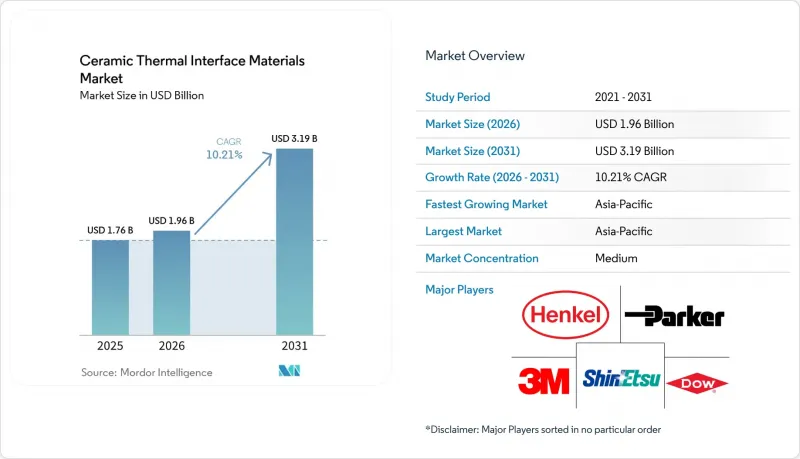
에 따르면 세라믹 열계면 재료 시장 규모는 2025년에 17억 6,000만 달러로 추계되고 있으며, 예측 기간(2026-2031년)에 CAGR 10.21%로 확대하며, 2026년 19억 6,000만 달러에서 2031년에는 31억 9,000만 달러에 달할 것으로 전망되고 있습니다.
전 세계 세라믹 열계면 소재 시장의 동향 및 인사이트
AI 및 고성능 컴퓨팅 분야의 열유속
AI 및 고성능 컴퓨팅용 하드웨어 분야에서 간헐적인 열 응력에서 지속적인 열 응력으로의 전환이 세라믹 열계면 소재 시장의 수요를 견인하고 있습니다. 고급 AI 가속기 모듈은 700W 이상의 열 설계 전력에 근접하고 있으며, 칩과 스프레더의 계면에서 열유속이 증가하고 있습니다. IEEE 전자 패키징 학회(Electronics Packaging Society)의 분석에 따르면 첨단 멀티칩 모듈에서 패키지의 뒤틀림이 피크에서 골까지 100-300μm, 모서리의 처짐이 300-400μm 이상에 달하는 것으로 보고되었습니다. 이러한 기계적 변화로 인해 열 사이클 중에 기존의 그리스나 상변화 물질이 밀려나거나 공극이 형성될 가능성이 있습니다. 베이스 플레이트와 콜드 플레이트 사이에 배치되는 세라믹 충전형 열계면 소재 2(TIM2) 제품은 경화 또는 반경화 구조 덕분에 이러한 변형에 더 효과적으로 저항합니다. 액체 냉각 방식의 하이퍼스케일 및 엣지 AI 시스템에서 랙 밀도가 높아짐에 따라 8 W/m*K 이상의 열전도율을 가진 디스펜서 적용 가능한 갭 필러의 중요성이 점점 더 커지고 있습니다.
자동차용 파워 일렉트로닉스의 전동화
EV의 트랙션 인버터 및 차량용 충전기에서 실리콘 절연 게이트 양극성 트랜지스터(IGBT) 모듈이 실리콘 카바이드 금속 산화물 반도체 전계 효과 트랜지스터(MOSFET)로 대체되고 있는 것이 세라믹 열계면 소재 시장에 긍정적인 영향을 미치고 있습니다. 실리콘 카바이드 MOSFET는 일반적인 전기자동차의 듀티 사이클 조건에서 175°C 이상에서 작동하는 반면, 실리콘 IGBT 모듈의 작동 상한은 150°C입니다. 이로 인해 냉각 기판과의 계면에서 더 강한 온도 구배와 큰 기계적 응력이 발생합니다. 2026년 7월, 헨켈(Henkel)은 첨단 운전자 보조 시스템(ADAS), 전자제어 장치(ECU) 및 전기자동차용 전력 변환 부품용으로 열전도율 6.5 W/m*K의 ‘Bergquist Gap Filler TGF 6500LVO’를 출시했습니다. 다우(Dow)사는 2027년까지 중국, 일본, 미국에서 특수 실리콘 생산 능력 확대에 1억 달러를 투자할 것이라고 발표했습니다. 이에 따라 상하이 및 미시간주 미들랜드에 위치한 ‘Cooling Science Labs’도 확장될 예정입니다. 전기자동차(EV) 생산 대수의 증가와 차량당 열 관리 소재 사용량 증가는 자동차 및 전기자동차 배터리 분야의 성장을 지원하고 있습니다.
붕소 질화물 및 알루미늄 질화물의 높은 비용
붕소 질화물 및 알루미늄 질화물의 높은 비용이 세라믹 열계면 소재 시장에서 고품질 필러의 보급을 저해하고 있습니다. 붕소 질화물은 높은 면내 열전도율에 필요한 판상 형태를 구현하기 위해 에너지 집약적인 합성, 제한된 생산 규모 및 정밀한 입자 제어가 필요합니다. 2025년 동료 심사를 거친 연구에 따르면 표면 개질된 질화 붕소 및 나노 다이아몬드는 대규모 생산 능력이 제한적이어서 알루미늄 산화물에 비해 구조적인 비용 면에서 불리함이 있는 것으로 밝혀졌습니다. 질화 알루미늄은 이론상 열전도율이 320 W/(m·K)를 초과하고 열팽창 계수가 실리콘에 가깝다는 장점이 있지만, 알루미나에 비해 가격이 상당히 비쌉니다. 이러한 충전재의 비용으로 인해 많은 소비자용 전자 제품에서 상업적으로 실현 가능한 열전도율 수준은 4-6 W/(m·K) 범위에 머물러 있습니다. Resonac사의 표면 처리된 질화붕소 기술은 원재료의 양을 늘리는 것이 아니라, 표면 화학을 활용하여 더 높은 충전재 함유율을 실현하는 것을 목표로 하고 있습니다.
부문 분석
2025년, 열 패드는 세라믹 열계면 소재 시장 점유율의 36.38%를 차지하며, 소비자용 전자기기, 전원 공급 장치 및 산업용 전자기기에서 확고한 입지를 반영하고 있습니다. 표준화된 형상, 취급의 용이성, 균일한 접합층 두께 덕분에 자동화된 대량 생산이 가능해집니다. 이 부문은 범용 1-3 W/m*K 패드부터 특수 용도의 6-8 W/m*K 제품에 이르기까지 폭넓게 아우르며, 단일 최종 시장에서 발생할 수 있는 대체 위험을 줄여줍니다.
열 그리스 및 젤은 재작업성과 얇은 접합층의 제어가 중요한 임베디드형 CPU 및 GPU 냉각 시스템에 사용됩니다. 상변화 소재와 열접착제가 또 다른 제품 카테고리를 형성하고 있으며, 열접착제는 전기자동차(EV) 배터리 구조적 접합 분야에서 활용이 확대되고 있습니다. 열 갭 필러는 가장 빠르게 성장하는 제품 유형이며, 이 부문의 세라믹 열계면 소재 시장 규모는 2031년까지 연평균 성장률(CAGR) 11.52%로 확대될 것으로 예측됩니다. 이러한 소재는 허용 갭이 크고 표면 형상이 불규칙한 용도에서 사용이 증가하고 있으며, 이러한 용도에서는 디스펜서로 도포 가능한 젤이 선호됩니다. 2026년 5월, 다우(Dow)사는 ‘DOWSIL TC-3120 열 젤’을 출시했습니다. 이 제품은 데이터센터 및 자동차 용도를 위해 12 W/m*K의 열전도율, 광학 등급의 청정도, 그리고 최소한의 오일 블리드를 실현하고 있습니다. 2025년 12월, 헨켈은 고출력 자동차, 통신 및 컴퓨팅 용도를 위해 열전도율 10 W/m*K를 특징으로 하는 ‘Bergquist TGF 10000’을 출시했습니다.
지역별 분석
아시아태평양은 2025년에 지역 점유율의 36.68%를 차지할 것으로 예상되며, 2031년까지 연평균 성장률(CAGR) 11.11%로 성장할 것으로 전망됩니다. 이 지역은 중국의 전기자동차(EV) 및 5G 인프라 규모와 일본 및 한국의 소재 제조 역량을 모두 갖추고 있습니다. 중국은 전기자동차 생산, 5G 기지국 네트워크, 그리고 확대되는 AI 연산 능력을 통해 수요를 주도하고 있습니다. 이러한 최종 시장은 제품 유형이나 열전도율 수준에 관계없이 수요를 창출하고 있습니다.
일본과 한국은 반도체 및 소비자 가전 공급망을 통해 수요에 기여하고 있습니다. 와커 케미(Wacker Chemie)는 2025년, 자동차 및 전자 분야 고객에게 서비스를 제공하기 위해 일본 츠쿠바와 한국 진천에 특수 실리콘 열계면 소재 제조 시설을 개설했습니다. 인도에서는 5G 구축이 확대되고 있으며, 전기자동차(EV) 제조 거점도 부상하고 있습니다. 비용 경쟁력이 뛰어난 알루미나계 배합 재료는 인도의 높은 수요에 적합합니다. 북미와 유럽은 각각 2위 및 3위 지역 시장으로, 프리미엄 배합, 자동차 OEM의 수요, 데이터센터 개발에 강점을 가지고 있습니다. 북미 지역의 하이퍼스케일 투자로 인해 칩과 방열판, 모듈과 콜드플레이트 사이의 계면에서 전력 밀도가 높아지고 있습니다. 다우(Dow)는 미시간주 오번과 중국 장자강에서 특수 실리콘 생산 능력을 확대했으며, 미들랜드와 상하이에 위치한 Cooling Science Labs도 확장했습니다. 독일은 전동 파워트레인 및 첨단 운전자 보조 시스템(ADAS)용 전자 기기에 신뢰성 높은 소재를 필요로 하는 자동차 OEM 및 1차 공급업체를 통해 유럽의 수요를 지원하고 있습니다.
남미, 중동 및 아프리카는 세라믹 열계면 소재 시장에서 규모는 작지만 성장을 지속하고 있는 지역입니다. 단기적인 수요는 브라질, 사우디아라비아, 남아프리카공화국에서의 5G 구축 및 전기자동차(EV)의 조기 보급과 밀접한 관련이 있습니다. 브라질의 가전제품 제조 거점과 통신 분야에 대한 투자가 남미의 초기 수요를 지원하고 있습니다. 사우디아라비아와 아랍에미리트(UAE)는 AI 및 디지털 전환(DX) 프로그램을 지원하기 위해 데이터센터 용량을 확대하고 있으며, 고성능 서버용 소재에 대한 새로운 수요를 창출하고 있습니다. 현지 생산 능력이 제한적이고 공급망도 미성숙한 탓에, 두 지역은 여전히 수입에 의존하고 있으며, 글로벌 공급업체에게는 조기에 공급 관계를 구축할 수 있는 좋은 기회가 되고 있습니다.
기타 혜택:
- 엑셀 형식의 시장 예측(ME) 시트
- 3개월간의 애널리스트 지원
자주 묻는 질문
목차
제1장 서론
- 조사 전제조건과 시장 정의
- 조사 범위
제2장 조사 방법
제3장 개요
제4장 시장 구도
- 시장 개요
- 시장 성장 촉진요인
- 시장 성장 억제요인
- 밸류체인 분석
- Porter's Five Forces 분석
제5장 시장 규모와 성장 예측
- 제품 유형별
- 세라믹 필러 유형별
- 용도별
- 지역별
- 아시아태평양
- 중국
- 인도
- 일본
- 한국
- 기타 아시아태평양 국가
- 북미
- 미국
- 캐나다
- 멕시코
- 유럽
- 독일
- 영국
- 프랑스
- 이탈리아
- 기타 유럽 국가
- 남미
- 브라질
- 아르헨티나
- 기타 남미 국가
- 중동 및 아프리카
- 사우디아라비아
- 남아프리카공화국
- 기타 중동 및 아프리카 국가
- 아시아태평양
제6장 경쟁 구도
- 시장 집중도
- 전략적 동향
- 시장 점유율·순위 분석
- 기업 개요
- 3M
- Aremco
- Denka Company Limited
- Dow
- DuPont
- Fujipoly America, Inc.
- Henkel AG & Co. KGaA
- Indium Corporation
- KYOCERA Corporation
- Momentive
- PARKER HANNIFIN CORP
- Resonac Holdings Corporation
- Rogers Corporation
- Saint-Gobain
- Shin-Etsu Chemical Co., Ltd.
- Wacker Chemie AG
제7장 시장 기회와 향후 전망
KSAAccording to Mordor Intelligence, the ceramic thermal interface materials market size is estimated at USD 1.76 billion in 2025 and is estimated to grow from USD 1.96 billion in 2026 to USD 3.19 billion by 2031, at a CAGR of 10.21% during the forecast period (2026-2031).
Global Ceramic Thermal Interface Materials Market Trends and Insights
AI and High-Performance Computing Heat Flux
The shift from intermittent to sustained thermal stress in AI and high-performance computing hardware is supporting demand in the ceramic thermal interface materials market. Advanced AI accelerator modules are approaching thermal design powers of 700 W or higher, increasing heat flux at the chip-to-spreader interface. An IEEE Electronics Packaging Society analysis reported package warpage of 100-300 μm peak to valley and corner deflections above 300-400 μm in advanced multi-chip modules. These mechanical changes can cause conventional greases and phase-change materials to pump out or form voids during thermal cycling. Ceramic-filled Thermal Interface Material 2 (TIM2) products positioned between baseplates and cold plates resist this movement more effectively due to their cured or semi-cured structure. As rack density rises in liquid-cooled hyperscale and edge AI systems, dispensable gap fillers rated above 8 W/m*K are becoming increasingly important.
Electrification of Vehicle Power Electronics
The replacement of silicon Insulated Gate Bipolar Transistor (IGBT) modules with silicon carbide Metal-Oxide-Semiconductor Field-Effect Transistors (MOSFETs) in EV traction inverters and onboard chargers is benefiting the ceramic thermal interface materials market. Silicon carbide MOSFETs operate above 175°C under typical EV duty cycles, compared with a 150°C ceiling for silicon IGBT modules. This creates stronger thermal gradients and greater mechanical stress at the interface with the cooling substrate. In July 2026, Henkel launched the Bergquist Gap Filler TGF 6500LVO, with a conductivity of 6.5 W/m*K, for Advanced Driver Assistance Systems (ADAS), Electronic Control Unit (ECU), and electric-vehicle power-conversion components. Dow announced USD 100 million in specialty silicones capacity investments through 2027 across China, Japan, and the United States, along with expanded Cooling Science Labs in Shanghai and Midland, Michigan. Higher EV production and greater thermal material content per vehicle are supporting growth in the automotive and EV-battery segments.
High Cost of Boron Nitride and Aluminum Nitride
The high cost of boron nitride and aluminum nitride limits the broader adoption of premium fillers in the ceramic thermal interface materials market. Boron nitride requires energy-intensive synthesis, limited-scale production, and controlled particle engineering to achieve the platelet morphology needed for high through-plane conductivity. A 2025 peer-reviewed study found that surface-modified boron nitride and nanodiamond had structural cost disadvantages relative to aluminum oxide due to limited large-scale production capacity. Aluminum nitride offers a theoretical thermal conductivity above 320 W/(m*K) and a thermal expansion coefficient close to that of silicon, but it also carries a substantial price premium over alumina. The cost of these fillers keeps commercially viable conductivity levels in many consumer electronics products within the 4-6 W/m*K range. Resonac's surface-treated boron nitride technology aims to enable higher filler loading through surface chemistry rather than higher raw material quantities.
Other drivers and restraints analyzed in the detailed report include:
- Rising Power Density in 5G and Telecommunications Equipment
- Cell-to-Pack Battery Architectures
- Viscosity and Dispensing Constraints at High Ceramic Loading
For complete list of drivers and restraints, kindly check the Table Of Contents.
Segment Analysis
Thermal pads held 36.38% of the ceramic thermal interface materials market share in 2025, reflecting their established role in consumer electronics, power supplies, and industrial electronics. Standardized shapes, simple handling, and consistent bond-line thickness support automated high-volume assembly. The segment covers products ranging from commodity 1-3 W/m*K pads to specialty 6-8 W/m*K options, limiting exposure to substitution in any single end market.
Thermal greases and gels are used in installed CPU and GPU cooling systems where reworkability and thin bond-line control are important. Phase-change materials and thermal adhesives form the other product category, with thermal adhesives gaining use in structural EV battery bonding. Thermal gap fillers are the fastest-growing product type, with the ceramic thermal interface materials market size for this segment projected to grow at an 11.52% CAGR through 2031. Their use is increasing in applications with large tolerance gaps and irregular surface profiles, which favor dispensable gels. In May 2026, Dow launched DOWSIL TC-3120 Thermal Gel, offering a thermal conductivity of 12 W/m*K, optical-grade cleanliness, and minimal oil bleed for data center and automotive applications. In December 2025, Henkel launched Bergquist TGF 10000, featuring 10 W/m*K thermal conductivity for high-power automotive, telecommunications, and computing applications.
Complete Report Scope:
- By Product Type
- Thermal Greases
- Thermal Gap Fillers
- Thermal Pads
- Others (Phase Change Materials, Thermal Adhesives, Thermal Gels)
- By Ceramic Filler Type
- Aluminum Oxide (Al2O3)
- Boron Nitride (BN)
- Aluminum Nitride (AlN)
- Others (Silicon Carbide, Magnesium Oxide, Zinc Oxide, Silicon Nitride, Other Ceramic Fillers)
- By Application
- Consumer Electronics
- Automotive and EV Batteries
- Power Electronics
- Others (LED Lighting, RF and Telecom Equipment, Industrial Electronics, Medical Electronics)
- By Geography
- Asia-Pacific
- China
- India
- Japan
- South Korea
- Rest of Asia-Pacific
- North America
- United States
- Canada
- Mexico
- Europe
- Germany
- United Kingdom
- France
- Italy
- Rest of Europe
- South America
- Brazil
- Argentina
- Rest of South America
- Middle-East and Africa
- Saudi Arabia
- South Africa
- Rest of Middle-East and Africa
- Asia-Pacific
Geography Analysis
Asia-Pacific accounted for 36.68% of the regional share in 2025 and is forecast to grow at a CAGR of 11.11% through 2031. The region combines China's EV and 5G infrastructure scale with materials manufacturing capacity in Japan and South Korea. China drives demand through its EV production, 5G base station network, and expanding AI computing capacity. These end markets create demand across product types and conductivity levels.
Japan and South Korea contribute to demand through semiconductor and consumer electronics supply chains. Wacker Chemie opened specialty silicone thermal interface material facilities in Tsukuba, Japan, and Jincheon, South Korea, in 2025 to serve automotive and electronics customers. India has an expanding 5G rollout and an emerging EV manufacturing base. Cost-competitive alumina-based formulations suit India's high demand. North America and Europe are the second- and third-largest regional markets, with strengths in premium formulations, automotive OEM demand, and data center development. North America's hyperscale investments are increasing power density at chip-to-heatsink and module-to-cold-plate interfaces. Dow expanded specialty silicone manufacturing capacity in Auburn, Michigan, and Zhangjiagang, China, and expanded Cooling Science Labs in Midland and Shanghai. Germany anchors European demand through automotive OEMs and tier-1 suppliers that require reliable materials for electrified powertrains and Advanced Driver-Assistance Systems (ADAS) electronics.
South America, the Middle-East, and Africa remain smaller but growing parts of the ceramic thermal interface materials market. Near-term demand is linked to 5G deployment and early EV adoption in Brazil, Saudi Arabia, and South Africa. Brazil's consumer electronics manufacturing base and telecommunications investment support early demand in South America. Saudi Arabia and the UAE are expanding data center capacity to support AI and digital transformation programs, creating new demand for high-performance server materials. Limited local manufacturing capacity and shallow supply chains keep both regions import-dependent, giving global suppliers an opportunity to establish supply relationships early.
- 3M
- Aremco
- Denka Company Limited
- Dow
- DuPont
- Fujipoly America, Inc.
- Henkel AG & Co. KGaA
- Indium Corporation
- KYOCERA Corporation
- Momentive
- PARKER HANNIFIN CORP
- Resonac Holdings Corporation
- Rogers Corporation
- Saint-Gobain
- Shin-Etsu Chemical Co., Ltd.
- Wacker Chemie AG
Additional Benefits:
- The market estimate (ME) sheet in Excel format
- 3 months of analyst support
TABLE OF CONTENTS
1 Introduction
- 1.1 Study Assumptions and Market Definition
- 1.2 Scope of the Study
2 Research Methodology
3 Executive Summary
4 Market Landscape
- 4.1 Market Overview
- 4.2 Market Drivers
- 4.2.1 AI and High-Performance Computing Heat Flux
- 4.2.2 Electrification of Vehicle Power Electronics
- 4.2.3 Increasing Use of Electrically Insulating High-Conductivity Fillers
- 4.2.4 Rising Power Density in 5G and Telecommunications Equipment
- 4.2.5 Cell-to-Pack Battery Architectures
- 4.2.6 Ceramic Filler Particle Engineering and High-Loading Formulations
- 4.3 Market Restraints
- 4.3.1 High Cost of Boron Nitride and Aluminum Nitride
- 4.3.2 Viscosity and Dispensing Constraints at High Ceramic Loading
- 4.3.3 Filler-Polymer Compatibility and Agglomeration
- 4.3.4 Qualification Cycles and Reliability Validation Requirements
- 4.4 Value Chain Analysis
- 4.5 Porter's Five Forces Analysis
- 4.5.1 Threat of New Entrants
- 4.5.2 Bargaining Power of Suppliers
- 4.5.3 Bargaining Power of Buyers
- 4.5.4 Threat of Substitutes
- 4.5.5 Competitive Rivalry
5 Market Size and Growth Forecasts (Value)
- 5.1 By Product Type
- 5.1.1 Thermal Greases
- 5.1.2 Thermal Gap Fillers
- 5.1.3 Thermal Pads
- 5.1.4 Others (Phase Change Materials, Thermal Adhesives, Thermal Gels)
- 5.2 By Ceramic Filler Type
- 5.2.1 Aluminum Oxide (Al2O3)
- 5.2.2 Boron Nitride (BN)
- 5.2.3 Aluminum Nitride (AlN)
- 5.2.4 Others (Silicon Carbide, Magnesium Oxide, Zinc Oxide, Silicon Nitride, Other Ceramic Fillers)
- 5.3 By Application
- 5.3.1 Consumer Electronics
- 5.3.2 Automotive and EV Batteries
- 5.3.3 Power Electronics
- 5.3.4 Others (LED Lighting, RF and Telecom Equipment, Industrial Electronics, Medical Electronics)
- 5.4 By Geography
- 5.4.1 Asia-Pacific
- 5.4.1.1 China
- 5.4.1.2 India
- 5.4.1.3 Japan
- 5.4.1.4 South Korea
- 5.4.1.5 Rest of Asia-Pacific
- 5.4.2 North America
- 5.4.2.1 United States
- 5.4.2.2 Canada
- 5.4.2.3 Mexico
- 5.4.3 Europe
- 5.4.3.1 Germany
- 5.4.3.2 United Kingdom
- 5.4.3.3 France
- 5.4.3.4 Italy
- 5.4.3.5 Rest of Europe
- 5.4.4 South America
- 5.4.4.1 Brazil
- 5.4.4.2 Argentina
- 5.4.4.3 Rest of South America
- 5.4.5 Middle-East and Africa
- 5.4.5.1 Saudi Arabia
- 5.4.5.2 South Africa
- 5.4.5.3 Rest of Middle-East and Africa
- 5.4.1 Asia-Pacific
6 Competitive Landscape
- 6.1 Market Concentration
- 6.2 Strategic Moves
- 6.3 Market Share (%)/Ranking Analysis
- 6.4 Company Profiles (includes Global Overview, Market Overview, Core Segments, Financials as available, Strategic Information, Products and Services, and Recent Developments)
- 6.4.1 3M
- 6.4.2 Aremco
- 6.4.3 Denka Company Limited
- 6.4.4 Dow
- 6.4.5 DuPont
- 6.4.6 Fujipoly America, Inc.
- 6.4.7 Henkel AG & Co. KGaA
- 6.4.8 Indium Corporation
- 6.4.9 KYOCERA Corporation
- 6.4.10 Momentive
- 6.4.11 PARKER HANNIFIN CORP
- 6.4.12 Resonac Holdings Corporation
- 6.4.13 Rogers Corporation
- 6.4.14 Saint-Gobain
- 6.4.15 Shin-Etsu Chemical Co., Ltd.
- 6.4.16 Wacker Chemie AG
7 Market Opportunities and Future Outlook
- 7.1 White-Space and Unmet-Need Assessment


