

|
시장보고서
상품코드
2154347
리튬 망간철인산염(LMFP) 배터리 : 시장 점유율 분석, 업계 동향과 통계, 성장 예측(2026-2031년)Lithium Manganese Iron Phosphate (LMFP) Battery - Market Share Analysis, Industry Trends & Statistics, Growth Forecasts (2026 - 2031) |
||||||
 Mordor Intelligence
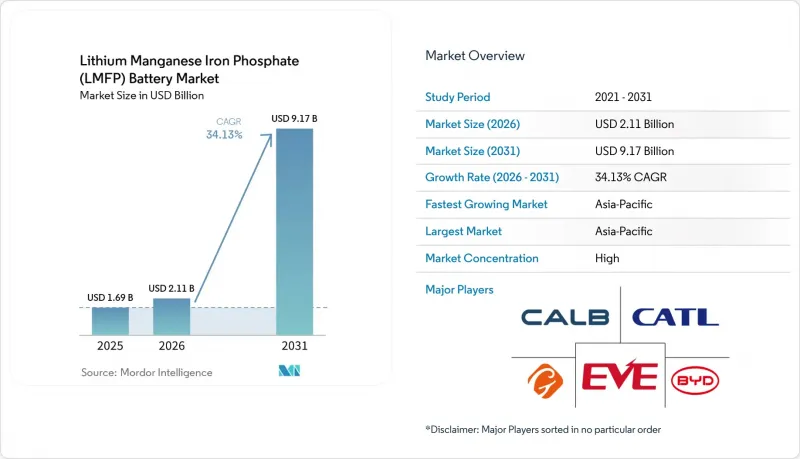
에 따르면 인산 리튬·망간·철 배터리 시장 규모는 2025년에 16억 9,000만 달러, 2026년에 21억 1,000만 달러에 달하며, 2031년까지 91억 7,000만 달러에 달할 것으로 예측됩니다.
2026-2031년까지의 연평균 성장률(CAGR)은 34.13%에 달할 것으로 전망됩니다.
세계 리튬·망간·철·인산염(LMFP) 배터리 시장의 동향 및 인사이트
저비용 중거리 전기자동차용 배터리 팩
LMFP 배터리 시장은 니켈·코발트계 배터리 시스템으로 완전히 전환되지 않은 채, 더 긴 주행 거리를 추구하는 자동차 제조사들에 의해 지지를 받고 있습니다. LMFP는 표준 LFP에 비해 15%에서 25% 더 높은 에너지 밀도를 제공할 수 있으며, 비용 차이는 1와트시당 5% 미만으로 억제됩니다. IONETIC사의 보고서에 따르면 2026년 팩 수준의 LMFP 시스템 에너지 밀도는 186 Wh/kg에 달할 것으로 전망됩니다. 이러한 성능을 통해 중거리 차종 개발 프로그램에서 주행 거리, 안전성, 비용 간의 균형을 맞출 수 있게 됩니다. 또한 코발트에 대한 의존도를 낮출 수 있으며, 제조사의 공급망 리스크를 경감시킬 수 있습니다. 따라서 LMFP 배터리 시장은 여전히 합리적인 가격이 중요한 요소로 작용하는 주류 차량 플랫폼으로의 진출 경로를 개발하고 있습니다.
자동차 제조사는 이러한 에너지 밀도 향상을 활용하여 셀 수를 줄이거나 배터리 케이스를 소형화할 수 있습니다. 이를 통해 팩 조립 요건을 줄임으로써 셀 비용 상승분을 일부 상쇄할 수 있습니다. 또한 이 화학 조성은 인산염 양극에 특유의 열적 안정성도 유지하고 있습니다. 이는 예측 가능한 배터리 안전성을 중시하는 제조사, 보험사, 규제 당국에게 중요한 요소입니다. 기존 철계 화학 조성 플랫폼에 대한 인증 획득을 통해 셀 시험 단계부터 차량에 대한 상용화까지 소요되는 기간을 단축할 수 있습니다. 이러한 요인들은 이미 LFP의 제조 및 시스템 설계를 이해하고 있는 OEM(순정 부품 제조사)에 의한 보다 광범위한 채택을 촉진할 것입니다.
니켈이나 코발트를 사용하지 않는 전기자동차의 주행 거리 향상
망간을 대체함으로써 LMFP 셀의 공칭 전압은 LFP의 3.2V에 비해 3.6V에서 3.8V로 상승합니다. 이 높은 전압 덕분에 LMFP는 인산염 골격을 유지하면서도 저등급 NMC 셀과의 에너지 밀도 격차를 좁힐 수 있습니다. LMFP 배터리 시장은 자동차 제조사가 양극에 니켈이나 코발트를 추가하지 않고도 이러한 성능 향상을 추구할 때 혜택을 볼 수 있습니다. LMFP 소재에 대한 연구에 따르면 철과 망간의 서로 다른 산화-환원 플레이트가 이 화학 조성의 성능 프로파일에서 중요한 요소임이 밝혀졌습니다. 이러한 작동 프로파일을 통해 개발자는 주행 거리, 안전성, 비용 목표를 설정할 때 새로운 선택지를 얻을 수 있습니다. 또한 이를 통해 LMFP는 셀 조립 라인을 변경하지 않고도 가공이 가능한 혼합 양극 방식에도 적합해집니다.
이러한 성능 향상은 셀 사양을 넘어 운영상 중요한 의미를 지닙니다. 더 소형화되거나 경량화된 팩 설계를 통해 자동차 제조사는 패키징 및 플랫폼 설계에서 더 큰 유연성을 확보할 수 있습니다. 이러한 선택지를 통해 고가의 셀로 인한 조립 부담을 줄일 수 있는 가능성이 있습니다. 따라서 LMFP는 NMC의 비용이나 재료 리스크를 감수할 수 없는 경우나, 표준 LFP보다 높은 에너지 밀도가 필요한 프로그램에 기여할 수 있습니다. 또한 LMFP 배터리 시장은 양극 조성 및 전해액 설계에 관한 지속적인 연구개발의 혜택을 받고 있습니다. 제조사들이 상용 셀에서 신뢰성 높은 고전압 작동을 추구하는 가운데, 이러한 개발 작업은 앞으로도 계속 중요할 것입니다.
망간에 기인하는 사이클 수명 및 용해 위험
망간의 용출은 여전히 LMFP 배터리 시장의 기술적 제약 요인으로 남아 있습니다. 전기화학학회(Electrochemical Society)가 노화된 LMFP 및 흑연 파우치 셀에 대해 논의한 바에 따르면 음극 표면의 망간 농도는 상한 컷오프 전압에 크게 좌우되는 것으로 보고되었습니다. 망간의 이동으로 인해 고체 전해질 계면이 두꺼워져, 사이클 동안 이용 가능한 리튬의 양이 감소할 가능성이 있습니다. 이러한 영향으로 인해 시간이 지남에 따라 사용 가능 용량이 저하될 우려가 있습니다. 현장 검증 및 보증 실적이 제한적이기 때문에 이 문제는 긴 수명을 요구하는 구매자에게 특히 중요합니다. 제조사는 실험실에서의 진전이 시판되는 셀 및 팩에서도 일관되게 적용된다는 것을 입증해야 합니다.
전해액 개발은 이러한 한계를 극복하는 한 가지 수단이 될 수 있습니다. LMFP 및 흑연 파우치 셀에 대한 조사 결과, LiDFOB 공염을 배합한 LiFSI 및 LiTFSI 염의 혼합물이 망간의 용해를 억제할 수 있는 것으로 밝혀진 반면, 이중 첨가제 시스템에서는 제1 사이클에서 89.3%의 쿨롱 효율을 기록했습니다. 또한 제공된 분석에 따르면 듀얼 첨가제가 포함된 탄산염 블렌드의 경우 600사이클 후 용량 유지율이 85% 이상인 것으로 나타났습니다. 이러한 결과는 전해액과 양극의 계면 설계가 상업적 차별화 요인으로 중요한 이유를 보여줍니다. 독자적인 전해액 배합은 소재 연구 및 지적 재산권 측면에서 강점을 가진 기존 공급업체에 유리하게 작용할 가능성이 있습니다. LMFP 배터리 시장에서는 이중 전압 거동을 고려한 신뢰성 높은 충전 제어 및 배터리 관리 시스템이 필요합니다.
부문 분석
2025년 시점에 LMFP 셀은 전체 LMFP 카테고리의 68.3%를 차지하고 있으며, 이는 상업적 인증 단계를 반영합니다. OEM(주문자 상표 제조업체) 및 에너지 저장 시스템 개발업체는 일반적으로 팩에 완전히 통합하기 전에 셀 테스트 및 승인을 진행합니다. 따라서 셀 출하량은 팩 출하량보다 18-24개월 앞서 나갈 가능성이 있습니다. LMFP 배터리 팩은 더 많은 셀 프로그램이 검증을 완료함에 따라 2026-2031년까지 연평균 성장률(CAGR) 34.5%를 기록할 것으로 예측됩니다. 자동차, 전력망, 산업 분야의 고객들이 샘플 테스트에서 시스템 도입으로 전환함에 따라 LMFP 배터리 팩 시장 규모는 확대될 전망입니다. 특히 상용 전기자동차(BEV)는 모듈식 팩 설계를 통해 플랫폼을 전면적으로 재설계하지 않고도 LMFP 셀을 채택할 수 있으므로 중요한 시장이 될 것입니다.
CALB의 우한 제4기 생산 기지에서는 설비 시운전이 진행 중이며, 연간 40만 유닛의 배터리 팩을 생산할 수 있도록 설계되었습니다. 생산 개시는 2026년 이내로 예상됩니다. 이 생산 능력은 셀 인증 후 필요하게 될 팩 수준의 공급을 지원할 수 있습니다. Gotion High-Tech의 Qichen Gen 2 셀은 2.58 g/cm³의 압축 밀도를 실현하여, 이를 통해 팩의 부피 요건을 줄일 수 있습니다. 조사 결과, 전자 전도성과 듀얼 전압 작동이 통합상 과제로 계속해서 지적되고 있습니다. 전류 밀도 성능을 향상시키기 위해, 고엔트로피 격자 변형을 포함한 도핑 기법이 검토되고 있습니다. 팩 제조업체는 이러한 셀 개선 사항을 BMS 보정, 열 설계 및 보증 근거와 결합해야 합니다. 팩 공급업체가 화학 기술 역량을 신뢰할 수 있는 시스템 솔루션으로 전환함으로써, LMFP 배터리 업계는 이러한 변화로부터 혜택을 얻을 수 있습니다.
지역별 분석
아시아태평양은 2025년 LMFP 전체 시장의 61.4%를 차지하며, 2031년까지 연평균 성장률(CAGR) 35.9%로 성장할 것으로 예측됩니다. 양극재부터 완제품 셀에 이르는 중국의 통합 공급망이 이 지역의 입지를 지원하고 있습니다. 국제에너지기구(IEA) 보고서에 따르면 이 분석에서 중국은 전 세계 LFP 및 LMFP 양극재의 98% 이상을 생산하고 있으며, 고순도 황산망간의 정제 능력의 95%를 차지하고 있습니다. 인도, 베트남, 인도네시아에서는 전기자동차 및 에너지 저장 수요가 확대됨에 따라 추가적인 수요 잠재력이 기대됩니다. 인도의 ‘첨단 화학 배터리 생산 연계 인센티브(ACCP)’ 프로그램은 배터리 제조 투자를 지원하는 것으로, 코발트를 사용하지 않는 화학 조성에 대한 관심과도 부합합니다.
제시된 분석에 따르면 북미와 유럽은 주로 LMFP 셀의 수입 시장이며, 양극재 생산은 제한적이었습니다. 이 지역들의 역할은 현지 배터리 공급에 대한 정책 지원에 의해 점차 형성되고 있습니다. 미국의 생산 크레딧 및 ‘우려 대상 외국 기업(FEOC)’에 관한 규정은 국내 LFP 및 LMFP 생산을 촉진하고 있지만, 황산망간의 공급은 여전히 부족합니다. 제공된 분석에 따르면 유럽에서는 상업적 규모의 LMFP 제조가 이루어지지 않았습니다. 2025-2027년까지 18억 유로 규모의 유럽 배터리 지원 패키지는 기가팩토리 투자를 촉진했습니다. 유럽내 LMFP 배터리 시장 규모는 현지 팩 생산을 통해 확대될 가능성이 있지만, 예측 기간 중 상류 화학물질 공급은 계속해서 중국에 의존할 것으로 보입니다.
CATL과 스텔란티스는 2025년 11월 스페인 피게레울라스에서 41억 유로를 투자해 LFP 및 LMFP 대응 셀 공장 건설을 시작했으며, 2026년 말까지 초기 생산을 시작하는 것을 목표로 하고 있습니다. 또한 CALB도 2026년 1월, 포르투갈 시네스에 배터리 공장을 건설하기 위해 20억 7,000만 유로 규모의 투자 계약을 체결했습니다. 남미, 중동 및 아프리카는 여전히 초기 단계의 시장이며, 전기자동차 수요가 본격화되기 전에 송전망 안정화 및 분산형 전력 수요가 에너지 저장 수요를 지원할 가능성이 있습니다. 이 지역들의 LMFP 배터리 시장은 실용적인 에너지 저장 설비의 조달과 프로젝트 파이낸싱에 의존하고 있습니다. BYD는 2026년 6월, 브라질 최초의 에너지 저장 입찰 체계와 관련하여, 해당 국가에서의 배터리 생산을 위해 최대 5억 브라질 레알(9,000만 달러 상당)을 투자할 것이라고 발표했습니다. 사우디아라비아, 아랍에미리트(UAE), 남아프리카공화국도 에너지 저장 및 배터리 소재 역량 강화를 추진하고 있으나, 이들 지역이 2031년까지 차지할 매출 비중은 미미할 것으로 전망됩니다.
기타 혜택:
- 엑셀 형식의 시장 예측(ME) 시트
- 3개월간의 애널리스트 지원
자주 묻는 질문
목차
제1장 서론
- 조사 전제조건과 시장 정의
- 조사 범위
제2장 조사 방법
제3장 개요
제4장 시장 구도
- 시장 개요
- 시장 성장 촉진요인
- 시장 성장 억제요인
- 공급망 분석
- Porter's Five Forces 분석
- 기술 동향
- 규제 상황
- 투자 분석
제5장 시장 규모와 성장 예측
- 배터리 유형별
- 최종사용자별
- 지역별
- 북미
- 미국
- 캐나다
- 멕시코
- 유럽
- 독일
- 프랑스
- 이탈리아
- 스페인
- 영국
- 폴란드
- 러시아
- 기타 유럽 국가
- 아시아태평양
- 중국
- 인도
- 일본
- 한국
- 호주
- 인도네시아
- 베트남
- 태국
- 기타 아시아태평양 국가
- 남미
- 브라질
- 아르헨티나
- 칠레
- 기타 남미 국가
- 중동 및 아프리카
- 사우디아라비아
- 아랍에미리트
- 이집트
- 남아프리카공화국
- 모로코
- 기타 중동 및 아프리카 국가
- 북미
제6장 경쟁 구도
- 시장 집중도
- 전략적 동향
- 시장 점유율 분석
- 기업 개요
- BYD Company Limited/FinDreams Battery
- CALB Group Co., Ltd.
- CATL(Contemporary Amperex Technology Co., Ltd.)
- Dynanonic Co., Ltd.
- EVE Energy Co., Ltd.
- Gotion High-tech Co., Ltd.
- Great Power Energy & Technology Co., Ltd.
- Guangdong Tianneng Lithium Technology Co., Ltd.
- Hefei Guoxuan High-Tech Power Energy Co., Ltd.
- Hithium Energy Storage Technology
- Hunan Yuneng New Material Technology Co., Ltd.
- Integrals Power Limited
- Lishen Battery(Tianjin Lishen Battery Joint-Stock Co., Ltd.)
- REPT BATTERO Energy Co., Ltd.
- Sunwoda Electronic Co., Ltd.
- SVOLT Energy Technology Co., Ltd.
제7장 시장 기회와 향후 전망
KSA 26.10.23According to Mordor Intelligence, the lithium manganese iron phosphate battery market size is projected to be USD 1.69 billion in 2025, USD 2.11 billion in 2026, and reach USD 9.17 billion by 2031, at a CAGR of 34.13% from 2026 to 2031.
Global Lithium Manganese Iron Phosphate (LMFP) Battery Market Trends and Insights
Lower-Cost Mid-Range EV Packs
The LMFP battery market is supported by vehicle makers that need more range without moving fully to nickel- and cobalt-based battery systems. LMFP can provide 15% to 25% higher energy density than standard LFP, with a cost premium below 5% per watt-hour. IONETIC reported a pack-level LMFP system energy density of 186 Wh/kg in 2026. This performance can help mid-range vehicle programs balance range, safety, and cost. It also reduces dependence on cobalt, which can create supply-chain exposure for manufacturers. The LMFP battery market, therefore, has a route into mainstream vehicle platforms where affordability remains important.
Vehicle manufacturers can use the energy-density gain to reduce cell count or make smaller battery enclosures. That can offset part of the higher cell cost through lower pack-assembly requirements. The chemistry also retains the thermal stability associated with phosphate cathodes. This matters for manufacturers, insurers, and regulators that place value on predictable battery safety behavior. Qualification of existing iron-based chemistry platforms can shorten the path from cell testing to vehicle use. These factors support wider adoption by original equipment manufacturers that already understand LFP manufacturing and system design.
EV Range Improvement Without Nickel and Cobalt
Manganese substitution raises the nominal LMFP cell voltage to 3.6 V to 3.8 V, compared with 3.2 V for LFP. The higher voltage helps LMFP narrow the energy-density gap with lower-tier NMC cells while retaining the phosphate framework. The LMFP battery market can benefit where vehicle makers want this improvement without adding nickel or cobalt to the cathode. Research on LMFP materials has also identified the different iron and manganese redox plateaus as an important part of the chemistry's performance profile. This operating profile gives developers another option when setting range, safety, and cost targets. It also makes LMFP relevant to blended-cathode approaches that can be processed without changing cell assembly lines.
The performance gain has operational importance beyond the cell specification. Smaller or lighter pack designs can give vehicle makers greater flexibility in packaging and platform design. These choices may reduce the assembly burden that follows a higher-priced cell. LMFP can therefore serve programs that cannot accept the cost or materials exposure of NMC, but require more energy density than standard LFP. The LMFP battery market also gains from continued work on cathode composition and electrolyte design. This development work is likely to remain important as manufacturers pursue reliable high-voltage operation in commercial cells.
Manganese-Driven Cycle-Life and Dissolution Risk
Manganese dissolution remains a technical restraint for the LMFP battery market. An Electrochemical Society discussion on aged LMFP and graphite pouch cells reported that manganese concentration on anode surfaces depends strongly on the upper cutoff voltage. Manganese movement can thicken the solid electrolyte interphase and reduce available lithium during cycling. These effects can reduce usable capacity over time. Limited field validation and warranty evidence make this issue especially important for buyers with long service-life requirements. Producers must show that laboratory advances can perform consistently in commercial cells and packs.
Electrolyte development offers a possible way to manage this limitation. Research on LMFP and graphite pouch cells found that LiFSI and LiTFSI salt blends with LiDFOB co-salts could reduce manganese dissolution, while dual-additive systems recorded first-cycle coulombic efficiency of 89.3%. The supplied analysis also cited capacity retention above 85% after 600 cycles for dual-additive carbonate blends. These results show why electrolyte-cathode interphase design is an important commercial differentiator. Proprietary electrolyte formulations can favor established suppliers with stronger materials research and intellectual-property positions. The LMFP battery market will require reliable charging controls and battery-management systems that account for its dual-voltage behavior.
Other drivers and restraints analyzed in the detailed report include:
- Grid and Distributed Energy Storage Procurement
- China-Led Manufacturing Scale and Process Transfer
- Concentrated High-Purity Manganese Processing
For complete list of drivers and restraints, kindly check the Table Of Contents.
Segment Analysis
LMFP Cells held 68.3% of the overall LMFP category in 2025, reflecting the stage of commercial qualification. Original equipment manufacturers and storage developers generally test and approve cells before they commit to complete pack integration. Cell volumes can therefore precede pack volumes by 18 to 24 months. LMFP Battery Packs are projected to record a 34.5% CAGR from 2026 to 2031 as more cell programs complete validation. The LMFP battery market size for packs should benefit as automotive, grid, and industrial customers move from sample testing to system deployment. Battery-electric commercial vehicles are particularly relevant because modular pack designs can accept LMFP cells without a full platform redesign.
CALB's Phase IV Wuhan production base was under equipment commissioning and was designed to produce 400,000 battery-pack units per year, with production expected within 2026. That capacity can support the pack-level supply needed after cell qualification. Gotion High-Tech's Qichen Gen 2 cell demonstrated a compaction density of 2.58 g/cm3, which can reduce pack volume requirements. Research has continued to identify electronic conductivity and dual-voltage operation as integration challenges. Doping approaches, including high-entropy lattice modifications, are being explored to improve rate performance. Pack producers will need to combine these cell improvements with BMS calibration, thermal design, and warranty evidence. The LMFP battery industry can gain from this shift when pack suppliers convert chemistry capability into a reliable system offering.
Complete Report Scope:
- By Battery Type
- LMFP Cells
- LMFP Battery Packs
- By End User
- Automotive
- Energy & Power
- Consumer Electronics
- Industrial
- Telecommunications
- Other End Users
- By Geography
- North America
- United States
- Canada
- Mexico
- Europe
- Germany
- France
- Italy
- Spain
- United Kingdom
- Poland
- Russia
- Rest of Europe
- Asia-Pacific
- China
- India
- Japan
- South Korea
- Australia
- Indonesia
- Vietnam
- Thailand
- Rest of Asia-Pacific
- South America
- Brazil
- Argentina
- Chile
- Rest of South America
- Middle East and Africa
- Saudi Arabia
- United Arab Emirates
- Egypt
- South Africa
- Morocco
- Rest of Middle East and Africa
- North America
Geography Analysis
Asia-Pacific held 61.4% of the overall LMFP category in 2025 and is forecast to grow at a 35.9% CAGR through 2031. China's integrated chain from cathode materials to finished cells underpins the region's position. The International Energy Agency reported that China produced more than 98% of global LFP and LMFP cathode material in the cited analysis and accounted for 95% of high-purity manganese sulfate refining capacity. India, Vietnam, and Indonesia provide additional demand potential as their electric-vehicle and storage needs develop. India's Advanced Chemistry Cell Production Linked Incentive program supports investment in battery manufacturing and aligns with interest in cobalt-free chemistries.
North America and Europe were largely LMFP cell import markets and had limited cathode manufacturing in the supplied analysis. Their role is increasingly shaped by policy support for local battery supply. U.S. production credits and foreign-entity-of-concern rules encourage domestic LFP and LMFP production, although manganese sulfate supply remains constrained. Europe did not manufacture LMFP at a commercial scale in the supplied analysis. The EUR 1.8 billion European battery package for 2025 to 2027 supported gigafactory investment. The LMFP battery market size in Europe can gain from local pack production, but upstream chemistry is likely to remain linked to China during the forecast period.
CATL and Stellantis started construction of a EUR 4.1 billion LFP and LMFP-capable cell plant in Figueruelas, Spain, in November 2025, with initial output targeted by the end of 2026. CALB also signed a EUR 2.07 billion investment agreement for a Sines battery plant in Portugal in January 2026. South America, the Middle East, and Africa remain earlier-stage markets where grid stability and distributed power needs can support storage before mass electric-vehicle demand develops. The LMFP battery market in these regions depends on practical storage procurement and project financing. BYD announced up to BRL 500 million, equivalent to USD 90 million, for battery production in Brazil in June 2026, connected to the country's first energy-storage auction framework. Saudi Arabia, the UAE, and South Africa are also pursuing storage and battery-material capabilities, although these areas are expected to represent a smaller share of revenue through 2031.
- BYD Company Limited / FinDreams Battery
- CALB Group Co., Ltd.
- CATL (Contemporary Amperex Technology Co., Ltd.)
- Dynanonic Co., Ltd.
- EVE Energy Co., Ltd.
- Gotion High-tech Co., Ltd.
- Great Power Energy & Technology Co., Ltd.
- Guangdong Tianneng Lithium Technology Co., Ltd.
- Hefei Guoxuan High-Tech Power Energy Co., Ltd.
- Hithium Energy Storage Technology
- Hunan Yuneng New Material Technology Co., Ltd.
- Integrals Power Limited
- Lishen Battery (Tianjin Lishen Battery Joint-Stock Co., Ltd.)
- REPT BATTERO Energy Co., Ltd.
- Sunwoda Electronic Co., Ltd.
- SVOLT Energy Technology Co., Ltd.
Additional Benefits:
- The market estimate (ME) sheet in Excel format
- 3 months of analyst support
TABLE OF CONTENTS
1 INTRODUCTION
- 1.1 Study Assumptions and Market Definition
- 1.2 Scope of the Study
2 RESEARCH METHODOLOGY
3 EXECUTIVE SUMMARY
4 MARKET LANDSCAPE
- 4.1 Market Overview
- 4.2 Market Drivers
- 4.2.1 Lower-Cost Mid-Range EV Packs
- 4.2.2 EV Range Improvement Without Nickel and Cobalt
- 4.2.3 Grid and Distributed Energy-Storage Procurement
- 4.2.4 China-Led Manufacturing Scale and Process Transfer
- 4.2.5 Policy-Led Battery-Supply-Chain Localization
- 4.2.6 Qualification Pull from Iron-Based Chemistry Platforms
- 4.3 Market Restraints
- 4.3.1 Limited Field Validation and Warranty Evidence
- 4.3.2 Manganese-Driven Cycle-Life and Dissolution Risk
- 4.3.3 Concentrated High-Purity Manganese Processing
- 4.3.4 Dual-Voltage BMS and Charging Optimization
- 4.4 Supply-Chain Analysis
- 4.5 Porter's Five Forces Analysis
- 4.5.1 Bargaining Power of Suppliers
- 4.5.2 Bargaining Power of Buyers
- 4.5.3 Threat of New Entrants
- 4.5.4 Threat of Substitutes
- 4.5.5 Competitive Rivalry
- 4.6 Technology Outlook
- 4.7 Regulatory Landscape
- 4.8 Investment Analysis
5 MARKET SIZE AND GROWTH FORECASTS
- 5.1 By Battery Type
- 5.1.1 LMFP Cells
- 5.1.2 LMFP Battery Packs
- 5.2 By End User
- 5.2.1 Automotive
- 5.2.2 Energy & Power
- 5.2.3 Consumer Electronics
- 5.2.4 Industrial
- 5.2.5 Telecommunications
- 5.2.6 Other End Users
- 5.3 By Geography
- 5.3.1 North America
- 5.3.1.1 United States
- 5.3.1.2 Canada
- 5.3.1.3 Mexico
- 5.3.2 Europe
- 5.3.2.1 Germany
- 5.3.2.2 France
- 5.3.2.3 Italy
- 5.3.2.4 Spain
- 5.3.2.5 United Kingdom
- 5.3.2.6 Poland
- 5.3.2.7 Russia
- 5.3.2.8 Rest of Europe
- 5.3.3 Asia-Pacific
- 5.3.3.1 China
- 5.3.3.2 India
- 5.3.3.3 Japan
- 5.3.3.4 South Korea
- 5.3.3.5 Australia
- 5.3.3.6 Indonesia
- 5.3.3.7 Vietnam
- 5.3.3.8 Thailand
- 5.3.3.9 Rest of Asia-Pacific
- 5.3.4 South America
- 5.3.4.1 Brazil
- 5.3.4.2 Argentina
- 5.3.4.3 Chile
- 5.3.4.4 Rest of South America
- 5.3.5 Middle East and Africa
- 5.3.5.1 Saudi Arabia
- 5.3.5.2 United Arab Emirates
- 5.3.5.3 Egypt
- 5.3.5.4 South Africa
- 5.3.5.5 Morocco
- 5.3.5.6 Rest of Middle East and Africa
- 5.3.1 North America
6 COMPETITIVE LANDSCAPE
- 6.1 Market Concentration
- 6.2 Strategic Moves
- 6.3 Market Share Analysis
- 6.4 Company Profiles (includes Global Level Overview, Market Level Overview, Core Segments, Financials as available, Strategic Information, Market Rank/Share, Products and Services, Recent Developments)
- 6.4.1 BYD Company Limited / FinDreams Battery
- 6.4.2 CALB Group Co., Ltd.
- 6.4.3 CATL (Contemporary Amperex Technology Co., Ltd.)
- 6.4.4 Dynanonic Co., Ltd.
- 6.4.5 EVE Energy Co., Ltd.
- 6.4.6 Gotion High-tech Co., Ltd.
- 6.4.7 Great Power Energy & Technology Co., Ltd.
- 6.4.8 Guangdong Tianneng Lithium Technology Co., Ltd.
- 6.4.9 Hefei Guoxuan High-Tech Power Energy Co., Ltd.
- 6.4.10 Hithium Energy Storage Technology
- 6.4.11 Hunan Yuneng New Material Technology Co., Ltd.
- 6.4.12 Integrals Power Limited
- 6.4.13 Lishen Battery (Tianjin Lishen Battery Joint-Stock Co., Ltd.)
- 6.4.14 REPT BATTERO Energy Co., Ltd.
- 6.4.15 Sunwoda Electronic Co., Ltd.
- 6.4.16 SVOLT Energy Technology Co., Ltd.
7 MARKET OPPORTUNITIES AND FUTURE OUTLOOK
- 7.1 White-Space and Unmet-Need Assessment


