

|
시장보고서
상품코드
2154364
천자용 카테터 : 시장 점유율 분석, 업계 동향과 통계, 성장 예측(2026-2031년)Centesis Catheters - Market Share Analysis, Industry Trends & Statistics, Growth Forecasts (2026 - 2031) |
||||||
 Mordor Intelligence
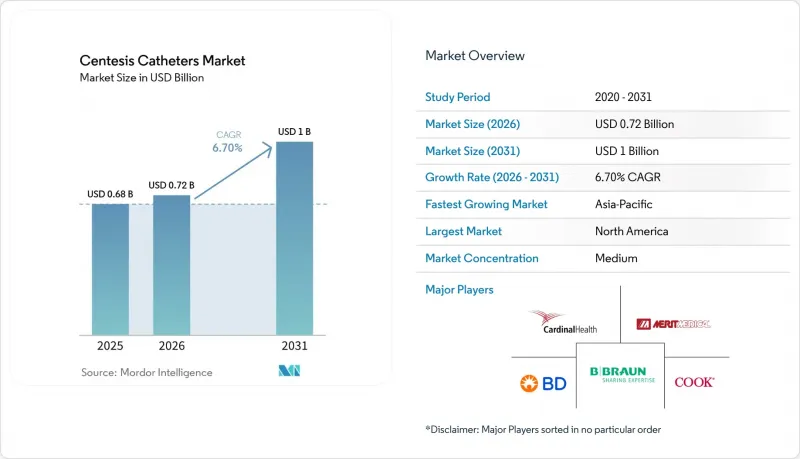
에 따르면 천자 카테터 시장 규모는 2025년에 6억 8,000만 달러, 2026년에 7억 2,000만 달러에 달하며, 2031년까지 10억 달러에 달할 것으로 예측되고 있으며, 2026-2031년에 CAGR 6.70%로 성장할 것으로 전망되고 있습니다.
전 세계 천자 카테터 시장의 동향 및 인사이트
복수 및 흉수 치료 건수의 증가
의료진은 복수 및 흉수를 계획적이고 반복적인 배액이 필요한 만성질환으로 관리하는 경향이 강해지고 있으며, 이는 천자 카테터 시장에 지속적인 수요를 창출하고 있습니다. 2017-2024년의 NHANES 데이터 분석에 따르면 미국 성인의 지방간 질환 연령 조정 유병률은 35.0%로, 이는 약 7,200만 명에 해당합니다. 또한 대사성 질환과 관련된 섬유화도 증가 추세를 보이고 있습니다. 또 다른 연구에 따르면 미국 성인의 대사 기능 장애 관련 지방간 질환 유병률은 2020년 33.7%에서 2050년까지 41.4%로 증가할 것이며, MASH(대사 기능 장애 관련 지방간염)와 관련된 간경변 사례 수는 거의 2배로 늘어날 것으로 예측됩니다. 세계보건기구(WHO)에 따르면 B형 및 C형 간염은 합쳐서 연간 110만 명 이상의 사망 원인이 되고 있으며, 간경변이나 복수로 진행될 가능성이 있습니다. 간 질환 환자들 사이에서 비만과 제2형 당뇨병이 증가함에 따라 환자층은 젊은 층으로 확대되고 있으며, 임상적으로도 더욱 복잡해지고 있습니다. 이러한 환자들은 장기간의 치료 과정에서 배액이 필요할 수 있으며, 신규 진단 건수가 그만큼 증가하지 않았음에도 불구하고 카테터 수요가 증가하고 있습니다.
영상 유도 하 천자의 보급 확대
초음파 유도 천자는 북미 및 유럽의 병원에서 복수 천자나 흉수 천자의 표준 기법으로 자리 잡았으며, 해부학적 지표에 기반한 카테터 삽입에 대한 의존도를 낮추고 시술의 일관성을 향상시키고 있습니다. 2025년에 실시된, 주로 8-10프렌치 카테터를 사용한 초음파 유도 피그테일 카테터 삽입 134건을 대상으로 한 후향적 연구에서는 기술적 성공률이 95% 이상인 것으로 보고되었습니다. 이러한 연구 결과는 영상 유도 하 흉수 배액의 유효성을 지원하며, 영상상에서 식별하기 쉽도록 설계된 카테터에 대한 수요를 높였습니다. 이러한 변화에 따라 병원에서는 기본적인 제품에서 보다 전문적인 시스템으로의 전환이 진행되고 있습니다. 초음파 조영성이 있는 바늘 끝, 조영성이 있는 카테터 본체, 그리고 비틀림에 강한 소재는 제품에서 점점 더 중요한 기능이 되고 있습니다. ‘iVASC M*Drain’이나 ‘Galt Medical Centeze’와 같은 제품은 이러한 기능이 배액 시스템에 통합되어 있음을 보여줍니다. 병원들이 영상 유도 치료를 표준화함에 따라 과거에는 고급 제품에 한정되었던 기능들이 이제 더 광범위한 제품 사양으로 자리 잡고 있습니다. 제품을 대대적으로 업그레이드하고 임상 지원을 제공할 수 있는 기업은 기본적인 카테터만 공급하는 업체에 비해 우위를 점할 수 있을 것입니다.
프리미엄 가격 책정 및 보험 급여액의 편차
브랜드 제품의 폐쇄형 시스템 키트는 특히 아시아태평양이나 남미에서 정부의 보상 기준에 따라 시술 보수가 결정되므로 카테터 단독 대체품보다 비싼 경우가 많습니다. 미국에서는 복수 천자 및 흉수 천자에 관한 CMS 시술 코드에서 일회용 폐쇄형 배액 키트와 카테터 단독의 개방형 세트를 구분하지 않았습니다. 따라서 의료 제공자는 시술 수익을 통해 프리미엄 키트의 비용을 회수하는 데 어려움을 겪을 수 있으며, 비용에 민감한 병원의 도입이 제한될 우려가 있습니다. 유럽의 환급 제도 또한 유사한 장벽을 야기할 가능성이 있습니다. 스위스의 DRG 정보에 따르면 경피적 복부 배액은 CHOP 코드 54.91 및 DRG Z65A로 분류되며, 기본 비용 가중치는 0.783으로 설정되어 있습니다. 반면, DRG E73B에는 흉강 배액에 대한 배출량 기반 조정이 포함되어 있습니다. 이러한 구조는 편의성상 이점이나 일일 기기 비용이 높음에도 불구하고 배출량이 적은 배액법을 우선시하여 장기 삽입 카테터의 사용을 저해할 가능성이 있습니다.
부문 분석
2025년, 대구경카테터는 천자 카테터 시장에서 63.45%의 점유율을 차지했습니다. 일반적으로 12프렌치(Fr) 이상인 이 제품들은 대량의 체액을 신속하게 제거해야 하는 입원 환자의 천자 시술을 지원했습니다. 이 제품들은 횡격막 압박이나 급성 호흡곤란에 따른 체액 저류에 대해 간내과 및 종양내과 병동에서 계속해서 널리 사용되었습니다. 병원 프로토콜과 공동 조달 기구(GPO)와의 계약이 이러한 제품의 지속적인 사용을 지원하여 안정적인 시장 지위를 공고히 했습니다.
‘기타’ 범주에는 다실성 삼출액이나 농흉 등 틈새 시장인 중재적 방사선학(영상 진단 하 치료) 시술을 위한 특수한 피그테일 형상이나 트로카식 배액 시스템이 포함됩니다. 사이드 홀 배치와 잠금식 테일 설계는 복잡한 체액 축적의 관리를 지원합니다. 소구경카테터 시장은 2026-2031년까지 연평균 성장률(CAGR) 8.12%로 확대될 것으로 예측됩니다. 초음파 유도 하에 시행된 8-10 Fr 피그테일 삽입 134건을 검증한 보고서에 따르면 흉막 배액술의 기술적 성공률은 95%를 초과했습니다. ISO 10993 요건 및 FDA 21 CFR 880 규정은 두 제품군 모두에 적용되며, 규정 준수 비용이 기존 공급업체의 가격 결정력을 지원하고 있습니다.
2025년에는 천자술이 시술 기반 매출의 56.77%를 차지했습니다. 간경변 및 악성 복수에 대한 반복적인 치료가 수요를 지원하고 있으며, 일부 환자의 경우 10-14일마다 배액이 필요했습니다. NHANES 조사 결과에 따르면 2017-2023년 사이 미국 성인의 35.0%가 지방간 질환을 앓고 있었으며, 이는 배액 서비스에 대한 지속적인 수요를 지원합니다. 또한 공동구매기구(GPO)와의 계약을 통해 복수 천자 키트의 지속적인 구매가 촉진되었습니다. 한편, ‘기타’ 범주에는 특수한 설계가 필요한 관절 천자나 심막 천자 등의 시술이 포함되었습니다.
흉강 천자 시장은 흉막 배액이 외래 진료로 전환되고 있는 것을 배경으로, 2026-2031년에 연평균 성장률(CAGR) 9.80%로 성장할 것으로 예측됩니다. AMPLE-1 보고서에 따르면 장기 삽입형 흉막 카테터를 삽입한 환자의 입원 기간 중앙값은 1일인 반면, 흉강 배액 및 활석 흉막 유착술을 통해 치료받은 환자의 경우 4일이었습니다. 2025년 연구에 따르면 악성 흉수에 대해 외래에서 시행하는 흉강 배액 및 활석 흉막 유착술이 실행 가능하고 안전한 것으로 나타났습니다. 이러한 추세는 입원 비용을 절감하고, 입원 병동 이외의 장소에서 사용하기 위한 밸브식 및 자가 밀폐형 카테터 시스템에 대한 수요를 지원하고 있습니다.
지역별 분석
2025년, 북미는 전 세계 매출의 42.35%를 차지하며 센테시스 카테터 시장에서 가장 큰 점유율을 기록했습니다. 높은 시술 건수, 확립된 영상 유도 배액 관행, 그리고 성숙한 공동 구매 조직 구조가 이 지역의 수요를 지원했습니다. 외래 종양학 및 간학 진료에서 신테시스 시술이 확대됨에 따라 미국의 의료 기관이 매출의 대부분을 차지했습니다. 2017-2023년까지 미국의 성인 약 7,200만 명이 지방간 질환을 앓고 있었으며, 대사성 질환의 증가에 따라 섬유화도 진행됨에 따라 2031년까지 반복되는 체액 배액 시술에 대한 수요가 지원되었습니다. 캐나다와 멕시코에서는 영상 유도 및 재택 배액 경로를 통해 규모는 작지만 수요가 확대되고 있습니다.
유럽은 두 번째로 큰 지역 시장으로, 독일, 프랑스, 영국, 이탈리아가 주도적인 역할을 했습니다. 영국에서는 지역 간호사의 지원을 받는 체계적인 삽입형 흉막 카테터 프로그램이 시행되었습니다. 2025년 2월 연구에 따르면 삽입형 흉막 카테터 관리에 관한 환자용 자료와 교육용 동영상은 예정에 없던 의료기관 방문을 줄이고, 간병인의 역량 평가 점수를 향상시켰다고 보고되었습니다. ewimed사는 2024년 데이터를 바탕으로 2025년 보고서에서 독일 의료기관으로부터 15년에 수집한 삽입형 흉막 카테터 삽입 관련 정보를 정리했습니다. 이탈리아와 스페인에서는 암 센터에서 완화 치료를 위한 천자 프로토콜이 확대되었으나, DRG(진단 관련 그룹) 제도에 따라 고가의 밀폐형 시스템의 보급이 제한될 가능성이 있습니다.
아시아태평양은 2031년까지 연평균 성장률(CAGR) 10.88%로 성장할 것으로 예측되며, 천자 카테터 시장에서 가장 두드러진 성장을 보일 것으로 전망됩니다. 중국과 인도에서는 병원 수용 능력 확대 및 만성질환 관리의 발전에 따라 수요 증가로 인한 최대 성장 기회가 예상됩니다. 일본과 한국에서는 첨단 중환자 치료 시설과 고령화를 배경으로, 더 높은 사양의 카테터 기술이 채택되었습니다. 한편, 인도와 중국에서는 Blue Neem Medical Devices사와 Polymedicure Ltd.가 제품 품질 측면에서 경쟁을 심화시켰습니다. 중동 및 아프리카의 수요는 걸프협력회의(GCC) 국가들의 3차 의료 기관에 대한 투자에 힘입었습니다. 반면, 브라질과 아르헨티나의 민간 의료 부문이 주도하는 남미 지역은 2031년까지 아시아태평양보다 완만한 성장에 그칠 것으로 예상됩니다.
기타 혜택:
- 엑셀 형식의 시장 예측(ME) 시트
- 3개월간의 애널리스트 지원
자주 묻는 질문
목차
제1장 서론
- 조사 전제조건과 시장 정의
- 조사 범위
제2장 조사 방법
제3장 개요
제4장 시장 구도
- 시장 개요
- 시장 성장 촉진요인
- 시장 성장 억제요인
- 밸류체인 분석
- 규제 상황
- 기술 전망
- Porter's Five Forces 분석
제5장 시장 규모와 성장 예측
- 제품 유형별
- 시술별
- 용도별
- 최종사용자별
- 지역별
- 북미
- 미국
- 캐나다
- 멕시코
- 유럽
- 독일
- 영국
- 프랑스
- 이탈리아
- 스페인
- 기타 유럽 국가
- 아시아태평양
- 중국
- 인도
- 일본
- 호주
- 한국
- 기타 아시아태평양 국가
- 중동 및 아프리카
- GCC
- 남아프리카공화국
- 기타 중동 및 아프리카 국가
- 남미
- 브라질
- 아르헨티나
- 기타 남미 국가
- 북미
제6장 경쟁 구도
- 시장 집중도
- 시장 점유율 분석
- 기업 개요
- AngioDynamics, Inc.
- Argon Medical Devices, Inc.
- Avanos Medical, Inc.
- Axiom Medical, Inc.
- B. Braun Melsungen AG
- Becton, Dickinson and Company
- Blue Neem Medical Devices Pvt. Ltd.
- Boston Scientific Corporation
- Cardinal Health, Inc.
- Canadian Hospital Specialties Ltd.
- Cook Medical LLC
- Galt Medical Corp.
- KM Medical, Inc.
- Medical Components, Inc.
- Medtronic plc
- Merit Medical Systems, Inc.
- Mermaid Medical A/S
- Ningbo Honde Medical Instruments Co., Ltd.
- PFM Medical, Inc.
- Polymedicure Ltd.
- REDAX S.p.A.
- Rocket Medical plc
- Teleflex Incorporated
- UreSil, LLC
- Utah Medical Products, Inc.
제7장 시장 기회와 향후 전망
KSAAccording to Mordor Intelligence, the centesis catheters market size is projected to be USD 0.68 billion in 2025, USD 0.72 billion in 2026, and reach USD 1 billion by 2031, growing at a CAGR of 6.70% from 2026 to 2031.
Global Centesis Catheters Market Trends and Insights
Rising Procedure Volumes for Ascites and Pleural Effusion
Healthcare providers increasingly manage ascites and pleural effusion as chronic conditions requiring planned, repeated drainage, creating recurring demand for the centesis catheters market. An analysis of NHANES data from 2017 to 2024 reported a 35.0% age-adjusted prevalence of steatotic liver disease among U.S. adults, representing nearly 72 million people, with metabolic disease-related fibrosis also increasing. Another study projected that metabolic dysfunction-associated steatotic liver disease prevalence among U.S. adults will increase from 33.7% in 2020 to 41.4% by 2050, while MASH-related cirrhosis cases will nearly double. The World Health Organization stated that hepatitis B and C together cause more than 1.1 million deaths annually and can progress to cirrhosis and ascites. The patient base is becoming younger and more clinically complex as obesity and type 2 diabetes increase among individuals with liver disease. These patients may require drainage over extended care periods, increasing catheter demand without a comparable rise in new diagnoses.
Increasing Adoption of Image-Guided Centesis
Ultrasound guidance has become a standard approach for paracentesis and thoracentesis in North American and European hospitals, reducing reliance on landmark-based placement and improving procedural consistency. A 2025 retrospective review of 134 ultrasound-guided pigtail catheter placements, primarily using 8-10 French catheters, reported a technical success rate above 95%. These findings supported image-guided pleural drainage and increased demand for catheters designed for imaging visibility. This shift encourages hospitals to replace basic products with more specialized systems. Echogenic needle tips, radiopaque catheter bodies, and kink-resistant materials are increasingly important product features. Products such as iVASC M*Drain and Galt Medical Centeze demonstrate the integration of these features into drainage systems. As hospitals standardize image-guided care, features once limited to premium products are becoming broader product specifications. Companies that can upgrade products at scale and provide clinical support may gain an advantage over suppliers of basic catheter-only products.
Premium Pricing and Reimbursement Variability
Branded closed-system kits often cost more than bare-catheter alternatives, particularly in Asia-Pacific and South America, where government reimbursement schedules determine procedure payments. In the United States, CMS procedure codes for paracentesis and thoracentesis did not differentiate between single-use closed drainage kits and open catheter-only setups. Providers may therefore struggle to recover premium kit costs through procedure revenue, limiting adoption in cost-sensitive hospitals. European reimbursement systems can create similar barriers. Swiss DRG information classified percutaneous abdominal drainage under CHOP code 54.91 and DRG Z65A, with a base cost weight of 0.783, while DRG E73B included volume-based adjustments for pleural drainage. These structures may favor shorter drainage volumes and discourage long-dwell catheters, despite their comfort benefits and higher daily device costs.
Other drivers and restraints analyzed in the detailed report include:
- Ambulatory Care and Recurrent Home-Based Drainage
- Palliative Drainage and Closed Workflow Standardization
- Procedure Safety, Training, and System Compatibility
For complete list of drivers and restraints, kindly check the Table Of Contents.
Segment Analysis
Large-bore catheters held a 63.45% share of the centesis catheters market in 2025. These products, typically 12 French (Fr) and above, supported inpatient paracentesis procedures requiring rapid removal of large fluid volumes. They remained widely used in hepatology and oncology wards for fluid accumulation associated with diaphragmatic compression and acute dyspnea. Hospital protocols and group purchasing organization contracts supported their continued use, reinforcing their stable market position.
The others category includes specialized pigtail configurations and trocar-based drainage systems for niche interventional radiology procedures, including multiloculated collections and empyema. Side-hole placement and locking-tail designs support the management of complex fluid collections. Small-bore catheters are forecast to grow at a CAGR of 8.12% from 2026 to 2031; a review of 134 ultrasound-guided 8-10 Fr pigtail placements reported a technical success rate above 95% in pleural drainage. ISO 10993 requirements and FDA 21 CFR 880 regulations apply to both product groups, with compliance costs supporting the pricing power of established suppliers.
Paracentesis accounted for 56.77% of procedure-based revenue in 2025. Repeat treatment for cirrhotic and malignant ascites supported demand, as some patients required drainage every 10-14 days. NHANES findings showed that steatotic liver disease affected 35.0% of US adults between 2017 and 2023, supporting continued demand for drainage services. Group purchasing organization contracts also facilitated recurring purchases of paracentesis kits, while the others category included arthrocentesis and pericardiocentesis procedures requiring specialized designs.
Thoracentesis is forecast to grow at a CAGR of 9.80% from 2026 to 2031, driven by the transition of pleural drainage toward ambulatory care. AMPLE-1 reported median hospitalization of one day for indwelling pleural catheter patients, compared with four days for patients treated with chest drainage and talc pleurodesis. A 2025 study found ambulatory chest drainage and talc pleurodesis to be feasible and safe for malignant pleural effusion. This model reduces hospitalization costs and supports demand for valve-gated and self-sealing catheter systems for use beyond inpatient wards.
Complete Report Scope:
- By Product Type
- Small-Bore Centesis Catheters
- Large-Bore Centesis Catheters
- Others
- By Procedure
- Paracentesis
- Thoracentesis
- Others
- By Application
- Drug Administration
- Fluid & Nutrition Administration
- Blood Transfusion
- Hemodialysis
- By End User
- Hospitals & Health Systems
- Specialty Clinics
- Ambulatory Surgical Centers
- Cancer Treatment Centers
- Home Healthcare
- Others
- By Geography
- North America
- United States
- Canada
- Mexico
- Europe
- Germany
- United Kingdom
- France
- Italy
- Spain
- Rest of Europe
- Asia-Pacific
- China
- India
- Japan
- Australia
- South Korea
- Rest of Asia-Pacific
- Middle East and Africa
- GCC
- South Africa
- Rest of Middle East and Africa
- South America
- Brazil
- Argentina
- Rest of South America
- North America
Geography Analysis
North America held 42.35% of global revenue in 2025, representing the largest centesis catheters market share. High procedure volumes, established image-guided drainage practices, and a mature group purchasing organization structure supported regional demand. U.S. facilities accounted for most revenue as centesis procedures expanded in outpatient oncology and hepatology care. Nearly 72 million U.S. adults had steatotic liver disease during 2017-2023, while fibrosis increased alongside metabolic disease, supporting repeated fluid-drainage procedures through 2031. Canada and Mexico contributed smaller but growing demand through image-guided and home-drainage pathways.
Europe was the second-largest regional market, led by Germany, France, the United Kingdom, and Italy. The United Kingdom had structured indwelling pleural catheter programs supported by community nursing. A February 2025 study reported that patient resources and educational videos for indwelling pleural catheter care reduced unplanned healthcare encounters and improved caregiver competency scores. ewimed collected indwelling pleural catheter implantation information from German centers for 15 years in its 2025 report, based on 2024 data. Italy and Spain expanded palliative centesis protocols in cancer centers, although DRG structures could restrain the uptake of premium closed systems.
Asia-Pacific is forecast to grow at a CAGR of 10.88% through 2031, making it the fastest-growing region in the centesis catheters market. China and India offer the largest incremental volume opportunities as hospital capacity and chronic disease management develop. Japan and South Korea adopted higher-specification catheter technologies, supported by advanced critical-care facilities and aging populations, while Blue Neem Medical Devices and Polymedicure Ltd. increased product-quality competition in India and China. Middle East and Africa demand was supported by tertiary hospital investment in Gulf Cooperation Council countries, while South America, led by Brazil and Argentina's private healthcare sectors, is expected to grow more slowly than Asia-Pacific through 2031.
- AngioDynamics
- Argon Medical Devices
- Avanos Medical
- Axiom Medical, Inc.
- B. Braun
- Beckton Dickinson
- Blue Neem Medical Devices Pvt. Ltd.
- Boston Scientific
- Cardinal Health
- Canadian Hospital Specialties Ltd.
- Cook Group
- Galt Medical Corp.
- KM Medical, Inc.
- Medical Components, Inc.
- Medtronic
- Merit Medical Systems
- Mermaid Medical
- Ningbo Honde Medical Instruments Co., Ltd.
- PFM Medical, Inc.
- Polymedicure Ltd.
- REDAX S.p.A.
- Rocket Medical plc
- Teleflex
- UreSil, LLC
- Utah Medical Products
Additional Benefits:
- The market estimate (ME) sheet in Excel format
- 3 months of analyst support
TABLE OF CONTENTS
1 INTRODUCTION
- 1.1 Study Assumptions and Market Definition
- 1.2 Scope of the Study
2 RESEARCH METHODOLOGY
3 EXECUTIVE SUMMARY
4 MARKET LANDSCAPE
- 4.1 Market Overview
- 4.2 Market Drivers
- 4.2.1 Rising Procedure Volumes for Ascites and Pleural Effusion
- 4.2.2 Increasing Adoption of Image-Guided Centesis
- 4.2.3 Expansion of Ambulatory and Outpatient Procedures
- 4.2.4 Growing Demand for Recurrent and Home-Based Fluid Drainage
- 4.2.5 Standardization of Closed, Valved Drainage Workflows
- 4.2.6 Expansion of Palliative Drainage for Advanced Cancer
- 4.3 Market Restraints
- 4.3.1 Premium Pricing and Reimbursement Variability
- 4.3.2 Procedure-Related Complications and Device Recalls
- 4.3.3 Training Dependence for Safe Placement and Drainage-Volume Control
- 4.3.4 Limited Interoperability Between Catheters, Tubing and Collection Systems
- 4.4 Value Chain Analysis
- 4.5 Regulatory Landscape
- 4.6 Technological Outlook
- 4.7 Porter's Five Forces Analysis
- 4.7.1 Competitive Rivalry
- 4.7.2 Threat of New Entrants
- 4.7.3 Bargaining Power of Suppliers
- 4.7.4 Bargaining Power of Buyers
- 4.7.5 Threat of Substitutes
5 MARKET SIZE AND GROWTH FORECASTS (VALUE, USD)
- 5.1 By Product Type
- 5.1.1 Small-Bore Centesis Catheters
- 5.1.2 Large-Bore Centesis Catheters
- 5.1.3 Others
- 5.2 By Procedure
- 5.2.1 Paracentesis
- 5.2.2 Thoracentesis
- 5.2.3 Others
- 5.3 By Application
- 5.3.1 Drug Administration
- 5.3.2 Fluid & Nutrition Administration
- 5.3.3 Blood Transfusion
- 5.3.4 Hemodialysis
- 5.4 By End User
- 5.4.1 Hospitals & Health Systems
- 5.4.2 Specialty Clinics
- 5.4.3 Ambulatory Surgical Centers
- 5.4.4 Cancer Treatment Centers
- 5.4.5 Home Healthcare
- 5.4.6 Others
- 5.5 By Geography
- 5.5.1 North America
- 5.5.1.1 United States
- 5.5.1.2 Canada
- 5.5.1.3 Mexico
- 5.5.2 Europe
- 5.5.2.1 Germany
- 5.5.2.2 United Kingdom
- 5.5.2.3 France
- 5.5.2.4 Italy
- 5.5.2.5 Spain
- 5.5.2.6 Rest of Europe
- 5.5.3 Asia-Pacific
- 5.5.3.1 China
- 5.5.3.2 India
- 5.5.3.3 Japan
- 5.5.3.4 Australia
- 5.5.3.5 South Korea
- 5.5.3.6 Rest of Asia-Pacific
- 5.5.4 Middle East and Africa
- 5.5.4.1 GCC
- 5.5.4.2 South Africa
- 5.5.4.3 Rest of Middle East and Africa
- 5.5.5 South America
- 5.5.5.1 Brazil
- 5.5.5.2 Argentina
- 5.5.5.3 Rest of South America
- 5.5.1 North America
6 COMPETITIVE LANDSCAPE
- 6.1 Market Concentration
- 6.2 Market Share Analysis
- 6.3 Company Profiles (includes Global Level Overview, Market Level Overview, Core Segments, Financials as available, Strategic Information, Market Rank/Share, Products and Services, Recent Developments)
- 6.3.1 AngioDynamics, Inc.
- 6.3.2 Argon Medical Devices, Inc.
- 6.3.3 Avanos Medical, Inc.
- 6.3.4 Axiom Medical, Inc.
- 6.3.5 B. Braun Melsungen AG
- 6.3.6 Becton, Dickinson and Company
- 6.3.7 Blue Neem Medical Devices Pvt. Ltd.
- 6.3.8 Boston Scientific Corporation
- 6.3.9 Cardinal Health, Inc.
- 6.3.10 Canadian Hospital Specialties Ltd.
- 6.3.11 Cook Medical LLC
- 6.3.12 Galt Medical Corp.
- 6.3.13 KM Medical, Inc.
- 6.3.14 Medical Components, Inc.
- 6.3.15 Medtronic plc
- 6.3.16 Merit Medical Systems, Inc.
- 6.3.17 Mermaid Medical A/S
- 6.3.18 Ningbo Honde Medical Instruments Co., Ltd.
- 6.3.19 PFM Medical, Inc.
- 6.3.20 Polymedicure Ltd.
- 6.3.21 REDAX S.p.A.
- 6.3.22 Rocket Medical plc
- 6.3.23 Teleflex Incorporated
- 6.3.24 UreSil, LLC
- 6.3.25 Utah Medical Products, Inc.
7 MARKET OPPORTUNITIES AND FUTURE OUTLOOK
- 7.1 White-Space and Unmet-Need Assessment


