

|
시장보고서
상품코드
2154754
남미의 감시용 아날로그 카메라 : 시장 점유율 분석, 업계 동향과 통계, 성장 예측(2026-2031년)South America Surveillance Analog Camera - Market Share Analysis, Industry Trends & Statistics, Growth Forecasts (2026 - 2031) |
||||||
 Mordor Intelligence
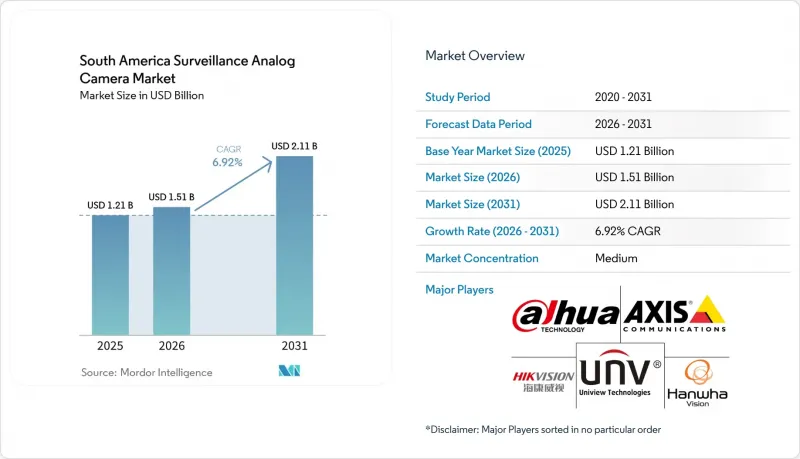
에 따르면 남미의 감시용 아날로그 카메라 시장 규모는 2025년 12억 1,000만 달러에서 2026년에는 15억 1,000만 달러로 확대되어, 2031년까지 21억 1,000만 달러에 달할 것으로 예측되며, 2026년부터 2031년까지 연평균 성장률(CAGR)은 6.92%가 될 전망입니다.
남미 감시용 아날로그 카메라 시장의 동향 및 인사이트
기존 동축 인프라와 단계적 업그레이드의 경제성
상업 시설 및 공공 시설의 동축 네트워크는 카메라 교체 시 여전히 견고한 기반을 제공하고 있습니다. 이러한 네트워크를 Cat6 케이블로 교체할 경우, 카메라 1대당 40-150달러의 인건비가 추가로 발생합니다. 2026년 기준으로, 카메라 8대를 갖춘 하이브리드 HVR 시스템의 비용은 700-950달러인 반면, 동등한 성능의 IP-NVR 시스템은 1,400달러 이상이 소요됩니다. 하이브리드 DVR을 활용하면 시설은 기존 케이블 자산을 유지하면서 카메라를 단계적으로 교체할 수 있습니다. Hikvision Turbo HD는 ‘Power over Coaxial(PoC)’을 지원하여, 단일 BNC 케이블로 전력과 영상을 전송합니다. 이러한 접근 방식을 통해 시설은 향후 교체 주기에서도 동축 카메라 도입을 지속할 수 있습니다.
비용 효율성과 합리적인 가격
남미 전역의 중소 규모 구매자에게 있어 가격 민감도는 여전히 중요한 요소입니다. 기존 DVR을 계속 사용하는 경우, AHD 및 HD-TVI 카메라는 더 저렴한 가격으로 1080p 화질을 제공할 수 있습니다. 민간 보안에 대한 지출은 저비용 감시 시스템에 대한 지속적인 수요를 뒷받침하고 있습니다. 패키지화된 아날로그 키트는 소매 채널을 통해 소규모 정식 및 비정식 기업에도 점차 보급되고 있습니다. Intelbras사는 마나우스 현지 생산의 혜택을 누리고 있으며, 이를 통해 DVR 및 카메라의 가격 경쟁력을 유지하고 있습니다. 따라서 남미의 아날로그 감시 카메라 시장에서는 초기 비용이 여전히 구매 결정에 중요한 역할을 하고 있습니다.
기술적 제약과 IP 카메라로의 대체
IP 카메라는 고급 시설이나 신축 프로젝트에서 점유율을 확대하고 있습니다. 이러한 시스템은 엣지 분석, 원격 관리 및 암호화된 영상 전송 기능을 제공합니다. IP 시스템과 하이브리드 시스템 간의 비용 차이가 줄어들고 있어 아날로그 시스템의 가치 제안에 압박이 가해지고 있습니다. 상파울루, 부에노스아이레스, 보고타와 같은 대도시권에서는 IP 도입이 의무화되는 경향이 강해지고 있습니다. 공급업체는 이러한 전환기에 중견 시장 구매자를 유지하기 위해 하이브리드 펌웨어 및 영상 관리 시스템과의 호환성을 확보해야 합니다.
부문 분석
2025년, 남미의 아날로그 감시 카메라 시장에서 돔 카메라는 34.27%의 점유율을 차지했습니다. 파손 방지형 하우징과 천장 설치형 디자인은 은행 지점, 소매점, 빌딩 로비에 적합합니다. 광각 렌즈를 통해 좁은 상업 구역의 사각지대를 줄여줍니다. 배럿 카메라는 외벽, 주차장, 고속도로변 등에서 여전히 널리 사용되고 있습니다. PTZ 카메라는 능동적인 장면 추적이 필요한 장소에서 사용됩니다. 박스 카메라는 특수한 설치 장소나 ATM 감시에서 여전히 중요한 역할을 하고 있습니다. 피쉬아이 카메라 및 멀티 센서 카메라는 2031년까지 연평균 성장률(CAGR) 7.32%로 성장할 것으로 예측됩니다. 이 카메라들은 시야가 넓기 때문에 창고나 교통 허브에서 필요한 카메라 대수를 줄일 수 있습니다.
멀티센서 유닛 1대로 동축 케이블 1개와 DVR 채널 1개를 사용하여 광활한 소매점 매장을 커버할 수 있습니다. 반면, 개별 돔 카메라를 사용할 경우, 비슷한 범위를 커버하려면 3-4개의 케이블과 채널이 필요합니다. 이러한 운영 모델을 통해 광활한 개방 공간에서의 배선 및 설치 작업을 줄일 수 있습니다. 인건비가 프로젝트 선정에 영향을 미치는 경우, 이러한 이점은 매우 중요합니다. 돔 카메라는 실내 상업 시설 구매자가 요구하는 일반적인 요건을 계속해서 충족하고 있습니다. 피쉬아이 모델은 개별 카메라 영상보다 광범위한 감시가 중시되는 장소에 적합합니다. 남미의 아날로그 감시 카메라 시장에서는 기존 동축 인프라를 통해 도입할 수 있기 때문에 두 가지 형식이 모두 활용되고 있습니다. 또한, 형식을 조합함으로써 설치 업체는 녹화 시스템을 변경하지 않고도 시스템을 맞춤 설정할 수 있습니다.
2025년, HD-TVI는 남미의 아날로그 감시 카메라 시장에서 38.41%의 점유율을 차지했습니다. Hikvision의 시장 내 입지는 광범위한 TVI 카메라 및 DVR 생태계 구축에 기여했습니다. 오픈 라이선스 기반 파생 제품 덕분에 단일 공급업체에 대한 의존과 관련된 구매자의 우려가 완화되었습니다. HD-CVI는 Dahua의 설치 업체 네트워크를 통해 동등한 동축 성능을 제공하고 있습니다. AHD는 가성비를 중시하는 브랜드 제품 및 비브랜드 제품 채널에서 계속해서 이용 가능합니다. 화질 요구 사항이 제한적인 업데이트 프로젝트에서는 표준 해상도의 아날로그 카메라가 계속 사용되고 있습니다. 아날로그와 IP 하이브리드 시스템은 2031년까지 연평균 성장률(CAGR) 7.13%로 성장할 것으로 예측됩니다. 하이브리드 XVR은 구형 동축 영상과 특정 IP 카메라 채널을 통합할 수 있습니다.
하이브리드 시스템을 통해 기관 투자자는 예산과 위험에 따라 업그레이드 순서를 조정할 수 있습니다. 주요 접근 지점에 분석 기능을 갖춘 IP 카메라를 추가하는 한편, 기존 동축 카메라는 계속 가동할 수 있습니다. 이 모델을 통해 모든 카메라와 케이블을 즉시 교체할 필요가 없어집니다. 또한 시스템 통합업체가 현대화 과정에서도 유지보수 계약을 유지하는 데 도움이 됩니다. 정부 프로그램에서는 새로운 지휘 센터의 요구 사항과 기존 주변 감시 카메라를 결합할 때 하이브리드 사양을 채택할 수 있습니다. 순수 DVR 플랫폼에서는 이러한 요구 사항에 대한 유연성이 떨어집니다. 순수 NVR 플랫폼의 경우 초기 인프라 투자 규모가 더 커질 수 있습니다. 남미의 아날로그 감시 카메라 시장은 여전히 이러한 단계적인 기술 전환 경로를 따르고 있습니다.
기타 이점:
- 엑셀 형식의 시장 예측(ME) 시트
- 3개월간의 애널리스트 지원
자주 묻는 질문
목차
제1장 소개
- 조사 가정과 시장 정의
- 조사 범위
제2장 조사 방법
제3장 주요 요약
제4장 시장 구도
- 시장 개요
- 시장 성장 촉진요인
- 시장 성장 억제요인
- 거시경제 요인이 시장에 미치는 영향
- 업계 공급망 분석
- 규제 상황
- Porter's Five Forces 분석
제5장 시장 규모와 성장 예측
- 카메라 형상별
- 기술별
- 해상도별
- 용도별
- 최종 이용 산업별
- 유통 채널별
- 지역별
- 브라질
- 아르헨티나
- 콜롬비아
- 칠레
- 기타 남미 국가
제6장 경쟁 구도
- 시장 집중도
- 전략적 동향
- 시장 점유율 분석
- 기업 개요
- Hangzhou Hikvision Digital Technology Co., Ltd.
- Zhejiang Dahua Technology Co., Ltd.
- Hanwha Vision Co., Ltd.
- Axis Communications AB
- Zhejiang Uniview Technologies Co., Ltd.
- i-PRO Co., Ltd.
- IDIS Co., Ltd.
- ACTi Corporation
- Tiandy Technologies Co., Ltd.
- TVT Digital Technology Co., Ltd.
- Infinova International, Inc.
- EverFocus Electronics Corp.
- CP PLUS International Pte. Ltd.
- Intelbras S.A. Industria de Telecomunicacao Eletronica Brasileira
- Teledyne FLIR LLC
- Pelco, Inc.
- VIVOTEK Inc.
- GeoVision Inc.
- D-Link Corporation
- Avigilon Corporation
제7장 시장 기회와 향후 전망
KSM 26.10.29According to Mordor Intelligence, the South America surveillance analog camera market size is projected to expand from USD 1.21 billion in 2025 to USD 1.51 billion in 2026, and to USD 2.11 billion by 2031, registering a CAGR of 6.92% between 2026 and 2031.
South America Surveillance Analog Camera Market Trends and Insights
Installed Coaxial Infrastructure and Staged Upgrade Economics
Coaxial networks in commercial and institutional buildings remain a durable base for camera replacements. Replacing those networks with Cat6 cabling adds USD 40 to USD 150 in labor cost for each camera. A hybrid HVR system costs USD 700 to USD 950 for 8 cameras, compared with USD 1,400 or more for a comparable IP-NVR system in 2026. Hybrid DVRs allow sites to retain cable assets while improving cameras in phases. Hikvision Turbo HD supports Power over Coaxial, which delivers power and video over a single BNC cable. This approach can keep a site committed to procuring coaxial cameras through subsequent refresh cycles.
Cost Effectiveness and Affordability
Price sensitivity remains important for small and mid-sized buyers across South America. AHD and HD-TVI cameras can provide 1080p quality at lower prices when an existing DVR is retained. Private security spending supports continued demand for lower-cost coverage. Pre-packaged analog kits are reaching smaller formal and informal enterprises through retail channels. Intelbras benefits from local production in Manaus, which supports competitive pricing for DVRs and cameras. The South America Surveillance Analog Camera Market, therefore, retains a role where upfront spending determines buying decisions.
Technological Limitations and IP Camera Substitution
IP cameras are gaining ground at premium sites and new construction projects. These systems offer edge analytics, remote administration, and encrypted video transmission. The narrowing cost difference between IP and hybrid systems places pressure on the analog value proposition. Large urban locations in Sao Paulo, Buenos Aires, and Bogota are more likely to specify IP deployments. Suppliers need hybrid firmware and video-management compatibility to retain mid-market buyers during this transition.
Other drivers and restraints analyzed in the detailed report include:
- Government Public Safety and Smart City Procurement
- Rising Crime and Security Investment
- Cybersecurity and Data Privacy Exposure of Legacy DVRs
For complete list of drivers and restraints, kindly check the Table Of Contents.
Segment Analysis
Dome cameras held 34.27% of the South America Surveillance Analog Camera Market in 2025. Their vandal-resistant housing and ceiling-mount design suit bank branches, retail outlets, and building lobbies. Wide-angle lenses reduce blind spots in compact commercial areas. Bullet cameras remain common for exterior walls, parking areas, and highway corridors. PTZ cameras are used in sites that require active scene tracking. Box cameras remain relevant for specialized enclosures and ATM surveillance. Fisheye and multi-sensor cameras are forecast to grow at a 7.32% CAGR through 2031. Their wider fields of view can reduce the number of cameras required in warehouses and transit hubs.
A multi-sensor unit can cover a broad retail floor with 1 coaxial run and 1 DVR channel. Separate dome cameras would require 3 to 4 runs and channels for similar coverage. This operating model can lower cabling and installation work in large open spaces. The benefit is important where labor costs affect project selection. Dome cameras continue to meet the general requirements of indoor commercial buyers. Fisheye models are well-suited to locations where wide-area observation is more valuable than discrete camera views. The South America Surveillance Analog Camera Market benefits from both formats because they can be deployed over existing coaxial infrastructure. The format mix also allows installers to tailor systems without changing the recording.
HD-TVI held 38.41% of the South America Surveillance Analog Camera Market in 2025. Hikvision's market presence helped establish a broad TVI camera and DVR ecosystem. Open-license derivatives reduced buyers' concerns about a single supplier. HD-CVI offers comparable coaxial performance through Dahua's installer network. AHD remains available in value-oriented branded and unbranded channels. Standard-definition analog continues to be used in replacement projects with limited image-quality requirements. Hybrid analog and IP is forecast to grow at a 7.13% CAGR through 2031. Hybrid XVRs can ingest older coaxial feeds and selected IP camera channels.
Hybrid systems allow institutional buyers to sequence upgrades according to budget and risk. An existing coaxial camera can remain active while an analytics-capable IP camera is added at a key access point. This model avoids immediate replacement of every camera and cable. It also helps system integrators keep maintenance relationships during modernization. Government programs can use hybrid specifications when they combine new command-center needs with existing perimeter cameras. Pure DVR platforms have less flexibility in these requirements. Pure NVR platforms can require a larger initial infrastructure commitment. The South America Surveillance Analog Camera Market remains linked to this staged technology path.
Complete Report Scope:
- By Camera Form
- Box Cameras
- Dome Cameras
- Bullet Cameras
- Pan-Tilt-Zoom Cameras
- Fisheye and Multi-Sensor Cameras
- Pinhole and Other Camera Forms
- By Technology
- Standard-Definition Analog
- AHD
- HD-CVI
- HD-TVI
- Hybrid Analog and IP
- By Resolution
- Up to 960H
- 720p
- 1080p and 2MP
- 4MP and 5MP
- 4K and Above
- By Application
- Indoor Surveillance
- Outdoor Surveillance
- Low-Light and Night Surveillance
- Traffic and Perimeter Monitoring
- By End-user Industry
- Government and Public Safety
- Banking, Financial Services, and Insurance
- Healthcare
- Transportation and Logistics
- Industrial
- Retail, Hospitality, and Commercial
- Residential and Small Businesses
- Education and Other End-user Industries
- By Distribution Channel
- Security Distributors
- System Integrators and Installers
- Specialist Retail and E-commerce
- Direct Enterprise and Government Procurement
- By Geography
- Brazil
- Argentina
- Colombia
- Chile
- Rest of South America
List of Companies Covered in this Report:
- Hangzhou Hikvision Digital Technology Co., Ltd.
- Zhejiang Dahua Technology Co., Ltd.
- Hanwha Vision Co., Ltd.
- Axis Communications AB
- Zhejiang Uniview Technologies Co., Ltd.
- i-PRO Co., Ltd.
- IDIS Co., Ltd.
- ACTi Corporation
- Tiandy Technologies Co., Ltd.
- TVT Digital Technology Co., Ltd.
- Infinova International, Inc.
- EverFocus Electronics Corp.
- CP PLUS International Pte. Ltd.
- Intelbras S.A. Industria de Telecomunicacao Eletronica Brasileira
- Teledyne FLIR LLC
- Pelco, Inc.
- VIVOTEK Inc.
- GeoVision Inc.
- D-Link Corporation
- Avigilon Corporation
Additional Benefits:
- The market estimate (ME) sheet in Excel format
- 3 months of analyst support
TABLE OF CONTENTS
1 INTRODUCTION
- 1.1 Study Assumptions and Market Definition
- 1.2 Scope of the Study
2 RESEARCH METHODOLOGY
3 EXECUTIVE SUMMARY
4 MARKET LANDSCAPE
- 4.1 Market Overview
- 4.2 Market Drivers
- 4.2.1 Installed Coaxial Infrastructure and Staged Upgrade Economics
- 4.2.2 Cost Effectiveness and Affordability
- 4.2.3 Government Public-Safety and Smart-City Procurement
- 4.2.4 Rising Crime and Security Investment
- 4.2.5 HD-over-Coax Resolution Improvements
- 4.2.6 Informal-Sector and Microenterprise Security Standardization
- 4.3 Market Restraints
- 4.3.1 Technological Limitations and IP-Camera Substitution
- 4.3.2 Cybersecurity and Data-Privacy Exposure of Legacy DVRs
- 4.3.3 Import Dependence, Currency Volatility, and Certification Costs
- 4.3.4 Shortage of Skilled Analog-to-Hybrid Installers Outside Major Cities
- 4.4 Impact of Macroeconomic Factors on the Market
- 4.5 Industry Supply-Chain Analysis
- 4.6 Regulatory Landscape
- 4.7 Porter's Five Forces Analysis
- 4.7.1 Threat of New Entrants
- 4.7.2 Bargaining Power of Suppliers
- 4.7.3 Bargaining Power of Buyers
- 4.7.4 Threat of Substitutes
- 4.7.5 Intensity of Competitive Rivalry
5 MARKET SIZE AND GROWTH FORECASTS (VALUE)
- 5.1 By Camera Form
- 5.1.1 Box Cameras
- 5.1.2 Dome Cameras
- 5.1.3 Bullet Cameras
- 5.1.4 Pan-Tilt-Zoom Cameras
- 5.1.5 Fisheye and Multi-Sensor Cameras
- 5.1.6 Pinhole and Other Camera Forms
- 5.2 By Technology
- 5.2.1 Standard-Definition Analog
- 5.2.2 AHD
- 5.2.3 HD-CVI
- 5.2.4 HD-TVI
- 5.2.5 Hybrid Analog and IP
- 5.3 By Resolution
- 5.3.1 Up to 960H
- 5.3.2 720p
- 5.3.3 1080p and 2MP
- 5.3.4 4MP and 5MP
- 5.3.5 4K and Above
- 5.4 By Application
- 5.4.1 Indoor Surveillance
- 5.4.2 Outdoor Surveillance
- 5.4.3 Low-Light and Night Surveillance
- 5.4.4 Traffic and Perimeter Monitoring
- 5.5 By End-user Industry
- 5.5.1 Government and Public Safety
- 5.5.2 Banking, Financial Services, and Insurance
- 5.5.3 Healthcare
- 5.5.4 Transportation and Logistics
- 5.5.5 Industrial
- 5.5.6 Retail, Hospitality, and Commercial
- 5.5.7 Residential and Small Businesses
- 5.5.8 Education and Other End-user Industries
- 5.6 By Distribution Channel
- 5.6.1 Security Distributors
- 5.6.2 System Integrators and Installers
- 5.6.3 Specialist Retail and E-commerce
- 5.6.4 Direct Enterprise and Government Procurement
- 5.7 By Geography
- 5.7.1 Brazil
- 5.7.2 Argentina
- 5.7.3 Colombia
- 5.7.4 Chile
- 5.7.5 Rest of South America
6 COMPETITIVE LANDSCAPE
- 6.1 Market Concentration
- 6.2 Strategic Moves
- 6.3 Market Share Analysis
- 6.4 Company Profiles (includes Global Level Overview, Market Level Overview, Core Segments, Financials as available, Strategic Information, Market Rank/Share, Products and Services, Recent Developments)
- 6.4.1 Hangzhou Hikvision Digital Technology Co., Ltd.
- 6.4.2 Zhejiang Dahua Technology Co., Ltd.
- 6.4.3 Hanwha Vision Co., Ltd.
- 6.4.4 Axis Communications AB
- 6.4.5 Zhejiang Uniview Technologies Co., Ltd.
- 6.4.6 i-PRO Co., Ltd.
- 6.4.7 IDIS Co., Ltd.
- 6.4.8 ACTi Corporation
- 6.4.9 Tiandy Technologies Co., Ltd.
- 6.4.10 TVT Digital Technology Co., Ltd.
- 6.4.11 Infinova International, Inc.
- 6.4.12 EverFocus Electronics Corp.
- 6.4.13 CP PLUS International Pte. Ltd.
- 6.4.14 Intelbras S.A. Industria de Telecomunicacao Eletronica Brasileira
- 6.4.15 Teledyne FLIR LLC
- 6.4.16 Pelco, Inc.
- 6.4.17 VIVOTEK Inc.
- 6.4.18 GeoVision Inc.
- 6.4.19 D-Link Corporation
- 6.4.20 Avigilon Corporation
7 MARKET OPPORTUNITIES AND FUTURE OUTLOOK
- 7.1 White-Space and Unmet-Need Assessment


