

|
시장보고서
상품코드
2154761
원자력 발전기 및 모터 : 시장 점유율 분석, 업계 동향과 통계, 성장 예측(2026-2031년)Nuclear Generators and Motors - Market Share Analysis, Industry Trends & Statistics, Growth Forecasts (2026 - 2031) |
||||||
 Mordor Intelligence
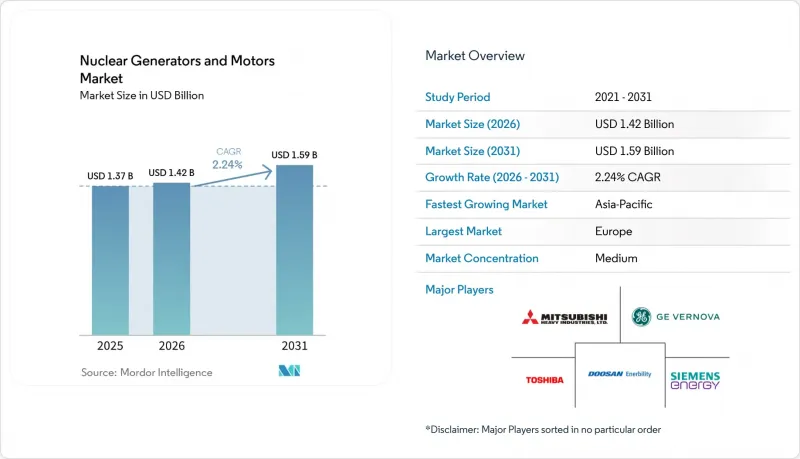
에 따르면 원자력 발전기 및 모터 시장 규모는 2025년 13억 7,000만 달러, 2026년 14억 2,000만 달러에서 2031년까지 15억 9,000만 달러로 확대될 것으로 예측되며, 2026년부터 2031년까지 연평균 성장률(CAGR)은 2.24%가 될 전망입니다.
전 세계 원자력 발전기 및 모터 시장의 동향과 인사이트
원자력 신규 건설 및 원자로 수명 연장 프로그램
원자력발전소 건설은 지난 30년 동안 최고 수준에 도달했습니다. 2025년에는 10기의 원자로 건설이 착공되었으며, 그중 9기는 중국, 1기는 러시아에서 진행되어, 이로 인해 전 세계 건설 예정 용량에 12.2 GW가 추가되었습니다. OECD 원자력기구(NEA) 보고서에 따르면, 전 세계적으로 70 GWe가 건설 중이며, 그 용량의 80% 가까이를 비OECD 국가들이 차지하고 있습니다. 대형 원자로 1기당 터빈·발전기 세트와 안전상 극히 중요한 유도 전동기가 여러 대 필요합니다. 이러한 건설 기반이 원자력용 발전기 및 전동기 시장 전체의 신규 설비 수주를 뒷받침하고 있습니다. 또한, 프랑스의 제4차 정기 안전성 재검토 프로그램에서는 2040년까지 1,300 MW급 원자로의 터빈 아일랜드 업그레이드가 요구되고 있습니다.
건설 활동의 규모가 반드시 원자로 가동 개시 지역과 일치하는 것은 아닙니다. 중국과 한국의 개발업체들이 많은 신규 프로젝트를 주도하고 있지만, 승인된 설계를 통해 유럽 및 북미의 장비 제조사들에게도 여전히 공급 기회가 생기고 있습니다. 대형 터빈 및 발전기 계약은 시운전 시작 훨씬 전에 발주되므로, 공급업체는 생산능력 및 기술 자원을 계획하기가 용이합니다. 운전 기간 연장 공사는 신규 부지 인가에 그다지 의존하지 않는, 발전소 고유의 수주라는 또 다른 흐름을 만들어 냅니다. 이러한 프로그램에서는 대개 회전 장비, 보조 시스템 및 인증 작업이 동시에 대상이 됩니다. 전력 회사가 안전성 향상과 운전 허가 기간 연장을 병행할 경우, 원자력용 발전기 및 모터 시장이 혜택을 받게 됩니다.
노후화된 터빈·발전기 및 클래스 1E 모터의 교체
유럽과 미국의 많은 원자력발전소는 1970년부터 1990년 사이에 건설되었기 때문에 주요 회전 장비는 당초 설계 수명에 근접했거나 이미 그 수명을 초과했습니다. ASNR은 2025년 7월, 프랑스의 1,300 MW급 원자로 20기에 대해 40년을 초과하는 운전을 승인했습니다. 주몽 일렉트릭(Jumon Electric)은 2025년 9월, EDF의 골페크 발전소에서 1,300 MW 교류 발전기 로터 교체를 완료했습니다. 이 작업은 설비군의 유지보수 프로그램이 어떻게 고부가가치 개보수 및 교체 수주로 이어지는지를 보여줍니다. IEEE 334-2024 표준에서는 클래스 1E 기기에 대해 설치 후 사용 수명 기간 동안의 성능을 입증할 것을 요구하고 있습니다. 이 표준은 재인증, 문서화된 교체 및 신규 모터 공급에 대한 수요를 뒷받침하고 있습니다.
안전상 극히 중요한 모터 용도에서 기존 문서는 큰 상업적 가치를 지닙니다. 설계 파일을 보유하고 있는 공급업체는 완전한 인증 프로그램을 시작하지 않고도 동등한 제품으로의 교체를 제공할 수 있습니다. 원자력 규제 당국은 안전 장비를 설치하기 전에 공식적인 증빙 자료를 요구하기 때문에 전력 회사는 인증되지 않은 대체품의 사용을 피해야 합니다. 이 때문에 애프터마켓에서의 경쟁은 일반 산업용 모터 판매에 비해 제한적입니다. 교체 비용은 계획 정전 기간 중에 예산에 반영할 수 있으며, 이를 통해 사업자는 설비 작업을 보다 광범위한 현대화 프로그램과 연계할 시간을 확보할 수 있습니다. 따라서 원자력발전기 및 모터 시장은 신규 원자로에 대한 투자뿐만 아니라 정기적인 교체 주기에 의해 뒷받침되고 있습니다.
원자력 등급 단조, 절연, 시험 분야의 병목 현상
원자력 등급 부품의 공급은 전문적인 단조, 기계 가공, 용접, 시험 및 검사 역량에 의존합니다. ‘원자력 확장 이니셔티브(Nuclear Scaling Initiative)’는 기계 가공, 용접, 마감 처리 및 비파괴 검사를 중요한 공급망 제약요인으로 지목했습니다. 이는 인증된 시설과 숙련된 인력이 필요하기 때문입니다. 클래스 1E 용도에서는 특정 인증 기록이 필요한 절연 시스템도 사용됩니다. 미국 에너지부는 2026년 6월, 10기의 AP1000 원자로를 위한 장기 리드타임이 필요한 조달을 지원하기 위해 175억 달러 규모의 조건부 대출을 발표했습니다. 이 프로그램은 자금 지원만으로는 즉시 인증된 제조 역량을 창출할 수 없다는 점을 인식하고 있습니다. 장기 리드타임이 필요한 품목은 프로젝트가 자금 지원을 받은 후에도 발전기나 모터의 조달을 지연시킬 가능성이 있습니다.
원자력 품질 규정에 따라 발주 후 자재를 대체하는 것은 어렵습니다. 인증된 자재, 공정 또는 부품의 변경에는 공식적인 심사나 추가 문서화가 필요할 수 있습니다. 따라서 전력 회사는 건설 일정이 확정되는 대로 조기에 생산 할당량을 확보합니다. 이러한 관행으로 인해 확립된 품질 시스템과 가용 생산능력을 갖춘 공급업체의 경쟁력이 높아집니다. 또한, 소규모 공급업체가 원자력 특유의 시험 및 검사 역량을 추가해야 할 경우, 상당한 압박에 직면하게 됩니다. 대규모 설비는 엄격하게 관리되는 여러 공급 단계에 의존하고 있기 때문에 원자력용 발전기 및 모터 시장은 이러한 제약의 영향을 지속적으로 받고 있습니다.
부문 분석
2025년 기준, 발전기는 원자력발전기·모터 시장 점유율의 93.8%를 차지하고 있으며, 2031년까지 연평균 성장률(CAGR) 2.4%로 성장할 것으로 예상됩니다. 이 부문이 주도적인 위치를 차지하는 이유는 모든 상업용 원자로에 터빈·발전기 세트가 필요하며, 그 가치가 발전소의 모터 관련 설비 가치를 크게 상회하고, 또한 사업자가 운전 기간 동안 전문적인 서비스를 필요로 하기 때문입니다. 1,000 MW급 원자로의 교체용 세트에는 무게가 2,000톤을 넘고 길이가 65미터에 달하는 어셈블리가 포함될 수 있으며, 관련 프로젝트 작업에는 설치 계획, 시험 및 장기적인 서비스 지원이 포함됩니다. 신규 건설 계약, 고정자 바 재권선, 회전자 개조 및 디지털 자속 제어 시스템으로의 업그레이드가 발전기 매출을 뒷받침하고 있으며, 이러한 각 활동은 가동중인 발전소의 유지보수 일정 및 안전 요건과 밀접하게 관련되어 있습니다. 정격 출력 125MW에서 345MW에 이르는 SMR용 발전기 세트에는 기존 대규모 원자로용 설비와는 다른 설계 접근 방식이 필요하며, 오클로(Oclo)사의 ‘오로라(Aurora)’ 프로젝트를 위해 지멘스 에너지(Siemens Energy)가 선정한 SGen-100A 유닛은 이러한 새로운 요구 사항을 여실히 보여주고 있습니다.
2025년 매출액 중 나머지 6.2%는 케이지형 유도 전동기가 차지했습니다. 가치 기준으로는 미미하지만, 이러한 전동기는 발전소의 안전 시스템에 필수적이기 때문에 여전히 중요한 위치를 차지하고 있습니다. 이들은 주냉각 펌프, 급수 시스템 및 비상 노심 냉각 장치를 구동하므로, 교체 결정 시 제안된 유닛이 해당 원자력 조건 하에서 확실하게 작동한다는 증거가 필요합니다. IEEE 334-2024 표준에 따라 설치 후 사용 수명 기간 동안 지속적인 성능을 입증하는 기록의 중요성이 높아지고 있으며, 이로 인해 기술 문서가 구매 결정의 핵심 요소가 되고 있습니다. 하얼빈 일렉트릭(Harbin Electric)은 중국의 ‘화룡 1호’, ‘구오화 1호’, 그리고 CAP1400의 각 주요 냉각수 펌프용 모터 설계에 대해 인증을 받았으며, 한편 주몽 일렉트릭사는 프랑스 및 한국의 원자력발전소군에서 원자로 냉각수 펌프용 모터의 주요 공급업체로서의 지위를 유지하고 있습니다. 그 결과, 여러 공급업체가 유사한 기술 사양을 충족하는 경우에도 각국의 인증 제도에 따라 국경을 초월한 경쟁이 제한되고 있습니다.
지역별 분석
2025년, 유럽은 원자력발전기 및 모터 시장 점유율의 42.1%를 차지하며, 해당 지역은 매출액 측면에서 1위를 기록했습니다. 프랑스에는 대규모의 가동중인 발전소 군이 있으며, 지속적인 운전 기간 연장 작업이 진행되고 있어 터빈 개조, 발전기 정비 및 모터 교체가 장기간에 걸쳐 이루어지고 있습니다. ASNR(프랑스 원자력 안전 규제청)은 2025년 7월, 가동 개시 후 40년이 지난 1,300MW급 프랑스 내 20기의 원자로를 대상으로 터빈 아일랜드 및 안전 설비에 대한 작업이 필요한 제4차 정기 안전 심사를 시작했습니다. 이러한 심사를 통해 조달 업무는 개별 발전소의 가동 중단 기간에 분산되어, 단일하고 집중된 수주 주기가 아닌 안정적인 애프터마켓을 뒷받침하고 있습니다. 헝가리에서는 2026년 2월에 파크시 2호기 건설이 시작되었으며, 한편 롤스로이스 SMR사는 2026년 4월에 체코 프로젝트의 초기 공사 계약을 체결하여, 해당 지역의 서비스 기반에 기존의 터빈 아일랜드 관련 사업 외에도 새로운 비즈니스 기회가 추가되었습니다.
아시아태평양은 2031년까지 연평균 성장률(CAGR) 3.5%로 성장할 것으로 예측되며, 원자력용 발전기 및 모터 시장에서 가장 빠르게 성장하는 지역이 될 전망입니다. 중국은 세계에서 가장 집중적인 원자로 건설 프로그램을 전개하고 있으며, 중국의 국산 원자로 설계를 통해 발전기, 원자로 냉각재 펌프용 모터 및 관련 회전 기기에 대한 수요가 뒷받침되고 있습니다. 미국 에너지정보청(EIA) 보고서에 따르면, 중국의 원자력발전 용량은 2016년 이후 거의 두 배로 증가하여, 중국의 장기적인 건설 확대 규모를 엿볼 수 있습니다. 국내 기업들은 현지 인증 절차와 중국의 원자로 설계와의 확고한 협력 관계의 혜택을 누리고 있으며, 하얼빈전기는 2025년에 ‘궈허 1호’ 실증 프로젝트를 위한 주냉각수 펌프용 모터 납품을 완료했습니다. 인도의 카이가 5호·6호 원자로 계획은 조달 수요의 폭을 넓히고 있는 반면, 일본의 원자로 재가동 및 원자력 사업의 회복은 장비와 서비스에 대한 또 다른 수요 기반을 제공하고 있습니다.
아메리카, 중동 및 아프리카가 나머지 지역의 수익 기반을 차지하고 있습니다. 미국 에너지부의 175억 달러 조건부 대출 약정은 AP1000 프로젝트의 조기 및 장기적인 계획 수립을 지원하고 있으며, 캐나다에서 BWRX-300의 건설이 시작됨에 따라 설계 및 조달 업무가 활발해지고 있습니다. 중동 및 아프리카에서 이집트의 다바아 프로젝트는 단기적으로 가장 중요한 기회이지만, 한편 브라질의 앙그라 3호기 및 아르헨티나의 CAREM 프로젝트는 예측 기간 동안 지역적 활동이 비교적 제한적일 것으로 보입니다. 국제적인 안전 요건과 양자 협력 협정에 따라 어떤 공급업체가 이러한 프로젝트 시장에 진입할 수 있는지가 결정되며, 다른 지역에서 볼 수 있는 것과 같은 자격 취득 장벽이 더욱 높아질 가능성이 있습니다.
기타 혜택:
- 엑셀 형식의 시장 예측(ME) 시트
- 3개월간의 애널리스트 지원
자주 묻는 질문
목차
제1장 소개
- 조사 가정과 시장 정의
- 조사 범위
제2장 조사 방법
제3장 주요 요약
제4장 시장 구도
- 시장 개요
- 시장 성장 촉진요인
- 시장 성장 억제요인
- 공급망 분석
- Porter's Five Forces 분석
- 기술 동향
- 규제 상황
- 투자 분석
제5장 시장 규모와 성장 예측
- 기기별
- 지역별
- 북미
- 미국
- 캐나다
- 멕시코
- 유럽
- 독일
- 프랑스
- 이탈리아
- 스페인
- 영국
- 폴란드
- 러시아
- 기타 유럽 국가
- 아시아태평양
- 중국
- 인도
- 일본
- 한국
- 호주
- 인도네시아
- 베트남
- 태국
- 기타 아시아태평양 국가
- 남미
- 브라질
- 아르헨티나
- 칠레
- 기타 남미 국가
- 중동 및 아프리카
- 사우디아라비아
- 아랍에미리트
- 이집트
- 남아프리카공화국
- 모로코
- 기타 중동 및 아프리카 국가
- 북미
제6장 경쟁 구도
- 시장 집중도
- 전략적 동향
- 시장 점유율 분석
- 기업 개요
- Ansaldo Energia S.p.A.
- Bharat Heavy Electricals Limited
- BWX Technologies, Inc.
- Dongfang Electric Corporation Limited
- Doosan Enerbility Co., Ltd.
- ELIN Motoren GmbH
- Framatome
- GE Vernova Inc.
- Harbin Electric Company Limited
- Hitachi GE Vernova Nuclear Energy, Ltd.
- Jeumont Electric SAS
- Larsen & Toubro Limited
- Mitsubishi Heavy Industries, Ltd.
- NIDEC CORPORATION
- Public Joint-Stock Company "Power Machines"
- Shanghai Electric Group Company Limited
- Siemens Energy AG
- The Babcock & Wilcox Company
- Toshiba Corporation
- Westinghouse Electric Company LLC
제7장 시장 기회와 향후 전망
KSM 26.10.29According to Mordor Intelligence, the nuclear generators and Motors Market size is projected to expand from USD 1.37 billion in 2025 and USD 1.42 billion in 2026 to USD 1.59 billion by 2031, registering a CAGR of 2.24% between 2026 and 2031.
Global Nuclear Generators and Motors Market Trends and Insights
Nuclear New-Build and Reactor Life-Extension Programs
Nuclear construction has reached its strongest level in 3 decades. Ten reactor construction starts took place in 2025, including 9 in China and 1 in Russia, adding 12.2 GW to the global pipeline. The OECD Nuclear Energy Agency reported 70 GWe under construction worldwide, with non-OECD countries accounting for nearly 80% of this capacity. Each large reactor requires a turbine-generator train and multiple safety-critical induction motors. This construction base supports new equipment orders across the nuclear generators and motors market. France's fourth periodic safety review program also requires turbine-island upgrades for 1,300 MW reactors through 2040.
The value of construction activity does not always follow the same geography as reactor starts. Chinese and South Korean developers lead many new projects, while licensed designs can still create supply roles for European and North American equipment makers. Large turbine-generator contracts are awarded well before commissioning, which helps suppliers plan capacity and engineering resources. Life-extension work adds a separate stream of plant-specific orders that is less dependent on new-site approvals. These programs often cover rotating equipment, auxiliary systems, and qualification work at the same time. The nuclear generators and motors market benefits when utilities combine safety upgrades with longer operating licenses.
Replacement of Aging Turbine-Generator and Class 1E Motor Fleets
Much of the Western nuclear fleet was built from 1970 to 1990, leaving major rotating assets near or beyond their original design lives. ASNR approved operation beyond 40 years for France's 20 reactors in the 1,300 MW series during July 2025. Jeumont Electric completed the replacement of a 1,300 MW alternator rotor at EDF's Golfech plant in September 2025. This work shows how fleet maintenance programs convert into high-value refurbishment and replacement orders. IEEE 334-2024 requires Class 1E equipment to demonstrate performance over its installed service life. The standard supports demand for requalification, documented replacement, and new motor supply.
Legacy documentation has substantial commercial value in safety-critical motor applications. A supplier that retains design files can offer a like-for-like replacement without starting a full qualification program. Utilities must avoid unqualified substitutes because nuclear regulators require formal evidence before safety equipment can be installed. This makes aftermarket competition narrower than in general industrial motor sales. Replacement spending can be scheduled during planned outages, which gives operators time to align equipment work with wider modernization programs. The nuclear generators and motors market is thus supported by a recurring replacement cycle alongside new reactor investment.
Nuclear-Grade Forging, Insulation and Testing Bottlenecks
Nuclear-grade component supply depends on specialized forging, machining, welding, testing, and inspection capacity. The Nuclear Scaling Initiative identified machining, welding, finishing, and non-destructive examination as important supply-chain constraints because they require qualified facilities and skilled labor. Class 1E applications also use insulation systems that require specific qualification records. The U.S. Department of Energy announced USD 17.5 billion in conditional loans during June 2026 to support long-lead procurement for 10 AP1000 reactors. The program recognizes that finance cannot immediately create qualified manufacturing throughput. Long lead items can delay generator and motor procurement even after a project receives financial backing.
Nuclear quality rules make material substitution difficult after an order has been placed. A change in a qualified material, process, or component can require formal review and additional documentation. Utilities, therefore, reserve manufacturing slots early when construction schedules are firm. This practice increases the advantage of suppliers with established quality systems and available capacity. It also places smaller suppliers under pressure when they need to add nuclear-specific testing or inspection capability. The nuclear generators and motors market remains exposed to these limits because large equipment depends on several tightly controlled supply stages.
Other drivers and restraints analyzed in the detailed report include:
- SMR and Advanced-Reactor Deployment Pipeline
- Nuclear-Powered Data Center and Industrial Load Strategies
- Nuclear Licensing, Qualification and Procurement Complexity
For complete list of drivers and restraints, kindly check the Table Of Contents.
Segment Analysis
Generators held 93.8% of the nuclear generators and motors market share in 2025 and are expected to grow at a 2.4% CAGR through 2031. The segment leads because every commercial reactor needs a turbine-generator train whose value substantially exceeds that of the plant's motor contingent, and because operators need specialist services throughout its operating life. Replacement sets for 1,000 MW-class reactors can involve assemblies above 2,000 tonnes and reaching 65 meters in length, while the related project work includes installation planning, testing, and long-term service support. New-build awards, stator-bar rewinding, rotor refurbishment, and digital excitation upgrades support generator revenue, with each activity tied to an operating plant's maintenance schedule and safety requirements. SMR generator sets rated from 125 MW to 345 MW require design approaches that differ from conventional large-reactor equipment, and Siemens Energy's selected SGen-100A unit for Oklo's Aurora project illustrates this developing requirement.
Squirrel cage induction motors accounted for the remaining 6.2% of revenue in 2025, a smaller value base that remains important because these motors serve plant safety systems. They operate main coolant pumps, feed-water systems, and emergency core cooling equipment, so replacement decisions require evidence that the proposed unit will perform under the applicable nuclear conditions. IEEE 334-2024 has increased the importance of records demonstrating continued performance over installed service life, which makes technical documentation a core part of the purchase decision. Harbin Electric has qualifications across Hualong One, Guohe One, and CAP1400 main coolant pump motor designs in China, while Jeumont Electric remains a reference supplier for reactor coolant pump motors in French and Korean fleets. National qualification regimes consequently limit cross-border competition even when several suppliers can meet similar technical specifications.
Complete Report Scope:
- By Equipment
- Squirrel Cage Induction Motors
- Generators
- By Geography
- North America
- United States
- Canada
- Mexico
- Europe
- Germany
- France
- Italy
- Spain
- United Kingdom
- Poland
- Russia
- Rest of Europe
- Asia-Pacific
- China
- India
- Japan
- South Korea
- Australia
- Indonesia
- Vietnam
- Thailand
- Rest of Asia-Pacific
- South America
- Brazil
- Argentina
- Chile
- Rest of South America
- Middle East and Africa
- Saudi Arabia
- United Arab Emirates
- Egypt
- South Africa
- Morocco
- Rest of Middle East and Africa
- North America
Geography Analysis
Europe held 42.1% of the nuclear generators and motors market share in 2025, giving the region the largest revenue position. France's large installed fleet and its continuing life-extension work support a long stream of turbine refurbishment, alternator work, and motor replacement. ASNR's July 2025 decision covered 20 French reactors in the 1,300 MW series beyond 40 years of operation, beginning fourth periodic safety reviews that require work on turbine islands and safety equipment. These reviews spread procurement over individual plant outages, which supports a stable aftermarket rather than a single concentrated order cycle. Hungary began construction at Paks II Unit 1 during February 2026, while Rolls-Royce SMR signed early works for a Czech project during April 2026, adding new conventional-island opportunities to the regional service base.
Asia-Pacific is forecast to grow at a 3.5% CAGR through 2031, making it the fastest-growing region in the nuclear generators and motors market. China has the world's most concentrated reactor construction program, and its local reactor designs sustain demand for generators, reactor coolant pump motors, and supporting rotating equipment. The U.S. Energy Information Administration reported that China's nuclear capacity had nearly doubled since 2016, showing the scale of the country's long-term buildout. Domestic companies benefit from local qualification routes and established links to Chinese reactor designs, with Harbin Electric completing delivery of main coolant pump motors for the Guohe One demonstration project in 2025. India's Kaiga 5 and 6 program adds procurement depth, while Japan's reactor restarts and recovering nuclear business provide a separate demand base for equipment and services.
North America, South America, the Middle East, and Africa represented the remaining global revenue base. The U.S. Department of Energy's USD 17.5 billion conditional loan commitment supports early long-lead planning for AP1000 projects, and Canada's BWRX-300 construction start has activated engineering and procurement work. Egypt's Dabaa project is the most significant near-term opportunity in the Middle East and Africa, whereas Brazil's Angra 3 and Argentina's CAREM project offer more limited regional activity during the forecast period. International safety requirements and bilateral cooperation arrangements determine which suppliers can access these project markets and can extend the qualification barriers seen elsewhere.
- Ansaldo Energia S.p.A.
- Bharat Heavy Electricals Limited
- BWX Technologies, Inc.
- Dongfang Electric Corporation Limited
- Doosan Enerbility Co., Ltd.
- ELIN Motoren GmbH
- Framatome
- GE Vernova Inc.
- Harbin Electric Company Limited
- Hitachi GE Vernova Nuclear Energy, Ltd.
- Jeumont Electric SAS
- Larsen & Toubro Limited
- Mitsubishi Heavy Industries, Ltd.
- NIDEC CORPORATION
- Public Joint-Stock Company "Power Machines"
- Shanghai Electric Group Company Limited
- Siemens Energy AG
- The Babcock & Wilcox Company
- Toshiba Corporation
- Westinghouse Electric Company LLC
Additional Benefits:
- The market estimate (ME) sheet in Excel format
- 3 months of analyst support
TABLE OF CONTENTS
1 INTRODUCTION
- 1.1 Study Assumptions and Market Definition
- 1.2 Scope of the Study
2 RESEARCH METHODOLOGY
3 EXECUTIVE SUMMARY
4 MARKET LANDSCAPE
- 4.1 Market Overview
- 4.2 Market Drivers
- 4.2.1 Nuclear New-Build and Reactor Life-Extension Programs
- 4.2.2 Grid Reliability and Low-Carbon Baseload Requirements
- 4.2.3 SMR and Advanced-Reactor Deployment Pipeline
- 4.2.4 Replacement of Aging Turbine-Generator and Class 1E Motor Fleets
- 4.2.5 Nuclear-Powered Data-Centre and Industrial Load Strategies
- 4.2.6 Standardized, Factory-Manufactured Nuclear Equipment
- 4.3 Market Restraints
- 4.3.1 High Capital Intensity and Long Project Lead Times
- 4.3.2 Nuclear Licensing, Qualification and Procurement Complexity
- 4.3.3 Nuclear-Grade Forging, Insulation and Testing Bottlenecks
- 4.3.4 Obsolescence of Qualification Records for Aging Motors and Generators
- 4.4 Supply-Chain Analysis
- 4.5 Porter's Five Forces Analysis
- 4.5.1 Bargaining Power of Suppliers
- 4.5.2 Bargaining Power of Buyers
- 4.5.3 Threat of New Entrants
- 4.5.4 Threat of Substitutes
- 4.5.5 Competitive Rivalry
- 4.6 Technology Outlook
- 4.7 Regulatory Landscape
- 4.8 Investment Analysis
5 MARKET SIZE AND GROWTH FORECASTS
- 5.1 By Equipment
- 5.1.1 Squirrel Cage Induction Motors
- 5.1.2 Generators
- 5.2 By Geography
- 5.2.1 North America
- 5.2.1.1 United States
- 5.2.1.2 Canada
- 5.2.1.3 Mexico
- 5.2.2 Europe
- 5.2.2.1 Germany
- 5.2.2.2 France
- 5.2.2.3 Italy
- 5.2.2.4 Spain
- 5.2.2.5 United Kingdom
- 5.2.2.6 Poland
- 5.2.2.7 Russia
- 5.2.2.8 Rest of Europe
- 5.2.3 Asia-Pacific
- 5.2.3.1 China
- 5.2.3.2 India
- 5.2.3.3 Japan
- 5.2.3.4 South Korea
- 5.2.3.5 Australia
- 5.2.3.6 Indonesia
- 5.2.3.7 Vietnam
- 5.2.3.8 Thailand
- 5.2.3.9 Rest of Asia-Pacific
- 5.2.4 South America
- 5.2.4.1 Brazil
- 5.2.4.2 Argentina
- 5.2.4.3 Chile
- 5.2.4.4 Rest of South America
- 5.2.5 Middle East and Africa
- 5.2.5.1 Saudi Arabia
- 5.2.5.2 United Arab Emirates
- 5.2.5.3 Egypt
- 5.2.5.4 South Africa
- 5.2.5.5 Morocco
- 5.2.5.6 Rest of Middle East and Africa
- 5.2.1 North America
6 COMPETITIVE LANDSCAPE
- 6.1 Market Concentration
- 6.2 Strategic Moves
- 6.3 Market Share Analysis
- 6.4 Company Profiles (includes Global Level Overview, Market Level Overview, Core Segments, Financials as available, Strategic Information, Products and Services, Recent Developments)
- 6.4.1 Ansaldo Energia S.p.A.
- 6.4.2 Bharat Heavy Electricals Limited
- 6.4.3 BWX Technologies, Inc.
- 6.4.4 Dongfang Electric Corporation Limited
- 6.4.5 Doosan Enerbility Co., Ltd.
- 6.4.6 ELIN Motoren GmbH
- 6.4.7 Framatome
- 6.4.8 GE Vernova Inc.
- 6.4.9 Harbin Electric Company Limited
- 6.4.10 Hitachi GE Vernova Nuclear Energy, Ltd.
- 6.4.11 Jeumont Electric SAS
- 6.4.12 Larsen & Toubro Limited
- 6.4.13 Mitsubishi Heavy Industries, Ltd.
- 6.4.14 NIDEC CORPORATION
- 6.4.15 Public Joint-Stock Company "Power Machines"
- 6.4.16 Shanghai Electric Group Company Limited
- 6.4.17 Siemens Energy AG
- 6.4.18 The Babcock & Wilcox Company
- 6.4.19 Toshiba Corporation
- 6.4.20 Westinghouse Electric Company LLC
7 MARKET OPPORTUNITIES AND FUTURE OUTLOOK
- 7.1 White-Space and Unmet-Need Assessment


