

|
시장보고서
상품코드
2154836
남미의 진동 센서 : 시장 점유율 분석, 업계 동향과 통계, 성장 예측(2026-2031년)South America Vibration Sensors - Market Share Analysis, Industry Trends & Statistics, Growth Forecasts (2026 - 2031) |
||||||
 Mordor Intelligence
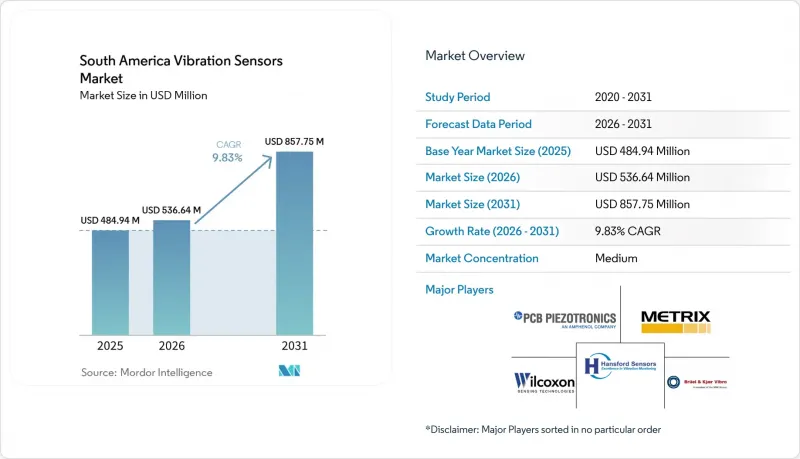
에 따르면 남미의 진동 센서 시장 규모는 2025년에 4억 8,494만 달러로 평가되며, 2026년 5억 3,664만 달러에서 2031년까지 8억 5,775만 달러에 달할 것으로 예측되고 있으며, 예측 기간(2026-2031년)에 CAGR은 9.83%에 달할 전망입니다.
남미 진동 센서 시장의 동향 및 인사이트
광업·금속 업계에서의 예측 유지보수 확대
남미의 진동 센서 시장은 광산 기업이 설비 모니터링을 지속적인 운영의 일환으로 인식하고 있다는 점에서 혜택을 보고 있습니다. 대규모 광산은 컨베이어, 밀, 펌프, 분쇄기 등에 의존하고 있으며, 예기치 못한 고장이 발생하면 단일 생산 공정이 중단되고, 하류 작업이 지연되며, 작업자가 열악한 작업 환경에서 설비를 점검해야만 하는 상황이 발생합니다. 코델코(Codelco)의 보고에 따르면 엘 테니엔테 광산에 센서 및 분석 기술을 도입함으로써 1,100만 달러가 넘는 잠재적 손실을 방지하고, 회전 기계와 관련된 수작업을 없앨 수 있었습니다. 발레(Vale)사는 7곳의 광산 댐에 467대의 연결형 로거를 도입하여, 모니터링 프로그램이 개별 기계뿐만 아니라 인프라도 대상으로 할 수 있으며, 원격지의 정보를 공통 운영 뷰에 통합할 수 있음을 보여주었습니다. ISO 17359:2018 및 ISO 13373 시리즈는 설비의 사양, 선정 및 유지보수 데이터 검증 방법에 영향을 미치는 공통 상태 모니터링 프레임워크를 제공합니다. 이러한 공식적인 유지보수 기법의 보급은 남미 진동 센서 시장에서 지속적인 센서 구매, 통합 서비스 및 장기적인 진단 업무를 지원하고 있습니다.
브라질의 해양 석유 및 가스 생산 확대
브라질의 프레솔트 프로젝트는 고부가가치이며 가혹한 운영 환경에서 작동하는 진동 센서에 대한 수요를 창출하고 있습니다. 페트로브라스와 그 파트너 기업은 심해용으로 설계된 해저 노드를 사용하여 멜로 유전의 지진 모니터링에 4억 5,000만 달러를 투자했습니다. 멜로 프로젝트에서는 2026년 첫 번째 적격성 평가 단계에서 수심 약 2,000미터 지점에 센서 유닛이 설치되었습니다. 또한 해양 플랫폼에서는 펌프, 압축기, 터빈, 라이저 및 기타 자산에 대한 모니터링도 필요합니다. 이러한 점검 및 접근에는 해양 물류, 생산 일정, 안전 관리, 그리고 운영 팀과 유지보수 팀 간의 치밀한 조정이 수반될 수 있습니다. 따라서 부유식 생산 설비가 1기 증설될 때마다 센싱 하드웨어, 데이터 수집 시스템, 예비 부품 및 유지보수 지원에 대한 수년에 걸친 수요가 발생하게 됩니다. 이러한 긴 프로젝트 주기로 인해 단기적인 상품 가격 변동이 있더라도 남미의 진동 센서 시장은 활기를 유지할 수 있습니다.
높은 수입 의존도와 환율 리스크
남미의 진동 센서 시장은 북미 및 유럽 공급업체로부터의 정밀 하드웨어 수입에 크게 의존하고 있습니다. 아르헨티나 페소나 브라질 레알의 환율 변동은 현지 구매력을 변화시키고, 승인된 예산을 어긋나게 하며, 조달 결정을 지연시킬 뿐만 아니라, 수입 시스템의 최종 비용이 프로젝트 승인시 예상되었던 비용과 다른 결과를 초래할 가능성이 있습니다. 또한 전자 부품 및 측정 기기에 부과되는 수입 관세 역시 브라질내 첨단 장비의 납품 비용을 상승시키고 있습니다. 이러한 비용은 모니터링 프로젝트에 명확한 운영상의 가치가 있고, 확립된 유지보수가 필요한 경우라 하더라도, 수년에 걸친 갱신 계획의 경제적 타당성을 저해할 가능성이 있습니다. 현지 통합 서비스는 사용자가 시스템을 구성하거나, 호환 가능한 부품을 조달하거나, 지원을 받거나, 설치시 필요한 작업을 줄이는 데 도움이 됩니다. 그러나 많은 정밀 변환기 소자가 여전히 수입에 의존하고 있으므로 환율 리스크는 계속해서 남미의 진동 센서 시장에 영향을 미치고 있습니다.
부문 분석
2025년, 가속도계는 남미 진동 센서 시장 점유율의 55.14%를 차지했습니다. 이들은 광업, 해양, 제조 설비 분야에서 베어링 결함, 축 불균형, 구조적 공진 및 유체에 의한 진동을 감지합니다. 이러한 도입 실적을 바탕으로 확립된 경보 임계값, 교정 절차 및 유지보수 워크플로가 형성되어 있으며, 최종사용자가 교체나 확장을 쉽게 할 수 있습니다. 속도 센서는 구형 회전 장비에서 여전히 유용하게 사용되고 있는 반면, 변위 센서는 터빈 및 압축기의 축 간극 모니터링에 활용되고 있습니다.
진동용 자이로스코프 시장은 2031년까지 연평균 성장률(CAGR) 11.39%로 확대될 것으로 예측됩니다. 이 장비는 방향성 시추의 자동화를 지원하며, 선형 가속도계로는 포착할 수 없는 각도 진동 데이터를 제공합니다. 석유기술자협회(SPE)는 아르헨티나의 바카 무에르타(Vaca Muerta)층과 관련된 케이싱 시추의 실시간 모니터링 사례를 보고했습니다. PCB Piezotronics사는 2026년 1월, 최대 2,000 VDC까지 직접 접촉 작동이 가능한 ‘HV356A03’을 출시했습니다. 한편, 키슬러(Kistler)사의 0.9그램짜리 ‘KiVibe Miniature’ 장치는 구조 역학 시험을 대상으로 합니다. 이러한 개발은 가속도계의 주도적 지위를 지원하는 한편, 고부가가치 용도에서 특수 장치의 확대를 촉진하고 있습니다.
2025년, 압전 기술은 해당 지역의 매출의 47.12%를 차지했습니다. 이 기술은 고주파 감도를 갖추고 있으며, 해양, 화학, 중공업 환경에서 그 실적이 입증되었습니다. 전하 출력 방식은 이미 많은 현장에 설치된 진동 분석 장치나 보호 시스템과 연동하여 작동할 수 있습니다. 압전 저항식, 정전용량식, 스트레인 게이지 기술은 댐, 교량, 풍력 터빈 타워의 구조 모니터링 등 저주파수의 준정적 용도로 사용되고 있습니다.
MEMS 기술은 2031년까지 연평균 성장률(CAGR) 10.87%로 성장할 것으로 예측됩니다. 단가 하락으로 인해 유선 시스템으로는 경제성이 없었던 장소에도 무선 3축 노드를 설치할 수 있게 되었습니다. Tebe Sensors사는 산업용 진동 및 온도 모니터링 제품을 제공하고 있으며, IEEE의 조사에 따르면 시험 대상이었던 MEMS 노드는 고장 분류 측면에서 기준이 되는 압전 시스템의 성능과 동등하거나 이를 상회하는 결과를 보였습니다. Sinop Energia사는 UHE Sinop 수력 발전소에서 스트레인 게이지와 근접 트랜스듀서를 사용하여 러너의 구성 부품을 모니터링했습니다. 압전 소자는 고정밀도가 요구되는 중요한 용도에서 계속해서 채택될 전망이지만, MEMS는 모니터링이 미흡한 설비로 적용 범위를 확대해 나갈 것입니다.
기타 혜택:
- 엑셀 형식의 시장 예측(ME) 시트
- 3개월간의 애널리스트 지원
자주 묻는 질문
목차
제1장 서론
- 조사 전제조건과 시장 정의
- 조사 범위
제2장 조사 방법
제3장 개요
제4장 시장 구도
- 시장 개요
- 시장 성장 촉진요인
- 시장 성장 억제요인
- 업계 밸류체인 분석
- 규제 상황
- 기술 전망
- Porter's Five Forces 분석
- 거시경제 요인이 시장에 미치는 영향
제5장 시장 규모와 성장 예측
- 제품 유형별
- 기술별
- 소재별
- 최종 용도 산업별
- 지역별
- 브라질
- 아르헨티나
- 칠레
- 콜롬비아
- 기타 남미 국가
제6장 경쟁 구도
- 시장 집중도
- 전략적 동향
- 시장 점유율 분석
- 기업 개요
- PCB Piezotronics, Inc.
- Bruel & Kjaer Vibro GmbH
- Hansford Sensors Ltd.
- Metrix Instrument Co. LP
- Wilcoxon Sensing Technologies
- Dytran Instruments, Inc.
- Connection Technology Center, Inc.
- Kistler Instrumente AG
- Acoem France SAS
- CEMB S.p.A.
- SPM Instrument AB
- Adash spol. s r.o.
- Vibration Research Corporation
- RDI Technologies, Inc.
- Sensoteq Limited
- SKF AB
- Meggitt Sensing Systems Limited
- FUTEK Advanced Sensor Technology, Inc.
- Advanced Sensors Calibration GmbH
- ASC GmbH
제7장 시장 기회와 향후 동향
- 화이트 스페이스 및 미충족 요구 평가
According to Mordor Intelligence, the South America vibration sensors market size was valued at USD 484.94 million in 2025 and estimated to grow from USD 536.64 million in 2026 to reach USD 857.75 million by 2031, at a CAGR of 9.83% during the forecast period (2026-2031).
South America Vibration Sensors Market Trends and Insights
Expansion of Predictive Maintenance in Mining and Metals
The South America vibration sensors market benefits as mining companies treat equipment monitoring as part of operating continuity. Large mines depend on conveyors, mills, pumps, and crushers, where an unplanned failure can interrupt a single production process, delay downstream activities, and require workers to inspect equipment in difficult operating areas. Codelco reported that sensor and analytics work at El Teniente avoided potential losses exceeding USD 11 million and eliminated manual tasks related to rotating machinery. Vale used 467 connected loggers across 7 mine dams, showing that monitoring programs can cover infrastructure as well as individual machines and can bring information from remote locations into a common operational view. ISO 17359:2018 and the ISO 13373 series provide common condition-monitoring frameworks that influence equipment specifications, equipment selection, and the way maintenance data is reviewed. This wider use of formal maintenance methods supports repeat sensor purchases, integration services, and long-term diagnostics work in the South America vibration sensors market.
Offshore Oil and Gas Production Growth in Brazil
Brazil's pre-salt projects create demand for vibration sensors that can work in high-value and difficult operating environments. Petrobras and its partners committed USD 450 million to seismic monitoring at the Mero field, using ocean-bottom nodes designed for deepwater use. The Mero project involved sensor units at depths of nearly 2,000 meters during the first qualification phase in 2026. Offshore platforms also require monitoring of pumps, compressors, turbines, risers, and other assets, where inspection access may involve offshore logistics, production scheduling, safety controls, and careful coordination between operations and maintenance teams. Each additional floating production unit can therefore create several years of demand for sensing hardware, data collection systems, spare parts, and maintenance support. This long project cycle helps the South America vibration sensors market remain active even when commodity prices change in the short term.
High Import Dependence and Foreign-Exchange Exposure
The South America vibration sensors market relies heavily on imported precision hardware from North American and European suppliers. Changes in the Argentine peso and Brazilian real can alter local purchasing power, disrupt approved budgets, delay procurement decisions, and cause the final cost of an imported system to differ from the cost considered at the time of project approval. Import tariffs on electronic components and measurement instruments also raise the delivered cost of advanced equipment in Brazil. These costs can weaken the financial case for multi-year replacement plans, even when a monitoring project has clear operational value and an established maintenance need. Local integration services can help users configure systems, source compatible parts, provide support, and reduce the work required during installation. However, many precision transducer elements remain imported, so foreign-exchange exposure continues to affect the South America vibration sensors market.
Other drivers and restraints analyzed in the detailed report include:
- Industrial Modernization and Industry 4.0 Adoption
- Deployment of Wireless MEMS Monitoring in Remote Assets
- Shortage of Vibration Diagnostics Specialists
For complete list of drivers and restraints, kindly check the Table Of Contents.
Segment Analysis
Accelerometers accounted for 55.14% of the South America vibration sensor market share in 2025. They detect bearing defects, shaft imbalance, structural resonance, and flow-induced vibration across mining, offshore, and manufacturing equipment. Their installed base has created established alarm thresholds, calibration practices, and maintenance workflows, which make replacement and expansion simpler for end users. Velocity sensors remain useful on older rotating equipment, while displacement sensors serve shaft-gap monitoring on turbines and compressors.
Vibration-grade gyroscopes are projected to expand at an 11.39% CAGR through 2031. They support directional drilling automation and provide angular vibration data that linear accelerometers do not capture. The Society of Petroleum Engineers documented real-time monitoring for casing drilling, which is relevant to Argentina's Vaca Muerta formation. PCB Piezotronics released the HV356A03 in January 2026 for direct-contact operation up to 2,000 VDC, while Kistler's 0.9-gram KiVibe Miniature device was targeted for structural dynamics testing. These developments support accelerometer leadership while specialized devices expand in high-value applications.
Piezoelectric technology accounted for 47.12% of regional revenue in 2025. It offers high-frequency sensitivity and has a recognized record in offshore, chemical, and heavy industrial environments. Charge-output configurations can work with vibration analyzers and protection systems already installed at many sites. Piezoresistive, capacitive, and strain-gauge technologies are used in lower-frequency, quasi-static applications, including structural monitoring of dams, bridges, and wind turbine towers.
MEMS technology is projected to grow at a 10.87% CAGR through 2031. Lower unit costs allow wireless triaxial nodes to be installed where cabled systems were not economical. Tebe Sensors offers vibration and temperature monitoring products for industrial applications, and IEEE research found that the tested MEMS nodes matched or exceeded the performance of a reference piezoelectric system in fault classification. Sinop Energia used strain gauges and proximity transducers to monitor runner components at the UHE Sinop hydroelectric plant. Piezoelectric devices are likely to retain critical precision applications, while MEMS expands coverage across less-monitored equipment.
Complete Report Scope:
- By Product Type
- Accelerometers
- Velocity Sensors
- Displacement Sensors
- Gyroscopes (Vibration-Grade)
- By Technology
- Piezoelectric
- Piezoresistive
- Capacitive
- Strain-Gauge
- MEMS
- By Material
- Quartz
- Piezoelectric Ceramics
- Doped Silicon
- Other Materials
- By End-Use Industry
- Automotive
- Aerospace and Defense
- Oil and Gas
- Industrial Manufacturing
- Power Generation
- Healthcare
- Consumer Electronics and Wearables
- Other End-Use Industries
- By Geography
- Brazil
- Argentina
- Chile
- Colombia
- Rest of South America
List of Companies Covered in this Report:
- PCB Piezotronics, Inc.
- Bruel & Kjaer Vibro GmbH
- Hansford Sensors Ltd.
- Metrix Instrument Co. LP
- Wilcoxon Sensing Technologies
- Dytran Instruments, Inc.
- Connection Technology Center, Inc.
- Kistler Instrumente AG
- Acoem France SAS
- CEMB S.p.A.
- SPM Instrument AB
- Adash spol. s r.o.
- Vibration Research Corporation
- RDI Technologies, Inc.
- Sensoteq Limited
- SKF AB
- Meggitt Sensing Systems Limited
- FUTEK Advanced Sensor Technology, Inc.
- Advanced Sensors Calibration GmbH
- ASC GmbH
Additional Benefits:
- The market estimate (ME) sheet in Excel format
- 3 months of analyst support
TABLE OF CONTENTS
1 INTRODUCTION
- 1.1 Study Assumptions and Market Definition
- 1.2 Scope of the Study
2 RESEARCH METHODOLOGY
3 EXECUTIVE SUMMARY
4 MARKET LANDSCAPE
- 4.1 Market Overview
- 4.2 Market Drivers
- 4.2.1 Expansion of Predictive Maintenance in Mining and Metals
- 4.2.2 Offshore Oil and Gas Production Growth in Brazil
- 4.2.3 Industrial Modernization and Industry 4.0 Adoption
- 4.2.4 Deployment of Wireless MEMS Monitoring in Remote Assets
- 4.2.5 Growth of Wind and Hydropower Equipment Monitoring
- 4.2.6 Retrofit Demand from Aging Rotating Machinery
- 4.3 Market Restraints
- 4.3.1 High Import Dependence and Foreign-Exchange Exposure
- 4.3.2 Shortage of Vibration Diagnostics Specialists
- 4.3.3 Connectivity and Data-Sovereignty Constraints at Remote Sites
- 4.3.4 Fragmented Procurement and Long Industrial Qualification Cycles
- 4.4 Industry Value Chain Analysis
- 4.5 Regulatory Landscape
- 4.6 Technological Outlook
- 4.7 Porter's Five Forces Analysis
- 4.7.1 Bargaining Power of Suppliers
- 4.7.2 Bargaining Power of Buyers
- 4.7.3 Threat of New Entrants
- 4.7.4 Threat of Substitutes
- 4.7.5 Competitive Rivalry
- 4.8 Impact of Macroeconomic Factors on the Market
5 MARKET SIZE AND GROWTH FORECASTS (VALUE)
- 5.1 By Product Type
- 5.1.1 Accelerometers
- 5.1.2 Velocity Sensors
- 5.1.3 Displacement Sensors
- 5.1.4 Gyroscopes (Vibration-Grade)
- 5.2 By Technology
- 5.2.1 Piezoelectric
- 5.2.2 Piezoresistive
- 5.2.3 Capacitive
- 5.2.4 Strain-Gauge
- 5.2.5 MEMS
- 5.3 By Material
- 5.3.1 Quartz
- 5.3.2 Piezoelectric Ceramics
- 5.3.3 Doped Silicon
- 5.3.4 Other Materials
- 5.4 By End-Use Industry
- 5.4.1 Automotive
- 5.4.2 Aerospace and Defense
- 5.4.3 Oil and Gas
- 5.4.4 Industrial Manufacturing
- 5.4.5 Power Generation
- 5.4.6 Healthcare
- 5.4.7 Consumer Electronics and Wearables
- 5.4.8 Other End-Use Industries
- 5.5 By Geography
- 5.5.1 Brazil
- 5.5.2 Argentina
- 5.5.3 Chile
- 5.5.4 Colombia
- 5.5.5 Rest of South America
6 COMPETITIVE LANDSCAPE
- 6.1 Market Concentration
- 6.2 Strategic Moves
- 6.3 Market Share Analysis
- 6.4 Company Profiles (includes Global Level Overview, Market Level Overview, Core Segments, Financials as available, Strategic Information, Market Rank/Share, Products and Services, Recent Developments)
- 6.4.1 PCB Piezotronics, Inc.
- 6.4.2 Bruel & Kjaer Vibro GmbH
- 6.4.3 Hansford Sensors Ltd.
- 6.4.4 Metrix Instrument Co. LP
- 6.4.5 Wilcoxon Sensing Technologies
- 6.4.6 Dytran Instruments, Inc.
- 6.4.7 Connection Technology Center, Inc.
- 6.4.8 Kistler Instrumente AG
- 6.4.9 Acoem France SAS
- 6.4.10 CEMB S.p.A.
- 6.4.11 SPM Instrument AB
- 6.4.12 Adash spol. s r.o.
- 6.4.13 Vibration Research Corporation
- 6.4.14 RDI Technologies, Inc.
- 6.4.15 Sensoteq Limited
- 6.4.16 SKF AB
- 6.4.17 Meggitt Sensing Systems Limited
- 6.4.18 FUTEK Advanced Sensor Technology, Inc.
- 6.4.19 Advanced Sensors Calibration GmbH
- 6.4.20 ASC GmbH
7 MARKET OPPORTUNITIES AND FUTURE TRENDS
- 7.1 White-Space and Unmet-Need Assessment


