

|
시장보고서
상품코드
2154863
남미의 당뇨병약 : 시장 점유율 분석, 업계 동향과 통계, 성장 예측(2026-2031년)South America Diabetes Drugs - Market Share Analysis, Industry Trends & Statistics, Growth Forecasts (2026 - 2031) |
||||||
 Mordor Intelligence
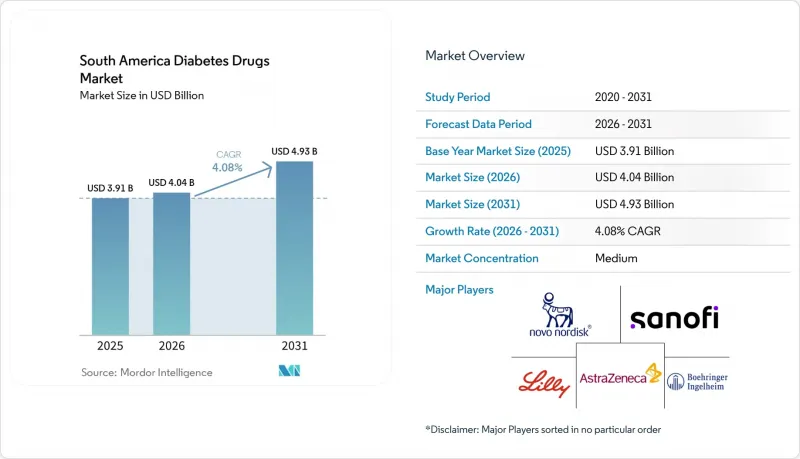
에 따르면 남미의 당뇨병 치료제 시장은 2025년 39억 1,000만 달러에서 2026년에는 40억 4,000만 달러로 확대하며, 2026-2031년에 CAGR 4.08%로 추이하며, 2031년까지 49억 3,000만 달러에 달할 것으로 예측됩니다.
남미 당뇨병 치료제 시장의 동향 및 인사이트
제2형 당뇨병 및 비만 부담의 증가
당뇨병과 비만의 증가는 남미 당뇨병 치료제 시장에 있으며, 가장 광범위한 수요 기반을 형성하고 있습니다. PAHO(범미보건기구)는 2025년 보고서에서 북미와 남미 대륙의 당뇨병 환자 수가 2000년 이후 53.6% 증가했다고 밝혔습니다. 동 보고서에 따르면 신체 활동 부족 비율이 35.6%로 전 세계에서 보아도 지역별로는 가장 높은 수준인 것으로 나타났습니다. 이러한 요인들로 인해 장기적인 혈당 관리가 필요할 가능성이 있는 인구층이 확대되고 있습니다. 이 지역의 도시 인구는 83%를 초과하고 있으며, 식습관 및 생활 습관에 기인한 위험이 대도시권에 집중되어 있습니다. 국제당뇨병연맹(IDF)의 추산에 따르면 2024년 중남미의 당뇨병 관련 의료비는 810억 달러에 달할 것으로 예상됩니다.
제2형 당뇨병은 비만 및 운동 부족과 밀접한 관련이 있으며, 이러한 치료 수요의 대부분을 차지하고 있습니다. 예방 조치를 통해 신규 발병을 억제하는 것은 가능하지만, 이미 진단을 받은 환자들이 지속적으로 필요로 하는 약물 수요를 해소할 수는 없습니다. 따라서 공공 및 민간 의료제도 간에 보험 급여 제도에 차이가 있더라도, 남미의 당뇨병 치료제 시장은 견고한 기반을 확보하고 있습니다.
GLP-1 수용체 작용제 및 SGLT2 억제제의 보급
GLP-1 수용체 작용제 및 SGLT2 억제제는 남미 당뇨병 치료제 시장의 처방 패턴을 변화시키고 있습니다. 임상의들이 심혈관계, 신장 및 체중과 관련된 결과도 고려하게 됨에 따라 이러한 약물의 사용은 기본적인 혈당 조절에 그치지 않고 확대되고 있습니다. 브라질에서는 2025년 2월, ‘포르시가(Forxiga)’라는 상품명으로 판매되는 다파글리플로진을 ‘파르마시아 포퓰라르(Farmacia Popular)’ 프로그램에 추가했습니다. 이를 통해 대상 환자들의 보조금 지원 접근성이 개선되었으며, 이 약제 클래스이 공공 의료 접근 시스템 내에서 보다 명확한 위치를 차지하게 되었습니다.
현지 생산 여부는 이러한 치료제나 인슐린 제제가 환자에게 얼마나 널리 보급될지를 좌우할 가능성이 있습니다. 브라질에서는 보건부 주도의 노력으로 20년간의 공백을 거쳐 2025년에 국내 인슐린 생산을 재개했습니다. 국내 공급을 통해 수입 중단으로 인한 영향을 완화하고 공공 조달 계획을 강화할 수 있습니다. 따라서 남미의 당뇨병 치료제 시장은 저비용 대체품으로 인해 시장 규모가 확대되는 한편, 혁신적인 제약 기업은 새로운 제형과 과학적 근거를 무기로 경쟁을 펼치게 될 것입니다.
높은 본인 부담금과 불균등한 보험 급여
높은 본인 부담금과 불충분한 보험 적용 범위가 남미 당뇨병 치료제 시장의 확장을 제한하고 있습니다. FIFARMA 보고서에 따르면 남미 환자들은 FDA 또는 EMA 승인 후 혁신적인 치료법이 공공 의료제도에서 제한적으로 또는 완전히 이용 가능해지기까지 평균 4.75년을 기다려야 했습니다. 콜롬비아와 칠레에서는 5년을 넘는 대기 기간이 기록되었습니다. 이러한 지연으로 인해 새로운 치료법이 판매 가능해졌음에도 불구하고 그 이용이 제한되고 있습니다. 충실한 민간 보험에 가입하지 않은 환자들은 오래되고 저렴한 제품을 계속 사용해야 할 가능성이 있습니다. 현지 대체품에 의한 가격 인하는 접근성을 확대할 수 있지만, 공적 보험 적용 범위의 공백을 완전히 해소하는 것은 아닙니다.
공공 의료와 민간 의료의 치료 경로 차이는 접근성 격차를 확대시킬 가능성이 있습니다. PAHO(범미보건기구)는 북미와 남미 대륙에서 4,300만 명의 당뇨병 환자가 치료를 받지 못하고 있다고 밝혔습니다. 각국의 보건 기관은 저마다 다른 근거 평가 기준, 예산, 그리고 처방약 리스트 규정을 채택하고 있습니다. 그 결과, 새로운 치료법에 대한 임상적 관심이 높아지고 있음에도 불구하고 남미의 당뇨병 치료제 시장은 여전히 경제적 부담으로 인해 제약을 받고 있습니다.
부문 분석
2025년, 인슐린 제제는 남미 당뇨병 치료제 시장에서 39.51%의 점유율을 차지했습니다. 이는 제1형 당뇨병에서 필수적인 역할과 제2형 당뇨병에서의 광범위한 사용에 힘입은 결과입니다. 인슐린은 병원, 1차 진료 네트워크 및 국가 프로그램을 통해 공급되므로 공공 조달은 여전히 중요합니다. 국내 생산은 공급의 회복력을 높이고 인슐린의 확고한 역할을 강화할 가능성이 있습니다. 공공 입찰의 규모가 크기 때문에 공급업체에게는 안정적인 공급과 경쟁력 있는 가격 책정이 중요합니다.
복합 제제는 2031년까지 연평균 성장률(CAGR) 5.24%로 가장 높은 성장률을 달성할 것으로 예측됩니다. SGLT2 억제제와 메트포르민 또는 DPP-4 억제제를 조합한 고정 용량 제제는 매일의 치료를 간소화할 수 있습니다. 이는 여러 작용 기전이 필요하면서도 복용해야 할 알약 수를 줄이고자 하는 환자를 돕는 것입니다. GLP-1 수용체 작용제는 비인슐린계 주사제 분야를 강화하고 있지만, 기존 의약품에 비해 접근성은 여전히 제한적입니다. 이처럼 남미의 당뇨병 치료제 시장은 조달 중심의 거대한 인슐린 시장과, 복약 순응도 및 병용 요법을 중시하는 치료법의 급속한 성장 사이에서 균형을 이루고 있습니다.
2025년 기준, 제2형 당뇨병은 남미 당뇨병 치료제 시장의 89.42%를 차지하고 있으며, 2031년까지 연평균 성장률(CAGR) 6.35%로 성장할 것으로 예측됩니다. 이러한 상황은 해당 지역의 질병 부담과 제2형 당뇨병 치료에서 고부가가치 GLP-1 및 SGLT2 요법의 활용을 반영합니다. 환자들은 시간이 지남에 따라 생활습관 요법에서 경구 단일 요법, 복합 경구 요법, 그리고 주사제로 전환할 가능성이 있습니다. 이러한 과정을 통해 여러 약물 군에 걸쳐 수요가 발생합니다. 또한 제2형 당뇨병의 발병 연령이 젊어지고 있는 점도 환자가 치료를 필요로 하는 기간을 연장시키는 요인이 되고 있습니다.
1형 당뇨병은 시장 점유율은 작지만, 인슐린 수요 측면에서 전략적으로 중요한 위치를 차지하고 있습니다. 이 그룹의 환자들은 속효성, 기저형 및 지속형 인슐린 제제에 대한 안정적인 공급에 의존하고 있습니다. 2024년 SUS(국가 의약품 리스트)가 제2형 당뇨병 환자에 대한 아날로그 인슐린 적용을 확대함에 따라 공공 의약품 리스트 수립 과정에서 이 두 치료 대상 집단의 격차가 좁혀졌습니다. 아르헨티나에서는 2025년부터 신규 경구 혈당 강하제의 유효 성분에 대해 생물학적 동등성 요건이 도입되어, 제네릭 경구약의 승인 절차에 새로운 규제 단계가 추가될 예정입니다. 따라서 남미의 당뇨병 치료제 시장은 필수적인 제1형 당뇨병 공급 인프라를 훼손하지 않으면서도 환자 수가 매우 많은 제2형 당뇨병 환자층에 대응해야 합니다.
기타 혜택:
- 엑셀 형식의 시장 예측(ME) 시트
- 3개월간의 애널리스트 지원
자주 묻는 질문
목차
제1장 서론
- 조사 전제조건과 시장 정의
- 조사 범위
제2장 조사 방법
제3장 개요
제4장 시장 구도
- 시장 개요
- 시장 성장 촉진요인
- 시장 성장 억제요인
- 공급망 분석
- 규제 상황
- 기술 전망
- Porter's Five Forces 분석
제5장 시장 규모와 성장 예측
- 약제 클래스별
- 당뇨병 유형별
- 투여 경로별
- 유통 채널별
- 국가별
- 브라질
- 아르헨티나
- 콜롬비아
- 칠레
- 페루
- 기타 남미 국가
제6장 경쟁 구도
- 시장 집중도
- 시장 점유율 분석
- 기업 개요
- Astellas Pharma Inc.
- AstraZeneca
- Biocon Limited
- Biomm S.A.
- Boehringer Ingelheim
- Boehringer Ingelheim and Eli Lilly Alliance
- Bristol Myers Squibb
- Eli Lilly and Company
- EMS S.A.
- Eurofarma Laboratorios S.A.
- Glenmark Pharmaceuticals Limited
- Hypera S.A.
- Janssen Pharmaceuticals
- Merck and Co., Inc.
- Novartis AG
- Novo Nordisk
- Pfizer Inc.
- Sanofi
- Takeda Pharmaceutical Company Limited
- Viatris Inc.
제7장 시장 기회와 향후 전망
KSA 26.10.28According to Mordor Intelligence, the South America diabetes drugs market is expected to grow from USD 3.91 billion in 2025 to USD 4.04 billion in 2026, and is forecasted to reach USD 4.93 billion by 2031, at a CAGR of 4.08% during 2026-2031.
South America Diabetes Drugs Market Trends and Insights
Rising Type 2 Diabetes and Obesity Burden
Rising diabetes and obesity create the broadest demand base for the South American diabetes drugs market. PAHO reported in 2025 that diabetes cases in the Americas had increased 53.6% since 2000. The same report placed physical inactivity at 35.6%, the highest regional level globally. These factors extend the pool of people likely to require long-term glucose management. The region's urban population exceeds 83%, concentrating dietary and lifestyle risks in large population centers. The IDF estimated diabetes-related health expenditure at USD 81 billion in South and Central America during 2024.
Type 2 diabetes accounts for most of this treatment need because it is closely linked with obesity and inactivity. Prevention measures can slow new cases, but they do not remove the ongoing medication needs of diagnosed patients. This gives the South American diabetes drugs market a durable base even when reimbursement is uneven across public and private health systems.
Broader Use of GLP-1 Receptor Agonists and SGLT2 Inhibitors
GLP-1 receptor agonists and SGLT2 inhibitors are changing prescribing patterns within the South American diabetes drugs market. Their use has expanded beyond basic glucose control because clinicians also consider cardiovascular, renal, and weight-related outcomes. Brazil added dapagliflozin, marketed as Forxiga, to the Farmacia Popular program in February 2025.This improved subsidized access for eligible patients and gave the class a clearer place in the public access system.
Local production could determine how widely these therapies and insulin products reach patients. Brazil resumed domestic insulin production in 2025 after a 20-year gap through a Ministry of Health-led initiative. Domestic supply can reduce exposure to import disruptions and strengthen public procurement planning. The South American diabetes drugs market may therefore gain volume through lower-cost alternatives while innovators compete on new formulations and evidence.
High Out-of-Pocket Spending and Uneven Reimbursement
High personal costs and incomplete coverage restrict the reach of the South American diabetes drugs market. FIFARMA reported that patients in South America waited an average of 4.75 years for innovative therapies to receive limited or full public availability after FDA or EMA approval. Colombia and Chile recorded waiting periods exceeding 5 years. This delay limits access to new therapies even after they are available for sale. Patients without generous private coverage may remain on older, less expensive products. Price reductions from local alternatives can expand access, but they do not fully address public coverage gaps.
The difference between public and private treatment pathways can widen access disparities. PAHO has stated that 43 million people with diabetes in the Americas cannot access treatment. National health agencies use separate evidence reviews, budgets, and formulary rules. The South American diabetes drugs market, therefore, remains constrained by affordability despite rising clinical interest in newer treatments.
Other drivers and restraints analyzed in the detailed report include:
- Government Subsidies and Essential-Medicine Programs
- Digital Prescribing, Tele-pharmacy, and Adherence Support
- Rural Cold-Chain and Last-Mile Availability Gaps
For complete list of drivers and restraints, kindly check the Table Of Contents.
Segment Analysis
Insulin drugs held 39.51% of the South American diabetes drugs market in 2025, supported by their essential role in type 1 diabetes and extensive use in type 2 diabetes. Public procurement remains important because insulin is supplied through hospitals, primary care networks, and national programs. Domestic production could improve supply resilience and reinforce insulin's established role. The scale of public tenders makes reliable supply and competitive pricing important for suppliers.
Combination drugs are projected to achieve the highest growth rate at a 5.24% CAGR through 2031. Fixed-dose products that pair SGLT2 inhibitors with metformin or DPP-4 inhibitors can simplify daily treatment. This supports patients who need more than one mechanism of action but prefer fewer tablets. GLP-1 receptor agonists are strengthening the non-insulin injectable group, although access remains more limited than for conventional medicines. The South American diabetes drugs industry is thus balancing a large, procurement-led insulin base with faster growth in therapies designed around adherence and combination care.
Type 2 diabetes accounted for 89.42% of the South American diabetes drugs market in 2025 and is forecasted to grow at a 6.35% CAGR through 2031. This position reflects the region's disease burden and the use of higher-value GLP-1 and SGLT2 therapies in type 2 care. Patients may move from lifestyle treatment to oral monotherapy, multiple oral therapies, and injectable products over time. This progression creates demand across several drug classes. Younger presentation of type 2 diabetes also extends the period during which patients may require treatment.
Type 1 diabetes represents a smaller share but remains strategically important to insulin demand. Patients in this group depend on consistent access to rapid-acting, basal, and long-acting insulin formulations. The 2024 SUS expansion of analog insulin access to type 2 patients brings the two treatment populations closer within public formulary planning. Argentina's 2025 bioequivalence requirements for new oral hypoglycemic active ingredients add a regulatory step for generic oral products. The South American diabetes drugs market must therefore serve a high-volume type 2 population without weakening essential type 1 supply infrastructure.
Complete Report Scope:
- By Drug Class
- Insulin Drugs
- Traditional Human Insulin
- Basal or Long-Acting Insulin
- Insulin Combinations
- Other Insulin Drugs
- Oral Anti-Diabetes Drugs
- Biguanides
- SGLT2 Inhibitors
- DPP-4 Inhibitors
- Other Oral Anti-Diabetes Drugs
- Non-Insulin Injectable Drugs
- GLP-1 Receptor Agonists
- Amylin Analogs
- Combination Drugs
- Insulin Drugs
- By Diabetes Type
- Type 1 Diabetes
- Type 2 Diabetes
- Gestational Diabetes
- By Route of Administration
- Oral
- Subcutaneous
- Intravenous
- By Distribution Channel
- Hospital Pharmacies
- Retail Pharmacies
- Online Pharmacies
- Other Distribution Channels
- By Country
- Brazil
- Argentina
- Colombia
- Chile
- Peru
- Rest of South America
List of Companies Covered in this Report:
- Astellas Pharma
- AstraZeneca
- Biocon
- Biomm S.A.
- Boehringer Ingelheim
- Boehringer Ingelheim and Eli Lilly Alliance
- Bristol-Myers Squibb
- Eli Lilly and Company
- EMS S.A.
- Eurofarma Laboratorios S.A.
- Glenmark Pharmaceuticals
- Hypera S.A.
- Janssen
- Merck
- Novartis
- Novo Nordisk
- Pfizer
- Sanofi
- Takeda Pharmaceuticals
- Viatris
Additional Benefits:
- The market estimate (ME) sheet in Excel format
- 3 months of analyst support
TABLE OF CONTENTS
1 Introduction
- 1.1 Study Assumptions and Market Definition
- 1.2 Scope of the Study
2 Research Methodology
3 Executive Summary
4 Market Landscape
- 4.1 Market Overview
- 4.2 Market Drivers
- 4.2.1 Rising Type 2 Diabetes and Obesity Burden
- 4.2.2 Broader Use of GLP-1 Receptor Agonists and SGLT2 Inhibitors
- 4.2.3 Government Subsidies and Essential-Medicine Programs
- 4.2.4 Increasing Diagnosis, Screening, and Treatment Initiation
- 4.2.5 Local Insulin and Peptide Manufacturing
- 4.2.6 Digital Prescribing, Tele-pharmacy, and Adherence Support
- 4.3 Market Restraints
- 4.3.1 High Out-of-Pocket Spending and Uneven Reimbursement
- 4.3.2 Fragmented Formularies and Slow HTA-Based Coverage Expansion
- 4.3.3 Rural Cold-Chain and Last-Mile Availability Gaps
- 4.3.4 Protocol-Driven Switching and Discontinuity in Public Programs
- 4.4 Supply Chain Analysis
- 4.5 Regulatory Landscape
- 4.6 Technological Outlook
- 4.7 Porter's Five Forces Analysis
- 4.7.1 Threat of New Entrants
- 4.7.2 Bargaining Power of Suppliers
- 4.7.3 Bargaining Power of Buyers
- 4.7.4 Threat of Substitutes
- 4.7.5 Competitive Rivalry
5 Market Size & Growth Forecasts (Value, USD)
- 5.1 By Drug Class
- 5.1.1 Insulin Drugs
- 5.1.1.1 Traditional Human Insulin
- 5.1.1.2 Basal or Long-Acting Insulin
- 5.1.1.3 Insulin Combinations
- 5.1.1.4 Other Insulin Drugs
- 5.1.2 Oral Anti-Diabetes Drugs
- 5.1.2.1 Biguanides
- 5.1.2.2 SGLT2 Inhibitors
- 5.1.2.3 DPP-4 Inhibitors
- 5.1.2.4 Other Oral Anti-Diabetes Drugs
- 5.1.3 Non-Insulin Injectable Drugs
- 5.1.3.1 GLP-1 Receptor Agonists
- 5.1.3.2 Amylin Analogs
- 5.1.4 Combination Drugs
- 5.1.1 Insulin Drugs
- 5.2 By Diabetes Type
- 5.2.1 Type 1 Diabetes
- 5.2.2 Type 2 Diabetes
- 5.2.3 Gestational Diabetes
- 5.3 By Route of Administration
- 5.3.1 Oral
- 5.3.2 Subcutaneous
- 5.3.3 Intravenous
- 5.4 By Distribution Channel
- 5.4.1 Hospital Pharmacies
- 5.4.2 Retail Pharmacies
- 5.4.3 Online Pharmacies
- 5.4.4 Other Distribution Channels
- 5.5 By Country
- 5.5.1 Brazil
- 5.5.2 Argentina
- 5.5.3 Colombia
- 5.5.4 Chile
- 5.5.5 Peru
- 5.5.6 Rest of South America
6 Competitive Landscape
- 6.1 Market Concentration
- 6.2 Market Share Analysis
- 6.3 Company Profiles (includes Global level Overview, Market level overview, Core Segments, Financials as available, Strategic Information, Market Rank/Share for key companies, Products & Services, Recent Developments)
- 6.3.1 Astellas Pharma Inc.
- 6.3.2 AstraZeneca
- 6.3.3 Biocon Limited
- 6.3.4 Biomm S.A.
- 6.3.5 Boehringer Ingelheim
- 6.3.6 Boehringer Ingelheim and Eli Lilly Alliance
- 6.3.7 Bristol Myers Squibb
- 6.3.8 Eli Lilly and Company
- 6.3.9 EMS S.A.
- 6.3.10 Eurofarma Laboratorios S.A.
- 6.3.11 Glenmark Pharmaceuticals Limited
- 6.3.12 Hypera S.A.
- 6.3.13 Janssen Pharmaceuticals
- 6.3.14 Merck and Co., Inc.
- 6.3.15 Novartis AG
- 6.3.16 Novo Nordisk
- 6.3.17 Pfizer Inc.
- 6.3.18 Sanofi
- 6.3.19 Takeda Pharmaceutical Company Limited
- 6.3.20 Viatris Inc.
7 Market Opportunities & Future Outlook
- 7.1 White-space & Unmet-need Assessment


