

|
시장보고서
상품코드
2154906
남미의 무인운반차(AGV) : 시장 점유율 분석, 업계 동향과 통계, 성장 예측(2026-2031년)South America Automated Guided Vehicles - Market Share Analysis, Industry Trends & Statistics, Growth Forecasts (2026 - 2031) |
||||||
 Mordor Intelligence
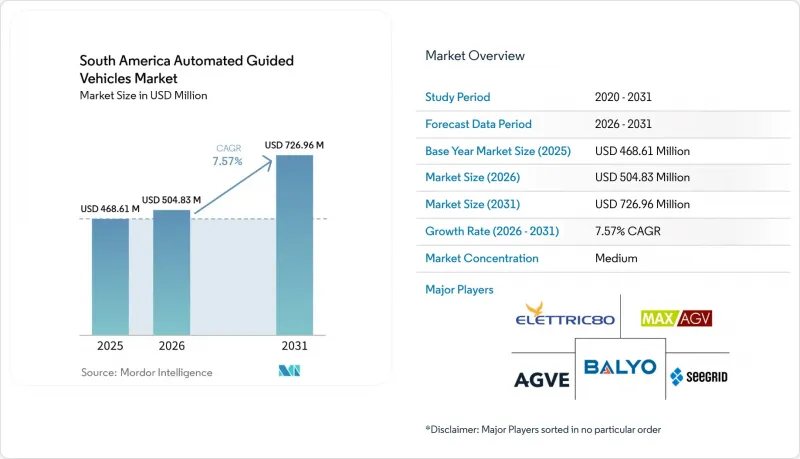
에 따르면 남미의 무인운반차(AGV) 시장 규모는 2025년에 4억 6,861만 달러로 평가되며, 2026년 5억 410만 달러에서 2031년까지 7억 2,696만 달러에 달할 것으로 예측되고 있으며, 예측 기간(2026-2031년)에 CAGR은 7.57%에 달할 전망입니다.
남미 무인운반차(AGV) 시장의 동향 및 인사이트
E-Commerce 및 옴니채널 주문 처리의 확대
신속한 주문 처리 수요가 증가함에 따라 남미 전역에서 물류 사업자들이 창고 수용 능력을 계획하는 방식이 변화하고 있습니다. 아마존 브라질은 2026년, 브라질 주요 8개 도시에서 퀵 커머스 사업을 운영하고 있으며, 연말까지 처리량을 3배로 확대하는 것을 목표로 하고 있고, 상파울루와 리우데자네이루에서는 15분 이내 배송을 약속하고 있습니다. 이러한 서비스 기준에 따라 보관 구역, 분류 구역, 출하 구역 간의 빈번하고 정확한 이송 필요성이 높아지고 있습니다. 남미의 무인 이송 차량(AGV) 시장은 작업자가 수작업만으로는 이러한 흐름을 유지할 수 없는 상황에서 그 혜택을 누리고 있습니다. 또한 창고 공간이 제한적이기 때문에 건물 면적을 확장하는 것보다 기존 시설 내에서 처리 능력을 높이는 것이 더 매력적인 선택이 되고 있습니다. 카트형 차량이나 언더라이더 시스템은 바쁜 주문 처리 업무에서 반복적인 경량 물품 이송에 가장 적합합니다.
창고 인력 부족과 생산성에 대한 압박
창고 운영 사업자들은 숙련된 피킹, 검품, 지게차 조작 인력이 부족한 지역에서 처리 능력 확대를 도모하고 있습니다. 지역별 물류 네트워크에 따라 수요량이나 작업 일정이 크게 다르기 때문에 이러한 제약은 일상적인 서비스 신뢰성에 영향을 미치고 있습니다. 마스크(Maersk)사는 브라질의 물류 회랑에서 니어쇼어링과 E-Commerce(e-커머스)의 활성화가 내부 운송 분야에서 AGV 및 AMR의 활용 확대를 지원하고 있다고 지적합니다. 그 결과, 남미의 자동 유도 차량(AGV) 시장은 인간의 업무를 모두 대체하기보다는 자재 이동을 안정화시키는 프로젝트를 통해 지원되고 있습니다. 견인 트랙터, 카트 차량, 팔레트 시스템은 반복적인 운반 작업을 수행하는 중규모 사업자에게 실용적인 선택지가 됩니다. 이러한 ‘업무의 연속성’이라는 근거가 있다면, 인력 부족시 서비스 수준을 유지하려는 경영진으로부터 자동화에 대한 승인을 얻기 쉬워질 가능성이 있습니다.
높은 초기 투자와 긴 투자 회수 기간
AGV 시스템에는 차량, 설치 장소 준비, 소프트웨어, 시스템 통합 및 지속적인 서비스에 드는 비용이 필요합니다. 이러한 비용은 아르헨티나의 구매자에게 특히 큰 부담이 됩니다. 해당 국가에서는 환율 상황이나 자금 조달 위험으로 인해 수입 장비의 실질 비용이 급등할 가능성이 있기 때문입니다. 중규모 제조업체나 제3자 물류 제공업체의 경우, 예상 수익이 불확실할 때 사내 승인 절차가 장기화될 가능성이 있습니다. 또한 지역에 따라 자금 조달 조건도 달라, 보조금이 지원되는 대출을 받을 수 있는 브라질의 구매자는 소규모 시장의 구매자보다 자동화 도입에 더 쉽게 접근할 수 있는 경우가 있습니다. 남미의 무인운반차(AGV) 시장은 현지 자금 조달 체계와 관리형 서비스 옵션을 제공할 수 있는 공급업체에게 여전히 진입하기 쉬운 상황입니다. 이러한 차이로 인해 국내 공급업체나 해당 지역의 법적 대응 능력 및 서비스 제공 역량을 갖춘 국제적으로 입지를 다진 기업이 유리한 위치를 차지할 가능성이 있습니다.
부문 분석
2025년, 남미의 자동 유도 차량(AGV) 시장에서 견인형/트랙터형/태그형 AGV는 23.47%의 점유율을 차지했습니다. 자동차 조립 라인에 대한 공급 및 물류 센터내 이송에서 이러한 AGV가 수행하는 역할이 브라질, 아르헨티나, 칠레에서의 지속적인 수요를 지원하고 있습니다. 자동차 산업 클러스터에서는 정해진 경로를 따라 부품을 정기적으로 이동시켜야 하므로, 이는 태그형 AGV의 구성에 적합합니다. 아나폴리스의 생산 라인은 조정된 내부 물류 지원이 필요할 수 있는 디지털화된 제조 투자의 한 예를 보여줍니다. 스텔란티스(Stellantis)도 2026년 7월, 포르토 레알 공장에서 지프 어벤저의 양산을 시작하는 동시에, 공장 현대화와 제2 생산 교대제 도입을 추진하고 있습니다. 이러한 환경에서는 자재 반입을 생산 일정에 맞출 수 있는 차량이 유리합니다.
카트형 및 소형 화물용 AGV는 2026-2031년까지 연평균 성장률(CAGR) 8.13%로 성장할 것으로 예측됩니다. E-Commerce 및 마이크로 풀필먼트 거점에서의 경량 화물 빈번한 운송이 이 유형의 주요 사용 사례가 되고 있습니다. 남미의 소형 AGV 시장 규모는 좁은 통로와 혼합 교통 환경에서 운영되는 시설에 의해 지원되고 있습니다. 콘티넨탈은 2025년 7월, 카트와의 호환성, 전방향 이동, 360도 장애물 감지 기능을 특징으로 하는 자동 소형 하역 운반차 ‘NXS 300’을 발표했습니다. 자동 지게차, 유닛 로드, 조립 라인, 팔레트 트럭형 AGV는 더 대규모의 산업 자재 흐름에 대응하고 있습니다. 리만 로보틱스(Lehman Robotics)는 브라질의 대형 물류 기업에서 자율주행 지게차를 도입했다고 보고했으며, 이는 자동차 공장 이외의 분야에서도 도입이 진행되고 있음을 보여줍니다.
2025년에는 남미의 자동 유도 차량(AGV) 시장 점유율의 26.94%를 자동차 업계가 차지할 것으로 예측됩니다. 자동차 및 부품 제조업체는 특정 중량, 납기, 품질 요건을 충족하는 신뢰성 높은 부품 취급을 필요로 합니다. 창안자동차(Changan)는 고도로 자동화된 생산 라인과 현지화된 공급망의 통합을 중심으로 아나폴리스 공장을 설계했습니다. 스텔란티스(Stellantis)는 2026년에 포르토 레알 공장에서 30억 브라질 레알(5억 5,500만 달러) 규모의 현대화 및 확장 주기를 시작할 전망입니다. 이러한 투자는 자동 라인 공급 및 부품 운송에 대한 수요를 지원할 것으로 기대됩니다. 자동차 업계는 내부 물류 요구 사항이 생산의 연속성과 밀접하게 연관되어 있으므로 여전히 안정적인 구매층으로 남아 있습니다.
소매 및 E-Commerce 분야는 2026-2031년까지 연평균 성장률(CAGR) 7.89%로 확대될 것으로 예측됩니다. 신속한 배송 모델에서는 풀필먼트 센터 전반에 걸쳐 더 빈번한 피킹, 분류, 발송 작업이 요구됩니다. 남미의 무인운반차(AGV) 시장은 레이아웃이 변화하는 환경에서도 작업자와 병행하여 운영될 수 있는 유연성이 높은 차량을 통해 이러한 요구를 충족시키고 있습니다. 나머지 최종사용자층은 식품 및 음료, 물류·3PL, 제약·헬스케어, 전자·전기, 항공우주·방위, 그리고 일반 제조업으로 구성되어 있습니다. 식품 및 음료 수출업체들은 추적성 및 온도 관리가 중요한 분야에서 콜드 체인의 자동화를 추진하고 있습니다. HAI Robotics의 보고서에 따르면 RD Saude사는 파라나주 론드리나에 200대 이상의 로봇을 배치한 자동 물류 센터를 건설할 계획이며, 2027년에 가동을 시작할 예정입니다.
기타 혜택:
- 엑셀 형식의 시장 예측(ME) 시트
- 3개월간의 애널리스트 지원
자주 묻는 질문
목차
제1장 서론
- 조사 전제조건과 시장 정의
- 조사 범위
제2장 조사 방법
제3장 개요
제4장 시장 구도
- 시장 개요
- 시장 성장 촉진요인
- 시장 성장 억제요인
- 거시경제 요인이 시장에 미치는 영향
- 업계 밸류체인 분석
- 규제 상황
- 기술 전망
- Porter's Five Forces 분석
제5장 시장 규모와 성장 예측
- 제품 유형별
- 최종사용자 산업별
- 페이로드 용량별
- 용도별
- 지역별
- 브라질
- 아르헨티나
- 칠레
- 콜롬비아
- 기타 남미 국가
제6장 경쟁 구도
- 시장 집중도
- 전략적 동향
- 시장 점유율 분석
- 기업 개요
- AGVE Group AB
- MAXAGV AB
- Elettric 80 S.p.A.
- BALYO SA
- Seegrid Corporation
- Swisslog Holding AG
- AGILOX Services GmbH
- Robotnik Automation S.L.L.
- Autonomous Solutions, Inc.
- Locus Robotics Corporation
- inVia Robotics, Inc.
- Cassioli S.r.l.
- Murata Machinery, Ltd.
- E&K Automation GmbH
- Transbotics Corporation
- Savant Automation, Inc.
- VisionNav Robotics(Shenzhen) Co., Ltd.
제7장 시장 기회와 향후 전망
KSA 26.10.28According to Mordor Intelligence, the South America automated guided vehicles market size was valued at USD 468.61 million in 2025 and estimated to grow from USD 504.1 million in 2026 to reach USD 726.96 million by 2031, at a CAGR of 7.57% during the forecast period (2026-2031).
South America Automated Guided Vehicles Market Trends and Insights
E-Commerce and Omnichannel Fulfillment Expansion
Rapid fulfillment requirements are changing how logistics operators plan warehouse capacity across South America. Amazon Brazil has quick-commerce operations in 8 major Brazilian cities in 2026 and is targeting a 3x increase in volume by year-end, with 15-minute delivery commitments in Sao Paulo and Rio de Janeiro. Such service standards increase the need for frequent, accurate movement between storage, sorting, and dispatch areas. The South America automated guided vehicles market benefits where operators cannot sustain those flows through manual processes alone. Constrained warehouse space also makes higher throughput within existing facilities more attractive than expanding the building footprint. Cart-style vehicles and under-rider systems are well-suited to repeated, low-weight movements in busy fulfillment operations.
Warehouse Labor Availability and Productivity Pressure
Warehouse operators are expanding capacity in locations where skilled picking, checking, and forklift labor is limited. This constraint affects daily service reliability because demand volumes and work schedules vary considerably across regional logistics networks. Maersk identified Brazil's logistics corridors as a setting where nearshoring and e-commerce activity support greater use of AGVs and AMRs for internal transport. The South America automated guided vehicles market is consequently supported by projects that stabilize material movement rather than replace every human task. Tow tractors, cart vehicles, and pallet systems offer practical options for mid-sized operators with recurring transport work. This operating-continuity rationale can make automation approvals easier when management is seeking to protect service levels during labor shortages.
High Initial Investment and Extended Payback Periods
AGV systems require spending on vehicles, site preparation, software, integration, and ongoing service. These costs are particularly difficult for buyers in Argentina, where exchange-rate conditions and financing risks can raise the effective cost of imported equipment. Mid-sized manufacturers and third-party logistics providers may face extended internal approval processes when projected returns are uncertain. Financing conditions also differ across the region, which can give Brazilian buyers with subsidized credit better access to automation than buyers in smaller markets. The South America automated guided vehicles market remains more accessible to suppliers that can provide local financing structures or managed-service options. This difference can favor domestic providers and internationally established firms with regional legal and service capabilities.
Other drivers and restraints analyzed in the detailed report include:
- Manufacturing Modernization and Industry 4.0 Adoption
- Safety Requirements for Repetitive Material Movement
- Integration Complexity Across WMS, ERP, MES, and Fleet-Control Systems
For complete list of drivers and restraints, kindly check the Table Of Contents.
Segment Analysis
Tow/Tractor/Tug AGVs held 23.47% of the South America automated guided vehicles market in 2025. Their role in automotive assembly feeding and distribution-center transport supports continued demand in Brazil, Argentina, and Chile. Automotive clusters require regular movement of components along defined routes, which suits tugger configurations. The Anapolis production line demonstrates the type of digitalized manufacturing investment that can require coordinated intralogistics support. Stellantis also began series production of the Jeep Avenger at Porto Real in July 2026, alongside modernization and the addition of a second production shift. These settings favor vehicles that can align material delivery with production schedules.
Cart and Small-Load AGVs are projected to grow at an 8.13% CAGR between 2026 and 2031. Frequent low-weight movements in e-commerce and micro-fulfillment sites provide the main use case for this format. The South America automated guided vehicles market size for smaller formats is supported by facilities that operate with narrow aisles and mixed traffic. Continental introduced the NXS 300 automated small-load carrier in July 2025, designed for cart compatibility, omnidirectional movement, and 360-degree obstacle detection. Automated Forklift, Unit-Load, Assembly Line, and Pallet Truck AGVs serve larger industrial material flows. Reeman Robotics reported autonomous forklift deployment at a major Brazilian logistics company, showing adoption beyond automotive plants.
Automotive is projected to account for 26.94% of the South America automated guided vehicles market share in 2025. Vehicle and component manufacturers require reliable parts handling that meets specific weight, timing, and quality requirements. Changan designed its Anapolis facility around a highly automated production line and localized supply chain integration. Stellantis is expected to begin a BRL 3 billion (USD 555 million) modernization and expansion cycle at its Porto Real facility in 2026. These investments are expected to support demand for automated line feeding and component transport. The automotive industry remains a stable buyer group, as its intralogistics requirements are closely linked to production continuity.
Retail and E-Commerce is projected to expand at a 7.89% CAGR from 2026 to 2031. Fast delivery models require more frequent picking, sorting, and dispatch activity across fulfillment locations. The South America automated guided vehicles market serves this need through flexible vehicles that can operate alongside workers in changing layouts. Food and Beverage, Logistics and 3PL, Pharmaceutical and Healthcare, Electronics and Electrical, Aerospace and Defense, and General Manufacturing make up the remaining end-user base. Food and beverage exporters are increasing cold-chain automation where traceability and temperature-controlled flows are important. HAI Robotics reported that RD Saude plans an automated distribution center in Londrina, Parana, with more than 200 robots and planned operation in 2027.
Complete Report Scope:
- By Product Type
- Automated Forklift AGVs
- Tow/Tractor/Tug AGVs
- Unit-Load AGVs
- Assembly Line AGVs
- Pallet Truck AGVs
- Cart and Small-Load AGVs
- Special-Purpose AGVs
- Other Product Types
- By End-User Industry
- Automotive
- Food and Beverage
- Retail and E-Commerce
- Electronics and Electrical
- Pharmaceutical and Healthcare
- Logistics and Third-Party Logistics (3PL)
- Aerospace and Defense
- General Manufacturing
- Other End-User Industries
- By Payload Capacity
- Less than 500 kg
- 500-1,000 kg
- 1,000-2,000 kg
- Above 2,000 kg
- By Application
- Material Handling and Transportation
- Order Picking and Sortation
- Trailer Loading and Unloading
- Packaging and Palletizing
- Assembly Operations
- Cold Chain and Refrigerated Storage
- Hazardous Materials Handling
- By Geography
- Brazil
- Argentina
- Chile
- Colombia
- Rest of South America
List of Companies Covered in this Report:
- AGVE Group AB
- MAXAGV AB
- Elettric 80 S.p.A.
- BALYO SA
- Seegrid Corporation
- Swisslog Holding AG
- AGILOX Services GmbH
- Robotnik Automation S.L.L.
- Autonomous Solutions, Inc.
- Locus Robotics Corporation
- inVia Robotics, Inc.
- Cassioli S.r.l.
- Murata Machinery, Ltd.
- E&K Automation GmbH
- Transbotics Corporation
- Savant Automation, Inc.
- VisionNav Robotics (Shenzhen) Co., Ltd.
Additional Benefits:
- The market estimate (ME) sheet in Excel format
- 3 months of analyst support
TABLE OF CONTENTS
1 INTRODUCTION
- 1.1 Study Assumptions and Market Definition
- 1.2 Scope of the Study
2 RESEARCH METHODOLOGY
3 EXECUTIVE SUMMARY
4 MARKET LANDSCAPE
- 4.1 Market Overview
- 4.2 Market Drivers
- 4.2.1 E-Commerce and Omnichannel Fulfillment Expansion
- 4.2.2 Warehouse Labor Availability and Productivity Pressure
- 4.2.3 Manufacturing Modernization and Industry 4.0 Adoption
- 4.2.4 Safety Requirements for Repetitive Material Movement
- 4.2.5 Port and Intermodal Terminal Automation in Chile, Peru, and Brazil
- 4.2.6 Export-Oriented Food and Beverage Logistics Modernization
- 4.3 Market Restraints
- 4.3.1 High Initial Investment and Extended Payback Periods
- 4.3.2 Integration Complexity Across WMS, ERP, MES, and Fleet-Control Systems
- 4.3.3 Shortage of Local AGV Engineering and Maintenance Specialists
- 4.3.4 Infrastructure Variability Across South American Facilities
- 4.4 Impact of Macroeconomic Factors on the Market
- 4.5 Industry Value Chain Analysis
- 4.6 Regulatory Landscape
- 4.7 Technological Outlook
- 4.8 Porter's Five Forces Analysis
- 4.8.1 Bargaining Power of Suppliers
- 4.8.2 Bargaining Power of Buyers
- 4.8.3 Threat of New Entrants
- 4.8.4 Threat of Substitutes
- 4.8.5 Competitive Rivalry
5 MARKET SIZE AND GROWTH FORECASTS (VALUE)
- 5.1 By Product Type
- 5.1.1 Automated Forklift AGVs
- 5.1.2 Tow/Tractor/Tug AGVs
- 5.1.3 Unit-Load AGVs
- 5.1.4 Assembly Line AGVs
- 5.1.5 Pallet Truck AGVs
- 5.1.6 Cart and Small-Load AGVs
- 5.1.7 Special-Purpose AGVs
- 5.1.8 Other Product Types
- 5.2 By End-User Industry
- 5.2.1 Automotive
- 5.2.2 Food and Beverage
- 5.2.3 Retail and E-Commerce
- 5.2.4 Electronics and Electrical
- 5.2.5 Pharmaceutical and Healthcare
- 5.2.6 Logistics and Third-Party Logistics (3PL)
- 5.2.7 Aerospace and Defense
- 5.2.8 General Manufacturing
- 5.2.9 Other End-User Industries
- 5.3 By Payload Capacity
- 5.3.1 Less than 500 kg
- 5.3.2 500-1,000 kg
- 5.3.3 1,000-2,000 kg
- 5.3.4 Above 2,000 kg
- 5.4 By Application
- 5.4.1 Material Handling and Transportation
- 5.4.2 Order Picking and Sortation
- 5.4.3 Trailer Loading and Unloading
- 5.4.4 Packaging and Palletizing
- 5.4.5 Assembly Operations
- 5.4.6 Cold Chain and Refrigerated Storage
- 5.4.7 Hazardous Materials Handling
- 5.5 By Geography
- 5.5.1 Brazil
- 5.5.2 Argentina
- 5.5.3 Chile
- 5.5.4 Colombia
- 5.5.5 Rest of South America
6 COMPETITIVE LANDSCAPE
- 6.1 Market Concentration
- 6.2 Strategic Moves
- 6.3 Market Share Analysis
- 6.4 Company Profiles (includes Global Level Overview, Market Level Overview, Core Segments, Financials as available, Strategic Information, Market Rank/Share, Products and Services, Recent Developments)
- 6.4.1 AGVE Group AB
- 6.4.2 MAXAGV AB
- 6.4.3 Elettric 80 S.p.A.
- 6.4.4 BALYO SA
- 6.4.5 Seegrid Corporation
- 6.4.6 Swisslog Holding AG
- 6.4.7 AGILOX Services GmbH
- 6.4.8 Robotnik Automation S.L.L.
- 6.4.9 Autonomous Solutions, Inc.
- 6.4.10 Locus Robotics Corporation
- 6.4.11 inVia Robotics, Inc.
- 6.4.12 Cassioli S.r.l.
- 6.4.13 Murata Machinery, Ltd.
- 6.4.14 E&K Automation GmbH
- 6.4.15 Transbotics Corporation
- 6.4.16 Savant Automation, Inc.
- 6.4.17 VisionNav Robotics (Shenzhen) Co., Ltd.
7 MARKET OPPORTUNITIES AND FUTURE OUTLOOK
- 7.1 White-Space and Unmet-Need Assessment


