

|
시장보고서
상품코드
2154931
고성능 감수제 : 시장 점유율 분석, 업계 동향과 통계, 성장 예측(2026-2031년)Superplasticizers - Market Share Analysis, Industry Trends & Statistics, Growth Forecasts (2026 - 2031) |
||||||
 Mordor Intelligence
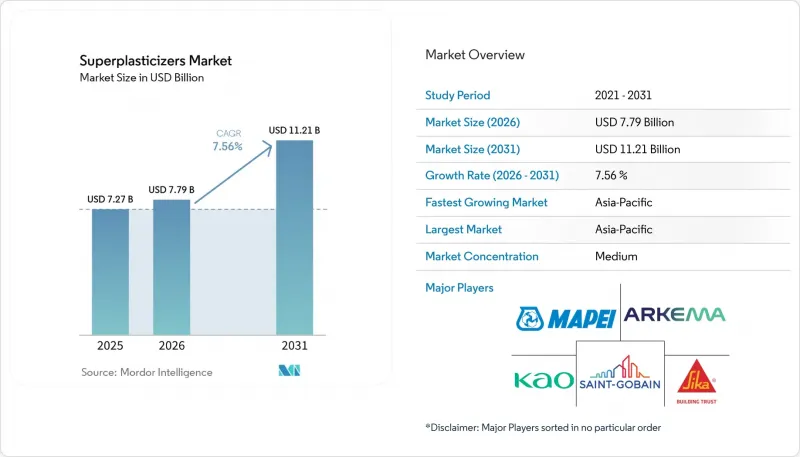
에 따르면 고성능 감수제 시장 규모는 2025년에 72억 7,000만 달러로 추계되고 있으며, 예측 기간(2026-2031년)에 CAGR 7.56%로 확대하며, 2026년 77억 9,000만 달러에서 2031년에는 112억 1,000만 달러에 달할 것으로 전망되고 있습니다.
전 세계 슈퍼플라스틱화제 시장의 동향 및 인사이트
저탄소 콘크리트 및 시멘트 감축 요건
저탄소 건설 요건으로 인해 콘크리트에 보조 시멘트질 재료가 더 많이 배합되면, 1입방미터당 혼화제 수요가 증가합니다. 이는 이러한 결합재가 물 수요, 분산 거동 및 타설 성능에 영향을 미치기 때문입니다. 2025년 'Scientific Reports'지에 게재된 연구에 따르면 석회석 소성 점토 시멘트(Limestone Calcined Clay Cement)에서 소성 점토의 함량이 높을수록, 작업성을 유지하기 위해 필요한 슈퍼플라스틱라이저의 투여량이 증가하는 것으로 밝혀졌습니다. 소성 점토는 비표면적이 크고 혼합물내 이용 가능한 유리수를 감소시키기 때문에 작업성 제어는 혼화제의 선정과 투여량에 크게 좌우됩니다. 이러한 상황으로 인해 저클링커 콘크리트에서는 정확한 분산이 더욱 중요해집니다. 2025년 'Buildings' 저널의 연구에 따르면 CEM III/A 및 CEM V/B 혼합물에 폴리카복실산 에테르(PCE)계 고성능 감수제를 첨가한 경우, 28일간의 압축 강도가 CEM I 기준 배합과 동등하거나 그 이상을 유지할 수 있었다고 보고되었습니다. 검증된 저탄소 제품에 관한 유럽의 조달 요건에 따라 배출량 관련 문서가 자재 선정에 영향을 미치는 공공 공사 및 민간 건설 분야에서 이러한 화학 조성이 중요하게 여겨지고 있습니다.
레디믹스 콘크리트의 배합 및 슬럼프 유지 요건
레디믹스트 플랜트에서는 배칭, 운반, 타설 및 펌프 송출의 각 공정에서 콘크리트가 작업 가능한 상태를 유지해야 합니다. 자동화 플랜트에서는 계량 투여 장치와 함께 액체 배합이 사용되며, 이를 통해 플랜트 관리자는 혼화제와 물의 비율 및 배치 간 일관성을 보다 엄격하게 제어할 수 있습니다. 투여량의 예측 가능성을 통해 플랜트는 배치 간 편차와 자재 낭비를 줄이면서 품질 보증을 지원할 수 있습니다. 공급업체는 장시간 운송 중, 혼잡한 현장 또는 고온의 기상 조건에서도 안정적인 콘크리트를 포함하여, 특정 슬럼프 유지 요구 사항에 맞춰 설계된 제품을 제공하고 있습니다. 이러한 요구 사항은 매일 여러 건설 현장에 운송용 콘크리트가 공급되는 대규모 도시 프로젝트나, 지연이 타설 품질, 인력 활용 및 프로젝트 일정에 영향을 미치는 현장에서 특히 중요합니다.
원자재 가격 및 공급 상황의 변동
아크릴산, 메타크릴산, 에틸렌옥사이드 또는 프로필렌옥사이드는 합쳐서 폴리카복실산 에테르(PCE) 생산 비용의 60-70%를 차지합니다. 이러한 원자재의 가격 변동은, 특히 공급업체가 고객 가격을 조정할 수 없거나 안정적인 자재 공급을 확보할 수 없는 경우, 배합 이익률 및 조달 결정에 영향을 미칩니다. 또한 PCE 제조업체는 폴리에테르 측쇄 원자재에도 의존하고 있으므로 상류 가격의 급격한 변동시 불확실성이 발생합니다. 설폰화 나프탈렌·포름알데히드(SNF) 생산자는 콜타르 정제 과정에서 발생하는 황산 및 나프탈렌이라는 또 다른 위험에 직면해 있습니다. 이로 인해 생산자는 가격 형성 패턴, 공급업체 기반, 물류 요건, 공급 중단 위험이 서로 다른 여러 상품 체인에 노출되게 됩니다. 모노머를 자체 생산하는 제조업체나 장기 원료 계약을 체결한 제조업체는 현물 시장에서 재료를 구매하는 배합 제조업체보다 이러한 위험을 더 효과적으로 관리하고 있습니다.
부문 분석
폴리카복실산 유도체는 2025년에 초가소제 시장 점유율의 40.45%를 차지할 것으로 예상되며, 2031년까지 연평균 성장률(CAGR) 8.34%로 성장할 것으로 전망됩니다. 이 폴리카복실산 골격과 폴리에틸렌옥사이드 측쇄는 입체 장애를 통해 입자의 분산을 촉진하여, 제조업체가 배합 설계의 유연성을 유지하면서 감수 관리를 수행하는 데 도움이 됩니다. 이러한 구조 덕분에 시멘트 입자에 영구적으로 흡착되지 않고도 감수가 가능해지며, 제조업체가 작업성, 응결 거동, 강도 발현 및 현장 자재와의 적합성 사이에서 균형을 맞춰야 할 때 유용합니다. PCE 등급은 감수와 높은 작업성을 모두 요구하는 범용 콘크리트에 가장 적합합니다.
제품 선정은 배합 설계 및 용도에 따라 달라집니다. 2026년 'Scientific Reports'지에 게재된 연구에 따르면 1%의 설폰화 나프탈렌 포름알데히드(SNF)를 첨가했을 때, 1성분 지오폴리머 콘크리트에서 상대 슬럼프가 272.9% 증가한 반면, 폴리카복실산 에테르(PCE)는 작업성 향상이 제한적이며, 첨가량이 증가하면 강도 저하를 초래한다는 사실이 밝혀졌습니다. 이 결과는 슬럼프의 장기 유지가 주요 요건이 아닌, 초기 강도 제어와 비용을 우선시하는 프리캐스트 및 특수 토목 용도에서 SNF의 사용이 계속해서 지지될 것임을 지원합니다. 개질 리그노술폰산염은 가격에 민감한 용도에서 여전히 유용하지만, 감수 능력이 낮기 때문에 구조용 콘크리트에서의 역할은 제한적입니다. 설폰화 멜라민 포름알데히드(SMF)에 대한 수요는 규제 준수 비용의 영향으로 유럽 및 미국 시장에서 압박을 받고 있지만, 남아시아 및 동남아시아의 일부 지역에서는 여전히 적용 가능합니다. 이러한 지역에서의 제품 전환은 현지 규제, 자본, 그리고 고객의 수용도에 달려 있습니다.
지역별 분석
아시아태평양은 2025년에 슈퍼 플라스틱화제 시장 점유율의 45.91%를 차지할 것으로 예상되며, 2031년까지 연평균 성장률(CAGR) 8.94%로 성장할 것으로 전망됩니다. 중국의 수력 발전, 고속철도, 주택에 대한 지속적인 투자는 콘크리트의 성능 요건과 맞물려 사용량 증가와 더욱 엄격한 혼화제 사양에 대한 수요를 지원하고 있습니다. 인도의 인프라 정비 계획과 주택 프로그램은 레디믹스 콘크리트의 채택을 촉진하고 있습니다. 일본과 한국에서는 프리캐스트 공법과 내진 요건으로 인해 수요가 유지되고 있으며, 이들 국가는 구조용 콘크리트의 특성 제어에 중점을 두는 경향이 있습니다. 인도네시아, 베트남, 필리핀에서는 유료 도로, 공항, 지하철 시스템의 건설이 잇따르고 있으며, 레디믹스 콘크리트 공급 및 프로젝트별 맞춤형 혼화제 지원에 대한 수요가 증가함에 따라 추가적인 비즈니스 기회가 창출되고 있습니다.
아시아태평양에서는 지역별 요구 사항이 다릅니다. 중국에서는 GB 8076이, 인도에서는 IS 9103이 혼화제의 성능을 규정하고 있습니다. 이러한 기준의 차이로 인해 각국의 건설 시장마다 적합성 관련 문서, 시험 방법, 고객의 기대치가 다르기 때문에 공급업체 입장에서는 지역에 맞춘 배합 설계와 기술 지원이 중요합니다. 북미의 수요는 고성능 콘크리트를 사용하는 인프라 프로젝트에 의해 주도되는 반면, 유럽의 수요는 저클링커 배합 및 매립 탄소 요건과 관련이 있습니다. EN 934-2는 혼합제의 품질에 관한 유럽 공통의 틀을 제공합니다.
남미, 중동 및 아프리카는 초플라스틱제 시장에서 여전히 비교적 작은 비중을 차지하고 있지만, 이 지역들의 프로젝트 구성은 지역 물류, 기후 및 성능 요건에 기반한 특수한 수요를 지원하고 있습니다. 브라질과 아르헨티나에서는 주택 및 사회주택 프로그램이 수요를 지원하고 있으며, 건설 활동과 현지 생산 상황이 혼합제 수요에 영향을 미치고 있습니다. 사우디아라비아의 2026년까지의 교통·산업 회랑에 대한 투자는 ISO 인증을 획득한 혼합제에 대한 수요를 지원하고 있습니다. NEOM 프로젝트에서는 장기간의 작업성이 요구되는 조건 하에서 대규모 콘크리트 타설이 필요하며, 내열 성능과 확실한 타설 기간 확보가 자재 선정의 중요한 기준이 되고 있습니다. SASO 2451은 사우디아라비아내 콘크리트 혼화제의 시험 및 등록 요건을 규정하고 있으며, 프로젝트 승인을 희망하는 공급업체에게는 규정 준수 준비와 현지 기술 문서의 정비가 중요합니다. 남아프리카 및 동아프리카 시장은 탄자니아에서의 생산을 포함한 지역적 공급 네트워크의 혜택을 받고 있습니다.
기타 혜택:
- 엑셀 형식의 시장 예측(ME) 시트
- 3개월간의 애널리스트 지원
목차
제1장 서론
- 조사 전제조건과 시장 정의
- 조사 범위
제2장 조사 방법
제3장 개요
제4장 시장 구도
- 시장 개요
- 시장 성장 촉진요인
- 시장 성장 억제요인
- 밸류체인 분석
- Porter's Five Forces 분석
제5장 시장 규모와 성장 예측
- 제품 유형별
- 폼별
- 용도별
- 지역별
- 아시아태평양
- 중국
- 인도
- 일본
- 한국
- ASEAN 국가
- 기타 아시아태평양 국가
- 북미
- 미국
- 캐나다
- 멕시코
- 유럽
- 독일
- 영국
- 프랑스
- 이탈리아
- 북유럽 국가
- 기타 유럽 국가
- 남미
- 브라질
- 아르헨티나
- 기타 남미 국가
- 중동 및 아프리카
- 사우디아라비아
- 남아프리카공화국
- 기타 중동 및 아프리카 국가
- 아시아태평양
제6장 경쟁 구도
- 시장 집중도
- 전략적 동향
- 시장 점유율·순위 분석
- 기업 개요
- Arkema
- Chembond Chemicals Limited
- Concrete Additives & Chemicals Pvt. Ltd.
- Enaspol a.s.
- Ha-Be Betonchemie GmbH
- Jiangsu Sobute New Materials Co., Ltd.
- Kao Corporation
- MAPEI S.p.A.
- MC-Bauchemie Muller GmbH & Co. KG
- MUHU(China) Co., Ltd.
- Rhein-Chemotechnik GmbH
- Saint-Gobain
- Shandong Wanshan Chemical Co., Ltd.
- Sika AG
- The Euclid Chemical Company
제7장 시장 기회와 향후 전망
KSAAccording to Mordor Intelligence, the superplasticizers market size was estimated at USD 7.27 billion in 2025 and is estimated to grow from USD 7.79 billion in 2026 to USD 11.21 billion by 2031, at a CAGR of 7.56% during the forecast period (2026-2031).
Global Superplasticizers Market Trends and Insights
Low-Carbon Concrete and Cement-Reduction Requirements
Low-carbon construction requirements increase admixture demand per cubic meter when concrete incorporates more supplementary cementitious materials, because these binders can alter water demand, dispersion behavior, and placement performance. A 2025 Scientific Reports study found that higher calcined-clay content in Limestone Calcined Clay Cement increased the superplasticizer dosage required to maintain workability. Calcined clay has a high specific surface area and reduces available free water in the mix, making workability control more dependent on admixture selection and dosing. This condition also makes accurate dispersion more important for low-clinker concrete. A 2025 Buildings study reported that Polycarboxylate Ether (PCE)-based superplasticizers in CEM III/A and CEM V/B blends maintained 28-day compressive strength at or above CEM I reference mixes. European procurement requirements for verified low-carbon products make this chemistry relevant to public works and private construction, where emissions documentation influences material selection.
Ready-Mix Batching and Slump-Retention Requirements
Ready-mix plants require concrete that remains workable during batching, transit, placement, and pumping. Liquid formulations are used with metered dosing equipment in automated plants, giving plant managers greater control over admixture-to-water ratios and batch consistency. Predictable dosing helps plants reduce batch variability and material waste while supporting quality assurance. Suppliers provide products designed for specific slump-retention needs, including mixes stable during long transit times, on congested sites, or in hot weather. These requirements are relevant in large urban projects where transit-mix concrete serves multiple construction sites daily and where delays affect placement quality, labor use, and project schedules.
Raw-Material Price and Availability Volatility
Acrylic acid, methacrylic acid, and ethylene or propylene oxide together represent 60-70% of Polycarboxylate Ether (PCE) production costs. Volatility in these inputs affects formulation margins and procurement decisions, particularly when suppliers cannot adjust customer prices or secure consistent material availability. PCE producers also depend on polyether side-chain inputs, which creates uncertainty when upstream pricing changes quickly. Sulfonated Naphthalene Formaldehyde (SNF) producers face separate exposure to sulfuric acid and naphthalene from coal-tar refining. This leaves producers exposed to multiple commodity chains with different pricing patterns, supplier bases, logistics requirements, and supply interruption risks. Manufacturers with monomer integration or long-term feedstock contracts manage this risk more effectively than formulators buying materials on the spot market.
Other drivers and restraints analyzed in the detailed report include:
- Precast, Modular, and High-Performance Concrete Adoption
- AI-Optimized Mix Design and Automated Dosing
- Cement and Aggregate Compatibility Variability
For complete list of drivers and restraints, kindly check the Table Of Contents.
Segment Analysis
Polycarboxylate derivatives held 40.45% of the superplasticizers market share in 2025 and are projected to grow at an 8.34% CAGR through 2031. Their polycarboxylate backbone and polyethylene oxide side chains promote particle dispersion through steric hindrance, helping producers manage water reduction while retaining flexibility in formulation design. This structure supports water reduction without permanently adsorbing to cement particles, which is useful when producers need to balance workability, set behavior, strength development, and local material compatibility. PCE grades are well-suited to general-purpose concrete where both water reduction and workable placement are required.
Product selection depends on the mix design and the intended application. A 2026 Scientific Reports study found that 1% Sulfonated Naphthalene Formaldehyde (SNF) increased relative slump by 272.9% in one-part geopolymer concrete, whereas Polycarboxylate Ether (PCE) yielded limited workability gains and caused strength reductions at higher dosages. This supports continued SNF use in precast and specialty civil applications that prioritize controlled early strength and cost, where extended slump retention is not the primary requirement. Modified lignosulfonates remain relevant in price-sensitive applications, although their lower water-reduction capability limits their role in structural concrete. Sulfonated Melamine Formaldehyde (SMF) demand is under pressure in Western markets due to compliance costs, but it remains applicable in parts of South Asia and Southeast Asia, where product transitions depend on local compliance, capital, and customer acceptance.
Complete Report Scope:
- By Product Type
- Polycarboxylate Derivatives (PC)
- Sulfonated Naphthalene-Formaldehyde Condensates (SNF)
- Sulfonated Melamine-Formaldehyde Condensates (SMF)
- Modified Lignosulfonates (MLS)
- Other Product Types
- By Form
- Liquid
- Powder
- By Application
- Ready-Mix Concrete
- Precast Concrete
- High-Performance Concrete
- Self-Compacting Concrete
- Other Applications
- By Geography
- Asia-Pacific
- China
- India
- Japan
- South Korea
- ASEAN Countries
- Rest of Asia-Pacific
- North America
- United States
- Canada
- Mexico
- Europe
- Germany
- United Kingdom
- France
- Italy
- NORDIC Countries
- Rest of Europe
- South America
- Brazil
- Argentina
- Rest of South America
- Middle East and Africa
- Saudi Arabia
- South Africa
- Rest of Middle East and Africa
- Asia-Pacific
Geography Analysis
Asia-Pacific held 45.91% of the superplasticizers market share in 2025 and is forecast to grow at an 8.94% CAGR through 2031. China's continued investment in hydropower, high-speed rail, and housing, combined with concrete performance requirements, supports higher usage and more demanding admixture specifications. India's infrastructure pipeline and housing programs support the adoption of ready-mix concrete. Japan and South Korea maintain demand through precast construction methods and earthquake-resistance requirements, which favor controlled concrete properties in structural applications. Indonesia, Vietnam, and the Philippines present additional opportunities as toll roads, airports, and metro systems enter construction, increasing the need for ready-mix supply and project-specific admixture support.
Regional requirements vary across the Asia-Pacific. China uses GB 8076, and India uses IS 9103 to govern admixture performance. This fragmentation makes localized formulation and technical support important for suppliers, as compliance documentation, test practices, and customer expectations differ across national construction markets. North American demand is driven by infrastructure projects using high-performance concrete, while European demand is linked to lower-clinker blends and embodied-carbon requirements. EN 934-2 provides a common European framework for admixture quality.
South America, the Middle East, and Africa remain smaller parts of the superplasticizers market, but their project mix supports specialized demand based on regional logistics, climate, and performance requirements. Brazil and Argentina are supported by residential and social housing programs, where construction activity and local production availability influence admixture demand. Saudi Arabia's 2026 transport and industrial corridor investment supports demand for ISO-certified admixtures. NEOM requires large-scale concrete placements under conditions demanding extended workability, making heat-resistant performance and dependable placement windows key material selection criteria. SASO 2451 establishes testing and registration requirements for concrete admixtures in Saudi Arabia, making compliance readiness and local technical documentation relevant for suppliers seeking project approvals. South Africa and East African markets benefit from regional supply links, including production in Tanzania.
- Arkema
- Chembond Chemicals Limited
- Concrete Additives & Chemicals Pvt. Ltd.
- Enaspol a.s.
- Ha-Be Betonchemie GmbH
- Jiangsu Sobute New Materials Co., Ltd.
- Kao Corporation
- MAPEI S.p.A.
- MC-Bauchemie Muller GmbH & Co. KG
- MUHU (China) Co., Ltd.
- Rhein-Chemotechnik GmbH
- Saint-Gobain
- Shandong Wanshan Chemical Co., Ltd.
- Sika AG
- The Euclid Chemical Company
Additional Benefits:
- The market estimate (ME) sheet in Excel format
- 3 months of analyst support
TABLE OF CONTENTS
1 Introduction
- 1.1 Study Assumptions and Market Definition
- 1.2 Scope of the Study
2 Research Methodology
3 Executive Summary
4 Market Landscape
- 4.1 Market Overview
- 4.2 Market Drivers
- 4.2.1 Infrastructure and Public-Works Investment
- 4.2.2 Low-Carbon Concrete and Cement-Reduction Requirements
- 4.2.3 Ready-Mix Batching and Slump-Retention Requirements
- 4.2.4 Precast, Modular and High-Performance Concrete Adoption
- 4.2.5 AI-Optimized Mix Design and Automated Dosing
- 4.3 Market Restraints
- 4.3.1 Raw-Material Price and Availability Volatility
- 4.3.2 Cement and Aggregate Compatibility Variability
- 4.3.3 Formaldehyde, Residue and Chemical-Compliance Burden
- 4.4 Value Chain Analysis
- 4.5 Porter's Five Forces Analysis
- 4.5.1 Bargaining Power of Suppliers
- 4.5.2 Bargaining Power of Buyers
- 4.5.3 Threat of New Entrants
- 4.5.4 Threat of Substitutes
- 4.5.5 Competitive Rivalry
5 Market Size and Growth Forecasts (Value)
- 5.1 By Product Type
- 5.1.1 Polycarboxylate Derivatives (PC)
- 5.1.2 Sulfonated Naphthalene-Formaldehyde Condensates (SNF)
- 5.1.3 Sulfonated Melamine-Formaldehyde Condensates (SMF)
- 5.1.4 Modified Lignosulfonates (MLS)
- 5.1.5 Other Product Types
- 5.2 By Form
- 5.2.1 Liquid
- 5.2.2 Powder
- 5.3 By Application
- 5.3.1 Ready-Mix Concrete
- 5.3.2 Precast Concrete
- 5.3.3 High-Performance Concrete
- 5.3.4 Self-Compacting Concrete
- 5.3.5 Other Applications
- 5.4 By Geography
- 5.4.1 Asia-Pacific
- 5.4.1.1 China
- 5.4.1.2 India
- 5.4.1.3 Japan
- 5.4.1.4 South Korea
- 5.4.1.5 ASEAN Countries
- 5.4.1.6 Rest of Asia-Pacific
- 5.4.2 North America
- 5.4.2.1 United States
- 5.4.2.2 Canada
- 5.4.2.3 Mexico
- 5.4.3 Europe
- 5.4.3.1 Germany
- 5.4.3.2 United Kingdom
- 5.4.3.3 France
- 5.4.3.4 Italy
- 5.4.3.5 NORDIC Countries
- 5.4.3.6 Rest of Europe
- 5.4.4 South America
- 5.4.4.1 Brazil
- 5.4.4.2 Argentina
- 5.4.4.3 Rest of South America
- 5.4.5 Middle East and Africa
- 5.4.5.1 Saudi Arabia
- 5.4.5.2 South Africa
- 5.4.5.3 Rest of Middle East and Africa
- 5.4.1 Asia-Pacific
6 Competitive Landscape
- 6.1 Market Concentration
- 6.2 Strategic Moves
- 6.3 Market Share (%)/Ranking Analysis
- 6.4 Company Profiles (includes Global Overview, Market Overview, Core Segments, Financials as available, Strategic Information, Products and Services, and Recent Developments)
- 6.4.1 Arkema
- 6.4.2 Chembond Chemicals Limited
- 6.4.3 Concrete Additives & Chemicals Pvt. Ltd.
- 6.4.4 Enaspol a.s.
- 6.4.5 Ha-Be Betonchemie GmbH
- 6.4.6 Jiangsu Sobute New Materials Co., Ltd.
- 6.4.7 Kao Corporation
- 6.4.8 MAPEI S.p.A.
- 6.4.9 MC-Bauchemie Muller GmbH & Co. KG
- 6.4.10 MUHU (China) Co., Ltd.
- 6.4.11 Rhein-Chemotechnik GmbH
- 6.4.12 Saint-Gobain
- 6.4.13 Shandong Wanshan Chemical Co., Ltd.
- 6.4.14 Sika AG
- 6.4.15 The Euclid Chemical Company
7 Market Opportunities and Future Outlook
- 7.1 White-Space and Unmet-Need Assessment


