

|
시장보고서
상품코드
2154992
두경부 편평상피암 : 시장 점유율 분석, 업계 동향과 통계, 성장 예측(2026-2031년)Head and Neck Squamous Cell Carcinoma - Market Share Analysis, Industry Trends & Statistics, Growth Forecasts (2026 - 2031) |
||||||
 Mordor Intelligence
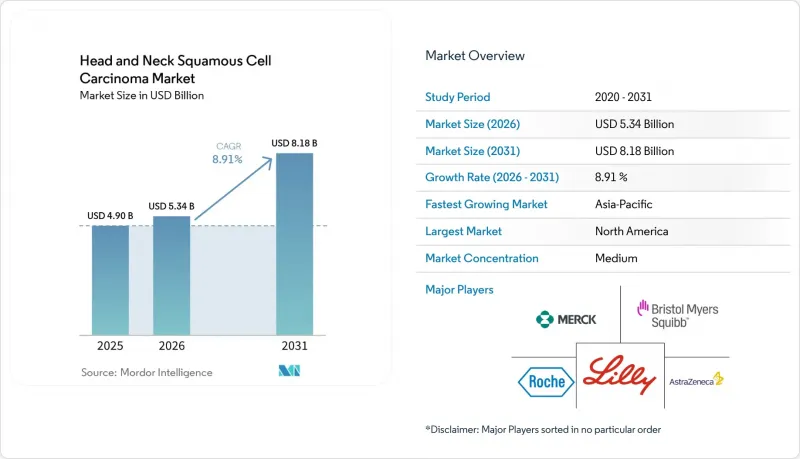
에 따르면 두경부 편평상피암 시장 규모는 2025년 49억 달러에서 2026년에는 53억 4,000만 달러로 확대하며, 2031년까지 81억 8,000만 달러에 달할 것으로 예상되고 있으며, 2026-2031년에 CAGR 8.91%로 성장할 것으로 전망되고 있습니다.
전 세계 두경부 편평상피암 시장의 동향 및 인사이트
HPV 관련 구강·인두암의 부담 증가
HPV 관련 구강·인두 질환은 두경부 편평상피암 시장에서 치료 대상 환자층의 변화를 초래하고 있습니다. ‘Global Burden of Disease Study 2021’에 따르면 1990-2021년까지 구강·인두암 사례 수는 163.17% 증가했습니다. 유럽 및 미국에서는 구강인두암의 70% 이상이 HPV에 기인했습니다. 미국의 60세에서 79세 남성 발병률은 10만 명년당 32.4건에 달하며, 2029년까지 미국의 연간 환자 수는 3만 건을 넘어설 것으로 예측됩니다. 영국 남성의 발병률은 2010-2020년에 2.1배 증가했으며, 2039년까지 더욱 증가할 것으로 예측됩니다. 이러한 질병의 추세는 HPV 양성 종양과 HPV 음성 종양을 구분하는 치료 프로그램에 대한 수요를 지원하고 있습니다.
1차 치료 옵션으로서의 PD-1/PD-L1 면역요법 도입
수술 전·수술 후 펨브롤리주맙 투여로 인해 두경부 편평상피암 시장에서 PD-1 억제 요법의 임상적 역할이 확대되었습니다. KEYNOTE-689 임상시험에는 3기부터 IVA기까지의 절제 가능하고 국소 진행성 두경부 편평상피암(HNSCC) 환자 714명이 등록되었습니다. PD-L1 복합 양성 점수가 1 이상인 682명의 환자에서 수술 전·수술 후 펨브롤리주맙 투여군의 무사건 생존 기간 중앙값은 59.7개월이었던 반면, 표준 치료군에서는 29.6개월이었습니다. 보고된 위험비(hazard ratio)는 0.70이었으며, 부작용으로 인한 수술 불능 사례의 증가는 관찰되지 않았습니다. 따라서 PD-L1 CPS 검사는 치료법 선택 및 동반 진단 수요와 점점 더 밀접하게 연관되고 있습니다. 미국의 경제 모델에 따르면 질 조정 생존년(QALY)당 임계값을 15만 달러로 설정했을 때, 수술 전·수술 후 펨브롤리주맙 요법은 시뮬레이션의 83%에서 비용 대비 효과가 높은 것으로 나타났습니다.
면역요법 및 표적요법의 높은 비용
두경부 편평상피암 시장에서 치료비는 여전히 면역요법 접근을 가로막는 큰 제약 요인으로 작용하고 있습니다. 2025년 분석에 따르면 6개월간의 펨브롤리주맙 치료비는 인도에서는 월 소득의 7,994%, 미국에서는 591%에 달하는 것으로 나타났습니다. 남아시아에서는 유사한 평가에서 게피티닙 비용이 월 소득의 171%에서 412%를 차지하는 것으로 나타났습니다. 펨브롤리주맙 1코스 분의 비용으로 게피티닙을 사용하는 18명에서 22명의 환자 치료비를 충당할 수 있습니다. 이러한 비용 격차로 인해 합리적인 가격이 최우선 과제가 되는 상황에서는 경구용 치료제가 선택되기 쉽습니다. 또한 이 격차는 고소득층을 대상으로 한 의료 시스템 내의 고가 치료법과, 가격에 민감한 환경에서의 국산 대체 의약품 간의 양극화를 조장하고 있습니다.
부문 분석
2025년, 두경부 편평상피암 시장 규모의 31.65%를 병용 요법이 차지했습니다. 이는 동일한 치료 계획 내에서 수술, 방사선 요법 및 전신 요법의 병용을 반영한 것입니다. 면역요법은 가장 빠르게 성장하는 치료법으로, 2031년까지의 예측 연평균 성장률(CAGR)은 10.54%입니다. 펨브롤리주맙은 기존의 국소 치료법을 단순히 대체하는 것이 아니라, 수술 전후 관리에 점차 통합되고 있습니다. 면역요법을 받을 수 없는 환자의 경우, 수술, 화학요법, 방사선 요법이 여전히 핵심 치료법으로 자리 잡고 있습니다. EGFR 관련 치료 접근법에서는 표적 요법, 특히 세툭시맙과의 병용 요법이 여전히 중요한 위치를 차지하고 있습니다. 두경부 편평상피암의 임상 현장에서는 종양의 병기, 해부학적 구조, 환자의 신체 상태가 크게 다르기 때문에 다모달 치료에 대한 의존이 지속되고 있습니다. 이러한 구조 덕분에 확립된 치료법과 새로운 전신 요법이 병행하여 지속적으로 사용되는 것이 지원되고 있습니다.
병용 요법이 주도적인 위치를 차지하고 있다는 점은 1회 치료당 수익의 차이도 반영하고 있습니다. 면역요법에 기반한 치료 프로토콜은 일반적으로 수술과 방사선 요법을 결합한 프로토콜보다 의료비가 더 높습니다. HPV 양성 구강인두암 치료 프로그램에서는 특정 환자군에서 면역요법이 방사선 요법을 대체할 수 있는지, 혹은 방사선 조사 강도를 조절할 수 있는지에 대한 검토가 진행되고 있습니다. 승인된 수술 전·수술 후 펨브롤리주맙 투여 대상 환자군에는 PD-L1 CPS 검사가 필수로 규정되어 있습니다. 이 요건으로 인해 치료 접근성은 진단 능력과 밀접하게 연결되어 있습니다. 따라서 두경부 편평상피암 시장은 외과 팀, 방사선과, 병리과, 그리고 전신 치료 제공자 간의 협력에 의존하고 있습니다. 이러한 역량을 갖춘 병원에서는 복잡한 치료 프로토콜을 보다 일관되게 시행할 수 있습니다. 또한 치료법 선택은 경제적 부담과 치료에 수반되는 부작용 관리에 의해서도 여전히 제약을 받고 있습니다.
2025년, 구강내 질환은 두경부 편평상피암 시장 점유율의 42.65%를 차지했습니다. 이는 여러 지역에 걸친 높은 질병 부담에 기인합니다. 인도는 전 세계 구강암 사례의 21.8%를 차지했으며, 미국은 13.4%를 차지했습니다. ‘글로벌 질병 부담(Global Burden of Disease)’ 분석에 따르면 1990-2021년까지 구강암 사례 수는 142.18% 증가했습니다. 남아시아의 구강암 연령 조정 발병률은 10만 명당 9.79였습니다. 구인두암은 2031년까지 연평균 성장률(CAGR) 9.99%로 증가할 것으로 예측됩니다. 이러한 증가는 HPV 관련 질환 및 수술 전후 면역 요법의 확대와 관련이 있습니다.
비인두암, 하인두암 및 기타 부위의 경우, 여전히 각각 고유한 치료 요구 사항과 역학적 특성이 존재합니다. 말레이시아에서는 비인두암의 연령 조정 발병률이 10만 명당 6.09로 기록되었습니다. 동아시아 및 동남아시아의 EBV 관련 질환 치료에서는 시스플라틴 기반 화학방사선요법이 여전히 치료의 주축을 이루고 있습니다. HPV 양성 및 HPV 음성 구강인두 종양은 생물학적으로 다르며, 임상 개발에서도 서로 다른 접근 방식이 채택되고 있습니다. HPV 양성 종양은 T세포 침윤이 더 두드러지며, 일반적으로 예후가 양호합니다. HPV 음성 질환은 많은 경우 흡연과 관련이 있으며, EGFR-MET 및 FGFR을 표적으로 하는 치료법 개발에서 여전히 중요한 위치를 차지하고 있습니다. 존슨앤드존슨은 HPV와 관련이 없는 1차 치료에서 구인두암에 대해 아미반타맙과 PD-1 억제제의 병용 요법으로 56%의 반응률을 보고했습니다. 이러한 질환 간의 차이는 발생 부위에 따른 치료법 선택이 필요함을 지원하고 있습니다.
지역별 분석
2025년, 북미는 두경부 편평상피암 시장의 43.54%를 차지했습니다. 이 지역은 높은 의약품 가격, 확립된 보험 환급 제도, 그리고 잘 갖춰진 전문 종양 의료 체계를 모두 갖추고 있습니다. 2025년 6월 FDA 승인을 통해 수술 전후 펨브롤리주맙은 미국의 기존 치료 체계에 편입되었습니다. 엑셀리시스(Exelixis)와 머크(Merck)는 3상 임상시험 프로그램에서 잔자린티닙과 펨브롤리주맙의 병용 요법을 연구하고 있습니다. 레제네론은 2026년 4월 피안리맙과 세미프리맙 병용 요법에 대한 2상 임상시험을 시작했습니다. 캐나다는 일반적으로 미국의 승인을 밀접하게 따르고 있습니다. 멕시코에서는 면역요법에 대한 보험 급여가 더 제한적이며, 흡연 관련 구강 질환의 부담이 높습니다.
유럽은 두경부 편평상피암 시장에서 두 번째로 큰 지역입니다. 유럽연합 집행위원회는 2025년 10월, EU 회원국 27개국과 아이슬란드, 리히텐슈타인, 노르웨이를 대상으로 수술 전후 펨브롤리주맙의 승인을 내렸습니다. 영국에서는 2025-2039년에 HPV 관련 구인두암으로 인한 사회적 비용이 143억 파운드에 달할 것으로 예측됩니다. 헝가리에서는 구인두암 발생률이 10만 명당 6.19건으로 보고되고 있습니다. 질병 부담이 큰 국가들에서는 예산 제약이 여전히 중요한 과제로 남아 있습니다. 스페인의 진료 지침에 포함된 권고 사항은 남유럽의 다른 지역 치료 방침에 영향을 미칠 가능성이 있습니다.
아시아태평양은 2031년까지 연평균 성장률(CAGR) 9.64%로 성장할 것으로 예측됩니다. 중국에서는 국가 보험 의약품 리스트 협상을 통해 국산 PD-1 억제제에 대한 접근성이 확대되었습니다. 국내 가격의 60% 인하가 보급을 촉진하고 있는 반면, 해외 제약사의 제품은 도시 지역에서 여전히 프리미엄 수요를 유지하고 있습니다. 일본에서는 오노제약 및 브리스톨-마이어스 스퀴브가 공급하는 니볼루맙에 대해 성숙한 보험 환급 체계가 마련되어 있습니다. 인도는 전 세계 구강암 환자 수에서 가장 큰 비중을 차지하고 있지만, 대도시권 이외 지역에서는 PD-L1 검사 실시가 제한적입니다. 남미에서는 브라질과 아르헨티나가 주도적인 역할을 하고 있습니다. 중동 및 아프리카에서는 GCC(걸프협력회의) 국가들의 의료 투자로 인해 지역별 차이가 발생하고 있지만, 여전히 화학요법에 대한 의존도가 높은 상황입니다. 이러한 접근성 격차가 두경부 편평상피암 시장에서 지역별 비즈니스 기회를 결정짓고 있습니다.
기타 혜택:
- 엑셀 형식의 시장 예측(ME) 시트
- 3개월간의 애널리스트 지원
자주 묻는 질문
목차
제1장 서론
- 조사 전제조건과 시장 정의
- 조사 범위
제2장 조사 방법
제3장 개요
제4장 시장 구도
- 시장 개요
- 시장 성장 촉진요인
- 시장 성장 억제요인
- 공급망 분석
- 규제 상황
- 기술 전망
- Porter's Five Forces 분석
제5장 시장 규모와 성장 예측
- 치료 유형별
- 암 발생 부위별
- 약제 클래스별
- 투여 경로별
- 최종사용자별
- 지역
제6장 경쟁 구도
- 시장 집중도
- 시장 점유율 분석
- 기업 개요
- AstraZeneca PLC
- BeiGene, Ltd.
- Bristol-Myers Squibb Company
- CStone Pharmaceuticals
- Eisai Co., Ltd.
- Exelixis, Inc.
- Eli Lilly and Company
- F. Hoffmann-La Roche Ltd
- GSK plc
- Iovance Biotherapeutics, Inc.
- Innovent Biologics, Inc.
- Jiangsu Hengrui Pharmaceuticals Co., Ltd.
- Johnson & Johnson
- Merck & Co., Inc.
- Novartis AG
- Ono Pharmaceutical Co., Ltd.
- Pfizer Inc.
- Regeneron Pharmaceuticals, Inc.
- Sanofi S.A.
- Takeda Pharmaceutical Company Limited
제7장 시장 기회와 향후 전망
KSA 26.10.28According to Mordor Intelligence, the head and neck squamous cell carcinoma market size is expected to increase from USD 4.90 billion in 2025 to USD 5.34 billion in 2026 and reach USD 8.18 billion by 2031, growing at a CAGR of 8.91% over 2026-2031.
Global Head and Neck Squamous Cell Carcinoma Market Trends and Insights
Rising HPV-Associated Oropharyngeal Cancer Burden
HPV-associated oropharyngeal disease is changing the patient mix treated in the head and neck squamous cell carcinoma market. Cases of oropharynx cancer increased 163.17% between 1990 and 2021 in the Global Burden of Disease Study 2021. HPV accounted for more than 70% of oropharyngeal cancers in Europe and the United States. Incidence among U.S. men aged 60 to 79 reached 32.4 cases per 100,000 person-years, and annual U.S. cases are projected to exceed 30,000 by 2029. UK rates among men increased 2.1-fold from 2010 to 2020, with further growth projected through 2039. This disease pattern supports demand for treatment programs that distinguish HPV-positive from HPV-negative tumors.
First-Line PD-1/PD-L1 Immunotherapy Adoption
Perioperative pembrolizumab has widened the clinical role of PD-1 blockade in the head and neck squamous cell carcinoma market. KEYNOTE-689 enrolled 714 patients with stage III to IVA resectable, locally advanced HNSCC. Among 682 patients with PD-L1 combined positive score of at least 1, median event-free survival was 59.7 months with perioperative pembrolizumab and 29.6 months with standard care. The reported hazard ratio was 0.70, with no increase in the inability to undergo surgery because of adverse reactions. PD-L1 CPS testing is therefore increasingly linked to treatment selection and to companion diagnostic demand. A U.S. economic model found perioperative pembrolizumab cost-effective in 83% of simulations at a USD 150,000 per quality-adjusted life-year threshold.
High Cost of Immunotherapy and Targeted Therapy
Treatment cost remains a major constraint on immunotherapy access in the head and neck squamous cell carcinoma market. A 2025 analysis found that 6 months of pembrolizumab represented 7,994% of monthly income in India and 591% in the United States. In South Asia, gefitinib costs represented 171% to 412% of monthly income in the same assessment. The cost of 1 pembrolizumab course could fund treatment for 18 to 22 patients using gefitinib. This cost gap favors oral treatment choices where affordability is the primary concern. It also sustains a split between premium treatments in higher-income systems and domestic alternatives in price-sensitive settings.
Other drivers and restraints analyzed in the detailed report include:
- Guideline and Reimbursement Expansion
- Growing Use of Biomarker-Guided Treatment
- Rapid Acquired Resistance in Biomarker-Selected Disease
For complete list of drivers and restraints, kindly check the Table Of Contents.
Segment Analysis
Combination therapy represented 31.65% of head and neck squamous cell carcinoma market size in 2025. Its role reflects the use of surgery, radiotherapy, and systemic therapy within the same care plan. Immunotherapy is the fastest-growing treatment type, with a forecast CAGR of 10.54% through 2031. Pembrolizumab is being incorporated into perioperative care rather than simply replacing established local treatments. Surgery, chemotherapy, and radiation therapy remain central for patients who cannot receive immunotherapy. Targeted therapy remains relevant in EGFR-related treatment approaches, particularly cetuximab combinations. The head and neck squamous cell carcinoma industry continues to rely on multi-modality care because tumor stage, anatomy, and patient fitness differ substantially. This structure supports sustained use of established treatment types alongside newer systemic treatments.
The leading position of combination therapy also reflects differences in revenue per treatment episode. Immunotherapy-based protocols generally involve higher medical costs than surgery plus radiation protocols. HPV-positive oropharyngeal programs are evaluating whether immunotherapy can replace or modify radiation intensity in selected patients. PD-L1 CPS testing is required for the approved perioperative pembrolizumab population. This requirement links treatment access to diagnostic capacity. The Head and neck squamous cell carcinoma market therefore depends on coordination between surgical teams, radiation services, pathology, and systemic therapy providers. Hospitals with these capabilities can administer complex protocols more consistently. Treatment selection also remains constrained by affordability and by the management of treatment-related effects.
Oral cavity disease held 42.65% of the head and neck squamous cell carcinoma market share in 2025. It is supported by a high disease burden across multiple regions. India represented 21.8% of global oral cancer cases, while the United States represented 13.4%. Oral cavity cases increased 142.18% from 1990 to 2021 in the Global Burden of Disease analysis. South Asia had an age-standardized incidence rate of 9.79 per 100,000 for oral cavity cancer. Oropharynx is forecast to grow at a 9.99% CAGR through 2031. Its growth is linked to HPV-associated disease and to the expansion of perioperative immunotherapy.
Nasopharynx, hypopharynx, and other sites retain distinct treatment needs and epidemiology. Malaysia recorded an age-standardized incidence rate of 6.09 per 100,000 for nasopharyngeal carcinoma. EBV-driven disease in East and Southeast Asia continues to rely on cisplatin-based chemoradiation as a cornerstone of care. HPV-positive and HPV-negative oropharyngeal tumors are biologically different and are being approached differently in clinical development. HPV-positive tumors have greater T-cell infiltration and generally better prognoses. HPV-negative disease is often tobacco-related and remains relevant to EGFR-MET and FGFR development. Johnson & Johnson reported a 56% response rate for amivantamab plus a PD-1 inhibitor in first-line HPV-unrelated oropharyngeal disease. These disease differences reinforce the need for site-specific treatment choices.
Complete Report Scope:
- By Treatment Type
- Surgery
- Radiation Therapy
- Chemotherapy
- Targeted Therapy
- Immunotherapy
- Combination Therapy
- By Cancer Site
- Oral Cavity
- Oropharynx
- Nasopharynx
- Hypopharynx
- Other Cancer Sites
- By Drug Class
- PD-1/PD-L1 Inhibitors
- EGFR Inhibitors
- VEGF and Angiogenesis Inhibitors
- Multikinase and FGFR-Directed Inhibitors
- Other Drug Classes
- By Route of Administration
- Intravenous
- Oral
- Other Routes of Administrations
- By End User
- Hospitals
- Specialty Cancer Centers
- Specialty Clinics
- Other End Users
- Geography
- North America
- United States
- Canada
- Mexico
- Europe
- Germany
- United Kingdom
- France
- Italy
- Spain
- Rest of Europe
- Asia-Pacific
- China
- Japan
- India
- Australia
- South Korea
- Rest of Asia-Pacific
- Middle East and Africa
- GCC
- South Africa
- Rest of Middle East and Africa
- South America
- Brazil
- Argentina
- Rest of South America
- North America
Geography Analysis
North America held 43.54% of the Head and neck squamous cell carcinoma market share in 2025. The region combines high pharmaceutical pricing, established reimbursement, and dense specialty oncology capacity. The June 2025 FDA approval placed perioperative pembrolizumab into an existing U.S. treatment framework. Exelixis and Merck are studying zanzalintinib plus pembrolizumab in a Phase 3 program. Regeneron initiated a Phase 2 study of fianlimab plus cemiplimab in April 2026. Canada generally follows U.S. approvals closely. Mexico faces more limited immunotherapy reimbursement and a higher burden of tobacco-related oral cavity disease.
Europe is the second-largest regional area in the head and neck squamous cell carcinoma market. The European Commission approved perioperative pembrolizumab in October 2025 for the 27 EU member states, Iceland, Liechtenstein, and Norway. The United Kingdom is projected to incur GBP 14.3 billion in societal costs from HPV-associated oropharyngeal cancer between 2025 and 2039. Hungary reported an oropharyngeal cancer incidence rate of 6.19 per 100,000. Budget constraints remain important in countries with high disease burden. Spain's guideline recommendation may influence treatment decisions elsewhere in Southern Europe.
Asia-Pacific is forecast to grow at a 9.64% CAGR through 2031. China has expanded access to domestic PD-1 inhibitors through National Reimbursement Drug List negotiations. Domestic price reductions of 60% have supported broader use, while foreign drugs retain premium urban demand. Japan has a mature reimbursement setting for nivolumab supplied by Ono Pharmaceutical and Bristol Myers Squibb. India has the highest share of global oral cancer cases, but limited PD-L1 testing outside metropolitan centers. South America is led by Brazil and Argentina. The Middle East and Africa remain more dependent on chemotherapy, although GCC healthcare investment creates local differences. These access gaps define the regional opportunity for the head and neck squamous cell carcinoma market.
- AstraZeneca
- BeiGene, Ltd.
- Bristol-Myers Squibb
- CStone Pharmaceuticals
- Eisai
- Exelixis, Inc.
- Eli Lilly and Company
- Roche
- GlaxoSmithKline
- Iovance Biotherapeutics, Inc.
- Innovent Biologics, Inc.
- Jiangsu Hengrui Pharmaceuticals Co., Ltd.
- Johnson & Johnson
- Merck
- Novartis
- Ono Pharmaceutical
- Pfizer
- Regeneron Pharmaceuticals
- Sanofi
- Takeda Pharmaceuticals
Additional Benefits:
- The market estimate (ME) sheet in Excel format
- 3 months of analyst support
TABLE OF CONTENTS
1 Introduction
- 1.1 Study Assumptions & Market Definition
- 1.2 Scope Of The Study
2 Research Methodology
3 Executive Summary
4 Market Landscape
- 4.1 Market Overview
- 4.2 Market Drivers
- 4.2.1 Rising HPV-Associated Oropharyngeal Cancer Burden
- 4.2.2 First-Line PD-1/PD-L1 Immunotherapy Adoption
- 4.2.3 Guideline and Reimbursement Expansion
- 4.2.4 Growing Use of Biomarker-Guided Treatment
- 4.2.5 AI-Enabled ENT Imaging and Earlier Lesion Detection
- 4.2.6 HPV Therapeutic-Vaccine and T-Cell-Engager Pipeline Expansion
- 4.3 Market Restraints
- 4.3.1 High Cost of Immunotherapy and Targeted Therapy
- 4.3.2 Treatment-Related Toxicity and Functional Morbidity
- 4.3.3 Uneven Biomarker-Testing and Radiation Infrastructure
- 4.3.4 Rapid Acquired Resistance in Biomarker-Selected Disease
- 4.4 Supply-Chain Analysis
- 4.5 Regulatory Landscape
- 4.6 Technological Outlook
- 4.7 Porter's Five Forces Analysis
- 4.7.1 Threat Of New Entrants
- 4.7.2 Bargaining Power Of Buyers
- 4.7.3 Bargaining Power Of Suppliers
- 4.7.4 Threat Of Substitutes
- 4.7.5 Competitive Rivalry
5 Market Size & Growth Forecasts (Value, USD)
- 5.1 By Treatment Type
- 5.1.1 Surgery
- 5.1.2 Radiation Therapy
- 5.1.3 Chemotherapy
- 5.1.4 Targeted Therapy
- 5.1.5 Immunotherapy
- 5.1.6 Combination Therapy
- 5.2 By Cancer Site
- 5.2.1 Oral Cavity
- 5.2.2 Oropharynx
- 5.2.3 Nasopharynx
- 5.2.4 Hypopharynx
- 5.2.5 Other Cancer Sites
- 5.3 By Drug Class
- 5.3.1 PD-1/PD-L1 Inhibitors
- 5.3.2 EGFR Inhibitors
- 5.3.3 VEGF and Angiogenesis Inhibitors
- 5.3.4 Multikinase and FGFR-Directed Inhibitors
- 5.3.5 Other Drug Classes
- 5.4 By Route of Administration
- 5.4.1 Intravenous
- 5.4.2 Oral
- 5.4.3 Other Routes of Administrations
- 5.5 By End User
- 5.5.1 Hospitals
- 5.5.2 Specialty Cancer Centers
- 5.5.3 Specialty Clinics
- 5.5.4 Other End Users
- 5.6 Geography
- 5.6.1 North America
- 5.6.1.1 United States
- 5.6.1.2 Canada
- 5.6.1.3 Mexico
- 5.6.2 Europe
- 5.6.2.1 Germany
- 5.6.2.2 United Kingdom
- 5.6.2.3 France
- 5.6.2.4 Italy
- 5.6.2.5 Spain
- 5.6.2.6 Rest of Europe
- 5.6.3 Asia-Pacific
- 5.6.3.1 China
- 5.6.3.2 Japan
- 5.6.3.3 India
- 5.6.3.4 Australia
- 5.6.3.5 South Korea
- 5.6.3.6 Rest of Asia-Pacific
- 5.6.4 Middle East and Africa
- 5.6.4.1 GCC
- 5.6.4.2 South Africa
- 5.6.4.3 Rest of Middle East and Africa
- 5.6.5 South America
- 5.6.5.1 Brazil
- 5.6.5.2 Argentina
- 5.6.5.3 Rest of South America
- 5.6.1 North America
6 Competitive Landscape
- 6.1 Market Concentration
- 6.2 Market Share Analysis
- 6.3 Company Profiles {(Includes Global Level Overview, Market Level Overview, Core Segments, Financials As Available, Strategic Information, Market Rank/Share For Key Companies, Products & Services, And Recent Developments)}
- 6.3.1 AstraZeneca PLC
- 6.3.2 BeiGene, Ltd.
- 6.3.3 Bristol-Myers Squibb Company
- 6.3.4 CStone Pharmaceuticals
- 6.3.5 Eisai Co., Ltd.
- 6.3.6 Exelixis, Inc.
- 6.3.7 Eli Lilly and Company
- 6.3.8 F. Hoffmann-La Roche Ltd
- 6.3.9 GSK plc
- 6.3.10 Iovance Biotherapeutics, Inc.
- 6.3.11 Innovent Biologics, Inc.
- 6.3.12 Jiangsu Hengrui Pharmaceuticals Co., Ltd.
- 6.3.13 Johnson & Johnson
- 6.3.14 Merck & Co., Inc.
- 6.3.15 Novartis AG
- 6.3.16 Ono Pharmaceutical Co., Ltd.
- 6.3.17 Pfizer Inc.
- 6.3.18 Regeneron Pharmaceuticals, Inc.
- 6.3.19 Sanofi S.A.
- 6.3.20 Takeda Pharmaceutical Company Limited
7 Market Opportunities & Future Outlook
- 7.1 White-Space & Unmet-Need Assessment


