

|
시장보고서
상품코드
2155326
지능형 천식 모니터링 디바이스 : 시장 점유율 분석, 업계 동향과 통계, 성장 예측(2026-2031년)Intelligent Asthma Monitoring Devices - Market Share Analysis, Industry Trends & Statistics, Growth Forecasts (2026 - 2031) |
||||||
 Mordor Intelligence
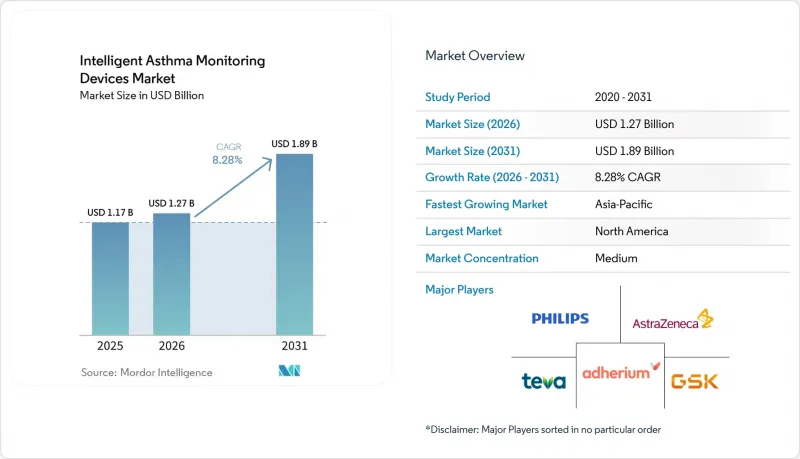
에 따르면 스마트 천식 모니터링 디바이스 시장 규모는 2025년에 11억 7,000만 달러로 평가되며, 2026년 12억 7,000만 달러에서 2031년까지 18억 9,000만 달러에 달할 것으로 예측되고 있으며, 예측 기간(2026-2031년)에 CAGR은 8.28%에 달할 전망입니다.
글로벌 지능형 천식 모니터링 기기 시장의 동향 및 인사이트
천식 유병률 증가와 진단 미비
천식은 특히 진단 및 치료가 미흡한 환경에서 보다 철저한 경과 관찰에 대한 큰 수요를 창출하고 있습니다. ‘세계 질병 부담(GBD)’ 조사에 따르면 2024년에는 3억 6,300만 명이 천식을 앓고 있으며, 이는 연간 44만 2,000명의 사망 원인이 될 것으로 추정됩니다. 세계보건기구(WHO) 보고서에 따르면 저소득국 및 중저소득국의 공공 1차 진료 시설 중 3분의 1 이상에서 천식 치료에 필수적인 의약품을 구할 수 없는 상황입니다. 발병률은 5세 미만 아동에서 가장 높고, 유병률은 95세 이상 성인에서 정점에 달하며, 이는 각각 서로 다른 모니터링 요건을 낳고 있습니다. 중국에서는 약 4,570만 명의 성인이 천식을 앓고 있으며, 이는 성인 인구의 4.2%에 해당합니다. 선별 검사를 통해 더 많은 환자가 확인됨에 따라 기저 질환 발병률의 증가 없이 적극적인 사례 관리를 통해 지능형 천식 모니터링 기기 시장이 확대되었습니다.
복약 순응도 부족 및 잘못된 흡입법
복약 순응도 저하는 커넥티드형 천식 관리 툴의 비즈니스적 가치를 더욱 높였습니다. 2025년 APPaRENT 3 조사에 따르면 환자의 55%가 가끔 흡입기 사용을 잊는 등 불규칙한 복약 순응도를 보였으며, 49%는 유지 요법용 흡입기를 하루에 한 번 미만으로 사용하고 있었습니다. 의사가 추정한 복약 순응도는 73%였습니다. 스페인에서 실시된 횡단면 연구에서는 전자 처방 기록을 바탕으로 만성 호흡기 질환 환자의 24.6%가 50% 미만의 복약 순응도를 보이는 것으로 나타났습니다. 2026년 연구에 따르면 정량 분무식 흡입기(MDI) 사용자 중 기준 시점에 올바른 사용법을 보인 사람은 6.6%에 불과했으나, 기기를 통한 지도를 받은 후에는 50.6%로 증가했습니다. 따라서 지능형 천식 모니터링 기기 시장은 투약 알림 기능에 그치지 않고, 흡기 유량, 흡입기 방향, 흡입 시간의 오류를 식별하는 기능으로 확대되었습니다.
제한적인 보험 적용과 모니터링 워크플로우에 대한 소유권의 불명확성
스마트 천식 모니터링에 대한 보험 급여는 관할 구역에 따라 여전히 일관성이 부족했습니다. CMS(미국 의료보험서비스센터)가 제안한 규정에 따라 원격 모니터링의 청구 범위가 확대되었지만, 호흡기 RTM 코드 98XX4는 전국 통일 요금표가 아닌 계약업체별 가격 책정 대상 그대로였습니다. 이러한 접근 방식으로 인해 미국내 관할 구역 간에 보험 환급률에 차이가 발생했습니다. 유럽의 평가 기관들은 추가적인 임상적·경제적 근거를 요구하고 있었으나, 아시아태평양의 많은 시장에서는 디지털 헬스 툴에 대한 본인 부담 결제가 주류를 이루고 있었습니다. 또한 지능형 천식 모니터링 기기 시장에서는 워크플로우상의 문제도 발생하고 있었습니다. 처방 의사, 약사 및 질환 관리 담당 간호사는 지속적인 모니터링 데이터 확인에 대해 반드시 보험 적용 대상이 되는 책임을 지고 있는 것은 아니었습니다. 명확한 케어 코디네이터의 역할이 정의되어 있지 않았기 때문에 의료 제공자는 기기의 데이터를 수집하더라도 임상적 대응을 시작하지 못하는 경우가 있었습니다.
부문 분석
스마트 흡입기는 확립된 처방 관행과 미국 식품의약국(FDA)의 승인 절차가 마련되어 있는 것을 배경으로, 2025년에는 제품 매출의 38.56%를 차지했습니다. 제약사들도 기존의 흡입 요법을 활용한 의약품과 기기의 연계형 제품을 지원하고 있습니다. 웨어러블형 천식 모니터링 기기는 수면 중이나 활동 중의 호흡 패턴을 모니터링하므로 2026-2031년까지 연평균 성장률(CAGR) 10.89%로 성장할 것으로 예측됩니다. 스마트 흡입기를 활용한 지능형 천식 모니터링 기기 시장 규모는 확립된 치료 제공 역할로부터 혜택을 받고 있는 반면, 웨어러블 기기는 보다 광범위한 모니터링 요구를 충족시키고 있습니다.
AptarGroup은 2025년 10월, 12세 이상 환자를 대상으로 하는 블루투스 지원 정량 흡입기용 애드온 ‘HeroTracker Sense’에 대해 FDA 승인을 획득했습니다. 아스트라제네카의 ‘BREZTRI Aerosphere’는 2026년 4월, 12세 이상 환자를 대상으로 한 천식 치료제로 미국 FDA의 승인을 획득했습니다. 스파이로미터와 피크 유량계의 진단적 역할은 제한적인 반면, 커넥티드 네뷸라이저는 여전히 중증 천식 및 소아 의료 분야에 집중되어 있습니다. Vitalograph사의 AIM 훈련을 통해 당초 정량 흡입기를 잘못 사용하고 있던 환자들에서 올바른 흡입 기술 습득률이 6.6%에서 50.6%로 상승했습니다. FindAir사는 2026년 6월, FindAir ONE에 대해 FDA의 510(k) 승인을 획득하여 90종 이상의 흡입기 형태 및 원격 모니터링 플랫폼과의 연동이 가능해졌습니다.
2025년에는 복약 순응도가 애플리케이션 가치의 58.67%를 차지하며, 보험사 및 의료 시스템에 복약 누락이나 오용을 모니터링할 수 있는 명확한 근거를 제공했습니다. APPaRENT 3 조사에 따르면 천식 환자의 55%에서 불규칙한 복약 순응도가 나타났습니다. 악화 예방 시장은 잠재적인 발작이 발생하기 24-72시간 전에 경고를 발령할 수 있는 예측 툴의 지원에 힘입어, 2026-2031년까지 연평균 성장률(CAGR) 12.34%로 성장할 것으로 전망됩니다. 흡입법의 개선과 진단 지원도 여전히 중요하지만, 보다 광범위한 의료기기 제공에 통합되는 경향이 강해지고 있습니다.
보험 환급 제도가 정비됨에 따라 원격 치료 모니터링 및 RWE(Real-World Evidence) 수집이 점차 보급되고 있습니다. 2026년 2월, FDA는 Sibel Health사의 웨어러블 기침 센서 ‘Aria’에 관한 의향서(LOI)를 ‘의약품 개발 툴 인증 프로그램(DDTQ)’에 접수했습니다. 이는 호흡기 임상 시험에서 기기가 생성하는 데이터에 대한 관심을 보여주는 것입니다. 2026년에 실시된 6세에서 12세 사이의 중국 아동을 대상으로 한 연구에서는 실시간 모니터링과 알림 기능을 활용했을 때의 복약 순응도가 89.2%였던 반면, 기존의 외래 추적 관찰에서는 58.0%에 그쳤습니다. 또한 기도 염증 마커가 42.9% 감소한 반면, 대조군에서는 17.1% 감소에 그친 것으로 보고되었으며, 이는 의료 자원이 제한된 임상 현장에서 커넥티드 매니지먼트의 유효성을 입증하는 것입니다.
지역별 분석
북미는 2025년, 메디케어의 보상 인프라, 대규모 커넥티드 흡입기 보급 기반, 그리고 디지털 헬스 투자에 힘입어 세계 시장 가치의 38.78%를 차지했습니다. CMS가 제안한 2026 회계연도 규정에서는 원격 모니터링 청구 기준이 월 2일로 하향 조정되고, 모니터링 검토와 관련된 의사의 시간 관리 코드가 포함될 예정입니다. Adherium사는 2026년 6월까지의 12개월 동안 RPM(원격 환자 모니터링)의 경상 수익이 9.4배 증가했으며, Hailie Smartinhaler의 출하 대수가 5,300대에 달했으며, 보험 적용 자격이 확인된 천식 환자 6만 8,000명을 대상으로 한 파이프라인을 보유하고 있다고 보고했습니다. 단기적인 시장 확대에 있어서는 기기의 가용성보다 임상 워크플로우로의 도입이 여전히 중요시되고 있습니다.
유럽은 두 번째로 큰 시장이며, 독일, 영국, 프랑스, 이탈리아, 스페인에서는 공적 보험 제도가 도입을 지원하고 있습니다. NICE(영국 국립의료기술평가기구)의 2024년 검토에 따르면 영국 국민보건서비스(NHS)가 스마트 흡입기에 대한 근거를 평가 중인 것으로 나타났습니다. 2025년, 아스트라제네카는 차세대 지구온난화지수(GWP)가 거의 제로인 추진제를 사용하는 ‘Trixeo Aerosphere’에 대해 EU 의약품위원회(CHMP)로부터 긍정적인 견해를 얻었습니다. GDPR(일반 데이터 보호 규정)에 따라 국경을 넘어 호흡기 계통의 생체 데이터를 다루는 플랫폼에 대한 규정 준수 요건이 추가되는 한편, 중동 및 아프리카 및 남미에서는 도시 지역의 호흡기 질환 증가와 정부 주도의 디지털 헬스 프로그램이 호재로 작용하고 있습니다. 이라크에서는 2026년 7월, 연간 생산 능력 900만 유닛 규모의 첨단 천식 흡입기 생산 라인이 가동을 시작했습니다.
아시아태평양은 중국의 추정 성인 천식 환자 4,570만 명과 인도의 웨어러블 시장 발전에 힘입어, 2026-2031년까지 12.25%라는 지역별 최고 연평균 성장률(CAGR)을 기록할 것으로 예측됩니다. 2026년 중국에서 208명의 소아를 대상으로 실시된 연구에 따르면 클라우드 기반의 지능형 관리를 통한 치료 순응도는 89.2%였던 반면, 기존의 외래 진료에서는 58.0%에 그쳤으며, FEV1 개선률도 대조군의 4.2%에 비해 12.3%를 기록했습니다. 2025년에 실시된 재택 폐기능 검사에 관한 연구에서는 5세에서 12세 소아를 대상으로 한 원격 폐기능 모니터링의 유효성이 입증된 반면, 비용, 보험, 데이터 보안이 장벽으로 지적되었습니다. 일본, 한국, 싱가포르에서는 지역 차원에서 도입이 진행되고 있으나, 인도에서는 대도시권 이외의 지역에서도 소매 채널에 맞춰 맞춤화된 제품이 활용됨에 따라 더 큰 혜택이 기대됩니다.
기타 혜택:
- 엑셀 형식의 시장 예측(ME) 시트
- 3개월간의 애널리스트 지원
자주 묻는 질문
목차
제1장 서론
- 조사 전제조건과 시장 정의
- 조사 범위
제2장 조사 방법
제3장 개요
제4장 시장 구도
- 시장 개요
- 시장 성장 촉진요인
- 시장 성장 억제요인
- 밸류·공급망 분석
- 규제 상황
- 기술 전망
- Porter's Five Forces 분석
제5장 시장 규모와 성장 예측
- 제품 유형별
- 용도별
- 환자 그룹별
- 최종사용자별
- 유통 채널별
- 지역별
- 북미
- 미국
- 캐나다
- 멕시코
- 유럽
- 독일
- 영국
- 프랑스
- 이탈리아
- 스페인
- 기타 유럽 국가
- 아시아태평양
- 중국
- 인도
- 일본
- 호주
- 한국
- 기타 아시아태평양 국가
- 중동 및 아프리카
- GCC
- 남아프리카공화국
- 기타 중동 및 아프리카 국가
- 남미
- 브라질
- 아르헨티나
- 기타 남미 국가
- 북미
제6장 경쟁 구도
- 시장 집중도
- 시장 점유율 분석
- 기업 개요
- Adherium Limited
- AEvice Health Pte. Ltd.
- Amiko Digital Health Limited
- AptarGroup, Inc.
- AstraZeneca plc
- Boehringer Ingelheim International GmbH
- BreatheSuite Inc.
- Cognita Labs LLC
- FindAir Sp. z o.o.
- GlaxoSmithKline plc
- Health Care Originals, Inc.
- Koninklijke Philips N.V.
- Novartis AG
- NuvoAir AB
- ResMed Inc.
- Respiri Limited
- Sensirion AG
- Teva Pharmaceutical Industries Limited
- Vectura Group Limited
- Vitalograph Limited
제7장 시장 기회와 향후 전망
KSA 26.10.28According to Mordor Intelligence, the intelligent asthma monitoring devices market size was valued at USD 1.17 billion in 2025 and is estimated to grow from USD 1.27 billion in 2026 to reach USD 1.89 billion by 2031, at a CAGR of 8.28% during the forecast period (2026-2031).
Global Intelligent Asthma Monitoring Devices Market Trends and Insights
Rising Asthma Prevalence and Underdiagnosis
Asthma created a substantial need for improved follow-up, particularly in settings with incomplete diagnosis and treatment. The Global Burden of Disease study estimated that 363 million people had asthma in 2024, causing 442,000 deaths annually. The World Health Organization reported that essential asthma medicines were unavailable in more than one-third of public primary care facilities in low- and lower-middle-income countries. Incidence was highest among children younger than 5 years, while prevalence peaked among adults aged 95 years and older, creating distinct monitoring requirements. China had an estimated 45.7 million adults with asthma, representing 4.2% of its adult population. As screening identified more patients, the intelligent asthma monitoring devices market expanded through active case management without an increase in underlying disease incidence.
Medication Nonadherence and Inhaler-Technique Errors
Medication nonadherence reinforced the business value of connected asthma management tools. The 2025 APPaRENT 3 survey found that 55% of patients demonstrated erratic nonadherence, including occasionally forgetting to use an inhaler, while 49% used controller inhalers less than once daily. Physicians estimated adherence at 73%. A Spanish cross-sectional study found that 24.6% of patients with chronic respiratory diseases had adherence below 50%, based on electronic prescription records. A 2026 study found that only 6.6% of metered-dose inhaler users demonstrated correct technique at baseline, increasing to 50.6% after device-guided training. The intelligent asthma monitoring devices market, therefore, extended beyond dose reminders by identifying errors in inspiratory flow, inhaler orientation, and inhalation duration.
Limited Reimbursement and Unclear Ownership of Monitoring Workflows
Reimbursement for intelligent asthma monitoring remained inconsistent across jurisdictions. A CMS proposed rule expanded remote monitoring billing, but the respiratory RTM code 98XX4 remained subject to contractor pricing rather than a national fee schedule. This approach resulted in varying reimbursement rates across U.S. jurisdictions. European assessment bodies required additional clinical and economic evidence, while many Asia-Pacific markets relied on out-of-pocket payments for digital health tools. The intelligent asthma monitoring devices market also faced workflow gaps. Prescribers, pharmacists, and disease-management nurses did not always have reimbursed responsibility for reviewing continuous monitoring data. Without a defined care-coordinator role, providers could collect device data without initiating a clinical response.
Other drivers and restraints analyzed in the detailed report include:
- Remote Patient Monitoring and Value-Based Care
- AI-Enabled Exacerbation Prediction and Personalized Intervention
- Clinical and Economic Evidence Variability
For complete list of drivers and restraints, kindly check the Table Of Contents.
Segment Analysis
Smart inhalers held 38.56% of product revenue in 2025, supported by established prescribing practices and recognized U.S. Food and Drug Administration (FDA) clearance pathways. Pharmaceutical manufacturers also support connected drug-device combinations using existing inhaler therapies. Wearable asthma monitoring devices are forecast to grow at a CAGR of 10.89% from 2026 to 2031, as they monitor respiratory patterns during sleep and activity. The intelligent asthma monitoring devices market size for smart inhalers benefits from their established treatment-delivery role, while wearables address broader monitoring needs.
AptarGroup received FDA clearance in October 2025 for HeroTracker Sense, a Bluetooth-enabled metered-dose inhaler add-on for patients aged 12 and older. AstraZeneca's BREZTRI Aerosphere received U.S. FDA approval for asthma in patients aged 12 and older in April 2026. Spirometers and peak flow meters have a limited diagnostic role, while connected nebulizers remain concentrated in severe asthma and pediatric care. Vitalograph AIM training increased correct inhaler technique from 6.6% to 50.6% among patients who initially used a metered-dose inhaler incorrectly. FindAir received FDA 510(k) clearance for FindAir ONE in June 2026, supporting integration with more than 90 inhaler formats and remote monitoring platforms.
Medication adherence represented 58.67% of application value in 2025, providing payers and health systems with a clear rationale to monitor missed or incorrect doses. The APPaRENT 3 survey found that 55% of asthma patients had erratic nonadherence. Exacerbation prevention is forecast to grow at a CAGR of 12.34% from 2026 to 2031, supported by predictive tools that can generate warnings 24 to 72 hours before a potential event. Inhaler-technique improvement and diagnostic support remain relevant but are increasingly integrated into broader device offerings.
Remote therapeutic monitoring and real-world evidence collection are gaining adoption as reimbursement pathways develop. The FDA accepted Sibel Health's Letter of Intent for the Aria wearable cough sensor into its Drug Development Tool Qualification Program in February 2026, indicating interest in device-generated measures for respiratory trials. A 2026 study of Chinese children aged 6 to 12 reported 89.2% medication adherence with real-time monitoring and reminders, compared with 58.0% with conventional outpatient follow-up. It also reported a 42.9% reduction in airway inflammation markers, compared with 17.1% in the control group, supporting connected management in capacity-constrained clinical settings.
Complete Report Scope:
- By Product Type
- Wearable Asthma Monitoring Devices
- Wearable Sensors and Patches
- Smart Inhalers
- Metered Dose Inhalers
- Dry Powder Inhalers
- Spirometers
- Peak Flow Meters
- Connected Nebulizers
- Others
- By Application
- Medication Adherence
- Inhaler-Technique Improvement
- Asthma Diagnosis Support
- Asthma Control and Self-Management
- Exacerbation Prevention
- Remote Therapeutic Monitoring
- Clinical Trials and Real-World Evidence
- Others
- By Patient Group
- Pediatric Patients
- Adults
- Older Adults
- By End User
- Hospitals
- Specialty Respiratory Clinics
- Primary-Care Clinics
- Homecare
- Others
- By Distribution Channel
- Hospital Pharmacies
- Retail Pharmacies
- Online Pharmacies and E-Commerce
- Others
- By Geography
- North America
- United States
- Canada
- Mexico
- Europe
- Germany
- United Kingdom
- France
- Italy
- Spain
- Rest of Europe
- Asia-Pacific
- China
- India
- Japan
- Australia
- South Korea
- Rest of Asia-Pacific
- Middle East and Africa
- GCC
- South Africa
- Rest of Middle East and Africa
- South America
- Brazil
- Argentina
- Rest of South America
- North America
Geography Analysis
North America held 38.78% of global market value in 2025, supported by Medicare reimbursement infrastructure, a large connected inhaler base, and digital health investment. The CMS proposed CY 2026 rule would reduce the remote monitoring billing threshold to two days per month and include physician time-management codes for monitoring reviews. Adherium reported 9.4-fold growth in recurring RPM revenue during the 12 months through June 2026, 5,300 Hailie Smartinhaler shipments, and a pipeline of 68,000 insurance-verified asthma patients. Clinical workflow adoption remained more important than device availability for near-term market expansion.
Europe is the second-largest geographic area, with public reimbursement systems supporting adoption in Germany, the United Kingdom, France, Italy, and Spain. NICE's 2024 review showed that the UK National Health Service was assessing evidence for smart inhalers. In 2025, AstraZeneca received a positive EU CHMP opinion for Trixeo Aerosphere, which uses a next-generation near-zero global-warming-potential propellant. GDPR adds compliance requirements for platforms handling cross-border respiratory biometric data, while the Middle East, Africa, and South America benefit from urban respiratory disease and government digital health programs. Iraq launched an advanced asthma inhaler production line with an annual capacity of 9 million units in July 2026.
Asia-Pacific is forecast to record the highest regional CAGR of 12.25% from 2026 to 2031, supported by China's estimated 45.7 million adults with asthma and India's growing wearable sector. A 2026 Chinese study involving 208 children reported 89.2% adherence with cloud-based intelligent management, compared with 58.0% under conventional outpatient care, and a 12.3% FEV1 improvement versus 4.2% in the control group. A 2025 home spirometry study supported remote lung-function monitoring for children aged 5 to 12 while identifying cost, insurance, and data security as barriers. Japan, South Korea, and Singapore support regional adoption, while India can benefit from products tailored to retail channels beyond major cities.
- Adherium
- AEvice Health Pte. Ltd.
- Amiko Digital Health
- AptarGroup, Inc.
- AstraZeneca
- Boehringer Ingelheim
- BreatheSuite
- Cognita Labs LLC
- FindAir Sp. z o.o.
- GlaxoSmithKline
- Health Care Originals, Inc.
- Koninklijke Philips
- Novartis
- NuvoAir AB
- Resmed
- Respiri Limited
- Sensirion
- Teva Pharmaceutical Industries
- Vectura Group Limited
- Vitalograph Limited
Additional Benefits:
- The market estimate (ME) sheet in Excel format
- 3 months of analyst support
TABLE OF CONTENTS
1 INTRODUCTION
- 1.1 Study Assumptions and Market Definition
- 1.2 Scope of the Study
2 RESEARCH METHODOLOGY
3 EXECUTIVE SUMMARY
4 MARKET LANDSCAPE
- 4.1 Market Overview
- 4.2 Market Drivers
- 4.2.1 Rising Asthma Prevalence and Underdiagnosis
- 4.2.2 Medication Nonadherence and Inhaler-Technique Errors
- 4.2.3 Remote Patient Monitoring and Value-Based Care
- 4.2.4 AI-Enabled Exacerbation Prediction and Personalized Intervention
- 4.2.5 Continuous Trigger and Environmental Exposure Correlation
- 4.2.6 Pediatric and Caregiver-Centered Digital Monitoring
- 4.3 Market Restraints
- 4.3.1 Limited Reimbursement and Unclear Ownership of Monitoring Workflows
- 4.3.2 Clinical and Economic Evidence Variability
- 4.3.3 Patient Privacy, Cybersecurity and Consent Burden
- 4.3.4 Device Fragmentation, Battery Waste and Interoperability Burden
- 4.4 Value/Supply-Chain Analysis
- 4.5 Regulatory Landscape
- 4.6 Technological Outlook
- 4.7 Porters Five Forces Analysis
- 4.7.1 Bargaining Power of Suppliers
- 4.7.2 Bargaining Power of Buyers
- 4.7.3 Threat of New Entrants
- 4.7.4 Threat of Substitutes
- 4.7.5 Competitive Rivalry
5 MARKET SIZE AND GROWTH FORECASTS (VALUE, USD)
- 5.1 By Product Type
- 5.1.1 Wearable Asthma Monitoring Devices
- 5.1.2 Wearable Sensors and Patches
- 5.1.3 Smart Inhalers
- 5.1.3.1 Metered Dose Inhalers
- 5.1.3.2 Dry Powder Inhalers
- 5.1.4 Spirometers
- 5.1.5 Peak Flow Meters
- 5.1.6 Connected Nebulizers
- 5.1.7 Others
- 5.2 By Application
- 5.2.1 Medication Adherence
- 5.2.2 Inhaler-Technique Improvement
- 5.2.3 Asthma Diagnosis Support
- 5.2.4 Asthma Control and Self-Management
- 5.2.5 Exacerbation Prevention
- 5.2.6 Remote Therapeutic Monitoring
- 5.2.7 Clinical Trials and Real-World Evidence
- 5.2.8 Others
- 5.3 By Patient Group
- 5.3.1 Pediatric Patients
- 5.3.2 Adults
- 5.3.3 Older Adults
- 5.4 By End User
- 5.4.1 Hospitals
- 5.4.2 Specialty Respiratory Clinics
- 5.4.3 Primary-Care Clinics
- 5.4.4 Homecare
- 5.4.5 Others
- 5.5 By Distribution Channel
- 5.5.1 Hospital Pharmacies
- 5.5.2 Retail Pharmacies
- 5.5.3 Online Pharmacies and E-Commerce
- 5.5.4 Others
- 5.6 By Geography
- 5.6.1 North America
- 5.6.1.1 United States
- 5.6.1.2 Canada
- 5.6.1.3 Mexico
- 5.6.2 Europe
- 5.6.2.1 Germany
- 5.6.2.2 United Kingdom
- 5.6.2.3 France
- 5.6.2.4 Italy
- 5.6.2.5 Spain
- 5.6.2.6 Rest of Europe
- 5.6.3 Asia-Pacific
- 5.6.3.1 China
- 5.6.3.2 India
- 5.6.3.3 Japan
- 5.6.3.4 Australia
- 5.6.3.5 South Korea
- 5.6.3.6 Rest of Asia-Pacific
- 5.6.4 Middle East and Africa
- 5.6.4.1 GCC
- 5.6.4.2 South Africa
- 5.6.4.3 Rest of Middle East and Africa
- 5.6.5 South America
- 5.6.5.1 Brazil
- 5.6.5.2 Argentina
- 5.6.5.3 Rest of South America
- 5.6.1 North America
6 COMPETITIVE LANDSCAPE
- 6.1 Market Concentration
- 6.2 Market Share Analysis
- 6.3 Company Profiles (includes Global Level Overview, Market Level Overview, Core Segments, Financials as available, Strategic Information, Market Rank/Share, Products and Services, Recent Developments)
- 6.3.1 Adherium Limited
- 6.3.2 AEvice Health Pte. Ltd.
- 6.3.3 Amiko Digital Health Limited
- 6.3.4 AptarGroup, Inc.
- 6.3.5 AstraZeneca plc
- 6.3.6 Boehringer Ingelheim International GmbH
- 6.3.7 BreatheSuite Inc.
- 6.3.8 Cognita Labs LLC
- 6.3.9 FindAir Sp. z o.o.
- 6.3.10 GlaxoSmithKline plc
- 6.3.11 Health Care Originals, Inc.
- 6.3.12 Koninklijke Philips N.V.
- 6.3.13 Novartis AG
- 6.3.14 NuvoAir AB
- 6.3.15 ResMed Inc.
- 6.3.16 Respiri Limited
- 6.3.17 Sensirion AG
- 6.3.18 Teva Pharmaceutical Industries Limited
- 6.3.19 Vectura Group Limited
- 6.3.20 Vitalograph Limited
7 MARKET OPPORTUNITIES AND FUTURE OUTLOOK
- 7.1 White-Space and Unmet-Need Assessment


