

|
시장보고서
상품코드
2157142
인도네시아의 의료 물류 : 시장 점유율 분석, 업계 동향과 통계, 성장 예측(2026-2031년)Indonesia Healthcare Logistics - Market Share Analysis, Industry Trends & Statistics, Growth Forecasts (2026 - 2031) |
||||||
 Mordor Intelligence
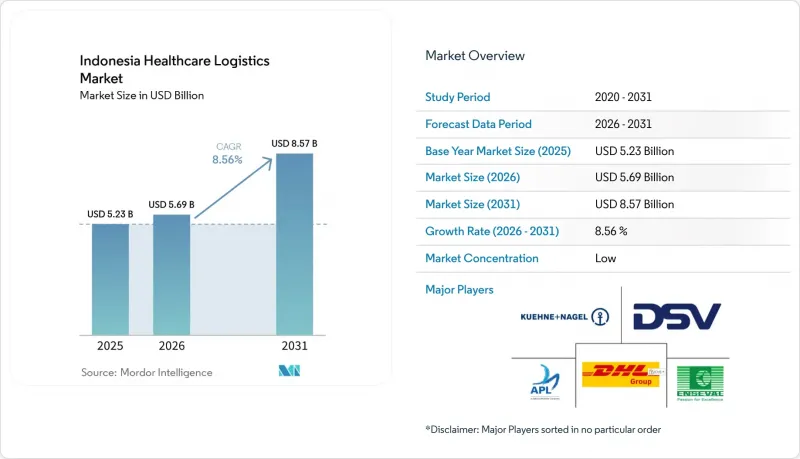
에 따르면 인도네시아의 의료 물류 시장 규모는 2025년에 52억 3,000만 달러로 평가되며, 2026년 56억 9,000만 달러에서 2031년까지 85억 7,000만 달러에 달할 것으로 예측되고 있으며, 2026-2031년 예측 기간의 CAGR은 8.56%에 달할 전망입니다.
인도네시아는 섬나라이기 때문에 특히 화물이 도로, 항만, 해상, 공항 및 지역 배송 네트워크 사이를 이동해야 하는 경우 의약품의 안정적인 유통이 어려워지고 있습니다. 이 보고서는 물류 기능(운송, 창고 보관 등), 온도대(온도 관리, 비온도 관리), 제품 유형(의약품, 백신 등), 배송지(국내, 해외), 최종사용자(병원·진료소, 바이오의약품 등) 및 지역(자바, 수마트라 등)별로 분류되어 있습니다. 시장 전망은 금액(달러) 기준으로 제시되어 있습니다.
인도네시아 헬스케어 물류 시장의 동향 및 인사이트
의료 접근성 확대가 의약품 물류 수요를 견인
JKN은 2025년에 거의 전 국민을 대상으로 하는 가입 체계를 확립하여, 인도네시아 인구의 98%, 즉 2억 8,000만 명의 가입자를 포괄했습니다. 이러한 보장율로 인해 의약품 공급량은 인도네시아 전역의 주에서 공공 의료 서비스 이용과 밀접하게 연결되어 있으며, 각 시설은 인도네시아 의료 물류 시장의 정기적인 배송 일정에 의존하고 있습니다. 신설되는 각 지역 보건 센터와 병원에서는 의약품, 의료기기, 백신, 진단약 및 기타 의료 용품의 지속적인 보충이 필요하며, 대부분의 경우 연중 내내 신뢰성을 유지해야 하는 정기적인 배송 체계를 통해 이루어지고 있습니다. 2026년 의료 예산 배정액은 244조 루피아(137억 5,000만 달러)이며, 이 중 69조 루피아(38억 9,000만 달러)가 JKN의 분담금으로 계상되어 전국 의료 시스템 내의 치료, 의약품 공급 및 서비스 제공을 위한 공공 자금 기반이 되었습니다. JKN의 급여율은 2026년 2월 111.8%에 달하여 치료 이용이 증가하고 있음을 보여주는 한편, 프로그램의 재정 상황에 대한 우려도 제기되고 있습니다. 인도네시아 의료 물류 시장에 있으며, 치료 서비스 이용 증가는 전국 및 지역 배송 네트워크를 통한 의약품 이동 빈도가 높아진다는 것을 의미합니다.
콜드체인 수요를 주도하는 생물제제, 백신 및 첨단 치료법
백신, 바이오시밀러, 항암제 주사제 및 혈장 유래 치료제는 검증된 냉장, 냉동 또는 초저온 취급이 필요합니다. 이러한 요건으로 인해 인도네시아 의료 물류 시장에서 전문적인 보관, 포장, 모니터링 및 항공 화물 운송 서비스의 가치가 높아지고 있습니다. 이는 해당 시장에서 콜드체인상의 문제가 제품의 사용 가능성에 영향을 미칠 수 있기 때문입니다. BPOM 규정 제20/2025호는 생물제제 및 백신에 대한 콜드체인 감독을 강화하고, 이러한 운송을 취급하는 사업자에 대한 운영 요건을 높였습니다. 데원제약 인도네시아는 2025년 9월, 치카랑 시설에서 자가 유래 줄기세포, NK 세포 및 엑소좀에 대해 BPOM의 GMP 인증을 획득했습니다. 첨단 치료법의 현지 생산에 따라 전용 극저온 운송 경로, 전문적인 포장, 훈련을 받은 취급 팀, 그리고 각 운송 단계에서의 문서화된 관리와 같은 수요가 발생하고 있습니다. 이러한 요건들은 기존의 일반 화물 운송업체가 쉽게 제공할 수 있는 것이 아닙니다. 또한 2025-2029년에 JKN(국민건강보험)을 통한 의료 접근성을 지원하는 세계은행의 8억 5,000만 달러 규모의 성과 연계형 프로그램도 인도네시아 의료 물류 시장에서 특수 의약품의 운송을 지원하고 있습니다.
군도 특유의 인프라 격차가 섬 간 물류 비용을 상승시키고 있습니다.
인도네시아에는 1만 7,000개 이상의 섬이 있으며, 그중 약 7,000개가 유인도입니다. 이러한 지역적 조건으로 인해 많은 의약품 운송에 복합 운송이 필요합니다. 화물은 대부분의 경우 육로로 항구까지 운반된 후, 해로를 통해 다른 섬으로 이동하고, 그 후 육로 또는 항공으로 최종 목적지까지 운반됩니다. 운송할 때마다 소요 시간, 취급 작업, 온도 관리상의 잠재적 위험이 증가할 뿐만 아니라, 특히 외딴 지역을 경유하여 제품이 운송되는 경우, 인도네시아 의료 물류 시장의 관계자 간 책임 분담을 더욱 명확히 할 필요성이 커집니다. 2024년 'PLOS Global Public Health' 저널의 조사에 따르면 마르쿠 주에는 29개의 항구와 14척의 선박이 있으며, 24개의 섬 간 항로를 운항하고 있고, 1회 항해에 소요되는 평균 일수는 15일이었습니다. 이러한 운송 기간은 일부 세포 치료제를 포함하여 안정 기간이 짧은 제품에는 적합하지 않습니다. 이러한 과제를 해결하려면 항구 간 연결, 콜드 체인 창고 및 완충 재고 시스템에 대한 투자가 필요하지만, 긴 투자 회수 기간을 감당할 수 없는 사업자에게는 시장 진입 장벽이 될 수 있습니다.
부문 분석
2025년, 인도네시아 의료 물류 시장에서 운송 부문은 46.34%의 점유율을 차지했습니다. 한편, 부가가치 서비스 및 기타 분야는 2031년까지 연평균 성장률(CAGR) 10.34%를 기록할 것으로 예상되며, 이는 의약품의 물리적 운송이 여전히 중요할 뿐만 아니라 전문 물류 서비스에 대한 수요가 증가하고 있음을 반영합니다. 운송은 다양한 현지 운송 환경 하에서 제조 거점, 유통업체, 병원, 진료소, 소매 약국, 지역 보건 센터를 연결합니다. 창고 및 유통은 이러한 이동을 지원하기 위해 필요한 보관, 집하, 주문 준비 및 인도 관리를 제공합니다. 부가가치 서비스에는 추적 및 추적 지원, 재포장, 콜드 체인 모니터링, 규제 관련 서류 작성 등이 포함됩니다. CDOB 2025에 따라 이러한 활동을 일상적인 물류 업무에 통합한 공급업체의 중요성이 더욱 높아졌습니다.
자바섬 및 수마트라섬 내의 섬내 물류에서는 여전히 도로 운송이 중심적인 역할을 하고 있는 반면, 해상 및 내륙 수로는 벌크 화물 운송과 외딴 섬 허브로의 연결을 지원하고 있습니다. 항공 화물은 생물제제, 임상 시험용 자재, 그리고 엄격한 시간 요건이 요구되는 특정 세포·유전자 치료 제품 등 긴급하고 고부가가치 화물의 운송에 이용되고 있습니다. 철도는 자바섬의 일부 도시 간 회랑에서 그 역할이 제한적이긴 하지만 발전하고 있습니다. 정부 관련 물류 계약에서도 실시간 추적, GDP 준수 보관, 재고 관리, 그리고 지방 배송 거점 전반에 걸친 다온도대 대응이 요구되고 있습니다. 인도네시아 의료 물류 시장에서는 전국, 지역 및 지방의 물류 네트워크 전반에 걸쳐 물리적 운송과 정보 관리, 규정 준수, 전문적인 취급을 결합하는 것이 사업자에게 점점 더 요구되고 있습니다.
2025년 시점에 인도네시아 의료 물류 시장 규모 중, 온도 관리가 필요 없는 물류가 56.38%를 차지했으나, 온도 관리가 필요한 물류는 2031년까지 연평균 성장률(CAGR) 11.93%를 기록할 것으로 예측되며, 이는 상온 보관이 가능한 의료 제품의 지속적인 우위와 전문적인 콜드체인 서비스에 대한 수요 증가를 반영합니다. 정제, 캡슐, 일반 의약품, 그리고 상온 보관이 가능한 의료기기는 여전히 주요 제품 흐름이며, 냉장이 필요하지 않은 경우에도 안전한 보관, 관리된 취급, 재고 관리, 그리고 확실한 배송이 요구됩니다. 온도 관리형 물류는 보관 및 운송 전 과정에서 소정의 온도 범위가 필요한 생물제제, 바이오시밀러, 백신 및 첨단 치료제를 지원합니다. 0°C에서 5°C의 냉장 취급 조건은 인슐린이나 기존 바이오의약품에 적합하지만, 더 엄격한 보관 요건을 가진 제품의 경우 초저온 및 극저온 조건이 필요합니다. 세포 치료나 유전자 치료의 경우, -150°C에서 -196°C의 액체 질소 조건이 필요한 경우가 있으며, 이에 따라 인증된 장비, 검증된 포장, 그리고 훈련을 받은 인력에 대한 전문적인 요건이 발생합니다.
BPOM 규정 제20/2025호는 품질 위험 관리 평가, 온도 이탈 절차, ALCOA++ 문서화 및 자동 경보 시스템을 통해 콜드 체인 물류의 운영 요건을 더욱 강화했습니다. 이러한 요건으로 인해 검증된 장비, 훈련을 받은 팀, 문서화된 프로세스, 경보 시스템, 온도 기록 및 일관된 편차 검토 절차가 부족한 도매업자나 유통업체의 경우 대응 비용이 증가하게 됩니다. 능동형 온도 관리 컨테이너의 이용 확대는 전문적인 의약품 물류 역량에 대한 수요가 증가하고 있음을 보여주는 반면, 탕게랑에 계획된 국가 차원의 의약품 인프라는 콜드체인 역량에 대한 지속적인 투자를 시사합니다. 따라서 인도네시아 헬스케어 물류 시장에서는 온도 관리된 운송 및 보관에 더해, 검증된 포장, 모니터링 시스템, 문서화 및 규제 준수를 결합하는 것이 공급업체에게 점점 더 요구되고 있습니다.
기타 혜택:
- 엑셀 형식의 시장 예측(ME) 시트
- 3개월간의 애널리스트 지원
자주 묻는 질문
목차
제1장 서론
- 조사 전제조건과 시장 정의
- 조사 범위
제2장 조사 방법
제3장 개요
- 시장 규모, 성장률 및 예측
- 주요 수요 요인과 의료 물류의 동향
- 주요 물류 거점과 수요 집중
- 경쟁 구도와 주요 의료 물류 프로바이더
제4장 시장 구도
- 시장 개요와 의료 분야에서 물류의 역할
- 의료비의 동향
- 시장 성장 촉진요인
- 시장 성장 억제요인
- 의료 물류 업무에 관한 규제 프레임워크
- 의료 공급망 및 유통 네트워크의 분석
- 기술 혁신과 디지털 물류 전망
- 의료 물류의 요건 변천
- 의약품 유통 네트워크와 화물 유동의 분석
- 콜드체인 처리 능력과 인프라 정비에 관한 분석
- 의료용 창고 및 물류 허브 네트워크의 분석
- Porter's Five Forces 분석
- 지정학적 이벤트가 공급망의 변화에 미치는 영향
제5장 시장 규모와 성장 예측
- 물류 기능별
- 온도 유형별
- 제품 유형별
- 목적지별
- 최종사용자별
- 지역별
- Java(자카르타 및 BOD)
- 수마트라
- 보르네오
- 술라웨시
- 발리 및 누사 텡가라
- 파푸아 지역 및 말루쿠 제도
제6장 경쟁 구도
- 시장 집중도
- 주요 전략적 동향
- 시장 점유율 분석
- 기업 개요
- PT Anugerah Pharmindo Lestari
- PT Enseval Putera Megatrading Tbk
- PT Parit Padang Global
- PT Anugrah Argon Medica
- PT Kimia Farma Trading & Distribution
- DHL Group
- Kuehne+Nagel International AG
- DSV A/S
- CEVA Logistics
- United Parcel Service, Inc.
- FedEx
- NX Group
- PT Jasa Angkasa Semesta Tbk
- Expeditors International
- A.P. Moller-Maersk
- Kiat Ananda Group
- MGM Bosco Logistics
- PT Sarana Mulya Logistik
- PT Millennium Pharmacon International Tbk
- PT Rajawali Nusindo
제7장 시장 기회와 향후 전망
KSAAccording to Mordor Intelligence, the Indonesia healthcare logistics market size was valued at USD 5.23 billion in 2025 and is estimated to grow from USD 5.69 billion in 2026 to reach USD 8.57 billion by 2031, at a CAGR of 8.56% during the forecast period from 2026 to 2031.
Indonesia's island geography makes dependable pharmaceutical distribution difficult, especially when a shipment needs to move between road, port, sea, airport, and local delivery networks. This report is Segmented by Logistics Function (Transportation, Warehousing, and More), by Temperature (Temperature, Non-Temperature), by Product Type (Pharmaceuticals, Vaccines, and More), by Destination (Domestic, International), by End User (Hospitals and Clinics, Biopharmaceutical, and More), and by Region (Java, Sumatra, and More). The Market Forecasts are Provided in Terms of Value (USD).
Indonesia Healthcare Logistics Market Trends and Insights
Expansion of Healthcare Access Increasing Pharmaceutical Logistics Demand
JKN had near-universal enrollment in 2025, covering 98% of Indonesia's population, or 280 million members. This coverage links medicine volumes closely to public healthcare access across Indonesia's provinces, where facilities depend on regular delivery schedules within the Indonesia healthcare logistics market. Each new community health center and hospital requires repeated replenishment of drugs, devices, vaccines, diagnostics, and other healthcare supplies, often through scheduled distribution arrangements that must remain reliable throughout the year. The 2026 health allocation of IDR 244 trillion (USD 13.75 billion), including IDR 69 trillion (USD 3.89 billion) for JKN contributions, provided a public funding base for treatment, medicine supply, and service delivery across the national healthcare system. JKN's claim ratio reached 111.8% in February 2026, indicating higher treatment use while raising questions about program finances. For the Indonesia healthcare logistics market, greater use of treatment services means more frequent pharmaceutical movements through national and regional delivery networks.
Biologics, Vaccines, and Advanced Therapies Driving Cold Chain Demand
Vaccines, biosimilars, oncology injectables, and plasma-derived therapies require validated chilled, frozen, or ultra-low-temperature handling. This requirement raises the value of specialized storage, packaging, monitoring, and airfreight services in the Indonesia healthcare logistics market, where cold-chain failures can affect product usability. BPOM Regulation No. 20/2025 strengthened cold-chain oversight for biological products and vaccines, raising operational requirements for providers handling these shipments. Daewoong Pharmaceutical Indonesia received BPOM GMP certification in September 2025 for autologous stem cells, NK cells, and exosomes at its Cikarang facility. Local production of advanced therapies creates demand for dedicated cryogenic transport routes, specialist packaging, trained handling teams, and documented control throughout each movement that conventional general-cargo providers cannot readily offer. The World Bank's USD 850 million Program-for-Results supporting JKN health access from 2025 to 2029 also supports the movement of specialty medicines through the Indonesian healthcare logistics market.
Archipelagic Infrastructure Gaps Increasing Inter-Island Logistics Costs
Indonesia has more than 17,000 islands, with nearly 7,000 inhabited, and this geography requires multimodal movement for many healthcare shipments. Goods often travel by road to a port, by sea to another island, and then by road or air to the final destination. Every transfer adds time, handling, potential temperature-control risk, and a need for clearer responsibility between parties in the Indonesia healthcare logistics market, particularly when products move through remote routes. A 2024 PLOS Global Public Health study reported that Maluku had 29 seaports and 14 vessels serving 24 inter-island routes, with single trips averaging 15 days. These transit periods are unsuitable for products with short stability windows, including some cell therapies. Addressing these gaps requires investment in port links, cold-chain warehousing, and buffer-stock systems, which may deter operators that cannot support long payback periods.
Other drivers and restraints analyzed in the detailed report include:
- SATUSEHAT Logistics Integration Improving National Healthcare Visibility
- Rising E-Pharmacy Demand Accelerating Time-Sensitive Healthcare Deliveries
- Uneven Power Reliability Constraining Cold-Chain Service Continuity
For complete list of drivers and restraints, kindly check the Table Of Contents.
Segment Analysis
Transportation held 46.34% of Indonesia healthcare logistics market share in 2025, while value-added services and others are forecast to record a 10.34% CAGR through 2031, reflecting the continued importance of physical pharmaceutical movement alongside increasing demand for specialized logistics services. Transportation connects manufacturing sites, distributors, hospitals, clinics, retail pharmacies, and community health centers across varied local transport conditions. Warehousing and distribution provide the storage, consolidation, order preparation, and handoff control required to support these movements. Value-added services include track-and-trace support, repackaging, cold-chain monitoring, and regulatory documentation. CDOB 2025 further increased the importance of providers who integrated these activities into routine logistics operations.
Road transport remains central to intra-island distribution on Java and Sumatra, while sea and inland waterways support bulk freight and connections to outer-island hubs. Air cargo is used for urgent, high-value shipments, including biologics, clinical trial materials, and certain cell and gene therapy products with strict timing requirements. Rail has a limited but developing role in Java for selected urban corridors. Government-linked distribution contracts also require real-time tracking, GDP-compliant storage, inventory management, and multi-temperature handling across subnational delivery points. The Indonesia healthcare logistics market increasingly requires operators to combine physical transportation with information management, compliance, and specialized handling across national, regional, and local distribution networks.
Non-temperature controlled logistics held 56.38% of Indonesia healthcare logistics market size in 2025, while temperature controlled logistics is projected to record an 11.93% CAGR through 2031, reflecting the continued dominance of ambient healthcare products alongside rising demand for specialized cold-chain services. Tablets, capsules, over-the-counter drugs, and ambient-stable medical devices remain major product flows and require secure storage, controlled handling, inventory management, and reliable delivery even without refrigeration. Temperature-controlled logistics support biologics, biosimilars, vaccines, and advanced therapies that require defined temperature ranges throughout storage and transportation. Chilled handling from 0 °C to 5 °C supports insulin and conventional biologics, while deep-frozen and ultra-low-temperature conditions are required for products with more demanding storage requirements. Cell and gene therapies can require liquid-nitrogen conditions from -150 °C to -196 °C, creating specialized requirements for qualified equipment, validated packaging, and trained personnel.
BPOM Regulation No. 20/2025 further increased operational requirements for cold-chain logistics through quality risk management assessments, temperature-excursion procedures, ALCOA++ documentation, and automatic alarm systems. These requirements increase adaptation costs for wholesalers and distributors that lack validated equipment, trained teams, documented processes, alarm systems, temperature records, and consistent deviation-review procedures. The growing use of active temperature-controlled containers also indicates increasing demand for specialized pharmaceutical logistics capabilities, while planned national pharmaceutical infrastructure in Tangerang signals continued investment in cold-chain capacity. The Indonesia healthcare logistics market, therefore, increasingly requires providers to combine temperature-controlled transportation and storage with validated packaging, monitoring systems, documentation, and regulatory compliance.
Complete Report Scope:
- By Logistics Function
- Transportation
- Road
- Air
- Sea and Inland Waterways
- Rail
- Warehousing & Distribution
- Value-added Services and Others
- Transportation
- By Temperature Type
- Temperature Controlled
- Chilled (0-5 °C)
- Frozen (-18-0 °C)
- Ambient
- Deep-Frozen / Ultra-Low (less than-20 °C)
- Non-Temperature Controlled
- Temperature Controlled
- By Product Type
- Pharmaceuticals
- Prescription & Speciality Drugs
- OTC Drugs
- Biopharmaceuticals (Biologics and Biosimilars)
- Vaccines
- Clinical Trial Materials
- Cell and Gene Therapies
- Medical Devices
- Veterinary Medicine
- Blood, Plasma & Blood Components
- Diagnostic and Laboratory Products
- Organs & Human Tissues
- Others
- Pharmaceuticals
- By Destination
- Domestics
- International
- By End User
- Pharmaceutical Manufacturers
- Biopharmaceutical Manufacturers
- Hospitals & Clinics
- Hospitals and Retail Pharmacies
- Healthcare Distributors and Wholesalers
- Others
- By Region
- Java (Jakarta and BOD)
- Sumatra
- Kalimantan
- Sulawesi
- Bali and Nusa Tenggara
- Papua Region and Maluku Islands
List of Companies Covered in this Report:
- PT Anugerah Pharmindo Lestari
- PT Enseval Putera Megatrading Tbk
- PT Parit Padang Global
- PT Anugrah Argon Medica
- PT Kimia Farma Trading & Distribution
- DHL Group
- Kuehne+Nagel International AG
- DSV A/S
- CEVA Logistics
- United Parcel Service, Inc.
- FedEx
- NX Group
- PT Jasa Angkasa Semesta Tbk
- Expeditors International
- A.P. Moller - Maersk
- Kiat Ananda Group
- MGM Bosco Logistics
- PT Sarana Mulya Logistik
- PT Millennium Pharmacon International Tbk
- PT Rajawali Nusindo
Additional Benefits:
- The market estimate (ME) sheet in Excel format
- 3 months of analyst support
TABLE OF CONTENTS
1 INTRODUCTION
- 1.1 Study Assumptions & Market Definition
- 1.2 Scope of the Study
2 RESEARCH METHODOLOGY
3 EXECUTIVE SUMMARY
- 3.1 Market Size, Growth, and Forecast Outlook
- 3.2 Key Demand Drivers and Healthcare Logistics Trends
- 3.3 Major Distribution Hubs and Demand Concentration
- 3.4 Competitive Landscape and Leading Healthcare Logistics Providers
4 MARKET LANDSCAPE
- 4.1 Market Overview & Role of Logistics in Healthcare
- 4.2 Healthcare Spending Trends
- 4.3 Market Drivers
- 4.3.1 Expansion of Healthcare Access Increasing Pharmaceutical Logistics Demand
- 4.3.2 Biologics, Vaccines, Advanced Therapies Driving Cold Chain Demand
- 4.3.3 Outsourcing Non-Core Logistics Boosting GDP-Compliant Service Adoption
- 4.3.4 SATUSEHAT Logistics Integration Improving National Healthcare Visibility
- 4.3.5 Inter-Island Micro-Hubs Expanding Temperature-Controlled Delivery Network Reach
- 4.3.6 Rising E-Pharmacy Demand Accelerating Time-Sensitive Healthcare Deliveries
- 4.4 Market Restraints
- 4.4.1 Archipelagic Infrastructure Gaps Increasing Inter-Island Logistics Costs
- 4.4.2 Compliance Requirements Increasing Specialized Capex and Staffing Costs
- 4.4.3 Multiple Handoffs Increasing Temperature Excursion and Spoilage Risks
- 4.4.4 Uneven Power Reliability Constraining Cold-Chain Service Continuity
- 4.5 Regulatory Framework for Healthcare Logistics Operations
- 4.6 Healthcare Supply Chain and Distribution Network Analysis
- 4.7 Technology Innovation and Digital Logistics Outlook
- 4.8 Evolution of Healthcare Logistics Requirements
- 4.9 Pharmaceutical Distribution Network and Cargo Flow Analysis
- 4.10 Cold Chain Capacity and Infrastructure Development Analysis
- 4.11 Healthcare Warehousing and Distribution Hub Network Analysis
- 4.12 Porter's Five Forces Analysis
- 4.12.1 Threat of New Entrants
- 4.12.2 Bargaining Power of Suppliers
- 4.12.3 Bargaining Power of Buyers
- 4.12.4 Threat of Substitutes
- 4.12.5 Rivalry Among Competitors
- 4.13 Impact of Geo-Political Events on Supply Chain Shifts
5 MARKET SIZE AND GROWTH FORECASTS
- 5.1 By Logistics Function
- 5.1.1 Transportation
- 5.1.1.1 Road
- 5.1.1.2 Air
- 5.1.1.3 Sea and Inland Waterways
- 5.1.1.4 Rail
- 5.1.2 Warehousing & Distribution
- 5.1.3 Value-added Services and Others
- 5.1.1 Transportation
- 5.2 By Temperature Type
- 5.2.1 Temperature Controlled
- 5.2.1.1 Chilled (0-5 °C)
- 5.2.1.2 Frozen (-18-0 °C)
- 5.2.1.3 Ambient
- 5.2.1.4 Deep-Frozen / Ultra-Low (less than-20 °C)
- 5.2.2 Non-Temperature Controlled
- 5.2.1 Temperature Controlled
- 5.3 By Product Type
- 5.3.1 Pharmaceuticals
- 5.3.1.1 Prescription & Speciality Drugs
- 5.3.1.2 OTC Drugs
- 5.3.2 Biopharmaceuticals (Biologics and Biosimilars)
- 5.3.3 Vaccines
- 5.3.4 Clinical Trial Materials
- 5.3.5 Cell and Gene Therapies
- 5.3.6 Medical Devices
- 5.3.7 Veterinary Medicine
- 5.3.8 Blood, Plasma & Blood Components
- 5.3.9 Diagnostic and Laboratory Products
- 5.3.10 Organs & Human Tissues
- 5.3.11 Others
- 5.3.1 Pharmaceuticals
- 5.4 By Destination
- 5.4.1 Domestics
- 5.4.2 International
- 5.5 By End User
- 5.5.1 Pharmaceutical Manufacturers
- 5.5.2 Biopharmaceutical Manufacturers
- 5.5.3 Hospitals & Clinics
- 5.5.4 Hospitals and Retail Pharmacies
- 5.5.5 Healthcare Distributors and Wholesalers
- 5.5.6 Others
- 5.6 By Region
- 5.6.1 Java (Jakarta and BOD)
- 5.6.2 Sumatra
- 5.6.3 Kalimantan
- 5.6.4 Sulawesi
- 5.6.5 Bali and Nusa Tenggara
- 5.6.6 Papua Region and Maluku Islands
6 COMPETITIVE LANDSCAPE
- 6.1 Market Concentration
- 6.2 Key Strategic Moves
- 6.3 Market Share Analysis
- 6.4 Company Profiles (includes Global Level Overview, Market Level Overview, Core Segments, Financials as available, Strategic Information, Geographic Coverage, Products and Services, Recent Developments)
- 6.4.1 PT Anugerah Pharmindo Lestari
- 6.4.2 PT Enseval Putera Megatrading Tbk
- 6.4.3 PT Parit Padang Global
- 6.4.4 PT Anugrah Argon Medica
- 6.4.5 PT Kimia Farma Trading & Distribution
- 6.4.6 DHL Group
- 6.4.7 Kuehne+Nagel International AG
- 6.4.8 DSV A/S
- 6.4.9 CEVA Logistics
- 6.4.10 United Parcel Service, Inc.
- 6.4.11 FedEx
- 6.4.12 NX Group
- 6.4.13 PT Jasa Angkasa Semesta Tbk
- 6.4.14 Expeditors International
- 6.4.15 A.P. Moller - Maersk
- 6.4.16 Kiat Ananda Group
- 6.4.17 MGM Bosco Logistics
- 6.4.18 PT Sarana Mulya Logistik
- 6.4.19 PT Millennium Pharmacon International Tbk
- 6.4.20 PT Rajawali Nusindo
7 MARKET OPPORTUNITIES AND FUTURE OUTLOOK
- 7.1 White-Space Opportunities and Unmet Healthcare Logistics Needs
- 7.2 High-Potential Healthcare Segments and Growth Opportunities
- 7.3 Strategic Growth Priorities Across Healthcare Logistics Ecosystem
- 7.4 Future Market Outlook and Emerging Healthcare Demand Pockets


