|
시장보고서
상품코드
1993590
토크 센서 시장(-2035년) : 토크 센서 유형별, 구성 유형별, 기술별, 응용 분야별, 출력별, 측정 범위별, 조직별 및 지역별 내역 : 업계 동향과 세계 예측Torque Sensors Market, till 2035: Distribution by Type of Torque Sensor, Type of Configuration, Technology, Application Area, Output, Level of Measurement Range, Organization and Geographical Regions: Industry Trends and Global Forecasts |
||||||

토크 센서 시장 전망
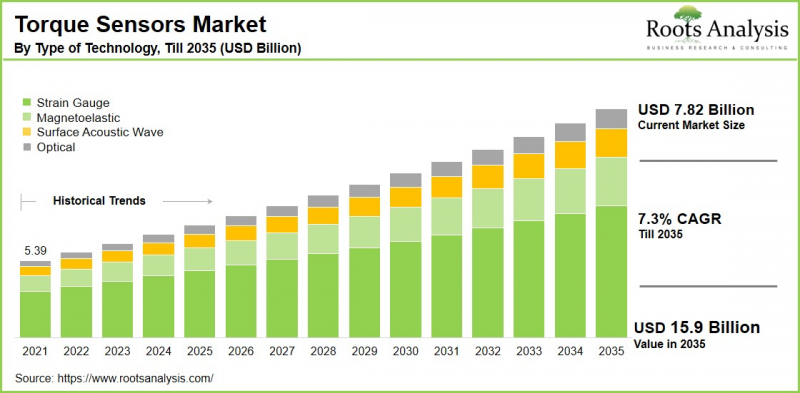
세계의 토크 센서 시장 규모는 2035년까지 CAGR 7.3%로 확대되어 현재 78억 2,000만 달러에서 2035년에는 158억 9,000만 달러에 달할 것으로 추정됩니다.
토크 센서는 물체에 작용하는 비틀림 또는 회전력(일반적으로 토크라고 함)을 측정하고 기록하기 위해 설계된 정밀 기기입니다. 이러한 장치는 샤프트나 표면에 토크가 가해지면 재료의 변형이나 변형이 발생하고, 이를 센서가 감지하여 정량적인 토크 값으로 변환하는 원리로 작동합니다. 이 기능을 통해 동적 및 정적 시스템에서 회전력을 정확하게 평가할 수 있습니다.
토크 센서는 자동차, 항공우주, 의료 등 다양한 산업에서 효율성, 안전성 및 운영 성능을 유지하는 데 필수적인 요소입니다. 정확한 토크 측정은 기계 및 산업 응용 분야에서 회전 운동에 직접적인 영향을 미치고 엄격한 품질 관리 프로세스를 지원하며 시스템의 신뢰성과 안전 메커니즘을 강화하는 데 필수적입니다.
세계 토크 센서 시장은 다양한 최종 사용 분야에서 정밀한 토크 측정에 대한 수요 증가를 주요 요인으로 꾸준히 성장하고 있습니다. 또한, 자동화, 로봇 공학 및 첨단 센서 기술에 대한 투자 증가는 예측 기간 동안 이 시장의 성장을 더욱 가속화할 것으로 예상됩니다.
경영진을 위한 전략적 인사이트
토크 센서 시장의 성장을 이끄는 주요 시장 촉진요인
토크 센서 시장의 성장은 주로 산업 전반에 걸쳐 정확성, 안전 표준 준수 및 운영 우수성에 대한 관심이 높아지면서 성장세를 견인하고 있습니다. 규제 요건과 품질 기준이 강화됨에 따라 제조업체는 제품의 신뢰성을 높이고 안전 표준을 준수하기 위해 첨단 토크센싱 솔루션을 채택할 수밖에 없습니다. 동시에 전기자전거 및 기타 전기 플랫폼을 포함한 보다 스마트하고 고효율의 커넥티드 마이크로모빌리티 솔루션에 대한 수요가 증가함에 따라 첨단 토크 감지 기술의 통합이 가속화되고 있습니다. 이러한 고급 센서는 페달과 모터의 토크를 실시간으로 측정하여 지능형 제어를 강화하고 전반적인 사용자 경험을 향상시킬 수 있습니다.
또한, 토크 센서는 모터 및 구동 시스템을 지속적으로 모니터링하여 공정 제어를 개선하고 기계 성능을 최적화할 수 있습니다. 이 기능은 에너지 소비를 줄이고 운영 비용을 절감하는 데 기여하며, 다양한 산업 분야에서 종합적인 가치 제안을 강화합니다.
토크 센서 시장 - 업계 내 기업의 경쟁 상황
세계 토크 센서 시장의 경쟁 환경은 다양한 최종 사용 분야에서 토크 감지 솔루션의 개발 및 제조에 주력하는 기존 업계 진입자와 신흥 혁신가들이 혼재되어 있습니다. 특히, 이 시장은 소규모 기업이 주류를 이루고 있으며, 중견기업이 그 뒤를 잇고 있으며, 소규모 기업의 예로는 MagCanica, Monad Electronics, Welan Technologies 등을 들 수 있습니다.
또한, 이 분야 기업의 90% 이상이 회전식 토크 센서를 제공하고 있으며, 이는 기존 시스템에 비해 운영상의 이점을 반영하고 있습니다. 또한 대부분의 기업은 제품에 스트레인 게이지 기술을 채택하여 센서 샤프트에 부착된 작은 전기 소자가 가해진 토크에 의해 발생하는 기계적 변형을 감지합니다.
토크 센서 시장 성장을 주도하는 전기자동차의 역할
자동차 산업에서 전기자동차(EV) 및 하이브리드 자동차로의 전환이 진행되면서 토크 센서 산업에도 큰 영향을 미치고 있습니다. 토크 센서는 모터 출력, 배터리 관리 시스템, 회생제동 메커니즘 및 드라이브 바이 와이어 기능을 정밀하게 모니터링하고 제어할 수 있도록 하는 데 중요한 역할을 합니다. 이 센서는 정확한 토크 측정과 실시간 피드백을 지원함으로써 차량의 성능을 향상시키고, 에너지 효율을 최적화하며, 전반적인 핸들링을 개선합니다. 또한, 이러한 센서의 통합은 향상된 트랙션 컨트롤 및 어댑티브 크루즈 컨트롤 시스템과 같은 첨단 안전 기능에 기여하여 운영 안정성을 향상시키고, 현대 차량 플랫폼 전반에 걸쳐 채택을 촉진하고 있습니다.
토크 센서 업계의 새로운 컴플라이언스 기준
토크 센서를 규제하는 프레임워크는 국가마다 다르지만, 공중보건 보호, 제품 품질 보장, 운영 리스크 감소라는 공통된 목적을 공유하고 있습니다. 최종사용자 산업 전반에 걸쳐 안전과 품질에 대한 기대치가 높아지면서 이러한 규제 기준의 발전에 큰 영향을 미치고 있습니다. 그 결과, 제조업체와 최종사용자는 컴플라이언스를 준수하고, 운영의 무결성을 높이고, 위험에 대한 노출을 줄이기 위해 고성능의 신뢰할 수 있는 토크센싱 솔루션에 점점 더 많은 투자를 하고 있습니다.
토크 센서 산업에 영향을 미치는 주요 규제 및 표준화 기관으로는 미국 국립표준기술연구소(NIST), 산업안전보건청(OSHA), 환경보호청(EPA), 유럽항공안전청(EASA), 독일 인증기관(DAkkS) 등이 있습니다. 각 기관은 각 관할권 내에서 규정 준수, 인증 및 안전 요건을 형성하는 데 중요한 역할을 담당하고 있습니다.
지역별 분석 - 아시아태평양이 토크 센서 시장을 주도
당사의 분석에 따르면, 올해 아시아태평양의 토크 센서 시장이 가장 큰 점유율을 차지했습니다. 이는 산업 자동화의 발전, 제조 활동의 급속한 확대, 자동차 부문, 특히 전기자동차(EV) 생산의 견조한 성장에 기인합니다. 또한, 국내 제조 역량 강화를 위한 정부 지원책과 더불어 기술 발전과 인더스트리 4.0의 빠른 도입은 이 지역의 시장 성장을 더욱 촉진하고 있습니다.
토크 센서 시장의 주요 과제
토크 센서 시장은 성장 궤도를 제약할 수 있는 몇 가지 운영 및 전략적 과제에 직면해 있습니다. 현재 진행 중인 세계 공급망의 혼란은 스트레인 게이지, 자기 탄성, 광학 기술을 포함한 특수 전자부품 및 재료의 가용성에 영향을 미치고 있습니다. 이로 인해 생산 지연, 비용 상승, 고급 토크센싱 솔루션에 대한 접근성 제한이 발생합니다.
또한, 첨단 토크 센서의 개발 및 도입에는 IoT 통합, 무선 통신, AI 기반 분석 등 다양한 분야의 다학제적 전문 지식이 필요하며, 이에 따라 설치 및 유지보수가 가능한 고도로 숙련된 전문가에 대한 수요가 증가하고 있습니다. 또한, 사이버 보안 위험의 증가도 심각한 문제로 대두되고 있습니다. 연결된 토크센싱 시스템의 취약성은 운영 안전, 규제 준수 및 데이터 무결성을 해칠 수 있기 때문입니다.
토크 센서 시장 : 주요 시장 세분화
토크 센서 타입
- 회전식 토크 센서
- 정적 토크 센서
- 6축 힘/토크 센서
- 4축 힘/토크 센서
- 기타
구성 유형
- 유선 토크 센서
- 무선 토크 센서
기술 유형
- 스트레인 게이지
- 자탄성
- 표면 탄성파 및 광학식
응용 분야
- 자동차 안전 시스템
- 로봇 시스템
- 의료기기
- 용접 및 조립 공정
- 항공기 비행 제어 시스템
- 기타
출력 형식
- 아날로그
- 디지털
측정 범위
- 낮은 토크
- 중간 토크
조직
- 소규모 사업자
- 중견기업
- 대기업
지역
- 북미
- 미국
- 캐나다
- 유럽
- 프랑스
- 독일
- 이탈리아
- 스페인
- 영국
- 기타 유럽
- 아시아태평양
- 중국
- 인도
- 일본
- 한국
- 기타 아시아태평양
- 라틴아메리카
- 아르헨티나
- 브라질
- 기타 라틴아메리카
- 중동 및 아프리카(MEA)
- 모로코
- 남아프리카공화국
- 기타 중동 및 아프리카
토크 센서 시장의 주요 기업 사례
- ABB Robotics
- A&D
- AIMCO
- Applied Measurements
- Crane Electronics
- Datum Electronics
- FUTEK Advanced Sensor Technology
- HITEC Sensor Developments
- Honeywell
- Hottinger Bruel & Kjaer
- Infineon Technologies
- Kistler
- KTR Systems
- Lorenz Messtechnik
- MagCanica
- Mecmesin
- TE Connectivity
토크 센서 시장 : 보고서의 범위
본 보고서에서는 아래 각 섹션에 대한 인사이트를 제공합니다:
- 시장 규모 및 기회 분석 : 토크 센서 시장에 대한 상세한 분석으로, [A] 토크 센서 유형, [B] 구성 유형, [C] 기술 유형, [D] 응용 분야, [E] 출력 유형, [F] 측정 범위 수준, [G] 조직 유형, [H] 지리적 지역 등 주요 시장 부문에 초점을 맞추고 있습니다.
- 경쟁 상황 : [A] 설립 연도, [B] 기업 규모, [C] 본사 소재지, [D] 소유 구조와 같은 관련 매개 변수를 기반으로 토크 센서 시장에 진입한 기업을 종합적으로 분석합니다.
- 기업 프로파일 : 토크 센서 시장에 진출한 주요 기업들의 상세한 프로필로, [A] 본사 소재지, [B] 기업 규모, [C] 기업 이념, [D] 사업 전개, [E] 경영진, [F] 연락처, [G] 재무정보, [H] 사업부문, [I] 제품 및 기술 포트폴리오, [J] 최근 동향 및 향후 전망에 대한 자세한 정보를 제공합니다.
- 특허 분석 : 토크 센서 분야에서 출원 및 등록된 특허에 대해 [A] 특허 종류, [B] 특허 공개 연도, [C] 특허 경과 기간, [D] 주요 기업 등 관련 파라미터를 기반으로 통찰력 있는 분석을 수행합니다.
- 최근 동향 : 토크 센서 분야의 최근 동향에 대한 개요와 [A] 추진 연도, [B] 추진 유형, [C] 지리적 분포, [D] 가장 활발한 플레이어 등 관련 파라미터를 기반으로 한 분석.
목차
제1장 배경
제2장 조사 방법
제3장 시장 역학
제4장 거시경제 지표
제5장 주요 요약
제6장 소개
제7장 규제 시나리오
제8장 밸류체인 분석
제9장 시장 구도 : 토크 센서 제조업체
제10장 기업 경쟁력 분석
제11장 스타트업·에코 생태계 분석
제12장 기업 개요 : 토크 센서 제조업체
제13장 승리를 위한 중요한 전략
제14장 메가트렌드
제15장 특허 분석
제16장 최근 동향
제17장 시장 영향 분석 : 촉진요인, 억제요인, 기회, 과제
제18장 세계의 토크 센서 시장
제19장 토크 센서 시장(토크 센서 유형별)
제20장 토크 센서 시장(구성 유형별)
제21장 토크 센서 시장(기술 유형별)
제22장 토크 센서 시장(응용 분야별)
제23장 토크 센서 시장(출력별)
제24장 토크 센서 시장(측정 범위별)
제25장 토크 센서 시장(조직 유형별)
제26장 토크 센서 시장(주요 지역별)
제27장 Porter's Five Forces 분석
제28장 결론
제29장 표형식 데이터
제30장 기업 및 조직 리스트
KSM 26.04.15Torque Sensors Market Outlook
As per Roots Analysis, the global torque sensors market size is estimated to grow from USD 7.82 billion in current year to USD 15.89 billion by 2035, at a CAGR of 7.3% during the forecast period, till 2035.
Torque sensors are precision instruments engineered to measure and record the twisting or rotational force, commonly referred to as torque, applied to an object. These devices operate on the principle that the application of torque to a shaft or surface generates material deformation or strain, which is detected by the sensor and translated into a quantifiable torque value. This capability enables accurate assessment of rotational forces in dynamic and static systems.
Torque sensors are integral to maintaining efficiency, safety, and operational performance across a wide range of industries, including automotive, aerospace, and healthcare. Accurate torque measurement is essential in mechanical and industrial applications, as it directly influences rotational motion, supports stringent quality control processes, and enhances system reliability and safety mechanisms.
The global torque sensors market is witnessing steady expansion, primarily driven by the growing need for precise torque measurements across diverse end-use sectors. Moreover, increasing investments in automation, robotics, and advanced sensor technologies are expected to further propel the growth of this market during the forecast period.
Strategic Insights for Senior Leaders
Key Drivers Propelling Growth of Torque Sensors Market
The growth of the torque sensors market is primarily driven by the growing emphasis on precision, safety compliance, and operational excellence across industries. Increasing regulatory requirements and quality standards have compelled manufacturers to adopt advanced torque sensing solutions to enhance product reliability and ensure adherence to safety norms. Simultaneously, the rising demand for smarter, highly efficient, and connected micromobility solutions, including e-bikes and other electric platforms, has accelerated the integration of advanced torque sensing technologies. These advanced sensors enable real-time measurement of pedal or motor torque, thereby enhancing intelligent control and improving the overall user experience.
Moreover, torque sensors facilitate continuous monitoring of motors and drivetrains, enabling improved process control and optimized machinery performance. This capability also contributes to reduced energy consumption and lower operational costs, thereby strengthening their overall value proposition across diverse industrial applications.
Torque Sensors Market: Competitive Landscape of Companies in this Industry
The competitive landscape of the global torque sensors market comprises a mix of well-established industry participants and emerging innovators focused on the development and manufacturing of torque sensing solutions across diverse end-use sectors. Notably, the market is predominantly characterized by small companies, followed by mid-sized players; examples of small enterprises include MagCanica, Monad Electronics, and Welan Technologies.
Additionally, over 90% of the companies in this domain offer rotatory torque sensors, reflecting their operational advantages over conventional systems. Further, most of the companies incorporate strain gauge technology into their products, wherein small electrical elements bonded to the sensor shaft detect mechanical strain induced by applied torque.
Role of Electric Vehicles in Driving Torque Sensor Market Growth
The ongoing transition toward electric vehicles (EV) and hybrid vehicles within the automotive sector is significantly influencing the torque sensors industry. Torque sensors play a critical role in enabling precise monitoring and control of motor output, battery management systems, regenerative braking mechanisms, and drive-by-wire functionalities. By supporting accurate torque measurement and real-time feedback, these sensors enhance vehicle performance, optimize energy efficiency, and improve overall handling. Further, their integration contributes to advanced safety features, including enhanced traction control and adaptive cruise control systems, thereby strengthening operational reliability and driving greater adoption across modern vehicle platforms.
Emerging Compliance Standards in the Torque Sensor Industry
Regulatory frameworks governing torque sensors differ across countries; however, they share a common objective of safeguarding public health, ensuring product quality, and mitigating operational risks. Increasing safety and quality expectations across end-use industries have significantly influenced the evolution of these regulatory standards. As a result, manufacturers and end users are increasingly investing in high-performance and reliable torque sensing solutions to maintain compliance, enhance operational integrity, and reduce risk exposure.
Key regulatory and standard-setting authorities influencing the torque sensors landscape include the National Institute of Standards and Technology (NIST), Occupational Safety and Health Administration (OSHA), Environmental Protection Agency (EPA), European Union Aviation Safety Agency (EASA), and Deutsche Akkreditierungsstelle (DAkkS), each of which plays a critical role in shaping compliance, accreditation, and safety requirements within their respective jurisdictions.
Regional Analysis: Asia-Pacific Lead the Torque Sensors Market
According to our analysis, in the current year, the torque sensors market in Asia-Pacific captures the largest share. This is due to increasing industrial automation, rapid expansion of manufacturing activities, and strong growth in the automotive sector, particularly electric vehicle production. Additionally, supportive government initiatives aimed at strengthening domestic manufacturing capabilities, coupled with technological advancements and the accelerated adoption of Industry 4.0 practices, are further propelling regional market growth.
Key Challenges in Torque Sensors Market
The torque sensors market faces several operational and strategic challenges that may constrain its growth trajectory. Ongoing global supply chain disruptions have impacted the availability of specialized electronic components and materials, including strain gauge, magnetoelastic, and optical technologies. This leads to production delays, elevated costs, and limited access to advanced torque sensing solutions.
In addition, the development and deployment of advanced torque sensors require multidisciplinary expertise in areas such as IoT integration, wireless communication, and AI-driven analytics, thereby creating a demand for highly skilled professionals capable of installation, and maintenance. Furthermore, increasing cybersecurity risks present a significant concern, as vulnerabilities in connected torque sensing systems can compromise operational safety, regulatory compliance, and data integrity.
Torque Sensors Market: Key Market Segmentation
Type of Torque Sensor
- Rotary Torque Sensors
- Static Torque Sensors
- 6 Axis Force / Torque Sensors
- 4 Axis Force / Torque Sensors
- Others
Type of Configuration
- Wired Torque Sensors
- Wireless Torque Sensors
Type of Technology
- Strain Gauge
- Magnetoelastic
- Surface Acoustic Wave and Optical
Application Area
- Automotive Safety Systems
- Robotic Systems
- Medical Devices
- Welding and Assembly Processes
- Aircraft Flight Control Systems
- Others
Type of Output
- Analog
- Digital
Level of Measurement Range
- Low Torque
- Medium Torque
Type of Organization
- Small Players
- Mid-sized Players
- Large Players
Geographical Regions
- North America
- US
- Canada
- Europe
- France
- Germany
- Italy
- Spain
- UK
- Rest of Europe
- Asia-Pacific
- China
- India
- Japan
- South Korea
- Rest of Asia-Pacific
- Latin America
- Argentina
- Brazil
- Rest of Latin America
- Middle East and Africa (MEA)
- Morocco
- South Africa
- Rest of MEA
Example Players in Torque Sensors Market
- ABB Robotics
- A&D
- AIMCO
- Applied Measurements
- Crane Electronics
- Datum Electronics
- FUTEK Advanced Sensor Technology
- HITEC Sensor Developments
- Honeywell
- Hottinger Bruel & Kjaer
- Infineon Technologies
- Kistler
- KTR Systems
- Lorenz Messtechnik
- MagCanica
- Mecmesin
- TE Connectivity
Torque Sensors Market: Report Coverage
The report on the torque sensors market features insights on various sections, including:
- Market Sizing and Opportunity Analysis: An in-depth analysis of the torque sensors market, focusing on key market segments, including [A] type of torque sensor, [B] type of configuration, [C] type of technology, [D] application area, [E] type of output, [F] level of measurement range, [G] type of organization, and [H] geographical regions.
- Competitive Landscape: A comprehensive analysis of the companies engaged in the torque sensors market, based on several relevant parameters, such as [A] year of establishment, [B] company size, [C] location of headquarters and [D] ownership structure.
- Company Profiles: Elaborate profiles of prominent players engaged in the torque sensors market, providing details on [A] location of headquarters, [B] company size, [C] company mission, [D] company footprint, [E] management team, [F] contact details, [G] financial information, [H] operating business segments, [I] product / technology portfolio, [J] recent developments, and an informed future outlook.
- Patent Analysis: An insightful analysis of patents filed / granted in the torque sensors domain, based on relevant parameters, including [A] type of patent, [B] patent publication year, [C] patent age and [D] leading players.
- Recent Developments: An overview of the recent developments made in the torque sensors domain, along with analysis based on relevant parameters, including [A] year of initiative, [B] type of initiative, [C] geographical distribution and [D] most active players.
Key Questions Answered in this Report
- What is the current and future market size?
- Who are the leading companies in this market?
- What are the growth drivers that are likely to influence the evolution of this market?
- What are the key partnership and funding trends shaping this industry?
- Which region is likely to grow at higher CAGR till 2035?
- How is the current and future market opportunity likely to be distributed across key market segments?
Reasons to Buy this Report
- Detailed Market Analysis: The report provides a comprehensive market analysis, offering detailed revenue projections of the overall market and its specific sub-segments. This information is valuable to both established market leaders and emerging entrants.
- In-depth Analysis of Trends: Stakeholders can leverage the report to gain a deeper understanding of the competitive dynamics within the market. Each report maps ecosystem activity across partnerships, funding, and patent landscapes to reveal growth hotspots and white spaces in the industry.
- Opinion of Industry Experts: The report features extensive interviews and surveys with key opinion leaders and industry experts to validate market trends mentioned in the report.
- Decision-ready Deliverables: The report offers stakeholders with strategic frameworks (Porter's Five Forces, value chain, SWOT), and complimentary Excel / slide packs with customization support.
Additional Benefits
- Complimentary Dynamic Excel Dashboards for Analytical Modules
- Exclusive 15% Free Content Customization
- Personalized Interactive Report Walkthrough with Our Expert Research Team
- Free Report Updates for Versions Older than 6-12 Months
TABLE OF CONTENTS
1. BACKGROUND
- 1.1. Context
- 1.2. Project Objectives
2. RESEARCH METHODOLOGY
- 2.1. Research Assumptions
- 2.1.1. Market Landscape and Market Trends
- 2.1.2. Market Forecast and Opportunity Analysis
- 2.1.3. Comparative Analysis
- 2.2. Database Building
- 2.2.1. Data Collection
- 2.2.2. Data Validation
- 2.2.3. Data Analysis
- 2.3. Project Methodology
- 2.3.1. Project Commencement
- 2.3.2. Secondary Research
- 2.3.2.1. Annual Reports
- 2.3.2.2. Academic Research Papers
- 2.3.2.3. Company Websites
- 2.3.2.4. Investor Presentations and Regulatory Filings
- 2.3.2.5. White Papers
- 2.3.2.6. Industry Publications
- 2.3.2.7. Conferences and Seminars
- 2.3.2.8. Government Portals
- 2.3.2.9. Media and Press Releases
- 2.3.2.10. Newsletters
- 2.3.2.11. Industry and Paid Databases
- 2.3.2.12. Roots Proprietary Databases
- 2.3.3. Primary Research
- 2.3.4. Data Analysis and Interpretation
- 2.3.5. Market Forecast and Validation
- 2.3.6. Report Compilation
- 2.4. Research Ethics and Integrity
- 2.5. Analytical Tools and Databases
- 2.6. Robust Quality Control Framework
3. MARKET DYNAMICS
- 3.1. Forecast Methodology
- 3.1.1. Top-Down Approach
- 3.1.2. Bottom-Up Approach
- 3.1.3. Hybrid Approach
- 3.2. Market Assessment Framework
- 3.2.1. Total Addressable Market (TAM)
- 3.2.2. Serviceable Addressable Market (SAM)
- 3.2.3. Serviceable Obtainable Market (SOM)
- 3.2.4. Currently Acquired Market (CAM)
- 3.3. Forecasting Tools and Techniques
- 3.3.1. Qualitative Forecasting
- 3.3.2. Correlation
- 3.3.3. Regression
- 3.3.4. Extrapolation
- 3.3.5. Convergence
- 3.3.6. Sensitivity Analysis
- 3.3.7. Scenario Planning
- 3.3.8. Data Visualization
- 3.3.9. Time Series Analysis
- 3.3.10. Forecast Error Analysis
- 3.4. Key Considerations
- 3.4.1. Demographics
- 3.4.2. Economic Factors
- 3.4.3. Competitive Landscape
- 3.4.4. Government Regulations and Policies
- 3.4.5. R&D Investment
- 3.4.6. Technological Factors
- 3.4.7. Industry Consolidation
- 3.4.8. Supply Chain
- 3.4.9. Market Access
- 3.4.10. Pandemics / Unforeseen Disruptions Impact
4. MACRO-ECONOMIC INDICATORS
- 4.1. Market Dynamics
- 4.1.1. Time Period
- 4.1.1.1. Historical Trends
- 4.1.1.2. Current and Forecasted Estimates
- 4.1.2. Currency Coverage
- 4.1.2.1. Overview of Major Currencies Affecting the Market
- 4.1.2.2. Impact of Currency Fluctuations on the Industry
- 4.1.3. Foreign Exchange Impact
- 4.1.3.1. Evaluation of Foreign Exchange Rates and Their Impact on Market
- 4.1.3.2. Strategies for Mitigating Foreign Exchange Risk
- 4.1.4. Recession
- 4.1.4.1. Historical Analysis of Past Recessions and Lessons Learnt
- 4.1.4.2. Assessment of Current Economic Conditions and Potential Impact on the Market
- 4.1.5. Inflation
- 4.1.5.1. Measurement and Analysis of Inflationary Pressures in the Economy
- 4.1.5.2. Potential Impact of Inflation on the Market Evolution
- 4.1.6. Other Indicators
- 4.1.6.1. War Impact Analysis
- 4.1.6.2. Cross-border Dynamics
- 4.1.6.3. Consumer Spendings and Gross Domestic Product
- 4.1.6.4. Stock Market Performance
- 4.1.1. Time Period
5. EXECUTIVE SUMMARY
6. INTRODUCTION
- 6.1. Overview of Torque Sensors
- 6.2. Key Components of Torque Sensors
- 6.3. Torque Sensors: Sensor Classifications and the Principles
- 6.4. Key Application Areas for Torque Sensors
- 6.5. Future Trends in the Torque Sensors Domain
7. REGULATORY SCENARIO
- 7.1. Chapter Overview
- 7.2. International and National Regulatory Authorities
- 7.2.1. National Institute of Standards and Technology (NIST)
- 7.2.2. Occupational Safety and Health Administration (OSHA)
- 7.2.3. Environmental Protection Agency (EPA)
- 7.2.4. European Union Aviation Safety Agency (EASA)
- 7.2.5. Deutsche Akkreditierungsstelle (DAkkS)
- 7.2.6. China National Accreditation Service for Conformity Assessment (CNAS)
8. VALUE CHAIN ANALYSIS
- 8.1. Chapter Overview
- 8.2. Brief Overview of Processes and Stakeholders Involved
- 8.3. Schematic Representation of Torque Sensors Development Process
- 8.4. Key Challenges of Torque Sensors Development and Mitigation Strategies
9. MARKET LANDSCAPE: TORQUE SENSOR MANUFACTURERS
- 9.1. Chapter Overview
- 9.2. Market Landscape: Torque Sensor Manufacturers
- 9.2.1. Analysis by Year of Establishment
- 9.2.2. Analysis by Company Size
- 9.2.3. Analysis by Location of Headquarters
- 9.2.4. Analysis by Type of Company
- 9.2.5. Analysis by Type of Torque Sensor
- 9.2.6. Analysis by Type of Configuration
- 9.2.7. Analysis by Type of Technology
- 9.2.8. Analysis by Type of Output
- 9.2.9. Analysis by Level of Measurement Range
- 9.2.8. Analysis by Availability of Customization
- 9.2.9. Analysis by Application Area
10. COMPANY COMPETITIVENESS ANALYSIS
- 10.1. Chapter Overview
- 10.2. Assumptions And Key Parameters
- 10.3. Methodology
- 10.4. Company Competitiveness Analysis: Comparison of Players
- 10.5. Company Competitiveness Analysis: Key Players
11. START-UP ECOSYSTEM ANALYSIS
- 11.1. Chapter Overview
- 11.2. Start-up Ecosystem: Torque Sensor Start-Ups
- 11.2.1. Analysis by Year of Establishment
- 11.2.2. Analysis by Type of Company
- 11.2.3. Analysis by Company Size
- 11.2.4. Analysis by Location of Headquarters (Region)
- 11.2.5. Analysis by Location of Headquarters (Country)
- 11.2.6. Analysis by Type of Torque Sensor
- 11.2.7. Analysis by Type of Configuration
- 11.2.8. Analysis by Type of Technology
- 11.2.9. Analysis by Type of Output
- 11.2.10. Analysis by Level of Measurement Range
- 11.2.11. Analysis by Availability of Customization
- 11.2.12. Analysis by Application Area
12. COMPANY PROFILES: TORQUE SENSOR MANUFACTURERS
- 12.1. Chapter Overview
- 12.2. ABB Robotics
- 12.2.1. Company Overview
- 12.2.2. Management Team
- 12.2.3. Torque Sensors Portfolio
- 12.2.4. Initiatives in the Torque Sensors Market
- similar details are presented for other below mentioned companies based on information in the public domain
- 12.3. A&D
- 12.4. AIMCO
- 12.5. Applied Measurements
- 12.6. Crane Electronics
- 12.7. Datum Electronics
- 12.8. FUTEK Advanced Sensor Technology
- 12.9. HITEC Sensor Developments
- 12.10. Honeywell
- 12.11. Hottinger Bruel & Kjaer
- 12.12. Infineon Technologies
- 12.13. Kistler
- 12.14. KTR Systems
- 12.15. Lorenz Messtechnik
- 12.16. MagCanica
- 12.17. Mecmesin
- 12.18. TE Connectivity
13. KEY WINNING STRATEGIES
14. MEGATRENDS
15. PATENT ANALYSIS
- 15.1. Chapter Overview
- 15.2. Methodology and Key Parameters
- 15.2.1. Analysis by Application Year
- 15.2.2. Analysis by Type of Patent
- 15.2.3. Analysis of Patent Jurisdiction
- 15.2.4. Analysis by Publication Year
- 15.2.5. Analysis by Type of Patent and Publication Year
- 15.2.6. Analysis by Leading Players
- 15.2.7. Analysis by Individual Patent Assignees
- 15.2.8. Analysis by Type of Applicant
- 15.2.9. Analysis by Patent Age
- 15.2.10. Patent Valuation: Analysis Methodology and Parameters
- 15.2.11. Patent Valuation: Analysis by Relative Valuation
16. RECENT DEVELOPMENTS
- 16.1. Chapter Overview
- 16.2. Recent Developments: Torque Sensors Focused Initiatives
- 16.2.1. Analysis by Year of Development
- 16.2.2. Analysis by Type of Development
- 16.2.3. Analysis by Year and Type of Development
- 16.2.4. Analysis by Type of Partnership
- 16.2.5. Analysis by Area of Application
- 16.2.6. Most Active Players: Distribution by Number of Initiatives
17. MARKET IMPACT ANALYSIS: DRIVERS, RESTRAINTS, OPPORTUNITIES AND CHALLENGES
- 17.1. Chapter Overview
- 17.2. Market Drivers
- 17.3. Market Restraints
- 17.4. Market Opportunities
- 17.5. Market Challenges
18. GLOBAL TORQUE SENSORS Market
- 18.1. Chapter Overview
- 18.2. Key Assumptions and Methodology
- 18.3. Global Novel Antibody Therapies Market, Historical Trends (Since 2021) and Forecasted Estimates (Till 2035)
- 18.4. Multivariate Scenario Analysis
- 18.4.1. Conservative Scenario
- 18.4.2. Optimistic Scenario
- 18.5. Key Market Segmentations
19. TORQUE SENSORS MARKET, BY TYPE OF TORQUE SENSOR
- 19.1. Chapter Overview
- 19.2. Key Assumptions and Methodology
- 19.3. Torque Sensors Market: Distribution by Type of Torque Sensor
- 19.3.1. Torque Sensors Market for Rotary Torque Sensors, Historical Trends (Since 2021) and Forecasted Estimates (Till 2035)
- 19.3.2. Torque Sensors Market for Static Torque Sensors, Historical Trends (Since 2021) and Forecasted Estimates (Till 2035)
- 19.3.3. Torque Sensors Market for 6 Axis Force/Torque Sensors, Historical Trends (Since 2021) and Forecasted Estimates (Till 2035)
- 19.3.4. Torque Sensors Market for 4 Axis Force/Torque Sensors, Historical Trends (Since 2021) and Forecasted Estimates (Till 2035)
- 19.3.5. Torque Sensors Market for Other Torque Sensors, Historical Trends (Since 2021) and Forecasted Estimates (Till 2035)
- 19.4. Data Triangulation and Validation
20. TORQUE SENSORS MARKET, BY TYPE OF CONFIGURATION
- 20.1. Chapter Overview
- 20.2. Key Assumptions and Methodology
- 20.3. Torque Sensors Market: Distribution by Type of Configuration
- 20.3.1. Torque Sensors Market for Wired Torque Sensors, Historical Trends (Since 2021) and Forecasted Estimates (Till 2035)
- 20.3.2. Torque Sensors Market for Wireless Torque Sensors, Historical Trends (Since 2021) and Forecasted Estimates (Till 2035)
- 20.4. Data Triangulation and Validation
21. TORQUE SENSORS MARKET, BY TYPE OF TECHNOLOGY
- 21.1. Chapter Overview
- 21.2. Key Assumptions and Methodology
- 21.3. Torque Sensors Market: Distribution by Type of Technology
- 21.3.1. Torque Sensors Market for Strain Gauge Technology, Historical Trends (Since 2021) and Forecasted Estimates (Till 2035)
- 21.3.2. Torque Sensors Market for Magnetoelastic Technology, Historical Trends (Since 2021) and Forecasted Estimates (Till 2035)
- 21.3.3. Torque Sensors Market for Surface Acoustic Wave Technology, Historical Trends (Since 2021) and Forecasted Estimates (Till 2035)
- 21.3.4. Torque Sensors Market for Optical Technology, Historical Trends (Since 2021) and Forecasted Estimates (Till 2035)
- 21.4. Data Triangulation and Validation
22. TORQUE SENSORS MARKET, BY APPLICATION AREA
- 22.1. Chapter Overview
- 22.2. Key Assumptions and Methodology
- 22.3. Torque Sensors Market: Distribution by Application Area
- 22.3.1. Torque Sensors Market for Automotive Safety Systems, Historical Trends (Since 2021) and Forecasted Estimates (Till 2035)
- 22.3.2. Torque Sensors Market for Robotic Systems, Historical Trends (Since 2021) and Forecasted Estimates (Till 2035)
- 22.3.3. Torque Sensors Market for Medical Devices, Historical Trends (Since 2021) and Forecasted Estimates (Till 2035)
- 22.3.4. Torque Sensors Market for Welding and Assembly Processes, Historical Trends (Since 2021) and Forecasted Estimates (Till 2035)
- 22.3.5. Torque Sensors Market for Aircraft Flight Control Systems, Historical Trends (Since 2021) and Forecasted Estimates (Till 2035)
- 22.3.6. Torque Sensors Market for Other Application Areas, Historical Trends (Since 2021) and Forecasted Estimates (Till 2035)
- 22.4. Data Triangulation and Validation
23. TORQUE SENSORS MARKET, BY TYPE OF OUTPUT
- 23.1. Chapter Overview
- 23.2. Key Assumptions and Methodology
- 23.3. Torque Sensors Market: Distribution by Type of Output
- 23.3.1. Torque Sensors Market for Analog, Historical Trends (Since 2021) and Forecasted Estimates (Till 2035)
- 23.3.2. Torque Sensors Market for Digital, Historical Trends (Since 2021) and Forecasted Estimates (Till 2035)
- 23.4. Data Triangulation and Validation
24. TORQUE SENSORS MARKET, BY LEVEL OF MEASUREMENT RANGE
- 24.1. Chapter Overview
- 24.2. Key Assumptions and Methodology
- 24.3. Torque Sensors Market: Distribution by Type of Output
- 24.3.1. Torque Sensors Market for Low Torque, Historical Trends (Since 2021) and Forecasted Estimates (Till 2035)
- 24.3.2. Torque Sensors Market for Medium Torque, Historical Trends (Since 2021) and Forecasted Estimates (Till 2035)
- 24.3.3. Torque Sensors Market for High Torque, Historical Trends (Since 2021) and Forecasted Estimates (Till 2035)
- 24.4. Data Triangulation and Validation
25. TORQUE SENSORS MARKET, BY TYPE OF ORGANIZATION
- 25.1. Chapter Overview
- 25.2. Key Assumptions and Methodology
- 25.3. Torque Sensors Market: Distribution by Type of Output
- 25.3.1. Torque Sensors Market for Large Players, Historical Trends (Since 2021) and Forecasted Estimates (Till 2035)
- 25.3.2. Torque Sensors Market for Mid-sized Players, Historical Trends (Since 2021) and Forecasted Estimates (Till 2035)
- 25.3.3. Torque Sensors Market for Small Players, Historical Trends (Since 2021) and Forecasted Estimates (Till 2035)
- 25.4. Data Triangulation and Validation
26. Torque Sensors Market, BY KEY Geographical Regions
- 26.1. Chapter Overview
- 26.2. Key Assumptions and Methodology
- 26.3. Torque Sensors Market: Distribution by Geographical Regions
- 26.3.1. Torque Sensors Market in North America, Historical Trends (Since 2021) and Forecasted Estimates (Till 2035)
- 26.3.1.1. Torque Sensors Market in the US, Historical Trends (Since 2021) and Forecasted Estimates (Till 2035)
- 26.3.1.2. Torque Sensors Market in Canada, Historical Trends (Since 2021) and Forecasted Estimates (Till 2035)
- 26.3.2. Torque Sensors Market in Europe, Historical Trends (Since 2021) and Forecasted Estimates (Till 2035)
- 26.3.2.1. Torque Sensors Market in Germany, Historical Trends (Since 2021) and Forecasted Estimates (Till 2035)
- 26.3.2.2. Torque Sensors Market in France, Historical Trends (Since 2021) and Forecasted Estimates (Till 2035)
- 26.3.2.3. Torque Sensors Market in Italy, Historical Trends (Since 2021) and Forecasted Estimates (Till 2035)
- 26.3.2.4. Torque Sensors Market in Spain, Historical Trends (Since 2021) and Forecasted Estimates (Till 2035)
- 26.3.2.5. Torque Sensors Market in the UK, Historical Trends (Since 2021) and Forecasted Estimates (Till 2035)
- 26.3.2.6. Torque Sensors Market in Rest of the Europe, Historical Trends (Since 2021) and Forecasted Estimates (Till 2035)
- 26.3.3. Torque Sensors Market in Asia-Pacific, Historical Trends (Since 2021) and Forecasted Estimates (Till 2035)
- 26.3.3.1. Torque Sensors Market in China, Historical Trends (Since 2021) and Forecasted Estimates (Till 2035)
- 26.3.3.2. Torque Sensors Market in Japan, Historical Trends (Since 2021) and Forecasted Estimates (Till 2035)
- 26.3.3.3. Torque Sensors Market in South Korea, Historical Trends (Since 2021) and Forecasted Estimates (Till 2035)
- 26.3.3.4. Torque Sensors Market in India, Historical Trends (Since 2021) and Forecasted Estimates (Till 2035)
- 26.3.3.5. Torque Sensors Market in Rest of Asia-Pacific, Historical Trends (Since 2021) and Forecasted Estimates (Till 2035)
- 26.3.4. Torque Sensors Market in Middle East and Africa, Historical Trends (Since 2021) and Forecasted Estimates (Till 2035)
- 26.3.4.1. Torque Sensors Market in Morocco, Historical Trends (Since 2021) and Forecasted Estimates (Till 2035)
- 26.3.4.2. Torque Sensors Market in South Africa, Historical Trends (Since 2021) and Forecasted Estimates (Till 2035)
- 26.3.4.3. Torque Sensors Market in Rest of Middle East and Africa, Historical Trends (Since 2021) and Forecasted Estimates (Till 2035)
- 26.3.5. Torque Sensors Market in Latin America, Historical Trends (Since 2021) and Forecasted Estimates (Till 2035)
- 26.3.5.1. Torque Sensors Market in Brazil, Historical Trends (Since 2021) and Forecasted Estimates (Till 2035)
- 26.3.5.2. Torque Sensors Market in Argentina, Historical Trends (Since 2021) and Forecasted Estimates (Till 2035)
- 26.3.5.3. Torque Sensors Market in Rest of Latin America, Historical Trends (Since 2021) and Forecasted Estimates (Till 2035)
- 26.3.1. Torque Sensors Market in North America, Historical Trends (Since 2021) and Forecasted Estimates (Till 2035)
- 26.4. Torque Sensors Market, By Geographical Regions: Market Dynamics Assessment
- 26.4.1. Market Movement Analysis
- 26.4.2. Penetration-Growth (P-G) Matrix
- 26.5. Data Triangulation and Validation
27. PORTER'S FIVE FORCES ANALYSIS
- 27.1. Chapter Overview
- 27.2. Methodology and Assumptions
- 27.3. Key Parameters
- 27.3.1. Threats of New Entrants
- 27.3.2. Bargaining Power of Buyers
- 27.3.3. Bargaining Power of Service Providers
- 27.3.4. Threats of Substitute Products
- 27.3.5. Rivalry Among Existing Competitors
- 27.4. Concluding Remarks