

|
시장보고서
상품코드
2112611
RNAi 치료제 시장( 제3판) : RNAi 분자 유형, 치료 영역, 투여 경로, 주요 지역, 주요 기업별 동향 및 판매 예측(-2035년)RNAi Therapeutics Market (3rd Edition) by Type of RNAi Molecule, Therapeutic Area, Route of Administration, Key Geographical Regions, Sales Forecast and Leading Industry Players - Trends and Forecast Till 2035 |
||||||

RNAi 치료제 시장: 개요
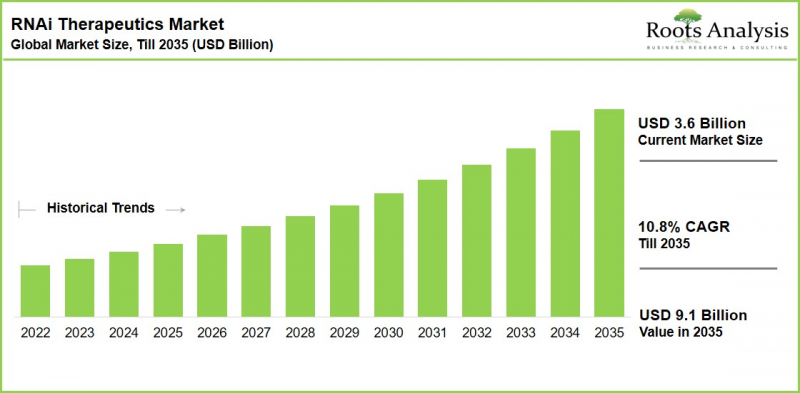
Roots Analysis의 조사에 따르면 세계의 RNAi 치료제 시장 규모는 올해 36억 달러에서 2035년에는 91억 달러로 확대할 것으로 추정되고 있으며, 예측 기간 중 CAGR은 약 10.8%에 달할 전망입니다.
RNAi 치료제 시장: 성장 및 동향
RNA 간섭(RNAi) 치료제는 전사 후 유전자 침묵을 통해 질병의 원인이 되는 유전자를 선택적으로 억제하는 임상적 유효성이 입증된 정밀 의학의 한 분야로 부상해 왔습니다. 병원성 단백질의 발현을 차단함으로써, RNAi 기반 치료법은 희귀 유전 질환, 대사성 질환, 심혈관 질환, 간 질환, 안과 질환, 신경질환, 종양학 적응증에 폭넓게 적용 가능한, 매우 특이성이 높은 치료 접근법을 제공합니다. 지난 수년 동안 여러 규제 당국의 승인을 바탕으로 한 RNAi 기술의 임상 적용 성공에 힘입어, 이 분야는 실험적인 유전자 침묵 플랫폼에서 상업적으로 실용 가능한 치료 방식으로 발전했습니다. 바이오의약품 업계에서의 채택도 확대되고 있습니다.
규제상의 이정표, 파이프라인의 성숙, 올리고뉴클레오티드 화학 및 표적 전달 기술의 지속적인 개선 등으로 인해 시장은 지속적인 성장을 보이고 있습니다. 임상적 유효성에 대한 근거가 늘어남에 따라 개발 기업은 RNAi의 적용 범위를 간을 표적으로 하는 치료를 넘어 확대하고 있으며, 차세대 전달 플랫폼을 통해 중추신경계, 신장, 폐, 눈, 고형 종양 등의 조직에 대한 선택적 표적화가 가능해졌습니다. 동시에, 전략적인 라이선싱 계약, 플랫폼 간 제휴, RNA 기반 신약 개발에 대한 투자 확대가 혁신을 가속화하는 동시에 개발 위험을 낮추고, 시장의 장기적인 상업적 전망을 강화하고 있습니다.
강력한 성장 궤도에 있음에도 불구하고 RNAi 치료제의 광범위한 보급은 간외 전달, 제조의 확장성, 장기적인 안전성 평가, 고액의 치료비와 관련된 과제로 인해 여전히 제약을 받고 있습니다. 그러나 조직 특이적 전달 기술의 지속적인 발전,임상 증거의 확대, 규제 당국의 호의적인 지원, 제약 업계의 투자 증가로 인해 이러한 장벽은 극복될 것으로 예상되며, 향후 10년 동안 RNAi 치료제는 광범위한 핵산 치료제 시장에서 가장 빠르게 진화하는 부문 중 하나로 자리매김할 것으로 전망됩니다.
성장의 원동력: 시장 확장을 지원하는 요인
시장 촉진요인 중 하나는 규제 당국의 승인 건수 증가입니다. 이에 따라 RNAi 치료제에 대한 임상적 신뢰도가 높아지면서, 여러 질환 영역에 걸쳐 이 치료법이 확대되고 있습니다. 심근증 동반 ATTR 아밀로이드증, A형 또는 B형 혈우병, 가족성 카이로미크론 혈증 증후군에 대한 최근 승인은, 당초 희귀 질환에 집중되었던 것에서 벗어나 RNAi 기반 의약품의 치료적 중요성이 높아지고 있음을 보여줍니다. 이러한 승인은 의료진의 채택 확대, 환자의 접근성 향상, 상업적 확장을 촉진할 것으로 기대됩니다.
RNA 화학 및 표적 전달 기술의 지속적인 발전 또한 RNAi 치료제의 안정성, 효능 및 임상적 유용성을 향상시키고 있습니다. 화학적 변형,결합 전략, 최적화된 전달 플랫폼을 통해 승인된 치료법 및 임상 시험 중인 여러 치료법에서 표적 조직에 대한 선택적 흡수, 유전자 침묵 지속 시간 연장, 편의성이 높은 투여 일정이 가능해졌으며, 이는 개발자가 치료 효과를 향상시키고 투여 부담을 줄이며 이 치료법의 임상적 가치를 확대하는 데 기여하고 있습니다.
시장 규모 및 기회 분석은 다음 매개변수를 기준으로 분류됩니다.
RNAi 분자 유형별
- siRNA
- shRNA
치료 분야별
- 종양성 질환
- 유전성 질환
- 대사성 질환
- 혈액 질환
- 안과 질환
- 기타
투여 경로별
- 피하
- 정맥내
- 국소
- 피내
주요 지역별
- 북미
- 유럽
- 아시아태평양
- 기타 지역
이 보고서에서는 전 세계 RNAi 치료제 시장을 조사하여 시장 개요, 배경, 시장 영향 요인 분석, 시장 규모 추이 및 전망, 각종 분류별 상세 분석, 경쟁 현황, 주요 기업 개요 등을 정리하여 전해드립니다.
목차
제1장 서문
제2장 조사 방법
제3장 시장 역학
제4장 거시경제 지표
제5장 개요
제6장 서론
제7장 시장 개요
제8장 경쟁 구도
제9장 기업의 경쟁력 분석
제10장 승인된 및 후기 단계 RNAi 치료제
제11장 기업 개요
제12장 주요 치료 적응증
제13장 임상시험 분석
제14장 키 오피니언 리더
제15장 특허 분석
제16장 출판물 분석
제17장 제휴·협력 관계
제18장 자금조달과 투자 분석
제19장 주요 상업화 전략
제20장 진단용 RNAi
제21장 RNAi 치료제 서비스 프로바이더
제22장 수요 분석
제23장 시장 규모와 기회 분석
제24장 SWOT 분석
제25장 이그제큐티브 인사이트
제26장 결론
제27장 부록 1 : 표형식 데이터
KSA 26.08.25RNAi THERAPEUTICS MARKET: OVERVIEW
As per Roots Analysis, the global RNAi therapeutics market is estimated to grow from USD 3.6 billion in the current year to USD 9.1 billion by 2035, reflecting a compound annual growth rate (CAGR) of approximately 10.8% during the forecast period.
RNAi Therapeutics Market: Growth and Trends
RNA interference (RNAi) therapeutics have emerged as a clinically validated class of precision medicines that selectively suppress disease-driving genes through post-transcriptional gene silencing. By preventing the expression of pathogenic proteins, RNAi-based therapies offer a highly specific treatment approach with broad applicability across rare genetic, metabolic, cardiovascular, hepatic, ophthalmic, neurological and oncology indications. The successful clinical translation of RNAi technology, supported by multiple regulatory approvals over the past few years, has transformed the field from an experimental gene-silencing platform into a commercially viable therapeutic modality with increasing adoption across the biopharmaceutical industry.
The market is witnessing sustained expansion, driven by a combination of regulatory milestones, pipeline maturation and continuous improvements in oligonucleotide chemistry and targeted delivery technologies. Increasing clinical validation has encouraged developers to broaden RNAi applications beyond liver-directed therapies, with next-generation delivery platforms enabling selective targeting of tissues such as the central nervous system, kidney, lung, eye and solid tumors. At the same time, strategic licensing agreements, platform collaborations and rising investment in RNA-based drug development are accelerating innovation while reducing development risk, strengthening the long-term commercial outlook of the market.
Despite its strong growth trajectory, widespread adoption of RNAi therapeutics remains constrained by challenges associated with extrahepatic delivery, manufacturing scalability, long-term safety evaluation and premium treatment costs. However, continuous advances in tissue-specific delivery technologies, expanding clinical evidence, favorable regulatory support and increasing pharmaceutical investment are expected to overcome these barriers, positioning RNAi therapeutics as one of the fastest-evolving segments within the broader nucleic acid therapeutics landscape over the coming decade.
Growth Drivers: Factors Fueling Market Expansion
One of the significant drivers of the market is the increasing number of regulatory approvals, which is strengthening clinical confidence in RNAi therapeutics and expanding the modality across multiple disease areas. Recent approvals for ATTR amyloidosis with cardiomyopathy, hemophilia A or B, and familial chylomicronemia syndrome demonstrate the growing therapeutic relevance of RNAi-based medicines beyond their initial rare-disease focus. These approvals are expected to support broader physician adoption, patient access, and commercial expansion.
Continued advances in RNA chemistry and targeted delivery technologies are also improving the stability, potency, and clinical utility of RNAi therapeutics. Chemical modifications, conjugation strategies, and optimized delivery platforms have enabled more targeted tissue uptake, longer duration of gene silencing, and convenient dosing schedules across several approved and investigational therapies, helping developers improve treatment efficacy, reduce dosing burden, and expand the clinical value of the modality.
Market Challenges: Critical Barriers Hindering Progress
Despite significant progress in liver-targeted delivery, efficient delivery of RNAi to non-hepatic tissues remains a major technical challenge. Several candidates continue to face barriers related to tissue-specific targeting, cellular uptake, endosomal escape, and sustained gene silencing in non-hepatic tissues. Overcoming these limitations will be critical for expanding RNAi therapeutics into larger disease areas such as oncology, neurology, ophthalmology, and renal disorders.
RNAi therapeutics also continue to face challenges related to off-target effects, immune stimulation, chemical modification complexity, manufacturing scalability, and high treatment costs. Developers must carefully optimize RNAi sequences, delivery systems, and dosing regimens to minimize unintended gene silencing while maintaining therapeutic efficacy. These requirements can increase development timelines, regulatory scrutiny, and commercialization costs for market participants.
RNAi Therapeutics Market: Key Insights
The report delves into the current state of the RNAi therapeutics market and identifies potential growth opportunities within the industry, particularly from a distributor and channel-partner perspective. Some key findings include:
- Accelerating Strategic Collaborations: Recent months have seen a wave of high-value partnerships aimed at expanding RNAi discovery and delivery capabilities, including a multi-billion-dollar AI-driven RNAi discovery collaboration, an expanded platform license spanning multiple therapeutic areas beyond neurology, and a cross-border licensing agreement covering cardiovascular siRNA assets, reflecting sustained strategic interest in the space.
- Growing Access to Growth Capital: Recent financing activity, including a sizeable Series B round supporting a next-generation RNAi engineering platform and pipeline, alongside continued capacity investment by leading manufacturers, reflects sustained investor confidence in siRNA and shRNA-based drug development.
- Blockbuster Commercial Validation: An approved siRNA therapy used to reduce LDL cholesterol generated in excess of USD 1 billion in annual sales, achieving blockbuster status and highlighting the commercial strength of RNAi therapies in the treatment and management of metabolic indications.
- Favorable Regulatory Environment: A steady cadence of USFDA approvals across haematological, metabolic, and rare genetic disorders over the past two years have de-risked the technology and shortened the path from launch to physician adoption.
- Rising Relevance of Asia-Pacific Innovation: China-based developers are advancing next-generation siRNA platforms across cardiovascular, metabolic, rare disease, CNS, and viral hepatitis indications, and are increasingly entering global licensing agreements with established multinational pharmaceutical companies.
- Key Future Growth Outlook: Efficient, tissue-selective delivery beyond the liver remains the central technical bottleneck; long-term extrahepatic delivery data is still accumulating and is expected to be a key determinant of platform adoption and market consolidation, making it an important metric for investors to monitor.
RNAi Therapeutics Market Segments
Roots Analysis segments the global RNAi Therapeutics opportunity across the following parameters:
By Type of RNAi Molecule
- siRNA
- shRNA
By Therapeutic Area
- Oncological Disorders
- Genetic Disorders
- Metabolic Disorders
- Hematological Disorders
- Ophthalmic Disorders
- Other Disorders
By Route of Administration
- Subcutaneous
- Intravenous
- Topical
- Intradermal
By Key Geographical Regions
- North America
- Europe
- Asia-Pacific
- Rest of the World
RNAi Therapeutics Market: Key Segments Insight
siRNA Segment Leads the RNAi Therapeutics Market
Based on our market assessment, the siRNA segment is expected to account for the largest share of the RNAi therapeutics market. This leadership is primarily driven by the strong clinical validation, regulatory success, and commercial availability of siRNA-based therapies across multiple therapeutic areas. Several approved RNAi products are based on siRNA technology, reinforcing the segment's leading position, while advances in chemical modification and targeted delivery continue to improve stability, potency, and dosing convenience. Some notable examples of the approved RNAi products are Onpattro(R), Amvuttra(R), Givlaari(R), Oxlumo(R), Leqvio(R), Qfitlia(R), and Rivfloza(R).
On the other hand, the shRNA segment is projected to register the highest CAGR during the forecast period. This growth is attributed to increasing interest in vector-based RNAi approaches that support longer-duration gene silencing compared to transient RNAi strategies, with platforms being explored across oncology, genetic disorders, and other difficult-to-address disease areas.
Metabolic Disorders Account for the Largest Share by Therapeutic Area
Based on our market analysis, revenues generated through drugs targeting gene silencing in metabolic disorders account for the largest share of the current market. This dominance is primarily driven by strong commercial adoption of RNAi therapies targeting lipid metabolism and cardiometabolic risk factors, reinforced by the recent approval of a rare metabolic disorder indication.
In contrast, revenues generated through drugs targeting gene silencing in oncological disorders are expected to register the highest CAGR during the forecast period. This highest CAGR is likely due to the increasing exploration of RNAi approaches for cancer-associated genes that remain difficult to address with conventional treatment strategies.
Intravenous Route Leads the Delivery of RNAi Therapeutics
According to our proprietary market analysis, the intravenous route of administration holds the highest share in the RNAi therapeutics market. This dominance is due to its suitability for delivering complex RNAi formulations under medical supervision through established infusion-center networks and reimbursement pathways. In contrast, the subcutaneous route is expected to register the highest CAGR through 2035, driven by the increasing shift toward convenient, less resource-intensive, outpatient dosing models.
North America Maintains Market Leadership; Asia-Pacific Emerges as the Fastest-Growing Region
North America is expected to retain the highest share of global market revenue through the forecast period. This dominance is supported by the region's strong RNAi innovation ecosystem, established specialty-care infrastructure, and concentration of companies advancing RNAi therapeutics across rare genetic, cardiometabolic, hematological, and neurological indications. Additionally, the ongoing investment in domestic siRNA manufacturing capacity is further strengthening regional supply readiness.
The RNAi therapeutics market in Asia-Pacific is expected to grow at the highest CAGR during the forecast period. This lucrative growth is driven by increasing regional RNAi innovation, expanding clinical development activity, and stronger participation of Asia-based companies in global RNAi drug development, particularly across cardiovascular, metabolic, rare disease, CNS, and viral hepatitis indications.
Example Players in RNAi Therapeutics Market
- Alnylam Pharmaceuticals
- Arbutus Biopharma
- Arrowhead Pharmaceuticals
- Benitec Biopharma
- Novo Nordisk
- Novartis
- OliX Pharmaceuticals
- Silence Therapeutics
- Sirnaomics
Expert Interview and Industry Insights
The opinions and insights presented in this study were influenced by discussions conducted with multiple stakeholders. The research report features detailed transcripts of interviews held with the following industry stakeholders:
- Founder and Chief Executive Officer, Mid-sized Company, US
- President and Chief Executive Officer, Mid-sized Company, UK
- President and Chief Executive Officer, Small Company, US
- Chief Executive Officer and Co-Founder, Small Company, US
- Chief Executive Officer, Large Company, US
- Senior Vice President, Head of International Region, Large Company, US
- Executive Vice President, Chief Commercial Officer, Large Company, US
- Chief Technology Officer and Head of US Operations, Mid-sized Company, US
- Former Chief Medical Officer, Large Company, US
- Head of Advanced Drug Delivery, Very Large Company, UK
RNAi THERAPEUTICS MARKET: RESEARCH COVERAGE
- Market Dynamics and Macro-Economic Indicators: The report examines the forecast methodology (top-down, bottom-up and hybrid approaches), the market assessment framework (TAM / SAM / SOM / CAM), and key macro-economic indicators, including currency fluctuations, recession and inflation trends, trade dynamics, and geopolitical and pandemic-related disruptions, that may influence market evolution through 2035.
- Introduction to RNAi: An overview of the discovery, mechanism, molecule types (siRNA, miRNA and shRNA), applications, and advantages / disadvantages of RNA interference, along with a case study on regulatory concerns raised during clinical submissions.
- Market Overview and Pipeline Analysis: A detailed assessment of the marketed and development-stage RNAi therapeutics pipeline, featuring analyses by type of RNAi molecule, phase of development, target gene, therapeutic area, route of administration, and special regulatory designations.
- Competitive Landscape and Company Competitiveness Analysis: A comprehensive study of RNAi therapeutics developers based on parameters such as year of establishment, company size, and location of headquarters, along with a proprietary company competitiveness analysis benchmarking developers based in North America, Europe, and Asia-Pacific.
- Approved and Late-Stage RNAi Therapeutics: In-depth profiles of approved and late-stage RNAi drug candidates, featuring information on drug and technology overview, current development status, recent clinical trial results, and recent partnerships.
- Company Profiles: In-depth profiles of prominent players engaged in the development of RNAi therapeutics, featuring information on company overview, RNAi therapeutics portfolio, management team, and key initiatives.
- Key Therapeutic Indications: A detailed analysis of RNAi therapeutics being developed across oncological disorders, infectious diseases, metabolic disorders, ophthalmic diseases, and genetic disorders, segmented by target indication, phase of development, and type of RNAi molecule.
- Clinical Trial Analysis: An analysis of clinical trials related to RNAi therapeutics, based on parameters such as trial registration year, trial phase, recruitment status, type of sponsor, therapeutic area, and geography, along with enrolled patient population trends.
- Key Opinion Leaders: An analysis of key opinion leaders (KOLs) active in the RNAi therapeutics domain, based on type of organization, qualification, geographical location, and comparative KOL strength and activeness scores.
- Patent Analysis: An analysis of patents filed / granted related to RNAi therapeutics, based on parameters such as type of patent, publication year, CPC symbols, type of applicant, geography, patent benchmarking, and patent valuation.
- Publication Analysis: An assessment of scientific publications related to RNAi therapeutics, based on year of publication, type of publication, popular keywords, journals, publishers, copyright holders, and funding institutes.
- Recent Partnerships and Collaborations: A detailed analysis of recent partnerships and collaborations in this industry, based on parameters such as year of partnership, type of partnership, type of RNAi molecule, scale of partnership, therapeutic area, and regional distribution of deals.
- Funding and Investment Analysis: An analysis of recent funding and investments in the RNAi therapeutics domain, based on amount invested, type of funding, type of RNAi molecule, region, and most active players and investors.
- Key Commercialization Strategies: An examination of commercialization strategies adopted by RNAi-based therapy developers before and after product approval, including participation in global events, collaborations, indication expansion, geographical expansion, patient assistance programs, and government alignment initiatives.
- RNAi in Diagnostics: An overview of circulating miRNA biomarkers and their diagnostic applications in oncological and cardiovascular disorders, along with an assessment of miRNA-based diagnostic tests in the pipeline.
- RNAi Therapeutics Service Providers: A detailed analysis of contract research organizations (CROs), contract manufacturing organizations (CMOs), and consumables / other service providers supporting the RNAi therapeutics industry.
- Demand Analysis: An estimate of the global demand for RNAi therapeutics, in terms of target patient population, segmented by therapeutic approach, target therapeutic area, route of administration, key players, and geography.
- Market Sizing and Opportunity Analysis: The report features an in-depth analysis of the RNAi therapeutics market, focusing on key market segments, including type of RNAi molecule, therapeutic area, route of administration, and geographical regions, along with product-level sales forecasts, net present value, and value creation analysis for key approved and late-stage RNAi therapeutics.
- SWOT Analysis: A qualitative assessment of the strengths, weaknesses, opportunities, and threats characterizing the RNAi therapeutics industry, along with a comparative Harvey Ball analysis of SWOT factors.
- Executive Insights: The report features detailed transcripts of interviews held with senior executives representing companies engaged in the RNAi therapeutics domain.
Key Questions Answered in this Report
- Which are the leading companies in the RNAi therapeutics market?
- Which region dominates the RNAi therapeutics market?
- What are the key trends observed in the RNAi therapeutics market?
- What factors are likely to influence the evolution of this market?
- What are the primary challenges faced by RNAi therapeutics developers?
- What is the current and future market size?
- What is the CAGR of this market?
- How is the current and future market opportunity likely to be distributed across key market segments?
Reasons to Buy this Report
This report has been specifically developed to support distributors, channel partners, and business development teams evaluating entry into the RNAi therapeutics market.
- The report provides a comprehensive market analysis, offering detailed revenue projections of the overall market and its specific sub-segments. This information is valuable to both established market leaders and emerging entrants.
- The report offers stakeholders a comprehensive overview of the market, including key drivers, barriers, opportunities, and challenges. This information empowers stakeholders to stay abreast of market trends and make data-driven decisions to capitalize on growth prospects.
- The report can aid businesses in identifying future opportunities in any sector. It also helps in understanding if those opportunities are worth pursuing.
- The report helps in identifying customer demand by understanding the needs, preferences, and behavior of the target audience in order to tailor products or services effectively.
- The report equips new entrants with requisite information regarding a particular market to help them build successful business strategies.
- The report allows for more effective communication with the audience and in building strong business relations.
Additional Benefits
- Complementary Insights Pack
- Complementary PPT Insights Pack
- Complementary Excel Data Packs for all Analytical Modules in the Report
- 15% Free Content Customization
- Detailed Report Walkthrough Session with Research Team
- Free Updated report if the report is 6-12 months old or older
TABLE OF CONTENTS
1. PREFACE
- 1.1. Scope of the Report
- 1.2. Research Methodology
- 1.3. Market Segmentations
- 1.4. Key Questions Answered
- 1.5. Chapter Outlines
2. RESEARCH METHODOLOGY
- 2.1. Chapter Overview
- 2.2. Research Assumptions
- 2.2.1. Market Landscape and Market Trends
- 2.2.2. Market Forecast and Opportunity Analysis
- 2.2.3. Comparative Analysis
- 2.3. Database Building
- 2.3.1. Data Collection
- 2.3.2. Data Validation
- 2.3.3. Data Analysis
- 2.4. Project Methodology
- 2.4.1. Secondary Research
- 2.4.1.1. Annual Reports
- 2.4.1.2. Academic Research Papers
- 2.4.1.3. Company Websites
- 2.4.1.4. Investor Presentations
- 2.4.1.5. Regulatory Filings
- 2.4.1.6. White Papers
- 2.4.1.7. Industry Publications
- 2.4.1.8. Conferences and Seminars
- 2.4.1.9. Government Portals
- 2.4.1.10. Media and Press Releases
- 2.4.1.11. Newsletters
- 2.4.1.12. Industry Databases
- 2.4.1.13. Roots Proprietary Databases
- 2.4.1.14. Paid Databases and Sources
- 2.4.1.15. Social Media Portals
- 2.4.1.16. Other Secondary Sources
- 2.4.2. Primary Research
- 2.4.2.1. Types of Primary Research
- 2.4.2.1.1. Qualitative Research
- 2.4.2.1.2. Quantitative Research
- 2.4.2.1.3. Hybrid Approach
- 2.4.2.2. Advantages of Primary Research
- 2.4.2.3. Techniques for Primary Research
- 2.4.2.3.1. Interviews
- 2.4.2.3.2. Surveys
- 2.4.2.3.3. Focus Groups
- 2.4.2.3.4. Observational Research
- 2.4.2.3.5. Social Media Interactions
- 2.4.2.4. Key Opinion Leaders Considered in Primary Research
- 2.4.2.4.1. Company Executives (CXOs)
- 2.4.2.4.2. Board of Directors
- 2.4.2.4.3. Company Presidents and Vice Presidents
- 2.4.2.4.4. Research and Development Heads
- 2.4.2.4.5. Technical Experts
- 2.4.2.4.6. Subject Matter Experts
- 2.4.2.4.7. Scientists
- 2.4.2.4.8. Doctors and Other Healthcare Providers
- 2.4.2.5. Ethics and Integrity
- 2.4.2.5.1. Research Ethics
- 2.4.2.5.2. Data Integrity
- 2.4.2.1. Types of Primary Research
- 2.4.3. Analytical Tools and Databases
- 2.4.1. Secondary Research
- 2.5. Robust Quality Control
3. MARKET DYNAMICS
- 3.1. Chapter Overview
- 3.2. Forecast Methodology
- 3.2.1. Top-down Approach
- 3.2.2. Bottom-up Approach
- 3.2.3. Hybrid Approach
- 3.3. Market Assessment Framework
- 3.3.1. Total Addressable Market (TAM)
- 3.3.2. Serviceable Addressable Market (SAM)
- 3.3.3. Serviceable Obtainable Market (SOM)
- 3.3.4. Currently Acquired Market (CAM)
- 3.4. Forecasting Tools and Techniques
- 3.4.1. Qualitative Forecasting
- 3.4.2. Correlation
- 3.4.3. Regression
- 3.4.4. Extrapolation
- 3.4.5. Convergence
- 3.4.6. Sensitivity Analysis
- 3.4.7. Scenario Planning
- 3.4.8. Data Visualization
- 3.4.9. Time Series Analysis
- 3.4.10. Forecast Error Analysis
- 3.5. Key Considerations
- 3.5.1. Demographics
- 3.5.2. Government Regulations
- 3.5.3. Reimbursement Scenarios
- 3.5.4. Market Access
- 3.5.5. Supply Chain
- 3.5.6. Industry Consolidation
- 3.5.7. Pandemic / Unforeseen Disruptions Impact
- 3.6. Limitations
4. MACRO-ECONOMIC INDICATORS
- 4.1. Chapter Overview
- 4.2. Market Dynamics
- 4.2.1. Time Period
- 4.2.1.1. Historical Trends
- 4.2.1.2. Current and Forecasted Estimates
- 4.2.2. Currency Coverage
- 4.2.2.1. Major Currencies Affecting the Market
- 4.2.2.2. Factors Affecting Currency Fluctuations on the Industry
- 4.2.2.3. Impact of Currency Fluctuations on the Industry
- 4.2.3. Foreign Currency Exchange Rate
- 4.2.3.1. Impact of Foreign Exchange Rate Volatility on the Market
- 4.2.3.2. Strategies for Mitigating Foreign Exchange Risk
- 4.2.4. Recession
- 4.2.4.1. Assessment of Current Economic Conditions and Potential Impact on the Market
- 4.2.4.2. Historical Analysis of Past Recessions and Lessons Learnt
- 4.2.5. Inflation
- 4.2.5.1. Measurement and Analysis of Inflationary Pressures in the Economy
- 4.2.5.2. Potential Impact of Inflation on the Market Evolution
- 4.2.6. Interest Rates
- 4.2.6.1. Interest Rates and Their Impact on the Market
- 4.2.6.2. Strategies for Managing Interest Rate Risk
- 4.2.7. Commodity Flow Analysis
- 4.2.7.1. Type of Commodity
- 4.2.7.2. Origins and Destinations
- 4.2.7.3. Values and Weights
- 4.2.7.4. Modes of Transportation
- 4.2.8. Global Trade Dynamics
- 4.2.8.1. Import Scenario
- 4.2.8.2. Export Scenario
- 4.2.8.3. Trade Policies
- 4.2.8.4. Strategies for Mitigating the Risks Associated with Trade Barriers
- 4.2.8.5. Impact of Trade Barriers on the Market
- 4.2.9. War Impact Analysis
- 4.2.9.1. Russian-Ukraine War
- 4.2.9.2. Israel-Hamas War
- 4.2.10. COVID Impact / Related Factors
- 4.2.10.1. Global Economic Impact
- 4.2.10.2. Industry-specific Impact
- 4.2.10.3. Government Response and Stimulus Measures
- 4.2.10.4. Future Outlook and Adaptation Strategies
- 4.2.11. Other Indicators
- 4.2.11.1. Fiscal Policy
- 4.2.11.2. Consumer Spending
- 4.2.11.3. Gross Domestic Product
- 4.2.11.4. Employment
- 4.2.11.5. Taxes
- 4.2.11.6. Stock Market Performance
- 4.2.11.7. Cross Border Dynamics
- 4.2.1. Time Period
- 4.3. Conclusion
5. EXECUTIVE SUMMARY
6. INTRODUCTION
- 6.1. Chapter Overview
- 6.2. Key Milestones and Historical Trends
- 6.2.1. Discovery of RNAi
- 6.2.2. RNAi Therapy Development Efforts
- 6.3. Mechanism of RNAi
- 6.3.1. Components of RNAi
- 6.3.2. Cellular Mechanism
- 6.4. Types of RNAi Molecules
- 6.4.1. siRNA
- 6.4.2. miRNA
- 6.4.3. shRNA
- 6.5. Applications of RNAi
- 6.5.1. Functional Genomics
- 6.5.2. Therapeutics
- 6.5.3. Biotechnology
- 6.5.4. Genome-scale Screening
- 6.6. Advantages and Disadvantages of RNAi
- 6.6.1. Advantages of RNAi
- 6.6.2. Disadvantages of RNAi
- 6.6.3. Case Study: Concerns Discussed During Regulatory Submissions in Clinic
- 6.7. Future Perspectives
7. MARKET OVERVIEW
- 7.1. Chapter Overview
- 7.2. RNAi Therapeutics: Marketed and Development Pipeline
- 7.2.1. Analysis by Type of RNAi Molecule
- 7.2.2. Analysis by Phase of Development
- 7.2.3. Analysis by Type of Molecule and Phase of Development
- 7.2.4. Analysis by Target Gene
- 7.2.5. Analysis by Therapeutic Area
- 7.2.6. Analysis by Route of Administration
- 7.2.7. RNAi Therapeutics: Special Designations
- 7.2.8. Key Players
8. COMPETITIVE LANDSCAPE
- 8.1. Chapter Overview
- 8.2. RNAi Therapeutics: Developer Landscape
- 8.2.1. Analysis by Year of Establishment
- 8.2.2. Analysis by Company Size
- 8.2.3. Analysis by Location of Headquarters
- 8.2.4. Analysis by Location of Headquarters (Country-wise)
- 8.2.5. Key Players: Analysis by Number of Drug Candidates
- 8.3. RNAi Therapeutics: Regional Landscape
9. COMPANY COMPETITIVENESS ANALYSIS
- 9.1. Chapter Overview
- 9.2. Assumptions / Key Parameters
- 9.3. Methodology
- 9.4. Company Competitive Analysis: RNAi Therapeutics Developers
- 9.5. Developers based in North America
- 9.6. Developers based in Europe
- 9.7. Developers based in Asia-Pacific
10. APPROVED AND LATE-STAGE RNAi THERAPEUTICS
- 10.1. Chapter Overview
- 10.2. Onpattro(R)
- 10.2.1. Drug Overview
- 10.2.2. Technology Overview
- 10.2.3. Current Development Status
- 10.2.4. Recent Clinical Trial Results
- 10.2.5. Recent Partnerships
- Similar details are presented for other RNAi therapeutics mentioned below (based on information in the public domain)
- 10.3. Givlaari(R)
- 10.4. Leqvio(R)
- 10.5. Oxlumo(R)
- 10.6. Fitusiran
- 10.7. Vutrisiran
- 10.8. Rivfloza(R)
- 10.9. SYL 1001
- 10.10. SR-061
11. COMPANY PROFILES
- 11.1. Chapter Overview
- 11.2. Alnylam Pharmaceuticals
- 11.2.1. Company Overview
- 11.2.2. RNAi Therapeutics Portfolio
- 11.2.3. Management Team
- 11.2.4. Key Initiatives
- Similar details are presented for other RNAi therapeutics developers mentioned below (based on information in the public domain)
- 11.3. Arbutus Biopharma
- 11.4. Arrowhead Pharmaceuticals
- 11.5. Benitec Biopharma
- 11.6. Novo Nordisk
- 11.7. Novartis
- 11.8. OliX Pharmaceuticals
- 11.9. Silence Therapeutics
12. KEY THERAPEUTIC INDICATIONS
- 12.1. Chapter Overview
- 12.2. Oncological Disorders
- 12.2.1. Analysis by Target Indication and Phase of Development
- 12.2.2. Analysis by Type of RNAi Molecule
- 12.3. Infectious Diseases
- 12.3.1. Analysis by Target Indication and Phase of Development
- 12.3.2. Analysis by Type of RNAi Molecule
- 12.4. Metabolic Disorders
- 12.4.1. Analysis by Target Indication and Phase of Development
- 12.4.2. Analysis by Type of RNAi Molecule
- 12.5. Ophthalmic Diseases
- 12.5.1. Analysis by Target Indication and Phase of Development
- 12.5.2. Analysis by Type of RNAi Molecule
- 12.6. Genetic Disorders
- 12.6.1. Analysis by Target Indication and Phase of Development
- 12.6.2. Analysis by Type of RNAi Molecule
13. CLINICAL TRIAL ANALYSIS
- 13.1. Chapter Overview
- 13.2. Scope and Methodology
- 13.3. RNAi Therapeutics: Clinical Trial Analysis
- 13.3.1. Analysis by Trial Registration Year
- 13.3.2. Analysis by Trial Phase
- 13.3.3. Analysis by Trial Recruitment Status
- 13.3.4. Analysis by Type of Sponsor / Collaborator
- 13.3.5. Analysis by Type of RNAi Molecule and Trial Recruitment Status
- 13.3.6. Analysis by Therapeutic Area
- 13.3.7. Geographical Analysis by Number of Clinical Trials
- 13.3.8. Geographical Analysis by Number of Clinical Trials, Trial Phase and Recruitment Status
- 13.3.9. Geographical Analysis by Number of Clinical Trials and Type of RNAi Molecule
- 13.3.10. Geographical Analysis by Number of Clinical Trials, Type of RNAi Molecule and Trial Phase
- 13.3.11. Geographical Analysis by Number of Clinical Trials and Therapeutic Area
- 13.3.12. Geographical Analysis by Number of Clinical Trials, Therapeutic Area and Trial Phase
- 13.3.13. Geographical Analysis of Enrolled Patient Population by Location of Trial
- 13.3.14. Geographical Analysis of Enrolled Patient Population by Trial Phase and Trial Recruitment Status
- 13.3.15. Geographical Analysis of Enrolled Patient Population by Type of RNAi Molecule and Location of Trial
- 13.3.16. Geographical Analysis of Enrolled Patient Population by Type of RNAi Molecule, Trial Phase and Location of Trial
- 13.3.17. Geographical Analysis of Enrolled Patient Population by Therapeutic Area and Location of Trial
- 13.3.18. Geographical Analysis of Enrolled Patient Population by Therapeutic Area, Trial Phase and Location of Trial
- 13.4. Concluding Remarks
- 13.4.1. Key Therapeutic Candidates
- 13.4.2. Key Clinical Trials
14. KEY OPINION LEADERS
- 14.1. Chapter Overview
- 14.2. RNAi Therapeutics: Key Opinion Leaders
- 14.2.1. Analysis by Type of Organization
- 14.2.2. Analysis by Qualification
- 14.2.3. Analysis by Geographical Location of KOLs
- 14.2.4. Most Prominent Organizations: Analysis by Number of KOLs
- 14.2.5. KOL Activeness v/s KOL Strength
- 14.2.6. Most Prominent KOLs: Analysis by KOL Strength
- 14.2.7. Most Prominent KOLs: Comparison of RA Score and Third-Party Score
15. PATENT ANALYSIS
- 15.1. Chapter Overview
- 15.2. Scope and Methodology
- 15.3. RNAi Therapeutics: Patent Analysis
- 15.3.1. Analysis by Publication Year
- 15.3.2. Analysis by Patent Type and Publication Year
- 15.3.3. Analysis by CPC Code
- 15.3.4. Analysis by Type of Applicant
- 15.3.5. Analysis by Geography
- 15.3.5.1. Analysis by Geography: North American Scenario
- 15.3.5.2. Analysis by Geography: European Scenario
- 15.3.5.3. Analysis by Geography: Asia-Pacific Scenario
- 15.3.6. Emerging Focus Areas
- 15.3.7. Leading Players: Analysis by Number of Patents
- 15.4. RNAi Therapeutics: Patent Benchmarking Analysis
- 15.4.1. Analysis by Key Patent Characteristics
- 15.4.1.1. Arrowhead Pharmaceuticals and Sirna Therapeutics
- 15.4.1.2. Other Leading Patent Assignees
- 15.4.1. Analysis by Key Patent Characteristics
- 15.5. RNAi Therapeutics: Patent Valuation Analysis
16. PUBLICATION ANALYSIS
- 16.1. Chapter Overview
- 16.2. Scope and Methodology
- 16.3. Analysis by Year of Publication
- 16.4. Analysis by Type of Publication
- 16.5. Most Popular Keywords
- 16.6. Most Popular Journals: Analysis by Number of Publications
- 16.7. Most Popular Publisher: Analysis by Number of Publications
- 16.8. Most Popular Copyright Holders: Analysis by Number of Publications
- 16.9. Key Funding Institutes: Analysis by Number of Publications
17. PARTNERSHIPS AND COLLABORATIONS
- 17.1. Chapter Overview
- 17.2. Partnership Models
- 17.3. RNAi Therapeutics: Recent Partnerships and Collaborations
- 17.3.1. Analysis by Year of Partnership
- 17.3.2. Analysis by Type of Partnership
- 17.3.3. Analysis by Type of RNAi Molecule
- 17.3.4. Analysis by Scale of Partnership
- 17.3.5. Analysis by Therapeutic Area
- 17.3.6. Most Active Players: Analysis by Number of Partnerships
- 17.3.7. Regional Analysis
- 17.3.7.1. Country-wise Distribution
- 17.3.7.2. Intercontinental and Intracontinental Deals
18. FUNDING AND INVESTMENT ANALYSIS
- 18.1. Chapter Overview
- 18.2. Types of Funding
- 18.3. RNAi Therapeutics: Funding and Investment Analysis
- 18.3.1. Analysis by Cumulative Funding Instances, Since 2014
- 18.3.2. Analysis by Amount Invested
- 18.3.3. Analysis by Type of Funding
- 18.3.4. Analysis by Year and Type of Funding
- 18.3.5. Analysis of Amount Invested Across Different Types of RNAi Molecules
- 18.3.6. Regional Analysis by Amount Invested
- 18.3.7. Most Active Players
- 18.3.8. Key Investors
- 18.4. Concluding Remarks
19. KEY COMMERCIALIZATION STRATEGIES
- 19.1. Chapter Overview
- 19.2. Successful Drug Launch Strategy: ROOTS Framework
- 19.3. Successful Drug Launch Strategy: Product Differentiation
- 19.4. Commonly Adopted Commercialization Strategies based on Stage of Development of the Product
- 19.5. Approved RNAi Therapeutics
- 19.6. Key Commercialization Strategies Adopted by RNAi-based Therapy Developers
- 19.6.1. Strategies Adopted Before Therapy Approval
- 19.6.1.1. Participation in Global Events
- 19.6.1.1.1. Onpattro
- 19.6.1.1.2. Givlaari
- 19.6.1.1.3. Oxlumo
- 19.6.1.2. Collaboration with Stakeholders and Pharmaceutical Firms
- 19.6.1.2.1. Leqvio
- 19.6.1.3. Indication Expansion
- 19.6.1.3.1. Onpattro
- 19.6.1.3.2. Givlaari
- 19.6.1.3.3. Oxlumo
- 19.6.1.3.4. Leqvio
- 19.6.1.1. Participation in Global Events
- 19.6.2. Strategies Adopted During / Post Therapy Approval
- 19.6.2.1. Participation in Global Events
- 19.6.2.1.1. Onpattro
- 19.6.2.1.2. Leqvio
- 19.6.2.2. Geographical Expansion
- 19.6.2.2.1. Onpattro
- 19.6.2.2.2. Givlaari
- 19.6.2.2.3. Oxlumo
- 19.6.2.2.4. Leqvio
- 19.6.2.3. Patient Assistance Programs
- 19.6.2.3.1. Onpattro
- 19.6.2.3.2. Givlaari
- 19.6.2.3.3. Oxlumo
- 19.6.2.4. Awareness Through Product Websites
- 19.6.2.5. Collaboration with Stakeholders and Pharmaceutical Firms
- 19.6.2.5.1. Onpattro
- 19.6.2.5.2. Givlaari
- 19.6.2.5.3. Oxlumo
- 19.6.2.5.4. Leqvio
- 19.6.2.6. Aligning with Government Initiatives to Ensure High Adoption Rate
- 19.6.2.6.1. Onpattro
- 19.6.2.6.2. Givlaari
- 19.6.2.6.3. Leqvio
- 19.6.2.1. Participation in Global Events
- 19.6.1. Strategies Adopted Before Therapy Approval
- 19.7. Concluding Remarks
20. RNAi IN DIAGNOSTICS
- 20.1. Chapter Overview
- 20.2. Key Characteristics of Biomarkers
- 20.3. Circulating miRNA Biomarkers
- 20.4. miRNA Biomarkers in Oncological Disorders
- 20.4.1. Importance of Early Cancer Detection
- 20.4.2. Cancer Screening and Diagnosis
- 20.4.3. Conventional Cancer Diagnostics
- 20.4.3.1. Biopsy
- 20.4.4. Need for Non-Invasive Approaches
- 20.4.5. Key Indications
- 20.4.5.1. Breast Cancer
- 20.4.5.2. Colorectal Cancer
- 20.4.5.3. Gastric Cancer
- 20.4.5.4. Hematological Cancer
- 20.4.5.4.1. Acute Myeloid Leukemia
- 20.4.5.4.2. Lymphoma
- 20.4.5.5. Lung Cancer
- 20.4.5.6. Prostate Cancer
- 20.5. miRNA Biomarkers in Cardiovascular Diseases
- 20.5.1. Key Indications
- 20.5.1.1. Coronary Artery Disease
- 20.5.1.2. Myocardial Infarction
- 20.5.1. Key Indications
- 20.6. miRNA Based Diagnostic Tests
21. RNAi THERAPEUTICS SERVICE PROVIDERS
- 21.1. Chapter Overview
- 21.2. Analysis by Types of Service Providers
- 21.3. RNAi Therapeutics: List of CROs
- 21.3.1. Analysis by Year of Establishment
- 21.3.2. Analysis by Location of Headquarters
- 21.3.3. Analysis by Company Size
- 21.3.4. Analysis by Type of RNAi Molecule
- 21.4. RNAi Therapeutics: List of CMOs
- 21.4.1. Analysis by Year of Establishment
- 21.4.2. Analysis by Location of Headquarters
- 21.4.3. Analysis by Company Size
- 21.4.4. Analysis by Type of RNAi Molecule
- 21.5. RNAi Therapeutics: List of Consumables and Other Service Providers
- 21.5.1. Analysis by Year of Establishment
- 21.5.2. Analysis by Location of Headquarters
- 21.5.3. Analysis by Company Size
- 21.5.4. Analysis by Type of RNAi Molecule
22. DEMAND ANALYSIS
- 22.1. Chapter Overview
- 22.2. Methodology
- 22.3. Global Demand for RNAi Therapeutics, Historical Trends (since 2022) and Forecasted Estimates (till 2035)
- 22.3.1. Analysis by Therapeutic Approach
- 22.3.2. Analysis by Target Therapeutic Area
- 22.3.3. Analysis by Route of Administration
- 22.3.4. Analysis by Key Players
- 22.3.5. Analysis by Geography
23. MARKET SIZING AND OPPORTUNITY ANALYSIS
- 23.1. Chapter Overview
- 23.2. Scope and Limitations
- 23.3. Key Assumptions and Forecast Methodology
- 23.4. Overall RNAi Therapeutics Market, Historical Trends (since 2022) and Forecasted Estimates (till 2035) (USD Billion)
- 23.4.1. RNAi Therapeutics Market: Analysis by Type of RNAi Molecule
- 23.4.2. RNAi Therapeutics Market: Analysis by Therapeutic Area
- 23.4.3. RNAi Therapeutics Market: Analysis by Route of Administration
- 23.4.4. RNAi Therapeutics Market: Share of Leading Players
- 23.4.5. RNAi Therapeutics Market: Analysis by Geography
- 23.5. RNAi Therapeutics Market: Value Creation Analysis
- 23.6. RNAi Therapeutics Market: Sales Forecasts
- 23.6.1. Onpattro(R)
- 23.6.1.1. Target Patient Population
- 23.6.1.2. Sales Forecast
- 23.6.1.3. Net Present Value
- 23.6.1.4. Value Creation Analysis
- 23.6.2. Givlaari(TM)
- 23.6.2.1. Target Patient Population
- 23.6.2.2. Sales Forecast
- 23.6.2.3. Net Present Value
- 23.6.2.4. Value Creation Analysis
- 23.6.3. Leqvio(R)
- 23.6.3.1. Target Patient Population
- 23.6.3.2. Sales Forecast
- 23.6.3.3. Net Present Value
- 23.6.3.4. Value Creation Analysis
- 23.6.4. Oxlumo(TM)
- 23.6.4.1. Target Patient Population
- 23.6.4.2. Sales Forecast
- 23.6.4.3. Net Present Value
- 23.6.4.4. Value Creation Analysis
- 23.6.5. Fitusiran
- 23.6.5.1. Target Patient Population
- 23.6.5.2. Sales Forecast
- 23.6.5.3. Net Present Value
- 23.6.5.4. Value Creation Analysis
- 23.6.6. Vutrisiran
- 23.6.6.1. Target Patient Population
- 23.6.6.2. Sales Forecast
- 23.6.6.3. Net Present Value
- 23.6.6.4. Value Creation Analysis
- 23.6.7. SYL-1001
- 23.6.7.1. Target Patient Population
- 23.6.7.2. Sales Forecast
- 23.6.7.3. Net Present Value
- 23.6.7.4. Value Creation Analysis
- 23.6.8. Nedosiran
- 23.6.8.1. Target Patient Population
- 23.6.8.2. Sales Forecast
- 23.6.8.3. Net Present Value
- 23.6.8.4. Value Creation Analysis
- 23.6.1. Onpattro(R)
24. SWOT ANALYSIS
- 24.1. Chapter Overview
- 24.2. Strengths
- 24.3. Weaknesses
- 24.4. Opportunities
- 24.5. Threats
- 24.6. Comparison of SWOT Factors
- 24.6.1. Concluding Remarks
25. EXECUTIVE INSIGHTS
26. CONCLUSION
- 26.1. Chapter Overview
- 26.2. Key Takeaways


