

|
시장보고서
상품코드
2132671
알파선 방출 방사성 리간드 치료 시장 : 동향과 예측(-2035년)Global Alpha-Emitting Radioligand Therapy Market - Trends and Forecast Till 2035 |
||||||

알파선 방출 방사성 리간드 치료 시장 : 개요
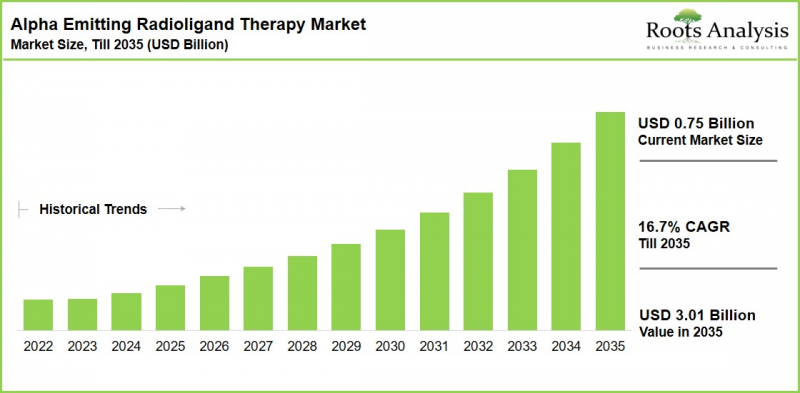
Roots Analysis의 조사에 따르면, 전 세계 알파선 방출 방사성 리간드 치료 시장은 올해 7억 5,000만 달러 규모로 평가되며, 2035년까지 30억 1,000만 달러에 달할 것으로 전망됩니다. 이는 예측 기간 동안 연평균 성장률(CAGR)이 16.7%임을 나타냅니다.
알파선 방출 방사성 리간드 치료 시장 : 성장 및 동향
전 세계적으로 암 발병률, 특히 진행성 전립선암, 신경내분비종양 및 치료 저항성 고형암의 발병률이 증가함에 따라, 고효율의 단거리 표적 치료법에 대한 수요가 가속화되고 있습니다. 알파선 방출 방사성 리간드는 극히 제한된 경로 길이에 걸쳐 높은 선형 에너지 전달(LET)을 가진 방사선을 조사하기 때문에 주변의 건강한 조직을 보존하면서 종양 세포를 정확하게 사멸시킬 수 있습니다. 이에 따라 알파선 방출체는 루테튬-177 제제 등 이미 확립된 베타선 방출 방사성 리간드 치료를 보완하거나 차세대 치료법으로 자리매김하고 있습니다.
주요 동향으로는 악티늄-225, 납-212, 라듐-223의 접합체에 관한 임상 파이프라인 확대, 동위원소 생산능력에 대한 투자 증가, 그리고 진단용 영상과 치료용 알파선 투여를 결합한 테라노스틱스(치료진단) 접근법의 통합이 진행되고 있다는 점을 들 수 있습니다. 제조업체들이 더 높은 수율과 1회 투여당 비용 절감을 추구하는 가운데, 지속적인 공정 집약화, 일회용 시스템 도입, 그리고 전문적인 방사성의약품 제조 인프라는 새로운 개념에서 운영상의 필수 요건으로 전환되고 있습니다. 또한, 지정학적 요인과 공급망 문제가 맞물리면서 주요 최종 시장과 가까운 지역에서의 동위원소 생산 및 완제품 제조의 온쇼어링이 진행되고 있습니다.
표적 알파 요법이 정밀 종양학의 확립된 한 요소로 자리 잡음에 따라, 시장은 시판 제품과 후기 임상 개발 단계의 파이프라인 자산 모두에 힘입어 지속적이고 장기적인 성장이 예상됩니다.
성장의 원동력 : 시장 확장을 뒷받침하는 요인
수요를 견인하는 것은 미세 전이 및 방사선 저항성 질환에 효과적인 치료법에 대한 임상적 필요성이며, 이 분야에서 알파 입자의 높은 상대적 생물학적 효능이 명확한 이점을 제공합니다. 제약 회사 및 생명공학 기업은 사내에 핵 시설을 건설하기 위한 막대한 자본 부담을 지는 일 없이, 전문적인 동위원소 생산, 킬레이트 화학 및 GMP 준수 방사성의약품 조제 능력을 활용할 수 있게 됩니다. 운영상의 유연성 덕분에 후원 기업은 임상 및 상업적 수요에 따라 생산 규모를 조정하는 동시에, 자본을 연구 개발 및 적응증 확대에 재투자할 수 있게 됩니다.
그 밖의 촉진요인으로는 승인된 의약품의 보험 적용 범위 확대, 방사성의약품 개발 과정에 대한 규제 당국의 지원, PSMA 및 SSTR을 표적으로 하는 치료법의 채택 확대, 그리고 맞춤형 및 영상 유도형 종양 치료로의 광범위한 전환 등을 들 수 있습니다.
시장의 과제 : 발전을 저해하는 중대한 장벽
견고한 펀더멘털이 있음에도 불구하고, 시장에는 몇 가지 제약요인이 존재합니다. 구체적으로는 주요 알파선 방출 동위원소(특히 악티늄-225)의 공급이 제한적이고 지리적으로 집중되어 있다는 점, 전문적인 제조 및 취급 인프라에 대한 막대한 자본 및 규제 요건, 물류 및 일정 관리를 복잡하게 만드는 짧은 반감기, 그리고 훈련된 핵의학 전문 인력의 필요성 등이 있습니다. 엄격한 방사선 안전 기준 및 GMP 요건, 베타선 방출체나 항체약물접합체(ADC)와 같은 다른 치료법과의 경쟁, 그리고 생산능력 확대를 둘러싼 단기적인 불확실성 등이 비용과 복잡성을 가중시키고 있습니다. 이 시장의 기회를 최대한 활용하고자 하는 이해관계자들에게는 동위원소 공급 안정화, 제조 규모 확대, 그리고 학제 간 교육에 대한 노력이 필수적일 것입니다.
알파선 방출 방사성 리간드 치료 시장 : 주요 인사이트
본 보고서는 전 세계 알파선 방출 방사성 리간드 치료 시장의 현황을 상세히 분석하고, 유통 파트너, 판매 채널 중개업체 및 전문 물류 제공업체를 위한 잠재적 성장 기회를 파악하고 있습니다. 주요 조사 결과는 다음과 같습니다:
- 알파선 방출 방사성 리간드 치료 개발 기업들은 주로 제조업체와의 직접적인 동위원소 공급 계약이나 장기 방사성동위원소 인수 계약에 의존하고 있으며, 기존 의약품 유통업체가 구축한 콜드체인 및 규제 물질 취급 네트워크를 보유하고 있음에도 불구하고 이 분야에서의 가시성은 제한적입니다.
- 아스타틴-211이나 납-212와 같은 동위원소의 반감기가 극히 짧다는 점(수 시간에서 수일)을 고려할 때, 전문 방사성의약품 네트워크나 핵의학 인증을 받은 물류 제공업체가 알파선 치료의 공급망에서 필수적인 역할을 수행하기 시작하고 있습니다.
- 이 분야에 진출하고자 하는 유통업체 및 물류 파트너는 알파 입자를 방출하는 의약품에 적용되는 엄격한 안전 및 규제 요건을 반영하여, NRC/IAEA에 준거한 방사성 물질 라이선스, 검증된 차폐 운송 인프라, 그리고 GMP에 준거한 보관 이력 문서를 제시해야 합니다.
- NorthStar Medical Radioisotopes, Niowave, Orano Med, Eckert & Ziegler와 같은 주요 기업들이 주도하는, 북미 및 유럽 전역에서 악티늄-225와 납-212의 생산능력이 급속히 확대됨에 따라, 방사성 물질 운송 규정을 준수할 수 있는 지역 유통 및 적시(JIT) 물류 파트너에 대한 수요가 증가하고 있습니다.
- 대형 제약사들이 알파선 치료 분야의 바이오테크 기업을 수십억 달러 규모로 인수하며 업계 재편이 진행되고 있어, 소규모 사업자에게는 진입 장벽이 높아지고 있는 반면, 특정 동위원소나 적응증에 대한 전문 지식을 갖춘 틈새 유통업체 및 물류 사업자에게는 새로운 비즈니스 기회가 생겨나고 있습니다.
- 유통 및 판매 채널 파트너사들은 물류 비용뿐만 아니라, 방사선 안전 관련 서류 작성 지원, 온도 및 차폐 관리가 이루어지는 운송, 선량 교정 조정, 치료 센터의 재고 관리와 같은 부가가치 서비스 분야에서 점점 더 치열한 경쟁을 펼치고 있습니다.
- PSMA 및 SSTR2를 표적으로 하는 악티늄-225 치료제의 후기 임상 파이프라인 확대에 더해, 새롭게 등장하고 있는 납-212 및 아스타틴-211 후보 물질로 인해, 예측 기간 동안 특수 동위원소 유통 인프라에 대한 수요 증가가 지속될 것으로 전망됩니다.
투자자들의 열기를 보여주는 최근 거래 동향
- Niowave사와 Ratio Therapeutics사는 Ratio사의 임상 단계에 있는 표적 방사선 치료제 파이프라인을 지원하기 위해 Niowave가 cGMP 준수 악티늄-225를 공급하는 공급 계약을 체결했습니다.
- NorthStar Medical Radioisotopes와 QSA Global은 NorthStar의 상업적 규모의 ‘캐리어 무첨가’ 악티늄-225 생산을 뒷받침할 라듐-226의 안정적인 공급을 확보하기 위해 다년간의 전략적 서비스 계약을 체결했습니다.
- ITM Isotope Technologies Munich와 Alpha-9 Oncology는 Alpha-9의 방사성의약품 파이프라인을 지원하기 위해 ITM과 Canadian Nuclear Laboratories의 합작 회사인 Actineer로부터 조달되는 악티늄-225에 관한 공급 계약을 체결했습니다.
- 아스트라제네카(AstraZeneca)는 퓨전 파마슈티컬스(Fusion Pharmaceuticals)를 약 24억 달러에 인수하는 절차를 완료하여, 악티늄-225 기반의 PSMA 표적 치료제인 FPI-2265를 확보하는 동시에, 니오웨이브(Niowave)와의 장기 악티늄-225 공급 계약을 연장했습니다.
- 브리스톨 마이어스 스큅(Bristol Myers Squibb)은 레이즈바이오(RayzeBio)를 41억 달러에 인수하여, 3상 임상시험 단계에 있는 자산 RYZ101을 포함한 악티늄-225 기반 방사성의약품 플랫폼과 자체 제조 능력을 확보했습니다.
- Eli Lilly는 POINT Biopharma를 약 14억 달러에 인수하여 알파선 및 베타선을 방출하는 방사성 리간드 자산과 제조 능력을 확보했습니다. 한편, Novartis는 Mariana Oncology 인수 및 PeptiDream과의 라이선싱 계약을 통해 악티늄-225 분야에 대한 집중을 강화했습니다.
이러한 거래들은 전반적으로 알파선을 방출하는 방사성 리간드 치료라는 치료법에 대한 투자자 및 전략적 인수 기업의 지속적인 신뢰를 뒷받침하고 있으며, 해당 시장 진출을 검토 중인 유통업체 및 물류 파트너에게 직접적으로 관련된 주제로서, 동위원소 공급의 안정성이 주요 전략적 자산으로 부상하고 있습니다.
알파선 방출 방사성 리간드 치료의 시장 세분화
시장 규모 및 기회 분석은 다음 매개변수를 기반으로 세분화되어 있습니다:
동위원소 종류별
- 악티늄-225(Ac-225)
- 납-212(Pb-212)
- 라듐-223(Ra-223)
- 아스타틴-211(At-211)
- 토륨-227(Th-227)
- 기타 알파선 방출 동위원소
제품 유형별
- 시판 중인 알파선 방출 방사성 리간드 치료
- 개발 파이프라인/임상 단계의 후보 물질
표적 분자별
- 단일클론 항체
- 펩타이드
- 저분자 화합물
- 항체 단편/기타 구조체
적응증별
- 전립선암(mCRPC)
- 신경내분비종양(GEP-NET)
- 골전이
- 간세포암
- 혈액악성종양(AML)
- 기타 고형암
최종사용자별
- 병원 및 전문 암 센터
- 핵의학/테라노스틱스 센터
- 외래 정맥주사 및 외래 치료 센터
유통 채널별
- 의료기관에 대한 직접 공급 제조사에 의한 유통
- 제3자 방사성의약품 조제 네트워크
- 특수 콜드체인/방사성 물질 물류 업체
지역별
- 북미
- 미국
- 캐나다
- 유럽
- 독일
- 영국
- 프랑스
- 이탈리아
- 스페인
- 기타 유럽
- 아시아태평양
- 중국
- 일본
- 인도
- 한국
- 호주
- 기타 아시아태평양
- 중동 및 북아프리카
- 사우디아라비아
- 아랍에미리트
- 라틴아메리카
- 브라질
- 아르헨티나
- 기타 라틴아메리카
기타 혜택
- 무료 PPT 인사이트 팩
- 보고서 내 모든 분석 모듈에 대응하는 무료 엑셀 데이터 팩
- 콘텐츠 맞춤 설정을 15% 무료로 제공해 드립니다.
- 조사팀이 진행하는 상세한 보고서 해설 세션
- 현재 버전이 6-12개월 이상 지난 경우, 최신판 보고서를 무료로 제공해 드립니다.
목차
제1장 서문
제2장 조사 방법
제3장 시장 역학
제4장 거시경제 지표
제5장 주요 요약
제6장 소개
제7장 알파선 방출 방사성 리간드 치료 : 시장 구도
제8장 임상시험 분석
제9장 기업 개요
제10장 제휴 및 공동 연구
제11장 자금 조달 및 투자 분석
제12장 특허 분석
제13장 사례 연구 : 세포 치료 제조
제14장 원가 분석
제15장 시장 영향 분석 : 촉진요인, 제약요인, 기회 및 과제
제16장 세계의 알파선 방출 방사성 리간드 치료 시장
제17장 알파선 방출 방사성 리간드 치료 시장 : 동위원소 유형별
제18장 알파선 방출 방사성 리간드 치료 시장 : 제품 유형별
제19장 알파선 방출 방사성 리간드 치료 시장 : 표적 분자군별
제20장 알파선 방출 방사성 리간드 치료 시장 : 적응별
제21장 알파선 방출 방사성 리간드 치료 시장 : 최종사용자별
제22장 알파선 방출 방사성 리간드 치료 시장 : 유통 채널별
제23장 알파선 방출 방사성 리간드 치료 시장 : 지역별 분포
제24장 알파선 방출 방사성 리간드 치료 시장 : 의약품 매출 예측
제25장 알파선 방출 방사성 리간드 치료 시장 : 주요 기업 매출 예측
제26장 경영진 인사이트
제27장 요약
제28장 부록 I : 표형식 데이터
제29장 부록 II : 기업 및 조직 리스트
제30장 부록 III : 자금 조달 및 투자 리스트
KSMALPHA-EMITTING RADIOLIGAND THERAPY MARKET: OVERVIEW
As per Roots Analysis, the global alpha-emitting radioligand therapy market is valued at USD 0.75 billion in the current year and is projected to reach USD 3.01 billion by 2035, representing a CAGR of 16.7% during the forecast period.
Alpha-Emitting Radioligand Therapy Market: Growth and Trends
Rising global cancer incidence, particularly advanced prostate cancer, neuroendocrine tumors, and treatment-resistant solid tumors, is accelerating demand for highly potent, short-range targeted therapies. Alpha-emitting radioligands deliver high linear-energy-transfer radiation over a very limited path length, enabling precise tumor-cell kill while sparing surrounding healthy tissue. This positions alpha emitters as a complementary or next-generation modality to established beta-emitting radioligand therapies such as lutetium-177 products.
Key trends include expanding clinical pipelines for actinium-225, lead-212, and radium-223 conjugates; growing investment in isotope production capacity; and increasing integration of theranostic approaches that pair diagnostic imaging with therapeutic alpha delivery. Continuous process intensification, single-use systems, and specialized radiopharmacy infrastructure are moving from emerging concepts to operational necessities as manufacturers seek higher yields and lower per-dose costs. Geopolitical and supply-chain considerations are also prompting onshoring of isotope production and finished-dose manufacturing closer to major end markets.
As targeted alpha therapy becomes an accepted component of precision oncology, the market is positioned for sustained, long-term expansion driven by both commercial products and late-stage pipeline assets.
Growth Drivers: Factors Fueling Market Expansion
Demand is propelled by the clinical need for therapies effective against micrometastases and radio-resistant disease, where alpha particles' high relative biological effectiveness offers clear advantages. Pharmaceutical and biotech companies gain access to specialized isotope production, chelation chemistry, and GMP radiopharmacy capabilities without the full capital burden of in-house nuclear facilities. Operational flexibility allows sponsors to scale manufacturing in line with clinical and commercial demand while redirecting capital toward R&D and indication expansion.
Additional drivers include expanding reimbursement for approved agents, regulatory support for radiopharmaceutical development pathways, rising adoption of PSMA and SSTR-targeted approaches, and the broader shift toward personalized, image-guided oncology.
Market Challenges: Critical Barriers Hindering Progress
Despite strong fundamentals, the market faces constraints, such as limited and geographically concentrated supply of key alpha-emitting isotopes (especially actinium-225), high capital and regulatory requirements for specialized production and handling infrastructure, short half-lives that complicate logistics and scheduling, and the need for trained nuclear-medicine personnel. Stringent radiation-safety and GMP expectations, competition from beta emitters and other modalities such as antibody-drug conjugates, and near-term uncertainty around capacity expansion all add cost and complexity. Addressing isotope supply security, manufacturing scale-up, and cross-disciplinary training will be essential for stakeholders seeking to capture the full opportunity.
Alpha-Emitting Radioligand Therapy Market: Key Insights
The report delves into the current state of the global alpha-emitting radioligand therapy market and identifies potential growth opportunities for distribution partners, channel intermediaries, and specialty logistics providers. Some key findings include:
- Alpha-emitting radioligand therapy developers predominantly rely on direct-to-manufacturer isotope supply agreements and long-term radioisotope offtake contracts, limiting the visibility that conventional pharmaceutical distributors have into this segment despite their established cold-chain and controlled-substance handling networks.
- Specialty radiopharmacy networks and nuclear-medicine-certified logistics providers are emerging as critical enablers of the alpha-therapy supply chain, given the extremely short half-lives (hours to a few days) of isotopes such as astatine-211 and lead-212.
- Distributors and logistics partners seeking entry into this space must demonstrate NRC/IAEA-aligned radioactive materials licensing, validated shielded-transport infrastructure, and GMP-compliant chain-of-custody documentation, reflecting the stringent safety and regulatory requirements attached to alpha-particle-emitting drug products.
- Rapid capacity build-out for actinium-225 and lead-212 production across North America and Europe, led by companies such as NorthStar Medical Radioisotopes, Niowave, Orano Med, and Eckert & Ziegler, is increasing demand for regional distribution and just-in-time logistics partners capable of navigating radioactive materials transport regulations.
- Consolidation among large pharmaceutical sponsors through billion-dollar acquisitions of alpha-therapy biotechs is raising barriers to entry for smaller players, while simultaneously creating openings for niche distributors and logistics providers with isotope-specific or indication-specific expertise.
- Distribution and channel partners increasingly compete on value-added services, including radiation-safety documentation support, temperature- and shielding-controlled transport, dose-calibration coordination, and treatment-center inventory management, rather than on logistics cost alone.
- The expanding late-stage pipeline of PSMA and SSTR2-targeted actinium-225 therapeutics, together with emerging lead-212 and astatine-211 candidates, is expected to sustain elevated demand for specialized isotope distribution infrastructure through the forecast period.
Recent Deal Activity Signaling Investor Momentum
- Niowave and Ratio Therapeutics signed a supply agreement under which Niowave will provide cGMP actinium-225 to support Ratio's clinical-stage targeted radiotherapeutic pipeline.
- NorthStar Medical Radioisotopes and QSA Global entered a multi-year strategic services agreement to secure the radium-226 target supply that underpins NorthStar's commercial-scale, no-carrier-added actinium-225 production.
- ITM Isotope Technologies Munich and Alpha-9 Oncology signed a supply agreement for actinium-225 sourced from Actineer, the ITM-Canadian Nuclear Laboratories joint venture, to support Alpha-9's radiopharmaceutical pipeline.
- AstraZeneca completed its approximately USD 2.4 billion acquisition of Fusion Pharmaceuticals, gaining the actinium-225-based PSMA-targeted asset FPI-2265 and extending a long-term actinium-225 supply agreement with Niowave.
- Bristol Myers Squibb completed its USD 4.1 billion acquisition of RayzeBio, adding an actinium-225-based radiopharmaceutical platform, including the Phase III asset RYZ101, along with in-house manufacturing capability.
- Eli Lilly acquired POINT Biopharma for approximately USD 1.4 billion, adding alpha- and beta-emitting radioligand assets and manufacturing capacity, while Novartis advanced its actinium-225 focus through the acquisition of Mariana Oncology and a licensing arrangement with PeptiDream.
Collectively, these transactions underscore sustained investor and strategic-acquirer confidence in the alpha-emitting radioligand therapy modality, with isotope supply security emerging as the primary strategic asset being acquired, a theme directly relevant to distributors and logistics partners evaluating exposure to this market.
Alpha-Emitting Radioligand Therapy Market Segments
The market sizing and opportunity analysis has been segmented across the following parameters:
By Isotope Type
- Actinium-225 (Ac-225)
- Lead-212 (Pb-212)
- Radium-223 (Ra-223)
- Astatine-211 (At-211)
- Thorium-227 (Th-227)
- Other Alpha-emitting Isotopes
By Product Type
- Marketed Alpha-emitting Radioligand Therapies
- Pipeline / Clinical-stage Candidates
By Targeting Moiety
- Monoclonal Antibodies
- Peptides
- Small Molecules
- Antibody Fragments / Other Constructs
By Indication
- Prostate Cancer (mCRPC)
- Neuroendocrine Tumors (GEP-NETs)
- Bone Metastases
- Hepatocellular Carcinoma
- Hematological Malignancies (AML)
- Other Solid Tumors
By End User
- Hospitals and Specialized Cancer Centers
- Nuclear Medicine / Theranostic Centers
- Ambulatory Infusion and Outpatient Treatment Centers
By Distribution Channel
- Direct-to-Center Manufacturer Distribution
- Third-Party Radiopharmacy Networks
- Specialty Cold-Chain / Radioactive Logistics Distributors
By Geographical Regions
- North America
- US
- Canada
- Europe
- Germany
- UK
- France
- Italy
- Spain
- Rest of Europe
- Asia-Pacific
- China
- Japan
- India
- South Korea
- Australia
- Rest of Asia-Pacific
- Middle East and North Africa
- Saudi Arabia
- UAE
- Latin America
- Brazil
- Argentina
- Rest of Latin America
Alpha-Emitting Radioligand Therapy Market: Key Segments
Actinium-225 Leads the Isotope-Type Landscape
Based on Roots Analysis research, actinium-225-based candidates account for the highest share of the active alpha-emitting radioligand therapy market. This leading position reflects Ac-225's favorable four-alpha-particle decay chain, established radiolabeling chemistry, and its adoption as the lead isotope across the RayzeBio, Fusion Pharmaceuticals, and Novartis actinium programs. Lead-212 is expected to register the fastest CAGR through 2035 as accelerator-based generator systems mature and reduce dependence on the constrained actinium-225 supply chain.
Prostate Cancer Remains the Dominant Indication
According to our analysis, mCRPC accounts for the largest indication-wise share of the alpha-emitting radioligand therapy pipeline. This highest share is underpinned by the large post-Pluvicto patient pool and multiple PSMA-targeted actinium-225 candidates in late-stage development. Neuroendocrine tumors represent the second-largest segment, led by RYZ101, and are projected to grow at a robust CAGR as sponsors pursue post-Lutathera treatment settings.
North America Dominates the Market and Asia-Pacific Registers a High CAGR
North America currently accounts for the largest share of global alpha-emitting radioligand therapy market. This high share is supported by the concentration of isotope production capacity, the presence of leading sponsors (Bristol Myers Squibb, AstraZeneca, Eli Lilly, Novartis), a mature theranostics infrastructure, and favorable reimbursement pathways. Europe follows, aided by isotope production hubs in Germany and the ITM-Canadian Nuclear Laboratories partnership, while Asia-Pacific is expected to post the fastest regional CAGR as China, Japan, and South Korea expand nuclear medicine capacity and cyclotron-based isotope production.
Nuclear Medicine and Theranostic Centers Lead by End User
Specialized nuclear medicine and theranostic centers currently administer the majority of alpha-emitting radioligand doses, given the radiation-safety infrastructure, dosimetry expertise, and PET-based patient selection capabilities required. Community hospital and ambulatory infusion settings are expected to expand their share as isotope supply stabilizes and simplified administration protocols are established.
Example Players In The Alpha-Emitting Radioligand Therapy Market
- AstraZeneca (Fusion Pharmaceuticals)
- Actinium Pharmaceuticals
- Bristol Myers Squibb (RayzeBio)
- Bayer
- Convergent Therapeutics
- Eli Lilly (POINT Biopharma)
- ITM Isotope Technologies Munich
- Novartis
- NorthStar Medical Radioisotopes
- Orano Med
- Perspective Therapeutics
- Telix Pharmaceuticals
ALPHA-EMITTING RADIOLIGAND THERAPY MARKET: RESEARCH COVERAGE
- Market Sizing and Opportunity Analysis: An in-depth analysis of the market focusing on key segments, including isotope type, product type, targeting moiety, indication, end user, distribution channel, and geographical regions.
- Isotope Supply Chain Landscape: A detailed assessment of active and emerging actinium-225, lead-212, and other alpha-isotope producers, featuring production route, capacity, and supply-agreement information.
- Company Profiles: In-depth profiles of prominent players engaged in alpha-emitting radioligand therapy development and isotope production, covering pipeline assets, manufacturing capabilities, and recent initiatives.
- Case Study (Alpha versus Beta Emitters): A concise comparison of alpha- and beta-emitting radioligand therapies, highlighting decay characteristics, manufacturing complexity, and clinical trade-offs.
- Partnerships and Collaborations: An analysis of isotope supply agreements, licensing deals, and manufacturing collaborations, based on parameters such as year of partnership, type of agreement, and most active players.
- Funding and M&A Analysis: A detailed analysis of funding rounds and acquisitions in this domain, based on year, deal value, purpose, geography, and most active acquirers and investors.
- Capacity and Demand Analysis: A comprehensive assessment of global installed isotope production capacity and projected clinical demand across major geographic regions.
- SWOT Analysis: A strategic assessment evaluating the market's key strengths, weaknesses, opportunities, and threats, with actionable insights into competitive positioning.
KEY QUESTIONS ANSWERED IN THIS REPORT
- Which are the leading companies in the alpha-emitting radioligand therapy market?
- Which isotope type and indication dominate the current pipeline, and which are growing fastest?
- What is the current and projected market size, and what is the CAGR through 2035?
- What are the key drivers, trends, and challenges shaping this market?
- How is the actinium-225 and lead-212 supply chain structured, and where are the bottlenecks?
- What opportunities exist for distributors, radiopharmacies, and logistics partners entering this space?
- Which region dominates the market, and which region is projected to grow fastest?
- How is market opportunity distributed across isotope type, indication, end user, and distribution channel?
REASONS TO BUY THIS REPORT
This report is designed to give distributors, channel partners, and investors a decisive analytical edge in a fast-consolidating, supply-constrained market. Its core differentiators include:
- Top-Down and Bottom-Up Triangulated Forecasting: Market estimates are built using a hybrid methodology that cross-validates macro-level assessments against bottom-up, program-level clinical and capacity data, minimizing forecast bias.
- Isotope-Specific Segmentation: Granular segmentation by isotope type (Ac-225, Pb-212, Ra-223, At-211, Th-227) enables precise opportunity sizing tied to production capacity and supply-agreement activity.
- Primary Research-Backed Insights: Findings are informed by direct engagement with executives across isotope producers, radiopharmaceutical sponsors, and logistics providers, ensuring insights reflect real operating conditions.
- Actionable Multi-Parameter Segmentation: Seven-parameter segmentation (isotope type, product type, targeting moiety, indication, end user, distribution channel, geography) enables precise opportunity sizing for any go-to-market or investment thesis.
ADDITIONAL BENEFITS
- Complementary PPT Insights Pack
- Complementary Excel Data Packs for All Analytical Modules in the Report
- 15% Free Content Customization
- Detailed Report Walkthrough Session with Research Team
- Free Updated Report if the Current Edition Is 6-12 Months Old or Older
TABLE OF CONTENTS
1. PREFACE
- 1.1. Introduction
- 1.2. Market Share Insights
- 1.3. Key Market Insights
- 1.4. Report Coverage
- 1.5. Key Questions Answered
- 1.6. Chapter Outlines
2. RESEARCH METHODOLOGY
- 2.1. Chapter Overview
- 2.2. Research Assumptions
- 2.2.1. Market Landscape and Market Trends
- 2.2.2. Market Forecast and Opportunity Analysis
- 2.2.3. Comparative Analysis
- 2.3. Database Building
- 2.3.1. Data Collection
- 2.3.2. Data Validation
- 2.3.3. Data Analysis
- 2.4. Project Methodology
- 2.4.1. Secondary Research
- 2.4.1.1. Annual Reports
- 2.4.1.2. Academic Research Papers
- 2.4.1.3. Company Websites
- 2.4.1.4. Investor Presentations
- 2.4.1.5. Regulatory Filings
- 2.4.1.6. White Papers
- 2.4.1.7. Industry Publications
- 2.4.1.8. Conferences and Seminars
- 2.4.1.9. Government Portals
- 2.4.1.10. Media and Press Releases
- 2.4.1.11. Newsletters
- 2.4.1.12. Industry Databases
- 2.4.1.13. Roots Proprietary Databases
- 2.4.1.14. Paid Databases and Sources
- 2.4.1.15. Social Media Portals
- 2.4.1.16. Other Secondary Sources
- 2.4.2. Primary Research
- 2.4.2.1. Types of Primary Research
- 2.4.2.1.1. Qualitative Research
- 2.4.2.1.2. Quantitative Research
- 2.4.2.1.3. Hybrid Approach
- 2.4.2.2. Advantages of Primary Research
- 2.4.2.3. Techniques for Primary Research
- 2.4.2.3.1. Interviews
- 2.4.2.3.2. Surveys
- 2.4.2.3.3. Focus Groups
- 2.4.2.3.4. Observational Research
- 2.4.2.3.5. Social Media Interactions
- 2.4.2.4. Key Opinion Leaders Considered in Primary Research
- 2.4.2.4.1. Company Executives (CXOs)
- 2.4.2.4.2. Board of Directors
- 2.4.2.4.3. Company Presidents and Vice Presidents
- 2.4.2.4.4. Research and Development Heads
- 2.4.2.4.5. Technical Experts
- 2.4.2.4.6. Subject Matter Experts
- 2.4.2.4.7. Scientists
- 2.4.2.4.8. Doctors and Other Healthcare Providers
- 2.4.2.5. Ethics and Integrity
- 2.4.2.5.1. Research Ethics
- 2.4.2.5.2. Data Integrity
- 2.4.2.1. Types of Primary Research
- 2.4.3. Analytical Tools and Databases
- 2.4.1. Secondary Research
- 2.5. Robust Quality Control
3. MARKET DYNAMICS
- 3.1. Chapter Overview
- 3.2. Forecast Methodology
- 3.2.1. Top-down Approach
- 3.2.2. Bottom-up Approach
- 3.2.3. Hybrid Approach
- 3.3. Market Assessment Framework
- 3.3.1. Total Addressable Market (TAM)
- 3.3.2. Serviceable Addressable Market (SAM)
- 3.3.3. Serviceable Obtainable Market (SOM)
- 3.3.4. Currently Acquired Market (CAM)
- 3.4. Forecasting Tools and Techniques
- 3.4.1. Qualitative Forecasting
- 3.4.2. Correlation
- 3.4.3. Regression
- 3.4.4. Extrapolation
- 3.4.5. Convergence
- 3.4.6. Sensitivity Analysis
- 3.4.7. Scenario Planning
- 3.4.8. Data Visualization
- 3.4.9. Time Series Analysis
- 3.4.10. Forecast Error Analysis
- 3.5. Key Considerations
- 3.5.1. Demographics
- 3.5.2. Government Regulations
- 3.5.3. Reimbursement Scenarios
- 3.5.4. Market Access
- 3.5.5. Supply Chain
- 3.5.6. Industry Consolidation
- 3.5.7. Pandemic / Unforeseen Disruptions Impact
- 3.6. Limitations
4. MACRO-ECONOMIC INDICATORS
- 4.1. Chapter Overview
- 4.2. Market Dynamics
- 4.2.1. Time Period
- 4.2.1.1. Historical Trends
- 4.2.1.2. Current and Forecasted Estimates
- 4.2.2. Currency Coverage
- 4.2.2.1. Major Currencies Affecting the Market
- 4.2.2.2. Factors Affecting Currency Fluctuations
- 4.2.2.3. Impact of Currency Fluctuations on the Industry
- 4.2.3. Foreign Currency Exchange Rate
- 4.2.3.1. Impact of Foreign Exchange Rate Volatility on the Market
- 4.2.3.2. Strategies for Mitigating Foreign Exchange Risk
- 4.2.4. Recession
- 4.2.4.1. Assessment of Current Economic Conditions and Potential Impact on the Market
- 4.2.4.2. Historical Analysis of Past Recessions and Lessons Learnt
- 4.2.5. Inflation
- 4.2.5.1. Measurement and Analysis of Inflationary Pressures in the Economy
- 4.2.5.2. Potential Impact of Inflation on the Market Evolution
- 4.2.6. Interest Rates
- 4.2.6.1. Interest Rates and Their Impact on the Market
- 4.2.6.2. Strategies for Managing Interest Rate Risk
- 4.2.7. Commodity Flow Analysis
- 4.2.7.1. Type of Commodity
- 4.2.7.2. Origins and Destinations
- 4.2.7.3. Values and Weights
- 4.2.7.4. Modes of Transportation
- 4.2.8. Global Trade Dynamics
- 4.2.8.1. Import Scenario
- 4.2.8.2. Export Scenario
- 4.2.8.3. Trade Policies
- 4.2.8.4. Strategies for Mitigating the Risks Associated with Trade Barriers
- 4.2.8.5. Impact of Trade Barriers on the Market
- 4.2.9. War Impact Analysis
- 4.2.9.1. Russian-Ukraine War
- 4.2.9.2. Israel-Hamas War
- 4.2.10. COVID Impact / Related Factors
- 4.2.10.1. Global Economic Impact
- 4.2.10.2. Industry-specific Impact
- 4.2.10.3. Government Response and Stimulus Measures
- 4.2.10.4. Future Outlook and Adaptation Strategies
- 4.2.11. Other Indicators
- 4.2.11.1. Fiscal Policy
- 4.2.11.2. Consumer Spending
- 4.2.11.3. Gross Domestic Product (GDP)
- 4.2.11.4. Employment
- 4.2.11.5. Taxes
- 4.2.11.6. Stock Market Performance
- 4.2.11.7. Cross-Border Dynamics
- 4.2.1. Time Period
- 4.3. Conclusion
5. EXECUTIVE SUMMARY
6. INTRODUCTION
- 6.1. Chapter Overview
- 6.2. Overview of T-cell Immunotherapies
- 6.2.1. Historical Evolution
- 6.2.2. Key Considerations for Alpha-Emitting Radioligand Therapy
- 6.2.3. Strategies Employed for the Redirection of Alpha-Emitting Radioligand Therapy
- 6.2.4. Manufacturing of Alpha-Emitting Radioligand Therapies
- 6.3. Concluding Remarks
7. ALPHA-EMITTING RADIOLIGAND THERAPY: MARKET LANDSCAPE
- 7.1. Chapter Overview
- 7.2. Alpha-Emitting Radioligand Therapy: Market Landscape
- 7.2.1. Analysis by Type of Isotope
- 7.2.2. Analysis by Type of Product
- 7.2.3. Analysis by Target Moiety
- 7.2.4. Analysis by Indication
- 7.2.5. Analysis by End User
- 7.2.6. Analysis by Distribution Channel
- 7.3. Alpha-Emitting Radioligand Therapy: Overall Developer Landscape
- 7.3.1. Analysis by Year of Establishment
- 7.3.2. Analysis by Company Size
- 7.3.3. Analysis by Location of Headquarters
8. CLINICAL TRIAL ANALYSIS
- 8.1. Chapter Overview
- 8.2. Scope and Methodology
- 8.3. Alpha-Emitting Radioligand Therapy: Clinical Trial Analysis
- 8.3.1. Analysis by Trial Registration Year
- 8.3.2. Analysis of Enrolled Patient Population by Trial Registration Year
- 8.3.3. Analysis by Trial Phase
- 8.3.4. Analysis of Enrolled Patient Population by Trial Phase
- 8.3.5. Analysis by Trial Registration Year and Trial Phase
- 8.3.6. Analysis by Trial Status
- 8.3.7. Analysis by Patient Gender
- 8.3.8. Analysis by Therapeutic Area
- 8.3.9. Analysis by Study Design
- 8.3.10. Most Active Industry Players: Analysis by Number of Registered Trials
- 8.3.11. Most Active Non-Industry Players: Analysis by Number of Registered Trials
- 8.3.12. Analysis by Geography
9. COMPANY PROFILES
- 9.1. Chapter Overview
- 9.2. AstraZeneca (Fusion Pharmaceuticals)
- 9.3. Actinium Pharmaceuticals
- 9.4. Bristol Myers Squibb Company (RayzeBio)
- 9.5. Bayer
- 9.6. Convergent Therapeutics
- 9.7. Eli Lilly (POINT Biopharma)
- 9.8. ITM Isotope Technologies Munich
- 9.9. Novartis
- 9.10. NorthStar Medical Radioisotopes
- 9.11. Orano Med
- 9.12. Perspective Therapeutics
- 9.13. Telix Pharmaceuticals
10. PARTNERSHIPS AND COLLABORATIONS
- 10.1. Chapter Overview
- 10.2. Partnership Models
- 10.3. Alpha-Emitting Radioligand Therapy: Partnerships and Collaborations
- 10.3.1. Analysis by Year of Partnership
- 10.3.2. Analysis by Type of Partnership
- 10.3.3. Analysis by Year and Type of Partnership
- 10.3.4. Analysis by Type of Partner
- 10.3.5. Most Popular Therapies: Analysis by Number of Partnerships
- 10.3.6. Most Active Industry Players: Analysis by Number of Partnerships
- 10.3.7. Most Active Non-Industry Players: Analysis by Number of Partnerships
- 10.3.8. Analysis by Geography
- 10.3.8.1. Intercontinental and Intracontinental Agreements
- 10.3.8.2. International and Local Agreements
11. FUNDING AND INVESTMENTS ANALYSIS
- 11.1. Chapter Overview
- 11.2. Types of Funding
- 11.3. Alpha-Emitting Radioligand Therapy: Funding and Investment Analysis
- 11.3.1. Analysis by Year of Funding
- 11.3.2. Analysis of Amount Invested
- 11.3.3. Analysis by Type of Funding
- 11.3.4. Analysis by Amount Invested and Type of Funding
- 11.3.5. Analysis of Amount Invested by Year and Type of Funding
- 11.3.6. Analysis by Type of Investor
- 11.3.7. Analysis by Geography
- 11.3.8. Most Active Players
- 11.3.9. Leading Investors: Analysis by Number of Funding Instances
12. PATENT ANALYSIS
- 12.1. Chapter Overview
- 12.2. Scope and Methodology
- 12.3. Alpha-Emitting Radioligand Therapy: Patent Analysis
- 12.3.1. Analysis by Patent Publication Year
- 12.3.2. Analysis by Patent Application Year
- 12.3.3. Analysis of Granted Patents and Patent Applications by Publication Year
- 12.3.4. Analysis by Patent Jurisdiction
- 12.3.5. Analysis by CPC Symbols
- 12.3.6. Analysis by Type of Applicant
- 12.3.7. Leading Industry Players: Analysis by Number of Patents
- 12.3.8. Leading Non-Industry Players: Analysis by Number of Patents
- 12.3.9. Leading Patent Assignees: Analysis by Number of Patents
- 12.4. Patent Benchmarking Analysis
- 12.4.1. Analysis by Patent Characteristics
- 12.5. Patent Valuation
- 12.6. Leading Patents by Number of Citations
13. CASE STUDY: CELL THERAPY MANUFACTURING
- 13.1. Chapter Overview
- 13.2. Overview of Cell Therapy Manufacturing
- 13.3. Cell Therapy Manufacturing Models
- 13.3.1. Centralized Manufacturing Model
- 13.3.2. Decentralized Manufacturing Model
- 13.4. Scalability of Cell Therapy Manufacturing Processes
- 13.4.1. Scale-Up
- 13.4.2. Scale-Out
- 13.5. Types of Cell Therapy Manufacturers
- 13.6. Key Challenges Related to Manufacturing of Cell Therapies
- 13.7. Key Considerations for Cell Therapy Manufacturing
- 13.7.1. Characterization
- 13.7.2. Cost of Goods
- 13.8. Automation of Cell Therapy Manufacturing Process
- 13.9. Cell Therapy Manufacturing Supply Chain
- 13.10. Comparison of Players Having In-house Capabilities and Contract Manufacturers
- 13.11. Regulatory Landscape
- 13.12. Future Perspectives
14. COST PRICE ANALYSIS
- 14.1. Chapter Overview
- 14.2. Factors Contributing to the High Price of Cell / Gene Therapies
- 14.3. Pricing Models for T-cell Immunotherapies
- 14.3.1. Based on Associated Costs
- 14.3.2. Based on Availability of Competing Products
- 14.3.3. Based on Patient Population
- 14.3.4. Based on Opinions of Industry Experts
- 14.4. Reimbursement related Considerations for T-cell Immunotherapies
- 14.4.1. Case Study: The National Institute for Health and Care Excellence (NICE) Appraisal of CAR-T Therapies
15. MARKET IMPACT ANALYSIS: DRIVERS, RESTRAINTS, OPPORTUNITIES AND CHALLENGES
- 15.1. Chapter Overview
- 15.2. Market Drivers
- 15.3. Market Restraints
- 15.4. Market Opportunities
- 15.5. Market Challenges
- 15.6. Conclusion
16. GLOBAL ALPHA-EMITTING RADIOLIGAND THERAPY MARKET
- 16.1. Chapter Overview
- 16.2. Key Assumptions and Methodology
- 16.3. Global Alpha-Emitting Radioligand Therapy Market, Historical Trends (since 2018) and Forecasted Estimates (till 2035)
- 16.4. Scenario Analysis
- 16.4.1. Conservative Scenario
- 16.4.2. Optimistic Scenario
- 16.5. Key Market Segmentations
17. ALPHA-EMITTING RADIOLIGAND THERAPY MARKET, BY ISOTOPE TYPE
- 17.1. Chapter Overview
- 17.2. Key Assumptions and Methodology
- 17.3. Alpha-Emitting Radioligand Therapy Market: Distribution by Isotope
- 17.3.1. Alpha-Emitting Radioligand Therapy Market for Actinium-225 (Ac-225): Forecasted Estimates (till 2035)
- 17.3.1.1. Alpha-Emitting Radioligand Therapy Market for Lead-212 (Pb-212): Forecasted Estimates (till 2035)
- 17.3.1.2. Alpha-Emitting Radioligand Therapy Market for Radium-223 (Ra-223): Forecasted Estimates (till 2035)
- 17.3.1.3. Alpha-Emitting Radioligand Therapy Market for Astatine-211 (At-211): Forecasted Estimates (till 2035)
- 17.3.1.4. Alpha-Emitting Radioligand Therapy Market for Thorium-227 (Th-227): Forecasted Estimates (till 2035)
- 17.3.1.5. Alpha-Emitting Radioligand Therapy Market for Other Alpha-Emitting Isotopes: Forecasted Estimates (till 2035)
- 17.3.1. Alpha-Emitting Radioligand Therapy Market for Actinium-225 (Ac-225): Forecasted Estimates (till 2035)
- 17.4. Data Triangulation and Validation
18. ALPHA-EMITTING RADIOLIGAND THERAPY MARKET, BY PRODUCT TYPE
- 18.1. Chapter Overview
- 18.2. Key Assumptions and Methodology
- 18.3. Alpha-Emitting Radioligand Therapy Market: Distribution by Product Type
- 18.3.1. Alpha-Emitting Radioligand Therapy Market for Marketed Alpha-Emitting Radioligand Therapies: Forecasted Estimates (till 2035)
- 18.3.2. Alpha-Emitting Radioligand Therapy Market for Pipeline / Clinical-Stage Candidates: Forecasted Estimates (till 2035)
- 18.4. Data Triangulation and Validation
19. ALPHA-EMITTING RADIOLIGAND THERAPY MARKET, BY TARGET MOIETY
- 19.1. Chapter Overview
- 19.2. Key Assumptions and Methodology
- 19.3. Alpha-Emitting Radioligand Therapy Market: Distribution by Target Moiety
- 19.3.1. Alpha-Emitting Radioligand Therapy Market for Monoclonal Antibodies: Forecasted Estimates (till 2035)
- 19.3.2. Alpha-Emitting Radioligand Therapy Market for Peptides: Forecasted Estimates (till 2035)
- 19.3.2. Alpha-Emitting Radioligand Therapy Market for Small Molecules: Forecasted Estimates (till 2035)
- 19.3.2. Alpha-Emitting Radioligand Therapy Market for Antibody Fragments / Other Constructs: Forecasted Estimates (till 2035)
- 19.4. Data Triangulation and Validation
20. ALPHA-EMITTING RADIOLIGAND THERAPY MARKET, BY INDICATION
- 20.1. Chapter Overview
- 20.2. Key Assumptions and Methodology
- 20.3. Alpha-Emitting Radioligand Therapy Market: Distribution by Indication
- 20.3.1. Alpha-Emitting Radioligand Therapy Market for Prostate Cancer (mCRPC): Forecasted Estimates (till 2035)
- 20.3.2. Alpha-Emitting Radioligand Therapy Market for Neuroendocrine Tumors (GEP-NETs): Forecasted Estimates (till 2035)
- 20.3.3. Alpha-Emitting Radioligand Therapy Market for Bone Metastases: Forecasted Estimates (till 2035)
- 20.3.4. Alpha-Emitting Radioligand Therapy Market for Hepatocellular Carcinoma: Forecasted Estimates (till 2035)
- 20.3.5. Alpha-Emitting Radioligand Therapy Market for Hematological Malignancies (AML): Forecasted Estimates (till 2035)
- 20.3.6. Alpha-Emitting Radioligand Therapy Market for Other Solid Tumors: Forecasted Estimates (till 2035)
- 20.4. Data Triangulation and Validation
21. ALPHA-EMITTING RADIOLIGAND THERAPY MARKET, BY END USER
- 21.1. Chapter Overview
- 21.2. Key Assumptions and Methodology
- 21.3. Alpha-Emitting Radioligand Therapy Market: Distribution by End User
- 21.3.1. Alpha-Emitting Radioligand Therapy Market for Hospitals and Specialized Cancer Centers: Forecasted Estimates (till 2035)
- 21.3.2. Alpha-Emitting Radioligand Therapy Market for Nuclear Medicine / Theranostic Centers: Forecasted Estimates (till 2035)
- 21.3.3. Alpha-Emitting Radioligand Therapy Market for Ambulatory Infusion and Outpatient Treatment Centers: Forecasted Estimates (till 2035)
- 21.4. Data Triangulation and Validation
22. ALPHA-EMITTING RADIOLIGAND THERAPY MARKET, BY DISTRIBUTION CHANNEL
- 22.1. Chapter Overview
- 22.2. Key Assumptions and Methodology
- 22.3. Alpha-Emitting Radioligand Therapy Market: Distribution by Distribution Channel
- 22.3.1. Alpha-Emitting Radioligand Therapy Market for Direct-to-Center Manufacturer Distribution: Forecasted Estimates (till 2035)
- 22.3.2. Alpha-Emitting Radioligand Therapy Market for Third-Party Radiopharmacy Networks: Forecasted Estimates (till 2035)
- 22.3.3. Alpha-Emitting Radioligand Therapy Market for Specialty Cold-Chain / Radioactive Logistics Distributors: Forecasted Estimates (till 2035)
- 22.4. Data Triangulation and Validation1
23. ALPHA-EMITTING RADIOLIGAND THERAPY MARKET: DISTRIBUTION BY GEOGRAPHICAL REGIONS
- 23.1. Chapter Overview
- 23.2. Key Assumptions and Methodology
- 23.3. Alpha-Emitting Radioligand Therapy Market: Distribution by Key Geographical Regions
- 23.3.1. Alpha-Emitting Radioligand Therapy Market in North America: Forecasted Estimates (till 2035)
- 23.3.2. Alpha-Emitting Radioligand Therapy Market in Europe: Forecasted Estimates (till 2035)
- 23.3.3. Alpha-Emitting Radioligand Therapy Market in Asia-Pacific: Forecasted Estimates (till 2035)
- 23.3.4. Alpha-Emitting Radioligand Therapy Market in Latin America: Forecasted Estimates (till 2035)
- 23.3.5. Alpha-Emitting Radioligand Therapy Market in Middle East and North Africa: Forecasted Estimates (till 2035)
- 23.3.6. Alpha-Emitting Radioligand Therapy Market in Rest of the World: Forecasted Estimates (till 2035)
- 23.4. Data Triangulation and Validation
24. ALPHA-EMITTING RADIOLIGAND THERAPY MARKET, SALES FORECAST OF DRUGS
- 24.1. Chapter Overview
- 24.2. Key Assumptions and Methodology
- 24.3. Commercialized Alpha-Emitting Radioligand Therapy: Sales Forecast
- 24.4. Clinical Alpha-Emitting Radioligand Therapy: Sales Forecast
- 24.5. Data Triangulation and Validation
25. ALPHA-EMITTING RADIOLIGAND THERAPY MARKET: SALES FORECAST OF LEADING PLAYERS
- 25.1. Chapter Overview
- 25.2. Key Assumptions and Methodology
- 25.3. Alpha-Emitting Radioligand Therapy: Leading Players
- 25.4. Data Triangulation and Validation


