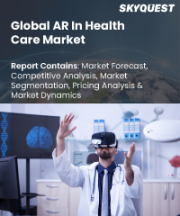
|
시장보고서
상품코드
1896081
의료 분야 증강현실(AR) 시장 규모, 점유율, 성장 분석 : 기술별, 제품별, 최종사용자별, 지역별 - 업계 예측(2026-2033년)AR In Health Care Market Size, Share, and Growth Analysis, By Technology (Head Mounted Devices, Handheld Devices), By Product (AR Displays, AR Sensors), By End User, By Region - Industry Forecast 2026-2033 |
||||||

세계의 의료 분야 증강현실(AR) 시장 규모는 2024년에 25억 5,000만 달러로 평가되었으며, 2025년 32억 5,000만 달러에서 2033년까지 227억 1,000만 달러로 성장할 전망입니다. 예측 기간(2026-2033년) 동안 CAGR은 27.5%로 예측됩니다.
의료 분야에서 증강현실(AR)의 통합은 디스플레이 및 센서 기술의 발전과 혁신적인 소프트웨어 솔루션과 결합하여 업계를 변화시키고 있습니다. 이 역동적인 접근 방식을 통해 외과의사, 간호사 등 의료진은 인체의 3D 시각화를 제공하는 AR 애플리케이션을 통해 환자와 상호작용을 할 수 있습니다. AR은 의료 행위를 향상시킬 뿐만 아니라 환자 교육을 강화하고 복잡한 수술 절차를 이해하는 데 도움을 줄 수 있습니다. 대표적인 응용 사례로는 정맥의 시각화를 들 수 있으며, 이는 주사의 정확성과 편안함을 크게 향상시킵니다. AR 시장의 확대는 진단 영상, 수술 시뮬레이션, 재활, 환자 관리에서 AR의 역할이 증가하고 있으며, AR 전문 스타트업의 급격한 증가와 이러한 첨단 기술에 대한 전 세계적인 대규모 투자가 이를 뒷받침하고 있습니다.
의료 분야 AR 시장 촉진요인
의료 분야 증강현실(AR) 기술은 의료진이 해부학적 구조의 3차원 모델을 시각화하고 조작할 수 있게 하여 수술 계획, 의학 교육, 진단 과정을 크게 향상시킬 수 있습니다. 몰입형 인터랙티브 경험을 제공함으로써 AR은 복잡한 생물학적 시스템에 대한 깊은 이해를 촉진하고 환자의 치료 결과를 향상시킬 수 있습니다. 이 혁신적인 접근 방식은 의료 절차의 정밀한 수행을 지원할 뿐만 아니라 의료진이 기술을 훈련하고 연마하는 방식에도 혁명을 가져올 것입니다. AR 기술의 도입은 궁극적으로 의료 분야의 다양한 응용 분야에서 보다 정보에 입각한 의사결정을 돕고, 효율성 향상을 촉진할 수 있습니다.
의료 분야 AR 시장 억제요인
증강현실(AR) 기술을 의료 분야에 통합할 때 환자 데이터의 프라이버시 보호, 보안, 규제 기준 준수와 관련하여 심각한 문제가 발생합니다. 이러한 우려는 보급의 걸림돌이 될 수 있습니다. 의료 서비스 제공자는 기밀성이 높은 환자 정보가 적절하게 보호된다는 보장이 없다면 AR 솔루션 도입을 주저할 수 있기 때문입니다. 의료 데이터를 규제하는 다양한 법령을 준수해야 하는 복잡성이 상황을 더욱 복잡하게 만들고 있습니다. 결과적으로, 이러한 프라이버시 및 보안에 대한 우려는 AR 혁신의 수용과 활용을 방해하고 의료 환경에서 AR의 잠재적 이점을 제한할 수 있습니다.
의료 분야 AR 시장 동향
증강현실(AR)의 의료 분야로의 통합은 원격진료와 원격의료에 혁명을 가져왔으며, 원격지에서 환자와 의료 제공자의 상호작용과 진단 과정을 개선하고 있습니다. 이러한 시장 트렌드는 기존의 한계를 뛰어넘는 몰입형 가상 체험을 가능하게 하는 접근성이 뛰어나고 효율적인 의료 솔루션에 대한 수요 증가에 의해 주도되고 있습니다. AR 기술은 의료 정보의 실시간 시각화를 촉진하고, 의료 종사자가 시술을 시뮬레이션하고 환자를 효과적으로 교육할 수 있게함으로써 신뢰와 참여도를 높일 수 있습니다. 원격의료가 현대 의료 제공의 근간이 되는 가운데, AR은 다양한 의료 현장에서 진료의 질 향상과 워크플로우 효율 최적화에 기여하며 점점 더 중요한 역할을 할 것으로 기대되고 있습니다.
자주 묻는 질문
목차
소개
- 조사 목적
- 조사 범위
- 정의
조사 방법
- 정보 조달
- 2차와 1차 데이터 방법
- 시장 규모 예측
- 시장 가정과 제한
주요 요약
- 세계 시장 전망
- 공급과 수요 동향 분석
- 부문별 기회 분석
시장 역학과 전망
- 시장 규모
- 시장 역학
- 성장 촉진요인과 기회
- 성장 억제요인과 과제
- Porters 분석
주요 시장 인사이트
- 핵심성공요인
- 경쟁 정도
- 주요 투자 기회
- 시장 생태계
- 시장 매력 지수(2025년)
- PESTEL 분석
- 거시경제 지표
- 밸류체인 분석
- 가격 분석
- 사례 연구
- 특허 분석
- 기술 분석
세계의 의료 분야 증강현실(AR) 시장 규모 : 기술별, CAGR(2026-2033년)
- 헤드 마운트형 디바이스
- 핸드헬드 디바이스
세계의 의료 분야 증강현실(AR) 시장 규모 : 제품별, CAGR(2026-2033년)
- AR 디스플레이
- AR 센서
- AR 입력 디바이스
- AR 반도체 부품
- 기타
세계의 의료 분야 증강현실(AR) 시장 규모 : 최종사용자별, CAGR(2026-2033년)
- 병원 및 진료소
- 연구기관
- 기타
세계의 의료 분야 증강현실(AR) 시장 규모, CAGR(2026-2033년)
- 북미
- 미국
- 캐나다
- 유럽
- 독일
- 스페인
- 프랑스
- 영국
- 이탈리아
- 기타 유럽
- 아시아태평양
- 중국
- 인도
- 일본
- 한국
- 기타 아시아태평양
- 라틴아메리카
- 브라질
- 기타 라틴아메리카
- 중동 및 아프리카
- GCC 국가
- 남아프리카공화국
- 기타 중동 및 아프리카
경쟁 정보
- 상위 5개사의 비교
- 주요 기업의 시장 포지셔닝(2025년)
- 주요 시장 기업이 채용한 전략
- 최근의 시장 동향
- 기업의 시장 점유율 분석(2025년)
- 주요 기업 개요
- 기업 상세
- 제품 포트폴리오 분석
- 기업 부문별 점유율 분석
- 매출 전년비 비교(2023-2025년)
주요 기업 개요
- Microsoft Corporation(United States)
- Alphabet Inc.(Google)(United States)
- Sony Corporation(Japan)
- Siemens(Siemens Healthcare)(Germany)
- Koninklijke Philips N.V.(Philips)(Netherlands)
- AccuVein Inc.(United States)
- EchoPixel(United States)
- DAQRI(United States)
- Atheer, Inc.(United States)
- Orca Health, Inc.(United States)
결론과 제안
KSM 26.01.12AR In Health Care Market size was valued at USD 2.55 Billion in 2024 and is poised to grow from USD 3.25 Billion in 2025 to USD 22.71 Billion by 2033, growing at a CAGR of 27.5% during the forecast period (2026-2033).
The integration of Augmented Reality (AR) in healthcare is transforming the industry through advancements in display and sensor technologies, coupled with innovative software solutions. This dynamic approach allows healthcare professionals like surgeons and nurses to interact with patients via AR applications, which provide 3D visualizations of the human body. AR not only enhances medical practice but also enriches patient education, helping individuals grasp complex surgical procedures. A notable application is vein visualization, significantly improving injection accuracy and comfort. The AR market's expansion is driven by its increasing role in diagnostic imaging, surgical simulations, rehabilitation, and patient management, supported by a surge of AR-focused startups and considerable global investments in these cutting-edge technologies.
Top-down and bottom-up approaches were used to estimate and validate the size of the AR In Health Care market and to estimate the size of various other dependent submarkets. The research methodology used to estimate the market size includes the following details: The key players in the market were identified through secondary research, and their market shares in the respective regions were determined through primary and secondary research. This entire procedure includes the study of the annual and financial reports of the top market players and extensive interviews for key insights from industry leaders such as CEOs, VPs, directors, and marketing executives. All percentage shares split, and breakdowns were determined using secondary sources and verified through Primary sources. All possible parameters that affect the markets covered in this research study have been accounted for, viewed in extensive detail, verified through primary research, and analyzed to get the final quantitative and qualitative data.
AR In Health Care Market Segments Analysis
Global AR In Health Care Market is segmented by Technology, Product, End User and region. Based on Technology, the market is segmented into Head Mounted Devices and Handheld Devices. Based on Product, the market is segmented into AR Displays, AR Sensors, AR Input Devices, AR Semiconductor Components and Other. Based on End User, the market is segmented into Hospitals and Clinics, Research Laboratories and Others. Based on region, the market is segmented into North America, Europe, Asia Pacific, Latin America and Middle East & Africa.
Driver of the AR In Health Care Market
Augmented Reality (AR) technology in the healthcare sector empowers medical professionals to visualize and engage with three-dimensional models of anatomical structures, significantly enhancing surgical planning, medical education, and diagnostic processes. By providing immersive and interactive experiences, AR facilitates a deeper understanding of complex biological systems and improves patient outcomes. This innovative approach not only aids in the precise execution of medical procedures but also revolutionizes the ways in which healthcare practitioners train and refine their skills. Embracing AR technology ultimately supports more informed decision-making and fosters greater efficiency within various healthcare applications.
Restraints in the AR In Health Care Market
The integration of augmented reality (AR) technology into the healthcare sector poses significant challenges regarding patient data privacy, security, and adherence to regulatory standards. These concerns can act as barriers to widespread adoption, as healthcare providers may hesitate to implement AR solutions without assurance that sensitive patient information will be adequately protected. The complexities of ensuring compliance with the various regulations governing healthcare data further complicate the situation. Consequently, these apprehensions regarding privacy and security issues may hinder the acceptance and utilization of AR innovations, limiting their potential benefits within the healthcare environment.
Market Trends of the AR In Health Care Market
The integration of augmented reality (AR) into healthcare is revolutionizing remote consultations and telemedicine, enhancing patient-provider interactions and diagnostic processes from afar. This market trend is driven by the growing demand for accessible and efficient healthcare solutions, enabling immersive virtual experiences that transcend traditional limitations. AR technologies facilitate real-time visualization of medical information, allowing practitioners to simulate procedures and educate patients effectively, thus fostering trust and engagement. As telehealth becomes a cornerstone of modern healthcare delivery, AR is poised to play an increasingly vital role, enhancing the quality of care and optimizing workflow efficiency across various medical settings.
Table of Contents
Introduction
- Objectives of the Study
- Scope of the Report
- Definitions
Research Methodology
- Information Procurement
- Secondary & Primary Data Methods
- Market Size Estimation
- Market Assumptions & Limitations
Executive Summary
- Global Market Outlook
- Supply & Demand Trend Analysis
- Segmental Opportunity Analysis
Market Dynamics & Outlook
- Market Overview
- Market Size
- Market Dynamics
- Drivers & Opportunities
- Restraints & Challenges
- Porters Analysis
- Competitive rivalry
- Threat of substitute
- Bargaining power of buyers
- Threat of new entrants
- Bargaining power of suppliers
Key Market Insights
- Key Success Factors
- Degree of Competition
- Top Investment Pockets
- Market Ecosystem
- Market Attractiveness Index, 2025
- PESTEL Analysis
- Macro-Economic Indicators
- Value Chain Analysis
- Pricing Analysis
- Case Studies
- Patent Analysis
- Technology Analysis
Global AR In Health Care Market Size by Technology & CAGR (2026-2033)
- Market Overview
- Head Mounted Devices
- Handheld Devices
Global AR In Health Care Market Size by Product & CAGR (2026-2033)
- Market Overview
- AR Displays
- AR Sensors
- AR Input Devices
- AR Semiconductor Components
- Other
Global AR In Health Care Market Size by End User & CAGR (2026-2033)
- Market Overview
- Hospitals and Clinics
- Research Laboratories
- Others
Global AR In Health Care Market Size & CAGR (2026-2033)
- North America (Technology, Product, End User)
- US
- Canada
- Europe (Technology, Product, End User)
- Germany
- Spain
- France
- UK
- Italy
- Rest of Europe
- Asia Pacific (Technology, Product, End User)
- China
- India
- Japan
- South Korea
- Rest of Asia-Pacific
- Latin America (Technology, Product, End User)
- Brazil
- Rest of Latin America
- Middle East & Africa (Technology, Product, End User)
- GCC Countries
- South Africa
- Rest of Middle East & Africa
Competitive Intelligence
- Top 5 Player Comparison
- Market Positioning of Key Players, 2025
- Strategies Adopted by Key Market Players
- Recent Developments in the Market
- Company Market Share Analysis, 2025
- Company Profiles of All Key Players
- Company Details
- Product Portfolio Analysis
- Company's Segmental Share Analysis
- Revenue Y-O-Y Comparison (2023-2025)
Key Company Profiles
- Microsoft Corporation (United States)
- Company Overview
- Business Segment Overview
- Financial Updates
- Key Developments
- Alphabet Inc. (Google) (United States)
- Company Overview
- Business Segment Overview
- Financial Updates
- Key Developments
- Sony Corporation (Japan)
- Company Overview
- Business Segment Overview
- Financial Updates
- Key Developments
- Siemens (Siemens Healthcare) (Germany)
- Company Overview
- Business Segment Overview
- Financial Updates
- Key Developments
- Koninklijke Philips N.V. (Philips) (Netherlands)
- Company Overview
- Business Segment Overview
- Financial Updates
- Key Developments
- AccuVein Inc. (United States)
- Company Overview
- Business Segment Overview
- Financial Updates
- Key Developments
- EchoPixel (United States)
- Company Overview
- Business Segment Overview
- Financial Updates
- Key Developments
- DAQRI (United States)
- Company Overview
- Business Segment Overview
- Financial Updates
- Key Developments
- Atheer, Inc. (United States)
- Company Overview
- Business Segment Overview
- Financial Updates
- Key Developments
- Orca Health, Inc. (United States)
- Company Overview
- Business Segment Overview
- Financial Updates
- Key Developments