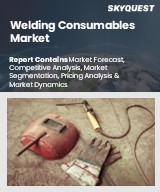
|
시장보고서
상품코드
1900321
용접 소모품 시장 규모, 점유율, 성장 분석 : 유형별, 용접 기술별, 모재별, 용도별, 지역별 - 업계 예측(2026-2033년)Welding Consumables Market Size, Share, and Growth Analysis, By Type (Electrodes, Flux), By Welding Technique (Arc Welding, Resistance Welding), By Base Material, By Application, By Region - Industry Forecast 2026-2033 |
||||||

세계의 용접 소모품 시장 규모는 2024년에 173억 6,000만 달러로 평가되었고, 2025년 182억 6,000만 달러에서 2033년까지 273억 9,000만 달러로 성장할 전망입니다. 예측 기간(2026-2033년)에 있어서 CAGR은 5.2%를 나타낼 것으로 예상됩니다.
인프라 개발, 제조업, 자동차 부문 수요 증가를 배경으로 세계의 용접 소모품 시장은 크게 확대될 것으로 전망됩니다. 산업화의 진전에 수반해, 건설, 조선, 석유 및 가스, 항공우주 등의 산업에 있어서, 효율적이고 고성능인 용접 소모품의 필요성이 높아지고 있습니다. 전극, 플럭스, 용가재, 차폐 가스 등의 필수 제품은 용접 구조물의 완전성과 내구성을 보장합니다. 시장에서는 자동화·로봇 용접 시스템이나 적층 조형(어디티브·매뉴팩처링) 등 선진 기술로의 이행이 진행되고 있어, 커스터마이즈 된 소모품 수요가 높아지고 있습니다. 또한 신재생에너지 프로젝트 확대와 방어 관련 정밀용접 수요 증가도 시장을 뒷받침하고 있습니다. 이러한 분야가 품질 및 안전 기준을 충족하는 혁신적인 솔루션을 추구하는 동안, 용접 소모품 시장은 역동적인 진화를 계속하고 있습니다.
세계 용접 소모품 시장의 성장 요인
용접 로봇의 도입 확대는 세계 용접 소모품 시장의 성장을 견인하는 주요 요인입니다. 이러한 첨단 로봇은 탁월한 정밀도와 용접 공정에서 안전성 향상 능력으로 높은 평가를 받고 있습니다. 재현성의 일관성은 대량 생산품의 제조 시간을 크게 단축합니다. 또한, 제조업체는 용접 로봇의 사용이 제품 품질을 향상시킬 뿐만 아니라 전체 제조 비용 절감에도 기여한다는 것을 인식하고 있습니다. 오프라인 프로그램 생성의 편의성과 타사 경로 간의 간편한 통합을 통해 사용자는 디지털 모델을 신속하게 엔터프라이즈 제품으로 변환할 수 있어 생산 공정을 더욱 간소화하고 다양한 용도에서 효율성을 높일 수 있습니다.
세계의 용접 소모품 시장 성장 억제요인
세계의 용접 소모품 시장이 직면한 심각한 과제는 많은 산업 분야에서 숙련된 용접 기술자의 현저한 부족입니다. 이 숙련 노동력 부족은 생산성을 저해하고 제품 품질 저하를 초래할 수 있으며 결국 전체 용접 작업의 효과에 영향을 미칩니다. 산업이 숙련 용접공의 확보와 정착을 고민하는 동안, 용접 소모품 수요는 악영향을 받을 가능성이 있습니다. 훈련받은 인재의 지속적인 부족은 시장의 병목 현상을 일으켜 성장 가능성을 저해하며 용접 기술과 기술의 발전을 제한할 수 있습니다. 이 기술 격차를 다루는 것은 용접 소모품 분야 수요를 활성화하는 데 매우 중요합니다.
세계의 용접 소모품 시장 동향
인공지능(AI)의 진보로 용접 작업의 효율성과 품질이 향상되고 세계의 용접 소모재 시장은 큰 변화를 경험하고 있습니다. AI 알고리즘은 용접 데이터를 분석하고 각 작업의 소모품 요구량을 정확하게 예측하여 소모품 사용을 최적화하고 폐기물을 줄이고 비용 효율성을 촉진합니다. 또한 AI는 실시간 설비 모니터링을 통한 예지 보전을 가능하게 하고, 고장 발생 전에 잠재적인 결함을 파악하여 다운타임을 최소화합니다. 이 예방적 접근은 소모품이 최적의 조건 하에서 사용되는 것을 보장할 뿐만 아니라, 용접 설비 및 재료의 수명을 연장하고, 보다 지속 가능하고 경제적으로 실현 가능한 시장 상황을 형성합니다.
자주 묻는 질문
목차
서론
- 조사 목적
- 조사 범위
- 정의
조사 방법
- 정보 조달
- 2차 및 1차 데이터 수집 방법
- 시장 규모 예측
- 시장의 전제조건과 제한
주요 요약
- 세계 시장 전망
- 공급과 수요 동향 분석
- 부문별 기회 분석
시장 역학과 전망
- 시장 규모
- 시장 역학
- 성장 촉진요인과 기회
- 성장 억제요인과 과제
- Porter's Five Forces 분석
주요 시장 인사이트
- 주요 성공 요인
- 경쟁도
- 주요 투자 기회
- 시장 생태계
- 시장의 매력 지수(2025년)
- PESTEL 분석
- 거시경제지표
- 밸류체인 분석
- 가격 분석
- 사례 연구
- 원재료 분석
세계의 용접 소모품 시장 규모 : 유형별&CAGR(2026-2033년)
- 전극
- 플럭스
- 차폐 가스
- 충전 금속
- 기타
세계의 용접 소모품 시장 규모 : 용접 기술별&CAGR(2026-2033년)
- 아크 용접
- 저항 용접
- 산소-연료 용접
- 고체 상태 용접
- 기타
세계의 용접 소모품 시장 규모 : 기초 재료별&CAGR(2026-2033년)
- 탄소강
- 스테인레스 스틸
- 알루미늄
- 티타늄
- 기타 모재
세계의 용접 소모품 시장 규모 : 용도별&CAGR(2026-2033년)
- 자동차
- 건축 및 건설
- 중공업
- 철도 및 조선
- 석유 및 가스
- 기타
세계의 용접 소모품 시장 규모&CAGR(2026-2033년)
- 북미
- 미국
- 캐나다
- 유럽
- 독일
- 스페인
- 프랑스
- 영국
- 이탈리아
- 기타 유럽
- 아시아태평양
- 중국
- 인도
- 일본
- 한국
- 기타 아시아태평양
- 라틴아메리카
- 브라질
- 기타 라틴아메리카
- 중동 및 아프리카
- GCC 국가
- 남아프리카
- 기타 중동 및 아프리카
경쟁 정보
- 상위 5개사 비교
- 주요 기업의 시장 포지셔닝(2025년)
- 주요 시장 기업이 채용한 전략
- 최근 시장 동향
- 기업의 시장 점유율 분석(2025년)
- 주요 기업 프로파일
- 기업 상세 정보
- 제품 포트폴리오 분석
- 기업의 부문별 점유율 분석
- 수익의 전년대비 비교(2023-2025년)
주요 기업 프로파일
- Lincoln Electric Holdings, Inc.(US)
- ESAB Corporation(US)
- The Welding Institute(TWI)(UK)
- Panasonic Welding Systems(Japan)
- Air Products and Chemicals, Inc.(US)
- Miller Electric Mfg LLC(US)
- Oerlikon Metco(Switzerland)
- Fronius International GmbH(Austria)
- Hyundai Welding Co., Ltd.(South Korea)
- Kobe Steel Ltd.(Japan)
- Migatronic A/S(Denmark)
- Tama Aerial Systems(Israel)
- KEMPPI WELDING TECHNOLOGIES(Finland)
- Weldcote Metals, Inc.(US)
결론과 권고
KTH 26.01.16Global Welding Consumables Market size was valued at USD 17.36 Billion in 2024 and is poised to grow from USD 18.26 Billion in 2025 to USD 27.39 Billion by 2033, growing at a CAGR of 5.2% during the forecast period (2026-2033).
The global welding consumables market is set for significant expansion, driven by increasing demand from infrastructure development, manufacturing, and the automotive sector. As industrialization intensifies, the necessity for efficient, high-performance welding materials rises in industries like construction, shipbuilding, oil & gas, and aerospace. Essential products such as electrodes, fluxes, filler metals, and shielding gases ensure the integrity and durability of welded structures. The market is witnessing a transition towards advanced technologies, including automated and robotic welding systems and additive manufacturing, prompting a need for customized consumables. Additionally, the growth of renewable energy projects and defense-related precision welding further accentuate demand. As these sectors pursue innovative solutions to meet quality and safety standards, the welding consumables market continues to evolve dynamically.
Top-down and bottom-up approaches were used to estimate and validate the size of the Global Welding Consumables market and to estimate the size of various other dependent submarkets. The research methodology used to estimate the market size includes the following details: The key players in the market were identified through secondary research, and their market shares in the respective regions were determined through primary and secondary research. This entire procedure includes the study of the annual and financial reports of the top market players and extensive interviews for key insights from industry leaders such as CEOs, VPs, directors, and marketing executives. All percentage shares split, and breakdowns were determined using secondary sources and verified through Primary sources. All possible parameters that affect the markets covered in this research study have been accounted for, viewed in extensive detail, verified through primary research, and analyzed to get the final quantitative and qualitative data.
Global Welding Consumables Market Segments Analysis
Global Welding Consumables Market is segmented by Type, Welding Technique, Base Material, Application and region. Based on Type, the market is segmented into Electrodes, Flux, Shielding Gas, Filler Metals, Others. Based on Welding Technique, the market is segmented into Arc Welding, Resistance Welding, Oxy-fuel Welding, Solid State Welding and Others. Based on Base Material, the market is segmented into Carbon Steel, Stainless Steel, Aluminum, Titanium and Other Base Materials. Based on Application, the market is segmented into Automotive, Building & Construction, Heavy Engineering, Railway & Shipbuilding, Oil & Gas and Others. Based on region, the market is segmented into North America, Europe, Asia Pacific, Latin America and Middle East & Africa.
Driver of the Global Welding Consumables Market
The increasing adoption of welding robots is a key factor driving growth in the global welding consumables market. These advanced robots are celebrated for their remarkable precision and their ability to enhance safety in welding processes. Their consistency in repeatability significantly shortens the production time for mass-manufactured goods. Additionally, manufacturers observe that the use of welding robots not only improves product quality but also reduces overall manufacturing costs. Their capacity for convenient offline program generation and effortless integration of third-party paths allows users to rapidly convert digital models into tangible products, further streamlining the production process and boosting efficiency in various applications.
Restraints in the Global Welding Consumables Market
A significant challenge facing the global welding consumables market is the pronounced lack of qualified welding professionals across numerous industries. This skilled labor shortage hampers productivity and can lead to compromised product quality, ultimately impacting the overall effectiveness of welding operations. As industries grapple with finding and retaining skilled welders, the demand for welding consumables may be adversely affected. The ongoing deficit of trained personnel is poised to create a bottleneck in the market, stifling growth potential and limiting advancements in welding technology and practices. Addressing this skill gap is crucial for revitalizing demand in the welding consumables sector.
Market Trends of the Global Welding Consumables Market
The Global Welding Consumables market is experiencing a significant transformation driven by advancements in artificial intelligence, which enhances efficiency and quality in welding operations. AI algorithms optimize consumable usage by analyzing welding data, accurately predicting requirements for each job, reducing waste, and promoting cost-effectiveness. Furthermore, AI facilitates predictive maintenance through real-time equipment monitoring, identifying potential failures before they occur and minimizing downtime. This proactive approach not only helps ensure consumables are utilized under optimal conditions but also extends the lifespan of welding equipment and materials, thus shaping a more sustainable and economically viable market landscape.
Table of Contents
Introduction
- Objectives of the Study
- Scope of the Report
- Definitions
Research Methodology
- Information Procurement
- Secondary & Primary Data Methods
- Market Size Estimation
- Market Assumptions & Limitations
Executive Summary
- Global Market Outlook
- Supply & Demand Trend Analysis
- Segmental Opportunity Analysis
Market Dynamics & Outlook
- Market Overview
- Market Size
- Market Dynamics
- Drivers & Opportunities
- Restraints & Challenges
- Porters Analysis
- Competitive rivalry
- Threat of substitute
- Bargaining power of buyers
- Threat of new entrants
- Bargaining power of suppliers
Key Market Insights
- Key Success Factors
- Degree of Competition
- Top Investment Pockets
- Market Ecosystem
- Market Attractiveness Index, 2025
- PESTEL Analysis
- Macro-Economic Indicators
- Value Chain Analysis
- Pricing Analysis
- Case Studies
- Raw Material Analysis
Global Welding Consumables Market Size by Type & CAGR (2026-2033)
- Market Overview
- Electrodes
- Flux
- Shielding Gas
- Filler Metals
- Others
Global Welding Consumables Market Size by Welding Technique & CAGR (2026-2033)
- Market Overview
- Arc Welding
- Resistance Welding
- Oxy-fuel Welding
- Solid State Welding
- Others
Global Welding Consumables Market Size by Base Material & CAGR (2026-2033)
- Market Overview
- Carbon Steel
- Stainless Steel
- Aluminum
- Titanium
- Other Base Materials
Global Welding Consumables Market Size by Application & CAGR (2026-2033)
- Market Overview
- Automotive
- Building & Construction
- Heavy Engineering
- Railway & Shipbuilding
- Oil & Gas
- Others
Global Welding Consumables Market Size & CAGR (2026-2033)
- North America (Type, Welding Technique, Base Material, Application)
- US
- Canada
- Europe (Type, Welding Technique, Base Material, Application)
- Germany
- Spain
- France
- UK
- Italy
- Rest of Europe
- Asia Pacific (Type, Welding Technique, Base Material, Application)
- China
- India
- Japan
- South Korea
- Rest of Asia-Pacific
- Latin America (Type, Welding Technique, Base Material, Application)
- Brazil
- Rest of Latin America
- Middle East & Africa (Type, Welding Technique, Base Material, Application)
- GCC Countries
- South Africa
- Rest of Middle East & Africa
Competitive Intelligence
- Top 5 Player Comparison
- Market Positioning of Key Players, 2025
- Strategies Adopted by Key Market Players
- Recent Developments in the Market
- Company Market Share Analysis, 2025
- Company Profiles of All Key Players
- Company Details
- Product Portfolio Analysis
- Company's Segmental Share Analysis
- Revenue Y-O-Y Comparison (2023-2025)
Key Company Profiles
- Lincoln Electric Holdings, Inc. (US)
- Company Overview
- Business Segment Overview
- Financial Updates
- Key Developments
- ESAB Corporation (US)
- Company Overview
- Business Segment Overview
- Financial Updates
- Key Developments
- The Welding Institute (TWI) (UK)
- Company Overview
- Business Segment Overview
- Financial Updates
- Key Developments
- Panasonic Welding Systems (Japan)
- Company Overview
- Business Segment Overview
- Financial Updates
- Key Developments
- Air Products and Chemicals, Inc. (US)
- Company Overview
- Business Segment Overview
- Financial Updates
- Key Developments
- Miller Electric Mfg LLC (US)
- Company Overview
- Business Segment Overview
- Financial Updates
- Key Developments
- Oerlikon Metco (Switzerland)
- Company Overview
- Business Segment Overview
- Financial Updates
- Key Developments
- Fronius International GmbH (Austria)
- Company Overview
- Business Segment Overview
- Financial Updates
- Key Developments
- Hyundai Welding Co., Ltd. (South Korea)
- Company Overview
- Business Segment Overview
- Financial Updates
- Key Developments
- Kobe Steel Ltd. (Japan)
- Company Overview
- Business Segment Overview
- Financial Updates
- Key Developments
- Migatronic A/S (Denmark)
- Company Overview
- Business Segment Overview
- Financial Updates
- Key Developments
- Tama Aerial Systems (Israel)
- Company Overview
- Business Segment Overview
- Financial Updates
- Key Developments
- KEMPPI WELDING TECHNOLOGIES (Finland)
- Company Overview
- Business Segment Overview
- Financial Updates
- Key Developments
- Weldcote Metals, Inc. (US)
- Company Overview
- Business Segment Overview
- Financial Updates
- Key Developments