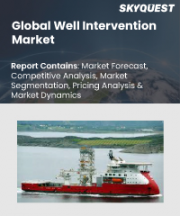
|
시장보고서
상품코드
1900679
갱정 개재 시장 규모, 점유율, 성장 분석 : 서비스 유형별, 용도별, 기술별, 최종 용도별, 지역별 - 업계 예측(2026-2033년)Well Intervention Market Size, Share, and Growth Analysis, By Service type (Well Completion, Well Maintenance), By Application (Onshore, Offshore), By Technology, By End Use, By Region - Industry Forecast 2026-2033 |
||||||

갱정 개재 시장 규모는 2024년에 96억 달러로 평가되었으며, 2025년 101억 3,000만 달러에서 2033년까지 155억 4,000만 달러로 성장할 전망입니다. 예측 기간(2026-2033년) 동안 CAGR은 5.5%로 예측됩니다.
갱정 개재 시장은 석유 및 가스 산업에서 매우 중요한 분야로, 세계 에너지 수요 증가에 따라 역동적으로 대응하고 있습니다. 성숙 유전의 생산이 저류층 고갈과 생산량 감소라는 도전에 직면한 가운데, 갱정 개재 서비스는 운영 효율을 유지하고 유정 수명을 연장하는 데 필수적인 요소로 부상하고 있습니다. 주요 성장 요인으로는 석유 및 가스 생산량 증가에 대한 긴급한 수요와 코일 튜빙, 슬릭라인, 유압식 개보수 장치와 같은 기술 발전으로 개입 프로세스를 최적화하는 기술 발전을 들 수 있습니다. 그러나 유가 변동과 환경 문제로 인한 시장 변동성이 문제점으로 지적되고 있습니다. 한편, 비재래식 자원의 개발 동향과 디지털 자동화의 통합은 시장 발전에 큰 기회를 가져다주고 있습니다.
갱정 개재 시장 촉진요인
세계 에너지 수요, 특히 석유 및 가스 분야의 수요 증가는 주로 인구 증가와 산업 성장에 의해 주도되고 있습니다. 이러한 수요로 인해 기존 우물에서 생산 및 채굴 방법을 강화해야 할 필요성이 대두되고 있습니다. 갱정 개재 기술은 생산 노력을 최적화하고 탄화수소 회수를 극대화함으로써 이 문제를 해결하는 데 중요한 역할을 할 수 있습니다. 예를 들어, 수압파쇄공법 등 첨단 공법은 기존에 미개발된 석유 및 가스 매장량에 대한 접근 능력을 크게 향상시켰습니다. 그 결과, 에너지 수요가 계속 확대됨에 따라 효율성 향상과 지속가능한 자원 관리를 보장하기 위해 갱정 개재의 중요성이 점점 더 분명해지고 있습니다.
갱정 개재 시장 억제요인
갱정 개재 시장은 환경 문제와 규제 프레임워크로 인해 심각한 도전에 직면해 있습니다. 수압파쇄법 등의 공법은 지하수 오염과 유발지진 가능성에 대한 우려를 불러일으키고 있습니다. 그 결과, 정부와 규제 당국은 환경 보호를 위해 더 엄격한 규제를 도입하고 있습니다. 이러한 규제를 준수하는 것은 종종 운영 비용의 증가로 이어지고, 다양한 개입 기술의 사용을 제한할 수 있으며, 시장의 성장과 혁신에 제약을 가져올 수 있습니다. 전반적으로, 환경 보호와 규제 준수의 상호 작용은 갱정 개재 분야에서 사업을 운영하는 기업들에게 복잡한 상황을 만들어 내고 있습니다.
갱정 개재 시장 동향
갱정 개재 시장에서는 디지털화 및 데이터 분석으로의 전환이 진행되고 있으며, 이는 운영 최적화에 있어 중요한 트렌드가 되고 있습니다. 업계 관계자들은 의사결정 과정을 강화하기 위해 실시간 모니터링 시스템, 고급 데이터 분석 플랫폼과 같은 첨단 기술 도입을 가속화하고 있습니다. 이러한 혁신 기술은 종합적인 데이터 수집 및 분석을 통해 운영자가 잠재적인 문제를 사전에 파악하고 유정의 거동을 예측할 수 있도록 돕습니다. 특히 예측보전 알고리즘의 도입은 주목할 만합니다. 장비 고장을 조기에 감지하여 다운타임을 최소화하고 개입 스케줄의 효율성을 높이기 위함입니다. 이러한 진화는 갱정 개재 분야의 효율성과 신뢰성에 대한 광범위한 노력을 강조하며, 궁극적으로 성장과 혁신을 촉진할 것입니다.
자주 묻는 질문
목차
소개
- 조사 목적
- 조사 범위
- 정의
조사 방법
- 정보 조달
- 2차와 1차 데이터 방법
- 시장 규모 예측
- 시장 가정과 제한
주요 요약
- 세계 시장 전망
- 공급과 수요 동향 분석
- 부문별 기회 분석
시장 역학과 전망
- 시장 규모
- 시장 역학
- 성장 촉진요인과 기회
- 성장 억제요인과 과제
- Porters 분석
주요 시장 인사이트
- 핵심성공요인
- 경쟁 정도
- 주요 투자 기회
- 시장 생태계
- 시장 매력 지수(2025년)
- PESTEL 분석
- 거시경제 지표
- 밸류체인 분석
- 가격 분석
세계의 갱정 개재 시장 규모 : 서비스 유형별 & CAGR(2026-2033년)
- 유정 완성
- 유정 보수
- 유정 폐지
- 자극 서비스
- 개선 작업 서비스
세계의 갱정 개재 시장 규모 : 용도별 & CAGR(2026-2033년)
- 온쇼어
- 오프쇼어
세계의 갱정 개재 시장 규모 : 기술별 & CAGR(2026-2033년)
- 코일드 튜빙
- 와이어라인
- 스너빙
- 유압 작업
- 피싱
세계의 갱정 개재 시장 규모 : 최종 용도별 & CAGR(2026-2033년)
- 석유 및 가스
- 지열
- 광업
세계의 갱정 개재 시장 규모 : 지역별 & CAGR(2026-2033년)
- 북미
- 미국
- 캐나다
- 유럽
- 독일
- 스페인
- 프랑스
- 영국
- 이탈리아
- 기타 유럽
- 아시아태평양
- 중국
- 인도
- 일본
- 한국
- 기타 아시아태평양
- 라틴아메리카
- 브라질
- 기타 라틴아메리카
- 중동 및 아프리카
- GCC 국가
- 남아프리카공화국
- 기타 중동 및 아프리카
경쟁 정보
- 상위 5개사의 비교
- 주요 기업의 시장 포지셔닝(2025년)
- 주요 시장 기업이 채용한 전략
- 최근의 시장 동향
- 기업의 시장 점유율 분석(2025년)
- 주요 기업 개요
- 기업 상세
- 제품 포트폴리오 분석
- 기업 부문별 점유율 분석
- 매출 전년비 비교(2023-2025년)
주요 기업 개요
- Schlumberger Limited(US)
- Halliburton Company(US)
- Baker Hughes(US)
- Weatherford International plc(UK)
- Archer Limited(Norway)
- Expro Group(UK)
- Trican Well Service Ltd.(Canada)
- National Oilwell Varco(US)
- C&J Energy Services, Inc.(US)
- Key Energy Services, Inc.(US)
- Nine Energy Services, Inc.(US)
- Patterson-UTI Energy, Inc.(US)
- Oceaneering International, Inc.(US)
- Hunting PLC(UK)
- Helix Energy Solutions Group, Inc.(US)
- NOV(US)
- Superior Energy Services, Inc.(US)
- ProWell Energy(Indonesia)
결론과 제안
KSM 26.01.21Well Intervention Market size was valued at USD 9.6 Billion in 2024 and is poised to grow from USD 10.13 Billion in 2025 to USD 15.54 Billion by 2033, growing at a CAGR of 5.5% during the forecast period (2026-2033).
The Well Intervention Market is a vital sector within the oil and gas industry, responding dynamically to increasing global energy demands. As the production from mature fields faces challenges such as reservoir depletion and declining output, well intervention services have emerged as essential for maintaining operational efficiency and extending the life of wells. Key growth drivers include the pressing need for enhanced oil and gas production and advancements in technology, such as coiled tubing, slickline, and hydraulic workover units, which have optimized intervention processes. However, market volatility driven by fluctuating oil prices and environmental concerns poses challenges. Conversely, trends toward unconventional resource exploitation and the integration of digital automation present significant opportunities for market advancement.
Top-down and bottom-up approaches were used to estimate and validate the size of the Well Intervention market and to estimate the size of various other dependent submarkets. The research methodology used to estimate the market size includes the following details: The key players in the market were identified through secondary research, and their market shares in the respective regions were determined through primary and secondary research. This entire procedure includes the study of the annual and financial reports of the top market players and extensive interviews for key insights from industry leaders such as CEOs, VPs, directors, and marketing executives. All percentage shares split, and breakdowns were determined using secondary sources and verified through Primary sources. All possible parameters that affect the markets covered in this research study have been accounted for, viewed in extensive detail, verified through primary research, and analyzed to get the final quantitative and qualitative data.
Well Intervention Market Segments Analysis
Global Well Intervention Market is segmented by Service type, Application, Technology, End Use and region. Based on Service type, the market is segmented into Well Completion, Well Maintenance, Well Abandonment, Stimulation Services and Workover Services. Based on Application, the market is segmented into Onshore and Offshore. Based on Technology, the market is segmented into Coiled Tubing, Wireline, Snubbing, Hydraulic Workover and Fishing. Based on End Use, the market is segmented into Oil and Gas, Geothermal and Mining. Based on region, the market is segmented into North America, Europe, Asia Pacific, Latin America and Middle East & Africa.
Driver of the Well Intervention Market
The increasing global appetite for energy, especially in the oil and gas sector, is largely driven by population expansion and industrial growth. This demand creates a pressing need for enhanced production and extraction methods from established wells. Well intervention techniques play a crucial role in this equation by optimizing production efforts and maximizing hydrocarbon recovery. For instance, advanced methods such as hydraulic fracturing have significantly improved the ability to access previously untapped oil and gas reserves. Consequently, as energy requirements continue to escalate, the significance of well intervention in boosting efficiency and ensuring sustainable resource management becomes increasingly evident.
Restraints in the Well Intervention Market
The well intervention market encounters significant challenges stemming from environmental concerns and regulatory frameworks. Practices like hydraulic fracturing have sparked worries about potential groundwater contamination and induced seismicity. As a result, governmental and regulatory authorities are instituting more stringent regulations to safeguard the environment. Adhering to these regulations often leads to increased operational expenses and may restrict the use of various intervention techniques, posing constraints on market growth and innovation. Overall, the interplay between environmental stewardship and regulatory compliance creates a complex landscape for businesses operating in the well intervention sector.
Market Trends of the Well Intervention Market
The Well Intervention market is witnessing a significant shift towards digitization and data analytics, marking a pivotal trend in operational optimization. Industry players are increasingly adopting advanced technologies such as real-time monitoring systems and sophisticated data analytics platforms to enhance decision-making processes. These innovations facilitate comprehensive data gathering and analysis, allowing operators to proactively identify potential issues and anticipate well behavior. The implementation of predictive maintenance algorithms is particularly noteworthy, as they enable early detection of equipment failures, thereby minimizing downtime and streamlining intervention schedules. This evolution underscores a broader push for efficiency and reliability within the well intervention sector, ultimately driving growth and innovation.
Table of Contents
Introduction
- Objectives of the Study
- Scope of the Report
- Definitions
Research Methodology
- Information Procurement
- Secondary & Primary Data Methods
- Market Size Estimation
- Market Assumptions & Limitations
Executive Summary
- Global Market Outlook
- Supply & Demand Trend Analysis
- Segmental Opportunity Analysis
Market Dynamics & Outlook
- Market Overview
- Market Size
- Market Dynamics
- Drivers & Opportunities
- Restraints & Challenges
- Porters Analysis
- Competitive rivalry
- Threat of substitute
- Bargaining power of buyers
- Threat of new entrants
- Bargaining power of suppliers
Key Market Insights
- Key Success Factors
- Degree of Competition
- Top Investment Pockets
- Market Ecosystem
- Market Attractiveness Index, 2025
- PESTEL Analysis
- Macro-Economic Indicators
- Value Chain Analysis
- Pricing Analysis
Global Well Intervention Market Size by Service type & CAGR (2026-2033)
- Market Overview
- Well Completion
- Well Maintenance
- Well Abandonment
- Stimulation Services
- Workover Services
Global Well Intervention Market Size by Application & CAGR (2026-2033)
- Market Overview
- Onshore
- Offshore
Global Well Intervention Market Size by Technology & CAGR (2026-2033)
- Market Overview
- Coiled Tubing
- Wireline
- Snubbing
- Hydraulic Workover
- Fishing
Global Well Intervention Market Size by End Use & CAGR (2026-2033)
- Market Overview
- Oil and Gas
- Geothermal
- Mining
Global Well Intervention Market Size & CAGR (2026-2033)
- North America (Service type, Application, Technology, End Use)
- US
- Canada
- Europe (Service type, Application, Technology, End Use)
- Germany
- Spain
- France
- UK
- Italy
- Rest of Europe
- Asia Pacific (Service type, Application, Technology, End Use)
- China
- India
- Japan
- South Korea
- Rest of Asia-Pacific
- Latin America (Service type, Application, Technology, End Use)
- Brazil
- Rest of Latin America
- Middle East & Africa (Service type, Application, Technology, End Use)
- GCC Countries
- South Africa
- Rest of Middle East & Africa
Competitive Intelligence
- Top 5 Player Comparison
- Market Positioning of Key Players, 2025
- Strategies Adopted by Key Market Players
- Recent Developments in the Market
- Company Market Share Analysis, 2025
- Company Profiles of All Key Players
- Company Details
- Product Portfolio Analysis
- Company's Segmental Share Analysis
- Revenue Y-O-Y Comparison (2023-2025)
Key Company Profiles
- Schlumberger Limited (US)
- Company Overview
- Business Segment Overview
- Financial Updates
- Key Developments
- Halliburton Company (US)
- Company Overview
- Business Segment Overview
- Financial Updates
- Key Developments
- Baker Hughes (US)
- Company Overview
- Business Segment Overview
- Financial Updates
- Key Developments
- Weatherford International plc (UK)
- Company Overview
- Business Segment Overview
- Financial Updates
- Key Developments
- Archer Limited (Norway)
- Company Overview
- Business Segment Overview
- Financial Updates
- Key Developments
- Expro Group (UK)
- Company Overview
- Business Segment Overview
- Financial Updates
- Key Developments
- Trican Well Service Ltd. (Canada)
- Company Overview
- Business Segment Overview
- Financial Updates
- Key Developments
- National Oilwell Varco (US)
- Company Overview
- Business Segment Overview
- Financial Updates
- Key Developments
- C&J Energy Services, Inc. (US)
- Company Overview
- Business Segment Overview
- Financial Updates
- Key Developments
- Key Energy Services, Inc. (US)
- Company Overview
- Business Segment Overview
- Financial Updates
- Key Developments
- Nine Energy Services, Inc. (US)
- Company Overview
- Business Segment Overview
- Financial Updates
- Key Developments
- Patterson-UTI Energy, Inc. (US)
- Company Overview
- Business Segment Overview
- Financial Updates
- Key Developments
- Oceaneering International, Inc. (US)
- Company Overview
- Business Segment Overview
- Financial Updates
- Key Developments
- Hunting PLC (UK)
- Company Overview
- Business Segment Overview
- Financial Updates
- Key Developments
- Helix Energy Solutions Group, Inc. (US)
- Company Overview
- Business Segment Overview
- Financial Updates
- Key Developments
- NOV (US)
- Company Overview
- Business Segment Overview
- Financial Updates
- Key Developments
- Superior Energy Services, Inc. (US)
- Company Overview
- Business Segment Overview
- Financial Updates
- Key Developments
- ProWell Energy (Indonesia)
- Company Overview
- Business Segment Overview
- Financial Updates
- Key Developments