

|
시장보고서
상품코드
2082631
<2026> 이차전지 건식전극 공정기술 개발동향 및 시장전망(-2035)<2026> Dry Electrode Process Technology for Secondary Batteries: Development Trends and Market Outlook (~2035) |
||||||

최근 글로벌 배터리 산업에서 건식전극(Dry Electrode) 공정이 차세대 배터리 제조 기술의 핵심 축으로 부상하고 있습니다. EV, ESS, 전고체전지, 나트륨이온전지(SIB) 등 다양한 배터리 분야에서 건식전극 기술에 대한 관심이 급격히 증가하고 있으며, 글로벌 배터리 기업들은 건식전극 기술 확보를 미래 경쟁력의 핵심 요소로 인식하고 있습니다.
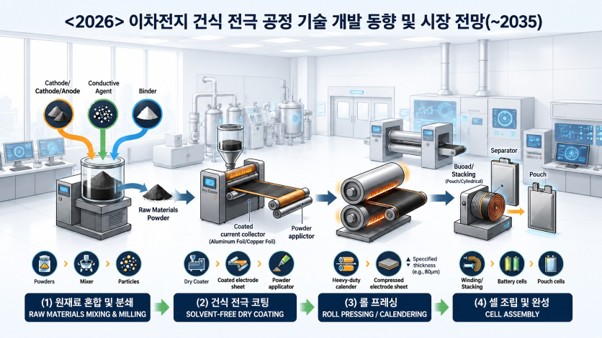
건식전극 공정은 용매를 사용하지 않고 활물질, 도전재, 바인더를 직접 혼합한 후 압연, 압착, 라미네이션 등의 공정을 통해 전극을 제조하는 방식입니다. 건조공정과 NMP 회수설비를 제거할 수 있어 공정 에너지 사용량을 약 20-40% 절감할 수 있으며, 공장 투자비(CAPEX)도 약 15-30% 감소시킬 수 있는 것으로 평가받고 있습니다. 또한 생산라인 길이를 단축하고 공장면적을 줄일 수 있어 대규모 배터리 생산에 매우 유리합니다.
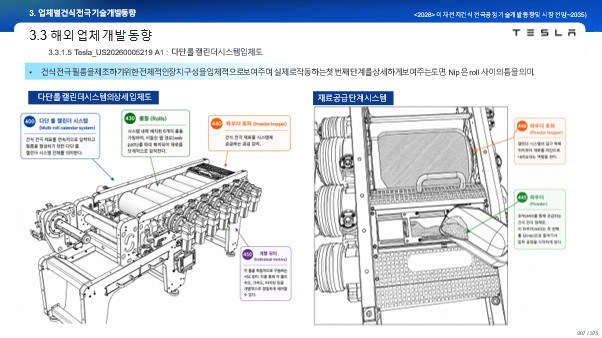
건식전극 공정의 대표적인 선도 기업은 Tesla입니다. Tesla는 2019년 Maxwell Technologies를 인수하면서 건식전극 기술 확보에 나섰으며, 이후 차세대 원통형 배터리인 4680 배터리 개발에 건식전극 공정을 핵심 기술로 적용해 왔습니다. 초기에는 건식 음극(Dry Anode)과 습식 양극(Wet Cathode)을 결합한 하이브리드 형태가 주로 적용되었으나, 최근 공개된 US2025/0364562특허를 통해 복합 바인더 시스템을 도입함으로써 양극에도 적용을 해결한 것으로 파악되며, PTFE외에 PVDF, PEO, PE등을 PTFE와 혼합하여, 추가된 고분자 바인더들의 활물질 표면 코팅을 통해 PTFE가 전극활물질과 직접 반응하는 것을 막아주는 보호막 역할을 하는 것으로 추측됩니다.
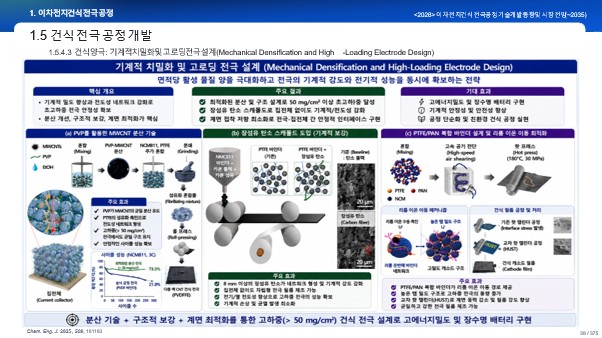
특히 4680 배터리는 기존 원통형 배터리보다 훨씬 두꺼운 전극(Thick Electrode)과 높은 면적당 로딩(Areal Loading)을 요구합니다. 또한 탭리스(Tabless) 구조를 채택하여 고출력 및 고에너지밀도를 구현해야 하기 때문에 건식전극 기술의 장점이 직접적으로 연결됩니다.
건식전극 기술은 전고체전지 분야에서 더욱 중요한 의미를 가집니다. 실제로 많은 전문가들은 전고체전지의 상용화 과정에서 건식전극 공정이 선택사항이 아니라 필수 제조 플랫폼이 될 가능성이 높다고 평가합니다.
그러나 전고체전지가 사용하는 황화물계(Sulfide), 산화물계(Oxide), 할라이드계(Halide) 등의 고체전해질은 수분과 유기용매에 민감하며, 습식 슬러리 공정에서 계면 반응이나 성능 저하가 발생할 수 있습니다. 특히 황화물계 전해질은 수분과 접촉할 경우 황화수소(H₂S)가 발생할 위험이 있어 제조공정에서 특별한 관리가 필요합니다.
이 때문에 전고체전지 제조에서는 건식 혼합(Dry Mixing), 건식 필름 형성(Dry Film Formation), 건식 라미네이션(Dry Lamination)과 같은 건식 기반 제조 방식이 매우 유리합니다. 건식전극 공정은 용매를 사용하지 않기 때문에 고체전해질의 안정성을 유지할 수 있으며, 입자 간 접촉을 향상시키고 계면 저항을 감소시키는 데에도 효과적입니다.
전고체전지의 가장 큰 기술적 난제 중 하나는 양극과 고체전해질, 음극과 고체전해질 사이의 계면접촉 문제입니다. 최근 연구에서는 건식 압연(Co-Rolling) 및 열압착(Hot Pressing) 기술을 통해 입자 간 밀착도를 향상시키고 기공을 감소시켜 우수한 전기화학적 성능을 확보하는 사례가 보고되고 있습니다. 실제로 건식 기반 전고체전지는 300 Wh/kg 이상의 높은 에너지밀도와 수백회 이상의 충방전 수명을 구현하며 상용화 가능성을 입증하고 있습니다.
또한 전고체전지는 본질적으로 제조원가가 높은 기술이기 때문에 건식전극 공정을 통한 비용 절감 효과가 더욱 중요합니다. 건조설비 제거, 공정 단순화, 에너지 사용량 감소 등을 통해 전체 제조비를 크게 낮출 수 있으며, 이는 향후 전고체전지 대량생산의 경제성을 확보하는 데 핵심 역할을 할 것으로 예상됩니다.
최근 Toyota, Nissan, LG에너지솔루션, 삼성SDI, CATL 등 주요 기업들도 전고체전지 및 차세대 배터리 제조에 건식전극 기술을 적극 개발하고 있습니다. 특히 전고체전지 상용화 시점으로 예상되는 2030년 전후에는 건식전극 공정이 사실상 표준 제조 플랫폼으로 자리잡을 가능성이 높습니다.
본 리포트는 이차전지 산업의 탄소중립형 공정 개발의 필요성, 기존 습식공정의 이슈, 현재 건식공정의 이슈 등 기술적인 내용과 최근 이차전지 관련 업체 건식 전극 공정 개발 동향과 전고체 전지 개발 동향에 대한 많은 업체들의 정보를 제공하여 건식공정의 현재와 가까운 미래의 현황을 전망하고자 하였습니다.
본 보고서의 Strong Point
① 건식전극 공정에 대한 배경 및 개발에 관한 풍성한 기술내용 수록
② 건식전극 공정 종류의 자세한 설명 및 전극 공정 이슈 내용 수록
③ 건식 공정과 습식 공정의 장∙단점 및 전지 적용까지의 상세한 비교내용 수록
④ 차세대 전지인 전고체전지의 건식 전극공정 적용에 대한 상세 기술내용 수록
⑤ 국내외 산업계의 전극 공정, 소재, 장비업체의 개발 동향에 대한 상세한 정보 수록
⑥ 건식전극관련 국가별 연구지원 프로젝트 및 주요 내용 수록
⑦ 건식전극 공정에 관한 주요 리서치사의 시장 전망 수록
[목 차]
1 이차전지 건식 전극 공정
- 1.1 이차전지 산업 탄소 중립형 공정 개발 필요성
- 1.1.1 탄소 중립 규제로 인한 전기차 수요 확대
- 1.1.2 주요국 탄소 배출 제한 및 2050 탄소 중립 비전 및 전략
- 1.1.3 탄소 중립 규제 대응을 위한 이차전지 산업 이슈
- 1.1.4 습식공정을 통한 후막전극 적용시 이슈 발생
- 1.1.5 건식 공정 기술 적용을 통한 cost 절감
- 1.1.6 건식 공정은 주류 공정으로 될 전망
- 1.2 이차전지 후막 전극 개발 필요성
- 1.2.1 종래 설계 vs 후막 설계의 차이
- 1.2.2 높은 에너지 밀도 및 비용 절감 목표
- 1.2.3 후막 전극 제작을 위한 전략(1)(2)(3)
- 1.3 습식 기반 전극 제조 공정 이슈
- 1.4 건식 공정 도입 배경
- 1.4.1 건식 전극 기술의 향상된 기술적 진보
- 1.4.2 Dry film 기술(바인더 섬유화)의 진보
- 1.4.3 습식 코팅의 한계 극복
- 1.4.4 PVDF 적용 Wet process 문제 극복 필요
- 1.4.5 PTFE 적용 Dry Process 장점
- 1.4.6 건식전극 특허출원 급증(630건)
- 1.4.7 건식 공정 및 바인더의 개발 : R2R 생산에 적합
- 1.4.8 PTFE 대체 바인더 개발 : PFAS Free 연구 활발
- 1.4.9 글로벌 주요 기업들이 핵심 기술로 개발 중
- 1.5 건식 전극 공정 개발
- 1.5.1 건식 전극 공정 기술 로드맵
- 1.5.2 건식 전극 제조 프로세스
- 1.5.3 건식 전극 : 음극 공정
- 1.5.3.1 바인더 및 첨가제 없는 접근 방식
- 1.5.3.2 전해질-바인더 상호작용 및 구조적 안정화
- 1.5.3.3 PTFE 비가역 분해 문제 해결 전략
- 1.5.4 건식 전극 : 양극
- 1.5.4.1 양극의 재료 및 배합 전략
- 1.5.4.2 전극 안정성을 위한 구조 및 인터페이스 엔지니어링
- 1.5.4.3 기계적 치밀화 및 고로딩 전극 설계
- 1.5.4.4 High loading-고성능 양극 구현 전략
- 1.5.4.5 건식 복합 양극
- 1.5.4.6 연속 압출 mixing을 통한 NMC 전극의 산업적 건식 코팅
- 1.5.4.7 Sheet결함 빈도 분석- 미세구조와 전하수송 특성
- 1.5.4.8 전기화학성능 및 안전성 평가
- 1.5.4.9 카본 블랙 특성이 미치는 영향(1)
- 1.5.4.10 카본 블랙 특성이 미치는 영향(2)
- 1.5.5 건식 후막 전극
- 1.5.5.1 20 mAh/cm² 구현 다공성 도전재 기반 건식 후막 전극 설계
- 1.5.5.2 로딩별 성능 및 에너지밀도증가 및 셀 수명 평가
- 1.5.6 High Areal Capacity 배터리
- 1.5.6.1 전기화학적 한계
- 1.5.6.2 소재의 화학적 전략 및 scale-up 및 고면적당 용량 전극개발
- 1.5.7 전고체전지용 전해질막
- 1.5.7.1 황화물계 Freestanding 박막 고체 전해질막 제조(1)
- 1.5.7.2 황화물계 Freestanding 박막 고체 전해질막 제조(1)
- 1.5.8 건식 공정용 바인터 특성
- 1.5.8.1 건식 공정용 바인터 특성(1)
- 1.5.8.2 건식 공정용 바인터 특성(2)
- 1.5.9 건식공정용 불소계 바인더 종류
- 1.5.10 수성 바인더(PTFE, PAA ) vs. 유성 바인더(PVDF)
- 1.5.11 PTFE 바인더 적용 : 습식 공정
- 1.5.12 PTFE/PAN 복합 바인더
- 1.5.12.1 전극의 미세구조 및 기계적 특성
- 1.5.12.2 전해질 습윤성 및 이온 확산 역학- 전하전달 저항 분석
- 1.5.12.3 Half-cell 및 Full cell 전기화학 성능
- 1.5.13 Fluorine Free 바인더
- 1.5.13.1 Half cell 전기화학적 성능 분석
- 1.5.13.2 PTFE/PAN 복합 바인더 (2)
- 1.6 건식 공정 종류
- 1.6.1 주요 Dry coating 기술 종류 및 비교
- 1.6.1.1 주요 Dry coating 기술 종류 및 비교(1)
- 1.6.1.2 주요 Dry coating 기술 종류 및 비교(2)
- 1.6.1.3 주요 Dry coating 기술 종류 및 비교(3)
- 1.6.2 건식 박막 증착 기술
- 1.6.3 건식 혼합 및 코팅
- 1.6.4 건식전극 vs. 습식전극 : 전기화학적 거동 비교
- 1.6.5 (폴리머 섬유화, 건식 분무 증착, 압출 공정) 기술의 특성
- 1.6.6 Free-standing electrode 기술
- 1.6.6.1 Free-standing electrode 기술(1)
- 1.6.6.2 Free-standing electrode 기술(2)
- 1.6.7 Direct Calendaring 기술
- 1.6.7.1 고밀화 작업을 완료하기 위해 롤 프레스 필요
- 1.6.7.2 주요 서브 시스템
- 1.6.7.3 Powder 투입 과정에서의 이슈
- 1.6.7.4 Powder 물성으로 인한 이슈
- 1.6.8 Brush Application(분말 sheet화 기술)
- 1.6.9 Electrostatic spraying 기술(1,2,3,4)
- 1.6.10 용융 증착 기술
- 1.6.11 분말 압축 기술
- 1.6.12 용융 압축 기술(1,2,3,4,5)
- 1.6.13 Direct Pressing
- 1.6.14 3D printing
- 1.6.15 ALD Coating(1,2,3)
- 1.6.16 Vapor deposition(기상 증착법)
- 1.6.17 건식막 형성 프로세스
- 1.6.18 건식 혼합 장치
- 1.6.1 주요 Dry coating 기술 종류 및 비교
- 1.7 건식 공정 이슈
- 1.7.1 건식공정기술의 기술적 허들
- 1.7.2 LIB 제조의 건식 공정의 과제
- 1.7.3 PTFE의 전기적 특성
- 1.7.4 PTFE의 음극과의 반응
- 1.7.5 건식 혼합 공정 시 이슈 및 해결 방안(1,2)
- 1.7.6 건식 전극 공정의 전고체전지 적용 시 해결 방안
- 1.8 건식 공정 vs 습식 공정 비교
- 1.8.1 습식공정과 건식공정 제조 기술의 비교
- 1.8.2 습식 공정의 단점
- 1.8.3 습식 공정 대체 옵션의 장단점
- 1.8.4 건식공정기술 도입의 장점
- 1.8.4.1 건식공정기술 도입의 장점 분석
- 1.8.4.2 더 나은 속도 성능
- 1.8.4.3 더 많은 이온 채널
- 1.8.4.4 재료 및 장비의 낮은 비용(1)
- 1.8.4.5 재료 및 장비의 낮은 비용(2)
- 1.8.4.6 더 나은 기계적 특성
- 1.8.7 습식 vs. 건식 특성 비교 : 양극, 음극에 적용
- 1.8.8 활물질 비율-압축 밀도-박리 강도 전극 두께 한계 비교
- 1.8.9 건식전극의 셀 성능 : 방전 속도 성능, 방전 용량, 용량 유지
- 1.8.10 LIB용 건식 전극의 제조 및 특성 분석
- 1.8.11 (LFP + CNT + PTFE) 양극
- 1.8.12 (NCM622 + PVDF) 양극
- 1.8.13 건식 vs 습식 공정기술의 종합비교
- 1.9 PTFE 섬유화(Fibrilization)
- 1.9.1 섬유화 공정: 성숙한 공정 및 생산 라인 호환성
- 1.9.1.1 섬유화 공정 : 성숙한 기술과 호환 가능한 생산 라인 구비
- 1.9.1.2 섬유화 공정 : 고전단 장비를 이용한 건식 필름 형성(1)
- 1.9.1.3 섬유화 공정 : 고전단 장비를 이용한 건식 필름 형성(2)
- 1.9.2 PTFE fibrilization(섬유화) 반응
- 1.9.3 PTFE fibrilization 현상
- 1.9.4 PTFE fibrilization 적용
- 1.9.5 PTFE fibrilization에 미치는 영향 인자
- 1.9.6 PTFE 바인더의 섬유화 및 최적화
- 1.9.7 PTFE 바인더의 부반응
- 1.9.8 PTFE 바인더의 부반응 차단 : 흑연 표면 코팅
- 1.9.9 PTFE 섬유화 방법에 의한 흑연 음극 제조
- 1.9.10 PTFE 변형 소재 개발
- 1.9.11 PTFE 기반 전지의 혁신적 기술과 시스템
- 1.9.1 섬유화 공정: 성숙한 공정 및 생산 라인 호환성
2 차세대 이차전지 건식 공정 적용
- 2.1 전고체전지 건식공정 적용 필요성
- 2.1.1 용매에 민감한 황화물계 고체전해질의 안정성 유지
- 2.1.2 화학적 안정성-구조적 결함방지-제조효율 향상 및 전해질막 설계
- 2.1.3 입자간 긴밀한 접촉 및 계면 엔지니어링 필요
- 2.1.4 고에너지 밀도 배터리를 위한 high loading/후막 전극
- 2.1.5 전도성 향상 및 접착력 향상
- 2.2 전고체전지 건식 전극 공정 적용 사례
- 2.2.1 국내외 기업 전고체 전지 건식 공정 적용 사례
- 2.2.2 PTFE 적용 Li-S 전지
- 2.2.3 PTFE 적용 무코발트(LNMO) 전지
- 2.2.4 PTFE 적용 전고체전지(황화물, 산화물, 할로겐화물)
- 2.2.5 PTFE 적용 전고체전지용 고체전해질 막 제조
- 2.2.6 건식공정 적용 고체전지(무기고체전해질 적용)
- 2.2.7 건식공정 적용 고체전지(고분자 고체전해질 적용)
- 2.2.8 건식공정 적용 고체전지(400 Wh/kg)
- 2.2.9 건식공정 적용 고체전지 : 상황별 에너지밀도 비교 외(1,2,3,4,5)
- 2.2.10 연속 분말 혼합을 통한 건식 배터리 전극 생산 기술 연구
- 2.2.11 고분자 전해질 전고체 배터리 전극의 무용매 생산 및 성능 연구
- 2.2.12 나트륨 배터리(SIB)의 에너지밀도향상 및 습식공정의 한계 극복
- 2.2.13 나트륨 배터리(SIB)적용: 물질 분산 및 구조적 미세 분석
- 2.2.14 나트륨 배터리(SIB)적용 : Na2C2O4의 분해 메커니즘 검증 외
- 2.2.15 건식 SIB 제조: 건식 층상산화물계 양극 + 습식 하드 카본 음극
- 2.2.16 Pre-lithiation 전략 : 양극-음극
3 업체/기관별 개발 동향
- 3.1 국내외 산업계 건식 공정 개발 동향
- 3.2 국내 업체 개발 동향
- 3.2.1 LG 에너지솔루션
- 3.2.2 삼성 SDI
- 3.2.3 SK On
- 3.2.4 코스모스랩
- 3.2.5 CNP Solutions
- 3.3 해외 업체 개발 동향
- 3.3.1 Tesla(US20260005219 A1 외 )
- 3.3.2 Sakuu(미)
- 3.3.3 Anaphite(영)
- 3.3.4 LiCap Technology(미)
- 3.3.5 AM Batteries(미)
- 3.3.6 BMW
- 3.3.7 Nissan
- 3.3.8 ATEIOS System(미)
- 3.3.9 Gujarat Fluorochemicals Limited(독)
- 3.3.10 Celanese Corporation
- 3.3.11 Empa(스)
- 3.3.12 Honeywell
- 3.4 장비 업체 개발 동향
- 3.4.1 한화모멘텀
- 3.4.2 피엔티(pnt)
- 3.4.3 윤성에프앤씨
- 3.4.4 씨아이에스(CIS)
- 3.4.5 나인테크
- 3.4.6 GITech(한)
- 3.4.7 Fraunhofer IWS + Bühler
- 3.4.8 IKA(독)
- 3.4.9 Fraunhofer FFB
- 3.4.10 Dr. Schenk(독)
- 3.4.11 Fraunhofer IWS
- 3.4.12 EIRICH(독)
- 3.4.13 先导智能(Lead Intelligent Equipment)
- 3.4.14 赢合科技(Yinghe Technology)
- 3.4.15 曼恩斯特(Shenzhen Manst Technology)
- 3.4.16 高能数造(TOP.E)
- 3.4.17 华亚智能(Suzhou Huaya Intelligent Technology)
- 3.4.18 利元亨(Lyric Robot)
- 3.4.19 宏工科技(ONGOAL TECHNOLOGY)
- 3.4.20 迈为股份(Maiwei Technology)
- 3.4.21 信宇人(Xinyuren Technology)
- 3.4.22 软控股份(Soft Control)
- 3.4.23 海目星(Hymson)
- 3.4.24 KATOP(Jiatuo Intelligent) (중)
- 3.4.25 Shanghai Lianjing Automation Technology Co
- 3.4.26 Xiamen TOB New Energy Technology
- 3.4.27 Xiamen TMAX Battery Equipment Limited
- 3.4.28 华彩科技(Huacai Technology)
- 3.5 학교/연구기관 개발 동향
- 3.5.1 서울대
- 3.5.2 연세대
- 3.5.3 고려대 + Arizona주립대
- 3.5.4 KAIST
- 3.5.5 성균관대 + 연세대
- 3.5.6 한국에너지기술연구원(KIER)
- 3.5.7 KIER + 울산대 + 경북대 + Cambridge대 + UNIST 외
- 3.5.8 가천대 + 한양대 + 삼성SDI
- 3.5.9 중앙대학교 + 현대자동차
4 국가별 연구 프로젝트
- 4.1 미국-유럽연합
- 4.2 EU 프로젝트
- 4.3 한국
- 4.4 일본-중국
- 4.5 영국-호주
5 건식 전극 적용 배터리 시장 전망(-2035)
- 5.1 건식 전극 적용 시장 개요
- 5.2 건식 전극 기술 적용 유망 배터리
- 5.3 건식 전극 기술 적용 배터리 유망 분야
- 5.4 4680 전지와 건식 전극 : 전망 및 시장 통찰
- 5.5 전고체전지와 건식 전극 : 미래 양산의 핵심 플랫홈
- 5.6 나트륨전지(SIB)와 건식 전극
- 5.7 LFP전지 및 건식 전극
- 5.8 ESS용 LIB + SIB 용량 전망
- 5.9 EV+ ESS용 46xx 배터리의 설계용량 vs 실제용량 전망
- 5.1 건식 공정을 적용한 EV + ESS용 46xx 배터리 용량 전망
- 5.11 건식 전극 공정을 적용한 ESS용 LFP 생산 전망(GWh)
- 5.12 건식 공정을 적용한 전고체전지 용량 전망
- 5.13 건식 적용 배터리 용량 전망
Recently, the dry electrode process has emerged as a key next-generation battery manufacturing technology in the global battery industry. Interest in dry electrode technology is rapidly growing across various battery applications, including EVs, ESSs, all-solid-state batteries, and sodium-ion batteries (SIBs). Global battery manufacturers increasingly recognize securing dry electrode technology as a critical factor in strengthening their future competitiveness.
The dry electrode process manufactures electrodes by directly mixing active materials, conductive additives, and binders without the use of solvents, followed by processes such as rolling, pressing, and lamination. By eliminating the drying process and NMP recovery equipment, the technology is estimated to reduce process energy consumption by approximately 20–40% and capital expenditures (CAPEX) for manufacturing facilities by approximately 15–30%. In addition, shorter production lines and reduced factory space requirements make the process highly advantageous for large-scale battery manufacturing.
Tesla is one of the leading companies in dry electrode technology. Tesla began securing dry electrode technology through its acquisition of Maxwell Technologies in 2019 and has since applied the dry electrode process as a core technology in the development of its next-generation 4680 cylindrical battery cells. Initially, a hybrid approach combining a dry anode with a wet cathode was primarily adopted. However, Tesla appears to have addressed the application of the dry process to cathodes by introducing a composite binder system, as disclosed in its recent patent US2025/0364562. In this approach, polymer binders such as PVDF, PEO, and PE are blended with PTFE. These additional polymer binders are believed to coat the surface of the active material, forming a protective layer that prevents direct interaction between PTFE and the electrode active material.
In particular, 4680 battery cells require significantly thicker electrodes and higher areal loading than conventional cylindrical cells. They also employ a tabless structure to achieve high power output and high energy density, making the advantages of dry electrode technology directly relevant to their performance and manufacturing requirements.
Dry electrode technology is even more significant in the field of all-solid-state batteries. Many industry experts believe that, as all-solid-state batteries move toward commercialization, the dry electrode process is likely to become an essential manufacturing platform rather than merely an optional technology.
However, solid electrolytes used in all-solid-state batteries, including sulfide-, oxide-, and halide-based electrolytes, are sensitive to moisture and organic solvents, which can cause interfacial reactions or performance degradation during wet slurry processing. Sulfide-based electrolytes, in particular, require special handling during manufacturing due to the risk of generating hydrogen sulfide (H₂S) upon exposure to moisture.
For this reason, dry-based manufacturing methods such as dry mixing, dry film formation, and dry lamination offer significant advantages in all-solid-state battery production. Since the dry electrode process does not use solvents, it can help maintain the stability of solid electrolytes while improving particle-to-particle contact and reducing interfacial resistance.
One of the major technical challenges facing all-solid-state batteries is achieving sufficient interfacial contact between the cathode and solid electrolyte, as well as between the anode and solid electrolyte. Recent studies have reported that dry co-rolling and hot pressing can improve particle contact and reduce porosity, thereby enabling strong electrochemical performance. In fact, dry-processed all-solid-state batteries have demonstrated high energy densities exceeding 300 Wh/kg and cycle life of several hundred charge-discharge cycles, highlighting their potential for commercialization.
In addition, as all-solid-state batteries inherently involve high manufacturing costs, the cost-saving benefits of the dry electrode process become even more important. Eliminating drying equipment, simplifying manufacturing processes, and reducing energy consumption can significantly lower overall production costs. These benefits are expected to play a key role in ensuring the economic viability of future mass production of all-solid-state batteries.
Major battery and automotive companies, including Toyota, Nissan, LG Energy Solution, Samsung SDI, and CATL, are also actively developing dry electrode technologies for all-solid-state batteries and other next-generation batteries. In particular, around 2030, when the commercialization of all-solid-state batteries is widely anticipated, the dry electrode process is likely to become a de facto standard manufacturing platform.
This report aims to provide an outlook on the current status and near-term future of dry electrode processing by examining key technical topics, including the need for carbon-neutral process development in the rechargeable battery industry, challenges associated with conventional wet processes, and current issues in dry electrode processing. It also provides information on the latest dry electrode process development trends among rechargeable battery industry players, as well as recent developments in all-solid-state battery technologies across a wide range of companies.
Strong Points of This Report
- (1) Comprehensive technical coverage of the background and development of dry electrode processes
- (2) Detailed explanations of different types of dry electrode processes and key issues associated with electrode manufacturing
- (3) In-depth comparison of the advantages and disadvantages of dry and wet processes, including their application to battery cells
- (4) Detailed technical coverage of the application of dry electrode processes to next-generation all-solid-state batteries
- (5) Detailed information on development trends among domestic and global companies involved in electrode processing, materials, and manufacturing equipment
- (6) Coverage of government-supported dry electrode research projects by country, including their key objectives and activities
- (7) Market outlooks for dry electrode processes from major research firms
Table of Contents
1. Dry Electrode Process for Secondary Batteries
- 1.1 Need to Develop Carbon-Neutral Processes in the Secondary Battery Industry
- 1.2 Need for Developing Thick Electrodes for Secondary Batteries
- 1.3 Issues in Wet-Based Electrode Manufacturing Processes
- 1.4 Background for Introducing Dry Processes
- 1.5 Development of Dry Electrode Processes
- 1.6 Types of Dry Processes
- 1.7 Issues in Dry Processes
- 1.8 Comparison of Dry and Wet Processes
- 1.9 PTFE Fibrillation
2. Application of Dry Processes to Next-Generation Secondary Batteries
- 2.1 Need to Apply Dry Processes to All-Solid-State Batteries
- 2.2 Case Studies on Applying Dry Electrode Processes to All-Solid-State Batteries
3. Development Trends by Company/Institution
- 3.1 Dry Process Development Trends in Domestic and Overseas Industries
- 3.2 Development Trends of Korean Companies
- 3.3 Development Trends of Overseas Companies
- 3.4 Development Trends of Equipment Companies
- 3.5 Development Trends of Universities and Research Institutes
4. Research Projects by Country
- 4.1 United States and European Union
- 4.2 EU Projects
- 4.3 Korea
- 4.4 Japan and China
- 4.5 United Kingdom and Australia
5. Market Outlook for Batteries Applying Dry Electrodes(~2035)
- 5.1 Market Overview for Dry Electrode Applications
- 5.2 Promising Batteries for Dry Electrode Technology Application
- 5.3 Promising Application Areas for Batteries Using Dry Electrode Technology
- 5.4 4680 Cells and Dry Electrodes: Outlook and Market Insights
- 5.5 All-Solid-State Batteries and Dry Electrodes: A Core Platform for Future Mass Production
- 5.6 Sodium-Ion Batteries (SIBs) and Dry Electrodes
- 5.7 LFP Batteries and Dry Electrodes
- 5.8 Capacity Outlook for LIBs + SIBs for ESS Applications
- 5.9 Outlook for Design Capacity vs. Actual Capacity of 46xx Batteries for EV + ESS Applications
- 5.10 Capacity Outlook for 46xx Batteries Applying Dry Processes for EV + ESS Applications
- 5.11 Capacity Outlook for LFP for ESS Applications Applying Dry Electrode Processes (GWh)
- 5.12 Capacity Outlook for All-Solid-State Batteries Applying Dry Processes
- 5.13 Capacity Outlook for Batteries Applying Dry Processes


