|
시장보고서
상품코드
1698605
음료 용기 시장 - 기회, 성장 촉진요인, 산업 동향 분석, 예측(2025-2034년)Beverage Container Market Opportunity, Growth Drivers, Industry Trend Analysis, and Forecast 2025-2034 |
||||||

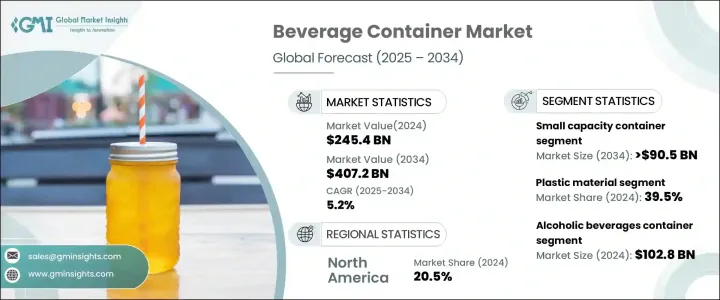
세계의 음료 용기 시장은 2024년 2,454억 달러로 평가되었고, CAGR 5.2%로 성장하여 2034년에는 4,072억 달러에 이를 것으로 예측됩니다.
이 성장은 더 건강한 라이프 스타일로 소비자의 선호도의 변화와 운반에 편리한 음료에 대한 수요 증가로 인한 것입니다. 더 많은 소비자가 달콤한 음료와 탄산 음료로부터 멀어짐에 따라 보존성을 높이고 신선도를 유지하는 신뢰할 수있는 패키징 솔루션에 대한 요구가 커지고 있습니다. 또한 건강 지향 소비자가 환경에 미치는 영향을 줄이는 친환경 소재를 선호하기 때문에 지속 가능한 패키징이 지지를 받고 있습니다. 음료 용기 제조업체는 제품의 수명을 연장하는 UV 컷 소재와 같은 첨단 솔루션으로 혁신을 진행하고 있으며, 식물 유래나 과일 주스의 생산자에게 매력적인 선택이 되고 있습니다.

또한 도시화와 페이스가 빠른 라이프 스타일이 레디 투 드링크의 소비를 뒷받침해, 재활용 가능한 음료 용기 수요가 높아지고 있습니다. 음료 브랜드는 싱글 서브와 휴대용 음료의 취향에 대응하기 위해 재활용 가능한 캔, 종이팩, 파우치를 선택하게 되어 시장 확대를 더욱 뒷받침하고 있습니다. 알루미늄 캔과 유리 병은 그 고급감과 환경면에서의 이점, 규제에 대한 적합성으로부터, 선호되는 패키지 옵션이 되고 있습니다. 제조업체는 또한 제품의 차별화를 강화하기 위해 경량 유리 병과 독특한 패키지 디자인에 주력하고 있습니다.
| 시장 범위 | |
|---|---|
| 시작 연도 | 2024년 |
| 예측 연도 | 2025-2034년 |
| 시작 금액 | 2,454억 달러 |
| 예측 금액 | 4,072억 달러 |
| CAGR | 5.2% |
음료 용기 시장은 용량별로 소용량(250ml 미만), 중용량(250-750ml), 대용량(750ml 이상)으로 구분됩니다. 바쁜 라이프 스타일로 이상적인 서빙 사이즈의 휴대용 음료 용기 수요가 높아지고 있기 때문에 2024년에는 중용량 부문이 1,142억 달러로 우위를 차지했습니다.
이 시장은 재료 유형별로 분류되어 2024년에는 플라스틱이 39.5%의 점유율을 차지합니다. 경량이고 비용 효율이 높고, 재활용 가능이라는 특성에서 플라스틱이 선택되고 있는 한편, 정부의 규제에 의해 재생 PET(rPET) 수요가 높아지고 있습니다. 종이 및 판지 용기는 가장 급성장하고 있는 분야이며, 2034년까지 513억 달러에 달할 것으로 예상되고 있습니다. 테트라팩과 같은 지속 가능한 패키징 솔루션은 까다로운 환경 규제에 부합하며 채택을 촉진합니다.
용도별로 시장은 알코올 음료 용기와 비 알코올 음료 용기로 나뉩니다. 비알코올 음료 분야는 식물성 음료 및 유제품 베이스 음료에 대한 소비자 수요가 증가함에 따라 2034년까지 2,476억 달러에 이를 것으로 예측됩니다. 제조업체는 보존 기간을 연장하고 수송을 용이하게 하는 파우치, 카톤, 페트병을 이용하는 것으로 대응하고 있습니다. 도시화 동향과 싱글 서브 음료에 대한 선호도 증가는 PET 병, 캔, 파우치 등 휴대용 패키징 솔루션의 채용을 촉진하고 있습니다.
지역별로는 지속가능하고 효율적인 포장기술의 강력한 성장으로 북미가 2024년 세계 시장의 20.5%를 차지했습니다. 미국은 다양한 음료 카테고리에서 알루미늄 캔과 종이팩에 대한 소비자의 선호도가 높아지고 있다는 배경으로, 562억 달러로 시장을 선도하고 있습니다. 이 지역의 기업들은 혁신적이고 친환경적인 패키징 솔루션에 주력하고 있으며, 시장 확대를 더욱 강화하고 있습니다.
목차
제1장 조사 방법과 조사 범위
제2장 주요 요약
제3장 업계 인사이트
- 생태계 분석
- 업계에 미치는 영향요인
- 성장 촉진요인
- 알코올 음료 소비 증가
- 지속가능하고 환경친화적인 포장에 관한 정부의 규제
- 편의성과 온 더 고 라이프 스타일
- 소비자의 건강 지향
- 프리미엄화와 브랜드 전략
- 업계의 잠재적 위험 및 과제
- 공급망의 혼란과 물류 문제
- 높은 초기 투자 비용
- 성장 촉진요인
- 성장 가능성 분석
- 규제 상황
- 기술 동향
- 미래 시장 동향
- 갭 분석
- Porter's Five Forces 분석
- PESTEL 분석
제4장 경쟁 구도
- 소개
- 기업 점유율 분석
- 주요 시장 기업의 경쟁 분석
- 경쟁 포지셔닝 매트릭스
- 전략 대시보드
제5장 시장 추계 및 예측 : 용량별, 2021-2034년
- 주요 동향
- 소용량(250ml 이하)
- 중용량(250-750ml)
- 대용량(750ml 이상)
제6장 시장 추계 및 예측 : 재료 유형별, 2021-2034년
- 주요 동향
- 플라스틱
- PET(폴리에틸렌 테레프탈레이트)
- HDPE(고밀도 폴리에틸렌)
- PP(폴리프로필렌)
- 바이오플라스틱
- 유리
- 소다 석회 유리
- 붕규산 유리
- 금속
- 알루미늄
- 스틸
- 종이 및 판지
- 성형 섬유
- 테트라팩 및 무균 판지
- 기타 재료(복합재료 및 세라믹)
제7장 시장 추계 및 예측 : 용도별, 2021-2034년
- 주요 동향
- 알코올 음료
- 맥주
- 와인
- 스피릿
- 무알코올 음료
- 청량음료
- 주스류
- 홍차 및 커피
- 기타
제8장 시장 추계 및 예측 : 지역별, 2021-2034년
- 주요 동향
- 북미
- 미국
- 캐나다
- 유럽
- 독일
- 영국
- 프랑스
- 스페인
- 이탈리아
- 네덜란드
- 아시아태평양
- 중국
- 인도
- 일본
- 호주
- 한국
- 라틴아메리카
- 브라질
- 멕시코
- 아르헨티나
- 중동 및 아프리카
- 사우디아라비아
- 남아프리카
- 아랍에미리트(UAE)
제9장 기업 프로파일
- Amcor
- Ardagh Group
- Ball Corporation
- Baixicans
- Berry Global Group
- CCL Containers
- Ceylon Beverage Can
- CPMC Holdings
- Crown Holdings
- Envases Group
- G3 Enterprises
- Graphic Packaging International
- Nampak
- Novelis
- Orora Packaging
- Scan Holdings
- Showa Aluminum-Can
- Silgan Holdings
- Smurfit Kappa
- Speira
- Stora Enso
- Tetra Pak International
- WestRock
The Global Beverage Container Market was valued at USD 245.4 billion in 2024 and is projected to grow at a CAGR of 5.2%, reaching USD 407.2 billion by 2034. This growth stems from shifting consumer preferences towards healthier lifestyles and a rising demand for convenient, on-the-go beverages. As more consumers move away from sugary and carbonated drinks, there is a growing need for reliable packaging solutions that enhance shelf life and maintain freshness. Additionally, sustainable packaging is gaining traction as health-conscious consumers prioritize eco-friendly materials that reduce environmental impact. Beverage container manufacturers are innovating with advanced solutions like UV-blocking materials that extend product longevity, making them an attractive choice for plant-based and fruit juice producers.
The market is also witnessing increased demand for recyclable beverage containers, driven by urbanization and fast-paced lifestyles that boost the consumption of ready-to-drink options. Beverage brands are increasingly opting for recyclable cans, paperboard cartons, and pouches to cater to single-serve and portable drink preferences, further fueling market expansion. Alcohol consumption is another factor contributing to the market's upward trajectory, with aluminum cans and glass bottles becoming preferred packaging options due to their premium appeal, environmental benefits, and regulatory compliance. Manufacturers are also focusing on lightweight glass bottles and unique packaging designs to enhance product differentiation.
| Market Scope | |
|---|---|
| Start Year | 2024 |
| Forecast Year | 2025-2034 |
| Start Value | $245.4 Billion |
| Forecast Value | $407.2 Billion |
| CAGR | 5.2% |
Based on capacity, the beverage container market is segmented into small (below 250ml), medium (250-750ml), and large (above 750ml). The medium capacity segment dominated in 2024, accounting for USD 114.2 billion, as busy lifestyles increase demand for portable beverage containers with ideal serving sizes.
The market is also classified by material type, with plastic holding 39.5% of the total share in 2024. Lightweight, cost-effective, and recyclable properties make plastic a preferred choice, while government regulations are driving demand for recycled PET (rPET). Paper and paperboard containers represent the fastest-growing segment and are expected to reach USD 51.3 billion by 2034. Sustainable packaging solutions such as tetra packs align with stringent environmental regulations, driving their adoption.
By application, the market is divided into alcoholic and non-alcoholic beverage containers. The non-alcoholic beverage segment is anticipated to reach USD 247.6 billion by 2034, with increasing consumer demand for plant-based and dairy-based drinks. Manufacturers are responding by utilizing pouches, cartons, and PET bottles that extend shelf life and facilitate transportation. Urbanization trends and the growing preference for single-serve beverages are driving the adoption of portable packaging solutions, including PET bottles, cans, and pouches.
Geographically, North America accounted for 20.5% of the global market in 2024, with strong growth in sustainable and efficient packaging technologies. The US led the market with USD 56.2 billion, driven by increasing consumer preference for aluminum cans and paperboard cartons in various beverage categories. Companies in the region are focusing on innovative and eco-friendly packaging solutions, further supporting market expansion.
Table of Contents
Chapter 1 Methodology and Scope
- 1.1 Market scope and definitions
- 1.2 Research design
- 1.2.1 Research approach
- 1.2.2 Data collection methods
- 1.3 Base estimates and calculations
- 1.3.1 Base year calculation
- 1.3.2 Key trends for market estimation
- 1.4 Forecast model
- 1.5 Primary research and validation
- 1.5.1 Primary sources
- 1.5.2 Data mining sources
Chapter 2 Executive Summary
- 2.1 Industry 360° synopsis
Chapter 3 Industry Insights
- 3.1 Industry ecosystem analysis
- 3.2 Industry impact forces
- 3.2.1 Growth drivers
- 3.2.1.1 Increase in Consumption of Alcohol Beverages
- 3.2.1.2 Government Regulation on Sustainable and Eco-friendly Packaging
- 3.2.1.3 Convenience and On-the-go Lifestyle
- 3.2.1.4 Consumer's preference towards healthier lifestyle
- 3.2.1.5 Premiumization and Branding Strategies
- 3.2.2 Industry pitfalls and challenges
- 3.2.2.1 Supply Chain Disruption & Logistics Issue
- 3.2.2.2 High Initial Investment Cost
- 3.2.1 Growth drivers
- 3.3 Growth potential analysis
- 3.4 Regulatory landscape
- 3.5 Technology landscape
- 3.6 Future market trends
- 3.7 Gap analysis
- 3.8 Porter's analysis
- 3.9 PESTEL analysis
Chapter 4 Competitive Landscape, 2024
- 4.1 Introduction
- 4.2 Company market share analysis
- 4.3 Competitive analysis of major market players
- 4.4 Competitive positioning matrix
- 4.5 Strategy dashboard
Chapter 5 Market Estimates and Forecast, By Capacity, 2021 – 2034 (USD Bn & Units)
- 5.1 Key trends
- 5.2 Small (below 250 ml)
- 5.3 Medium (250–750 ml)
- 5.4 Large (above 750 ml)
Chapter 6 Market Estimates and Forecast, By Material Type, 2021 – 2034 (USD Bn & Units)
- 6.1 Key trends
- 6.2 Plastic
- 6.2.1 PET (Polyethylene Terephthalate)
- 6.2.2 HDPE (High-Density Polyethylene)
- 6.2.3 PP (Polypropylene)
- 6.2.4 Bioplastics
- 6.3 Glass
- 6.3.1 Soda-lime glass
- 6.3.2 Borosilicate glass
- 6.4 Metal
- 6.4.1 Aluminum
- 6.4.2 Steel (Tinplate)
- 6.5 Paper and Paperboad
- 6.5.1 Molded fiber
- 6.5.2 Tetra Pak & aseptic cartons
- 6.6 Other Materials (Composite materials and Ceramic)
Chapter 7 Market Estimates and Forecast, By Application, 2021 – 2034 (USD Bn & Units)
- 7.1 Key trends
- 7.2 Alcoholic beverages
- 7.2.1 Beer
- 7.2.2 Wine
- 7.2.3 Spirits
- 7.3 Non-alcoholic beverages
- 7.3.1 Soft drinks
- 7.3.2 Juices
- 7.3.3 Teas and coffee
- 7.3.4 Others
Chapter 8 Market Estimates and Forecast, By Region, 2021 – 2034 (USD Bn & Units)
- 8.1 Key trends
- 8.2 North America
- 8.2.1 U.S.
- 8.2.2 Canada
- 8.3 Europe
- 8.3.1 Germany
- 8.3.2 UK
- 8.3.3 France
- 8.3.4 Spain
- 8.3.5 Italy
- 8.3.6 Netherlands
- 8.4 Asia Pacific
- 8.4.1 China
- 8.4.2 India
- 8.4.3 Japan
- 8.4.4 Australia
- 8.4.5 South Korea
- 8.5 Latin America
- 8.5.1 Brazil
- 8.5.2 Mexico
- 8.5.3 Argentina
- 8.6 Middle East and Africa
- 8.6.1 Saudi Arabia
- 8.6.2 South Africa
- 8.6.3 UAE
Chapter 9 Company Profiles
- 9.1 Amcor
- 9.2 Ardagh Group
- 9.3 Ball Corporation
- 9.4 Baixicans
- 9.5 Berry Global Group
- 9.6 CCL Containers
- 9.7 Ceylon Beverage Can
- 9.8 CPMC Holdings
- 9.9 Crown Holdings
- 9.10 Envases Group
- 9.11 G3 Enterprises
- 9.12 Graphic Packaging International
- 9.13 Nampak
- 9.14 Novelis
- 9.15 Orora Packaging
- 9.16 Scan Holdings
- 9.17 Showa Aluminum-Can
- 9.18 Silgan Holdings
- 9.19 Smurfit Kappa
- 9.20 Speira
- 9.21 Stora Enso
- 9.22 Tetra Pak International
- 9.23 WestRock