|
시장보고서
상품코드
1928913
콜드체인 물류 시장 기회, 성장요인, 업계 동향 분석 및 예측(2026-2035년)Cold Chain Logistics Market Opportunity, Growth Drivers, Industry Trend Analysis, and Forecast 2026 - 2035 |
||||||

콜드체인 물류 시장은 2025년에 3,823억 달러로 평가되었고, 2035년까지 연평균 복합 성장률(CAGR) 13.8%로 성장하여 1조 3,700억 달러에 이를 것으로 예측됩니다.
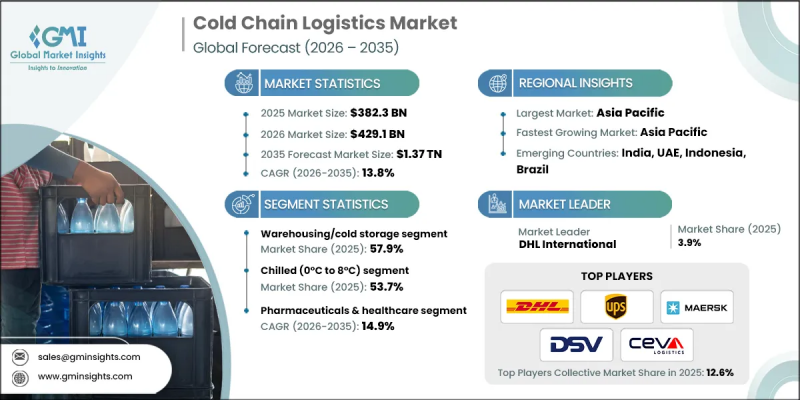
업계 관계자에 따르면, 국제 무역의 확대는 온도 관리형 공급망을 전문으로 하는 물류 사업자에게 큰 기회를 창출하고 있다고 합니다. 이전에는 물류 인프라가 미비하여 많은 수입국에서 정밀한 온도 조건을 필요로 하는 상품을 취급하는 데 제약이 있었습니다. 이 격차는 시장 진입을 제한하고 제품 손실을 증가시키는 원인이 되었습니다. 그러나 온도에 민감한 상품과 신선식품을 취급하는 업계가 첨단 콜드체인 솔루션에 대한 의존도가 높아지면서 상황이 바뀌고 있습니다. 세계 보건 위기는 신뢰할 수 있는 온도 관리의 중요성을 부각시켰고, 여러 지역에서 구조적인 문제를 보여주었습니다. 현재 콜드체인 시스템은 민감한 소재를 다루는 다양한 분야에서 필수적인 기반으로 널리 인식되고 있습니다. 동시에, 기존의 냉장 방식이 높은 에너지 소비와 환경 부하를 수반하기 때문에 지속가능성이 핵심 우선순위로 떠오르고 있습니다. 그 결과, 공급업체들은 에너지 효율이 높은 기술, 대체 동력 시스템, 환경 부하가 적은 냉각 솔루션을 도입하고 있습니다. 지역별로 보면, 아시아태평양은 강력한 제조거점과 투자 증가에 힘입어 주요 시장으로 간주되며 예측 기간 동안 견조한 성장세를 유지할 것으로 예측됩니다.
| 시장 범위 | |
|---|---|
| 개시 연도 | 2025년 |
| 예측 기간 | 2026-2035년 |
| 개시 연도 가치 | 3,823억 달러 |
| 예측 금액 | 1조 3,700억 달러 |
| CAGR | 13.8% |
2025년 창고 및 냉장 보관 부문은 2,212억 달러로 콜드체인 물류 산업의 구조적 기반이 될 것으로 예측됩니다. 온도관리형 저장시설은 많은 초기 투자비용과 긴 운영 수명을 필요로 하며, 냉장 운송 네트워크가 효율적으로 작동하기 위해서는 먼저 냉장 운송 네트워크가 구축되어야 합니다. 이러한 시설을 통해 제품을 장기간 안정적으로 보관할 수 있으며, 운송 중에만 수익을 창출하는 운송 서비스에 비해 단위당 가치 창출이 높습니다.
0°C에서 8°C 범위에서 운영되는 냉장 온도 카테고리는 2025년 53.7%의 점유율을 차지하며 2035년까지 7,199억 달러에 달할 것으로 예측됩니다. 이 온도대는 얼지 않고 신선도를 유지해야 하는 제품에 적합하기 때문에 시장에서 가장 큰 비중을 차지할 것으로 예측됩니다. 이러한 상품에 대한 세계 수요가 지속되면서 유통 채널 전반에서 냉장 물류 솔루션의 견조한 성장이 뒷받침되고 있습니다.
미국 콜드체인 물류 시장은 2025년 1,052억 달러 규모를 기록할 것으로 예측됩니다. 중국은 세계 물류 시장에서 지속적으로 선도적인 위치를 유지하고 있습니다. 성장을 뒷받침하는 것은 디지털 커머스 모델의 확장입니다. 이를 통해 도심에 가까운 온도 관리 시설의 정비가 진행되어 라스트 마일 능력이 강화되고 있습니다. 또한, 엄격한 온도 관리 요건을 충족하기 위해 첨단 냉장 운송 수단 및 특수 보관 시스템에 대한 투자도 증가하고 있습니다.
자주 묻는 질문
목차
제1장 조사 방법
제2장 주요 요약
제3장 업계 인사이트
- 생태계 분석
- 공급업체 상황
- 이익률
- 비용 구조
- 각 단계 부가가치
- 밸류체인에 영향을 미치는 요인
- 파괴적 변화
- 업계에 대한 영향요인
- 성장 촉진요인
- 신선식품에 대한 수요 증가
- 의약품 및 백신 유통 확대
- 온도 관리가 필요한 상품 국제 무역 확대
- 냉동식품 및 레디밀(Ready Meal) 보급 확대
- 업계의 잠재적 리스크&과제
- 개발도상 지역 콜드체인 인프라 부족
- 에너지 집약형 업무와 전력 공급 신뢰성에 관한 과제
- 시장 기회
- 신흥 시장 급속한 콜드체인 인프라 정비
- 바이오의약품 및 특수 의약품 수요 증가
- 소비지 근교 냉장 창고 시설 확충
- 전자상거래 및 온라인 식료품 플랫폼 성장
- 성장 촉진요인
- 성장 가능성 분석
- 규제 상황
- 북미
- 식품 안전 현대화 법(FSMA)
- FDA 현행 적정 제조 기준(cGMP)
- 의약품 공급 체인 안전법(DSCSA)
- CDC 백신 보관·취급해 가이드라인
- 유럽
- EU적정 유통 기준(GDP) 가이드라인
- 유럽연합 일반 식품법(EC규칙178/2002)
- 유럽 약전 온도 요건
- 아시아태평양
- ASEAN·일본 콜드체인 물류 가이드라인
- ISO 23412-저온 유통 서비스 사양
- IATA 신선 화물 규칙(PCR)
- 라틴아메리카
- FSSC 22000-식품 안전 매니지먼트
- BRCGS 식품 안전 세계의 기준
- SQF(세이프·퀄리티·후드)
- 중동 및 아프리카
- 사우디아라비아 식품 의약품청GDP
- 국가 식품 안전 및 콜드체인 운송 규제
- 북미
- Porter의 Five Forces 분석
- PESTEL 분석
- 기술과 혁신 동향
- 현재 기술 동향
- 신기술
- 비용 내역 분석
- 지속가능성과 환경 영향
- 환경 영향 평가
- 사회적 영향과 지역사회에의 기여
- 거버넌스와 기업 사회적 책임
- 지속가능금융과 투자 동향
- 사례 연구
- 온도 감시 및 품질 보증 시스템
- 리스크 관리와 운영상 과제
- 네트워크 설계 및 용량 계획 분석
- 라스트 마일·콜드체인과 도시 배송
제4장 경쟁 구도
- 서론
- 기업의 시장 점유율 분석
- 북미
- 유럽
- 아시아태평양
- 라틴아메리카
- 중동 및 아프리카
- 주요 시장 기업의 경쟁 분석
- 경쟁 포지셔닝 매트릭스
- 전략적 전망 매트릭스
- 주요 발전
- 인수합병(M&A)
- 제휴 및 협업
- 신제품 발매
- 사업 확대 계획과 자금조달
제5장 시장 추산·예측 : 서비스별, 2022-2035
- 창고 보관/냉장 보관
- 공공 창고업
- 프라이빗 창고
- 운송
- 철도
- 항공수송
- 도로
- 수로
- 부가가치형 콜드체인 서비스
제6장 시장 추산·예측 : 온도 범위별, 2022-2035
- 냉장(0оC-8оC)
- 냉동(-18℃--25℃)
- 초저온 냉동(-25℃--60℃이하)
제7장 시장 추산·예측 : 용도별, 2022-2035
- 식품 및 음료
- 과일 및 채소
- 유제품 및 냉동 디저트
- 육류, 가금류, 수산물
- 베이커리 및 제과
- 음료
- 레토르트 식품/가공식품
- 의약품 및 헬스케어
- 화학제품 및 특수 재료
- 기타 용도
제8장 시장 추산·예측 : 목적지별, 2022-2035
- 국내
- 국제
제9장 시장 추산·예측 : 최종 용도별, 2022-2035
- 식품 소매업체 및 슈퍼마켓
- 식품 가공업자 및 제조업체
- 제약 기업 및 바이오테크놀러지 기업
- 전자상거래 플랫폼
- 기타
제10장 시장 추산·예측 : 지역별, 2022-2035
- 북미
- 미국
- 캐나다
- 유럽
- 독일
- 영국
- 프랑스
- 이탈리아
- 스페인
- 러시아
- 북유럽 국가
- 베네룩스
- 아시아태평양
- 중국
- 인도
- 일본
- 한국
- ANZ
- 싱가포르
- 말레이시아
- 인도네시아
- 베트남
- 태국
- 라틴아메리카
- 브라질
- 멕시코
- 아르헨티나
- 콜롬비아
- 중동 및 아프리카
- 남아프리카공화국
- 사우디아라비아
- 아랍에미리트(UAE)
제11장 기업 개요
- 세계 기업
- Lineage Logistics
- Americold Logistics
- DHL International
- Kuehne+Nagel
- Maersk
- United Parcel Service(UPS)
- FedEx
- DSV
- C.H. Robinson
- CEVA Logistics
- Nippon Express
- XPO Logistics
- Kerry Logistics
- Yusen Logistics
- Bollore Logistics
- Agility Logistics
- 지역 기업 뉴 콜드/Nichirei Corporation 물류/바리스로지스티크스/프리파드후리
- NewCold
- Nichirei Logistics
- Burris Logistics
- Preferred Freezer Services
- 신규 기업
- Snowman Logistics
- Celsius Logistics
- Tippmann
- CJ Logistics
The Cold Chain Logistics Market was valued at USD 382.3 billion in 2025 and is estimated to grow at a CAGR of 13.8% to reach USD 1.37 trillion by 2035.
Industry participants state that rising international trade has unlocked significant opportunities for logistics providers specializing in temperature-controlled supply chains. In earlier years, many importing nations faced limitations in handling goods requiring precise thermal conditions due to an underdeveloped logistics infrastructure. This gap restricted market access and increased product losses. The situation has shifted as industries dealing with temperature-sensitive and perishable commodities increasingly rely on advanced cold chain solutions. Global health events highlighted the importance of reliable temperature management, revealing structural gaps in several regions. Cold chain systems are now widely recognized as critical enablers across multiple sectors handling sensitive materials. At the same time, sustainability has emerged as a central priority, as conventional refrigeration methods are associated with high energy usage and environmental impact. As a result, providers are adopting energy-efficient technologies, alternative power systems, and low-impact cooling solutions. From a regional perspective, Asia Pacific is viewed as the leading market, supported by a strong manufacturing base and rising investments, and it is expected to maintain strong growth momentum over the forecast period.
| Market Scope | |
|---|---|
| Start Year | 2025 |
| Forecast Year | 2026-2035 |
| Start Value | $382.3 Billion |
| Forecast Value | $1.37 Trillion |
| CAGR | 13.8% |
In 2025, the warehousing and cold storage segment accounted for USD 221.2 billion and is regarded as the structural backbone of the cold chain logistics industry. Temperature-controlled storage facilities require high upfront investment and long operational lifespans, and they must be established before refrigerated transport networks can function efficiently. These facilities allow products to remain stable over extended periods, which results in higher value generation per unit when compared with transportation services that only generate revenue during movement.
The chilled temperature category, operating between 0°C and 8°C, represented a 53.7% share in 2025 and is projected to reach USD 719.9 billion by 2035. This range is considered the largest portion of the market due to its suitability for products that require freshness without freezing. Continuous global demand for such goods is sustaining strong growth for chilled logistics solutions across distribution channels.
U.S. Cold Chain Logistics Market generated USD 105.2 billion in 2025. The country continues to hold a dominant position within the global logistics landscape. Growth is being supported by the expansion of digital commerce models, which is encouraging the development of temperature-controlled facilities closer to urban centers and enhancing last-mile capabilities. Additional investments are being directed toward advanced refrigerated transport and specialized storage systems designed to meet strict temperature compliance requirements.
Key companies active in the Global Cold Chain Logistics Market include Lineage Logistics, DHL International, NewCold, United Parcel Service (UPS), Americold Logistics, Maersk, U.S. Cold Storage, CEVA Logistics, DSV, and C.H. Robinson Worldwide. Companies operating in the Global Cold Chain Logistics Market are reinforcing their competitive positions through network expansion, technology integration, and strategic collaborations. Many players are investing heavily in automated and digitally enabled storage facilities to improve efficiency, traceability, and reliability. Fleet modernization, including the adoption of energy-efficient transportation assets, is being prioritized to lower operating costs and meet sustainability goals.
Table of Contents
Chapter 1 Methodology
- 1.1 Research approach
- 1.2 Quality commitments
- 1.2.1 GMI AI policy & data integrity commitment
- 1.3 Research trail & confidence scoring
- 1.3.1 Research trail components
- 1.3.2 Scoring components
- 1.4 Data collection
- 1.4.1 Partial list of primary sources
- 1.5 Data mining sources
- 1.5.1 Paid sources
- 1.6 Base estimates and calculations
- 1.6.1 Base year calculation
- 1.7 Forecast model
- 1.8 Research transparency addendum
Chapter 2 Executive Summary
- 2.1 Industry 360° synopsis
- 2.2 Key market trends
- 2.2.1 Regional
- 2.2.2 Service
- 2.2.3 Temperature Range
- 2.2.4 Application
- 2.2.5 Destination
- 2.2.6 End Use
- 2.3 TAM analysis, 2026-2035
- 2.4 CXO perspectives: Strategic imperatives
- 2.4.1 Executive decision points
- 2.4.2 Critical success factors
- 2.5 Future outlook and recommendations
Chapter 3 Industry Insights
- 3.1 Industry ecosystem analysis
- 3.1.1 Supplier landscape
- 3.1.2 Profit margin
- 3.1.3 Cost structure
- 3.1.4 Value addition at each stage
- 3.1.5 Factor affecting the value chain
- 3.1.6 Disruptions
- 3.2 Industry impact forces
- 3.2.1 Growth drivers
- 3.2.1.1 Growing demand for perishable food products
- 3.2.1.2 Expansion of pharmaceutical and vaccine distribution
- 3.2.1.3 Rising global trade of temperature-sensitive goods
- 3.2.1.4 Increasing adoption of frozen and ready-to-eat foods
- 3.2.2 Industry pitfalls and challenges
- 3.2.2.1 Lack of cold chain infrastructure in developing regions
- 3.2.2.2 Energy-intensive operations and power reliability issues
- 3.2.3 Market opportunities
- 3.2.3.1 Rapid cold chain infrastructure development in emerging markets
- 3.2.3.2 Increasing demand for biologics and specialty pharmaceuticals
- 3.2.3.3 Expansion of cold storage facilities near consumption centers
- 3.2.3.4 Growth of e-commerce and online grocery platforms
- 3.2.1 Growth drivers
- 3.3 Growth potential analysis
- 3.4 Regulatory landscape
- 3.4.1 North America
- 3.4.1.1 Food Safety Modernization Act (FSMA)
- 3.4.1.2 FDA Current Good Manufacturing Practice (cGMP)
- 3.4.1.3 Drug Supply Chain Security Act (DSCSA)
- 3.4.1.4 CDC Vaccine Storage and Handling Guidelines
- 3.4.2 Europe
- 3.4.2.1 EU Good Distribution Practice (GDP) Guidelines
- 3.4.2.2 European Union General Food Law (Regulation EC 178/2002)
- 3.4.2.3 European Pharmacopoeia temperature requirements
- 3.4.3 Asia Pacific
- 3.4.3.1 ASEAN Japan Cold Chain Logistics Guidelines
- 3.4.3.2 ISO 23412 - Cold chain service specifications
- 3.4.3.3 IATA Perishable Cargo Regulations (PCR)
- 3.4.4 Latin America
- 3.4.4.1 FSSC 22000 - food safety management
- 3.4.4.2 BRCGS Food Safety Global Standard
- 3.4.4.3 SQF (Safe Quality Food)
- 3.4.5 Middle East & Africa
- 3.4.5.1 Saudi Food and Drug Authority GDP
- 3.4.5.2 National food safety and cold chain transport regulations
- 3.4.1 North America
- 3.5 Porter';s analysis
- 3.6 PESTEL analysis
- 3.7 Technology and innovation landscape
- 3.7.1 Current technological trends
- 3.7.2 Emerging technologies
- 3.8 Cost breakdown analysis
- 3.9 Sustainability and environmental impact
- 3.9.1 Environmental impact assessment
- 3.9.2 Social impact & community benefits
- 3.9.3 Governance & corporate responsibility
- 3.9.4 Sustainable finance & investment trends
- 3.10 Case studies
- 3.11 Temperature monitoring and quality assurance systems
- 3.12 Risk management and operational challenges
- 3.13 Network Design & Capacity Planning Analysis
- 3.14 Last-Mile Cold Chain & Urban Distribution
Chapter 4 Competitive Landscape, 2025
- 4.1 Introduction
- 4.2 Company market share analysis
- 4.2.1 North America
- 4.2.2 Europe
- 4.2.3 Asia Pacific
- 4.2.4 LATAM
- 4.2.5 MEA
- 4.3 Competitive analysis of major market players
- 4.4 Competitive positioning matrix
- 4.5 Strategic outlook matrix
- 4.6 Key developments
- 4.6.1 Mergers & acquisitions
- 4.6.2 Partnerships & collaborations
- 4.6.3 New product launches
- 4.6.4 Expansion plans and funding
Chapter 5 Market Estimates & Forecast, By Service, 2022 - 2035 ($Bn)
- 5.1 Key trends
- 5.2 Warehousing/Cold Storage
- 5.2.1 Public Warehousing
- 5.2.2 Private Warehousing
- 5.3 Transportation
- 5.3.1 Railways
- 5.3.2 Airways
- 5.3.3 Roadways
- 5.3.4 Waterways
- 5.4 Value-Added Cold Chain Services
Chapter 6 Market Estimates & Forecast, By Temperature Range, 2022 - 2035 ($Bn)
- 6.1 Key trends
- 6.2 Chilled (0°C to 8°C)
- 6.3 Frozen (-18°C to -25°C)
- 6.4 Deep Frozen (-25°C to -60°C or less)
Chapter 7 Market Estimates & Forecast, By Application, 2022 - 2035 ($Bn)
- 7.1 Key trends
- 7.2 Food & Beverage
- 7.2.1 Fruits & vegetables
- 7.2.2 Dairy & frozen desserts
- 7.2.3 Meat, Poultry & Seafood
- 7.2.4 Bakery & Confectionery
- 7.2.5 Beverages
- 7.2.6 Ready-to-Eat Meals / Processed Foods
- 7.3 Pharmaceuticals & Healthcare
- 7.4 Chemicals & Specialty Materials
- 7.5 Other applications
Chapter 8 Market Estimates & Forecast, By Destination, 2022 - 2035 ($Bn)
- 8.1 Key trends
- 8.2 Domestic
- 8.3 International
Chapter 9 Market Estimates & Forecast, By End Use, 2022 - 2035 ($Bn)
- 9.1 Key trends
- 9.2 Food Retailers & Supermarkets
- 9.3 Food Processors & Manufacturers
- 9.4 Pharmaceutical & Biotech Companies
- 9.5 E-Commerce Platforms
- 9.6 Others
Chapter 10 Market Estimates & Forecast, By Region, 2022 - 2035 ($Bn)
- 10.1 Key trends
- 10.2 North America
- 10.2.1 US
- 10.2.2 Canada
- 10.3 Europe
- 10.3.1 Germany
- 10.3.2 UK
- 10.3.3 France
- 10.3.4 Italy
- 10.3.5 Spain
- 10.3.6 Russia
- 10.3.7 Nordics
- 10.3.8 Benelux
- 10.4 Asia Pacific
- 10.4.1 China
- 10.4.2 India
- 10.4.3 Japan
- 10.4.4 South Korea
- 10.4.5 ANZ
- 10.4.6 Singapore
- 10.4.7 Malaysia
- 10.4.8 Indonesia
- 10.4.9 Vietnam
- 10.4.10 Thailand
- 10.5 Latin America
- 10.5.1 Brazil
- 10.5.2 Mexico
- 10.5.3 Argentina
- 10.5.4 Colombia
- 10.6 MEA
- 10.6.1 South Africa
- 10.6.2 Saudi Arabia
- 10.6.3 UAE
Chapter 11 Company Profiles
- 11.1 Global companies
- 11.1.1 Lineage Logistics
- 11.1.2 Americold Logistics
- 11.1.3 DHL International
- 11.1.4 Kuehne + Nagel
- 11.1.5 Maersk
- 11.1.6 United Parcel Service (UPS)
- 11.1.7 FedEx
- 11.1.8 DSV
- 11.1.9 C.H. Robinson
- 11.1.10 CEVA Logistics
- 11.1.11 Nippon Express
- 11.1.12 XPO Logistics
- 11.1.13 Kerry Logistics
- 11.1.14 Yusen Logistics
- 11.1.15 Bollore Logistics
- 11.1.16 Agility Logistics
- 11.2 Regional companies
- 11.2.1 NewCold
- 11.2.2 Nichirei Logistics
- 11.2.3 Burris Logistics
- 11.2.4 Preferred Freezer Services
- 11.3 Emerging companies
- 11.3.1 Snowman Logistics
- 11.3.2 Celsius Logistics
- 11.3.3 Tippmann
- 11.3.4 CJ Logistics