
|
시장보고서
상품코드
1906259
인도네시아의 콜드체인 물류 : 시장 점유율 분석, 업계 동향과 통계, 성장 예측(2026-2031년)Indonesia Cold Chain Logistics - Market Share Analysis, Industry Trends & Statistics, Growth Forecasts (2026 - 2031) |
||||||
 Mordor Intelligence
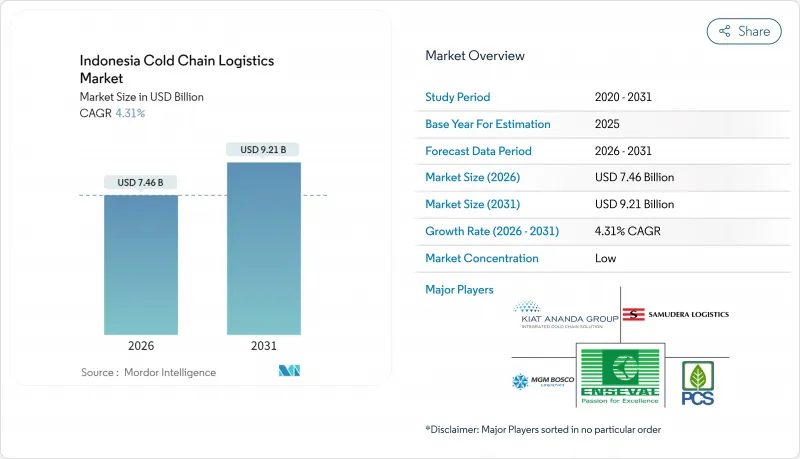
인도네시아의 콜드체인 물류시장은 2025년 71억 5,000만 달러로 평가되었고, 2026년 74억 6,000만 달러에서 2031년까지 92억 1,000만 달러에 이를 것으로 보입니다. 예측기간(2026-2031년)의 CAGR은 4.31%를 나타낼 전망입니다.
시장의 상승세는 인도네시아가 물류 인프라 현대화, 전국적 유통 비용 절감, 고부가가치 신선식품의 신규 수출 경로 개척을 위해 기울인 노력을 반영합니다. 정부의 ‘시나스로그(SiNasLog)’ 프로그램은 2024년 물류 비용을 GDP 대비 14.29%로 낮추었으며 2045년까지 8%를 목표로 삼아 성장 동력을 강화하고 있습니다. 급속한 전자식료품 시장 확대, 수산물 수출 급증, 전국적 백신 유통으로 인해 온도 조절 저장 시설과 부가가치 서비스 수요가 증가했습니다. 기업들은 신뢰성 향상, 할랄 인증 규정 충족, 전력망 미연결 섬 지역까지 서비스 확대를 위해 IoT 센서, 블록체인 추적 시스템, 태양광 마이크로 냉장고에 투자하고 있습니다. 항만 디지털화와 냉동화물 친화적 선박 업그레이드는 인도네시아의 지역 냉장 물류 허브 역할을 더욱 공고히 합니다.
인도네시아의 콜드체인 물류시장 동향 및 인사이트
냉동 수산물 및 육류 수출 급증
인도네시아는 여전히 세계 2위의 어업 생산국이며, 해양수산부는 프리미엄 수출 시장을 충족시키기 위해 양식 기준을 업그레이드하고 있습니다. 수마트라와 술라웨시에 신설된 냉장 저장 시설은 수출 리드 타임을 단축시켜 가공업체들이 미국 및 EU의 온도 프로토콜을 준수할 수 있도록 지원합니다. 미국으로 월 160만 개의 달걀을 수출하는 최근 계약은 인증된 냉장 처리가 필요한 단백질 수출량 증가를 보여줍니다. 통합 품질 보증 플랫폼은 IoT 센서와 블록체인을 결합해 관리 이력 데이터를 보호하여 구매자 신뢰도와 가격 결정력을 높입니다. 걸프 시장에서 검증된 할랄 해산물 수요가 증가함에 따라 수출 지향 가공업체들은 정부 규정 42/2024를 준수하는 전용 할랄 전용 냉장실을 추가하고 있습니다. 이러한 투자는 국제 운송사들이 추가 냉장 컨테이너 선박 운항을 계획하도록 유도함으로써 인도네시아 콜드체인 물류 시장을 확대하고 있습니다.
온라인 식료품 및 라스트마일 냉장 배송 붐
인도네시아의 전자상거래 시장 규모는 2024년 587억 달러에서 2028년 868억 1,000만 달러로 급성장할 것으로 예상되며, 특히 식료품 카테고리가 현저한 성장세를 보이고 있습니다. 온라인 쇼핑객들은 신선 및 냉동 식품이 24시간 이내에 배송되기를 기대하며, 이로 인해 플랫폼들은 밀집된 도시 지역에 다크 스토어, 크로스독 마이크로 허브, 냉장 이륜차 배송망을 구축해야 합니다. 2023년 제정된 장관령 31호는 허가 절차를 간소화하여 스타트업들이 냉장 배송 서비스를 더 빠르게 출시할 수 있도록 했습니다. NCS와 같은 대형 택배 통합업체들은 현재 주문 피킹 시 ±1°C 정밀도를 유지하는 자체 개발 WMS(창고 관리 시스템)를 갖춘 160개의 다목적 창고를 운영 중입니다. 첨단 온도 프로브는 실시간 경보를 라이더의 휴대 기기로 전송해 상품 변질을 방지하고 소비자 신뢰를 강화합니다. 이러한 역학은 인도네시아 콜드체인 물류 시장에 새로운 자본을 유입시키고, 무공해 도시 물류 실현을 위한 배터리 구동 냉장 자전거 실험을 촉진하고 있습니다.
급등하는 전력 및 디젤 연료비
냉장 창고는 엄청난 전력을 소비하지만 2024년 전력 요금과 발전기 디젤 가격이 상승하며 운영사 마진을 압박했습니다. 트럭용 바이오디젤 프로그램이 B35 혼합유로 확대되었으나, 고정식 창고는 여전히 화석 연료 기반 전기에 의존합니다. 프라보워 대통령의 15년 내 석탄발전소 폐쇄 공약은 75GW의 신규 재생에너지 설비가 필요하나, 절차적 지연으로 증설이 더딥니다. 태양광 냉각기는 유망하다 : 현지 제작 장비 단가는 2,682달러이며 백신 보관에 적합한 0.69의 성능계수를 제공합니다. 그러나 자금 조달 장벽과 토지 임대 복잡성으로 대규모 보급이 제한됩니다. 따라서 저탄소 전력이 더 널리 보급되기 전까지는 높은 에너지 비용이 인도네시아 콜드체인 물류 시장 확장을 억제할 전망입니다.
부문 분석
2025년 시점에서 냉장 저장은 인도네시아의 콜드체인 물류 시장의 53.40%를 차지하고 있으며 국가 식량 안보 비축의 기반이 되고 있습니다. 정부의 쌀, 계란, 수산물 비축을 위해 자카르타, 수라바야, 메단 인근에 대량 냉장 창고가 필요하며, 이는 전략적 비축 물량이 수출 준비 상태를 유지하고 인플레이션에 대비할 수 있도록 보장합니다. 운영사들은 키갈리 협약 기준 준수를 위해 암모니아 또는 CO2 시스템으로 시설을 개조하고 있으며, 디지털 트윈 기술은 공기 흐름 패턴을 최적화하여 에너지 사용량을 전년 대비 8% 절감합니다. 블록체인 통합은 할랄 수출 화물의 제품 진위성을 검증하여 목적지 항구에서의 통관 시간을 단축합니다.
부가가치 서비스는 CAGR 4.73%로 확대되고 있으며, 제조업자는 기존 자사에서 하고 있던 라벨링, 소분, 품질 보증 작업을 외부 위탁하고 있습니다. 규제 42/2024에 의해 할랄 제품과 비할랄 제품의 별도 라인화가 의무화되어 분리 보관실이나 인정 검사원 수요가 급증. 이것은 제3자물류(3PL) 사업자에게 호기심이되었습니다. 운송 분야에서는 단열 사양의 경질 박스와 GPS 연동 센서를 도입한 도로 운송업자가 주도하여 온도 기록의 98.35%를 실시간으로 업로드. 시장 점유율은 여전히 큰 것 분산 상태가 계속되고 있습니다. 해상 운송은 삼델라 인도네시아의 2억 8,000만 달러 규모의 선박 확충에 의해 마카사르에서 중국으로의 피더편이 강화되어 수요가 증가하고 있습니다. 항공화물의 프리미엄 분야는 DHL의 홍콩-자카르타 직항편의 운항에 의해 고가치 생물 제제의 배송 시간이 단축되어 더욱 강화되고 있습니다. 이러한 서비스 혁신이 결합되어 인도네시아의 콜드체인 물류 시장에서 경쟁 경계가 재구성되고 있습니다.
기타 혜택 :
- 엑셀 형식 시장 예측(ME) 시트
- 애널리스트의 3개월간 지원
자주 묻는 질문
목차
제1장 서론
- 조사의 전제조건과 시장의 정의
- 조사 범위
제2장 조사 방법
제3장 주요 요약
제4장 시장 상황
- 시장 개요
- 시장 성장 촉진요인
- 냉동 수산물 및 육류 수출 급증
- 전자상거래 식료품 및 냉장 배송 붐
- 정부의 「SiNasLog」물류 인프라 정비 추진
- 의약품 콜드체인 확대(백신/생물학적 제제)
- 수출용 할랄 인증 콜드체인 수요
- 오프 그리드 아일랜드의 태양광 발전식 마이크로 냉장 창고
- 시장 성장 억제요인
- 급등하는 전력 및 디젤 연료 비용
- 자바 회랑 외부 지역에서의 용량 격차
- 인증된 냉장 트럭 운전사 부족
- 키갈리 냉매 단계적 삭감에 따른 개조 비용
- 가치/공급망 분석
- 규제 상황
- 정부의 규제와 시책
- 할랄 기준과 인증의 영향
- 기술의 전망
- Porter's Five Forces 분석
- 신규 참가업체의 위협
- 구매자의 협상력
- 공급기업의 협상력
- 대체품의 위협
- 경쟁 기업간 경쟁 관계
- 업계 밸류 체인/서플라이 체인 분석
제5장 시장 규모와 성장 예측
- 서비스 유형별
- 냉장 저장
- 공공 창고
- 개인 창고
- 냉장 운송
- 도로
- 철도
- 해상
- 항공
- 부가가치 서비스
- 냉장 저장
- 온도 유형별
- 냉장(0-5℃)
- 냉동(-18-0℃)
- 상온
- 초저온 냉동(-20℃ 미만)
- 용도별
- 과일 및 야채
- 육류 및 가금류
- 해산물
- 유제품 및 냉동 디저트
- 베이커리 및 과자류
- 레토르트 식품
- 의약품 및 생물 제제
- 백신 및 임상시험용 자재
- 화학제품 및 특수재료
- 기타 신선품
- 지역별(인도네시아)
- 자바(자카르타 및 BOD)
- 수마트라
- 칼리만탄
- 술라웨시
- 발리, 누사, 툰가라 주
- 기타
제6장 경쟁 구도
- 시장 집중도
- 전략적 동향
- 시장 점유율 분석
- 기업 프로파일
- Kiat Ananda Group
- Enseval Putera Megatrading Tbk
- MGM Bosco Logistics
- Samudera Logistics
- Pluit Cold Storage
- PT International Mega Sejahtera
- PT YCH Indonesia
- PT Wira Logitama Saksama
- DHL Supply Chain Indonesia
- PT BGR Logistik Indonesia
- PT Wahana Cold Storage
- Yusen Logistics
- Ninja Xpress
- Nippon Express
- PT Tira Cipta Logistik(TCL)
- CKL Indonesia Raya(CKL Cargo)
- PT Perishable Logistics Indonesia(PLI)
- PT Mitsubishi Logistics Indonesia
- JAS Worldwide
- Coolkas
제7장 시장 기회와 장래의 전망
제8장 부록
- 냉장 저장 시설의 연간 통계
- 냉동 식품 제품의 수출입 무역 데이터
- 식품의 운송 및 보관에 관한 규제 프레임워크
- 식품 및 음료 부문 지표
The Indonesia Cold Chain Logistics Market was valued at USD 7.15 billion in 2025 and estimated to grow from USD 7.46 billion in 2026 to reach USD 9.21 billion by 2031, at a CAGR of 4.31% during the forecast period (2026-2031).
The market's upward trajectory reflects Indonesia's efforts to modernize logistics infrastructure, lower nationwide distribution costs, and unlock new export channels for high-value perishable goods. Growth momentum is reinforced by the government's SiNasLog program, which reduced logistics costs to 14.29% of GDP in 2024 and is targeting 8% by 2045. Rapid e-grocery adoption, surging seafood exports, and nationwide vaccine distribution have pushed up demand for temperature-controlled storage and value-added services. Companies are investing in IoT sensors, blockchain traceability, and solar-powered micro cold stores to improve reliability, meet halal certification rules, and extend reach to off-grid islands. Digitalization of ports and reefer-friendly vessel upgrades further strengthen Indonesia's role as a regional refrigeration hub.
Indonesia Cold Chain Logistics Market Trends and Insights
Surge in Frozen Seafood & Meat Exports
Indonesia remains the world's second-largest fisheries producer, and the Ministry of Marine Affairs and Fisheries is upgrading aquaculture standards to satisfy premium export markets. New cold storage nodes on Sumatra and Sulawesi shorten export lead times, helping processors meet U.S. and EU temperature protocols. A recent deal to ship 1.6 million eggs monthly to the United States underlines rising protein export volumes that need certified refrigerated handling. Integrated quality-assurance platforms combine IoT sensors and blockchain to secure chain-of-custody data, boosting buyer confidence and pricing power. As demand for verified halal seafood rises in Gulf markets, export-oriented processors are adding dedicated halal-only cold rooms compliant with Government Regulation 42/2024. These investments broaden the Indonesian cold chain logistics market by attracting international carriers to schedule additional reefer-equipped sailings.
E-grocery & Last-mile Refrigerated Delivery Boom
Indonesia's e-commerce value is forecast to jump from USD 58.7 billion in 2024 to USD 86.81 billion in 2028, with groceries as a standout growth category. Online shoppers expect fresh and frozen items to arrive within 24 hours, forcing platforms to deploy dark stores, cross-dock micro hubs, and refrigerated two-wheeler fleets in dense urban corridors. Ministerial Regulation 31/2023 simplified licensing, enabling start-ups to roll out chilled delivery services faster. Large parcel integrators such as NCS now operate 160 multipurpose warehouses equipped with proprietary WMS that maintain +-1 °C precision during order picking. Advanced temperature probes dispatch real-time alerts to riders' handhelds, preventing spoilage and reinforcing consumer trust. These dynamics inject fresh capital into the Indonesia cold chain logistics market and foster experimentation with battery-powered refrigerated bikes for zero-emission urban fulfillment.
High Electricity & Diesel Costs
Cold rooms draw heavy power, yet grid tariffs and generator diesel prices climbed in 2024, squeezing operators' margins. While the biodiesel program advanced to a B35 blend for trucks, stationary warehouses still rely on fossil-based electricity. President Prabowo's pledge to retire coal plants within 15 years requires 75 GW of new renewables, but procedural delays slow capacity additions. Solar chillers show promise: locally engineered units cost USD 2,682 each and deliver a 0.69 coefficient of performance suitable for vaccines. Yet financing hurdles and land-lease complexities limit widespread deployment. High energy costs, therefore, temper the Indonesia cold chain logistics market expansion until low-carbon electricity becomes more accessible.
Other drivers and restraints analyzed in the detailed report include:
- Government "SiNasLog" Logistics-Infrastructure Push
- Pharmaceutical Cold-Chain Expansion (Vaccines/Biologics)
- Capacity Gap Outside Java Corridor
For complete list of drivers and restraints, kindly check the Table Of Contents.
Segment Analysis
Refrigerated storage contributed 53.40% to the Indonesia cold chain logistics market in 2025 and continues to anchor national food security reserves. Government rice, egg, and seafood buffers require bulk cold depots near Jakarta, Surabaya, and Medan, ensuring strategic stockpiles remain export-ready and inflation-proof. Operators retrofit facilities with ammonia or CO2 systems to comply with Kigali standards, while digital twins optimize airflow patterns and cut energy use 8% year-on-year. Blockchain integration verifies product authenticity for halal export consignments, shortening clearance at destination ports.
Value-added services are expanding at a 4.73% CAGR as manufacturers outsource labelling, portioning, and quality-assurance workflows that once occurred in-house. Regulation 42/2024 compels separate halal and non-halal lines, spurring demand for segregated rooms and certified inspectors, a boon for third-party logistics (3PLs). Transportation retains a large but fragmented share, led by road carriers deploying insulation-grade rigid boxes and GPS-linked sensors that upload 98.35% of temperature logs in real time. Maritime traffic gains from Samudera Indonesia's USD 280 million vessel expansion, bolstering feeder links from Makassar to China. Airfreight's premium niche is reinforced by DHL's direct Hong Kong-Jakarta rotation, shaving delivery times for high-value biologics. Collectively, service innovation is reshaping competitive boundaries within the Indonesia cold chain logistics market.
The Indonesia Cold Chain Logistics Market Report is Segmented by Service Type (Refrigerated Storage, Refrigerated Transportation, and Value-Added Services), Temperature Type (Chilled, Frozen, Ambient, and Deep-Frozen/Ultra-Low), Application (Fruits & Vegetables, Meat & Poultry, Fish & Seafood, Dairy & Frozen Desserts, and More), Region (Java, Sumatra, Kalimantan, and More). The Market Forecasts are Provided in Terms of Value (USD).
List of Companies Covered in this Report:
- Kiat Ananda Group
- Enseval Putera Megatrading Tbk
- MGM Bosco Logistics
- Samudera Logistics
- Pluit Cold Storage
- PT International Mega Sejahtera
- PT YCH Indonesia
- PT Wira Logitama Saksama
- DHL Supply Chain Indonesia
- PT BGR Logistik Indonesia
- PT Wahana Cold Storage
- Yusen Logistics
- Ninja Xpress
- Nippon Express
- PT Tira Cipta Logistik (TCL)
- CKL Indonesia Raya (CKL Cargo)
- PT Perishable Logistics Indonesia (PLI)
- PT Mitsubishi Logistics Indonesia
- JAS Worldwide
- Coolkas
Additional Benefits:
- The market estimate (ME) sheet in Excel format
- 3 months of analyst support
TABLE OF CONTENTS
1 Introduction
- 1.1 Study Assumptions & Market Definition
- 1.2 Scope of the Study
2 Research Methodology
3 Executive Summary
4 Market Landscape
- 4.1 Market Overview
- 4.2 Market Drivers
- 4.2.1 Surge in frozen seafood & meat exports
- 4.2.2 E-grocery & last-mile refrigerated delivery boom
- 4.2.3 Government "SiNasLog" logistics-infrastructure push
- 4.2.4 Pharmaceutical cold-chain expansion (vaccines/biologics)
- 4.2.5 Halal-certified cold-chain demand for exports
- 4.2.6 Solar-powered micro cold-stores in off-grid islands
- 4.3 Market Restraints
- 4.3.1 High electricity & diesel costs
- 4.3.2 Capacity gap outside Java corridor
- 4.3.3 Shortage of certified reefer-truck drivers
- 4.3.4 Kigali refrigerant phase-down retrofit costs
- 4.4 Value / Supply-Chain Analysis
- 4.5 Regulatory Landscape
- 4.5.1 Government regulations & initiatives
- 4.5.2 Halal standards & certification impacts
- 4.6 Technological Outlook
- 4.7 Porter's Five Forces Analysis
- 4.7.1 Threat of New Entrants
- 4.7.2 Bargaining Power of Buyers
- 4.7.3 Bargaining Power of Suppliers
- 4.7.4 Threat of Substitutes
- 4.7.5 Competitive Rivalry
- 4.8 Industry Value-Chain / Supply-Chain Analysis
5 Market Size & Growth Forecasts (Value)
- 5.1 By Service Type
- 5.1.1 Refrigerated Storage
- 5.1.1.1 Public Warehousing
- 5.1.1.2 Private Warehousing
- 5.1.2 Refrigerated Transportation
- 5.1.2.1 Road
- 5.1.2.2 Rail
- 5.1.2.3 Sea
- 5.1.2.4 Air
- 5.1.3 Value-Added Services
- 5.1.1 Refrigerated Storage
- 5.2 By Temperature Type
- 5.2.1 Chilled (0-5 °C)
- 5.2.2 Frozen (-18-0 °C)
- 5.2.3 Ambient
- 5.2.4 Deep-Frozen / Ultra-Low (less than-20 °C)
- 5.3 By Application
- 5.3.1 Fruits & Vegetables
- 5.3.2 Meat & Poultry
- 5.3.3 Fish & Seafood
- 5.3.4 Dairy & Frozen Desserts
- 5.3.5 Bakery & Confectionery
- 5.3.6 Ready-to-Eat Meals
- 5.3.7 Pharmaceuticals & Biologics
- 5.3.8 Vaccines & Clinical Trial Materials
- 5.3.9 Chemicals & Specialty Materials
- 5.3.10 Other Perishables
- 5.4 By Region (Indonesia)
- 5.4.1 Java (Jakarta & BOD)
- 5.4.2 Sumatra
- 5.4.3 Kalimantan
- 5.4.4 Sulawesi
- 5.4.5 Bali & Nusa Tenggara
- 5.4.6 Others
6 Competitive Landscape
- 6.1 Market Concentration
- 6.2 Strategic Moves
- 6.3 Market Share Analysis
- 6.4 Company Profiles (includes Global level Overview, Market level overview, Core Segments, Financials as available, Strategic Information, Market Rank/Share for key companies, Products & Services, Recent Developments)
- 6.4.1 Kiat Ananda Group
- 6.4.2 Enseval Putera Megatrading Tbk
- 6.4.3 MGM Bosco Logistics
- 6.4.4 Samudera Logistics
- 6.4.5 Pluit Cold Storage
- 6.4.6 PT International Mega Sejahtera
- 6.4.7 PT YCH Indonesia
- 6.4.8 PT Wira Logitama Saksama
- 6.4.9 DHL Supply Chain Indonesia
- 6.4.10 PT BGR Logistik Indonesia
- 6.4.11 PT Wahana Cold Storage
- 6.4.12 Yusen Logistics
- 6.4.13 Ninja Xpress
- 6.4.14 Nippon Express
- 6.4.15 PT Tira Cipta Logistik (TCL)
- 6.4.16 CKL Indonesia Raya (CKL Cargo)
- 6.4.17 PT Perishable Logistics Indonesia (PLI)
- 6.4.18 PT Mitsubishi Logistics Indonesia
- 6.4.19 JAS Worldwide
- 6.4.20 Coolkas
7 Market Opportunities & Future Outlook
- 7.1 White-space & unmet-need assessment
8 Appendix
- 8.1 Annual Statistics on Refrigerated Storage Facilities
- 8.2 Import-Export Trade Data of Frozen Food Products
- 8.3 Regulatory Framework on Food Transport & Storage
- 8.4 Food & Beverage Sector Indicators