|
시장보고서
상품코드
1959289
식물 기반 카제인 유사체 시장 기회, 성장요인, 업계 동향 분석 및 예측(2026-2035년)Plant-based Casein Analogs Market Opportunity, Growth Drivers, Industry Trend Analysis, and Forecast 2026 - 2035 |
||||||

세계의 식물 기반 카제인 유사체 시장은 2025년에 17억 7,000만 달러로 평가되었고, 2035년까지 연평균 복합 성장률(CAGR) 22.5%로 성장하여 132억 7,000만 달러에 이를 것으로 예측되고 있습니다.
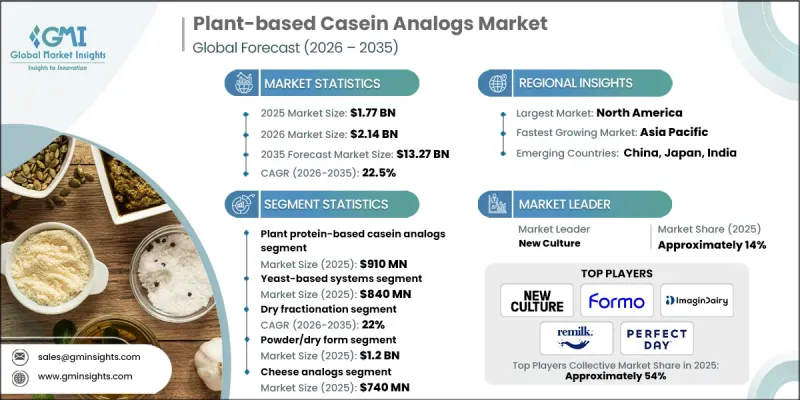
전체 시장의 지속적인 성장은 전 세계적으로 식물성 및 비건 식단의 보급이 가속화되면서 견인되고 있습니다. 소비자들은 윤리적 조달, 환경적 책임, 저탄소 영향을 점점 더 중요하게 여기고 있으며, 이는 우유에서 유래한 단백질로의 전환을 촉진하고 있습니다. 식품 제조업체들은 클린 라벨에 대한 기대와 책임 있는 조달 기준에 부합하기 위해 식물성 카제인 대체물을 사용하여 제품을 재설계하고 있습니다. 유당불내증, 유단백질 과민증, 콜레스테롤 관리에 대한 우려도 구매 행동에 영향을 미치는 중요한 요소로 작용하고 있습니다. 식물성 카제인 대체물은 기존 우유 카제인의 일반적인 소화기 및 알레르겐 관련 제한을 피하면서 기능성 단백질로서의 성능을 제공합니다. 고단백 및 기능성 영양에 대한 관심이 높아지면서 비건, 채식주의자, 플렉시테리언, 건강 지향적 개인을 포함한 광범위한 소비자층에서 시장 채택을 더욱 촉진하고 있습니다. 단백질 추출, 발효, 배합 기술의 지속적인 개선으로 기능성이 크게 향상되어 식감이나 성능 저하 없이 다양한 형태의 첨단 대체 유제품에 적용할 수 있게 되었습니다.
| 시장 범위 | |
|---|---|
| 개시 연도 | 2025년 |
| 예측 연도 | 2026-2035년 |
| 개시 금액 | 17억 7,000만 달러 |
| 예측 금액 | 132억 7,000만 달러 |
| CAGR | 22.5% |
효모 시스템 부문은 2025년 8억 4,000만 달러의 수익을 창출할 것으로 예상되며, 2026년부터 2035년까지 연평균 21.9%의 성장률을 보일 것으로 예측됩니다. 이 부문은 기존의 식품 등급 발효 인프라와의 높은 호환성과 확장 가능한 생산 모델로 인해 지속적으로 성장하고 있습니다. 제조업체는 안정적인 가공 조건과 예측 가능한 단백질 품질의 이점을 통해 안정적인 상업적 생산을 지원합니다. 동시에, 대체 미생물 시스템의 혁신은 생산 경로를 다양화하여 공급업체가 속도, 비용 효율성 및 단백질 특이성을 향상시킬 수 있게 해줍니다. 이러한 발전은 수율 관리 및 제조 경제성 최적화 전략의 재구축을 촉진하고 있습니다.
건조 분획 부문은 2025년 6억 6,000만 달러로 평가되었고, 2035년까지 연평균 22% 성장할 것으로 예측됩니다. 건조 분획의 채택은 물 사용량 감소와 가공 공정의 효율화를 통해 지속가능성을 중시하는 생산에 도움을 줍니다. 이 방식은 효율성과 환경 성능을 중시하는 진화하는 제조 모델과 잘 어울립니다. 건조분획법은 균형 잡힌 기능성이 요구되는 분야에서 점점 더 많이 적용되고 있습니다. 한편, 습식 추출법은 더 높은 순도와 정교한 성능이 요구되는 용도를 지속적으로 지원하고 있습니다. 프로세스 효율성과 제품별 활용의 지속적인 개선으로 두 방법의 경쟁력이 강화되고 있습니다.
북미 식물성 카제인 대체품 시장은 2025년 6억 5,000만 달러 규모에 달할 것으로 예상되며, 예측 기간 동안 매력적인 성장세를 기록할 것으로 예측됩니다. 첨단 식품 가공 기술, 강력한 혁신 생태계, 유제품 대체품에 대한 소비자의 높은 수용성이 지역적 확장을 뒷받침하고 있습니다. 음료, 영양 중심 제품, 재조합 우유 대체품에서 기능성 단백질에 대한 수요는 지속적으로 증가하고 있습니다. 미국에서는 제품 재개발 시 식감 및 관능적 특성 향상, 전통적인 유제품 특성에 대한 접근을 중시하고 있습니다. 제조업체는 기능성 성능 요구 사항을 충족시키기 위해 발효 유래 카제인 대체품 및 하이브리드 단백질 솔루션의 통합을 가속화하고 있습니다.
자주 묻는 질문
목차
제1장 조사 방법
제2장 주요 요약
제3장 업계 인사이트
제4장 경쟁 구도
제5장 시장 추산·예측 : 원료 유형별, 2022-2035년
제6장 시장 추산·예측 : 미생물 숙주별, 2022-2035년
제7장 시장 추산·예측 : 가공 기술별, 2022-2035년
제8장 시장 추산·예측 : 형태별, 2022-2035년
제9장 시장 추산·예측 : 용도별, 2022-2035년
제10장 시장 추산·예측 : 지역별, 2022-2035년
제11장 기업 개요
LSH 26.03.26The Global Plant-based Casein Analogs Market was valued at USD 1.77 billion in 2025 and is estimated to grow at a CAGR of 22.5% to reach USD 13.27 billion by 2035.
Consistent growth across the market is driven by the accelerating adoption of plant-based and vegan dietary patterns worldwide. Consumers are increasingly prioritizing ethical sourcing, environmental responsibility, and lower carbon impact, which is encouraging a shift away from dairy-derived proteins. Food manufacturers are responding by reformulating products with plant-based casein analogs to align with clean-label expectations and responsible sourcing standards. Health considerations also play a major role, as concerns around lactose intolerance, milk protein sensitivities, and cholesterol management continue to influence purchasing behavior. Plant-based casein analogs provide functional protein performance while avoiding common digestive and allergen-related limitations associated with conventional dairy casein. Rising interest in high-protein and functional nutrition further supports market adoption across a broader consumer base that includes vegans, flexitarians, and health-focused individuals. Continuous improvements in protein extraction, fermentation, and formulation technologies are significantly enhancing functional properties, enabling wider application across advanced dairy-alternative formats without compromising texture or performance.
| Market Scope | |
|---|---|
| Start Year | 2025 |
| Forecast Year | 2026-2035 |
| Start Value | $1.77 Billion |
| Forecast Value | $13.27 Billion |
| CAGR | 22.5% |
The yeast-based systems segment generated USD 0.84 billion in 2025 and is projected to grow at a CAGR of 21.9% from 2026 to 2035. This segment continues to gain momentum due to strong compatibility with established food-grade fermentation infrastructure and scalable production models. Manufacturers benefit from consistent processing conditions and predictable protein quality, which supports reliable commercial output. At the same time, innovation in alternative microbial systems is diversifying production pathways, allowing suppliers to improve speed, cost efficiency, and protein specificity. These developments are reshaping optimization strategies across yield management and manufacturing economics.
The dry fractionation segment was valued at USD 0.66 billion in 2025 and is expected to grow at a CAGR of 22% through 2035. Adoption of dry fractionation supports sustainability-driven production by reducing water usage and streamlining processing steps. This method aligns well with evolving manufacturing models that emphasize efficiency and environmental performance. Dry fractionation is increasingly applied where balanced functionality is required, while wet extraction continues to support applications that demand higher purity and refined performance. Ongoing improvements in process efficiency and byproduct utilization are strengthening both approaches.
North America Plant-based Casein Analogs Market accounted for USD 0.65 billion in 2025 and is expected to record attractive growth over the forecast period. Regional expansion is supported by advanced food processing capabilities, strong innovation ecosystems, and high consumer acceptance of dairy alternatives. Demand continues to rise for functional proteins across beverages, nutrition-focused products, and reformulated dairy substitutes. In the U.S., product redevelopment efforts emphasize improved texture, sensory performance, and closer alignment with traditional dairy characteristics. Manufacturers increasingly integrate fermentation-derived casein analogs and hybrid protein solutions to address functional performance requirements.
Key companies operating in the Global Plant-based Casein Analogs Market include Perfect Day, Remilk, Formo, New Culture, Imagindairy, and other emerging innovators shaping the competitive landscape. Companies active in the plant-based casein analogs market pursue targeted strategies to strengthen market foothold and accelerate growth. Heavy investment in research and development enables continuous improvement in protein functionality, texture performance, and production scalability. Strategic partnerships with food brands and ingredient suppliers support faster commercialization and broader application reach. Many players focus on fermentation-based production to achieve consistency and cost efficiency while meeting clean-label expectations. Portfolio diversification across multiple food categories helps mitigate risk and expand addressable markets. Companies also prioritize regulatory alignment and transparent labeling to build consumer trust. Geographic expansion and capacity scaling further support long-term competitiveness and global market penetration.
Table of Contents
Chapter 1 Methodology
- 1.1 Market scope and definition
- 1.2 Research design
- 1.2.1 Research approach
- 1.2.2 Data collection methods
- 1.3 Data mining sources
- 1.3.1 Global
- 1.3.2 Regional/Country
- 1.4 Base estimates and calculations
- 1.4.1 Base year calculation
- 1.4.2 Key trends for market estimation
- 1.5 Primary research and validation
- 1.5.1 Primary sources
- 1.6 Forecast model
- 1.7 Research assumptions and limitations
Chapter 2 Executive Summary
- 2.1 Industry 360° synopsis
- 2.2 Key market trends
- 2.2.1 Regional
- 2.2.2 Source Type
- 2.2.3 Microbial Host
- 2.2.4 Processing Technology
- 2.2.5 Form
- 2.2.6 Application
- 2.3 TAM Analysis, 2026-2035
- 2.4 CXO perspectives: Strategic imperatives
- 2.4.1 Executive decision points
- 2.4.2 Critical success factors
- 2.5 Future Outlook and Strategic Recommendations
Chapter 3 Industry Insights
- 3.1 Industry ecosystem analysis
- 3.1.1 Supplier Landscape
- 3.1.2 Profit Margin
- 3.1.3 Value addition at each stage
- 3.1.4 Factor affecting the value chain
- 3.1.5 Disruptions
- 3.2 Industry impact forces
- 3.2.1 Growth drivers
- 3.2.2 Industry pitfalls and challenges
- 3.2.3 Market opportunities
- 3.3 Growth potential analysis
- 3.4 Regulatory landscape
- 3.4.1 North America
- 3.4.2 Europe
- 3.4.3 Asia Pacific
- 3.4.4 Latin America
- 3.4.5 Middle East & Africa
- 3.5 Porter’s analysis
- 3.6 PESTEL analysis
- 3.7 Price trends
- 3.7.1 By region
- 3.7.2 By product
- 3.8 Future market trends
- 3.9 Technology and Innovation landscape
- 3.9.1 Current technological trends
- 3.9.2 Emerging technologies
- 3.10 Patent Landscape
- 3.11 Trade statistics (Note: the trade statistics will be provided for key countries only)
- 3.11.1 Major importing countries
- 3.11.2 Major exporting countries
- 3.12 Sustainability and Environmental Aspects
- 3.12.1 Sustainable Practices
- 3.12.2 Waste Reduction Strategies
- 3.12.3 Energy Efficiency in Production
- 3.12.4 Eco-friendly Initiatives
- 3.13 Carbon Footprint Considerations
Chapter 4 Competitive Landscape, 2025
- 4.1 Introduction
- 4.2 Company market share analysis
- 4.2.1 By region
- 4.2.1.1 North America
- 4.2.1.2 Europe
- 4.2.1.3 Asia Pacific
- 4.2.1.4 LATAM
- 4.2.1.5 MEA
- 4.2.1 By region
- 4.3 Company matrix analysis
- 4.4 Competitive analysis of major market players
- 4.5 Competitive positioning matrix
- 4.6 Key developments
- 4.6.1 Mergers & acquisitions
- 4.6.2 Partnerships & collaborations
- 4.6.3 New Product Launches
- 4.6.4 Expansion Plans
Chapter 5 Market Estimates and Forecast, By Source Type, 2022- 2035 (USD Billion, Kilo Tons)
- 5.1 Key trends
- 5.2 Precision Fermentation-derived Casein Analogs
- 5.3 Plant Protein-based Casein Analogs
- 5.3.1 Pea Protein
- 5.3.2 Soy Protein
- 5.3.3 Whey Protein
- 5.3.4 Other plant proteins
- 5.4 Hybrid Formulations
- 5.5 Others
Chapter 6 Market Estimates and Forecast, By Microbial Host, 2022 - 2035 (USD Billion, Kilo Tons)
- 6.1 Key trends
- 6.2 Yeast-based Systems
- 6.3 Bacterial Systems
- 6.4 Fungal Systems
- 6.5 Others
Chapter 7 Market Estimates and Forecast, By Processing Technology, 2022 - 2035 (USD Billion, Kilo Tons)
- 7.1 Key trends
- 7.2 Dry Fractionation
- 7.3 Wet Extraction
- 7.4 Enzymatic Treatment & Modification
- 7.5 Supercritical CO2 Extraction
- 7.6 Others
Chapter 8 Market Estimates and Forecast, By Form, 2022 - 2035 (USD Billion, Kilo Tons)
- 8.1 Key trends
- 8.2 Powder/Dry Form
- 8.3 Liquid Concentrate
- 8.4 Ready-to-use Formulations
Chapter 9 Market Estimates and Forecast, By Application, 2022 - 2035 (USD Billion, Kilo Tons)
- 9.1 Key trends
- 9.2 Cheese Analogs
- 9.2.1 Mozzarella Analogs
- 9.2.2 Cheddar Analogs
- 9.2.3 Cream Cheese Analogs
- 9.2.4 Specialty Cheese Analogs
- 9.3 Yogurt & Fermented Dairy Analogs
- 9.4 Milk Beverages & Coffee Creamers
- 9.5 Ice Cream & Frozen Desserts
- 9.6 Bakery & Confectionery
- 9.7 Others
Chapter 10 Market Estimates and Forecast, By Region, 2022 - 2035 (USD Billion, Kilo Tons)
- 10.1 Key trends
- 10.2 North America
- 10.2.1 U.S.
- 10.2.2 Canada
- 10.3 Europe
- 10.3.1 Germany
- 10.3.2 UK
- 10.3.3 France
- 10.3.4 Italy
- 10.3.5 Spain
- 10.3.6 Rest of Europe
- 10.4 Asia Pacific
- 10.4.1 China
- 10.4.2 India
- 10.4.3 Japan
- 10.4.4 Australia
- 10.4.5 South Korea
- 10.4.6 Rest of Asia Pacific
- 10.5 Latin America
- 10.5.1 Brazil
- 10.5.2 Mexico
- 10.5.3 Argentina
- 10.5.4 Rest of Latin America
- 10.6 Middle East & Africa
- 10.6.1 Saudi Arabia
- 10.6.2 South Africa
- 10.6.3 UAE
- 10.6.4 Rest of Middle East & Africa
Chapter 11 Company Profiles
- 11.1 Change Foods
- 11.2 Eden Brew
- 11.3 Formo
- 11.4 Imagindairy
- 11.5 New Culture
- 11.6 Nobell Foods
- 11.7 Perfect Day
- 11.8 Remilk
- 11.9 Standing Ovation