
|
시장보고서
상품코드
2038370
무선 원예 용품 시장 : 시장 기회, 성장요인, 업계 동향 분석 및 예측(2026-2035년)Cordless Garden Equipment Market Opportunity, Growth Drivers, Industry Trend Analysis, and Forecast 2026 - 2035 |
||||||

세계의 무선 원예 용품 시장은 2025년에 119억 달러로 평가되었고, CAGR 8.7%로 성장할 전망이며, 2035년까지 276억 달러에 이를 것으로 추정되고 있습니다.
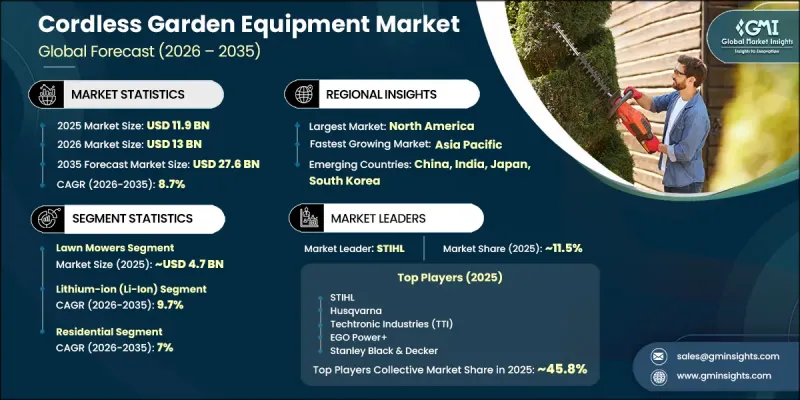
환경 인식이 높아지고 배출 기준이 강화됨에 따라 소비자들은 기존의 연료 구동식 공구를 보다 깨끗한 대체품으로 교체할 것을 촉구하고 있습니다. 고효율화, 급속 충전 기능, 장수명화 등 배터리 성능의 향상도 그 보급을 더욱 가속화하고 있습니다. 무선 원예기기는 기존 제품에 비해 휴대가 간편하고, 조작이 쉬우며, 유지관리의 번거로움이 적어 인기를 끌고 있습니다. 주택 개보수 활동의 확대와 야외 공간의 미적 감각에 대한 관심 증가도 시장 성장에 기여하고 있습니다. 소비자들은 라이프스타일을 개선하고 웰니스를 중시하는 삶의 일환으로 원예와 조경에 대한 투자를 점점 더 많이 하고 있습니다. 제조업체들은 변화하는 지속가능성에 대한 기대와 규제 요건에 맞추어 에너지 효율적이고 고성능의 솔루션으로 제품 라인업을 확장함으로써 이에 대응하고 있습니다.
| 시장 범위 | |
|---|---|
| 개시 연도 | 2025년 |
| 예측 기간 | 2026-2035년 |
| 개시 연도 시장 규모 | 119억 달러 |
| 예측 시장 규모 | 276억 달러 |
| CAGR | 8.7% |
무선 원예 장비 시장은 편리하고 저소음의 야외 유지보수 도구에 대한 소비자 선호도가 높아짐에 따라 수혜를 받고 있습니다. 배터리 구동 솔루션은 운영 효율성과 환경 부하 감소로 인해 기존 시스템을 대체하고 있습니다. 에너지 저장 시스템의 기술 발전으로 사용 시간 연장 및 제품 성능 향상이 가능해져 시장 침투가 더욱 강화되고 있습니다. 또한, 탄소 배출량을 줄이기 위한 규제 조치로 인해 주거용 및 상업용 용도에서 무선 제품의 채택이 촉진되고 있습니다.
잔디깎기기계 부문은 2025년 47억 달러를 차지했으며, 2035년까지 연평균 9.4%의 성장률을 보일 것으로 예측됩니다. 이 부문은 개인 주택 및 상업시설의 정기적인 잔디 관리에서 필수적인 역할을 하고 있기 때문에 지배적인 지위를 유지하고 있습니다. 기존 연료식 기기에 비해 정숙성, 기동성, 사용 편의성 등으로 인해 무선 모델이 점점 더 선호되고 있습니다.
주거용 부문은 2025년 76.4%의 점유율을 차지했으며, 2026-2035년 연평균 복합 성장률(CAGR) 7%로 성장할 것으로 전망됩니다. 이러한 우위는 텃밭과 잔디밭 가꾸기 활동에 대한 참여가 증가하고 있는 것에 기인합니다. 주택 소유자는 편리함, 저소음 및 친환경적인 작동으로 인해 무선 기기를 계속 선호하고 있으며, 이는 가정용으로 매우 적합합니다.
미국의 무선 원예 장비 시장은 2025년 41억 달러에 달했으며, 2035년까지 연평균 8%의 성장률을 보일 것으로 예측됩니다. 이 나라 시장 확대는 개인 잔디밭을 가꾸는 것이 일반화된 교외 거주지의 확산에 힘입은 바 큽니다. 배터리로 구동되는 잔디깎기기계, 트리머, 송풍기, 헤지 트리머의 경우, 사용 편의성과 저소음으로 인해 높은 수요를 보이고 있습니다. 소비자들은 배터리의 장시간 구동, 빠른 충전 성능, 그리고 통합 배터리 시스템으로 구동되는 여러 도구 간의 호환성을 점점 더 중요하게 여기고 있습니다.
자주 묻는 질문
목차
제1장 조사 방법 및 범위
제2장 주요 요약
제3장 업계 인사이트
제4장 경쟁 구도
제5장 시장 추산 및 예측 : 제품 유형별(2022-2035년)
제6장 시장 추산 및 예측 : 배터리 유형별(2022-2035년)
제7장 시장 추산 및 예측 : 가격별(2022-2035년)
제8장 시장 추산 및 예측 : 용도별(2022-2035년)
제9장 시장 추산 및 예측 : 유통 채널별(2022-2035년)
제10장 시장 추산 및 예측 : 지역별(2022-2035년)
제11장 기업 개요
AJY 26.06.11The Global Cordless Garden Equipment Market was valued at USD 11.9 billion in 2025 and is estimated to grow at a CAGR of 8.7% to reach USD 27.6 billion by 2035.
Rising environmental awareness and tightening emission standards are encouraging consumers to replace traditional fuel-powered tools with cleaner alternatives. Improvements in battery performance, including higher efficiency, faster charging capabilities, and longer operational life, are further accelerating adoption. Cordless garden equipment is gaining popularity due to its portability, ease of operation, and lower maintenance requirements compared to conventional alternatives. Expanding home improvement activities and increased interest in outdoor aesthetics are also contributing to market growth. Consumers are increasingly investing in gardening and landscaping as part of lifestyle enhancement and wellness-focused living. Manufacturers are responding by expanding product portfolios with energy-efficient, high-performance solutions aligned with evolving sustainability expectations and regulatory requirements.
| Market Scope | |
|---|---|
| Start Year | 2025 |
| Forecast Year | 2026-2035 |
| Start Value | $11.9 Billion |
| Forecast Value | $27.6 Billion |
| CAGR | 8.7% |
The cordless garden equipment market is also benefiting from growing consumer preference for convenient and low-noise outdoor maintenance tools. Battery-powered solutions are increasingly replacing conventional systems due to their operational efficiency and reduced environmental impact. Technological advancements in energy storage systems are enabling longer usage durations and improved product performance, further strengthening market penetration. In addition, regulatory initiatives aimed at reducing carbon emissions are encouraging wider adoption of cordless alternatives across residential and commercial applications.
The lawn mowers segment accounted for USD 4.7 billion in 2025 and is expected to grow at a CAGR of 9.4% through 2035. This segment maintains a dominant position due to its essential role in regular lawn maintenance across both private and commercial spaces. Cordless variants are increasingly preferred for their quiet operation, mobility, and ease of use compared to traditional fuel-based equipment.
The residential segment held a 76.4% share in 2025 and is projected to grow at a CAGR of 7% from 2026 to 2035. This dominance is supported by rising participation in home gardening and lawn care activities. Homeowners continue to favor cordless equipment due to its convenience, low noise levels, and environmentally friendly operation, making it highly suitable for household use.
United States Cordless Garden Equipment Market reached USD 4.1 billion in 2025 and is expected to grow at a CAGR of 8% through 2035. Market expansion in the country is supported by widespread suburban living, where private lawn maintenance is common. Strong demand is observed for battery-operated lawn mowers, trimmers, blowers, and hedge cutters due to their ease of use and reduced noise output. Consumers increasingly prioritize long battery life, fast charging performance, and compatibility across multiple tools powered by unified battery systems.
Key companies operating in the Global Cordless Garden Equipment Market include Husqvarna, Stanley Black & Decker, Bosch, STIHL, John Deere, Makita, Techtronic Industries (TTI), Greenworks, Honda, Toro, EGO Power+, Einhell, AL-KO, Karcher, and Positec Tool Corporation. Companies in the Cordless Garden Equipment Market are focusing on technological innovation, product diversification, and sustainability-driven strategies to strengthen their market position. They are investing in advanced battery systems to improve runtime, charging speed, and overall efficiency. Many manufacturers are expanding their cordless product portfolios to cover a wider range of gardening applications, enhancing consumer convenience. Strategic partnerships and distribution expansion, particularly through online and retail channels, are helping companies reach broader customer bases. Firms emphasize compatibility across tool platforms to create ecosystem-based product offerings. Additionally, continuous research and development efforts aimed at improving performance, durability, and environmental compliance are enabling companies to maintain strong competitive positioning in the evolving market landscape.
Table of Contents
Chapter 1 Methodology & Scope
- 1.1 Market scope and definition
- 1.2 Research design
- 1.2.1 Research approach
- 1.2.2 Data collection methods
- 1.3 Data mining sources
- 1.3.1 Global
- 1.3.2 Regional/Country
- 1.4 Base estimates and calculations
- 1.4.1 Base year calculation
- 1.4.2 Key trends for market estimation
- 1.5 Primary research and validation
- 1.5.1 Primary sources
- 1.6 Forecast model
- 1.7 Research assumptions and limitations
Chapter 2 Executive Summary
- 2.1 Industry 360° synopsis
- 2.2 Key market trends
- 2.2.1 Regional
- 2.2.2 Product Type
- 2.2.3 Battery Type
- 2.2.4 Price
- 2.2.5 End Use
- 2.2.6 Distribution channel
Chapter 3 Industry Insights
- 3.1 Industry ecosystem analysis
- 3.1.1 Supplier landscape
- 3.1.2 Profit margin
- 3.1.3 Value addition at each stage
- 3.1.4 Factor affecting the value chain
- 3.2 Industry impact forces
- 3.2.1 Growth drivers
- 3.2.1.1 Rising adoption of battery-powered and eco-friendly garden tools
- 3.2.1.2 Growing popularity of home gardening and landscaping activities
- 3.2.1.3 Expansion of residential landscaping and property maintenance services
- 3.2.2 Pitfalls & Challenges
- 3.2.2.1 Higher upfront cost compared to corded or gas-powered equipment
- 3.2.2.2 Limited battery life and charging requirements
- 3.2.3 Opportunities
- 3.2.3.1 Integration of smart and IoT-enabled garden equipment
- 3.2.3.2 Rising trend of sustainable and noise-free outdoor tools in urban areas
- 3.2.1 Growth drivers
- 3.3 Growth potential analysis
- 3.4 Future market trends
- 3.5 Technology and innovation landscape
- 3.5.1 Current technological trends
- 3.5.2 Emerging technologies
- 3.6 Regulatory landscape
- 3.6.1 Standards and compliance requirements
- 3.6.2 Regional regulatory frameworks
- 3.6.3 Certification standards
- 3.7 Porter's analysis
- 3.8 PESTEL analysis
- 3.9 Pricing analysis (driven by primary research)
- 3.9.1 Historical price trend analysis (driven by primary research)
- 3.9.2 Pricing strategy by player type (premium / value / cost-plus) (driven by primary research)
- 3.9.3 Price comparison: battery vs gas-powered equipment
- 3.9.4 Impact of battery cost on overall equipment pricing
- 3.9.5 Regional price variations & drivers
- 3.10 Trade data analysis (HS Code- 8467.21) (driven by primary research)
- 3.10.1 Import/export volume & value trends (driven by paid data base)
- 3.10.2 Key trade corridors & tariff impact (driven by paid data base)
- 3.10.3 Major exporting & importing countries
- 3.10.4 Trade policy impact on market dynamics
- 3.11 Capacity & production landscape (driven by primary research)
- 3.11.1 Installed capacity by region & key producer (driven by primary research)
- 3.11.2 Capacity utilization rates & expansion pipelines (driven by primary research)
Chapter 4 Competitive Landscape, 2025
- 4.1 Introduction
- 4.2 Company market share analysis
- 4.2.1 By Region
- 4.2.1.1 North America
- 4.2.1.2 Europe
- 4.2.1.3 Asia Pacific
- 4.2.1.4 Latin America
- 4.2.1.5 Middle East & Africa
- 4.2.1 By Region
- 4.3 Company matrix analysis
- 4.4 Competitive analysis of major market players
- 4.5 Competitive positioning matrix
- 4.6 Key developments
- 4.6.1 Mergers & acquisitions
- 4.6.2 Partnerships & collaborations
- 4.6.3 New product launches
- 4.6.4 Expansion plans
Chapter 5 Market Estimates & Forecast, By Product Type, 2022 - 2035, (USD Billion) (Thousand Units)
- 5.1 Key trends
- 5.2 Lawn mowers
- 5.3 Chainsaws
- 5.4 Hedge trimmers
- 5.5 Leaf blowers
- 5.6 Grass trimmers
- 5.7 Other tools
Chapter 6 Market Estimates & Forecast, By Battery Type, 2022 - 2035, (USD Billion) (Thousand Units)
- 6.1 Key trends
- 6.2 Lithium-Ion (Li-Ion)
- 6.3 Nickel-Cadmium (NiCd)
- 6.4 Others
Chapter 7 Market Estimates & Forecast, By Price, 2022 - 2035, (USD Billion) (Thousand Units)
- 7.1 Key trends
- 7.2 Low
- 7.3 Medium
- 7.4 High
Chapter 8 Market Estimates & Forecast, By End Use, 2022 - 2035, (USD Billion) (Thousand Units)
- 8.1 Key trends
- 8.2 Residential
- 8.3 Commercial
Chapter 9 Market Estimates & Forecast, By Distribution Channel, 2022 - 2035, (USD Billion) (Thousand Units)
- 9.1 Key trends
- 9.2 Online
- 9.3 Offline
Chapter 10 Market Estimates & Forecast, By Region, 2022 - 2035, (USD Billion) (Thousand Units)
- 10.1 Key trends
- 10.2 North America
- 10.2.1 U.S.
- 10.2.2 Canada
- 10.3 Europe
- 10.3.1 Germany
- 10.3.2 UK
- 10.3.3 France
- 10.3.4 Italy
- 10.3.5 Spain
- 10.4 Asia Pacific
- 10.4.1 China
- 10.4.2 India
- 10.4.3 Japan
- 10.4.4 South Korea
- 10.4.5 Australia
- 10.5 Latin America
- 10.5.1 Brazil
- 10.5.2 Mexico
- 10.5.3 Argentina
- 10.6 MEA
- 10.6.1 Saudi Arabia
- 10.6.2 UAE
- 10.6.3 South Africa
Chapter 11 Company Profiles
- 11.1 AL-KO
- 11.2 Bosch
- 11.3 EGO Power+
- 11.4 Einhell
- 11.5 Greenworks
- 11.6 Honda
- 11.7 Husqvarna
- 11.8 John Deere
- 11.9 Karcher
- 11.10 Makita
- 11.11 Positec Tool Corporation
- 11.12 Stanley Black & Decker
- 11.13 STIHL
- 11.14 Techtronic Industries (TTI)
- 11.15 Toro