|
시장보고서
상품코드
2038700
자기공명영상(MRI) 시스템 시장 : 시장 기회, 성장요인, 업계 동향 분석 및 예측(2026-2035년)Magnetic Resonance Imaging Systems Market Opportunity, Growth Drivers, Industry Trend Analysis, and Forecast 2026 - 2035 |
||||||

세계의 자기공명영상(MRI) 시스템 시장은 2025년에 68억 달러로 평가되었고, CAGR 6.5%로 성장할 전망이며, 2035년까지 127억 달러에 이를 것으로 추정되고 있습니다.
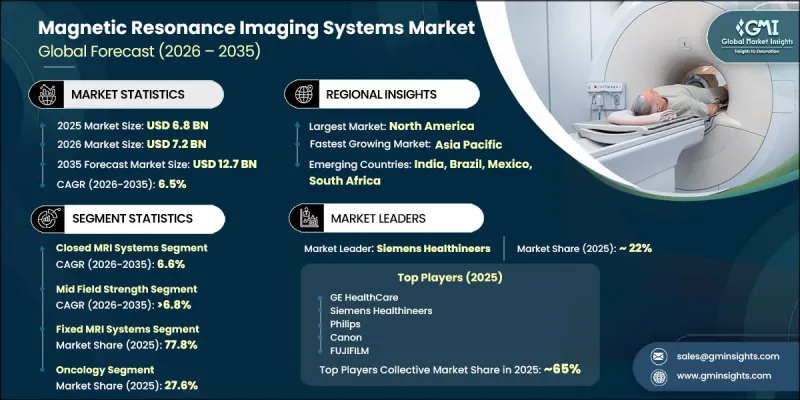
이러한 시장 확대는 전 세계 만성질환 유병률 증가, 조기 및 정확한 진단에 대한 중요성 증가, 첨단 의료 영상 진단 솔루션에 대한 인식 증가에 힘입어 성장세를 보이고 있습니다. 영상 진단용 하드웨어 및 소프트웨어의 지속적인 기술 발전으로 진단 정확도, 운영 효율성, 스캔 속도가 향상되어 시장 보급을 더욱 촉진하고 있습니다. 또한, 노화에 따른 질병은 빈번하고 세밀한 진단 평가가 필요하기 때문에 고령 인구 증가가 수요에 크게 기여하고 있습니다. 자기공명영상(MRI) 시스템은 전리방사선 피폭 없이 고해상도 비침습적 영상을 제공할 수 있어 현대 의료 인프라에 점점 더 많이 도입되고 있습니다. 이를 통해 신경계, 심혈관계, 종양학, 근골격계 질환을 포함한 복잡한 질병을 감지하고 모니터링하는 데 필수적인 역할을 하고 있습니다. 의료 투자 확대와 병원 현대화 프로그램은 선진국과 신흥국 의료 시장 모두에서 MRI 시스템의 광범위한 도입을 더욱 촉진하고 있습니다.
| 시장 범위 | |
|---|---|
| 개시 연도 | 2025년 |
| 예측 기간 | 2026-2035년 |
| 개시 연도 시장 규모 | 68억 달러 |
| 예측 시장 규모 | 127억 달러 |
| CAGR | 6.5% |
자기공명영상(MRI) 시스템은 강력한 자기장, 고주파 에너지 및 컴퓨터 신호 처리를 이용하여 매우 상세한 신체 내부 영상을 생성하는 첨단 진단 플랫폼입니다. 이 시스템은 인체 조직 내 수소 원자와 상호 작용하여 환자를 유해한 방사선에 노출시키지 않고도 연부조직과 장기의 선명한 고대비 이미지를 생성합니다. 비침습성과 뛰어난 영상 선명도로 인해 다양한 질환의 식별, 평가 및 경과 관찰을 위한 진단 도구로 선호되고 있습니다. 전 세계 만성 질환의 유병률 증가는 MRI 시스템에 대한 수요를 가속화하는 주요 요인으로 작용하고 있습니다. 이는 효과적인 치료 결과를 얻기 위해서는 조기 진단과 지속적인 모니터링이 필수적이기 때문입니다. 또한, 노인 인구 증가도 시장 성장에 기여하고 있습니다. 노인은 장기적인 건강 문제를 겪기 쉽고, 진단 및 질병 관리를 위해 고도의 영상 진단 지원이 필요한 경향이 있기 때문입니다.
밀폐형 MRI 시스템 부문은 2026-2035년 연평균 복합 성장률(CAGR) 6.6%를 나타낼 것으로 예측됩니다. 이 부문의 성장은 보어 디자인 개선, 환자 편의성 향상, 영상 촬영 시퀀싱 속도 향상과 같은 기술적 진보에 힘입어 성장세를 보이고 있습니다. 밀폐형 MRI 시스템은 외부의 간섭이나 움직임에 의한 왜곡을 줄여 우수한 화질을 제공하여 정밀한 진단용 영상 촬영에 매우 적합합니다. 뛰어난 임상적 성능으로 진단 및 치료 계획에서 영상의 정확성과 일관성이 매우 중요한 신경학, 근골격계, 순환기계, 종양학 분야에서 널리 사용되고 있습니다.
2025년 기준, 고정형 MRI 시스템 부문은 시장 점유율의 77.8%를 차지했습니다. 고정형 MRI 시스템은 광범위한 임상 능력과 다양한 자기장 강도에 대한 대응 능력으로 인해 여전히 세계 시장에서 주요 카테고리로 자리 잡고 있습니다. 이 시스템은 복잡한 영상 진단 절차, 중재적 지원 및 조사 용도가 요구되는 첨단 진단센터 및 대규모 의료시설에서 널리 사용되고 있습니다. 설치 및 인프라에 대한 높은 요구 사항, 긴 작동 수명, 확장성 및 높은 환자 처리 능력으로 인해 안정적인 수요를 지속적으로 견인하고 있습니다.
미국의 자기공명영상(MRI) 시스템 시장은 2025년 24억 달러에 달했습니다. 이 지역의 성장은 미국과 캐나다 전역의 만성질환 유병률 증가에 큰 영향을 받고 있습니다. 성인 인구의 상당수가 진단 및 지속적인 모니터링을 위해 고도의 영상 진단이 필요한 장기적인 건강 상태를 가지고 있으며, 이는 MRI 시스템에 대한 지속적인 수요를 뒷받침하고 있습니다. 잘 구축된 의료 인프라의 존재와 의료 영상 기술에 대한 지속적인 투자는 북미 전역 시장 확대를 더욱 촉진하고 있습니다.
자주 묻는 질문
목차
제1장 조사 방법
제2장 주요 요약
제3장 업계 인사이트
제4장 경쟁 구도
제5장 시장 추산 및 예측 : 아키텍처별(2022-2035년)
제6장 시장 추산 및 예측 : 자장 강도별(2022-2035년)
제7장 시장 추산 및 예측 : 설계별(2022-2035년)
제8장 시장 추산 및 예측 : 용도별(2022-2035년)
제9장 시장 추산 및 예측 : 최종 용도별(2022-2035년)
제10장 시장 추산 및 예측 : 지역별(2022-2035년)
제11장 기업 개요
AJY 26.06.11The Global Magnetic Resonance Imaging Systems Market was valued at USD 6.8 billion in 2025 and is estimated to grow at a CAGR of 6.5% to reach USD 12.7 billion by 2035.
The market expansion is supported by the rising incidence of chronic diseases worldwide, increasing emphasis on early and accurate diagnosis, and growing awareness regarding advanced medical imaging solutions. Continuous technological advancements in imaging hardware and software are improving diagnostic precision, operational efficiency, and scan speed, further strengthening market adoption. In addition, the growing elderly population is significantly contributing to demand, as age-related conditions require frequent and detailed diagnostic evaluation. Magnetic resonance imaging systems are increasingly being integrated into modern healthcare infrastructure due to their ability to deliver high-resolution, non-invasive imaging without ionizing radiation exposure. This makes them essential for detecting and monitoring complex medical conditions, including neurological, cardiovascular, oncological, and musculoskeletal disorders. Expanding healthcare investments and hospital modernization programs are further supporting widespread installation of MRI systems across both developed and emerging healthcare markets.
| Market Scope | |
|---|---|
| Start Year | 2025 |
| Forecast Year | 2026-2035 |
| Start Value | $6.8 Billion |
| Forecast Value | $12.7 Billion |
| CAGR | 6.5% |
Magnetic resonance imaging systems are advanced diagnostic platforms that utilize strong magnetic fields, radiofrequency energy, and computerized signal processing to produce highly detailed internal body images. These systems work by interacting with hydrogen atoms in human tissues to generate clear and contrast-rich images of soft tissues and organs without exposing patients to harmful radiation. Their non-invasive nature and superior imaging clarity make them a preferred diagnostic tool for identifying, evaluating, and tracking a wide range of diseases. Rising global chronic disease prevalence is a key factor accelerating demand for MRI systems, as early diagnosis and continuous monitoring are critical for effective treatment outcomes. The increasing elderly population is also contributing to market growth, as older individuals are more prone to long-term health conditions requiring advanced imaging support for diagnosis and disease management.
The closed MRI systems segment is expected to register a CAGR of 6.6% during 2026-2035. Growth in this segment is driven by advancements such as improved bore designs, enhanced patient comfort features, and faster imaging sequences. Closed MRI systems provide superior image quality by reducing external interference and motion-related distortions, making them highly suitable for precise diagnostic imaging. Their strong clinical performance supports widespread adoption across neurological, musculoskeletal, cardiovascular, and oncology applications, where imaging accuracy and consistency are critical for diagnosis and treatment planning.
The fixed MRI systems segment accounted for 77.8% share in 2025. Fixed MRI systems remain the dominant category in the global market due to their broad clinical capabilities and compatibility across multiple magnetic field strengths. These systems are extensively used in advanced diagnostic centers and large healthcare facilities where complex imaging procedures, interventional support, and research applications are required. Their long operational lifespan, scalability, and ability to support high patient throughput continue to drive steady demand, despite higher installation and infrastructure requirements.
U.S. Magnetic Resonance Imaging Systems Market reached USD 2.4 billion in 2025. Growth in the region is strongly influenced by the rising prevalence of chronic diseases across the United States and Canada. A significant portion of the adult population lives with long-term health conditions that require advanced imaging for diagnosis and ongoing monitoring, supporting sustained demand for MRI systems. The presence of a well-established healthcare infrastructure and continuous investments in medical imaging technologies further reinforce market expansion across North America.
Prominent players operating in the Global Magnetic Resonance Imaging Systems Industry include Siemens Healthineers, GE HealthCare, Philips, Canon, FUJIFILM, United Imaging, Neusoft, Esaote, FONAR, ASG Superconductors, MinFound, MR Solutions, Aspect Imaging, Aurora, Synaptive, and Time Medical Systems. Key strategies adopted by companies in the magnetic resonance imaging systems market include continuous investment in research and development to enhance image resolution, scanning speed, and patient comfort. Manufacturers are increasingly focusing on the development of compact and energy-efficient MRI systems to expand accessibility across smaller healthcare facilities. Strategic collaborations with hospitals, diagnostic centers, and research institutes are being used to strengthen market penetration and accelerate technology adoption. Companies are also integrating artificial intelligence and advanced software solutions to improve image reconstruction, workflow automation, and diagnostic accuracy. Expansion into emerging markets through distribution partnerships and localized production is another key strategy.
Table of Contents
Chapter 1 Research Methodology
- 1.1 Research approach
- 1.2 Quality commitments
- 1.2.1 GMI AI policy & data integrity commitment
- 1.2.1.1 Source consistency protocol
- 1.2.1 GMI AI policy & data integrity commitment
- 1.3 Research trail & confidence scoring
- 1.3.1 Research trail components
- 1.3.2 Scoring components
- 1.4 Data collection
- 1.4.1 Partial list of primary sources
- 1.5 Data mining sources
- 1.5.1 Paid sources
- 1.5.1.1 Sources, by region
- 1.5.1 Paid sources
- 1.6 Base estimates and calculations
- 1.6.1 Base year calculation for any one approach
- 1.7 Forecast model
- 1.7.1 Quantified market impact analysis
- 1.7.1.1 Mathematical impact of growth parameters on forecast
- 1.7.1 Quantified market impact analysis
- 1.8 Research transparency addendum
- 1.8.1 Source attribution framework
- 1.8.2 Quality assurance metrics
- 1.8.3 Our commitment to trust
Chapter 2 Executive Summary
- 2.1 Industry 3600 synopsis
- 2.2 Key market trends
- 2.2.1 Architecture trends
- 2.2.2 Field strength trends
- 2.2.3 Design trends
- 2.2.4 Application trends
- 2.2.5 End use trends
- 2.2.6 Regional trends
- 2.3 CXO perspectives: Strategic imperatives
Chapter 3 Industry Insights
- 3.1 Industry ecosystem analysis
- 3.2 Industry impact forces
- 3.2.1 Growth drivers
- 3.2.1.1 Growing geriatric population
- 3.2.1.2 Increasing chronic disease prevalence globally
- 3.2.1.3 Growing awareness pertaining to early diagnosis
- 3.2.1.4 Technological advancements in the MRI system
- 3.2.1.5 Increasing number of accidents
- 3.2.2 Industry pitfalls and challenges
- 3.2.2.1 Dearth of skilled professionals
- 3.2.2.2 High cost of the MRI system
- 3.2.3 Market opportunities
- 3.2.3.1 Portable MRI systems for emergency and bedside imaging
- 3.2.3.2 AI-enhanced workflow optimization and diagnostic support
- 3.2.1 Growth drivers
- 3.3 Growth potential analysis
- 3.4 Regulatory landscape
- 3.4.1 North America
- 3.4.2 Europe
- 3.4.3 Asia Pacific
- 3.5 Technology landscape (Driven by primary research)
- 3.5.1 Current technological trends
- 3.5.1.1 Ultra high field MRI technology
- 3.5.1.2 Artificial intelligence (AI) integration in MRI systems
- 3.5.2 Emerging technologies
- 3.5.2.1 Portable and point of care MRI innovation
- 3.5.2.2 Zero boil off (ZBO) magnet technology and helium free MRI systems
- 3.5.1 Current technological trends
- 3.6 Future market trends (Driven by primary research)
- 3.7 Impact of AI and Generative AI on the market (Driven by primary research)
- 3.8 Pricing analysis, 2025 (Driven by primary research)
- 3.9 Investment landscape
- 3.10 Porter's analysis
- 3.11 PESTEL analysis
Chapter 4 Competitive Landscape, 2025
- 4.1 Introduction
- 4.1.1 GE HealthCare
- 4.1.2 Siemens Healthineers
- 4.1.3 Philips
- 4.2 Company market share analysis
- 4.2.1 North America
- 4.2.2 Europe
- 4.2.3 Asia Pacific
- 4.3 Company matrix analysis
- 4.4 Competitive analysis of major market players
- 4.5 Competitive positioning matrix
- 4.6 Key developments
- 4.6.1 Mergers and acquisitions
- 4.6.2 Partnerships and collaborations
- 4.6.3 New product launches
- 4.6.4 Expansion plans
Chapter 5 Market Estimates and Forecast, By Architecture, 2022 - 2035 ($ Mn)
- 5.1 Key trends
- 5.2 Open system
- 5.3 Closed system
Chapter 6 Market Estimates and Forecast, By Field Strength, 2022 - 2035 ($ Mn)
- 6.1 Key trends
- 6.2 Low field strength
- 6.3 Mid field strength
- 6.4 High field strength
Chapter 7 Market Estimates and Forecast, By Design, 2022 - 2035 ($ Mn)
- 7.1 Key trends
- 7.2 Fixed MRI systems
- 7.3 Portable MRI systems
Chapter 8 Market Estimates and Forecast, By Application, 2022 - 2035 ($ Mn)
- 8.1 Key trends
- 8.2 Oncology
- 8.3 Neurology
- 8.4 Musculoskeletal
- 8.5 Vascular
- 8.6 Gastroenterology
- 8.7 Cardiology
- 8.8 Other applications
Chapter 9 Market Estimates and Forecast, By End Use, 2022 - 2035 ($ Mn)
- 9.1 Key trends
- 9.2 Hospitals
- 9.3 Imaging centers
- 9.4 Ambulatory surgical centers
- 9.5 Other end users
Chapter 10 Market Estimates and Forecast, By Region, 2022 - 2035 ($ Mn)
- 10.1 Key trends
- 10.2 North America
- 10.2.1 U.S.
- 10.2.2 Canada
- 10.3 Europe
- 10.3.1 Germany
- 10.3.2 UK
- 10.3.3 France
- 10.3.4 Spain
- 10.3.5 Italy
- 10.3.6 Netherlands
- 10.4 Asia Pacific
- 10.4.1 China
- 10.4.2 Japan
- 10.4.3 India
- 10.4.4 Australia
- 10.4.5 South Korea
- 10.5 Latin America
- 10.5.1 Brazil
- 10.5.2 Mexico
- 10.5.3 Argentina
- 10.6 Middle East and Africa
- 10.6.1 South Africa
- 10.6.2 Saudi Arabia
- 10.6.3 UAE
Chapter 11 Company Profiles
- 11.1 ASG SUPERCONDUCTORS
- 11.2 aspectimaging
- 11.3 AURORA
- 11.4 esaote
- 11.5 Canon
- 11.6 FONAR
- 11.7 FUJIFILM
- 11.8 GE HealthCare
- 11.9 Philips
- 11.10 MinFound
- 11.11 MRSOLUTIONS
- 11.12 Neusoft
- 11.13 UNITED IMAGING
- 11.14 Siemens Healthineers
- 11.15 Synaptive
- 11.16 TIME MEDICAL SYSTEMS