
|
시장보고서
상품코드
2116706
인도의 자기공명영상(MRI) 시장 : 점유율 분석, 업계 동향과 통계, 성장 예측(2026-2031년)India Magnetic Resonance Imaging (MRI) - Market Share Analysis, Industry Trends & Statistics, Growth Forecasts (2026 - 2031) |
||||||
 Mordor Intelligence
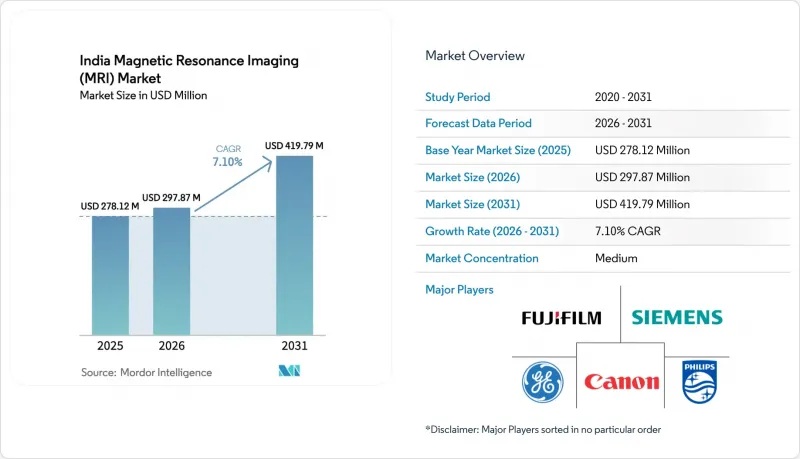
Mordor Intelligence에 의하면, 2026년 인도의 자기공명영상(MRI) 시장 규모는 2억 9,787만 달러로 추정되고 있어 2025년 2억 7,812만 달러에서 확대해, 2031년에는 4억 1,979만 달러에 이를 것으로 예측됩니다.
2026년부터 2031년까지의 연평균 성장률(CAGR)은 7.10%를 나타낼 전망입니다.
본 보고서는 아키텍처(밀폐형 MRI 시스템, 개방형 MRI 시스템), 자기장 강도(저자기장, 중자기장, 고자기장, 초고자기장),용도(신경학, 근골격계, 심혈관, 복부·골반, 유방 영상, 종양학(전신)), 최종 사용자(공립 병원, 민간 병원, 기타)별로 분류되어 있습니다. 시장 전망은 금액(달러) 기준으로 제시되어 있습니다.
인도 자기공명영상(MRI) 시장 동향 및 인사이트
비감염성 질환(NCD) 부담 증가가 영상 진단 수요를 가속화
인도 내 비전염성 질환(NCD) 유병률의 확대에 따라 고해상도 연조직 영상 진단에 대한 임상적 필요성이 높아지고 있습니다. 암 발생률은 2022년 10만 명당 529.40건에서 2031년까지 10만 명당 549.17건으로 증가할 것으로 예상되며, 이는 MRI를 이용한 종양학 진단에 대한 구조적 수요를 뒷받침하고 있습니다. 뇌졸중, 간질, 신경퇴행성 질환도 계속해서 증가하고 있으며, 신경과 전문의들은 병변을 보다 상세하게 파악하기 위해 MRI 검사를 점점 더 많이 활용하고 있습니다. 이로 인해, 특히 의료 격차가 여전히 심각한 지방 도시에서 스캐너의 일상적인 가동률이 향상되고 있습니다. 유방암 및 자궁경부암에 대한 정부의 선별 검사 프로그램에서는 확정 진단을 위한 MRI 검사가 일상적으로 지시되고 있으며, 이 검사법이 표준 진료 과정에 정착되고 있습니다. ‘아유슈만 바라트’ 제도에 따른 건강보험 급여로 인해 저소득 가구의 경제적 부담이 더욱 경감되면서, 인도 MRI 시장의 환자 수가 지속적으로 증가하고 있습니다. 그 결과, 의료 제공업체들은 질병 양상이 변화하는 가운데 임상적 의의를 유지하기 위해서는 MRI 설비 확충이 필수적이라고 판단하고 있습니다.
민간 진단센터 체인의 확대와 의료 관광
Dr. Lal PathLabs, Neuberg, Metropolis와 같은 조직형 진단 네트워크는 총 1,500곳 이상의 영상 진단 거점을 운영하고 있으며, 자산 부담이 적은 프랜차이즈 모델로 인해 자본 집약도가 낮아지고 있어 2028년까지 그 수가 2배로 늘어날 가능성이 있습니다. 이러한 그룹들은 경쟁이 적은 중소 도시에 새로운 스캐너를 도입함으로써, 인도 MRI 시장의 침투를 대도시권 이외의 지역으로 확대되고 있습니다. 이와 병행하여, 2024년에는 의료 관광을 통한 입국자 수가 46만 3,725건의 비자 발급에 달했습니다. 이는 해외 환자들이 MRI 진단과 연계된 비용 대비 효과가 높은 암, 척추, 심장 치료를 찾았기 때문입니다. 델리, 첸나이, 코치에 위치한 병원들은 수술 전·후 3T MRI 스캔이 포함된 정액제 종양학 패키지를 홍보하고 있으며, MRI는 수익의 주축으로서의 입지를 공고히 하고 있습니다. 이러한 해외 환자 유입으로 인해, 서비스 수준을 유지하기 위해 AI를 통해 처리 속도가 향상된 고성능 시스템을 도입하려는 의료 제공업체들의 동기가 생기고 있습니다. 국내 수요와 해외 수요라는 이중의 호재 덕분에, OEM 및 현지 조립 업체들에게 스캐너 구매 전망은 견조한 추세를 보이고 있습니다.
스캐너의 높은 비용과 낮은 보험 환급금
수입된 1.5T 또는 3T 스캐너의 가격은 6,000만-9,000만 루피(2024년도 환율 기준 73만-110만 달러)로, 저-중소득층을 대상으로 하는 소규모 병원에게는 큰 장벽이 되고 있습니다. ‘아유슈만 바라트’ 제도에 따른 정부의 환급액은 1회 스캔당 평균 3,000루피(36달러)로, 전기료, 헬륨 비용, 유지관리비를 간신히 충당할 수 있는 수준입니다. 그 결과, 많은 지역 수준의 의료기관에서는 MRI 사용을 복잡한 증례로만 제한하고 있으며, 이로 인해 규모의 경제가 훼손되어 투자 회수 기간이 7년 이상에 달하는 상황이 발생하고 있습니다. 국내 생산을 통해 저가격이 기대되지만, 초기 기종에서는 여전히 검증 지연이 발생하고 있어 가격 면에서의 격차가 장기화되고 있습니다. 요금 체계의 재검토나 포괄 결제 제도의 도입이 없는 한, 비용 제약이 있는 지역에서는 수익 측면의 압박이 인도 MRI 시장의 보급을 둔화시킬 가능성이 있습니다.
부문 분석
2025년 인도 자기공명영상(MRI) 시장에서 밀폐형 시스템이 매출의 75.20%를 차지했습니다. 이는 의료 기관들이 신경종양학 및 혈관 영상 진단에 필수적인 높은 신호 대 잡음비(SN비)를 중시하고 있음을 반영합니다. 또한, 밀폐형 보어 설계는 45mT/m를 초과하는 그라디언트 강도를 지원하여, 소규모 클리닉이 복잡한 증례를 가진 환자를 유치하는 데 활용할 수 있는 고차원 확산 및 기능적 프로토콜의 실행을 가능하게 합니다. 높은 가동률 덕분에 스캔당 비용이 경쟁사 수준으로 유지되고 있어, 밀폐형 스캐너는 인도 MRI 시장에서 주력 장비로서의 입지를 공고히 하고 있습니다. 그러나 환자의 편안함은 여전히 과제로 남아 있습니다. 도시 지역에서는 밀실 공포증으로 인한 검사 중단이 8%에 달하는 경우도 있어, 의료 기관들은 개방형 시스템 도입을 통한 보완적 대응을 검토하고 있습니다.
개방형 시스템은 2025년 시장 규모에서 차지하는 비중이 24.80%에 그치지만, 2031년까지 연평균 성장률(CAGR) 8.05%를 나타낼 것으로 예측되어, 인도 자기공명영상(MRI) 시장 전체의 성장률을 상회할 전망입니다. 환자의 높은 내성, 비만 환자까지 대응 가능한 테이블 하중 용량, 소아 환자 수 증가가 도입을 뒷받침하고 있으며, 특히 교외의 진단 체인에서 두드러지게 나타나고 있습니다. AI를 활용한 영상 재구성 소프트웨어 덕분에 기존에 존재하던 해상도 격차가 줄어들어, 의료 기관은 허용 가능한 화질로 척추 및 근골격계(MSK)의 정기 검사를 실시할 수 있게 되었습니다. 현지 OEM 업체들은 모듈식 코일 설계를 활용하여 설치 면적을 축소하고 있으며, 부동산 비용이 높은 지역에서 개방형 스캐너를 실용적인 확장 장치로 자리매김하고 있습니다. 개방형과 밀폐형 스캐너의 보험 환급 격차가 카르나타카주와 마하라슈트라주 이외의 지역으로 확대됨에 따라 신규 도입이 가속화되고, 벤더의 제품 포트폴리오가 다양화됨과 동시에 밀폐형 아키텍처의 지배력이 약화될 가능성이 있습니다.
2025년, 인도의 자기공명영상(MRI) 시장 규모의 55.72%를 1.5T 스캐너가 차지하며, 진단의 범용성과 인프라 친화성 간의 균형을 실현했습니다. 이러한 스캐너에 필요한 것은 불과 600제곱피트의 차폐 공간과 표준 45kVA의 전력뿐입니다. 공립 병원에서는 외상 분류부터 간 부피 측정까지 폭넓은 용도로 1.5T를 선호하여 보험 환급을 통한 처리량을 극대화하고 있습니다. 국내 생산을 통해 도입 비용을 35-40% 절감할 수 있으므로, 2031년까지 1.5T 시장 우위가 유지될 전망입니다. 그러나 학술 기관에서는 연구용으로 더욱 정밀한 그라디언트가 요구되고 있어, 3T 초과 시스템은 현재 도입 대수에서 차지하는 비중이 14%에 그치지만, 연평균 성장률(CAGR) 7.72%로 인도 자기공명영상(MRI) 시장 전체보다 빠른 속도로 성장할 것으로 예측됩니다.
초고자기장(7T)은 CDSCO(인도 의약품 규제 당국)의 승인 지연과 4억 루피(480만 달러)에 달하는 가격으로 인해 여전히 틈새 시장으로 남아 있습니다. 그럼에도 불구하고 델리, 방갈로르, 하이데라바드의 일류 기관들은 생명공학부(Ministry of Biotechnology)의 초기 단계 신경과학 연구 보조금에 힘입어 향후 7T용 스위트 설치를 위한 공간을 확보하고 있습니다. 저자기장 시스템(1.5T 이하)은 뇌졸중 현장 진단 및 신생아 중환자실(ICU)에서 극히 제한적인 존재감을 유지하고 있습니다. Hyperfine사의 0.064T 휴대용 장치는 2024년에 판매 승인을 받았으며, 구급차 주차 공간에도 들어갈 수 있어 분산형 영상 촬영의 가능성을 시사하고 있습니다. 이 모든 것을 종합해 보면, 자기장 강도 구분은 인도 자기공명영상(MRI) 시장에서 계층화된 구매 행동을 여실히 드러내고 있습니다. 가성비를 중시하는 지방 병원은 1.5T를 선호하는 반면, 플래그십 시설은 학술적 성과를 차별화하기 위해 초고자기장 영역으로 진출하고 있습니다.
기타 혜택
- 엑셀 형식 시장 예측(ME) 시트
- 3개월간의 애널리스트 지원
자주 묻는 질문
목차
제1장 서론
제2장 조사 방법
제3장 개요
제4장 시장 구도
제5장 시장 규모와 성장 예측
제6장 경쟁 구도
제7장 시장 기회와 향후 전망
JHS 26.09.01According to Mordor Intelligence, India magnetic resonance imaging (MRI) market size in 2026 is estimated at USD 297.87 million, growing from 2025 value of USD 278.12 million with 2031 projections showing USD 419.79 million, growing at 7.10% CAGR over 2026-2031.
This report is Segmented by Architecture (Closed MRI Systems, Open MRI Systems), Field Strength (Low-Field, Mid-Field, High-Field, Ultra-High Field), Application (Neurology, Musculoskeletal, Cardiovascular, Abdominal and Pelvic, Breast Imaging, and Oncology (Whole Body)), End User (Public Hospitals, Private Hospitals, and More). The Market Forecasts are Provided in Terms of Value (USD).
India Magnetic Resonance Imaging (MRI) Market Trends and Insights
Rising NCD Burden Accelerates Diagnostic Imaging Demand
India's escalating NCD prevalence raises the clinical urgency for high-resolution soft-tissue imaging. Cancer incidence is expected to climb from 529.40 per 100,000 in 2022 to 549.17 per 100,000 by 2031, underpinning structural demand for MRI-based oncology diagnostics. Stroke, epilepsy, and neuro-degenerative conditions also continue to rise, so neurologists increasingly prescribe MRI scans for finer lesion mapping, boosting daily scanner utilization, particularly in secondary cities where care gaps remain acute. Government screening programs for breast and cervical cancer routinely direct patients toward MRI for confirmatory scans, embedding the modality into standard care pathways. Health-insurance payouts under Ayushman Bharat further raise affordability for low-income households, sustaining patient-volume growth in the India MRI market. Consequently, providers view MRI capacity expansion as a prerequisite for clinical relevance as disease patterns evolve.
Expansion of Private Diagnostic-Center Chains & Medical Tourism
Organized diagnostic networks such as Dr. Lal PathLabs, Neuberg, and Metropolis collectively operate over 1,500 imaging hubs, and the number could double by 2028 as asset-light franchise models reduce capital intensity. These groups channel fresh scanner installations into smaller cities where competition is limited, thus diffusing India MRI market penetration beyond metro clusters. In parallel, medical-tourism arrivals rose to 463,725 visas in 2024 as foreign patients sought cost-advantaged cancer, spine, and cardiac care bundled with MRI diagnostics. Hospitals in Delhi, Chennai, and Kochi advertise fixed-price oncology packages that include pre- and post-surgical 3 T MRI scans, reinforcing MRI as a revenue anchor. Such inbound traffic incentivizes providers to install premium-spec systems with AI-accelerated throughput to maintain service levels. The dual tailwind of domestic and foreign demand keeps scanner-purchase pipelines healthy for OEMs and local assemblers.
High Scanner Cost & Low Reimbursement Tariffs
Imported 1.5 T or 3 T scanners cost INR 6-9 crore (USD 730,000-1.1 million at FY 2024 exchange rates), a steep hurdle for small hospitals serving low-to-middle-income populations. Government reimbursement under Ayushman Bharat averages INR 3,000 (USD 36) per scan, barely covering electricity, helium, and maintenance. Consequently, many district-level facilities limit MRI utilization to complex cases, undercutting economies of scale and elongating ROI timelines beyond seven years. Although domestic manufacturing promises lower prices, early units still face validation delays, prolonging the affordability gap. Without tariff recalibration or bundled-payment alternatives, bottom-line pressure could temper India MRI market uptake in cost-constrained geographies.
Other drivers and restraints analyzed in the detailed report include:
- Public-Hospital Imaging Upgrades Under Ayushman Bharat
- AI-Enabled High-Field Imaging Boosts Throughput & Quality
- Shortage of Trained Radiologists/Technologists
For complete list of drivers and restraints, kindly check the Table Of Contents.
Segment Analysis
Closed systems generated 75.20% of 2025 revenue in the India Magnetic Resonance Imaging market, reflecting provider preference for higher signal-to-noise ratios essential for neuro-oncology and vascular imaging. The sealed bore design also supports gradient strengths above 45 mT/m, enabling advanced diffusion and functional protocols that smaller clinics use to attract complex referrals. High utilization levels keep per-scan costs competitive, reinforcing closed scanners as the workhorse of the India Magnetic Resonance Imaging market. Patient comfort, however, remains a pain point; claustrophobia-induced cancellations can reach 8% in urban centers, prompting providers to explore supplemental open-system capacity.
Open systems, though holding only 24.80% of 2025 value, are projected to grow at 8.05% CAGR through 2031, outpacing the overall India Magnetic Resonance Imaging market. Better patient tolerance, bariatric-friendly table loads, and pediatric volumes drive adoption, especially within suburban diagnostic chains. AI-powered image-reconstruction software narrows the historical resolution gap, letting providers conduct routine spine and MSK studies with acceptable quality. Local OEMs leverage modular coil designs to shorten installation footprints, positioning open scanners as pragmatic expansion units where real estate costs are high. As reimbursement parity between open and closed scans spreads beyond Karnataka and Maharashtra, incremental installations may accelerate, diversifying vendor portfolios and reducing the dominance of sealed-bore architectures.
1.5 T scanners captured 55.72% of the India Magnetic Resonance Imaging market size in 2025, balancing diagnostic versatility with infrastructure friendliness; they require only 600 sq ft of shielded space and standard 45 kVA power. Public hospitals favor 1.5 T for broad-spectrum applications-from trauma triage to liver volumetry-maximizing reimbursement throughput. Domestic manufacture could trim acquisition costs by 35-40%, preserving 1.5 T's market lead through 2031. Yet academic centers seek finer gradient fidelity for research; thus, 3 T and higher systems, although currently 14% of installed base, are forecast to grow faster than the India Magnetic Resonance Imaging market at 7.72% CAGR.
Ultra-high field (7 T) remains niche because of CDSCO clearance lags and INR 40 crore (USD 4.8 million) price tags. Still, premier institutes in Delhi, Bengaluru, and Hyderabad are provisioning space for future 7 T suites, encouraged by early neuroscience grants from the Department of Biotechnology. Low-field systems (<1.5 T) maintain marginal presence in point-of-care stroke and neonatal ICUs; Hyperfine's 0.064 T portable unit gained marketing authorization in 2024 and can fit into ambulance bays, hinting at decentralized imaging opportunities. Taken together, field-strength segmentation underscores stratified purchasing behavior within the India Magnetic Resonance Imaging market: value-driven district hospitals gravitate toward 1.5 T, while flagship centers stretch into the ultra-high field frontier to differentiate academic output.
Complete Report Scope:
- By Architecture
- Closed MRI Systems
- Open MRI Systems
- By Field Strength
- Low-field (Less than 0.3 T)
- Mid-field (0.3-1.5 T)
- High-field (3 T)
- Ultra-high field (Above 3 T)
- By Application
- Neurology
- Musculoskeletal
- Cardiovascular
- Abdominal & Pelvic
- Breast Imaging
- Oncology (Whole Body)
- By End User
- Public Hospitals
- Private Hospitals
- Diagnostic Imaging Centers
- Ambulatory Surgical Centers
List of Companies Covered in this Report:
- Wipro GE Healthcare Pvt Ltd
- Siemens Healthineers
- Philips India Ltd
- Hitachi
- Canon
- Fujifilm Holdings Corp
- United Imaging Healthcare
- Esaote
- Voxelgrids Innovations Pvt Ltd
- Hyperfine Inc
- Neusoft Medical Systems
- IMRIS Inc
- Medtronic plc (iMRI)
- Allengers
- Time Medical Systems
- Shenzhen Anke High-Tech
- Aspect Imaging
- Aurora Imaging Technology
- Bharat Electronics Ltd (MRI R&D)
- Agfa HealthCare (NOVA MRI PACS)
Additional Benefits:
- The market estimate (ME) sheet in Excel format
- 3 months of analyst support
TABLE OF CONTENTS
1 Introduction
- 1.1 Study Assumptions & Market Definition
- 1.2 Scope of the Study
2 Research Methodology
3 Executive Summary
4 Market Landscape
- 4.1 Market Overview
- 4.2 Market Drivers
- 4.2.1 Rising NCD Burden (Cancer, Neuro, CVD)
- 4.2.2 Expansion of Private Diagnostic-Centre Chains & Medical Tourism
- 4.2.3 Public-Hospital Imaging Upgrades Under Ayushman Bharat
- 4.2.4 AI-Enabled High-Field Imaging Boosts Throughput & Quality
- 4.2.5 Make-In-India MRI Manufacturing Lowers Cap-Ex
- 4.2.6 Ban on Refurbished Imports Shifts Demand To New Units
- 4.3 Market Restraints
- 4.3.1 High Scanner Cost & Low Reimbursement Tariffs
- 4.3.2 Shortage of Trained Radiologists/Technologists
- 4.3.3 Helium Supply Volatility Elevates OPEX
- 4.3.4 CDSCO Approval Lags For >3 T Systems
- 4.4 Value Chain Analysis
- 4.5 Regulatory Landscape
- 4.6 Technological Outlook
- 4.7 Porter's Five Forces Analysis
- 4.7.1 Threat of New Entrants
- 4.7.2 Bargaining Power of Buyers/Consumers
- 4.7.3 Bargaining Power of Suppliers
- 4.7.4 Threat of Substitute Products
- 4.7.5 Intensity of Competitive Rivalry
5 Market Size & Growth Forecasts (Value)
- 5.1 By Architecture
- 5.1.1 Closed MRI Systems
- 5.1.2 Open MRI Systems
- 5.2 By Field Strength
- 5.2.1 Low-field (Less than 0.3 T)
- 5.2.2 Mid-field (0.3-1.5 T)
- 5.2.3 High-field (3 T)
- 5.2.4 Ultra-high field (Above 3 T)
- 5.3 By Application
- 5.3.1 Neurology
- 5.3.2 Musculoskeletal
- 5.3.3 Cardiovascular
- 5.3.4 Abdominal & Pelvic
- 5.3.5 Breast Imaging
- 5.3.6 Oncology (Whole Body)
- 5.4 By End User
- 5.4.1 Public Hospitals
- 5.4.2 Private Hospitals
- 5.4.3 Diagnostic Imaging Centers
- 5.4.4 Ambulatory Surgical Centers
6 Competitive Landscape
- 6.1 Market Concentration
- 6.2 Market Share Analysis
- 6.3 Company Profiles (includes Global level Overview, Market level overview, Core Segments, Financials as available, Strategic Information, Market Rank/Share for key companies, Products & Services, and Recent Developments)
- 6.3.1 Wipro GE Healthcare Pvt Ltd
- 6.3.2 Siemens Healthineers
- 6.3.3 Philips India Ltd
- 6.3.4 Hitachi Medical Systems
- 6.3.5 Canon Medical Systems
- 6.3.6 Fujifilm Holdings Corp
- 6.3.7 United Imaging Healthcare
- 6.3.8 Esaote SpA
- 6.3.9 Voxelgrids Innovations Pvt Ltd
- 6.3.10 Hyperfine Inc
- 6.3.11 Neusoft Medical Systems
- 6.3.12 IMRIS Inc
- 6.3.13 Medtronic plc (iMRI)
- 6.3.14 Allengers Medical Systems Ltd
- 6.3.15 Time Medical Systems
- 6.3.16 Shenzhen Anke High-Tech
- 6.3.17 Aspect Imaging
- 6.3.18 Aurora Imaging Technology
- 6.3.19 Bharat Electronics Ltd (MRI R&D)
- 6.3.20 Agfa HealthCare (NOVA MRI PACS)
7 Market Opportunities & Future Outlook
- 7.1 White-space & Unmet-Need Assessment