
|
시장보고서
상품코드
2116690
이탈리아의 자기공명영상 시장 : 점유율 분석, 업계 동향과 통계, 성장 예측(2026-2031년)Italy Magnetic Resonance Imaging - Market Share Analysis, Industry Trends & Statistics, Growth Forecasts (2026 - 2031) |
||||||
 Mordor Intelligence
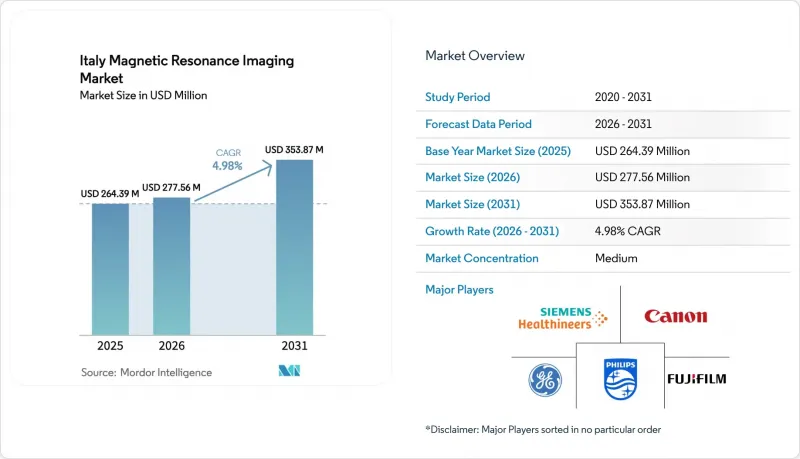
Mordor Intelligence에 의하면, 2026년 이탈리아의 MRI 시장 규모는 2억 7,756만 달러로 추정되고 있어 2025년 2억 6,439만 달러에서 확대해, 2031년에는 3억 5,387만 달러에 이를 것으로 예측됩니다.
2026년부터 2031년까지 연평균 성장률(CAGR) 4.98%로 성장할 것으로 전망됩니다.
본 보고서는 아키텍처(밀폐형 MRI 시스템, 개방형 MRI 시스템), 자기장 강도(저자기장 MRI 시스템, 기타), 용도(종양학, 신경학, 기타), 최종 사용자(병원, 영상 센터, 연구 기관)별로 세분화되어 있습니다. 본 보고서에서는 상기 각 부문 시장 규모(100만 달러)를 제시하고 있습니다.
이탈리아 자기공명영상 시장 동향 및 인사이트
MRI 업그레이드를 위한 국가 부흥 및 회복탄력성 계획(PNRR)의 설비 투자
1944억 유로 규모의 이탈리아 PNRR은 병원 시설 현대화에 전례 없는 자금을 투입하고 있으며, 노후화된 스캐너의 즉각적인 교체를 뒷받침하기 위해 단기간의 조달 기간을 마련하고 있습니다. 건설비 급등으로 인해 지역 병원의 목표 수가 1,350개 시설에서 936개 시설로 축소되었지만, 그럼에도 불구하고 수백 대의 신규 MRI 도입으로 이어질 것입니다. 이를 보완하는 ‘Piano Transizione 5.0’에서는 에너지 소비량을 3% 이상 감축한 시설에 대해 127억 유로의 세액 공제가 추가로 제공되며, 이를 통해 보일오프 제로형 자석에 대한 실질적인 보조가 이루어지고 있습니다. 이러한 조치들이 맞물려, 특히 그동안 영상 진단 역량에서 뒤처져 있던 남부 지역을 중심으로 구매 결정이 가속화되고 있습니다.
만성 질환 분야의 영상 진단 수요 증가
65세 이상 인구가 전체의 24%에 달하는 고령화로 인해 신경학, 종양학, 순환기학 각 부문에서 MRI 이용이 확대되고 있습니다. 알츠하이머병 환자 수는 이미 41만 3,715명을 넘어섰으며, 스캐너의 가동 부하를 증가시키는 신경 영상 프로토콜에 대한 수요를 견인하고 있습니다. 2022년 연간 신규 암 발병 건수는 39만 700건에 달했으며, 2025년까지 15% 더 증가할 것으로 예상되어 정확한 병기 분류 및 경과 관찰용 영상 진단에 대한 수요가 높아지고 있습니다. AI 기반 재구성 도구를 활용하면 스캔 시간을 최대 30% 단축할 수 있어, 화질을 저하시키지 않으면서 하루 검사 건수를 늘릴 수 있습니다.
높은 장비 비용과 수명 주기 비용
새로운 스캐너의 가격은 100만-300만 달러 범위이며, 서비스 계약에는 연간 구매 가격의 8-12%가 소요됩니다. 헬륨 보충 비용은 10년 동안 250%나 급등했으며, 구형 자석 장치의 경우 연간 지출이 2만 8,000-3만 6,000달러에 달할 전망입니다. 이탈리아의 방사선과에서 실시한 에너지 감사에 따르면, MRI 장비는 하루당 부서 전력 소비량의 24%(214.6kWh)를 차지하여 병원 예산을 압박하고 있습니다.
부문 분석
2025년, 이탈리아 MRI 시장 점유율의 77.62%를 밀폐형 스캐너가 차지하고 있으며, 그 화질, 멀티채널 코일, 종양학 및 신경학 부문에서의 높은 진단 신뢰성 덕분에 지지를 받고 있습니다. 이탈리아의 휴대용 MRI 시장 규모는 현재로서는 소규모이지만 빠르게 확대되고 있으며, 휴대용 플랫폼은 2026년부터 2031년까지 연평균 성장률(CAGR) 5.32%를 나타낼 것으로 예측됩니다. 도입이 가장 빠르게 진행되고 있는 곳은 공간이나 헬륨 조달상의 제약으로 인해 기존 원통형 설계를 채택하기 어려운 응급실이나 지방의 클리닉입니다. 각 제조업체는 화질을 향상시키기 위해 AI 재구성 기술을 통합하고 있으며, 밀폐형 시스템과의 성능 격차를 좁히고 있습니다.
휴대용 스캐너는 특히 환자의 이동 거리가 전국 평균을 웃도는 칼라브리아주와 시칠리아섬에서 이탈리아가 내세우는 ‘공평한 의료 접근성’이라는 목표 달성을 뒷받침하고 있습니다. 에사오테(Esaote)사의 ‘Magnifico Open’과 ‘O-scan’ 시스템은 영구 자석을 채택하고 음향 노이즈를 저감함으로써 사용자의 편의성을 높이고 있습니다. 또한 병원에서는 종양학과에서 발표된 환자 수의 급증에 대응하기 위해 이동식 트레일러를 도입하고 있습니다. 세계 벤더들이 틈새 시장인 휴대용 기기 분야의 혁신 기업을 인수하여 포트폴리오를 확대함에 따라 시장 통합이 더욱 진행될 가능성이 있습니다.
2025년 현재, 중자기장(0.5-1.5T) 플랫폼은 이탈리아 MRI 시장 규모의 47.65%를 차지하고 있으며, 뇌, 척추, 관절의 일상적인 영상 촬영에서 여전히 주류를 이루고 있습니다. 이탈리아 MRI 시장에서 점유율 우위는 임상적 범용성과 비교적 낮은 운영 비용에 기인합니다. 고급 신경종양학 프로토콜과 롬바르디아주 및 토스카나주로의 연구 자금 유입에 힘입어, 초고자기장(3T 이상) 시스템 시장은 연평균 성장률(CAGR) 5.58%를 나타낼 것으로 예측됩니다.
7T의 경우, 임상의는 뛰어난 명암비(CNR)와 미세혈관 시각화를 실현할 수 있어, 피질의 미세 출혈이나 미세한 해마 경화증의 감지에 도움이 됩니다. 비용은 여전히 주요 장벽이지만, PNRR(국가 부흥 및 회복력 계획)에 따른 인센티브 덕분에 일부 학술 기관에서는 도입에 대한 타당성이 입증될 가능성이 있습니다. 중자기장 스캐너도 제자리걸음을 하고 있는 것은 아닙니다. 각 벤더들은 고자기장의 해상도를 모방하는 AI 기반 시퀀싱를 추가하여 지역 병원에서도 이러한 시스템의 유용성을 유지하고 있습니다.
기타 혜택
- 엑셀 형식 시장 예측(ME) 시트
- 3개월간의 애널리스트 지원
자주 묻는 질문
목차
제1장 서론
제2장 조사 방법
제3장 개요
제4장 시장 구도
제5장 시장 규모와 성장 예측(금액, 100만 달러)
제6장 경쟁 구도
제7장 시장 기회와 향후 전망
JHS 26.09.01According to Mordor Intelligence, Italy MRI market size in 2026 is estimated at USD 277.56 million, growing from 2025 value of USD 264.39 million with 2031 projections showing USD 353.87 million, growing at 4.98% CAGR over 2026-2031.
This report is Segmented by Architecture (Closed MRI Systems, and Open MRI Systems), Field Strength (Low Field MRI Systems, and More), Application (Oncology, Neurology, and More), End User (Hospitals, Diagnostic Imaging Centers, and Research Institutes). The Report Offers the Value (in USD Million) for the Above Segments.
Italy Magnetic Resonance Imaging Market Trends and Insights
National Recovery & Resilience (PNRR) Cap-ex for MRI Upgrades
Italy's EUR 194.4 billion PNRR channels unprecedented funds toward hospital equipment modernization, opening a short procurement window that favors immediate replacement of aging scanners . Revised community-hospital targets, cut from 1,350 to 936 because of construction-cost inflation, still translate into hundreds of new MRI installations. The complementary Piano Transizione 5.0 adds EUR 12.7 billion in tax credits for facilities that cut energy consumption by at least 3%, effectively subsidizing zero-boil-off magnets. Together, these measures accelerate purchasing decisions, especially in Southern regions that historically lagged in imaging capacity.
Rising Chronic-Disease Imaging Demand
Population aging to 24% above 65 years fuels MRI use across neurology, oncology, and cardiology. Alzheimer's prevalence already tops 413,715 patients and drives neuroimaging protocols that add to scanner workloads. Annual cancer incidence reached 390,700 cases in 2022 and is poised for a further 15% increase by 2025, intensifying demand for precise staging and follow-up imaging. AI-based reconstruction tools cut scan time by as much as 30%, enabling higher daily volumes without compromising image quality.
High Equipment & Lifecycle Costs
New scanners range between USD 1 million and USD 3 million, while service contracts consume 8-12% of purchase price annually . Helium refill prices have soared 250% over ten years, pushing annual outlays to USD 28,000-36,000 for older magnets. Energy audits in Italian radiology departments show MRI units account for 24% of daily departmental electricity at 214.6 kWh, eroding hospital budgets.
Other drivers and restraints analyzed in the detailed report include:
- Technological Breakthroughs in MRI
- Expanding Clinical Indications for MRI
- Shortage of MRI-Trained Technologists & Radiologists
For complete list of drivers and restraints, kindly check the Table Of Contents.
Segment Analysis
Closed scanners kept 77.62% of Italy MRI market share in 2025, favored for image quality, multichannel coils, and high diagnostic confidence in oncology and neurology. The Italy MRI market size for portable units is modest today yet rising quickly; portable platforms are forecast to record a 5.32% CAGR between 2026-2031. Adoption is fastest in emergency departments and rural clinics where space and helium logistics restrict classic cylindrical designs. Manufacturers are integrating AI reconstruction to uplift image quality, shrinking the performance gap versus closed systems.
Portable scanners support Italy's goal of equitable access, particularly in Calabria and Sicily, where patient travel distances exceed national averages. Esaote's Magnifico Open and O-scan systems use permanent magnets and low acoustic noise to enhance user comfort. Hospitals also deploy mobile trailers to manage surges in oncology referrals. Market consolidation could intensify as global vendors acquire niche portable innovators to broaden their portfolio.
Mid-field (0.5-1.5 T) platforms commanded 47.65% of Italy MRI market size in 2025 and remain the workhorse for routine brain, spine, and joint imaging. The Italy MRI market share advantage stems from clinical versatility and relatively low operating costs. Nonetheless, ultra-high field (>3 T) systems are projected to grow at 5.58% CAGR, propelled by advanced neuro-oncology protocols and research funding flows to Lombardy and Tuscany.
At 7 T, clinicians achieve superior contrast-to-noise and microvascular visualization, helping detect cortical microbleeds and subtle hippocampal sclerosis. Cost remains the primary barrier, yet PNRR incentives could tip the business case for select academic centers. Mid-field scanners are not static; vendors are adding AI-driven sequences that mimic high-field resolution, keeping these systems relevant for community hospitals.
Complete Report Scope:
- By Architecture
- Closed MRI Systems
- Open MRI Systems
- By Field Strength
- Low Field (<0.5 T)
- Mid Field (0.5-1.5 T)
- High Field (1.5-3 T)
- Very-/Ultra-High (>3 T)
- By Application
- Neurology
- Oncology
- Cardiology
- Gastroenterology
- Musculoskeletal
- Other Applications
- By End User
- Hospitals
- Diagnostic Imaging Centers
- Research Institutes
List of Companies Covered in this Report:
- Siemens Healthineers
- GE Healthcare
- Koninklijke Philips
- Canon
- Esaote
- Bruker
- Fujifilm Holdings Corp.
- Hitachi
- United Imaging Healthcare
- Paramed Medical Systems
- Fonar
- Shenzhen Anke High-Tech
- Neusoft Medical Systems
- IMRIS Inc.
- Aspect Imaging
- Medonica
- Samsung Neurologica
- Agilent MR Solutions
- Time Medical Systems
- Oxford Instruments
Additional Benefits:
- The market estimate (ME) sheet in Excel format
- 3 months of analyst support
TABLE OF CONTENTS
1 Introduction
- 1.1 Study Assumptions & Market Definition
- 1.2 Scope of the Study
2 Research Methodology
3 Executive Summary
4 Market Landscape
- 4.1 Market Overview
- 4.2 Market Drivers
- 4.2.1 Rising chronic-disease imaging demand
- 4.2.2 National Recovery & Resilience (PNRR) cap-ex for MRI upgrades
- 4.2.3 Technological breakthroughs in MRI
- 4.2.4 Steady growth in healthcare spending and modernization of hospital & outpatient imaging infrastructure worldwide
- 4.2.5 Expanding clinical indications for MRI
- 4.2.6 Shift toward patient-centric, non-ionizing diagnostic alternatives
- 4.3 Market Restraints
- 4.3.1 High equipment & lifecycle costs
- 4.3.2 Slow, fragmented reimbursement approvals
- 4.3.3 Shortage of MRI-trained technologists & radiologists
- 4.3.4 Volatile helium & energy prices pressuring OPEX
- 4.4 Value / Supply-Chain Analysis
- 4.5 Regulatory Landscape
- 4.6 Technological Outlook
- 4.7 Porter's Five Forces Analysis
- 4.7.1 Threat of New Entrants
- 4.7.2 Bargaining Power of Buyers
- 4.7.3 Bargaining Power of Suppliers
- 4.7.4 Threat of Substitutes
- 4.7.5 Competitive Rivalry
5 Market Size & Growth Forecasts (Value, USD mn)
- 5.1 By Architecture
- 5.1.1 Closed MRI Systems
- 5.1.2 Open MRI Systems
- 5.2 By Field Strength
- 5.2.1 Low Field (<0.5 T)
- 5.2.2 Mid Field (0.5-1.5 T)
- 5.2.3 High Field (1.5-3 T)
- 5.2.4 Very-/Ultra-High (>3 T)
- 5.3 By Application
- 5.3.1 Neurology
- 5.3.2 Oncology
- 5.3.3 Cardiology
- 5.3.4 Gastroenterology
- 5.3.5 Musculoskeletal
- 5.3.6 Other Applications
- 5.4 By End User
- 5.4.1 Hospitals
- 5.4.2 Diagnostic Imaging Centers
- 5.4.3 Research Institutes
6 Competitive Landscape
- 6.1 Market Concentration
- 6.2 Market Share Analysis
- 6.3 Company Profiles (includes Global-level Overview, Market-level Overview, Core Segments, Financials, Strategic Information, Market Rank/Share, Products & Services, Recent Developments)
- 6.3.1 Siemens Healthineers AG
- 6.3.2 GE HealthCare
- 6.3.3 Koninklijke Philips N.V.
- 6.3.4 Canon Medical Systems Corp.
- 6.3.5 Esaote SpA
- 6.3.6 Bruker Corporation
- 6.3.7 Fujifilm Holdings Corp.
- 6.3.8 Hitachi Medical Systems
- 6.3.9 United Imaging Healthcare
- 6.3.10 Paramed Medical Systems
- 6.3.11 Fonar Corporation
- 6.3.12 Shenzhen Anke High-Tech
- 6.3.13 Neusoft Medical Systems
- 6.3.14 IMRIS Inc.
- 6.3.15 Aspect Imaging
- 6.3.16 Medonica Co. Ltd
- 6.3.17 Samsung Neurologica
- 6.3.18 Agilent MR Solutions
- 6.3.19 Time Medical Systems
- 6.3.20 Oxford Instruments
7 Market Opportunities & Future Outlook
- 7.1 White-space & Unmet-Need Assessment