|
시장보고서
상품코드
2038742
커넥티드 오토바이 시장 기회, 성장요인, 업계 동향 분석 및 예측(2026-2035년)Connected Motorcycle Market Opportunity, Growth Drivers, Industry Trend Analysis, and Forecast 2026 - 2035 |
||||||

세계의 커넥티드 오토바이 시장은 2025년에 4억 4,040만 달러로 평가되었고, 2035년까지 연평균 복합 성장률(CAGR) 25.2%로 성장하여 39억 8,000만 달러에 이를 것으로 예측됩니다.
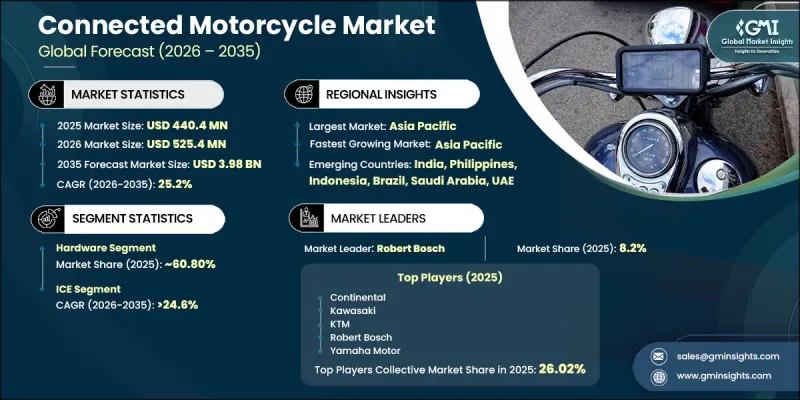
커넥티드 오토바이의 보급 확대는 충돌 경고, 사각지대 모니터링, 실시간 교통정보 업데이트와 같은 안전 기능이 주도하고 있습니다. 이러한 기술 발전은 사고를 줄이고, 라이더의 채택을 촉진하며, 소비자 시장과 차량 시장 모두에서 임베디드 커넥티비티 솔루션에 대한 수요를 창출하고 있습니다. 전기 자전거와 스쿠터의 보급은 배터리 관리, 성능 모니터링 및 무선 업데이트가 가능한 커넥티비티에 대한 수요를 더욱 촉진하고 있습니다. 또한, 커넥티드 오토바이는 경로 최적화, 예지보전, 실시간 추적을 가능하게 함으로써 도심 배송 서비스, 라이드셰어링 기업, 물류 차량에 도움을 주고 있습니다. 구독형 텔레매틱스 서비스는 지속적인 수익원을 개발하고 유선 또는 임베디드 커넥티비티의 사용을 촉진하여 이러한 차량의 상용 시장을 가속화하고 있습니다. 이륜차 제조업체들은 라이더의 안전성 향상, 운영 효율성 향상, 첨단 커넥티비티 기능의 보급을 촉진하기 위해 센서, 카메라, V2X(Vehicle-to-Everything) 통신을 통합하는 데 주력하고 있습니다. 이러한 시스템은 스마트시티 등 스마트 인프라와 원활하게 연동되어 전 세계적으로 상시 연결 기능을 제공할 수 있도록 설계되는 경우가 늘고 있습니다.
| 시장 범위 | |
|---|---|
| 시작 연도 | 2025년 |
| 예측 기간 | 2026-2035년 |
| 시작 연도 시장 규모 | 4억 4,040만 달러 |
| 예측 규모 | 39억 8,000만 달러 |
| CAGR | 25.2% |
하드웨어 부문은 2025년 60.80%의 점유율을 차지해, 2035년까지 연평균 24.1%의 성장률을 보일 것으로 전망됩니다. GNSS/GPS, 가속도 센서, 첨단 운전자 보조 시스템(ARAS) 구성 요소와 같은 센서의 통합으로 오토바이는 고도로 연결된 차량으로 변모하고 있습니다. 이 센서들은 안전 기능을 제공할 뿐만 아니라 예지보전 및 실시간 진단을 가능하게 하여 라이더에게 보다 정교한 경험을 제공합니다. 현재 제조업체들은 특히 전기 모터사이클 분야에서 배터리 수명과 차량 성능에 미치는 영향을 최소화하면서 연결성을 확보하기 위해 소형 저전력 텔레매틱스 제어 유닛(TCU), 디스플레이, 통신 모듈 개발에 집중하고 있습니다.
2025년에는 셀룰러 통신 부문이 시장에서 가장 큰 점유율을 차지했습니다. 이는 차량, 클라우드 시스템, 외부 네트워크 간의 실시간 및 장거리 통신을 지원하는 능력에 기반합니다. 셀룰러 연결은 블루투스와 같은 단거리 통신 옵션과 달리 내비게이션, 시스템 모니터링, 보안 추적, 긴급 지원 등의 기능에서 끊김 없는 데이터 흐름을 가능하게 하며, 고도의 커넥티드 기능과 원활한 사용자 경험에 필수적인 요소입니다. 필수적인 요소입니다. 또한, 4G의 지속적인 보급과 5G 기술의 등장으로 네트워크 속도, 안정성 및 데이터 처리 능력이 크게 향상되었습니다.
중국의 커넥티드 오토바이 시장은 64.9%의 점유율을 차지해, 2025년에는 1억 2,400만 달러 규모에 도달할 것으로 예측됐습니다. 중국 시장은 도시 개발의 가속화, 소비자의 구매력 향상, 스마트 모빌리티 기술의 보급 확대에 따라 빠르게 성장하고 있습니다. 스마트폰의 보급과 강력한 초고속 인터넷 인프라로 인해 내비게이션, 실시간 모니터링, 앱 기반 제어와 같은 기능이 원활하게 통합되어 기술적으로 진보된 오토바이에 대한 소비자 수요에 영향을 미치고 있습니다. 또한, 중국의 전기 모빌리티 및 지능형 교통 시스템 개발에 대한 집중적인 노력이 커넥티드 바이크의 성장을 뒷받침하고 있으며, 국내 및 세계 제조업체들의 지속적인 투자가 IoT 지원 이륜차 생태계를 더욱 강화시키고 있습니다.
자주 묻는 질문
목차
제1장 조사 방법
제2장 주요 요약
제3장 업계 인사이트
제4장 경쟁 구도
제5장 시장 추산 및 예측 : 컴포넌트별, 2022-2035년
제6장 시장 추산 및 예측 : 접속 방식별, 2022-2035년
제7장 시장 추산 및 예측 : 추진력별, 2022-2035년
제8장 시장 추산 및 예측 : 네트워크별, 2022-2035년
제9장 시장 추산 및 예측 : 최종 용도별, 2022-2035년
제10장 시장 추산 및 예측 : 오토바이 유형별, 2022-2035년
제11장 시장 추산 및 예측 : 지역별, 2022-2035년
제12장 기업 개요
JHS 26.05.29The Global Connected Motorcycle Market was valued at USD 440.4 million in 2025 and is estimated to grow at a CAGR of 25.2% to reach USD 3.98 billion by 2035.
The growing adoption of connected motorcycles is driven by safety features, such as collision warnings, blind-spot monitoring, and real-time traffic updates. These advancements reduce accidents, increase rider adoption, and create demand for embedded connectivity solutions across both consumer and fleet markets. The expansion of electric motorcycles and scooters further fuels the demand for connectivity, allowing for better battery management, performance monitoring, and over-the-air updates. Connected motorcycles also support urban delivery services, ride-hailing companies, and logistics fleets by enabling route optimization, predictive maintenance, and real-time tracking. The subscription-based telematics services have opened avenues for recurring revenue, promoting the use of tethered or embedded connectivity, which is accelerating the commercial market for these vehicles. Motorcycle manufacturers are focusing on integrating sensors, cameras, and Vehicle-to-Everything (V2X) communication to improve rider safety, enhance operational efficiency, and increase the adoption of advanced connectivity features. These systems are increasingly being designed to work seamlessly with smart infrastructure, such as smart cities, to offer always-connected capabilities globally.
| Market Scope | |
|---|---|
| Start Year | 2025 |
| Forecast Year | 2026-2035 |
| Start Value | $ 440.4 Million |
| Forecast Value | $3.98 Billion |
| CAGR | 25.2% |
The hardware segment held a 60.80% share in 2025 and is anticipated to grow at a CAGR of 24.1% through 2035. The integration of sensors like GNSS/GPS, accelerometers, and components of Advanced Rider Assistance Systems (ARAS) is transforming motorcycles into highly connected vehicles. These sensors not only provide safety features but also enable predictive maintenance and real-time diagnostics, offering a more sophisticated experience for riders. Manufacturers are now focusing on developing compact, low-power telematics control units (TCUs), displays, and communication modules to ensure connectivity while minimizing the impact on battery life and vehicle performance, especially in the electric motorcycle sector.
The cellular segment accounted for the largest share of the market in 2025, driven by its capability to support real-time, long-distance communication across vehicles, cloud systems, and external networks. In contrast to short-range options like Bluetooth, cellular connectivity enables uninterrupted data flow for functions such as navigation, system monitoring, security tracking, and emergency support, making it a critical component for advanced connected features and a smooth user experience. In addition, the ongoing rollout of 4G and the emergence of 5G technologies are significantly improving network speed, stability, and data handling capacity.
China Connected Motorcycle Market held a 64.9% share, generating USD 124 million in 2025. The market in China is expanding rapidly due to accelerating urban development, increasing consumer spending power, and growing adoption of smart mobility technologies. Widespread smartphone usage and robust high-speed internet infrastructure are enabling seamless integration of features such as navigation, real-time monitoring, and app-based controls, which is influencing consumer demand for technologically advanced motorcycles. Furthermore, the country's strong focus on electric mobility and intelligent transportation development is supporting the growth of connected motorcycles, while ongoing investments by domestic and global manufacturers are further strengthening the ecosystem for IoT-enabled two-wheelers.
Prominent players in the Connected Motorcycle Market include companies like BMW Motorrad, Ducati, Yamaha, Kawasaki, Honda, Harley-Davidson, KTM, Piaggio, Robert Bosch, and Continental. These companies are driving innovation in connected motorcycle technologies, focusing on safety and performance features that enhance the riding experience. To strengthen their market position, companies in the connected motorcycle industry are investing heavily in research and development to integrate cutting-edge technologies such as telematics, V2X communication, and ARAS into their motorcycles. By embedding advanced safety systems and connectivity solutions, they are offering a higher value proposition to consumers. In addition, many companies are focusing on creating seamless integration with mobile apps and telematics platforms, allowing riders to monitor and optimize their motorcycles' performance.
Table of Contents
Chapter 1 Methodology
- 1.1 Research approach
- 1.2 Quality Commitments
- 1.2.1 GMI AI policy & data integrity commitment
- 1.2.1.1 Source consistency protocol
- 1.2.1 GMI AI policy & data integrity commitment
- 1.3 Research Trail & Confidence Scoring
- 1.3.1 Research Trail Components
- 1.3.2 Scoring Components
- 1.4 Data Collection
- 1.4.1 Partial list of primary sources
- 1.5 Data mining sources
- 1.5.1 Paid sources
- 1.5.1.1 Sources, by region
- 1.5.1 Paid sources
- 1.6 Base estimates and calculations
- 1.6.1 Base year calculation
- 1.7 Forecast Model
- 1.7.1 Quantified market impact analysis
- 1.7.1.1 Mathematical impact of growth parameters on forecast
- 1.7.1 Quantified market impact analysis
- 1.8 Research transparency addendum
- 1.8.1 Source attribution framework
- 1.8.2 Quality assurance metrics
- 1.8.3 Our commitment to trust
Chapter 2 Executive Summary
- 2.1 Industry 360° synopsis, 2022 - 2035
- 2.2 Key market trends
- 2.2.1 Regional
- 2.2.2 Component
- 2.2.3 Connectivity
- 2.2.4 Propulsion
- 2.2.5 Network
- 2.2.6 End use
- 2.2.7 Motorcycle Type
- 2.3 TAM Analysis, 2026-2035
- 2.4 CXO perspectives: Strategic imperatives
Chapter 3 Industry Insights
- 3.1 Industry ecosystem analysis
- 3.1.1 Supplier landscape
- 3.1.2 Profit margin analysis
- 3.1.3 Cost structure
- 3.1.4 Value addition at each stage
- 3.1.5 Factor affecting the value chain
- 3.1.6 Disruptions
- 3.2 Industry impact forces
- 3.2.1 Growth drivers
- 3.2.1.1 Increasing Demand for Rider Safety and Assistance Systems
- 3.2.1.2 Rising Adoption of IoT and Telematics
- 3.2.1.3 Growth in Urban Mobility and Smart Transportation
- 3.2.1.4 Expansion of Electric Connected Motorcycles
- 3.2.2 Industry pitfalls and challenges
- 3.2.2.1 High Cost of Connected Systems
- 3.2.2.2 Data Security and Privacy Concerns
- 3.2.3 Market opportunities
- 3.2.3.1 Integration of AI, 5G, and V2X Technologies
- 3.2.3.2 Growth in Emerging Markets
- 3.2.3.3 Subscription-Based and Mobility Services
- 3.2.3.4 Predictive Maintenance and OTA Updates
- 3.2.1 Growth drivers
- 3.3 Growth potential analysis
- 3.4 Technology and Innovation landscape
- 3.4.1 Current technological trends
- 3.4.2 Emerging technologies
- 3.5 Pricing Analysis (Driven by Primary Research)
- 3.5.1 Historical Price Trend Analysis
- 3.5.2 Pricing Strategy by Player Type (Premium / Value / Cost-plus)
- 3.6 Regulatory guideline
- 3.6.1 North America
- 3.6.1.1 U.S.: NHTSA Vehicle Safety Standards, FCC V2X Regulations
- 3.6.1.2 Canada: Motor Vehicle Safety Regulations (MVSR), Transport Canada Cybersecurity Guidelines
- 3.6.2 Europe
- 3.6.2.1 Germany: EU General Safety Regulation (GSR), eCall Regulation
- 3.6.2.2 UK: UK Vehicle Type Approval Regulations, Connected Vehicle Cybersecurity Standards
- 3.6.2.3 France: French Road Safety Code, Intelligent Transport Systems (ITS) Framework
- 3.6.2.4 Italy: Italian Highway Code, EU Vehicle Connectivity Compliance Standards
- 3.6.3 Asia Pacific
- 3.6.3.1 China: MIIT Intelligent Connected Vehicle (ICV) Policy, V2X Standards
- 3.6.3.2 India: AIS Standards, Bharat NCAP Framework
- 3.6.3.3 Japan: MLIT ITS Regulations, Road Transport Vehicle Safety Standards
- 3.6.3.4 Australia: Australian Design Rules (ADR), Vehicle Cybersecurity Guidelines
- 3.6.4 Latin America
- 3.6.4.1 Brazil: CONTRAN Vehicle Safety Regulations, ABS Mandate Standards
- 3.6.4.2 Mexico: NOM Vehicle Standards, Road Transport Safety Regulations
- 3.6.4.3 Argentina: ANSV Road Safety Regulations, National Vehicle Compliance Standards
- 3.6.5 MEA
- 3.6.5.1 UAE: ESMA Vehicle Standards, Smart Mobility Regulations
- 3.6.5.2 Saudi Arabia: SASO Vehicle Standards, Vision 2030 Mobility Framework
- 3.6.5.3 3.7.5.3 South Africa: National Road Traffic Act, SABS Vehicle Standards
- 3.6.1 North America
- 3.7 PESTEL analysis
- 3.8 Patent Landscape (Driven by Primary Research)
- 3.9 Trade Data Analysis (Based on Paid Database)
- 3.9.1 Import/Export Volume & Value Trends
- 3.9.2 Key Trade Corridors & Tariff Impact
- 3.10 Impact of AI & Generative AI on the Market (Driven by Primary Research)
- 3.10.1 AI-Driven Disruption of Existing Business Models
- 3.10.2 GenAI Use Cases & Adoption Roadmap by Segment
- 3.10.3 Risks, Limitations & Regulatory Considerations
- 3.11 Capacity & Production Landscape (Driven by Primary Research)
- 3.11.1 Production Capacity by Region & Key Producer
- 3.11.2 Capacity Utilization Rates & Expansion Pipelines
- 3.12 Sustainability and environmental aspects
- 3.12.1 Sustainable practices
- 3.12.2 Waste reduction strategies
- 3.12.3 Energy efficiency in production
- 3.12.4 Eco-friendly initiatives
- 3.12.5 Carbon footprint considerations
- 3.13 Forecast assumptions & scenario analysis (Driven by Primary Research)
- 3.13.1 Base Case - Key Macro & Industry Variables Driving CAGR
- 3.13.2 Optimistic Scenarios - Favourable macro and industry tailwinds
- 3.13.3 Pessimistic Scenario - Macroeconomic slowdown or industry headwinds
Chapter 4 Competitive Landscape, 2025
- 4.1 Introduction
- 4.2 Company market share analysis
- 4.2.1 North America
- 4.2.2 Europe
- 4.2.3 Asia Pacific
- 4.2.4 Latin America
- 4.2.5 MEA
- 4.3 Competitive analysis of major market players
- 4.4 Competitive positioning matrix
- 4.5 Key developments
- 4.5.1 Mergers & acquisitions
- 4.5.2 Partnerships & collaborations
- 4.5.3 New Product Launches
- 4.5.4 Expansion Plans and funding
- 4.6 Company Tier Benchmarking
- 4.6.1 Tier Classification Criteria & Qualifying Thresholds
- 4.6.2 Tier Positioning Matrix by Revenue, Geography & Innovation
Chapter 5 Market Estimates & Forecast, By Component, 2022 - 2035 ($Bn, Units)
- 5.1 Key trends
- 5.2 Hardware
- 5.2.1 TCU
- 5.2.2 Display
- 5.2.3 Sensors
- 5.2.4 Others
- 5.3 Software
- 5.4 Services
- 5.4.1 Professional service
- 5.4.2 Managed services
Chapter 6 Market Estimates & Forecast, By Connectivity, 2022 - 2035 ($Bn, Units)
- 6.1 Key trends
- 6.2 Embedded
- 6.3 Tethered
- 6.4 Aftermarket
Chapter 7 Market Estimates & Forecast, By Propulsion, 2022 - 2035 ($Bn, Units)
- 7.1 Key trends
- 7.2 ICE
- 7.3 Electric
- 7.3.1 PHEV
- 7.3.2 HEV
- 7.3.3 FCEV
- 7.3.4 BEV
Chapter 8 Market Estimates & Forecast, By Network, 2022 - 2035 ($Bn, Units)
- 8.1 Key trends
- 8.2 Cellular
- 8.3 Short range
- 8.4 Others
Chapter 9 Market Estimates & Forecast, By End Use, 2022 - 2035 ($Bn, Units)
- 9.1 Key trends
- 9.2 Private
- 9.3 Commercial
Chapter 10 Market Estimates & Forecast, By Motorcycle Type, 2022 - 2035 ($Bn, Units)
- 10.1 Key trends
- 10.2 Sport Motorcycles
- 10.3 Touring Motorcycles
- 10.4 Roadster / Naked Bikes
- 10.5 Heritage / Cruiser Bikes
- 10.6 Adventure Motorcycles
- 10.7 Others
Chapter 11 Market Estimates & Forecast, By Region, 2022 - 2035 ($Bn, Units)
- 11.1 Key trends
- 11.2 North America
- 11.2.1 US
- 11.2.2 Canada
- 11.3 Europe
- 11.3.1 Germany
- 11.3.2 UK
- 11.3.3 France
- 11.3.4 Italy
- 11.3.5 Spain
- 11.3.6 Russia
- 11.3.7 Netherlands
- 11.3.8 Belgium
- 11.4 Asia Pacific
- 11.4.1 China
- 11.4.2 India
- 11.4.3 Japan
- 11.4.4 Australia
- 11.4.5 South Korea
- 11.4.6 Philippines
- 11.4.7 Indonesia
- 11.5 Latin America
- 11.5.1 Brazil
- 11.5.2 Mexico
- 11.5.3 Argentina
- 11.6 MEA
- 11.6.1 South Africa
- 11.6.2 Saudi Arabia
- 11.6.3 UAE
Chapter 12 Company Profiles
- 12.1 Global Leaders
- 12.1.1 BMW Motorrad
- 12.1.2 Continental
- 12.1.3 Ducati
- 12.1.4 Harley-Davidson
- 12.1.5 Honda
- 12.1.6 Kawasaki Heavy Industries
- 12.1.7 KTM
- 12.1.8 Piaggio
- 12.1.9 Robert Bosch
- 12.1.10 Suzuki Motor.
- 12.1.11 Triumph Motorcycles
- 12.1.12 Yamaha Motor
- 12.2 Regional Champions
- 12.2.1 Ather Energy
- 12.2.2 Bajaj Auto
- 12.2.3 CFMoto
- 12.2.4 Gogoro
- 12.2.5 Hero MotoCorp
- 12.2.6 Indian Motorcycle
- 12.2.7 NIU Technologies
- 12.2.8 Ola Electric
- 12.2.9 Royal Enfield
- 12.2.10 TVS Motor Company
- 12.3 Emerging Players
- 12.3.1 LiveWire
- 12.3.2 Revolt Motors
- 12.3.3 Zero Motorcycles