

|
시장보고서
상품코드
2138095
커넥티드 오토바이 시장 : 하드웨어별(임베디드, 테더드/통합형), 네트워크 유형별(3G/4G, 5G), 이륜차 유형별, 추진 방식별, 최종사용자별, 용도별(안전 & 보안, 내비게이션, 인포테인먼트), 지역별 - 세계 예측(-2033년)Connected Motorcycle Market by Hardware (Embedded & Tethered/Integrated), Network Type (3G/4G, 5G), Two-wheeler Type, Propulsion Type, End User, Application (Safety & Security, Navigation, Infotainment), and Region - Global Forecast to 2033 |
||||||

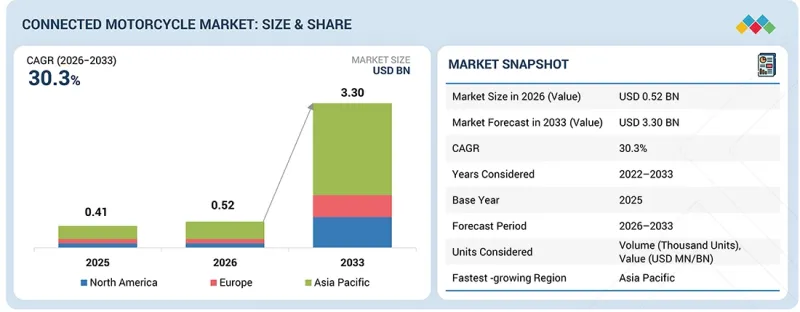
커넥티드 오토바이 시장 규모는 2026년 5억 2,000만 달러에서 2033년에는 33억 달러로 성장할 것으로 예상되며, 연평균 성장률(CAGR)은 30.3%에 달할 것으로 추정됩니다.
커넥티드 오토바이 시장은 기본적인 스마트폰 연동 기능에서, 오토바이가 가동 상태, 위치 정보, 라이더 정보, 파워트레인 데이터를 클라우드 플랫폼과 지속적으로 주고받는 상시 연결형 차량 아키텍처로 전환되고 있습니다. 텔레매틱스 제어 장치, eSIM 연결, GNSS 추적, 내장형 연결 기능 및 클라우드 연결형 오토바이의 통합을 통해 OEM은 원격 진단, 차량 상태 모니터링, 예측 유지보수, 도난 방지 시스템, OTA 업데이트를 위한 상시 데이터 채널을 구축할 수 있게 되었습니다.
| 조사 범위 | |
|---|---|
| 조사 대상 기간 | 2026-2033년 |
| 기준 연도 | 2025년 |
| 예측 기간 | 2026-2033년 |
| 단위 | 달러 |
| 부문 | 이륜차 유형, 하드웨어, 추진 방식, 네트워크 유형, 최종사용자, 용도 |
| 대상 지역 | 아시아태평양, 북미, 유럽 |
전기이륜차의 경우, BMS의 연결성, 배터리 충전 상태 모니터링, 주행 거리 모니터링, EV 원격 진단을 통해 배터리 시스템, 차량 컨트롤러, 라이더용 앱, 백엔드 플랫폼 간에 직접적인 데이터 인터페이스가 구축되므로, 이러한 아키텍처의 중요성이 높아지고 있습니다. 이러한 전략적 전환에 따라 커넥티비티는 단순한 선택적 디지털 기능에서 스마트 바이크, 커넥티드 스쿠터,지능형 오토바이, 커넥티드 모빌리티를 뒷받침하는 기반이 되는 데이터 인프라로 전환되고 있으며, OEM은 판매 후에도 차량의 기능을 확장하고, 오토바이를 중심으로 한 지속적인 소프트웨어 및 커넥티드 서비스를 구축할 수 있게 되었습니다.
“전자기기의 고도화된 통합이 커넥티드 기능의 보급을 촉진”
배기량 126cc에서 300cc의 내연기관(ICE) 탑재 오토바이 부문은 커넥티드 오토바이의 보급을 주도하고 있습니다. 이러한 오토바이는 일반적으로 ECU, 디지털 계기판, 블루투스 모듈, GNSS, 텔레매틱스,스마트폰 연결 기능 등을 탑재하여 엔트리 모델보다 고도화된 전자 아키텍처를 갖추고 있습니다. 또한, 도시 지역의 통근이나 고부가가치의 일상 이동 수단으로 널리 이용되고 있기 때문에 오토바이용 텔레매틱스, 주행 분석, 내비게이션, 차량 추적, 원격 진단, 도난 방지 시스템에 대한 수요가 높아지고 있습니다.
전자기기의 탑재가 많아짐에 따라, 임베디드 커넥티비티, IoT 플랫폼, 클라우드 연결형 오토바이, OTA 업데이트, 차량 상태 모니터링을 통합할 기회가 확대되고 있습니다. 또한 OEM은 고배기량 프리미엄 오토바이에 따른 비용 부담 없이 이러한 기능을 추가할 수 있습니다. 이처럼 전자부품 탑재율 상승, 견조한 판매 대수, 디지털 라이더 서비스에 대한 수요 증가가 맞물려 이 부문의 선도적 지위를 뒷받침하고 있습니다. 예를 들어, 배기량 155cc의 Yamaha MT 15는 야마하의 Y Connect 플랫폼을 통해 스마트폰 연결 기능을 갖추고 있으며, 주행 데이터, 정비 정보, 연료 소비량 등의 커넥티드 기능을 제공하고 있습니다.
“커넥티드 오토바이에는 더 높은 대역폭, 낮은 지연 시간, 실시간 차량 인텔리전스가 요구되기 때문에 5G 도입이 가속화되고 있습니다.”
임베디드 커넥티비티, 오토바이용 텔레매틱스, 차량 커넥티비티의 급속한 통합으로 인해 커넥티드 오토바이 및 커넥티드 이륜차 전반에 걸쳐 5G 도입이 촉진되고 있습니다. 특히 스마트 오토바이, 디지털 오토바이, 커넥티드 전기 오토바이에서는 대량의 데이터를 처리하는 기능의 탑재가 진행되고 있습니다. 대역폭 확대와 지연 시간 단축을 통해 텔레매틱스 제어 장치, 클라우드 연결형 오토바이, 커넥티드 차량 플랫폼 간의 통신 속도가 빨라져, 실시간 원격 진단, 차량 상태 모니터링, 라이더 분석, 원격 차량 모니터링, 내비게이션 및 인포테인먼트,긴급 지원, 도난 방지 시스템 등이 지원됩니다. 커넥티드 전동 스쿠터 및 전기이륜차의 텔레매틱스 분야에서도 5G는 BMS(배터리 관리 시스템)의 연결성, 배터리 충전 상태 모니터링, 주행 가능 거리 모니터링, 배터리 연결, EV(전기자동차) 원격 진단, EV OTA(무선 소프트웨어 업데이트)를 강화합니다. 따라서 첨단 셀룰러 연결은 차세대 커넥티드 모빌리티 및 커넥티드 이륜차 시장에서 점점 더 중요해지고 있습니다. 예를 들어, 야마하(Yamaha)의 Y Connect 생태계에서는 차량에 탑재된 통신 제어 장치를 사용하여 오토바이와 클라우드 기반 애플리케이션을 연결하여 주행 기록, 차량 정보, 정비 권장 정보, 위치 정보를 제공하는 동시에, EV 모델에서는 배터리 잔량 및 예상 주행 거리 모니터링을 가능하게 합니다. 이러한 연결 기능이 실시간 원격 진단, 배터리 모니터링, 예측 유지보수, OTA 업데이트로 확대되는 가운데, 5G의 광대역과 저지연은 더욱 고도화된 커넥티드 오토바이 및 커넥티드 전기이륜차로의 전환을 뒷받침하고 있습니다.
“EU의 엄격한 차량 요건과 OEM에 의한 텔레매틱스의 급속한 통합이 유럽 내 커넥티드 바이크의 보급을 가속화하고 있습니다.”
유럽은 L 카테고리 차량에 대한 엄격한 안전 및 환경 요건과 전자 장비를 탑재한 프리미엄 오토바이의 높은 보급률로 인해 커넥티드 오토바이 시장에서 성장세가 두드러지는 지역이 되었습니다. EU의 형식 인증 요건에 따라 오토바이용 온보드 진단 및 전자 모니터링이 단계적으로 강화되면서, 차량 상태 모니터링, 원격 진단, 오토바이용 텔레매틱스, 커넥티드 차량 플랫폼을 위한 견고한 기술적 기반이 구축되고 있습니다.
동시에 BMW Motorrad나 Ducati와 같은 유럽의 OEM들은 커넥티비티, GNSS 추적, 내비게이션 및 인포테인먼트, 주행 분석, 정비 정보, 스마트폰 연동 기능을 양산 오토바이에 탑재하고 있습니다. BMW Motorrad는 커넥티드 생태계를 통해 내비게이션, 경로 기록, 오토바이 정비 정보를 지원하고 있는 반면, Ducati는 자사의 커넥티드 플랫폼을 활용하여 성능 데이터, 내비게이션, 차량 파라미터 관리, 주행 분석을 구현하고 있습니다.
본 보고서에서는 전 세계 커넥티드 오토바이 시장을 조사하여, 시장 개요, 시장 성장에 영향을 미치는 각종 요인 분석, 기술 및 특허 동향, 법규제 환경, 사례 연구, 시장 규모 추정 및 전망, 각종 분류·지역/주요 국가별 상세 분석, 경쟁 구도, 주요 기업 개요 등을 정리하고 있습니다.
자주 묻는 질문
목차
제1장 소개
제2장 주요 요약
제3장 주요 인사이트
제4장 시장 개요
제5장 업계 동향
제6장 기술의 진보, AI의 영향, 특허, 혁신, 향후 응용
제7장 주요 관계자와 구입 기준
제8장 지속가능성과 규제 상황
제9장 커넥티드 오토바이 시장 : 이륜차 유형별
제10장 커넥티드 오토바이 시장 : 하드웨어별
제11장 커넥티드 오토바이 시장 : 추진 방식별
제12장 커넥티드 오토바이 시장 : 네트워크 유형별
제13장 커넥티드 오토바이 시장 : 최종사용자별
제14장 커넥티드 오토바이 시장 : 용도별
제15장 커넥티드 오토바이 시장 : 지역별
제16장 경쟁 구도
제17장 기업 개요
제18장 조사 방법
제19장 부록
KSM 26.10.08The connected motorcycle market is estimated to grow from USD 0.52 billion in 2026 to USD 3.30 billion in 2033, at a CAGR of 30.3%. The connected motorcycle market is shifting from basic smartphone-linked features toward an always connected vehicle architecture in which the motorcycle continuously exchanges operational, location, rider, and powertrain data with cloud platforms. Integration of telematics control units, eSIM connectivity, GNSS tracking, embedded connectivity, and cloud-connected motorcycles is allowing OEMs to establish persistent data channels for remote diagnostics, vehicle health monitoring, predictive maintenance, anti-theft systems, and OTA updates.
| Scope of the Report | |
|---|---|
| Years Considered for the Study | 2026-2033 |
| Base Year | 2025 |
| Forecast Period | 2026-2033 |
| Units Considered | USD billion |
| Segments | Two-wheeler Type, Hardware, Propulsion Type, Network Type, End User and Application |
| Regions covered | Asia Pacific, North America, Europe |
For electric two-wheelers, this architecture is becoming more significant as BMS connectivity, battery state of charge monitoring, range monitoring, and EV remote diagnostics create a direct data interface between the battery system, vehicle controller, rider application, and backend platform. The strategic shift is therefore moving connectivity from an optional digital feature toward an underlying data infrastructure for smart motorcycles, connected scooters, intelligent motorcycles, and connected mobility, enabling OEMs to extend vehicle functionality after sale and build recurring software and connected services around the motorcycle.
"Higher Electronic Integration Drives Connected Feature Adoption"
The 126 CC to 300 CC ICE motorcycle segment is leading connected motorcycle adoption because these motorcycles typically incorporate more advanced electronic architectures than entry-level models, including ECUs, digital instrument clusters, Bluetooth modules, GNSS, telematics, and smartphone connectivity. The segment is also widely used for urban commuting and premium daily mobility, increasing demand for motorcycle telematics, ride analytics, navigation, vehicle tracking, remote diagnostics, and anti-theft systems. The higher electronic content creates greater integration opportunities for embedded connectivity, IoT platforms, cloud-connected motorcycles, OTA updates, and vehicle health monitoring, while OEMs can add these functions without the cost burden associated with high-displacement premium motorcycles. The combination of higher electronic content, strong sales volumes, and increasing demand for digital rider services is therefore supporting the segment's leading position. For instance, Yamaha MT 15, 155 CC integrates smartphone connectivity through Yamaha's Y Connect platform, enabling ride data, maintenance information, fuel consumption, and other connected functions.
"5G adoption is accelerating as connected motorcycles require higher bandwidth, lower latency, and real-time vehicle intelligence"
The rapid integration of embedded connectivity, motorcycle telematics, and vehicle connectivity is driving 5G adoption across connected motorcycles and connected two wheelers, particularly as smart motorcycles, digital motorcycles, and connected electric motorcycles incorporate data intensive functions. Higher bandwidth and lower latency enable faster communication between the telematics control unit, cloud-connected motorcycles, and connected vehicle platforms, supporting real-time remote diagnostics, vehicle health monitoring, rider analytics, remote vehicle monitoring, navigation and infotainment, emergency assistance, and anti-theft systems. For connected electric scooters and electric two wheeler telematics, 5G also strengthens BMS connectivity, battery state of charge monitoring, range monitoring, battery connectivity, EV remote diagnostics, and EV OTA updates, making advanced cellular connectivity increasingly relevant for next generation connected mobility and the connected two wheeler market. For instance, Yamaha's Y Connect ecosystem uses an onboard Communication Control Unit to connect motorcycles with cloud-based applications, enabling riding logs, vehicle information, maintenance recommendations, location information, and, for EV models, battery level and estimated range monitoring. As such connected functions expand toward real-time remote diagnostics, battery monitoring, predictive maintenance, and OTA updates, the higher bandwidth and lower latency of 5G are supporting the transition toward more advanced connected motorcycles and connected electric two-wheelers.
"Stringent EU vehicle requirements and rapid OEM integration of telematics are accelerating connected motorcycle adoption in Europe"
Europe is a growing region for the connected motorcycle market as the region combines stringent L category vehicle safety and environmental requirements with high adoption of electronically equipped premium motorcycles. EU type approval requirements have progressively strengthened onboard diagnostics and electronic monitoring for motorcycles, creating a stronger technical foundation for vehicle health monitoring, remote diagnostics, motorcycle telematics, and connected vehicle platforms. At the same time, European OEMs such as BMW Motorrad and Ducati are integrating connectivity, GNSS tracking, navigation and infotainment, ride analytics, maintenance information, and smartphone-connected functions into production motorcycles. BMW Motorrad supports navigation, route recording, and motorcycle service information through its Connected ecosystem, while Ducati uses its connected platform for performance data, navigation, vehicle parameter management, and ride analytics.
A regional driving factor is the growing emphasis on anti-theft systems and emergency assistance. EU-funded H GEAR technology combines Galileo-based positioning, motorcycle anti-theft functionality, mobile alerts, vehicle tracking, battery status information, and eCall functionality for small and medium motorcycles. GPS tracking, remote vehicle monitoring, motorcycle IoT, and connected mobility are moving from optional features toward integrated vehicle functions in connected scooters, connected mopeds, smart motorcycles, and intelligent motorcycles. The expansion of connected electric motorcycles and connected electric scooters is further increasing demand for battery connectivity, BMS connectivity, battery state of charge monitoring, range monitoring, EV remote diagnostics, and EV OTA updates, supporting Europe's strong growth in the connected two-wheeler market.
In-depth interviews were conducted with CEOs, marketing directors, innovation and technology directors, and executives from various key organizations operating in this market.
- By Company Type: OEMs - 33%, Hardware & Software Providers - 67%
- By Designation: CXOs - 33%, Directors - 15%, Others - 52%
- By Country: Asia Pacific - 60%, North America - 15%, Europe - 25%
The dominance of technology providers is driven by the specialized technical infrastructure required to connect motorcycles, which many OEMs source from external providers rather than developing entirely in-house. Companies such as Starcom Systems, Comodule, KPIT Technologies, Ituran Global, and Novia are supplying combinations of telematics control units, embedded connectivity, GNSS tracking, cloud platforms, eSIM connectivity, vehicle data management, remote diagnostics, anti-theft systems, and connected vehicle services. Their ability to integrate hardware, cellular communication, software, and cloud interfaces into OEM vehicle architectures is reducing development time and enabling faster deployment across multiple motorcycle models and regions. Product development and strategic deals are therefore allowing these providers to expand their technology into connected motorcycles, connected scooters, fleet management, vehicle tracking, remote monitoring, and EV telematics applications, strengthening their position across the connected two-wheeler market. Ituran Global offers connected vehicle technology for two-wheelers, integrating telematics solutions that combine GNSS positioning, cellular communication, vehicle tracking, anti-theft functionality, and remote monitoring. The company's technology enables continuous transmission of vehicle location and status data to backend systems, supporting theft recovery and fleet or asset monitoring.
Research Coverage:
The report covers the Connected Motorcycle Market by Two-wheeler Type, Hardware, Propulsion Type, Network Type, End-User, Application, and Region. It covers the competitive landscape and company profiles of the major players in the Connected Motorcycle Market ecosystem.
The study also includes an in-depth competitive analysis of the key players in the market, along with their company profiles, key observations related to product and business offerings, recent developments, and key market strategies.
Key Benefits of Buying the Report:
- This report will help market leaders/new entrants in this market with information on the closest approximations of revenue numbers for the Connected Motorcycle Market ecosystem and its subsegments.
- This report will help stakeholders understand the competitive landscape and gain more insights to better position their businesses and plan suitable go-to-market strategies.
- This report will also help stakeholders understand the market's pulse and provide information on key market drivers, restraints, challenges, and opportunities.
The report provides insight on the following pointers:
- Analysis of key drivers (Growing OEM Integration of Telematics and Connected Services, Rising Adoption of Connected Electric Two-Wheelers, Expanding Connected Rider and Vehicle Applications), restraints (High Cost and Limited Willingness to Pay, Fragmentation of Connectivity Ecosystems), opportunities (Growth of Connected-Service Monetization, Expansion of Connected Diagnostics and Aftermarket Telematics), and challenges (Rising Cybersecurity Risks, Increasing Software and OTA Complexity)
- Product Development/Innovation: Detailed insights into upcoming technologies, research & development activities, and product launches in the Connected Motorcycle Market.
- Market Development: Comprehensive information about lucrative markets - the report analyses the Connected Motorcycle Market across varied regions.
- Market Diversification: Exhaustive information about new products, untapped geographies, recent developments, and investments in the Connected Motorcycle Market.
- Competitive Assessment: In-depth assessment of market ranking, growth strategies, and service offerings of leading players.
TABLE OF CONTENTS
1 INTRODUCTION
- 1.1 STUDY OBJECTIVES
- 1.2 MARKET DEFINITION
- 1.3 STUDY SCOPE
- 1.3.1 MARKET SEGMENTATION
- 1.3.2 INCLUSIONS & EXCLUSIONS
- 1.4 YEARS CONSIDERED
- 1.5 CURRENCY CONSIDERED
- 1.6 UNIT CONSIDERED
- 1.7 STAKEHOLDERS
- 1.8 SUMMARY OF CHANGES
2 EXECUTIVE SUMMARY
- 2.1 MARKET HIGHLIGHTS AND KEY INSIGHTS
- 2.2 KEY MARKET PARTICIPANTS: MAPPING OF STRATEGIC DEVELOPMENTS
- 2.3 DISRUPTIVE TRENDS IN CONNECTED MOTORCYCLE MARKET
- 2.4 HIGH-GROWTH SEGMENTS IN CONNECTED MOTORCYCLE MARKET
- 2.5 REGIONAL SNAPSHOT: MARKET SIZE, GROWTH RATE, AND FORECAST
3 PREMIUM INSIGHTS
- 3.1 ATTRACTIVE OPPORTUNITIES FOR PLAYERS IN CONNECTED MOTORCYCLE MARKET
- 3.2 CONNECTED MOTORCYCLE MARKET, BY TWO-WHEELER TYPE
- 3.3 CONNECTED MOTORCYCLE MARKET, BY HARDWARE
- 3.4 CONNECTED MOTORCYCLE MARKET, BY PROPULSION TYPE
- 3.5 CONNECTED MOTORCYCLE MARKET, BY NETWORK TYPE
- 3.6 CONNECTED MOTORCYCLE MARKET, BY END USER
- 3.7 CONNECTED MOTORCYCLE MARKET, BY APPLICATION
- 3.8 CONNECTED MOTORCYCLE MARKET, BY REGION
4 MARKET OVERVIEW
- 4.1 INTRODUCTION
- 4.2 MARKET DYNAMICS
- 4.2.1 DRIVERS
- 4.2.1.1 Growing OEM integration of telematics and connected services
- 4.2.1.2 Rising adoption of connected electric two-wheelers
- 4.2.1.3 Expanding connected rider and vehicle applications
- 4.2.2 RESTRAINTS
- 4.2.2.1 High cost and limited willingness to pay
- 4.2.2.2 Fragmentation of connectivity ecosystems
- 4.2.3 OPPORTUNITIES
- 4.2.3.1 Growth of connected-service monetization
- 4.2.3.2 Expansion of connected diagnostics and aftermarket telematics
- 4.2.4 CHALLENGES
- 4.2.4.1 Rising cybersecurity risks
- 4.2.4.2 Increasing software and OTA complexity
- 4.2.1 DRIVERS
- 4.3 UNMET NEEDS AND WHITE SPACES
- 4.3.1 SEAMLESS CROSS-OEM CONNECTIVITY
- 4.3.2 COMPREHENSIVE MOTORCYCLE-SPECIFIC EMERGENCY RESPONSE
5 INDUSTRY TRENDS
- 5.1 MACROECONOMIC INDICATORS
- 5.1.1 INTRODUCTION
- 5.1.2 GDP TRENDS AND FORECAST
- 5.1.3 TRENDS IN GLOBAL AUTOMOTIVE SCOOTERS AND MOTORCYCLES MARKET
- 5.1.4 TRENDS IN GLOBAL CONNECTED VEHICLE INDUSTRY
- 5.2 SUPPLY CHAIN ANALYSIS
- 5.3 ECOSYSTEM MAPPING
- 5.3.1 NETWORK PROVIDERS
- 5.3.2 SERVICE PLATFORM PROVIDERS
- 5.3.3 SOFTWARE PROVIDERS
- 5.3.4 HARDWARE PROVIDERS
- 5.3.5 OEMS
- 5.4 PRICING ANALYSIS
- 5.4.1 AVERAGE PRICING ANALYSIS BY KEY PLAYERS, 2024-2026
- 5.4.2 AVERAGE PRICING ANALYSIS, BY REGION (2024-2026)
- 5.5 TRADE ANALYSIS
- 5.5.1 IMPORT SCENARIO (HS CODE 8711)
- 5.5.2 EXPORT SCENARIO (HS CODE 8711)
- 5.6 KEY CONFERENCES AND EVENTS, 2026-2027
- 5.7 TRENDS AND DISRUPTIONS IMPACTING CUSTOMER BUSINESSES
- 5.8 INVESTMENT AND FUNDING SCENARIO
- 5.9 CASE STUDY ANALYSIS
- 5.9.1 CONNECTED VEHICLE PLATFORM FOR REMOTE DIAGNOSTICS AND OTA UPDATES
- 5.9.2 OTA SOFTWARE UPDATES AND FUNCTION ON DEMAND FOR TWO-WHEELERS
- 5.9.3 CONNECTED MOTORCYCLE PLATFORM FOR ADVENTURE MOTORCYCLES
- 5.9.4 CONNECTED MOTORCYCLE ECOSYSTEM FOR NAVIGATION AND VEHICLE DATA
- 5.10 IMPACT OF ISRAEL-IRAN WAR
- 5.10.1 INTRODUCTION
- 5.10.2 ENERGY MARKET DISRUPTION
- 5.10.3 FUEL PRICE VOLATILITY INCREASES VALUE PROPOSITION OF CONNECTED MOTORCYCLE FEATURES
- 5.10.4 OPERATING COST IMPACT
- 5.10.5 MARKET DEMAND SHIFT
- 5.10.6 SUPPLY CHAIN AND LOCALIZATION IMPACT
- 5.10.7 STRATEGIC MARKET OUTLOOK
- 5.11 EU-INDIA TRADE DEAL IMPACT ANALYSIS
- 5.11.1 INTRODUCTION
- 5.11.2 EU TARIFFS
6 TECHNOLOGICAL ADVANCEMENTS, AI-DRIVEN IMPACT, PATENTS, INNOVATIONS, AND FUTURE APPLICATIONS
- 6.1 TECHNOLOGY ANALYSIS
- 6.1.1 INTRODUCTION
- 6.1.2 KEY TECHNOLOGIES
- 6.1.2.1 Embedded telematics systems
- 6.1.2.2 ECU and sensor integration
- 6.1.2.3 Advanced rider assistance system (ARAS)
- 6.1.3 COMPLEMENTARY TECHNOLOGIES
- 6.1.3.1 Smartphone connectivity platforms
- 6.1.3.2 Human machine interface (HMI) systems
- 6.1.3.3 Navigation and geo-fencing modules
- 6.1.3.4 Integration of smart helmets with wearables
- 6.1.4 ADJACENT TECHNOLOGIES
- 6.1.4.1 Over-the-air (OTA) update systems
- 6.1.4.2 Battery management systems (BMS) for connected EVs
- 6.1.4.3 Predictive maintenance
- 6.2 TECHNOLOGY/PRODUCT ROADMAP
- 6.3 PATENT ANALYSIS
- 6.4 IMPACT OF AI/GEN AI
- 6.5 FUTURE APPLICATIONS
- 6.5.1 VEHICLE DATA ENABLES PREDICTIVE MAINTENANCE AND RECURRING SERVICE REVENUE
- 6.5.2 V2X CONNECTIVITY TURNS MOTORCYCLES INTO COOPERATIVE SAFETY NODES
- 6.5.3 FLEET CONNECTIVITY CONVERTS MOTORCYCLES INTO DATA-DRIVEN COMMERCIAL ASSETS
7 KEY STAKEHOLDERS & BUYING CRITERIA
- 7.1 DECISION-MAKING PROCESS
- 7.2 KEY STAKEHOLDERS AND BUYING CRITERIA
- 7.2.1 KEY STAKEHOLDERS IN BUYING PROCESS
- 7.2.2 BUYING CRITERIA
8 SUSTAINABILITY AND REGULATORY LANDSCAPE
- 8.1 REGULATORY LANDSCAPE
- 8.1.1 LIST OF REGULATORY BODIES, GOVERNMENT AGENCIES, AND OTHER ORGANIZATIONS
- 8.1.2 REGULATORY FRAMEWORK
- 8.1.2.1 Canada
- 8.1.2.2 US
- 8.1.2.3 European Union
- 8.1.2.3.1 General Data Protection Regulation (GDPR)
9 CONNECTED MOTORCYCLE MARKET, BY TWO-WHEELER TYPE
- 9.1 INTRODUCTION
- 9.2 MOTORCYCLE
- 9.2.1 HIGHER VEHICLE COMPLEXITY INCREASING VALUE OF EMBEDDED CONNECTIVITY IN MOTORCYCLES
- 9.3 SCOOTER/MOPED
- 9.3.1 HIGH URBAN USAGE SHIFTING SCOOTER CONNECTIVITY TOWARD PRACTICAL DIGITAL SERVICES
- 9.4 KEY PRIMARY INSIGHTS
10 CONNECTED MOTORCYCLE MARKET, BY HARDWARE
- 10.1 INTRODUCTION
- 10.2 EMBEDDED
- 10.2.1 DEDICATED CONNECTIVITY HARDWARE ENABLES ALWAYS-ON MOTORCYCLE SERVICES
- 10.3 INTEGRATED
- 10.3.1 INTEGRATED ELECTRONICS TURN CONNECTIVITY INTO CORE RIDER EXPERIENCE
- 10.4 KEY PRIMARY INSIGHTS
11 CONNECTED MOTORCYCLE MARKET, BY PROPULSION TYPE
- 11.1 INTRODUCTION
- 11.1.1 BESTSELLING CONNECTED MOTORCYCLES, BY PROPULSION, 2025
- 11.2 ICE
- 11.2.1 GREATER VEHICLE INTELLIGENCE EXTENDING CONNECTIVITY BEYOND RIDER CONVENIENCE
- 11.2.2 < 125 CC
- 11.2.2.1 Lower vehicle price limiting advanced connectivity adoption
- 11.2.3 126-300 CC
- 11.2.3.1 Growing premiumization expanding connected motorcycle functionality
- 11.2.4 > 300 CC
- 11.2.4.1 Premium vehicle architecture enabling advanced connected experiences
- 11.3 ELECTRIC
- 11.3.1 BATTERY INTELLIGENCE TURNING CONNECTIVITY INTO CORE EV OPERATING SYSTEM
- 11.3.2 < 3 KW
- 11.3.2.1 Lower power EVs prioritize essential battery and vehicle connectivity
- 11.3.3 3-7 KW
- 11.3.3.1 Increasing battery dependence driving deeper vehicle connectivity
- 11.3.4 > 7 KW
- 11.3.4.1 High-power EVs making connectivity integral to vehicle intelligence
- 11.4 KEY PRIMARY INSIGHTS
12 CONNECTED MOTORCYCLE MARKET, BY NETWORK TYPE
- 12.1 INTRODUCTION
- 12.2 3G/4G
- 12.2.1 WIDER CELLULAR COVERAGE MAKING CLOUD-CONNECTED FUNCTIONS STANDARD ACROSS MOTORCYCLES
- 12.3 5G
- 12.3.1 HIGHER BANDWIDTH AND LOWER LATENCY ENABLING SAFETY-INTENSIVE MOTORCYCLE CONNECTIVITY
- 12.4 OTHERS
- 12.4.1 DIRECT VEHICLE COMMUNICATION EXTENDING MOTORCYCLE SAFETY BEYOND LINE OF SIGHT
- 12.5 KEY PRIMARY INSIGHTS
13 CONNECTED MOTORCYCLE MARKET, BY END USER
- 13.1 INTRODUCTION
- 13.1.1 COMPANIES PROVIDING RIDE-HAILING SERVICES ON MOTORCYCLES
- 13.2 PRIVATE
- 13.2.1 RISING DEMAND FOR CONNECTED RIDING EXPERIENCES DRIVING PRIVATE MOTORCYCLE CONNECTIVITY
- 13.3 COMMERCIAL
- 13.3.1 FLEET DIGITIZATION AND RISING DELIVERY DEMAND ACCELERATING COMMERCIAL MOTORCYCLE CONNECTIVITY
- 13.4 KEY PRIMARY INSIGHTS
14 CONNECTED MOTORCYCLE MARKET, BY APPLICATION
- 14.1 INTRODUCTION
- 14.2 SAFETY & SECURITY
- 14.2.1 INCREASED EMPHASIS ON SAFETY AND SECURITY DURING COMMUTE TO DRIVE MARKET
- 14.2.2 ECALL & BCALL
- 14.2.3 GEO-FENCING
- 14.2.4 ADVANCED RIDER ASSISTANCE SYSTEMS (ARAS)
- 14.2.5 RIDER BEHAVIOR MONITORING
- 14.3 NAVIGATION
- 14.3.1 INCREASING POPULARITY OF CONNECTED FEATURES FOR NAVIGATION PURPOSES TO DRIVE DEMAND
- 14.3.2 TURN-BY-TURN NAVIGATION
- 14.3.3 REAL-TIME TRAFFIC UPDATES
- 14.3.4 TRIP PLANNING & ROUTE SHARING
- 14.3.5 PARKING ASSISTANCE & LOCATOR
- 14.4 VEHICLE HEALTH & DIAGNOSTICS
- 14.4.1 EMPHASIS ON MAINTAINING HEALTH OF TWO-WHEELERS TO DRIVE MARKET
- 14.4.2 PREDICTIVE MAINTENANCE ALERTS
- 14.4.3 BATTERY MANAGEMENT SYSTEM (FOR EVS)
- 14.4.4 REMOTE DIAGNOSTICS
- 14.5 INFOTAINMENT & COMMUNICATION
- 14.5.1 SMARTPHONE CONNECTIVITY
- 14.5.2 MUSIC/MEDIA STREAMING AND VOICE ASSISTANTS
- 14.5.3 RIDE TELEMETRY & PERFORMANCE ANALYTICS
- 14.5.4 HELMET CONNECTIVITY
- 14.6 OTHER APPLICATIONS
- 14.6.1 OTA SOFTWARE UPDATES
- 14.6.2 REMOTE FEATURE UNLOCKS/SUBSCRIPTION UPGRADES
- 14.6.3 CHARGING STATION LOCATOR
- 14.6.4 REMOTE LOCK/UNLOCK (FOR SHARED BIKES)
- 14.7 KEY PRIMARY INSIGHTS
15 CONNECTED MOTORCYCLE MARKET, BY REGION
- 15.1 INTRODUCTION
- 15.2 ASIA PACIFIC
- 15.2.1 CHINA
- 15.2.1.1 Large two-wheeler base and expanding digital ecosystem to accelerate connected motorcycle adoption
- 15.2.2 INDIA
- 15.2.2.1 Electrification and smart scooter adoption to drive market growth
- 15.2.3 JAPAN
- 15.2.3.1 Premium motorcycles, advanced rider technology, and digital integration to drive growth
- 15.2.4 SOUTH KOREA
- 15.2.4.1 Smart urban mobility and digital infrastructure to accelerate demand
- 15.2.5 PHILIPPINES
- 15.2.5.1 High two-wheeler dependence and expanding digital mobility services to support adoption
- 15.2.6 INDONESIA
- 15.2.6.1 Platform-led delivery and ride-hailing demand to accelerate market growth
- 15.2.7 VIETNAM
- 15.2.7.1 Electric scooter expansion to accelerate embedded connectivity adoption
- 15.2.8 THAILAND
- 15.2.8.1 Premium scooter demand and electric mobility development to support market growth
- 15.2.9 REST OF ASIA PACIFIC
- 15.2.9.1 Smart electric mobility expansion and premium scooter demand to strengthen adoption
- 15.2.1 CHINA
- 15.3 EUROPE
- 15.3.1 FRANCE
- 15.3.1.1 Electric mobility growth and connected vehicle regulation to strengthen telematics adoption
- 15.3.2 GERMANY
- 15.3.2.1 Premium model launches and advanced digital features to strengthen connected motorcycle adoption
- 15.3.3 ITALY
- 15.3.3.1 Strong domestic OEM innovation and premium model launches to expand market
- 15.3.4 SPAIN
- 15.3.4.1 Strong scooter demand and rising focus on connected safety technologies to drive market
- 15.3.5 UK
- 15.3.5.1 Premium motorcycle demand and digital rider technologies to strengthen market growth
- 15.3.6 REST OF EUROPE
- 15.3.6.1 Urban electrification and premium riding demand to fuel market expansion
- 15.3.1 FRANCE
- 15.4 NORTH AMERICA
- 15.4.1 US
- 15.4.1.1 Premium motorcycle demand and OEM-led telematics innovation to strengthen market growth
- 15.4.2 CANADA
- 15.4.2.1 Premium motorcycle demand and OEM connectivity innovation to drive market growth
- 15.4.3 MEXICO
- 15.4.3.1 Expanding motorcycle usage and rising adoption of digitally equipped models to drive connected motorcycle demand
- 15.4.1 US
16 COMPETITIVE LANDSCAPE
- 16.1 OVERVIEW
- 16.2 KEY PLAYERS' STRATEGIES/RIGHT TO WIN
- 16.3 MARKET SHARE ANALYSIS, 2025
- 16.4 REVENUE ANALYSIS OF KEY PLAYERS
- 16.5 COMPANY VALUATION AND FINANCIAL METRICS
- 16.5.1 COMPANY VALUATION
- 16.5.2 FINANCIAL METRICS
- 16.6 BRAND COMPARISON
- 16.7 COMPANY EVALUATION MATRIX: KEY PLAYERS (OEMS), 2025
- 16.7.1 STARS
- 16.7.2 EMERGING LEADERS
- 16.7.3 PERVASIVE PLAYERS
- 16.7.4 PARTICIPANTS
- 16.7.5 COMPANY FOOTPRINT: KEY PLAYERS (OEMS), 2025
- 16.7.5.1 Company footprint
- 16.7.5.2 Hardware footprint
- 16.7.5.3 Region footprint
- 16.8 COMPANY EVALUATION MATRIX: KEY PLAYERS (TECHNOLOGY PROVIDERS), 2025
- 16.8.1 STARS
- 16.8.2 EMERGING LEADERS
- 16.8.3 PERVASIVE PLAYERS
- 16.8.4 PARTICIPANTS
- 16.8.5 COMPANY FOOTPRINT: KEY PLAYERS (TECHNOLOGY PROVIDERS), 2025
- 16.8.5.1 Company footprint
- 16.8.5.2 Hardware footprint
- 16.8.5.3 Region footprint
- 16.9 COMPETITIVE SCENARIO
- 16.9.1 PRODUCT LAUNCHES
- 16.9.2 DEALS
- 16.9.3 EXPANSIONS
- 16.9.4 OTHER DEVELOPMENTS
17 COMPANY PROFILES
- 17.1 KEY PLAYERS: SOFTWARE PROVIDERS
- 17.1.1 STARCOM SYSTEMS LLC
- 17.1.1.1 Business overview
- 17.1.1.2 Products offered
- 17.1.1.3 MnM view
- 17.1.1.3.1 Key strengths
- 17.1.1.3.2 Strategic choices
- 17.1.1.3.3 Weaknesses and competitive threats
- 17.1.2 COMODULE OU
- 17.1.2.1 Business overview
- 17.1.2.2 Products offered
- 17.1.2.3 Recent developments
- 17.1.2.3.1 Product launches
- 17.1.2.3.2 Deals
- 17.1.2.4 MnM view
- 17.1.2.4.1 Key strengths
- 17.1.2.4.2 Strategic choices
- 17.1.2.4.3 Weaknesses and competitive threats
- 17.1.3 KPIT TECHNOLOGIES LTD.
- 17.1.3.1 Business overview
- 17.1.3.2 Products offered
- 17.1.3.3 Recent developments
- 17.1.3.3.1 Deals
- 17.1.3.3.2 Expansions
- 17.1.3.4 MnM view
- 17.1.3.4.1 Key strengths
- 17.1.3.4.2 Strategic choices
- 17.1.3.4.3 Weaknesses and competitive threats
- 17.1.4 ITURAN GLOBAL
- 17.1.4.1 Business overview
- 17.1.4.2 Products offered
- 17.1.4.2.1 Deals
- 17.1.4.3 MnM view
- 17.1.4.3.1 Key strengths
- 17.1.4.3.2 Strategic choices
- 17.1.4.3.3 Weaknesses and competitive threats
- 17.1.5 E-NOVIA S.P.A
- 17.1.5.1 Business overview
- 17.1.5.2 Products offered
- 17.1.5.3 Recent developments
- 17.1.5.3.1 Deals
- 17.1.5.4 MnM view
- 17.1.5.4.1 Key strengths
- 17.1.5.4.2 Strategic choices
- 17.1.5.4.3 Weaknesses and competitive threats
- 17.1.1 STARCOM SYSTEMS LLC
- 17.2 KEY PLAYERS (OEMS)
- 17.2.1 YAMAHA MOTOR CO., LTD.
- 17.2.1.1 Business overview
- 17.2.1.2 Products offered
- 17.2.1.3 Recent developments
- 17.2.1.3.1 Product launches
- 17.2.1.3.2 Deals
- 17.2.1.4 MnM view
- 17.2.1.4.1 Key strengths
- 17.2.1.4.2 Strategic choices
- 17.2.1.4.3 Weaknesses and competitive threats
- 17.2.2 KAWASAKI MOTORS CORP.
- 17.2.2.1 Business overview
- 17.2.2.2 Products offered
- 17.2.2.3 Recent developments
- 17.2.2.3.1 Product launches
- 17.2.2.3.2 Deals
- 17.2.2.4 MnM view
- 17.2.2.4.1 Key strengths
- 17.2.2.4.2 Strategic choices
- 17.2.2.4.3 Weaknesses and competitive threats
- 17.2.3 SUZUKI MOTOR CORPORATION
- 17.2.3.1 Business overview
- 17.2.3.2 Products offered
- 17.2.3.3 Recent developments
- 17.2.3.3.1 Product launches
- 17.2.3.3.2 Deals
- 17.2.3.3.3 Other developments
- 17.2.3.4 MnM view
- 17.2.3.4.1 Key strengths
- 17.2.3.4.2 Strategic choices
- 17.2.3.4.3 Weaknesses and competitive threats
- 17.2.4 HARLEY-DAVIDSON
- 17.2.4.1 Business overview
- 17.2.4.2 Products offered
- 17.2.4.3 Recent developments
- 17.2.4.3.1 Product launches
- 17.2.4.3.2 Deals
- 17.2.4.3.3 Other developments
- 17.2.4.4 MnM view
- 17.2.4.4.1 Key strengths
- 17.2.4.4.2 Strategic choices
- 17.2.4.4.3 Weaknesses and competitive threats
- 17.2.5 BMW GROUP
- 17.2.5.1 Business overview
- 17.2.5.2 Products offered
- 17.2.5.3 Recent developments
- 17.2.5.3.1 Product launches
- 17.2.5.3.2 Deals
- 17.2.5.3.3 Other developments
- 17.2.5.4 MnM view
- 17.2.5.4.1 Key strengths
- 17.2.5.4.2 Strategic choices
- 17.2.5.4.3 Weaknesses and competitive threats
- 17.2.1 YAMAHA MOTOR CO., LTD.
- 17.3 KEY PLAYERS: HARDWARE PROVIDERS
- 17.3.1 ROBERT BOSCH GMBH
- 17.3.1.1 Business overview
- 17.3.1.2 Products offered
- 17.3.1.3 Recent developments
- 17.3.1.3.1 Product launches
- 17.3.1.3.2 Deals
- 17.3.1.3.3 Other developments
- 17.3.1.4 MnM view
- 17.3.1.4.1 Key strengths
- 17.3.1.4.2 Strategic choices
- 17.3.1.4.3 Weaknesses and competitive threats
- 17.3.2 CONTINENTAL AG
- 17.3.2.1 Business overview
- 17.3.2.2 Products offered
- 17.3.2.3 Recent developments
- 17.3.2.3.1 Product launches
- 17.3.2.3.2 Deals
- 17.3.2.4 MnM view
- 17.3.2.4.1 Key strengths
- 17.3.2.4.2 Strategic choices
- 17.3.2.4.3 Weaknesses and competitive threats
- 17.3.3 AUTOTALKS
- 17.3.3.1 Business overview
- 17.3.3.2 Products offered
- 17.3.3.3 Recent developments
- 17.3.3.3.1 Product launches
- 17.3.3.3.2 Deals
- 17.3.3.4 MnM view
- 17.3.3.4.1 Key strengths
- 17.3.3.4.2 Strategic choices
- 17.3.3.4.3 Weaknesses and competitive threats
- 17.3.4 PANASONIC CORPORATION
- 17.3.4.1 Business overview
- 17.3.4.2 Products offered
- 17.3.4.3 Recent developments
- 17.3.4.3.1 Product launches
- 17.3.4.3.2 Deals
- 17.3.4.4 MnM view
- 17.3.4.4.1 Key strengths
- 17.3.4.4.2 Strategic choices
- 17.3.4.4.3 Weaknesses and competitive threats
- 17.3.5 SIEMENS
- 17.3.5.1 Business overview
- 17.3.5.2 Products offered
- 17.3.5.3 Recent developments
- 17.3.5.3.1 Deals
- 17.3.5.4 MnM view
- 17.3.5.4.1 Key strengths
- 17.3.5.4.2 Strategic choices
- 17.3.5.4.3 Weaknesses and competitive threats
- 17.3.1 ROBERT BOSCH GMBH
- 17.4 KEY PLAYERS: SERVICE PLATFORM PROVIDERS
- 17.4.1 IBM
- 17.4.1.1 Business overview
- 17.4.1.2 Products offered
- 17.4.1.3 Recent developments
- 17.4.1.3.1 Deals
- 17.4.1.3.2 Other developments
- 17.4.1.4 MnM view
- 17.4.1.4.1 Key strengths
- 17.4.1.4.2 Strategic choices
- 17.4.1.4.3 Weaknesses and competitive threats
- 17.4.2 AMAZON
- 17.4.2.1 Business overview
- 17.4.2.2 Products offered
- 17.4.2.3 Recent developments
- 17.4.2.3.1 Deals
- 17.4.2.4 MnM view
- 17.4.2.4.1 Key strengths
- 17.4.2.4.2 Strategic choices
- 17.4.2.4.3 Weaknesses and competitive threats
- 17.4.3 GOOGLE LLC
- 17.4.3.1 Business overview
- 17.4.3.2 Products offered
- 17.4.3.3 Recent developments
- 17.4.3.3.1 Product launches
- 17.4.3.3.2 Deals
- 17.4.3.3.3 Other Developments
- 17.4.3.4 MnM view
- 17.4.3.4.1 Key strengths
- 17.4.3.4.2 Strategic choices
- 17.4.3.4.3 Weaknesses and competitive threats
- 17.4.4 APPLE INC.
- 17.4.4.1 Business overview
- 17.4.4.2 Products offered
- 17.4.4.3 Recent developments
- 17.4.4.3.1 Deals
- 17.4.4.4 MnM view
- 17.4.4.4.1 Key strengths
- 17.4.4.4.2 Strategic choices
- 17.4.4.4.3 Weaknesses and competitive threats
- 17.4.5 DXC TECHNOLOGY COMPANY
- 17.4.5.1 Business overview
- 17.4.5.2 Products offered
- 17.4.5.3 Recent developments
- 17.4.5.3.1 Product launches
- 17.4.5.3.2 Other developments
- 17.4.5.4 MnM view
- 17.4.5.4.1 Key strengths
- 17.4.5.4.2 Strategic choices
- 17.4.5.4.3 Weaknesses and competitive threats
- 17.4.1 IBM
- 17.5 KEY PLAYERS: NETWORK PROVIDERS
- 17.5.1 VODAFONE GROUP
- 17.5.1.1 Business overview
- 17.5.1.2 Products offered
- 17.5.1.3 Recent developments
- 17.5.1.3.1 Deals
- 17.5.1.3.2 Other developments
- 17.5.1.4 MnM view
- 17.5.1.4.1 Key strengths
- 17.5.1.4.2 Strategic choices
- 17.5.1.4.3 Weaknesses and competitive threats
- 17.5.2 VERIZON
- 17.5.2.1 Business overview
- 17.5.2.2 Products offered
- 17.5.2.3 Recent developments
- 17.5.2.3.1 Deals
- 17.5.2.3.2 Other developments
- 17.5.2.4 MnM view
- 17.5.2.4.1 Key strengths
- 17.5.2.4.2 Strategic choices
- 17.5.2.4.3 Weaknesses and competitive threats
- 17.5.3 TELEFONICA S.A.
- 17.5.3.1 Business overview
- 17.5.3.2 Products offered
- 17.5.3.3 Recent developments
- 17.5.3.3.1 Deals
- 17.5.3.3.2 Expansions
- 17.5.3.3.3 Other developments
- 17.5.3.4 MnM view
- 17.5.3.4.1 Key strengths
- 17.5.3.4.2 Strategic choices
- 17.5.3.4.3 Weaknesses and competitive threats
- 17.5.4 AERIS
- 17.5.4.1 Business overview
- 17.5.4.2 Products offered
- 17.5.4.3 Recent developments
- 17.5.4.3.1 Deals
- 17.5.4.4 MnM view
- 17.5.4.4.1 Key strengths
- 17.5.4.4.2 Strategic choices
- 17.5.4.4.3 Weaknesses and competitive threats
- 17.5.5 CHINA TELECOM GLOBAL LIMITED
- 17.5.5.1 Business overview
- 17.5.5.2 Products offered
- 17.5.5.3 Recent developments
- 17.5.5.3.1 Expansions
- 17.5.5.4 MnM view
- 17.5.5.4.1 Key strengths
- 17.5.5.4.2 Strategic choices
- 17.5.5.4.3 Weaknesses and competitive threats
- 17.5.1 VODAFONE GROUP
- 17.6 OTHER KEY PLAYERS (OEMS)
- 17.6.1 HERO MOTOCORP LTD.
- 17.6.2 HONDA MOTOR CO., LTD.
- 17.6.3 TRIUMPH MOTORCYCLES
- 17.6.4 TVS MOTORS COMPANY
- 17.6.5 KEEWAY
- 17.6.6 ROYAL ENFIELD
- 17.6.7 KTM AG
- 17.6.8 DUCATI MOTOR HOLDING S.P.A
- 17.6.9 IAV
- 17.6.10 FACOMSA
- 17.6.11 HARMAN INTERNATIONAL
- 17.6.12 TOMTOM INTERNATIONAL BV
- 17.6.13 NVIDIA CORPORATION
- 17.6.14 AIRTEL INDIA
- 17.6.15 QUALCOMM TECHNOLOGIES, INC.
- 17.6.16 NXP SEMICONDUCTORS
- 17.7 OTHER KEY PLAYERS (SOFTWARE & HARDWARE PROVIDERS)
- 17.7.1 ZERO MOTORCYCLES, INC.
- 17.7.2 TORK MOTORS
- 17.7.3 TE CONNECTIVITY
- 17.7.4 EMBIEN TECHNOLOGIES INDIA PVT LTD.
- 17.7.5 CALIMOTO GMBH
- 17.7.6 NAVINFO
- 17.7.7 INDIAN MOTORCYCLE INTERNATIONAL, LLC
- 17.7.8 THE FLOOW LIMITED
- 17.7.9 TELTONIKA
- 17.7.10 PARKOFON INC. DBA SHEEVA.AI
- 17.7.11 SIBROS TECHNOLOGIES INC.
- 17.7.12 TWILIO INC.
- 17.7.13 COSMO CONNECTED
- 17.7.14 CONCIRRUS LTD.
- 17.7.15 RIDE VISION
- 17.7.16 AMODO
- 17.7.17 BLUARMOR
- 17.7.18 COBI.BIKE
- 17.7.19 SENA TECHNOLOGIES INC.
- 17.7.20 YADEA TECHNOLOGY GROUP CO., LTD.
- 17.7.21 BAJAJ AUTO LTD.
- 17.7.22 NIU INTERNATIONAL
- 17.7.23 PIAGGIO & C. SPA
- 17.7.24 KYMCO
- 17.7.25 ATHER ENERGY
- 17.7.26 OLA ELECTRIC MOBILITY LTD.
18 RESEARCH METHODOLOGY
- 18.1 RESEARCH DATA
- 18.1.1 SECONDARY DATA
- 18.1.1.1 Major secondary sources
- 18.1.1.2 Key data from secondary sources
- 18.1.2 PRIMARY DATA
- 18.1.2.1 Primary interview participants
- 18.1.2.2 Breakdown of primary interviews
- 18.1.1 SECONDARY DATA
- 18.2 MARKET SIZE ESTIMATION
- 18.2.1 BOTTOM-UP APPROACH
- 18.2.2 TOP-DOWN APPROACH
- 18.3 DATA TRIANGULATION
- 18.4 RESEARCH ASSUMPTIONS
- 18.5 RESEARCH LIMITATIONS
19 APPENDIX
- 19.1 KEY INSIGHTS FROM INDUSTRY EXPERTS
- 19.2 DISCUSSION GUIDE
- 19.3 KNOWLEDGESTORE: MARKETSANDMARKETS' SUBSCRIPTION PORTAL
- 19.4 CUSTOMIZATION OPTIONS
- 19.4.1 COMPANY INFORMATION
- 19.4.1.1 Profiling of additional market players (Up to 5)
- 19.4.1 COMPANY INFORMATION
- 19.5 RELATED REPORTS
- 19.6 AUTHOR DETAILS


