

|
시장보고서
상품코드
2071190
유기질 비료 시장 : 기회, 성장 촉진요인, 업계 동향 분석 및 예측(2026-2035년)Organic Manure-Based Fertilizers Market Opportunity, Growth Drivers, Industry Trend Analysis, and Forecast 2026 - 2035 |
||||||

세계의 유기질 비료 시장은 2025년에 75억 2,000만 달러 규모가 되어, CAGR 9.1%로 성장하여 2035년까지 180억 4,000만 달러에 이를 것으로 추정되고 있습니다.
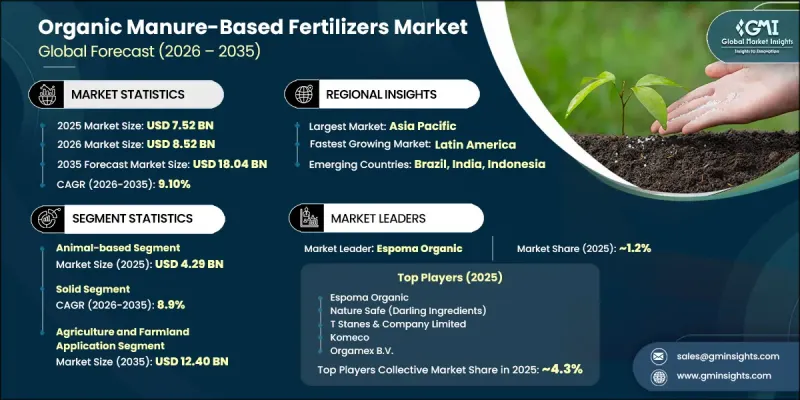
시장 성장을 주도하고 있는 요인은 전 세계 유기농 인증 경작 면적의 지속적인 확대, 주요 농업국에서 화학 비료 사용을 규제하는 엄격한 규정, 그리고 농업 및 축산 폐기물을 상업적 가치가 있는 작물용 영양 제품으로 전환하는 순환형 경제 이니셔티브의 도입 확대입니다. 다양한 영양 솔루션과 특수 작물 생산에 대한 수요가 증가함에 따라, 식물 유래 및 생물학적으로 강화된 복합 비료의 인기가 높아지고 있습니다. 정부 주도의 인센티브 프로그램과 농업 지원책은 특히 비용에 민감한 농업 지역에서 제품 채택을 더욱 촉진하고 있습니다. 지속가능성 목표가 농업 정책 및 생산 전략에 점점 더 반영됨에 따라, 예측 기간 동안 기존 및 신흥 농업 시장 모두에서 유기 퇴비 기반 비료에 대한 수요는 계속해서 견조할 것으로 예측됩니다.
| 시장 범위 | |
|---|---|
| 시작 연도 | 2025년 |
| 예측 기간 | 2026-2035년 |
| 개시 금액 | 75억 2,000만 달러 |
| 예측 금액 | 180억 4,000만 달러 |
| CAGR | 9.1% |
식물 유래 부문은 2035년까지 73억 2,000만 달러에 달할 것으로 예상되며, 예측 기간 동안 연평균 성장률(CAGR) 9.3%로 성장할 전망입니다. 이 성장률은 동물성 대체품을 소폭 상회하고 있으며, 유기농 생산 기준에 대한 보다 광범위한 준수와 영양 관리 프로그램의 유연성 향상을 추구하는 생산자들의 선호도 변화를 여실히 보여주고 있습니다. 또한, 이 부문의 성장은 진화하는 지속가능성 목표에 부합하는 천연 토양 개량 제품 및 작물 영양 솔루션에 대한 수요 증가에 힘입고 있습니다. 유기농업 시스템이 지속적으로 다양화되는 가운데, 식물 유래 비료 제품은 폭넓은 작물 유형과 생산 환경에 적응할 수 있다는 점에서 상업적 재배에 점점 더 많이 도입되고 있습니다.
원예 분야는 2026년부터 2035년까지 연평균 성장률(CAGR) 10.7%로 성장할 것으로 전망됩니다. 이러한 강력한 성장은 과일, 채소, 관상용 작물과 같은 분야에서 고가 유기농 생산이 집중되어 있는 데 힘입은 것입니다. 이러한 분야에서는 생산자가 고가의 전문 유기 자재 비용을 보다 효과적으로 감당할 수 있기 때문입니다. 또한, 원예 사업은 일반적으로 1에이커당 수익성이 높기 때문에 고급 비료 도입에 있어 경제적으로 유리한 환경이 조성되고 있습니다. 또한, 제어 환경 농업 및 첨단 재배 시스템에 대한 지속적인 투자 역시 효율적인 영양 공급과 토양 개량을 목적으로 하는 가공 유기 비료 수요를 뒷받침하고 있습니다.
북미의 유기 퇴비 기반 비료 시장은 2035년까지 39억 5,000만 달러에 달할 것으로 전망됩니다. 미국은 여전히 이 지역의 매출에서 가장 큰 비중을 차지하는 국가이며, 확립된 유기농업 기준과 인증 요건에 힘입고 있습니다. 이들은 2024년 기준 550만 에이커 이상에 달하는 인증된 유기농 농지에서 승인된 유기 비료 제품의 사용을 장려하고 있습니다. 제품 승인 및 인증 체계는 구매 결정 과정에서 여전히 중요한 역할을 하고 있으며, 제조업체에게 상업 농업 및 소매 원예 채널 모두에서 시장 진입에 있어 중요한 경쟁 우위를 제공합니다. 유기농 식품 생산 및 지속 가능한 농업 관행에 대한 소비자의 선호도가 높아짐에 따라, 해당 지역 전체에서 유기질 비료에 대한 수요는 견조한 추세를 보일 것으로 예측됩니다.
자주 묻는 질문
목차
제1장 조사 방법과 범위
제2장 주요 요약
제3장 업계 인사이트
제4장 경쟁 구도
제5장 시장 추산 및 예측 : 원료 유형별, 2022-2035년
제6장 시장 추산 및 예측 : 형태별, 2022-2035년
제7장 시장 추산 및 예측 : 용도별, 2022-2035년
제8장 시장 추산 및 예측 : 지역별, 2022-2035년
제9장 기업 개요
JHS 26.07.01The Global Organic Manure-Based Fertilizers Market was valued at USD 7.52 billion in 2025 and is estimated to grow at a CAGR of 9.1% to reach USD 18.04 billion by 2035.
Market growth is driven by the continued increase in certified organic farming acreage worldwide, stricter regulations governing synthetic fertilizer use in major agricultural economies, and the growing adoption of circular economy initiatives that convert agricultural and livestock waste into commercially valuable crop nutrition products. Plant-derived and biologically enhanced formulations are gaining momentum due to the increasing demand for diversified nutrient solutions and specialty crop production. Government-backed incentive programs and agricultural support schemes are further stimulating product adoption, particularly in cost-sensitive farming regions. As sustainability goals become increasingly integrated into agricultural policies and production strategies, demand for organic manure-based fertilizers is expected to remain strong across both established and emerging agricultural markets throughout the forecast period.
| Market Scope | |
|---|---|
| Start Year | 2025 |
| Forecast Year | 2026-2035 |
| Start Value | $7.52 Billion |
| Forecast Value | $18.04 Billion |
| CAGR | 9.1% |
The plant-based segment is anticipated to reach USD 7.32 billion by 2035, expanding at a CAGR of 9.3% over the forecast period. This growth rate slightly surpasses that of animal-based alternatives, highlighting shifting preferences among growers seeking broader compliance with organic production standards and greater flexibility in nutrient management programs. The segment's expansion is also supported by rising demand for natural soil-enhancement products and crop-nutrition solutions that align with evolving sustainability objectives. As organic farming systems continue to diversify, plant-derived fertilizer products are increasingly incorporated into commercial cultivation practices due to their adaptability across a wide range of crop categories and production environments.
The horticulture segment is projected to grow at a CAGR of 10.7% between 2026 and 2035. Strong growth is supported by the concentration of premium-priced organic production within fruits, vegetables, and ornamental crops, where growers can more effectively absorb the higher cost of specialized organic inputs. In addition, horticultural operations typically generate higher returns per acre, creating favorable economics for premium fertilizer adoption. Continued investment in controlled-environment agriculture and advanced cultivation systems is also supporting demand for processed organic fertilizer formulations designed for efficient nutrient delivery and soil improvement.
North America Organic Manure-Based Fertilizers Market is forecast to reach USD 3.95 billion by 2035. The United States remains the leading contributor to regional revenue, supported by established organic farming standards and certification requirements that encourage the use of approved organic fertilizer products across more than 5.5 million acres of certified organic cropland as of 2024. Product approval and certification frameworks continue to play a significant role in purchasing decisions, providing manufacturers with important market access advantages across both commercial farming operations and retail gardening channels. Growing consumer preference for organic food production and sustainable agricultural practices is expected to maintain steady demand for organic manure-based fertilizers throughout the region.
Major participants operating in the Global Organic Manure-Based Fertilizers Market include T Stanes & Company Limited, Espoma Organic, Midwestern BioAg, Nature Safe (Darling Ingredients), Orgamex B.V., Komeco, Adriatica Fertilizzanti, Angibaud, and Madras Fertilizers Limited. Companies operating in the organic manure-based fertilizers market are focusing on a combination of capacity expansion, product innovation, strategic partnerships, and distribution network enhancement to strengthen their market position. Manufacturers are investing in advanced processing technologies to improve nutrient consistency, product efficiency, and shelf life while developing specialized formulations tailored to different crop requirements. Many industry participants are expanding their presence through collaborations with agricultural distributors, farming cooperatives, and retail channels to improve product accessibility and brand visibility. Strategic acquisitions and regional expansion initiatives are also helping companies broaden their customer base and enter emerging agricultural markets.
Table of Contents
Chapter 1 Methodology & Scope
- 1.1 Market scope and definition
- 1.2 Research design
- 1.2.1 Research approach
- 1.2.2 Data collection methods
- 1.3 Data mining sources
- 1.3.1 Global
- 1.3.2 Regional/Country
- 1.4 Base estimates and calculations
- 1.4.1 Base year calculation
- 1.4.2 Key trends for market estimation
- 1.5 Primary research and validation
- 1.5.1 Primary sources
- 1.6 Forecast model
- 1.7 Research assumptions and limitations
Chapter 2 Executive Summary
- 2.1 Industry 360° synopsis
- 2.2 Key market trends
- 2.2.1 Regional
- 2.2.2 Source Type
- 2.2.3 Form
- 2.2.4 Application
- 2.3 TAM Analysis, 2026-2035
- 2.4 CXO perspectives: Strategic imperatives
- 2.4.1 Executive decision points
Chapter 3 Industry Insights
- 3.1 Industry ecosystem analysis
- 3.1.1 Supplier landscape
- 3.1.2 Profit margin
- 3.1.3 Value addition at each stage
- 3.1.4 Factor affecting the value chain
- 3.1.5 Disruptions
- 3.2 Industry impact forces
- 3.2.1 Growth drivers
- 3.2.2 Industry pitfalls and challenges
- 3.2.3 Market opportunities
- 3.3 Growth potential analysis
- 3.4 Regulatory landscape
- 3.4.1 North America
- 3.4.2 Europe
- 3.4.3 Asia Pacific
- 3.4.4 Latin America
- 3.4.5 Middle East & Africa
- 3.5 Porter's analysis
- 3.6 PESTEL analysis
- 3.7 Price trends
- 3.7.1 By region
- 3.7.2 By type
- 3.8 Future market trends
- 3.9 Technology and Innovation landscape
- 3.9.1 Current technological trends
- 3.9.2 Emerging technologies
- 3.10 Patent Landscape
- 3.11 Trade statistics (HS code)
- 3.11.1 Major importing countries
- 3.11.2 Major exporting countries
- 3.12 Sustainability and environmental aspects
- 3.12.1 Sustainable practices
- 3.12.2 Waste reduction strategies
- 3.12.3 Energy efficiency in production
- 3.12.4 Eco-friendly initiatives
- 3.13 Carbon footprint consideration
Chapter 4 Competitive Landscape, 2025
- 4.1 Introduction
- 4.2 Company market share analysis
- 4.2.1 By region
- 4.2.1.1 North America
- 4.2.1.2 Europe
- 4.2.1.3 Asia Pacific
- 4.2.1.4 LATAM
- 4.2.1.5 MEA
- 4.2.1 By region
- 4.3 Company matrix analysis
- 4.4 Competitive analysis of major market players
- 4.5 Competitive positioning matrix
- 4.6 Key developments
- 4.6.1 Mergers & acquisitions
- 4.6.2 Partnerships & collaborations
- 4.6.3 New Product Launches
- 4.6.4 Expansion Plans
Chapter 5 Market Estimates and Forecast, By Source Type, 2022-2035 (USD Million)
- 5.1 Key trends
- 5.2 Animal-Based
- 5.3 Plant-Based
Chapter 6 Market Estimates and Forecast, By Form, 2022-2035 (USD Million)
- 6.1 Key trends
- 6.2 Solid / Dry
- 6.3 Liquid
Chapter 7 Market Estimates and Forecast, By Application, 2022-2035 (USD Million)
- 7.1 Key trends
- 7.2 Agriculture / Farmland
- 7.3 Horticulture
- 7.4 Turf & Landscaping
Chapter 8 Market Estimates and Forecast, By Region, 2022-2035 (USD Million)
- 8.1 Key trends
- 8.2 North America
- 8.2.1 U.S.
- 8.2.2 Canada
- 8.3 Europe
- 8.3.1 Germany
- 8.3.2 UK
- 8.3.3 France
- 8.3.4 Spain
- 8.3.5 Italy
- 8.3.6 Rest of Europe
- 8.4 Asia Pacific
- 8.4.1 China
- 8.4.2 India
- 8.4.3 Japan
- 8.4.4 Australia
- 8.4.5 South Korea
- 8.4.6 Rest of Asia Pacific
- 8.5 Latin America
- 8.5.1 Brazil
- 8.5.2 Mexico
- 8.5.3 Argentina
- 8.5.4 Rest of Latin America
- 8.6 Middle East and Africa
- 8.6.1 Saudi Arabia
- 8.6.2 South Africa
- 8.6.3 UAE
- 8.6.4 Rest of Middle East and Africa
Chapter 9 Company Profiles
- 9.1 Espoma Organic
- 9.2 Nature Safe (Darling Ingredients)
- 9.3 T Stanes & Company Limited
- 9.4 Komeco
- 9.5 Orgamex B.V.
- 9.6 Madras Fertilizers Limited
- 9.7 Adriatica Fertilizzanti
- 9.8 Angibaud
- 9.9 Midwestern BioAg
- 9.10 PT Pupuk Kalimantan Timur
- 9.11 WormTech
- 9.12 Biohumus (Ekosol)
- 9.13 KV Organic
- 9.14 Huma / BioHuma


