

|
시장보고서
상품코드
2071369
항공 연료 시장 기회, 성장 촉진요인, 산업 동향 분석, 예측(2026-2035년)Aviation Fuel Market Opportunity, Growth Drivers, Industry Trend Analysis, and Forecast 2026 - 2035 |
||||||

세계의 항공 연료 시장은 2025년에 2,189억 달러로 평가되었으며, CAGR 5.1%로 성장하여 2035년까지 3,674억 달러에 달할 것으로 추정됩니다.
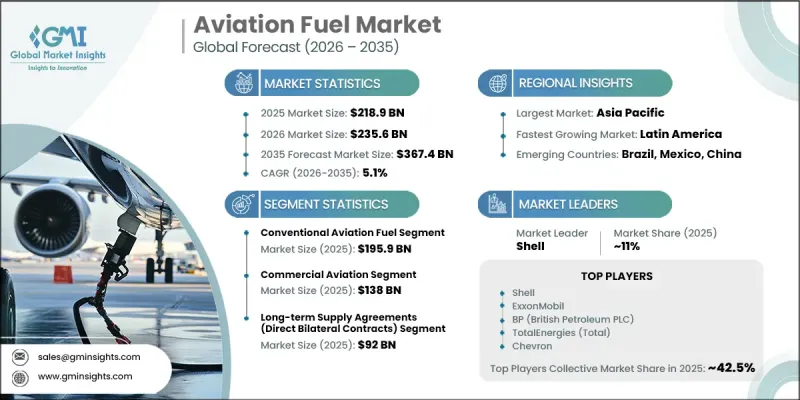
이 시장은 국내선과 국제선을 불문하고 전 세계 항공 여객 수송량이 지속적으로 증가하고 있는 데 힘입어 꾸준히 성장하고 있습니다. 관광 활동의 활성화, 비즈니스 여행의 증가, 지역 간 항공 네트워크의 확충이 진행되고 있는 것이 전 세계 항공기의 가동률 향상에 기여하고 있습니다. 신흥국의 가처분 소득 증가와 중산층의 확대는 여객 수 증가를 더욱 촉진하고, 항공 운송 서비스에 대한 수요를 높이고 있습니다. 또한, 장거리 여행의 회복과 항공편 운항 횟수의 증가가 민간 항공사의 운항에 따른 항공 연료 소비량 증가를 이끌고 있습니다. 장거리 여행에서 항공 운송에 대한 선호도가 높아짐에 따라 시장 성장이 계속해서 촉진되고 있습니다. 항공 연료 시장은 항공사의 기종 교체와 공항 인프라 확충에 대한 지속적인 투자 덕분에 혜택을 보고 있습니다. 각 항공사는 증가하는 여객 수요에 대응하면서 운항 효율을 높이기 위해 항공기 기종의 확충과 갱신을 추진하고 있습니다. 동시에, 정부 및 민간 부문의 이해관계자들은 항공 운송 역량을 강화하기 위해 공항 확장 프로젝트, 연료 공급 인프라, 지역 간 연결 강화 노력에 투자하고 있습니다. 이러한 추세는 전 세계 항공 업계 전반에 걸쳐 지속적인 성장을 위한 유리한 여건을 지속적으로 조성하고 있습니다.
| 시장 범위 | |
|---|---|
| 시작 연도 | 2025년 |
| 예측 기간 | 2026-2035년 |
| 시작 시점 시장 규모 | 2,189억 달러 |
| 예측액 | 3,674억 달러 |
| CAGR | 5.1% |
기존 항공 연료 부문은 2025년에 1,959억 달러의 시장 규모를 기록했습니다. 이 부문은 민간, 군사, 화물 항공 등 각 분야에서 널리 활용되고 있어 계속해서 업계를 주도하고 있습니다. 승객 수의 꾸준한 증가, 항공사 네트워크의 확대, 그리고 항공기 이착륙 횟수의 증가가 기존 항공 연료에 대한 견조한 수요를 뒷받침하고 있습니다. 또한, 확립된 정제 능력, 성숙한 공급망, 그리고 기존 항공기 기술과의 호환성이 전 세계 주요 항공 시장에서 기존 항공 연료의 광범위한 채택을 지속적으로 뒷받침하고 있습니다.
2025년, 민간 항공 부문의 시장 규모는 1,380억 달러에 달했습니다. 이 부문의 확고한 입지는 국내선 및 국제선의 승객 수 증가, 항공사 네트워크의 지속적인 확대, 그리고 전 세계 항공기 도입 대수의 증가에 힘입어 유지되고 있습니다. 관광, 비즈니스 출장 및 저비용 항공사의 운항 확대는 민간 항공 부문의 연료 수요를 지속적으로 뒷받침하고 있습니다. 또한, 항공 화물 운송의 활성화와 공항 인프라의 지속적인 확충도 연료 소비량 증가에 기여하고 있으며, 이로 인해 이 부문의 시장 입지가 더욱 공고해지고 있습니다.
2025년, 북미 항공 연료 시장은 633억 달러 규모를 기록했습니다. 이 지역은 승객 수 증가, 확고히 자리 잡은 민간 항공 산업, 그리고 지속적인 항공기 증강의 혜택을 누리고 있습니다. 미국은 광범위한 국내 항공 네트워크, 대규모 국방 항공 활동, 그리고 항공 연료 생산을 뒷받침하는 고도로 발달된 정제 인프라에 힘입어, 계속해서 해당 지역의 매출에서 가장 큰 기여를 하는 국가로 자리매김하고 있습니다. 또한, 화물 항공 활동의 증가와 공항 현대화, 항공 인프라 개발에 대한 지속적인 투자도 이 지역의 성장을 뒷받침하고 있습니다.
자주 묻는 질문
목차
제1장 조사 방법과 범위
제2장 주요 요약
제3장 업계 인사이트
제4장 경쟁 구도
제5장 시장 추정 및 예측 : 연료 유형별, 2022-2035년
제6장 시장 추정 및 예측 : 용도별, 2022-2035년
제7장 시장 추정 및 예측 : 조달 채널별, 2022-2035년
제8장 시장 추정 및 예측 : 지역별, 2022-2035년
제9장 기업 개요
KSM 26.07.03The Global Aviation Fuel Market was valued at USD 218.9 billion in 2025 and is estimated to grow at a CAGR of 5.1% to reach USD 367.4 billion by 2035.
The market is experiencing steady expansion owing to the continuous rise in global air passenger traffic across both domestic and international routes. Increasing tourism activity, growing business travel, and improved regional air connectivity are contributing to higher aircraft utilization worldwide. Rising disposable incomes and the expansion of the middle-class population in developing economies are further supporting passenger growth and strengthening demand for air transportation services. In addition, the recovery of long-distance travel and the increase in flight frequency are driving higher aviation fuel consumption across commercial airline operations. Growing preference for air transportation for long-distance travel continues to reinforce market growth. The Aviation Fuel Market is also benefiting from ongoing investments in airline fleet modernization and airport infrastructure development. Airlines are expanding and upgrading their aircraft fleets to accommodate rising passenger demand while improving operational efficiency. Simultaneously, governments and private-sector stakeholders are investing in airport expansion projects, fueling infrastructure, and regional connectivity initiatives to enhance aviation capacity. These developments continue to create favorable conditions for sustained growth across the global aviation sector.
| Market Scope | |
|---|---|
| Start Year | 2025 |
| Forecast Year | 2026-2035 |
| Start Value | $218.9 Billion |
| Forecast Value | $367.4 Billion |
| CAGR | 5.1% |
The conventional aviation fuel segment generated USD 195.9 billion in 2025. The segment continues to dominate the industry due to its extensive use across commercial, military, and cargo aviation operations. Consistent growth in passenger traffic, expanding airline networks, and increasing aircraft movements are supporting strong demand for traditional aviation fuels. Furthermore, established refining capabilities, mature supply chains, and compatibility with existing aircraft technologies continue to reinforce the widespread adoption of conventional aviation fuel across major aviation markets worldwide.
The commercial aviation segment captured USD 138 billion in 2025. The segment's strong position is driven by rising passenger volumes across domestic and international routes, continued expansion of airline networks, and increasing aircraft deployment globally. Growth in tourism, business travel, and budget airline operations continues to support fuel demand within the commercial aviation sector. Additionally, increasing air freight activity and ongoing airport infrastructure enhancements are contributing to higher fuel consumption levels, further strengthening the segment's market position.
North America Aviation Fuel Market generated USD 63.3 billion in 2025. The region benefits from increasing passenger traffic, a well-established commercial aviation industry, and continuous fleet expansion activities. The United States remains the largest contributor to regional revenue, supported by an extensive domestic aviation network, substantial defense aviation operations, and a highly developed refining infrastructure that supports aviation fuel production. Regional growth is also being supported by increasing cargo aviation activity and continued investments in airport modernization and aviation infrastructure development.
Major companies operating in the Global Aviation Fuel Market include Chevron, Shell, ExxonMobil, TotalEnergies, BP (British Petroleum PLC), World Kinect Corporation, Vitol, China Aviation Oil, Indian Oil Corporation Limited, Bharat Petroleum Corporation Limited (BPCL), Hindustan Petroleum Corporation Limited (HPCL), Gazprom, Mercury Air Group, and Virent, Inc. a Companies operating in the Aviation Fuel Market are adopting a variety of strategic initiatives to strengthen their market presence and enhance long-term competitiveness. Key strategies include expanding refining capacity, optimizing fuel supply networks, and strengthening distribution infrastructure to improve operational efficiency and meet growing demand. Market participants are also investing in sustainable aviation fuel development, advanced production technologies, and research initiatives aimed at reducing carbon emissions and supporting industry sustainability goals. Strategic partnerships, long-term supply agreements, and collaborations with airlines, airports, and fuel distributors are helping companies secure stable revenue streams and expand customer reach. Additionally, businesses are focusing on geographic expansion, digital supply chain management, and infrastructure modernization to improve service reliability, increase market penetration, and maintain a strong competitive position within the evolving aviation fuel industry.
Table of Contents
Chapter 1 Methodology & Scope
- 1.1 Market scope and definition
- 1.2 Research design
- 1.2.1 Research approach
- 1.2.2 Data collection methods
- 1.3 Data mining sources
- 1.3.1 Global
- 1.3.2 Regional/Country
- 1.4 Base estimates and calculations
- 1.4.1 Base year calculation
- 1.4.2 Key trends for market estimation
- 1.5 Primary research and validation
- 1.5.1 Primary sources
- 1.6 Forecast model
- 1.7 Research assumptions and limitations
Chapter 2 Executive Summary
- 2.1 Industry 360° synopsis
- 2.2 Key market trends
- 2.2.1 Regional
- 2.2.2 Fuel Type
- 2.2.3 Application
- 2.2.4 Procurement Channel
- 2.3 TAM Analysis, 2026-2035
- 2.4 CXO perspectives: Strategic imperatives
- 2.4.1 Executive decision points
- 2.4.2 Critical success factors
- 2.5 Future Outlook and strategic recommendations
Chapter 3 Industry Insights
- 3.1 Industry ecosystem analysis
- 3.1.1 Supplier Landscape
- 3.1.2 Profit Margin
- 3.1.3 Value addition at each stage
- 3.1.4 Factor affecting the value chain
- 3.1.5 Disruptions
- 3.2 Industry impact forces
- 3.2.1 Growth drivers
- 3.2.1.1 Rising global air passenger traffic
- 3.2.1.2 Expansion of airline fleets and airport infrastructure
- 3.2.1.3 Growth in air cargo and logistics transportation
- 3.2.2 Industry pitfalls and challenges
- 3.2.2.1 Volatility in crude oil prices
- 3.2.2.2 Stringent environmental regulations
- 3.2.3 Market opportunities
- 3.2.3.1 Increasing adoption of sustainable aviation fuel (SAF)
- 3.2.3.2 Emerging aviation markets in developing economies
- 3.2.1 Growth drivers
- 3.3 Growth potential analysis
- 3.4 Regulatory landscape
- 3.4.1 North America
- 3.4.2 Europe
- 3.4.3 Asia Pacific
- 3.4.4 Latin America
- 3.4.5 Middle East & Africa
- 3.5 Porter's analysis
- 3.6 PESTEL analysis
- 3.6.1 Technology and innovation landscape
- 3.6.2 Current technological trends
- 3.6.3 Emerging technologies
- 3.7 Price trends
- 3.7.1 By region
- 3.7.2 By product type
- 3.8 Future market trends
- 3.9 Technology and Innovation Landscape
- 3.9.1 Current technological trends
- 3.9.2 Emerging technologies
- 3.10 Patent Landscape
- 3.11 Trade statistics (HS code) (Note: the trade statistics will be provided for key countries only)
- 3.11.1 Major importing countries
- 3.11.2 Major exporting countries
- 3.12 Sustainability and environmental aspects
- 3.12.1 Sustainable practices
- 3.12.2 Waste reduction strategies
- 3.12.3 Energy efficiency in production
- 3.12.4 Eco-friendly initiatives
- 3.13 Carbon Footprint Considerations
Chapter 4 Competitive Landscape, 2025
- 4.1 Introduction
- 4.2 Company market share analysis
- 4.2.1 By region
- 4.2.1.1 North America
- 4.2.1.2 Europe
- 4.2.1.3 Asia Pacific
- 4.2.1.4 LATAM
- 4.2.1.5 MEA
- 4.2.1 By region
- 4.3 Company matrix analysis
- 4.4 Competitive analysis of major market players
- 4.5 Competitive positioning matrix
- 4.6 Key developments
- 4.6.1 Mergers & acquisitions
- 4.6.2 Partnerships & collaborations
- 4.6.3 New product launches
- 4.6.4 Expansion plans
Chapter 5 Market Estimates and Forecast, By Fuel Type, 2022 - 2035 (USD Billion) (Kilo Tons)
- 5.1 Key trends
- 5.2 Conventional Aviation Fuel
- 5.2.1 Jet Fuel (Turbine Fuel)
- 5.2.2 Aviation Gasoline (Avgas)
- 5.2.3 Others
- 5.3 Sustainable Aviation Fuel (SAF)
- 5.3.1 HEFA-SPK (Hydroprocessed Esters & Fatty Acids)
- 5.3.2 FT-SPK (Fischer-Tropsch Synthetic Paraffinic Kerosene)
- 5.3.3 ATJ-SPK (Alcohol-to-Jet Synthetic Paraffinic Kerosene)
- 5.3.4 Others (Co-processing, SIP, HC-HEFA)
- 5.4 Others
Chapter 6 Market Estimates and Forecast, By Application, 2022 - 2035 (USD Billion) (Kilo Tons)
- 6.1 Key trends
- 6.2 Commercial aviation
- 6.2.1 Narrow-body aircraft
- 6.2.2 Wide-body aircraft
- 6.2.3 Regional jets & turboprops
- 6.2.4 Air cargo & freighters
- 6.3 Military aviation
- 6.3.1 Fighter & combat aircraft
- 6.3.2 Transport & logistics aircraft
- 6.3.3 Military helicopters
- 6.3.4 Military UAVs & unmanned combat aerial vehicles (UCAVs)
- 6.4 Private & business aviation
- 6.4.1 Business jets
- 6.4.2 Turboprop & piston-engine private aircraft
- 6.5 Commercial & civil UAVs/drones
- 6.5.1 Logistics & last-mile delivery drones
- 6.5.2 Surveillance, mapping & inspection UAVs
- 6.5.3 Agricultural UAVs
- 6.6 Others
Chapter 7 Market Estimates and Forecast, By Procurement Channel, 2022 - 2035 (USD Billion) (Kilo Tons)
- 7.1 Key trends
- 7.2 Long-Term Supply Agreements (Direct Bilateral Contracts)
- 7.3 Spot Market Purchases
- 7.4 Into-Plane Service Contracts (via FBOs & Handling Agents)
- 7.5 Government & Tender-Based Procurement
- 7.6 Others
Chapter 8 Market Estimates and Forecast, By Region, 2022 - 2035 (USD Billion) (Kilo Tons)
- 8.1 Key trends
- 8.2 North America
- 8.2.1 U.S.
- 8.2.2 Canada
- 8.3 Europe
- 8.3.1 Germany
- 8.3.2 UK
- 8.3.3 France
- 8.3.4 Spain
- 8.3.5 Italy
- 8.3.6 Rest of Europe
- 8.4 Asia Pacific
- 8.4.1 China
- 8.4.2 India
- 8.4.3 Japan
- 8.4.4 Australia
- 8.4.5 South Korea
- 8.4.6 Rest of Asia Pacific
- 8.5 Latin America
- 8.5.1 Brazil
- 8.5.2 Mexico
- 8.5.3 Argentina
- 8.5.4 Rest of Latin America
- 8.6 Middle East and Africa
- 8.6.1 Saudi Arabia
- 8.6.2 South Africa
- 8.6.3 UAE
- 8.6.4 Rest of Middle East and Africa
Chapter 9 Company Profiles
- 9.1 ExxonMobil
- 9.2 Shell
- 9.3 BP (British Petroleum PLC)
- 9.4 TotalEnergies (Total)
- 9.5 Chevron
- 9.6 Vitol
- 9.7 World Kinect Corporation
- 9.8 China Aviation Oil
- 9.9 Indian Oil Corporation Limited
- 9.10 Bharat Petroleum Corporation Limited (BPCL)
- 9.11 Hindustan Petroleum Corporation Limited (HPCL)
- 9.12 Gazprom
- 9.13 Mercury Air Group
- 9.14 Virent, Inc.


