
|
시장보고서
상품코드
2073559
남미의 항공 연료 시장 : 점유율 분석, 업계 동향과 통계, 성장 예측(2025-2031년)South America Aviation Fuel - Market Share Analysis, Industry Trends & Statistics, Growth Forecasts (2025 - 2031) |
||||||
 Mordor Intelligence
Mordor Intelligence에 의하면, 남미 항공 연료 시장 규모는 2025년에 122억 5,000만 달러로 평가되었고 2026년 133억 달러에서 2031년까지 200억 9,000만 달러에 이를 것으로 추정되고 있어 예측 기간(2026-2031년) CAGR은 8.60%를 나타낼 전망입니다.
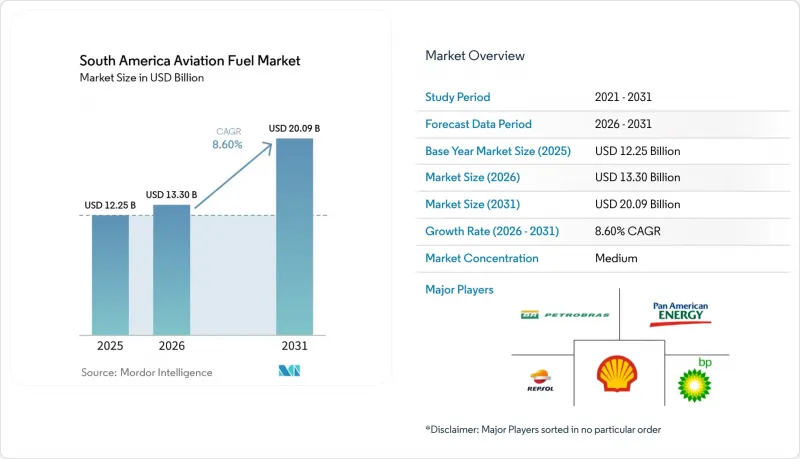
본 보고서는 연료 유형(기존 제트 연료, SAF, 항공용 가솔린), 항공기 유형(나로우드기, 와이드바디기, 지역 제트기 및 터보프롭기, 화물기), 용도(민간 항공, 국방·군사, 일반 항공, 도심항공모빌리티(UAM)/EVTOL), 지역(브라질, 아르헨티나, 콜롬비아, 칠레, 페루, 기타 남미 국가)별로 분류되어 있습니다. 시장 전망치는 금액(달러) 단위로 제시되어 있습니다.
남미 항공 연료 시장 동향과 인사이트
항공 여객 수의 회복이 Jet-A1 수요를 견인하고 있습니다.
남미 항공 업계는 단순한 회복 단계를 넘어 더 광범위한 성장 국면에 접어들었으며, 이에 따라 남미 항공 연료 시장은 더욱 견고한 수요 기반을 구축해 나가고 있습니다. 라틴아메리카 및 카리브해 지역의 항공사들은 2026년 1분기에 전년 동기 대비 RPK(여객 킬로미터)가 8.6% 증가했으며, 같은 기간 브라질 국내 시장도 11.4% 성장했습니다. 이는 승객 수 증가세가 여전히 많은 초기 예상치를 상회하고 있음을 보여줍니다. 탑승률도 높은 수준을 유지하고 있으며, 2025년 11월에는 지역 시장에서 85.9%에 달했습니다. 이는 일시적인 예약 급증 때문이 아니라, 공급 능력의 부족과 항공기 가동률 상승을 시사합니다. 항공사가 항공기 운항 시간을 연장하여 더 많은 좌석을 채우게 되면, 간선 노선, 연결 노선 및 공항에서의 회전 시간 동안 연료 수요가 직접적이고 예측 가능한 방식으로 증가합니다. 이것이 바로 남미의 항공 연료 시장이 승객 수 증가뿐만 아니라, 이용 가능한 항공기와 공항 슬롯의 보다 집중적인 활용을 통해서도 혜택을 보고 있는 이유입니다.
LCC의 확대와 노선 자유화가 연료 시장을 확대되고 있습니다.
저가 항공사의 성장에 힘입어, 주요 수도 간 노선을 넘어 정기적인 연료 공급이 필요한 지방 공항으로 서비스가 확대되면서 남미의 항공 연료 시장이 성장하고 있습니다. 아르헨티나의 규제 완화 추진에 따라 2026년 1분기 좌석 공급 능력은 8.5% 증가했습니다. 이는 정책 변경이 얼마나 신속하게 항공기 운항 증가나 출발 빈도 향상으로 이어지는지를 보여줍니다. 이것이 중요한 이유는 새로운 노선이 단순히 여객 수를 늘리는 데 그치지 않고, 저장 및 배송 조정이 필요하며 공급업체의 신뢰성을 요구하는 지속적인 연료 수요 거점을 창출하기 때문입니다. 이러한 영향은 단일 통로 항공기의 일일 가동률이 높고, 연료가 가장 직접적인 운항 변수 중 하나인 국내선이나 단거리 노선에서 특히 두드러집니다. 자유화가 진행됨에 따라 남미의 항공 연료 시장에서는 수요가 최대 규모의 허브 공항에만 국한되지 않고 지리적으로 확대될 것으로 전망됩니다.
지역 내 SAF 생산 능력 부족으로 인해 단기적인 공급 리스크가 발생하고 있습니다.
남미의 항공 연료 시장은 해당 지역이 안정적으로 공급할 수 있는 충분한 생산 기반을 구축하기도 전에, SAF 소비 의무화로 전환되고 있습니다. 페트로브라스는 브라질 내에서 최초공급 벤치마크를 확립했으나, 지역 공급망은 아직 초기 단계에 머물러 있어 소수의 프로젝트와 계획 중인 생산 능력 확대에 집중된 상태가 지속되고 있습니다. 이로 인해 공급 여력이 줄어들게 되며, 조기 규제 준수는 시장의 높은 유동성이 아니라 소수의 생산자, 제한된 공동 처리량, 그리고 정유시설의 단계적인 적응에 의존하게 될 것입니다. MIT, LATAM 및 에어버스가 수행한 라틴아메리카의 탈탄소화에 관한 연구에서도 ‘북 앤 클레임(Book and Claim)’ 방식의 가치를 지적하고 있습니다. 왜냐하면 소규모 국내 시장의 경우, 현지 물리적 공급 체계가 완전히 갖춰질 때까지 기다려야만 SAF 조달에 참여할 수 있다면 어려움을 겪게 되기 때문입니다. 생산 규모가 소수의 핵심 프로젝트를 넘어 확대되기 전까지는 남미의 항공 연료 시장이 공급 측면의 제약에 직면하게 될 것이며, 규제가 이미 명확한 경우에도 SAF 도입을 지연시키는 요인이 될 수 있습니다.
부문별 분석
2025년 기준으로 남미 항공 연료 시장 규모의 92.3%를 기존 제트 연료가 차지하고 있으며, 이는 이 지역이 여전히 화석 연료 기반에 깊이 의존하여 운영되고 있음을 보여줍니다. 이러한 지배적 지위는 시장의 현황과 밀접한 관련이 있습니다. 이는 공항의 연료 공급 시스템, 유통 자산 및 정유시설의 생산량 대부분이 이미 Jet A-1 및 관련 항공용 등유의 규격에 부합하고 있기 때문입니다. 따라서 규제로 인해 저탄소 대체 연료를 둘러싼 조달 행태가 변화하기 시작하더라도, 당분간 이 부문이 주요 공급원으로 남을 것입니다. 한편, 아부가스는 규모는 작지만 여전히 견조한 틈새 시장으로 자리 잡고 있습니다. 이는 일반 항공, 농업용 비행 및 내륙 교통망이 여전히 주요 항공사의 기체군과는 다른 연료 특성을 가진 항공기 유형에 의존하고 있기 때문입니다.
SAF는 가장 빠르게 성장하고 있는 연료 유형으로, 남미 항공 연료 시장에서 이 부문의 규모는 2026년부터 2031년까지 연평균 성장률(CAGR) 28.6%로 확대될 것으로 전망됩니다. 성장률이 높게 보이는 것은 출발점이 아직 작기 때문이지만, 브라질의 정책 체계와 CORSIA 준수 압력으로 인해 SAF가 단순한 상징적인 구매가 아닌 계획상의 필수 요건이 되어가고 있으므로, 그 이면에 있는 변화는 현실이 되고 있습니다. 페트로브라스는 2025년 12월 국내 최초로 SAF 공급을 실현하며 이러한 흐름을 뒷받침했습니다. 이를 통해 인증된 현지 공급이 정유시설의 생산 단계에서 공항으로의 유통 단계로 전환될 수 있음이 입증되었습니다. 보아벤투라 프로젝트와 라이젠의 인증 절차 역시 남미 항공 연료 업계가 단일 기술 성과를 기다리기보다는 원료 확보, 공동 처리, 그리고 에탄올 기반 경로를 중심으로 구축되어 가고 있음을 보여줍니다.
기타 혜택:
- 엑셀 형식 시장 예측(ME) 시트
- 3개월간의 애널리스트 지원
자주 묻는 질문
목차
제1장 서론
제2장 조사 방법
제3장 주요 요약
제4장 시장 구도
제5장 시장 규모와 성장 예측
제6장 경쟁 구도
제7장 시장 기회와 향후 전망
JHS 26.07.07According to Mordor Intelligence, the south america aviation fuel market size was valued at USD 12.25 billion in 2025 and is estimated to grow from USD 13.30 billion in 2026 to reach USD 20.09 billion by 2031, at a CAGR of 8.60% during the forecast period (2026-2031).
This report is Segmented by Fuel Type (Conventional Jet Fuel, SAF, Avgas), Aircraft Type (Narrow-Body, Wide-Body, Regional Jets and Turboprops, Cargo/Freighters), Application (Commercial Airlines, Defense/Military, General Aviation, Urban Air Mobility/EVTOL), and Geography (Brazil, Argentina, Colombia, Chile, Peru, Rest of South America). Market Forecasts are Provided in Value (USD).
South America Aviation Fuel Market Trends and Insights
Recovering Air Passenger Traffic Fuels Jet-A1 Demand
South America's airline sector has moved beyond a simple rebound and into a broader expansion phase that is now giving the South America aviation fuel market a firmer demand base. Latin America and Caribbean airlines recorded 8.6% year-on-year RPK growth in Q1 2026, and Brazil's domestic market grew 11.4% in the same period, which shows that traffic growth is still running ahead of many earlier expectations. Load factors have also stayed high, with the regional market reaching 85.9% in November 2025, which points to tight capacity and stronger aircraft utilization rather than a short-lived spike in bookings. When airlines keep aircraft in the air longer and fill more seats, fuel demand rises in a direct and predictable way across trunk routes, connecting routes, and airport turnarounds. This is why the South America aviation fuel market is benefiting not only from more passengers, but also from a more intensive use of available fleets and airport slots.
Expanding Low-Cost Carriers and Route Liberalization Widen the Fuel Market
Low-cost carrier growth is widening the South America aviation fuel market by pushing service beyond the main capital-city corridors and into secondary airports that need regular fuel supply. Argentina's liberalization push helped lift seat capacity by 8.5% in Q1 2026, which shows how policy change can quickly translate into more aircraft activity and more frequent departures. This matters because each new route does more than add passengers; it creates a repeat fuel-demand point that needs storage, delivery coordination, and supplier reliability. The effect is especially visible in domestic and short-haul flying, where single-aisle fleets run high daily utilization and turn fuel into one of the most immediate operating variables. As liberalization spreads, the South America aviation fuel market should see demand broaden geographically rather than remain tied only to the largest hubs.
Limited Regional SAF Production Capacity Creates Near-Term Supply Risk
The South America aviation fuel market is moving into mandated SAF consumption before the region has built a wide enough production base to supply it comfortably. Petrobras has established the first domestic delivery benchmark in Brazil, but the regional supply chain is still early and remains concentrated in a small number of projects and planned capacity additions. This creates a narrow supply window in which early compliance can depend on a small producer set, limited co-processing volumes, and gradual refinery adaptation rather than deep market liquidity. The MIT, LATAM, and Airbus work on Latin American decarbonization also points to the value of book-and-claim structures, because smaller national markets will struggle if they must wait for full local physical supply before participating in SAF procurement. Until production spreads beyond a few anchor projects, the South America aviation fuel market will face a supply-side constraint that can slow adoption even where regulation is already clear.
Other drivers and restraints analyzed in the detailed report include:
- Green-Corridor Commitments Accelerating SAF Uptake
- Airport Infrastructure Modernization Programs Drive Long-Term Fuel Infrastructure Demand
- Currency Volatility Increasing Fuel-Price Risk for Operators
For complete list of drivers and restraints, kindly check the Table Of Contents.
Segment Analysis
Conventional jet fuel accounted for 92.3% of South America aviation fuel market size in 2025, which shows that the region still runs on a deeply established fossil-fuel base. This dominance is tied to the installed reality of the market, because airport fuel systems, distribution assets, and most refinery output are already aligned with Jet A-1 and related aviation kerosene specifications. The segment should therefore remain the main source of supply over the near term, even as regulation starts to reshape procurement behavior around lower-carbon alternatives. Avgas remains a small but durable niche because general aviation, agricultural flying, and interior connectivity still depend on aircraft types that do not move with the same fuel profile as the main airline fleet.
SAF is the fastest-growing fuel type, with South America aviation fuel market size for this segment projected to expand at a 28.6% CAGR from 2026 to 2031. The growth rate looks high because the starting base is still small, but the underlying shift is real as Brazil's policy framework and CORSIA compliance pressures begin to turn SAF into a planning requirement rather than a symbolic purchase. Petrobras strengthened that path with its first domestic SAF delivery in December 2025, proving that certified local supply can move from refinery output into airport distribution. The Boaventura project and Raizen's certification pathway also show that the South America aviation fuel industry is building around feedstock access, co-processing, and ethanol-based routes rather than waiting for a single technology outcome.
Complete Report Scope:
- By Fuel Type
- Conventional Jet Fuel
- Sustainable Aviation Fuel (SAF)
- Avgas
- By Aircraft Type
- Narrow-body
- Wide-body
- Regional Jets and Turboprops
- Cargo/Freighters
- By Application
- Commercial Airlines
- Defense/Military Aviation
- General and Business Aviation
- Urban Air Mobility / eVTOL
- By Geography
- Brazil
- Argentina
- Colombia
- Chile
- Peru
- Rest of South America
List of Companies Covered in this Report:
- Petroleo Brasileiro SA (Petrobras)
- Repsol SA
- BP PLC
- Shell PLC
- TotalEnergies SE
- Pan American Energy SL
- Exxon Mobil Corporation
- Allied Aviation Services Inc.
- Ipiranga Produtos de Petroleo SA
- Raizen Energia SA
- YPF SA
- ENAP Refinerias SA
- Petroperu SA
- Chevron Corporation
- Vitol Aviation BV
- Gevo Inc.
- World Energy LLC
- Amyris Inc.
- SkyNRG BV
- Neste Oyj
Additional Benefits:
- The market estimate (ME) sheet in Excel format
- 3 months of analyst support
TABLE OF CONTENTS
1 Introduction
- 1.1 Study Assumptions & Market Definition
- 1.2 Scope of the Study
2 Research Methodology
3 Executive Summary
4 Market Landscape
- 4.1 Market Overview
- 4.2 Market Drivers
- 4.2.1 Recovering air passenger traffic post-pandemic
- 4.2.2 Expanding low-cost carriers and route liberalization
- 4.2.3 Rising disposable income & middle-class growth
- 4.2.4 Airport infrastructure modernization programs
- 4.2.5 eVTOL & regional air-taxi projects boost Jet-A1 demand
- 4.2.6 Green-corridor commitments accelerating SAF uptake
- 4.3 Market Restraints
- 4.3.1 Limited regional SAF production capacity
- 4.3.2 Currency volatility increasing fuel-price risk
- 4.3.3 Fossil-fuel dominated energy mix & policy inertia
- 4.3.4 Fuel-pipeline bottlenecks to remote airports
- 4.4 Supply-Chain Analysis
- 4.5 Regulatory Landscape
- 4.6 Technological Outlook
- 4.7 Porter's Five Forces
- 4.7.1 Bargaining Power of Suppliers
- 4.7.2 Bargaining Power of Consumers
- 4.7.3 Threat of New Entrants
- 4.7.4 Threat of Substitutes
- 4.7.5 Intensity of Competitive Rivalry
5 Market Size & Growth Forecasts
- 5.1 By Fuel Type
- 5.1.1 Conventional Jet Fuel
- 5.1.2 Sustainable Aviation Fuel (SAF)
- 5.1.3 Avgas
- 5.2 By Aircraft Type
- 5.2.1 Narrow-body
- 5.2.2 Wide-body
- 5.2.3 Regional Jets and Turboprops
- 5.2.4 Cargo/Freighters
- 5.3 By Application
- 5.3.1 Commercial Airlines
- 5.3.2 Defense/Military Aviation
- 5.3.3 General and Business Aviation
- 5.3.4 Urban Air Mobility / eVTOL
- 5.4 By Geography
- 5.4.1 Brazil
- 5.4.2 Argentina
- 5.4.3 Colombia
- 5.4.4 Chile
- 5.4.5 Peru
- 5.4.6 Rest of South America
6 Competitive Landscape
- 6.1 Market Concentration
- 6.2 Strategic Moves
- 6.3 Market Share Analysis
- 6.4 Company Profiles (includes Global level Overview, Market level overview, Core Segments, Financials as available, Strategic Information, Market Rank/Share for key companies, Products & Services, and Recent Developments)
- 6.4.1 Petroleo Brasileiro SA (Petrobras)
- 6.4.2 Repsol SA
- 6.4.3 BP PLC
- 6.4.4 Shell PLC
- 6.4.5 TotalEnergies SE
- 6.4.6 Pan American Energy SL
- 6.4.7 Exxon Mobil Corporation
- 6.4.8 Allied Aviation Services Inc.
- 6.4.9 Ipiranga Produtos de Petroleo SA
- 6.4.10 Raizen Energia SA
- 6.4.11 YPF SA
- 6.4.12 ENAP Refinerias SA
- 6.4.13 Petroperu SA
- 6.4.14 Chevron Corporation
- 6.4.15 Vitol Aviation BV
- 6.4.16 Gevo Inc.
- 6.4.17 World Energy LLC
- 6.4.18 Amyris Inc.
- 6.4.19 SkyNRG BV
- 6.4.20 Neste Oyj
7 Market Opportunities & Future Outlook
- 7.1 White-space & Unmet-Need Assessment