|
시장보고서
상품코드
2101582
블랙 매스 재활용 시장 기회, 성장 촉진요인, 업계 동향 분석 및 예측(2026-2035년)Black Mass Recycling Market Opportunity, Growth Drivers, Industry Trend Analysis, and Forecast 2026 - 2035 |
||||||

세계의 블랙 매스 재활용 시장은 2025년에 155억 달러 규모에 달하고, 2035년까지 CAGR 15.2%로 성장하여 650억 달러에 달할 것으로 추정됩니다.
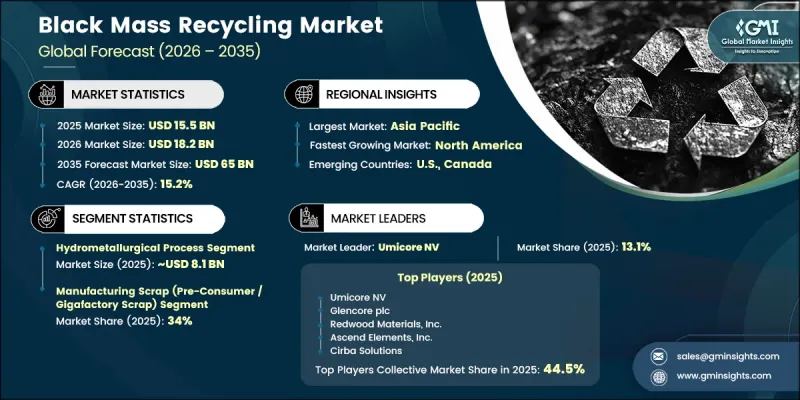
배터리 재활용 업계가 주로 제조 폐기물 처리에서 증가하는 사용 후 배터리 관리로 전환됨에 따라, 블랙 매스 재활용 시장은 급속히 확대되고 있습니다. 이러한 변화는 재활용 밸류체인 전체를 재구성하고 있으며, 회수 시스템, 재료 선별, 전처리 공정 및 정제 기술의 향상을 촉진하고 있습니다. 배터리 폐기물의 종류가 다양해지고 기술적으로도 고도화됨에 따라, 재활용 기업들은 더 광범위한 종류의 배터리 화학 성분을 효율적으로 처리할 수 있는 첨단 회수 공정에 투자하고 있습니다. 이 시장은 기존의 폐기물 관리라는 역할을 넘어 진화하고 있으며, 새로운 배터리 생산을 위한 귀중한 2차 원료를 공급함으로써 배터리 소재 공급망에서 필수적인 요소로 자리 잡고 있습니다. 재활용 기술의 지속적인 발전으로 회수율, 재료 순도 및 운영 효율이 향상되어, 재활용 업체들은 배터리 제조 요건을 충족하는 고품질 제품을 생산할 수 있게 되었습니다. 순환 경제 이니셔티브, 자원의 안정적인 확보, 그리고 지속가능한 배터리 생산에 대한 관심이 높아지고 있는 것이 시장 성장을 더욱 가속화하고 있습니다. 첨단 재활용 인프라에 대한 투자 증가, 소재 회수 기술의 향상, 그리고 배터리용 핵심 광물에 대한 수요 증가로 인해, 예측 기간 동안 블랙 매스 재활용 시장에 장기적이고 큰 기회가 창출될 것으로 전망됩니다.
| 시장 범위 | |
|---|---|
| 시작 연도 | 2025년 |
| 예측 기간 | 2026-2035년 |
| 시작 시점 시장 규모 | 155억 달러 |
| 예측액 | 650억 달러 |
| CAGR | 15.2% |
습식 야금 공정 분야는 52%의 점유율을 차지하며, 2025년에는 81억 달러의 시장 규모를 기록하고, 2035년까지 연평균 성장률(CAGR) 15.6%로 성장할 것으로 예측됩니다. 이 공정은 귀중한 배터리 소재의 높은 회수율을 실현하는 동시에, 배터리 등급 용도에 필요한 순도 수준을 확보할 수 있기 때문에 여전히 가장 선호되는 재활용 기술로 자리 잡고 있습니다. 통합 처리 기술의 지속적인 개선을 통해 운영 효율이 향상되고, 처리 비용이 절감되며, 회수 작업이 간소화되고 있습니다. 대체 회수 방법에 초점을 맞춘 지속적인 연구를 통해 지속가능성과 자원 효율성이 더욱 향상될 뿐만 아니라, 업계 전반의 미래 기술 발전이 촉진될 것으로 기대됩니다.
제조 스크랩(프리컨슈머/기가팩토리 스크랩) 부문은 2025년에 34%의 점유율을 차지했습니다. 이 부문은 제조 스크랩이 지닌 일관된 품질, 균일한 조성 및 효율적인 처리 특성 덕분에 계속해서 시장 수익에 크게 기여하고 있습니다. 그러나 사용 후 배터리가 재활용 흐름에 대량으로 유입됨에 따라, 이 부문의 시장 점유율은 전반적으로 서서히 감소하고 있습니다. 한편, 기존 회수 시스템과 예측 가능한 교체 주기를 통해 안정적인 원료 공급이 확보되고 있어, 새로운 배터리 공급원으로부터의 안정적인 공급이 일관된 재활용 활동을 지속적으로 뒷받침하고 있습니다.
2025년, 북미의 블랙 매스 재활용 시장은 16%의 점유율을 차지했습니다. 지역 시장의 확대는 국내 배터리 재활용 인프라에 대한 투자 증가, 지역 밀착형 배터리 소재 공급망에 대한 중요성 부각, 그리고 전기자동차 생산 대수 증가에 힘입어 이루어지고 있습니다. 재활용 능력 확대, 기술 혁신, 그리고 폐쇄형 소재 회수 시스템의 도입 확대가 계속해서 지역 시장을 강화하고 있습니다. 동시에 업계 관계자들은 재활용 배터리 소재에 대한 수요 증가에 대응하면서 지속가능한 장기적 성장을 뒷받침하기 위해 업무 효율성 향상, 소재 추적성, 그리고 규제 준수에 계속해서 주력하고 있습니다.
자주 묻는 질문
목차
제1장 조사 방법과 범위
제2장 주요 요약
제3장 업계 인사이트
제4장 경쟁 구도
제5장 시장 추정 및 예측 : 재활용 기술별, 2022-2035년
제6장 시장 추정 및 예측 : 배터리 종류별, 2022-2035년
제7장 시장 추정 및 예측 : 전지 화학 조성별, 2022-2035년
제8장 시장 추정 및 예측 : 회수 금속별, 2022-2035년
제9장 시장 추정 및 예측 : 최종 용도별, 2022-2035년
제10장 시장 추정 및 예측 : 지역별, 2022-2035년
제11장 기업 개요
KSM 26.08.04The Global Black Mass Recycling Market was valued at USD 15.5 billion in 2025 and is estimated to grow at a CAGR of 15.2% to reach USD 65 billion by 2035.
The black mass recycling market is experiencing rapid expansion as the battery recycling industry transitions from processing primarily manufacturing waste to managing increasing volumes of end-of-life batteries. This transformation is reshaping the entire recycling value chain, driving improvements in collection systems, material sorting, pre-processing operations, and refining technologies. As battery waste becomes more diverse and technologically advanced, recycling companies are investing in sophisticated recovery processes capable of efficiently handling a broader range of battery chemistries. The market is evolving beyond its traditional role in waste management and is becoming an essential component of the battery materials supply chain by supplying valuable secondary raw materials for new battery production. Continuous advancements in recycling technologies are improving recovery rates, material purity, and operational efficiency, enabling recyclers to produce high-quality outputs that meet battery manufacturing requirements. Growing emphasis on circular economy initiatives, resource security, and sustainable battery production is further accelerating market growth. Increasing investments in advanced recycling infrastructure, improvements in material recovery techniques, and rising demand for critical battery minerals are expected to create substantial long-term opportunities for the black mass recycling market throughout the forecast period.
| Market Scope | |
|---|---|
| Start Year | 2025 |
| Forecast Year | 2026-2035 |
| Start Value | $15.5 Billion |
| Forecast Value | $65 Billion |
| CAGR | 15.2% |
The hydrometallurgical process segment held 52% share, generating USD 8.1 billion in 2025, and is projected to grow at a CAGR of 15.6% through 2035. This process remains the preferred recycling technology because it delivers high recovery rates for valuable battery materials while producing the purity levels required for battery-grade applications. Continuous improvements in integrated processing technologies are enhancing operational efficiency, reducing processing costs, and simplifying recovery operations. Ongoing research focused on alternative recovery methods is expected to further improve sustainability and resource efficiency while supporting future technological advancements across the industry.
The manufacturing scrap (pre-consumer/gigafactory scrap) segment held 34% share in 2025. This segment continues to contribute significantly to market revenue due to the consistent quality, uniform composition, and efficient processing characteristics of manufacturing scrap. However, its overall market share is gradually declining as larger volumes of end-of-life batteries enter the recycling stream. At the same time, stable supply from additional battery sources continues to support consistent recycling activity, benefiting from established collection systems and predictable replacement cycles that contribute to reliable feedstock availability.
North America Black Mass Recycling Market accounted for 16% share in 2025. Regional market expansion is supported by increasing investments in domestic battery recycling infrastructure, growing emphasis on localized battery material supply chains, and rising production of electric vehicles. Expanding recycling capacity, technological innovation, and growing adoption of closed-loop material recovery systems continue to strengthen the regional market. At the same time, industry participants remain focused on improving operational efficiency, material traceability, and regulatory compliance to support sustainable long-term growth while meeting increasing demand for recycled battery materials.
Major companies operating in the global black mass recycling market include Umicore NV, Glencore plc, Redwood Materials, Inc., Ascend Elements, Inc., Cirba Solutions, SungEel HiTech Co., Ltd., GEM Co., Ltd., Brunp Recycling Technology Co., Ltd., SK Tes, Stena Recycling AB, Accurec Recycling GmbH, Electra Battery Materials Corporation, ACE Green Recycling Inc., Altilium Metals Ltd., and 6K Inc. Companies operating in the black mass recycling market are strengthening their competitive position through continuous investment in advanced recycling technologies, capacity expansion, and strategic partnerships across the battery value chain. Market participants are enhancing hydrometallurgical processing capabilities, improving material recovery efficiency, and developing technologies that deliver battery-grade recycled materials. Businesses are also expanding processing facilities and strengthening collection networks to secure reliable feedstock supplies as battery volumes continue to increase. Strategic collaborations with battery manufacturers, automotive companies, and raw material suppliers are helping establish integrated closed-loop recycling systems.
Table of Contents
Chapter 1 Methodology & Scope
- 1.1 Research approach
- 1.2 Quality Commitments
- 1.2.1 GMI AI policy & data integrity commitment
- 1.2.1.1 Source consistency protocol
- 1.2.1 GMI AI policy & data integrity commitment
- 1.3 Research Trail & Confidence Scoring
- 1.3.1 Research Trail Components
- 1.3.2 Scoring Components
- 1.4 Data Collection
- 1.4.1 Partial list of primary sources
- 1.5 Data mining sources
- 1.5.1 Paid sources
- 1.5.1.1 Sources, by region
- 1.5.1 Paid sources
- 1.6 Base estimates and calculations
- 1.6.1 Base year calculation for any one approach
- 1.7 Forecast model
- 1.7.1 Quantified market impact analysis
- 1.7.1.1 Mathematical impact of growth parameters on forecast
- 1.7.1 Quantified market impact analysis
- 1.8 Research transparency addendum
- 1.8.1 Source attribution framework
- 1.8.2 Quality assurance metrics
- 1.8.3 Our commitment to trust
Chapter 2 Executive Summary
- 2.1 Industry 360° synopsis
- 2.2 Key market trends
- 2.2.1 Regional
- 2.2.2 Recycling Technology
- 2.2.3 Battery Source
- 2.2.4 Battery Chemistry
- 2.2.5 Recovered Metal
- 2.2.6 End-Use Application
Chapter 3 Industry Insights
- 3.1 Industry ecosystem analysis
- 3.1.1 Supplier landscape
- 3.1.2 Profit margin
- 3.1.3 Value addition at each stage
- 3.1.4 Factor affecting the value chain
- 3.1.5 Disruptions
- 3.2 Industry impact forces
- 3.2.1 Growth drivers
- 3.2.2 Industry pitfalls and challenges
- 3.2.3 Market opportunities
- 3.3 Growth potential analysis
- 3.4 Regulatory landscape
- 3.4.1 North America
- 3.4.2 Europe
- 3.4.3 Asia Pacific
- 3.4.4 Latin America
- 3.4.5 Middle East & Africa
- 3.5 Porter’s analysis
- 3.6 PESTEL analysis
- 3.7 Price trends
- 3.7.1 By region
- 3.7.2 By feedstock type
- 3.8 Future market trends
- 3.9 Technology and innovation landscape
- 3.9.1 Current technological trends
- 3.9.2 Emerging technologies
- 3.10 Patent Landscape
- 3.11 Trade statistics (HS code)
- 3.11.1 Major importing countries
- 3.11.2 Major exporting countries
- 3.12 Sustainability and environmental aspects
- 3.12.1 Sustainable practices
- 3.12.2 Waste reduction strategies
- 3.12.3 Energy efficiency in production
- 3.12.4 Eco-friendly initiatives
- 3.13 Carbon footprint consideration
Chapter 4 Competitive Landscape, 2025
- 4.1 Introduction
- 4.2 Company market share analysis
- 4.2.1 By region
- 4.2.1.1 North America
- 4.2.1.2 Europe
- 4.2.1.3 Asia Pacific
- 4.2.1.4 LATAM
- 4.2.1.5 MEA
- 4.2.1 By region
- 4.3 Competitive analysis of major market players
- 4.4 Competitive positioning matrix
- 4.5 Key developments
- 4.5.1 Mergers & acquisitions
- 4.5.2 Partnerships & collaborations
- 4.5.3 New Product Launches
- 4.5.4 Expansion Plans
Chapter 5 Market Estimates and Forecast, By Recycling Technology, 2022–2035 (USD Billion) (Kilo Tons)
- 5.1 Key trends
- 5.2 Hydrometallurgical Process
- 5.2.1 Acid Leaching
- 5.2.2 Alkaline / Ammoniacal Leaching
- 5.3 Pyrometallurgical Process
- 5.3.1 High-Temperature Smelting
- 5.3.2 Thermal Pre-Treatment (Calcination / Pyrolysis)
- 5.4 Direct Recycling / Physical Separation
- 5.5 Hybrid / Combined Process
- 5.6 Bio-leaching
Chapter 6 Market Estimates and Forecast, By Battery Source, 2022–2035 (USD Billion) (Kilo Tons)
- 6.1 Key trends
- 6.2 Automotive & Electric Vehicle (EV) Batteries
- 6.2.1 Battery Electric Vehicles (BEV)
- 6.2.2 Plug-in Hybrid Electric Vehicles (PHEV)
- 6.2.3 Hybrid Electric Vehicles (HEV)
- 6.3 Consumer Electronics Batteries
- 6.3.1 Smartphones & Tablets
- 6.3.2 Laptops & Portable Computers
- 6.3.3 Wearables & Others
- 6.4 Energy Storage System (ESS) Batteries
- 6.4.1 Grid-Scale / Utility ESS
- 6.4.2 Commercial & Industrial ESS
- 6.4.3 Residential ESS
- 6.5 Industrial Batteries
- 6.5.1 Forklifts & Material Handling Equipment
- 6.5.2 Power Tools & Portable Industrial Equipment
- 6.5.3 UPS & Backup Power Systems
- 6.6 Aerospace & Defense Batteries
- 6.7 Manufacturing Scrap (Pre-Consumer / Gigafactory Scrap)
- 6.8 Others
Chapter 7 Market Estimates and Forecast, By Battery Chemistry, 2022–2035 (USD Billion) (Kilo Tons)
- 7.1 Key trends
- 7.2 Lithium-Ion (Li-ion)
- 7.2.1 NMC (Nickel Manganese Cobalt Oxide)
- 7.2.2 NCA (Nickel Cobalt Aluminium Oxide)
- 7.2.3 LFP (Lithium Iron Phosphate)
- 7.2.4 LCO (Lithium Cobalt Oxide)
- 7.3 Nickel-Metal Hydride (NiMH)
- 7.4 Solid-State
- 7.5 Others (NiCd, Alkaline, Legacy Chemistries)
Chapter 8 Market Estimates and Forecast, By Recovered Metal, 2022–2035 (USD Billion) (Kilo Tons)
- 8.1 Key trends
- 8.2 Lithium
- 8.2.1 Lithium Carbonate (Li₂CO₃)
- 8.2.2 Lithium Hydroxide (LiOH)
- 8.3 Cobalt
- 8.4 Nickel
- 8.5 Manganese
- 8.6 Copper
- 8.7 Graphite
- 8.8 Others (Aluminium, Electrolyte Salts, Specialty Metals)
Chapter 9 Market Estimates and Forecast, By End-Use Application, 2022–2035 (USD Billion) (Kilo Tons)
- 9.1 Key trends
- 9.2 EV Battery Manufacturing (Cathode Active Material Re-entry)
- 9.3 Energy Storage System (ESS) Battery Manufacturing
- 9.4 Consumer Electronics Battery Manufacturing
- 9.5 Industrial & Specialty Applications (Alloys, Electroplating)
- 9.6 Others (Aerospace, Medical Devices, Emerging Applications)
Chapter 10 Market Estimates and Forecast, By Region, 2022–2035 (USD Billion) (Kilo Tons)
- 10.1 Key trends
- 10.2 North America
- 10.2.1 U.S.
- 10.2.2 Canada
- 10.3 Europe
- 10.3.1 Germany
- 10.3.2 UK
- 10.3.3 France
- 10.3.4 Spain
- 10.3.5 Italy
- 10.3.6 Rest of Europe
- 10.4 Asia Pacific
- 10.4.1 China
- 10.4.2 India
- 10.4.3 Japan
- 10.4.4 Australia
- 10.4.5 South Korea
- 10.4.6 Rest of Asia Pacific
- 10.5 Latin America
- 10.5.1 Brazil
- 10.5.2 Mexico
- 10.5.3 Argentina
- 10.5.4 Rest of Latin America
- 10.6 Middle East and Africa
- 10.6.1 Saudi Arabia
- 10.6.2 South Africa
- 10.6.3 UAE
- 10.6.4 Rest of Middle East and Africa
Chapter 11 Company Profiles
- 11.1 Umicore NV
- 11.2 Glencore plc
- 11.3 Redwood Materials, Inc.
- 11.4 Ascend Elements, Inc.
- 11.5 Cirba Solutions
- 11.6 SungEel HiTech Co., Ltd.
- 11.7 GEM Co., Ltd.
- 11.8 Brunp Recycling Technology Co., Ltd.
- 11.9 SK Tes (formerly TES-AMM)
- 11.10 Stena Recycling AB
- 11.11 Accurec Recycling GmbH
- 11.12 Electra Battery Materials Corporation
- 11.13 ACE Green Recycling Inc.
- 11.14 Altilium Metals Ltd.
- 11.15 6K Inc.