

|
시장보고서
상품코드
2101604
농약 잔류 검사 시장 기회, 성장요인, 업계 동향 분석 및 예측(2026-2035년)Pesticide Residue Testing Market Opportunity, Growth Drivers, Industry Trend Analysis, and Forecast 2026 - 2035 |
||||||

세계의 농약 잔류 검사 시장은 2025년에 40억 달러 규모에 달하며, CAGR 5%로 성장하며, 2035년까지 87억 달러에 달할 것으로 예측됩니다.
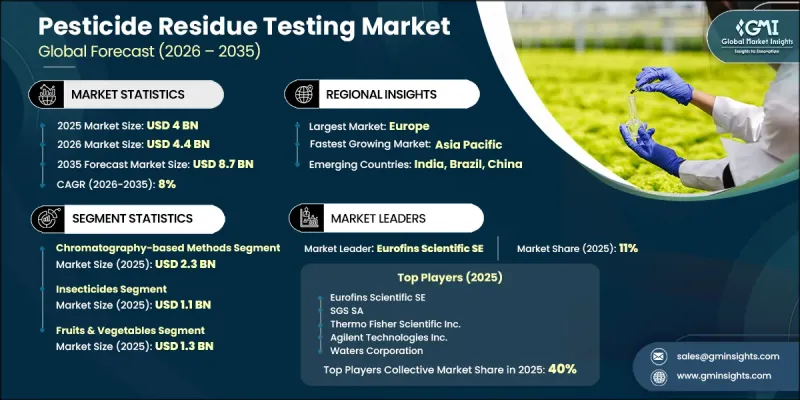
농약 잔류 검사 시장의 성장은 점점 더 엄격해지는 식품 안전 규제, 세계 식품 무역의 확대, 그리고 식품의 품질과 안전에 대한 소비자의 인식 제고로 인해 견인되고 있습니다. 규제 당국은 식품내 농약 잔류물에 대한 감시 요건을 지속적으로 강화하고 있으며, 이로 인해 첨단 검사 장비 및 분석 솔루션에 대한 지속적인 수요가 발생하고 있습니다. 검사 시설 인프라에 대한 지속적인 투자, 규제 감독 강화, 그리고 농업 무역의 확대가 여러 지역에서 시장의 발전을 지원하고 있습니다. 한편, 성숙한 시장에서는 검사 효율성 향상, 분석 방법의 표준화 진전, 그리고 규제 체계의 진화를 통해 시장이 발전하고 있습니다. 기술의 진보 또한 잔류물 분석의 속도, 정확도 및 접근성을 향상시킴으로써 시장 확대에 기여하고 있습니다. 검사 기관에서는 업무 효율성을 높이기 위해 신속 스크리닝 기술, 첨단 분석 플랫폼 및 디지털 실험실 관리 시스템의 도입이 점점 더 확대되고 있습니다. 보다 광범위한 식품 안전 모니터링, 품질 보증 및 환경 평가가 중요시됨에 따라 농약 잔류 검사 범위는 기존의 농업 용도를 넘어 지속적으로 확대되고 있으며, 이로 인해 전 세계 농약 잔류 검사 시장에 더 많은 장기적인 기회가 창출되고 있습니다.
| 시장 범위 | |
|---|---|
| 시작연도 | 2025년 |
| 예측 기간 | 2026-2035년 |
| 초기 시장 규모 | 40억 달러 |
| 예측액 | 87억 달러 |
| CAGR | 5% |
2025년, 크로마토그래피 부문은 23억 달러의 시장 규모를 기록했습니다. 이러한 분석 기술은 뛰어난 감도, 높은 분석 정확도, 그리고 한 번의 분석으로 여러 농약 화합물을 검출할 수 있는 능력을 갖추고 있으며, 계속해서 시장을 주도하고 있습니다. 입증된 신뢰성과 일관된 성능을 바탕으로, 크로마토그래피법은 식품안전검사 기관의 규제 준수 시험 및 확인용 잔류 분석 분야에서 가장 선호되는 기법으로서의 입지를 확고히 하고 있습니다.
살충제 부문은 2025년에 11억 달러의 시장 규모를 기록했습니다. 규제 당국이 식품 공급망 전반에 걸친 살충제 잔류물 감시를 지속적으로 우선시함에 따라 이 부문은 주도적인 위치를 유지하고 있습니다. 잔류 규제의 지속적인 개정, 더욱 엄격해진 규정 준수 요건, 그리고 지속적인 모니터링 프로그램으로 인해 다양한 농산물에 대한 살충제 잔류물 검사 수요가 지속적으로 증가하고 있습니다.
북미의 농약 잔류 검사 시장은 2025년 12억 달러에서 2035년까지 22억 달러로 성장할 것으로 예측됩니다. 이 지역의 시장 성장은 확립된 식품 안전 감시 프로그램, 포괄적인 규제 감독, 그리고 엄격한 수입 규정 준수 요건에 의해 지원되고 있습니다. 식품 공급망 전반에 걸친 검사 활동의 지속적인 확대와 더불어, 식품 품질 및 소비자 안전에 대한 규제 당국의 기대가 높아짐에 따라 북미 전역에서 농약 잔류 검사용 시약 및 분석 솔루션에 대한 수요는 계속해서 증가하고 있습니다.
자주 묻는 질문
목차
제1장 조사 방법과 범위
제2장 개요
제3장 업계 인사이트
제4장 경쟁 구도
제5장 시장 추산·예측 : 시험 기술별, 2022-2035년
제6장 시장 추산·예측 : 농약 유형별, 2022-2035년
제7장 시장 추산·예측 : 식품 및 샘플 매트릭스별, 2022-2035년
제8장 시장 추산·예측 : 지역별, 2022-2035년
제9장 기업 개요
KSA 26.07.31The Global Pesticide Residue Testing Market was valued at USD 4 billion in 2025 and is estimated to grow at a CAGR of 5% to reach USD 8.7 billion by 2035.
Growth in the pesticide residue testing market is driven by increasingly stringent food safety regulations, expanding global food trade, and rising consumer awareness regarding food quality and safety. Regulatory authorities continue strengthening monitoring requirements for pesticide residues in food products, creating sustained demand for advanced testing materials and analytical solutions. Ongoing investments in laboratory infrastructure, improved regulatory oversight, and expanding agricultural trade continue to support market development across several regions. Meanwhile, mature markets are advancing through improved testing efficiency, greater method standardization, and evolving regulatory frameworks. Technological advancements are also contributing to market expansion by improving the speed, accuracy, and accessibility of residue analysis. Laboratories are increasingly adopting rapid screening technologies, advanced analytical platforms, and digital laboratory management systems to enhance operational performance. The scope of pesticide residue testing continues to expand beyond traditional agricultural applications as greater emphasis is placed on broader food safety monitoring, quality assurance, and environmental assessment, creating additional long-term opportunities for the global pesticide residue testing market.
| Market Scope | |
|---|---|
| Start Year | 2025 |
| Forecast Year | 2026-2035 |
| Start Value | $4 Billion |
| Forecast Value | $8.7 Billion |
| CAGR | 5% |
The chromatography-based methods segment generated USD 2.3 billion in 2025. These analytical technologies continue to lead the market because they provide exceptional sensitivity, high analytical accuracy, and the ability to detect multiple pesticide compounds within a single analysis. Their proven reliability and consistent performance have established chromatography-based methods as the preferred approach for regulatory compliance testing and confirmatory residue analysis across food safety laboratories.
The insecticides segment captured USD 1.1 billion in 2025. The segment maintains its leading position because regulatory agencies continue to prioritize monitoring of insecticide residues throughout the food supply chain. Ongoing updates to residue regulations, stricter compliance requirements, and continuous monitoring programs are driving sustained demand for insecticide residue testing across a wide range of agricultural products.
North America Pesticide Residue Testing Market is projected to grow from USD 1.2 billion in 2025 to USD 2.2 billion by 2035. Market growth across the region is supported by well-established food safety monitoring programs, comprehensive regulatory oversight, and stringent import compliance requirements. Continuous expansion of testing activities throughout the food supply chain, combined with increasing regulatory expectations for food quality and consumer safety, continues to strengthen demand for pesticide residue testing materials and analytical solutions across North America.
Major companies operating in the global pesticide residue testing market include Eurofins Scientific SE, SGS SA, Thermo Fisher Scientific Inc., Agilent Technologies Inc., Waters Corporation, Bureau Veritas SA, Intertek Group plc, Shimadzu Corporation, LGC Group, Fera Science Ltd, Merieux NutriSciences, Food Safety Net Services (FSNS), Neogen Corporation, Romer Labs, and Charm Sciences Inc. Companies operating in the pesticide residue testing market are strengthening their competitive position by expanding analytical capabilities and investing in advanced testing technologies that improve accuracy, efficiency, and regulatory compliance. Many organizations continue to increase research and development activities to enhance testing performance and support evolving food safety requirements. Manufacturers and service providers are also improving laboratory infrastructure, adopting digital laboratory management systems, and optimizing operational workflows to increase productivity and testing capacity. Strategic collaborations with regulatory agencies, food manufacturers, and laboratory networks help expand market reach and strengthen customer relationships.
Table of Contents
Chapter 1 Methodology & Scope
- 1.1 Market scope and definition
- 1.2 Research design
- 1.2.1 Research approach
- 1.2.2 Data collection methods
- 1.3 Data mining sources
- 1.3.1 Global
- 1.3.2 Regional/Country
- 1.4 Base estimates and calculations
- 1.4.1 Base year calculation
- 1.4.2 Key trends for market estimation
- 1.5 Primary research and validation
- 1.5.1 Primary sources
- 1.6 Forecast model
- 1.7 Research assumptions and limitations
Chapter 2 Executive Summary
- 2.1 Industry 360° synopsis
- 2.2 Key market trends
- 2.2.1 Testing Technology
- 2.2.2 Pesticide Type
- 2.2.3 Food & Sample Matrix
- 2.2.4 Regional
- 2.3 TAM Analysis, 2026-2035
- 2.4 CXO perspectives: Strategic imperatives
- 2.5 Future outlook and strategic recommendations
Chapter 3 Industry Insights
- 3.1 Industry ecosystem analysis
- 3.1.1 Supplier landscape
- 3.1.2 Profit margin
- 3.1.3 Value addition at each stage
- 3.1.4 Factor affecting the value chain
- 3.1.5 Disruptions
- 3.2 Industry impact forces
- 3.2.1 Growth drivers
- 3.2.1.1 Tightening global mrl regulations & food safety enforcement
- 3.2.1.2 Growth in cross-border food trade & export certification requirements
- 3.2.1.3 Rising consumer demand for organic & pesticide-free food
- 3.2.2 Industry pitfalls and challenges
- 3.2.2.1 High cost of advanced analytical instruments
- 3.2.2.2 Shortage of skilled analytical chemists & accredited lab capacity
- 3.2.3 Market opportunities
- 3.2.3.1 Growth of portable & rapid residue testing for field-level & point-of-entry screening
- 3.2.3.2 Expansion of environmental pesticide residue testing
- 3.2.1 Growth drivers
- 3.3 Growth potential analysis
- 3.4 Regulatory landscape
- 3.4.1 North America
- 3.4.2 Europe
- 3.4.3 Asia Pacific
- 3.4.4 Latin America
- 3.4.5 Middle East & Africa
- 3.5 Porter's analysis
- 3.6 PESTEL analysis
- 3.7 Technology and innovation landscape
- 3.7.1 Current technological trends
- 3.7.2 Emerging technologies
- 3.8 Price trends
- 3.8.1 By region
- 3.8.2 By Testing Technology
- 3.9 Future market trends
- 3.10 Patent landscape
- 3.11 Trade statistics (HS code)
- 3.11.1 Major importing countries
- 3.11.2 Major exporting countries
- 3.12 Sustainability and environmental aspects
- 3.12.1 Sustainable practices
- 3.12.2 Waste reduction strategies
- 3.12.3 Energy efficiency in production
- 3.12.4 Eco-friendly initiatives
- 3.13 Carbon footprint consideration
Chapter 4 Competitive Landscape, 2025
- 4.1 Introduction
- 4.2 Company market share analysis
- 4.2.1 By region
- 4.2.1.1 North America
- 4.2.1.2 Europe
- 4.2.1.3 Asia Pacific
- 4.2.1.4 LATAM
- 4.2.1.5 MEA
- 4.2.1 By region
- 4.3 Company matrix analysis
- 4.4 Competitive analysis of major market players
- 4.5 Competitive positioning matrix
- 4.6 Key developments
- 4.6.1 Mergers & acquisitions
- 4.6.2 Partnerships & collaborations
- 4.6.3 New product launches
- 4.6.4 Expansion plans
Chapter 5 Market Estimates and Forecast, By Testing Technology, 2022-2035 (USD Billion) (Kilo Tons)
- 5.1 Key trends
- 5.2 Chromatography-Based Methods
- 5.3 Immunoassay-Based Methods
- 5.4 Spectroscopy-Based Methods
- 5.5 Enzyme Inhibition-Based Methods
- 5.6 Biosensor & Rapid Test Kit-Based
- 5.7 Others (Emerging & Hybrid)
Chapter 6 Market Estimates and Forecast, By Pesticide Type, 2022-2035 (USD Billion) (Kilo Tons)
- 6.1 Key trends
- 6.2 Herbicides
- 6.3 Insecticides
- 6.4 Fungicides
- 6.5 Acaricides
- 6.6 Nematicides
- 6.7 Plant Growth Regulators (PGRs)
- 6.8 Others
Chapter 7 Market Estimates and Forecast, By Food & Sample Matrix, 2022-2035 (USD Billion) (Kilo Tons)
- 7.1 Key trends
- 7.2 Fruits & Vegetables
- 7.3 Cereals, Grains & Pulses
- 7.4 Meat & Poultry
- 7.5 Dairy Products
- 7.6 Processed Food & Beverages
- 7.7 Spices, Herbs & Dried Products
- 7.8 Water & Environmental Samples
- 7.9 Others
Chapter 8 Market Estimates and Forecast, By Region, 2022-2035 (USD Billion) (Kilo Tons)
- 8.1 Key trends
- 8.2 North America
- 8.2.1 U.S.
- 8.2.2 Canada
- 8.3 Europe
- 8.3.1 Germany
- 8.3.2 UK
- 8.3.3 France
- 8.3.4 Spain
- 8.3.5 Italy
- 8.3.6 Rest of Europe
- 8.4 Asia Pacific
- 8.4.1 China
- 8.4.2 India
- 8.4.3 Japan
- 8.4.4 Australia
- 8.4.5 South Korea
- 8.4.6 Rest of Asia Pacific
- 8.5 Latin America
- 8.5.1 Brazil
- 8.5.2 Mexico
- 8.5.3 Argentina
- 8.5.4 Rest of Latin America
- 8.6 Middle East and Africa
- 8.6.1 Saudi Arabia
- 8.6.2 South Africa
- 8.6.3 UAE
- 8.6.4 Rest of Middle East and Africa
Chapter 9 Company Profiles
- 9.1 Eurofins Scientific SE
- 9.2 SGS SA
- 9.3 Thermo Fisher Scientific Inc.
- 9.4 Agilent Technologies Inc.
- 9.5 Waters Corporation
- 9.6 Bureau Veritas SA
- 9.7 Intertek Group plc
- 9.8 Shimadzu Corporation
- 9.9 LGC Group
- 9.10 Fera Science Ltd
- 9.11 Merieux NutriSciences
- 9.12 Food Safety Net Services (FSNS)
- 9.13 Neogen Corporation
- 9.14 Romer Labs
- 9.15 Charm Sciences Inc.


