

|
시장보고서
상품코드
2118041
말레이시아 및 베트남의 화훼 원예 자재 시장 : 시장 점유율 분석, 업계 동향 및 통계, 성장 예측(2026-2031년)Malaysia and Vietnam Floriculture Inputs - Market Share Analysis, Industry Trends & Statistics, Growth Forecasts (2026 - 2031) |
||||||
 Mordor Intelligence
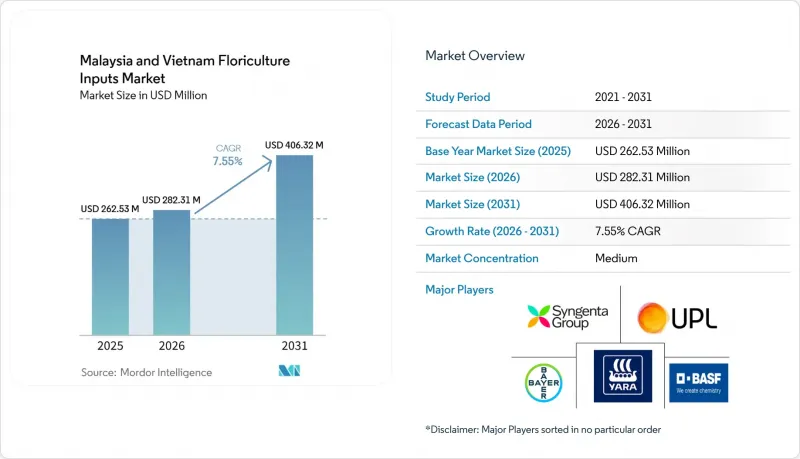
Mordor Intelligence에 의하면, 말레이시아 및 베트남의 화훼 원예 자재 시장 규모는 2025년 2억 6,253만 달러로 평가되었고, 2026년 2억 8,231만 달러에서 2031년까지 4억 632만 달러로 확대될 것으로 예측되며, 2026-2031년 CAGR 7.55%를 기록할 전망입니다.
본 보고서는 제품 유형별(종자 및 식재 자재, 비료 및 식물 영양 제품, 작물 보호 제품 등), 최종 사용자별(상업용 화훼 재배업자, 묘상 및 번식 센터, 조경업자), 지역별(말레이시아 및 베트남)로 분류되어 있습니다. 본 보고서에서는 시장 규모 및 전망을 금액(달러) 기준으로 제시하고 있습니다.
말레이시아 및 베트남의 화훼 원예 자재 시장 동향 및 인사이트
상업용 화훼 생산 및 수출 지향형 묘상의 확대
말레이시아 및 베트남의 화훼 원예 자재 시장은 양국에서 이미 확립된 화훼 생산 규모로부터 직접적인 뒷받침을 받고 있습니다. 베트남의 절화 및 꽃봉오리 수출 매출액은 2025년에 8,150만 달러를 넘어섰으며, 생산 면적은 45,000헥타르에 육박했습니다. 이는 상업적 화훼 재배가 더 이상 해당 시장에서 작은 틈새 분야가 아님을 보여줍니다. 말레이시아도 계속해서 이 지역의 주요 수출국으로 자리 잡고 있으며, ITC Trade Map에 따르면 2025년에는 생절화 수출액만 8,230만 달러를 넘어섰습니다. 람동성에서는 고품질 화훼 농장이 이미 큰 부가가치를 창출하고 있으며, 이를 통해 일회성 저비용 구매가 아닌, 더 우수한 비료, 작물 보호 프로그램 및 번식용 자재에 대한 지속적인 투자가 촉진되고 있습니다. 또한, 말레이시아 농림부는 원예 제품 수출에 관한 2026년 식물 검역 요건을 발표했습니다. 이로 인해 생산자들이 인증된 식재 재료와 품질이 보장된 자재를 사용해야 할 이유가 하나 더 추가되었습니다. 수출용 묘목장 및 대규모 생산자가 확대됨에 따라, 말레이시아 및 베트남의 화훼 원예 자재 시장은 보다 정기적인 발주 패턴과 출하 품질 기준 달성에 도움이 되는 제품에 대한 수요 증가라는 혜택을 누리고 있습니다. 이러한 요인은 단일 계절에 국한된 단기적인 수요 급증이 아니라, 여러 재배 주기에 걸쳐 자재를 지속적으로 사용할 수 있도록 뒷받침한다는 점에서 특히 중요합니다.
보호 재배 및 환경 제어형 생산의 확산
말레이시아 및 베트남의 화훼 원예 자재 시장은 네트하우스, 온실 및 제어된 재배 시스템의 보급에 따라 변화하고 있습니다. 2024년 3월, 아시아생산성기구와 베트남 국립생산성연구소는 일본의 IoT 기반 미기후 제어 시스템을 도입한 실증용 온실 농장을 달랏에 설립했습니다. 이는 주요 화훼 재배 지역에서 정밀한 생산 도구가 이미 도입되기 시작했음을 보여줍니다. 또한 하노이에 위치한 상업용 난초 재배 시설에서도 2024년에 역삼투막을 이용한 수처리, 첨단 공조 설비, 조직 배양법이 채택되었습니다. 이는 관상용 식물의 재배 환경이 보다 체계적으로 관리되는 방향으로 전환되는 추세를 반영하고 있습니다. 이러한 시스템은 자재 구성에 변화를 가져옵니다. 왜냐하면 무토양 재배나 배지를 이용한 재배에서는 광범위한 야외 살포 대신 수용성 비료, 더 깨끗한 물, 그리고 표적화된 식물 보호에 의존하기 때문입니다. 말레이시아에서는 캐머런 하이랜즈의 기상 이변이 노지 재배가 얼마나 큰 영향을 받기 쉬운지를 여실히 보여주고 있어, 생산을 안정화하고 손실을 줄일 수 있는 보호 재배 시설의 도입이 비즈니스 측면에서 점점 더 중요해지고 있습니다. 생산자가 이러한 시설로 전환하면 재배용 배지, 관개 설비 및 계획적인 시비 프로그램에 대한 의존도도 높아집니다. 따라서 보호 재배는 농업의 현대화에 그치지 않고, 말레이시아 및 베트남의 화훼 원예 자재 시장 수요를 두 배로 늘리는 요인이 되고 있습니다.
소규모 생산자의 분산된 생산자 기반과 제한된 투자 능력
말레이시아 및 베트남의 화훼 원예 자재 시장은 여전히 근본적인 제약에 직면해 있습니다. 많은 생산자가 소규모이며, 고품질 프로그램의 비용을 쉽게 감당할 수 없기 때문입니다. 람동성에서는 소규모 농가가 화훼 생산의 대부분을 차지하고 있어, 시장의 상당 부분이 여전히 단기 현금 흐름과 빠듯한 운전 자금 속에서 구매를 진행하고 있음을 의미합니다. 말레이시아의 생산자 기반 또한 카메론 하이랜즈 화훼 재배자 협회나 조호르주 묘목 산업 협회와 같은 단체로 분산되어 있어, 공급업체의 영향력은 여전히 소수의 유력한 농업 그룹이 아닌 수많은 소규모 거래처에 의존하고 있음을 알 수 있습니다. 이러한 구조로 인해 방출 조절 비료, 생물학적 작물 관리, 그리고 시비 관개 시스템의 도입이 지연되고 있습니다. 투자 회수에는 대개 여러 번의 재배 주기가 필요하기 때문입니다. 비료 가격의 급등은 이러한 주저함을 더욱 심화시키고 있습니다. 생산자들은 고가의 자재에 투자하기 전에 우선 운전자금을 확보하려 하기 때문입니다. 그 결과, 공급업체들은 보다 선진적인 프로그램을 대규모 묘상이나 수출용 농장에만 판매하는 경우가 많으며, 더 광범위한 생산자층은 기존 방식의 제품을 계속 사용하고 있습니다. 이로 인해 말레이시아 및 베트남의 화훼 원예 자재 시장은 성장을 이어가고 있지만, 고부가가치 자재가 전체 고객층에 보급되는 속도는 둔화되고 있습니다.
부문 분석
2025년, 말레이시아 및 베트남의 화훼 원예 자재 시장 규모에서 비료 및 식물 영양 제품은 38.4%를 차지했으며, 작물 보호 제품 및 기타 제품군을 크게 앞지르며 1위를 유지했습니다. 이러한 우위는 절화, 화분 관상용 식물, 묘목의 일상적인 영양 요구에 기인합니다. 이러한 작물의 경우, 균형 잡힌 비료 시비가 줄기의 강도, 꽃의 균일성, 수확 후 수명에 영향을 미치기 때문입니다. 그 뒤를 이어 작물 보호 제품이 자리 잡았습니다. 이는 두 나라 모두 생산 지역이 습윤하여 병해충 관리를 지속적으로 수행해야 하기 때문입니다. 또한, 말레이시아 및 베트남의 화훼 원예 자재 시장 전체 수요를 뒷받침하기 위해 재배용 배지, 토양 개량제, 관개 자재, 종자가 포함되었습니다.
말레이시아와 베트남의 화훼 재배용 자재 시장에서 생물 제제는 2031년까지 10.9%라는 가장 높은 연평균 성장률(CAGR)을 보일 것으로 예측됩니다. 이는 잔류물에 대한 우려가 큰 수출 경로와 베트남에서 생물 농법의 본격적인 보급이 뒷받침하고 있기 때문입니다. 또한, 현지 조직 배양 능력이 확대되고 생산자들이 더욱 신뢰할 수 있는 식물 품질을 요구함에 따라 종자 및 식재 재료의 중요성도 높아지고 있습니다. 정밀 영양 제품은 온실이나 비료·관개 시스템에서 수용성이며 생육 단계에 따른 비료 공급이 필요하기 때문에 앞으로도 성장을 이어갈 전망입니다. 관개 관련 자재와 첨단 배지는 보호 재배의 확대에 따라 증가할 것으로 예측됩니다. 한편, 생산자들이 품목 구성 전반에 걸친 병해 위험과 기상 관련 압박에 대처해 나가는 과정에서 작물 보호는 계속해서 필수적인 요소가 될 것입니다.
기타 혜택 :
- 엑셀 형식 시장 예측(ME) 시트
- 3개월간의 애널리스트 지원
자주 묻는 질문
목차
제1장 서론
제2장 조사 방법
제3장 주요 요약
제4장 시장 역학
제5장 시장 규모 및 성장 예측
제6장 경쟁 구도
제7장 시장 기회 및 향후 전망
AJY 26.09.03According to Mordor Intelligence, the Malaysia and Vietnam floriculture inputs market size is anticipated to expand from USD 262.53 million in 2025 and USD 282.31 million in 2026 to USD 406.32 million by 2031, registering a CAGR of 7.55% between 2026 and 2031.
This report is Segmented by Product Type (Seeds and Planting Material, Fertilizers and Plant Nutrition Products, Crop Protection Products, and More), by End User (Commercial Floriculture Growers, Nurseries and Propagation Centers, and Landscaping Operators), and by Geography (Malaysia and Vietnam). The Report Offers the Market Size and Forecasts in Terms of Value (USD).
Malaysia and Vietnam Floriculture Inputs Market Trends and Insights
Expansion of Commercial Floriculture Production and Export-Oriented Nurseries
The Malaysia and Vietnam floriculture inputs market gains direct support from the scale of flower production that is already in place across both countries. Vietnam's cut flowers and flower buds export turnover passed USD 81.5 million in 2025, and the production area reached nearly 45,000 hectares, which shows that commercial flower growing is no longer a small niche in that market. Malaysia also remained a major regional exporter, and fresh-cut flower exports alone reached more than USD 82.3 million in 2025, according to ITC Trade Map. In Lam Dong, high-grade flower farms are already producing significant value, which supports repeat spending on better fertilizers, crop protection programs, and propagation materials rather than one-time low-cost purchases. Malaysia's Department of Agriculture also issued its 2026 phytosanitary requirements for horticulture exports, which adds another reason for growers to use certified planting material and quality-assured inputs. As export nurseries and larger growers expand, the Malaysia and Vietnam floriculture inputs market benefits from more regular ordering patterns and stronger demand for products that help meet shipment quality standards. This driver is especially important because it supports recurring input use over many crop cycles rather than a short burst of demand tied to a single season.
Rising Adoption of Protected Cultivation and Controlled-Environment Production
The Malaysia and Vietnam floriculture inputs market is also moving with the wider use of net houses, greenhouses, and controlled growing systems. In March 2024, the Asian Productivity Organization and the Vietnam National Productivity Institute established a demonstration greenhouse farm in Da Lat with a Japanese Internet of Things-enabled microclimate control system, which shows that precision production tools are already being introduced in a key flower-growing area. A commercial orchid facility in Hanoi also used reverse osmosis water treatment, advanced air conditioning, and tissue culture methods in 2024, which reflects the move toward more managed growing conditions for ornamentals. These systems change the input mix because soilless or substrate-based cultivation depends on soluble nutrition, cleaner water, and targeted plant protection rather than broad field applications. In Malaysia, weather disruptions in Cameron Highlands have shown how exposed open cultivation remains, which strengthens the business case for protected structures that can stabilize production and reduce losses. Once growers shift into these structures, they also become more dependent on growing media, irrigation tools, and measured feeding programs. That is why protected cultivation is not only a farming upgrade, but also a demand multiplier for the Malaysia and Vietnam floriculture inputs market.
Fragmented Grower Base and Limited Investment Capacity Among Small-Scale Producers
The Malaysia and Vietnam floriculture inputs market still faces a basic limit because many growers remain small and cannot absorb the cost of premium programs easily. In Lam Dong, small farming households account for the major share of flower production, which means a large part of the market still buys with short cash cycles and tight working capital. Malaysia's grower base is also scattered across associations such as the Cameron Highlands Floriculturist Association and the Nursery Industry Association of Johor, which shows that supplier reach still depends on many smaller accounts rather than a few dominant farm groups. This structure slows adoption of controlled-release fertilizers, biological crop care, and fertigation systems because the payback often comes over several crop cycles. Higher fertilizer prices make that hesitation worse because growers first protect operating cash before they move into premium inputs. As a result, suppliers often sell more advanced programs only to larger nurseries and export farms, while the wider base stays with conventional products. This keeps the Malaysia and Vietnam floriculture inputs market growing, but it slows the speed at which higher-value inputs can spread across the full customer base.
Other drivers and restraints analyzed in the detailed report include:
- Increasing Demand for High-Quality Planting Material and Crop Inputs
- Growing Use of Biologicals and Sustainable Crop Management Solutions
- Dependence on Imported Planting Material and Specialized Inputs
For complete list of drivers and restraints, kindly check the Table Of Contents.
Segment Analysis
Fertilizers and plant nutrition products held 38.4% of the Malaysia and Vietnam floriculture inputs market size in 2025, which kept them firmly ahead of crop protection products and the other product groups. Their lead came from the daily nutrient needs of cut flowers, potted ornamentals, and nursery stock, where balanced feeding affects stem strength, flower uniformity, and post-harvest life. Crop protection products followed because humid production areas in both countries require steady disease and pest management. Growing media, soil amendments, irrigation inputs, and seeds were then added to support demand across the Malaysia and Vietnam floriculture inputs market.
Biologicals are anticipated to record the fastest CAGR at 10.9% through 2031 in the Malaysia and Vietnam floriculture inputs market, supported by residue-sensitive export channels and more formal promotion of biological crop care in Vietnam. Seeds and planting material also gain relevance as local tissue culture capacity expands and growers seek more reliable plant quality. Precision nutrition products are likely to keep growing because greenhouse and fertigation systems need soluble and stage-specific feeding. Irrigation-related inputs and advanced media should rise with protected cultivation, while crop protection remains essential as growers manage disease risk and weather-related pressure across the product mix.
Complete Report Scope:
- By Product Type
- Seeds and Planting Material
- Fertilizers and Plant Nutrition Products
- Crop Protection Products
- Growing Media and Soil Amendments
- Irrigation and Protected Cultivation Inputs
- Biologicals
- By End User
- Commercial Floriculture Growers
- Nurseries and Propagation Centers
- Landscaping and Urban Horticulture Operators
- By Geography
- Malaysia
- Vietnam
List of Companies Covered in this Report:
- Syngenta Group
- Bayer AG
- BASF SE
- UPL Limited
- Yara International ASA
- Corteva Agriscience
- FMC Corporation
- Sumitomo Chemical Co., Ltd.
- Nutrien Ltd.
- Haifa Group
- Vinaseed (PAN Group)
- Tiến Nong Group
- Advansia Sdn Bhd
- Agromaster Fertilizer Sdn Bhd
- Known-You Seed
Additional Benefits:
- The market estimate (ME) sheet in Excel format
- 3 months of analyst support
TABLE OF CONTENTS
1 Introduction
- 1.1 Study Assumptions and Market Definition
- 1.2 Scope of the Study
2 Research Methodology
3 Executive Summary
4 Market Dynamics
- 4.1 Market Overview
- 4.2 Market Drivers
- 4.2.1 Expansion of commercial floriculture production and export-oriented nurseries
- 4.2.2 Rising adoption of protected cultivation and controlled-environment production
- 4.2.3 Increasing demand for high-quality planting material and crop inputs
- 4.2.4 Growing use of biologicals and sustainable crop management solutions
- 4.2.5 Urban landscaping, hospitality, and ornamental plant demand
- 4.2.6 Adoption of precision nutrition and specialized plant nutrition programs
- 4.3 Market Restraints
- 4.3.1 Fragmented grower base and limited investment capacity among small-scale producers
- 4.3.2 Dependence on imported planting material and specialized inputs
- 4.3.3 Input cost volatility and rising production expenses
- 4.3.4 Pest, disease, and climate-related production risks
- 4.4 Regulatory Landscape
- 4.5 Technological Outlook
- 4.6 Porter's Five Forces Analysis
- 4.6.1 Bargaining Power of Suppliers
- 4.6.2 Bargaining Power of Buyers
- 4.6.3 Threat of New Entrants
- 4.6.4 Threat of Substitutes
- 4.6.5 Competitive Rivalry
5 Market Size and Growth Forecasts (Value)
- 5.1 By Product Type
- 5.1.1 Seeds and Planting Material
- 5.1.2 Fertilizers and Plant Nutrition Products
- 5.1.3 Crop Protection Products
- 5.1.4 Growing Media and Soil Amendments
- 5.1.5 Irrigation and Protected Cultivation Inputs
- 5.1.6 Biologicals
- 5.2 By End User
- 5.2.1 Commercial Floriculture Growers
- 5.2.2 Nurseries and Propagation Centers
- 5.2.3 Landscaping and Urban Horticulture Operators
- 5.3 By Geography
- 5.3.1 Malaysia
- 5.3.2 Vietnam
6 Competitive Landscape
- 6.1 Market Concentration
- 6.2 Strategic Moves
- 6.3 Market Share Analysis
- 6.4 Company Profiles (Includes Global Level Overview, Market Level Overview, Core Segments, Financials as available, Strategic Information, Market Rank/Share, Products and Services, Recent Developments)
- 6.4.1 Syngenta Group
- 6.4.2 Bayer AG
- 6.4.3 BASF SE
- 6.4.4 UPL Limited
- 6.4.5 Yara International ASA
- 6.4.6 Corteva Agriscience
- 6.4.7 FMC Corporation
- 6.4.8 Sumitomo Chemical Co., Ltd.
- 6.4.9 Nutrien Ltd.
- 6.4.10 Haifa Group
- 6.4.11 Vinaseed (PAN Group)
- 6.4.12 Tiến Nong Group
- 6.4.13 Advansia Sdn Bhd
- 6.4.14 Agromaster Fertilizer Sdn Bhd
- 6.4.15 Known-You Seed


